Fortresses and dinosaurs

Georgia, April 2025

Our hotel in Akhaltsikhe was ok, definitely not as nice as some of the others we had had.  Unfortunately I could not get the water hot enough to wash my hair and breakfast spread was not as vast as other places – serious first world problems and nothing I could not cope with (especially for only 1 night). 

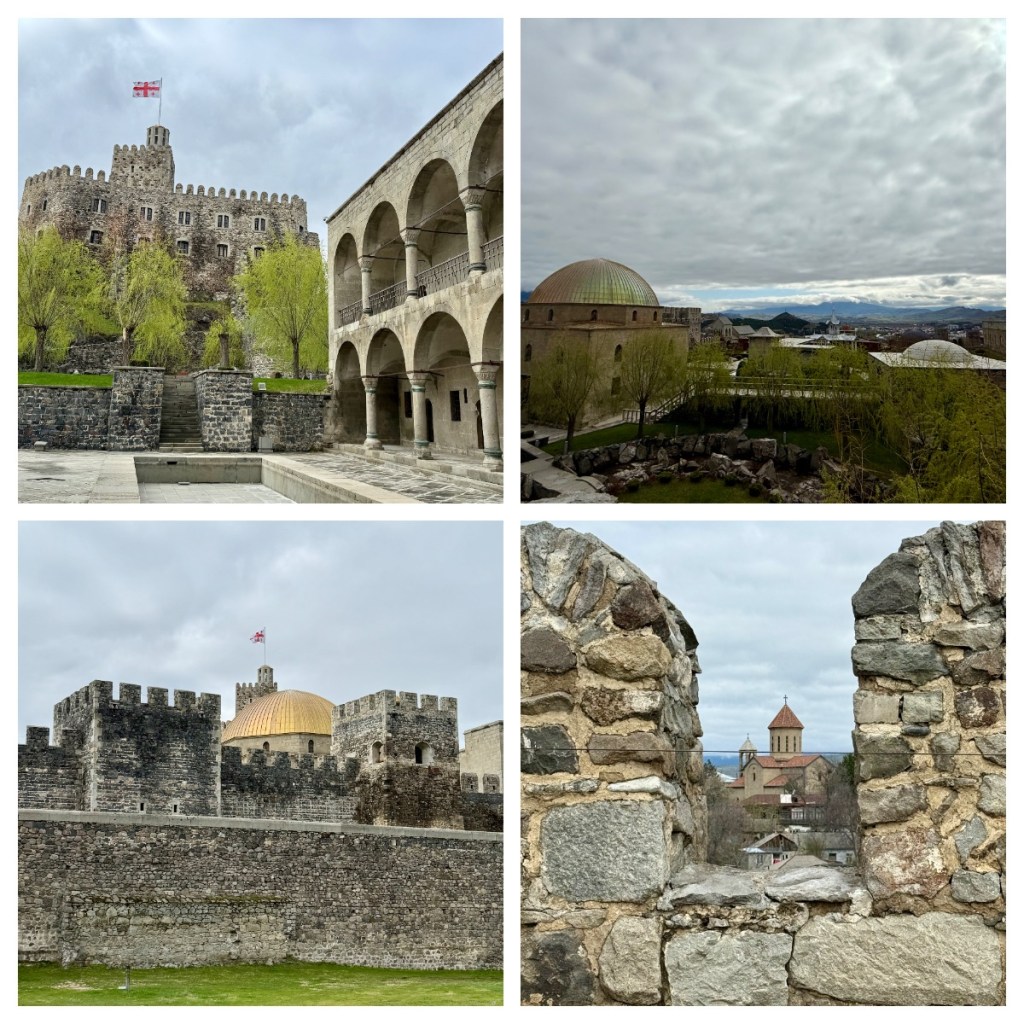
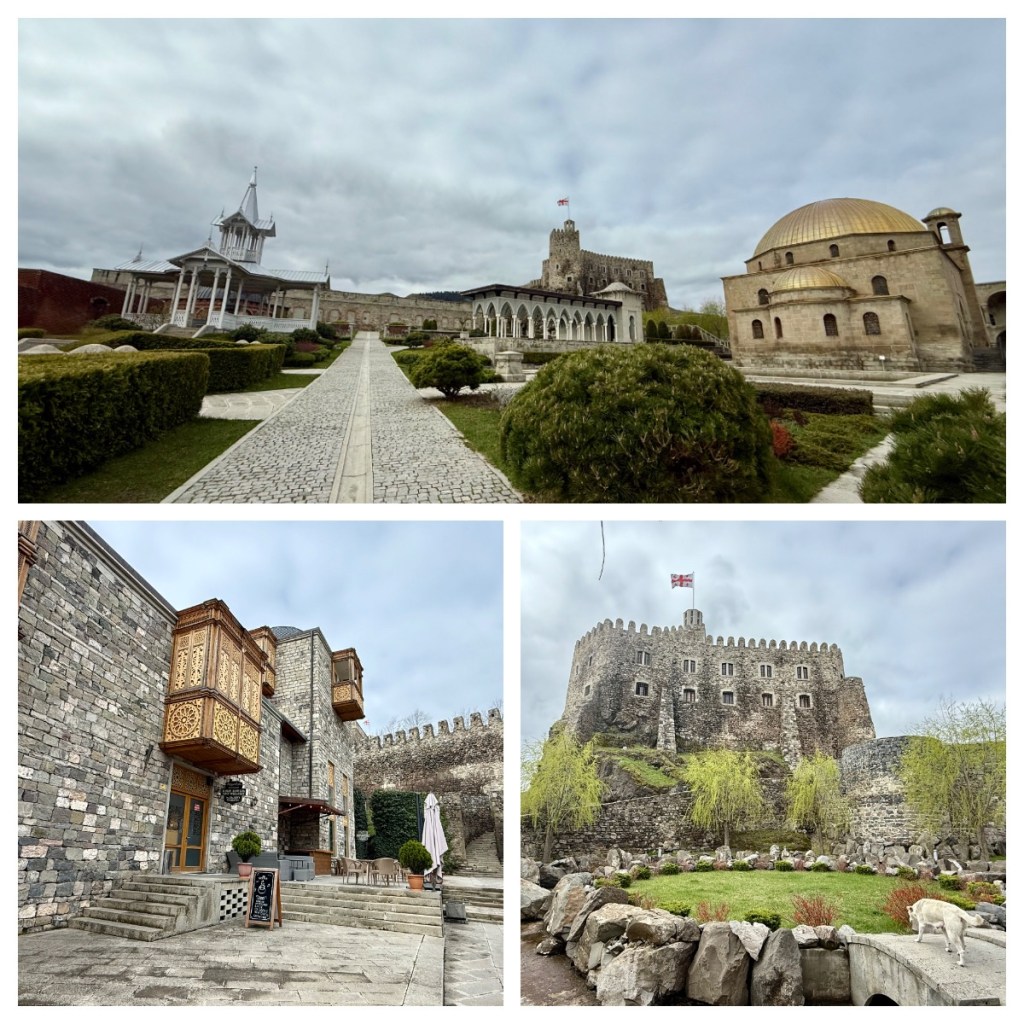
Akhaltsikhe is a small town with a population of only 18,000 and sitting at 1000m above sea level and before leaving we visited Rabat Castle, which dominates the town.  It is medieval fortress, initially built in the 9th century which has been called Lomsia (Lion), Akhal-tsikhe (New Fortress) and Rabat or Rabati (meaning fortress in Arabic)! 

We had to wait a few minutes for our English guide and acquainted ourselves with a couple of the local stray dogs.  There are stray dogs everywhere in Georgia but despite being stray, they seem well feed and looked after and they are not aggressive with us or each other.  In fact they are all very friendly.  That said, it seems our ā€˜guide’ dog was not a fan of our actual guide and did her best to keep in between us and him and barked at him if he got too close lol.

The oldest part of the complex was built in the 9th century, with subsequent additions, including the high walls, entrance gates and watch towers being added in the 12th century.  The varying architectures of the different eras and religions is clear here and it was interesting to learn that the ā€œchurchā€ has functioned as a church and a mosque over the years – depending on who won the most recent battle.  From the covered balcony’s (for Muslim women to enjoy fresh air without being seen) to the mosque/church which was actually designed by an Italian Catholic), a Muslim madras (or school) and a ā€˜secret’ opium room.  What we see today has been through extensive reconstruction and renovation in more recent years. 

Apparently, Tamerlane and his Turco-Mongol army attacked in the late 1300’s on his rampage across the continent– if you had been reading my blogs for a while your may remember I met Tamerlane (or Timur) in Uzbekistan in 2019.  In this instance, Rabati Fortress withstood his attack.  

The fortress continued to be a site of battles as the area saw constant struggles between Iran and Turkey, and the region was in fact part of Turkey, and predominately Muslim until the invasion of the Russian Empire in the early 1800s.  The region briefly returned to Turkish control after WWI in 1918, falling back to Russia and the USSR in 1921.

Over the years, this multi-faceted complex has also been a military prison and a hospital!  And of course, the citadel which was used as a signal point to send messages by lighting fires which could be send 10kms away.  All the fortresses would be used in this way, passing messages for 100’s of miles through multiple fortresses and castle citadels.

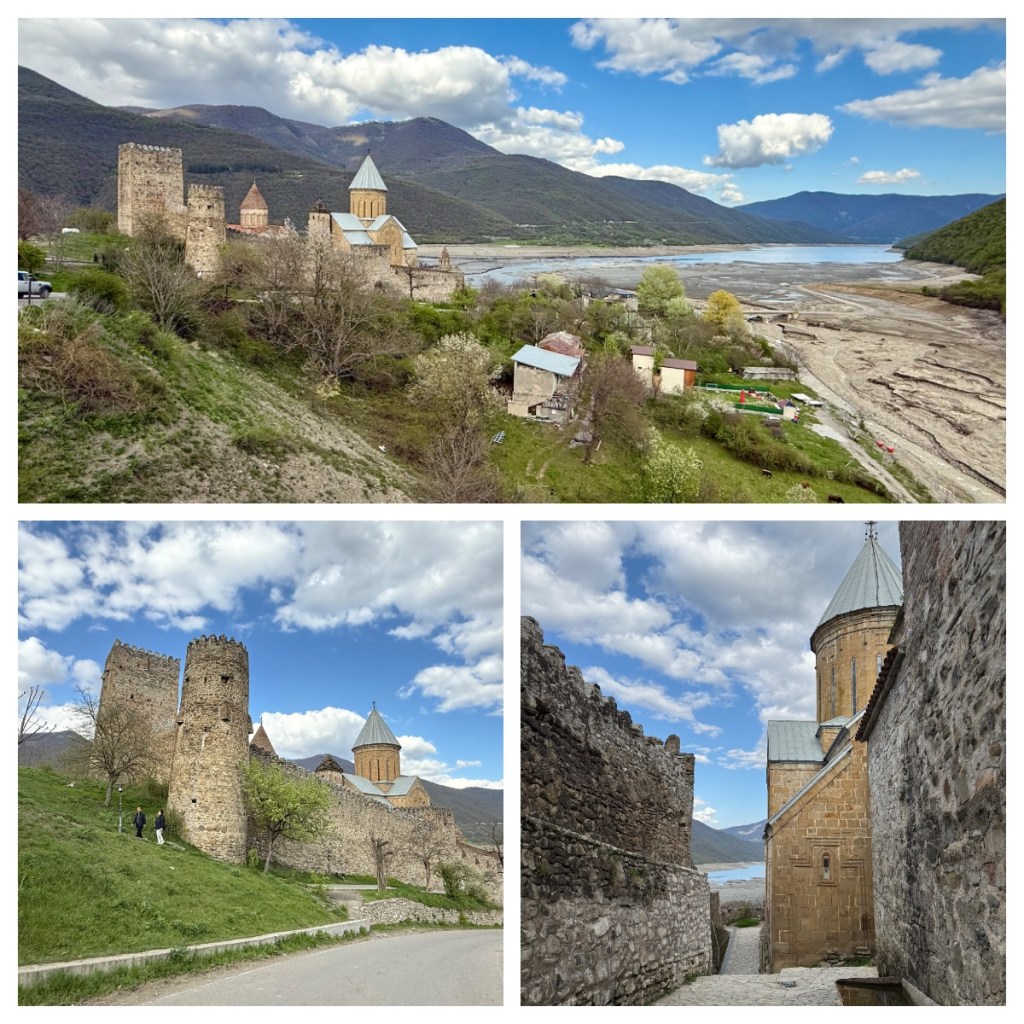
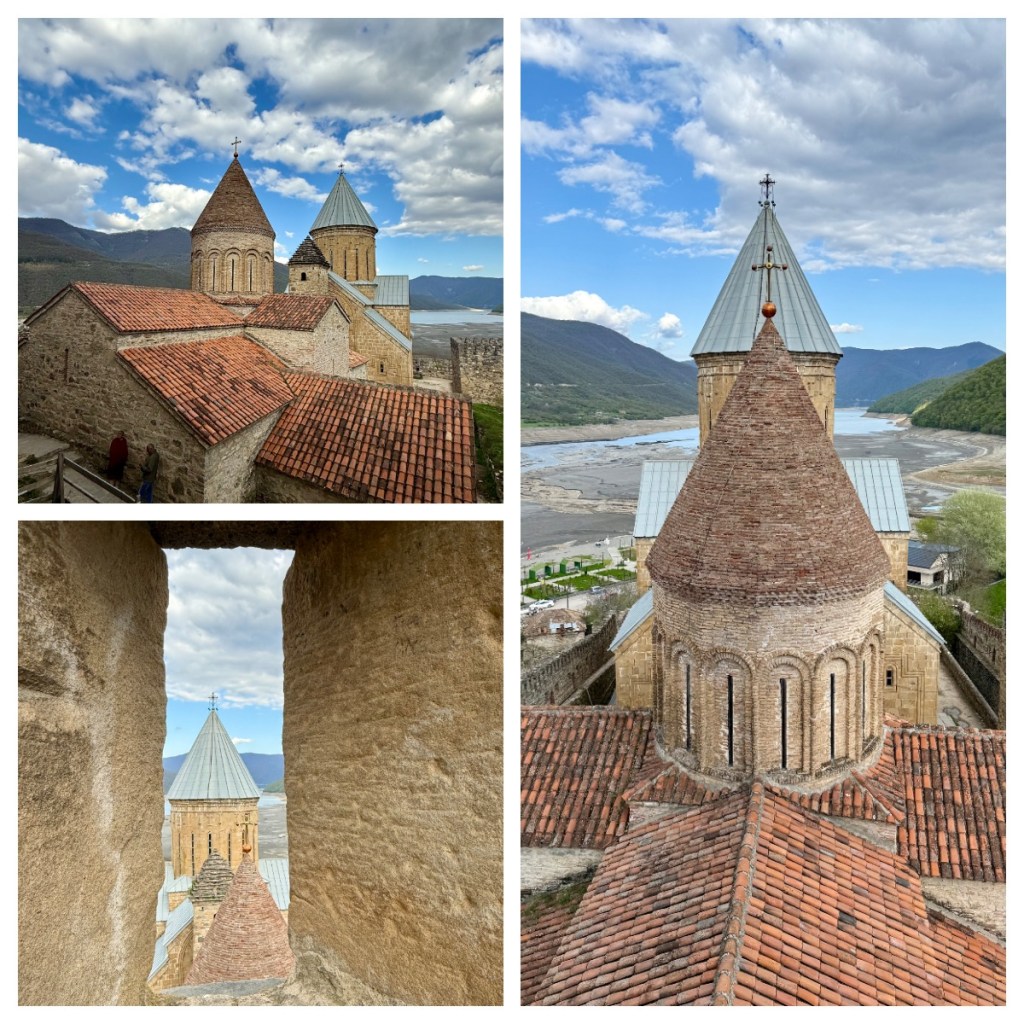
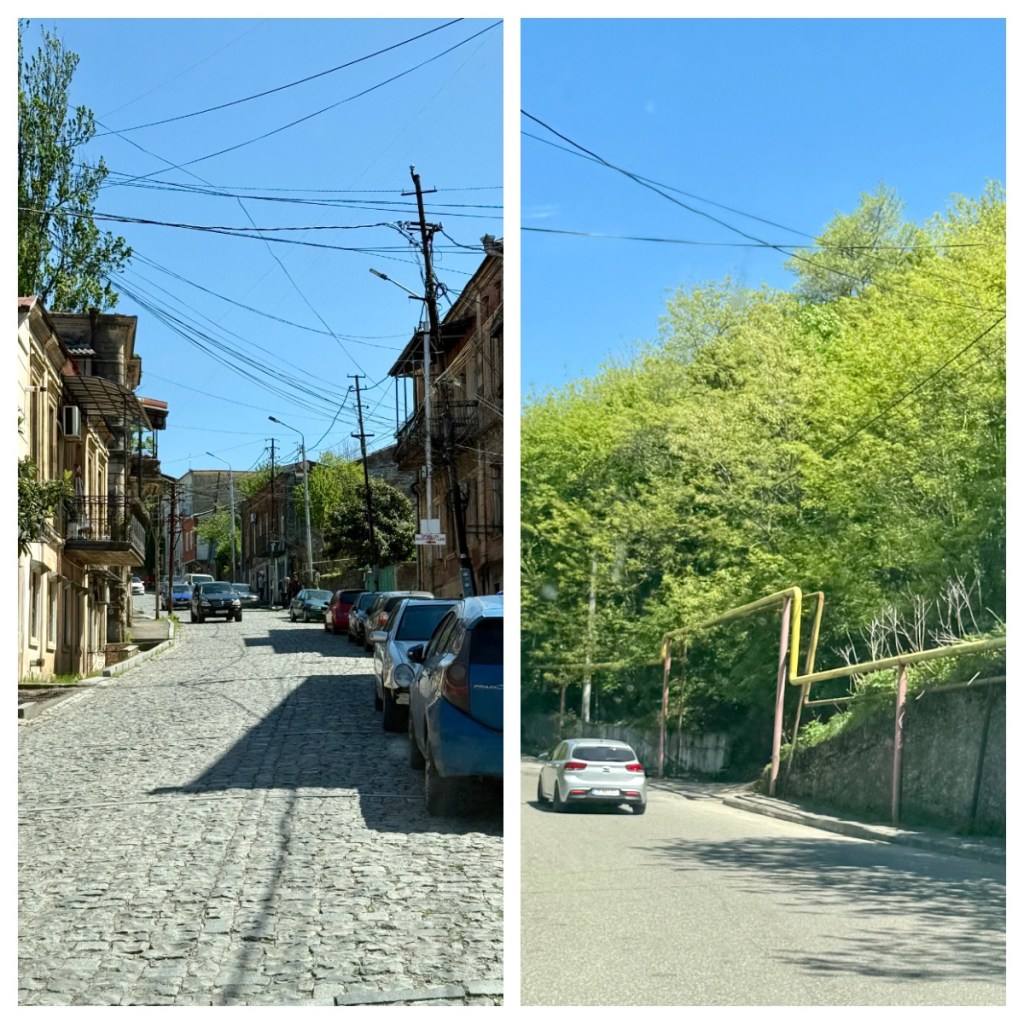
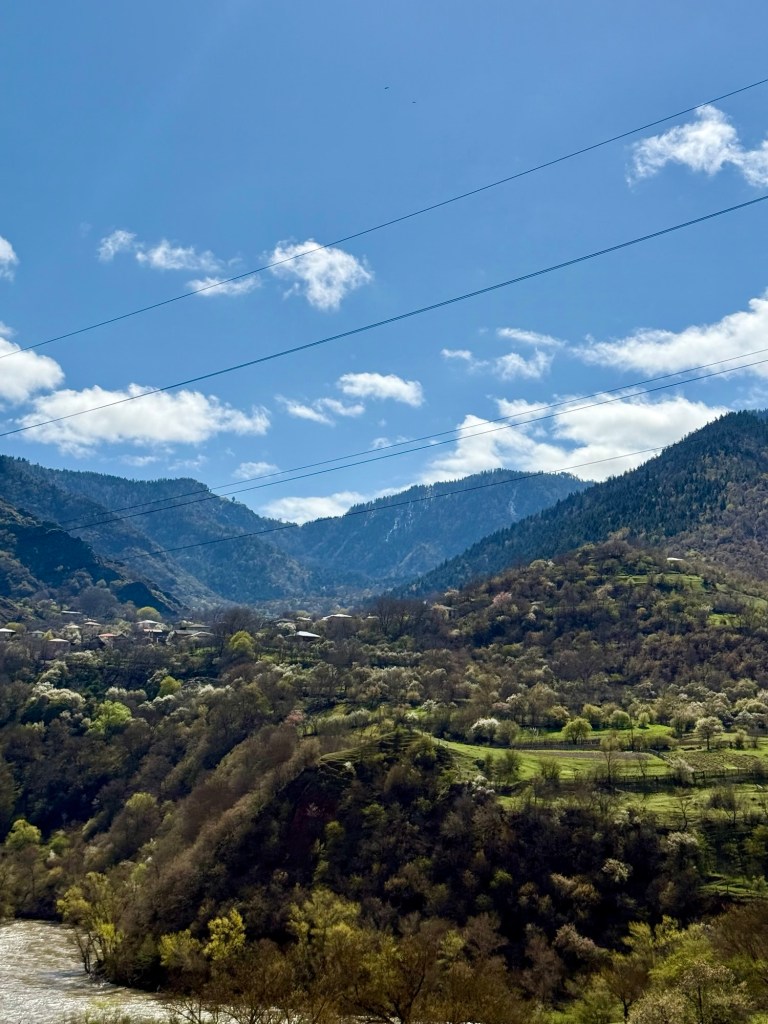
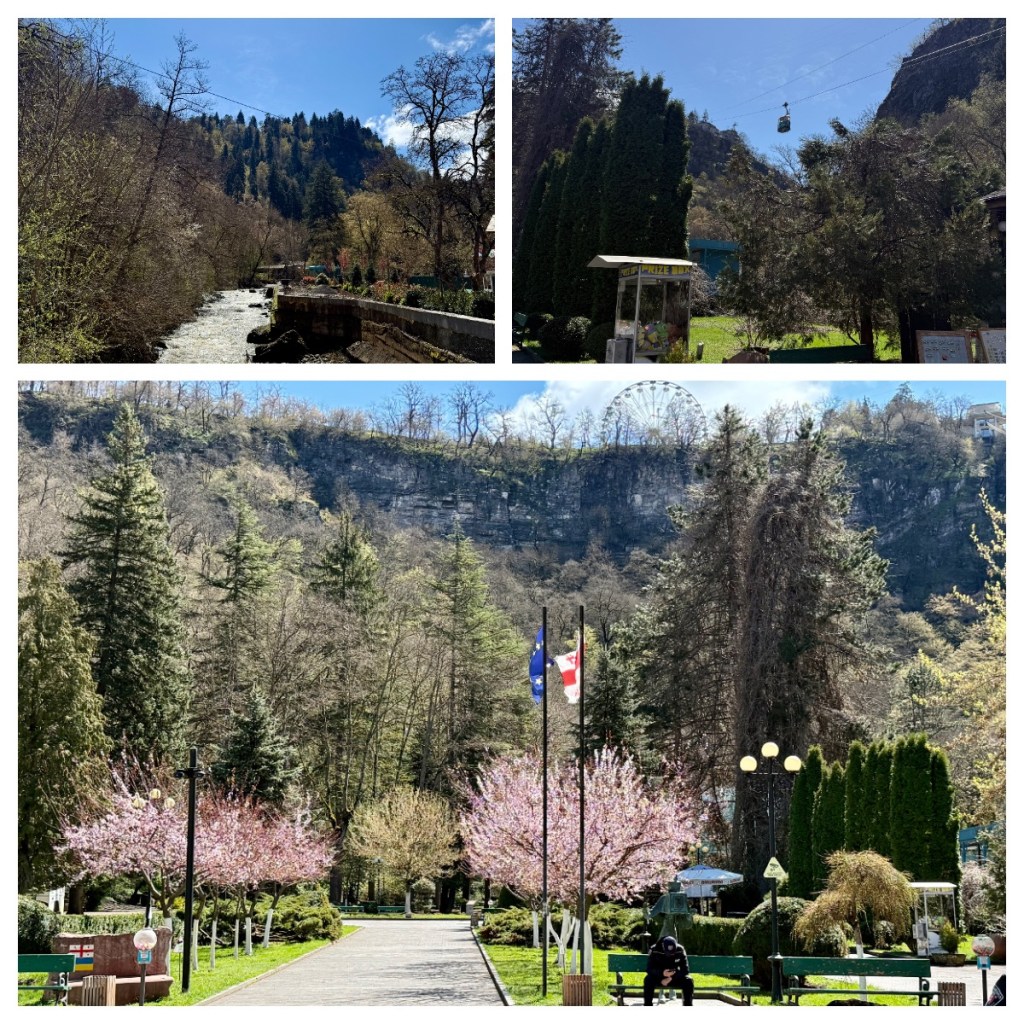
Leaving town and heading towards our next destination, we passed through beautiful landscapes spotting fortresses on hilltops (part of the message sending chain I mentioned above).  We stopped for a brief walk in the beautiful town of Borjomi, who’s name is famous as a brand of naturally carbonated water that originates in the springs here.

Borjomi is a resort town, with a population of just over 11,000 which sits in the Borjomi Gorge.   As well as its mineral water fame, today it is known as a hub for adventure activities including 4WD trips, hiking, rafting, horse riding etc. and is continuing to grow in popularity. In the past, it was the home to the nearby Romanov summer palace and the gardens here started life as a park solely for the Russian royal family and other aristocrats and the town was used frequently by the Russian military for convalescence and to partake in the healing powers of the local mineral water.  It was once known as ā€œthe pearl of Caucasusā€.

During the period of the USSR, all the aristocratic mansions were seized by the state and turned into sanatoriums for Communist party elite (so the same thing, just for different ā€˜aristocrats’).

On the day of our visit, the town was pretty quiet and lots of people were trying to sell their activities and wares.  Apparently, some of the guys were telling Tazo that they were give him a cut if he convinced us to do something with them!  We did stop and have a stilted but interesting conversation with an older lady selling ā€˜medicinal’ products made out of pine trees (needles, sap, bark etc) found in the local forests.  Not really sure of the medicinal part of it but it was interesting to learn about their beliefs in the natural products.

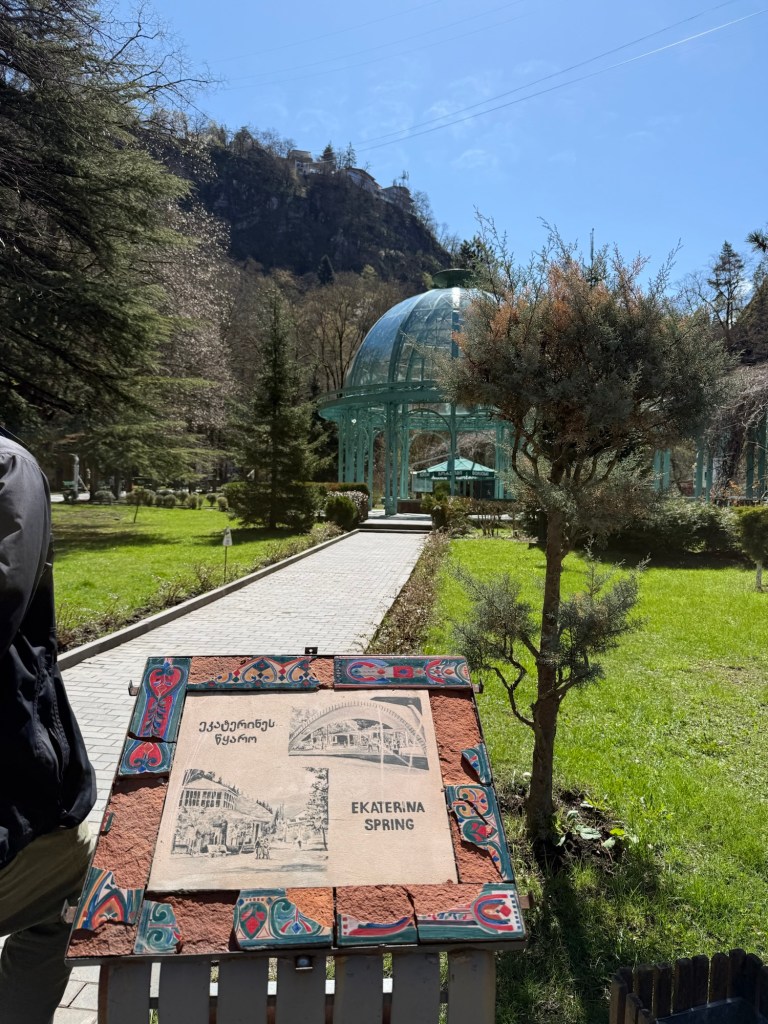
The park was beautiful and it was lovely to have a brief stroll in the sunshine and sample the so-called therapeutic waters from the Ekaterina Spring.  There is a fountain that you can fill your bottles from or drink straight from the tap …. It was not good lol.  If you did not breathe you could escape the sulphur smell, but you could not escape the metallic taste.  After a small sip, I did not go back for seconds!

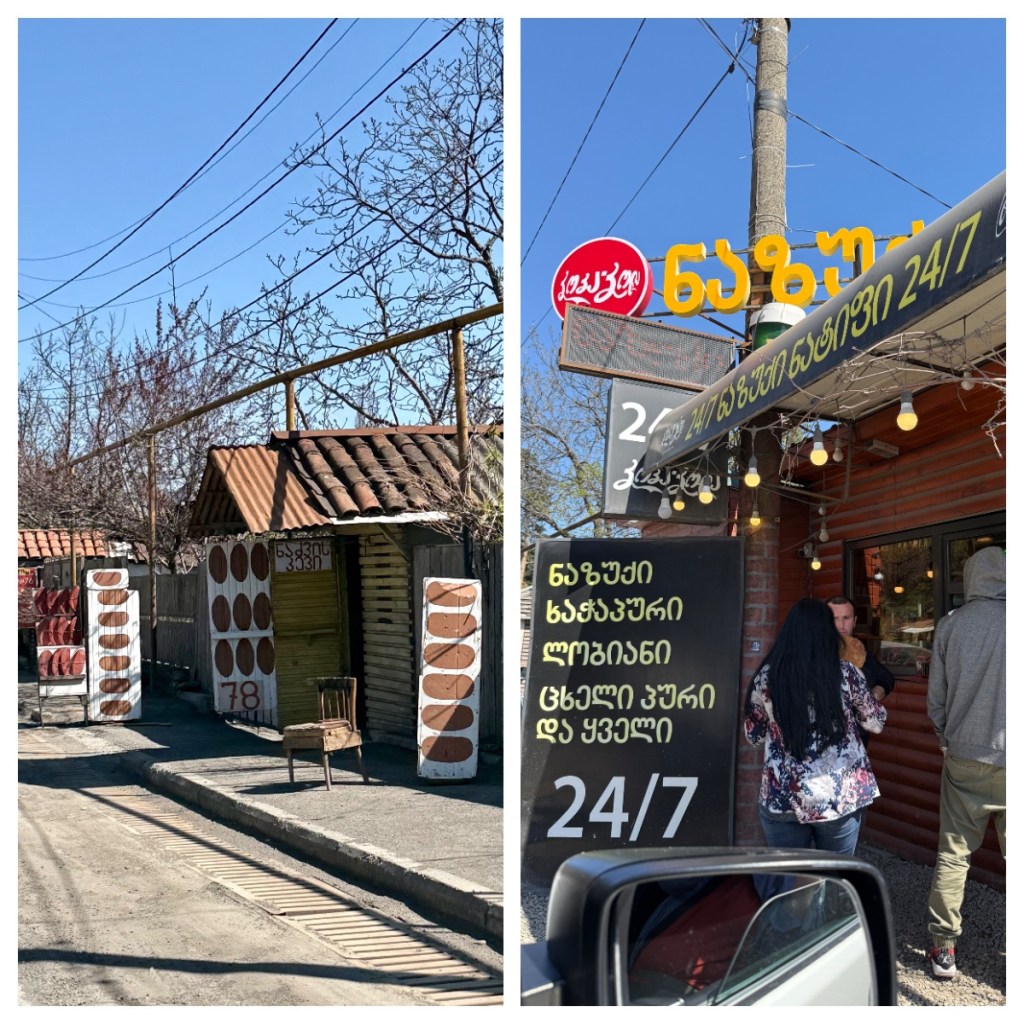
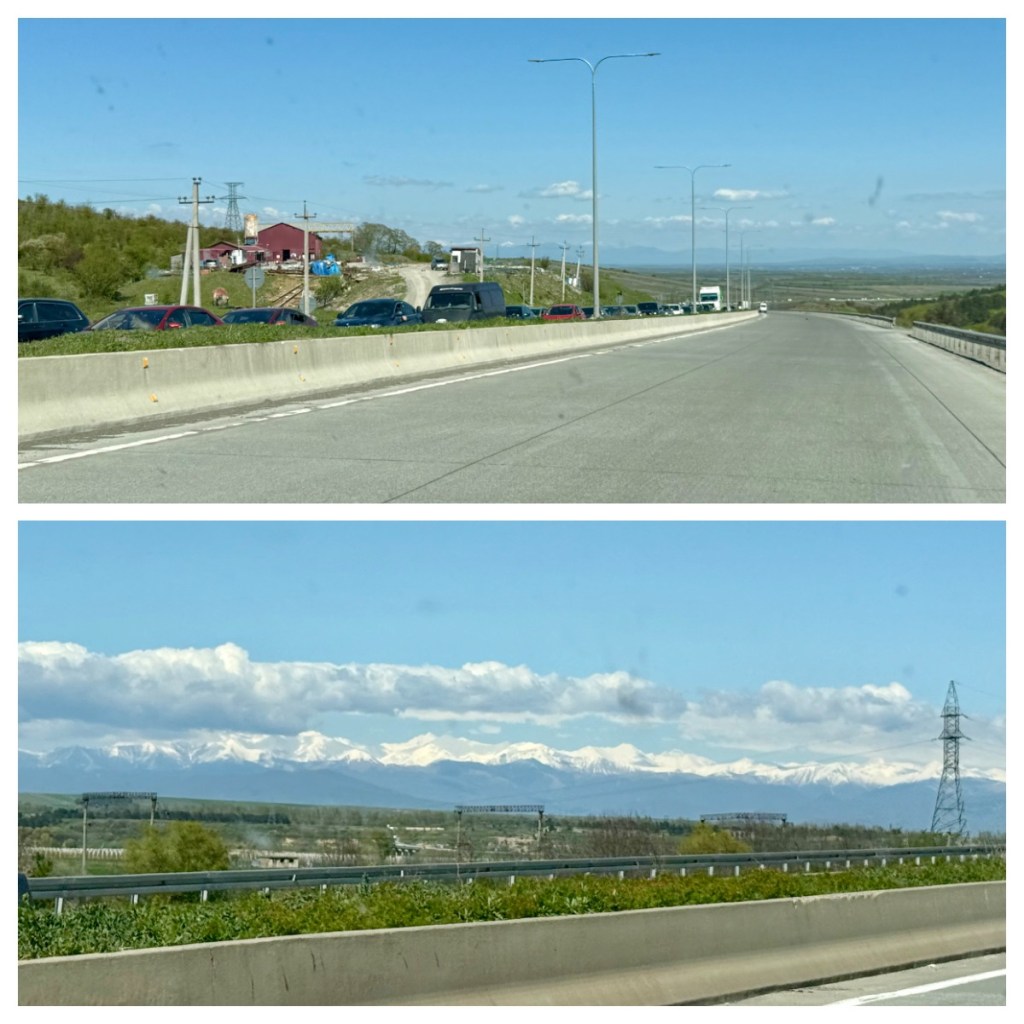
We were soon back on the motorway and this section of the road has over 40 tunnels cutting through the hills, and big roadside rest stops featuring small supermarkets and American chain fast food restaurants Wendy’s, Subway and Dunkin Donuts.  More importantly they had clean toilets – most toilets come at a cost here, 1 Lari a visit, so we often found Tazo sponsoring out toilet visits lol.

Car chats with Tazo today covered the following:

  • It was the long Easter weekend and most in the country are Georgian Orthodox, so Easter is taken pretty seriously.  What we call Good Friday; they call Red Friday and families dye eggs red to represent the blood of Christ shed on the day of the crucifixion. Now we did not discuss ā€˜Easter Grass’ but I did see it being sold – they either grow or purchase this (basically 10cm high wheatgrass) which is used as decoration along with the red eggs to symbolise new life after the resurrection.

On Easter Monday, in a few days’ time, families gather for picnics at cemeteries to commemorate their loved ones, sometimes pouring wine on top of the graves.

  • The Georgian philosophy ā€œEverything to my country, I get what my country can give backā€ reflects the strong sense of national dedication and loyalty.
  • After the collapse of the USSR, the years 1991 to 2003 are referred to as ā€œ12 years of sufferingā€.  There was turmoil internally and with neighbours and political and economic instability.  In 2003, the so-called Rose Revolution saw a non-violent uprising bringing on a change of government and subsequently stability.  They introduced a Zero tolerance policy and within 5 years they become one of the safety countries in the world.

We arrived in the city of Kutaisi, but before stopping in the city, we drove through and out to the Sataplia Nature Reserve, 10km out of town.  The park was created in 1935, after the discovery of the cave complex and the dinosaur footprints.    The name Sataplia translates to ā€œhoney placeā€ as bees used to live in small holes in the cliffs.  Most are gone today but you can still see the evidence of their previous existence.

We had to wait around 45 minutes for an English guide (which was mandatory) but to be honest they really were not worth the wait as they did not really tell us anything.  They just directed us places, first into a small building that covers the dinosaur footprints.  There are 150 footprints, thought to be from 30 different individuals from 5-6 different dinosaur species, including one new genus called the Satapliasaurus. Generally they appear to be both raptors and grass eating dinosaurs from the Jurassic period.

From the dinosaur footprints we moved on to the incredible cave system – a karst cave system carved out by the Oghaskura River over 30 million of years its 300m length is filled with stalactites and stalagmites.  There is a boardwalk type walkway through the cave and the cave was filled with music and lights. It is also always a constant 14 degrees inside – to be honest it felt a little more like a disco than a cave complex lol.   The cave’s main attraction was a heart shaped formation where people make wishes. 

Once out of the cave we had free time to explore some of the 350 ha of forest, part of which has dinosaur figures that come to life as you walk near them and then the piece de resistance – the glass panoramic viewpoint overlooking the area.  It was rather a unique experience but it was lovely to have a walk through the forest and enjoy the nature.

Back in town, we decided to find somewhere to have a quick drink before Tazo dropped us at our hotel and we found a small cafĆ© in the old town and we enjoyed a home-made semi sweet rose in the sun.  I think I have mentioned that everyone in Georgia make their own wine and although it was rather yeasty, it was still tasty.

Our hotel here was lovely (most have been pretty good) and we went to a restaurant called Agerari, recommended my Tazo, for a delicious dinner and a local beer. We had so much food, we almost had to roll back to the hotel lol.


Mountains high, valleys low

Georgia, April 2025


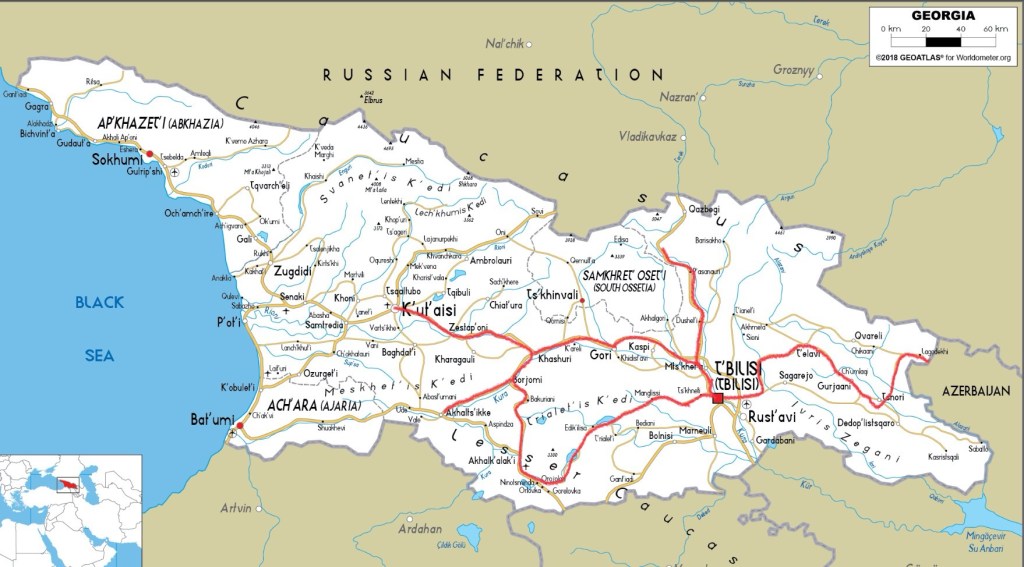
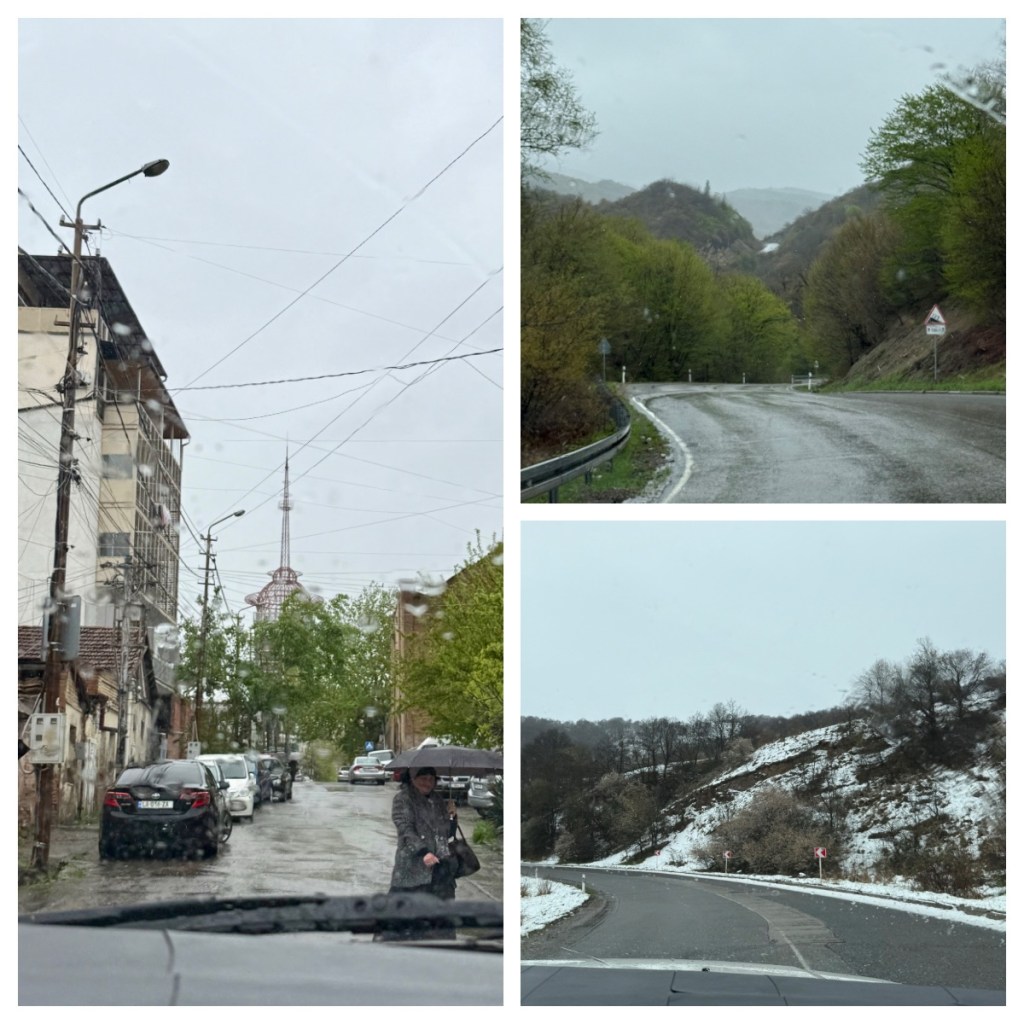
We woke to another day of cold rain, and due to the Easter holidays (where many things would be closed and traffic would be crazy), Tazo had managed to rearrange our itinerary, so instead of staying in Tbilisi for a few days, we were heading straight out again.

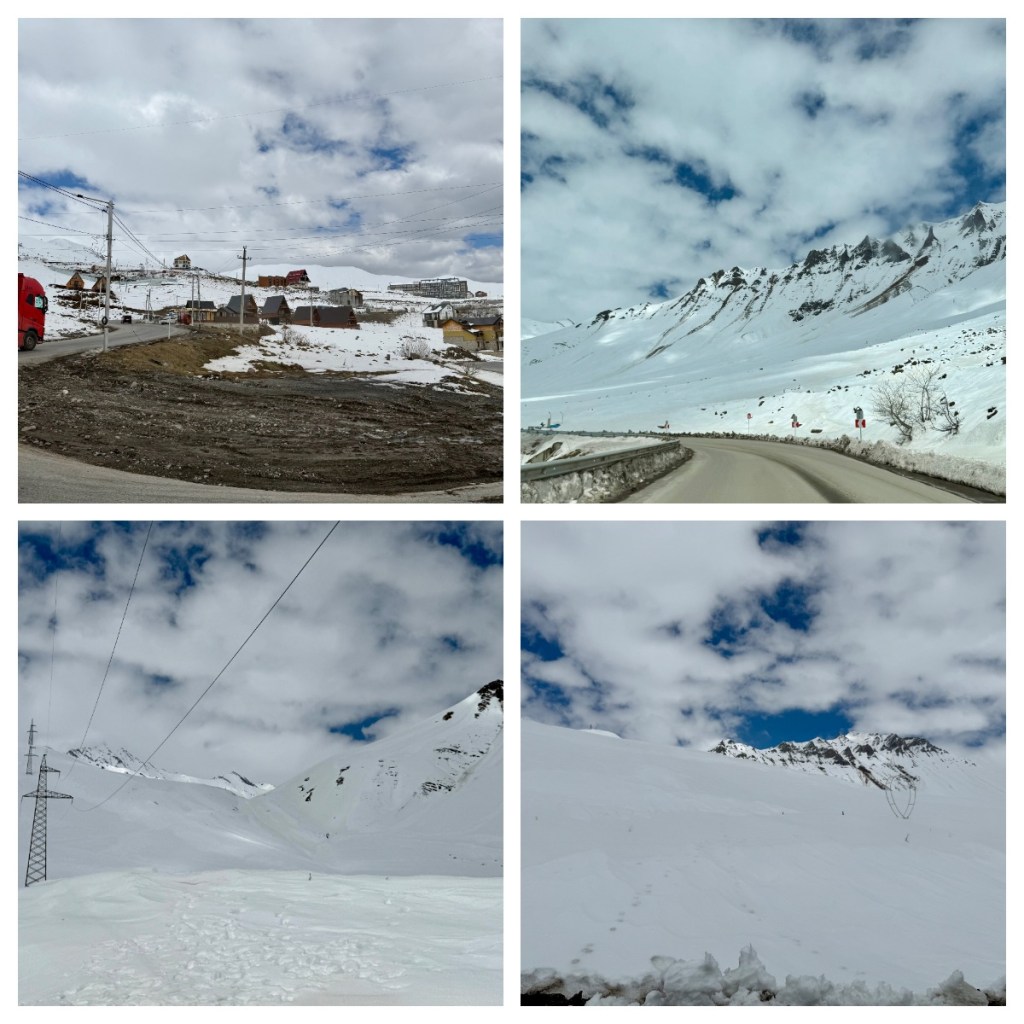
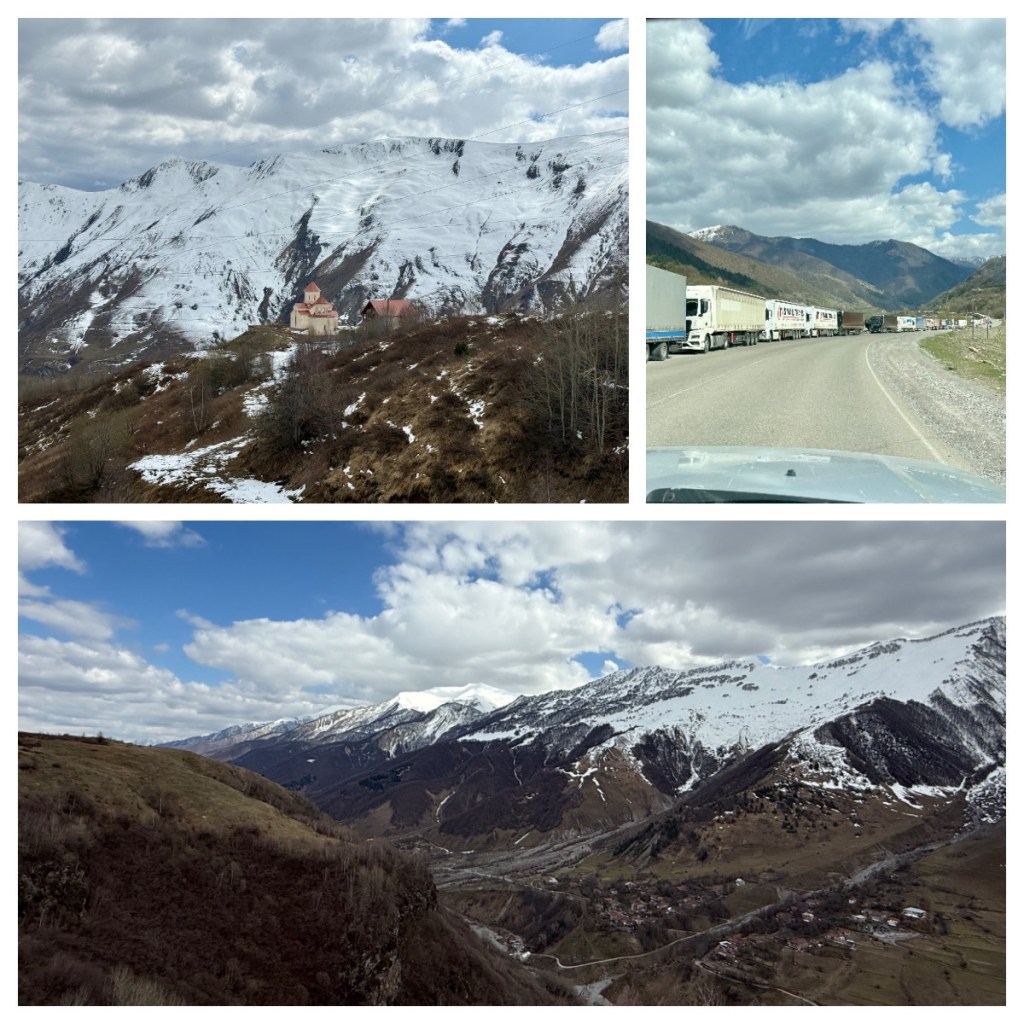
Today’s journey took us over the mountains of the Samtskhe-Javakheti region and we passed through beautiful mountain landscapes and small villages – neither were conducive to any good photos from a moving car …. in the rain!   But as we drove higher we started to started to see snow on cars coming from the direction we were going in!

In ā€œCar Chatsā€ today we talked about Georgia’s fight to retain its territory and independence.  Here, all men need to do 2 years military service and the last major skirmish, the Russo-Georgian war, was in 2008 when Russia took occupation of Abkhazia and South Ossetia.  Still today, Russia and 4 UN states recognise these areas as independent states, whilst Georgia and most other UN states recognise it was part of Georgia, and therefore the EU, and the UN now recognise the areas as ā€œoccupied territoriesā€.  Despite that, Russian continues to build military bases in the regions, create borders along the boundaries of the disputed lands and refuse entry to any international monitoring missions.

Russia continues to claim that Abkhazia and South Ossetia are independent states and not occupied territories and citizens can have local passports (of Abkhazia and South Ossetia) but get Russian passports for international travel.   Still today, tensions still run high along these borders and a permanent and peaceful resolution does not appear close.

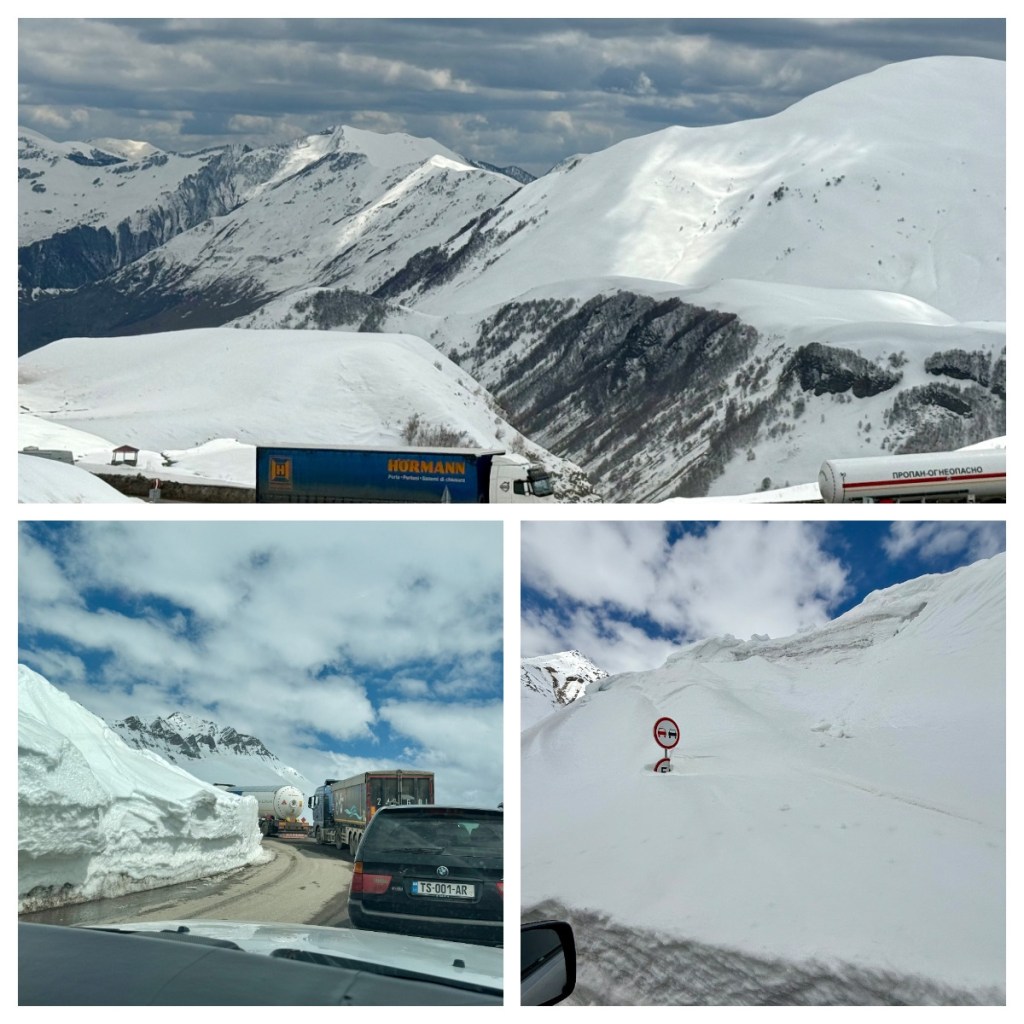
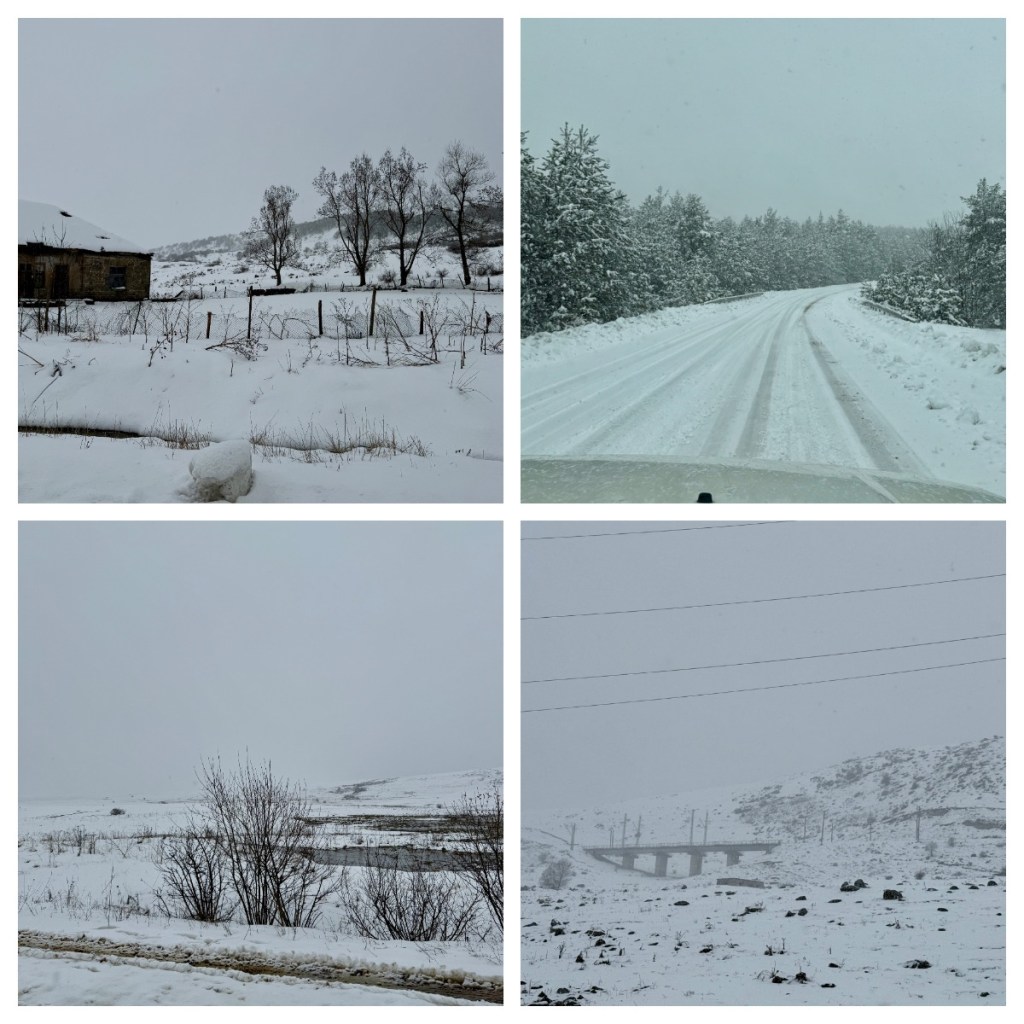
Up into the snow we drove and at almost 2000m above sea level it was actively snowing.  And it snowed and snowed, like serious snow!  Apparently, March had been a very warm month and most people had changed to their summer tires so this was not ideal and it was not long before we came upon a traffic jam.   Not sure if there had been an accident or if people had just decided they could not go any further, either way, the road was blocked!

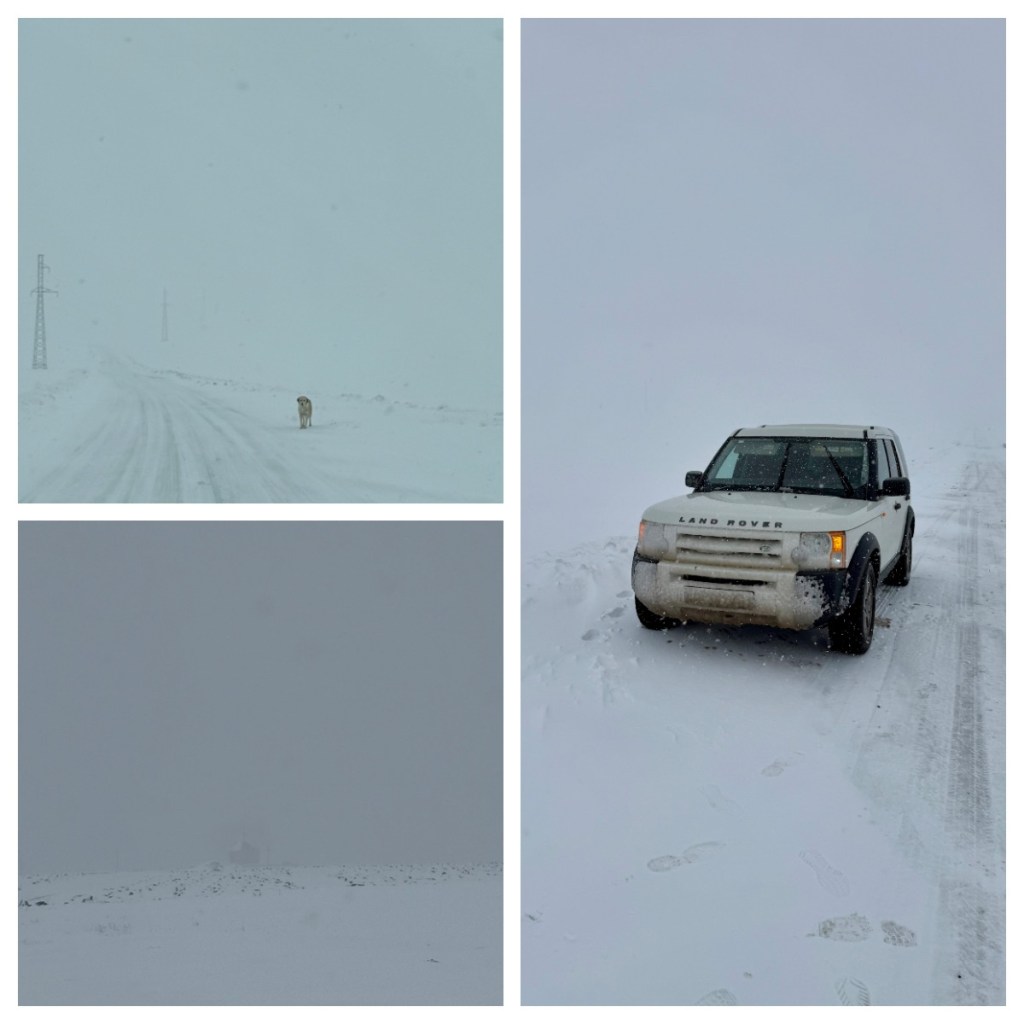
Thankfully, Tazo had picked us up this morning in his Landrover, so we went off road to get past the jam (I enjoyed this very much lol).  If we had not been able to do this, we would never have reached our destination for the day!

As we continued on, we got into almost a complete white out and the glare was insane!  Who knew the first time I would need my sunglasses would be for the snow!    We had now gone beyond the areas where the roads had been cleared and/or driven on by other cars and it was not always obvious where the road actually was!!   Tazo was also very excited by the snow as in the winter they plough immediately so he doesn’t often see snow like this on the roads!

We were supposed to have a stop at Paravani Lake, Georgia’s largest lake which is apparently quite beautiful.  Not only could we barely see the lake, but we could also not see the road that takes you down to the lake so a visit to the small chapel and wooden cross on the lake shore was not an option lol.  

Today we learnt about Saint Nino, considered the ā€œenlightener of Georgiaā€.    Born in Cappadocia in around 296 to an Orthodox Christian family, and after studying the Holy Scriptures in Jerusalem, the Virgin Mary visited her during a dream.  She gave her a cross made from vine branches and told her to spread Christianity across the region. 

Saint Nino was joined by a number of other women her pilgrimage but they were captured by Tsar Trdat III who killed all the others.  Nino managed to escape death and continued on to the shores of Paravani Lake to rest.

The lake and its surrounding landscapes left a profound impression on Nino, who found solace in its peace and beauty. She spent several days by the water, where the local inhabitants offered her food and shelter, allowing her to regain her strength before she set off for the capital city of Mtskheta where she was complete her mission of the conversion of the people from Zoroastrianism to Christianity.    She is still one of the most revered Saints in the Georgian Orthodox Church and a grape vine cross is a symbol of Georgian Christianity. 

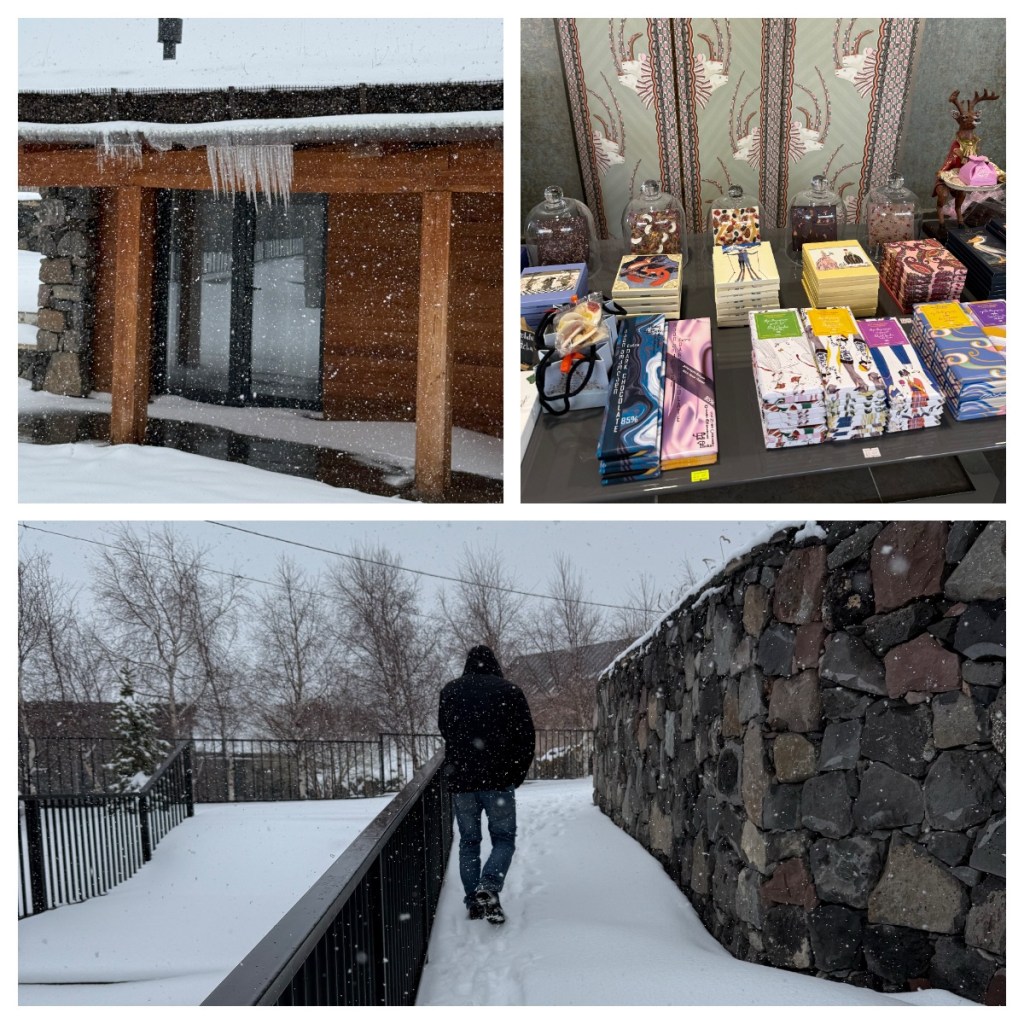
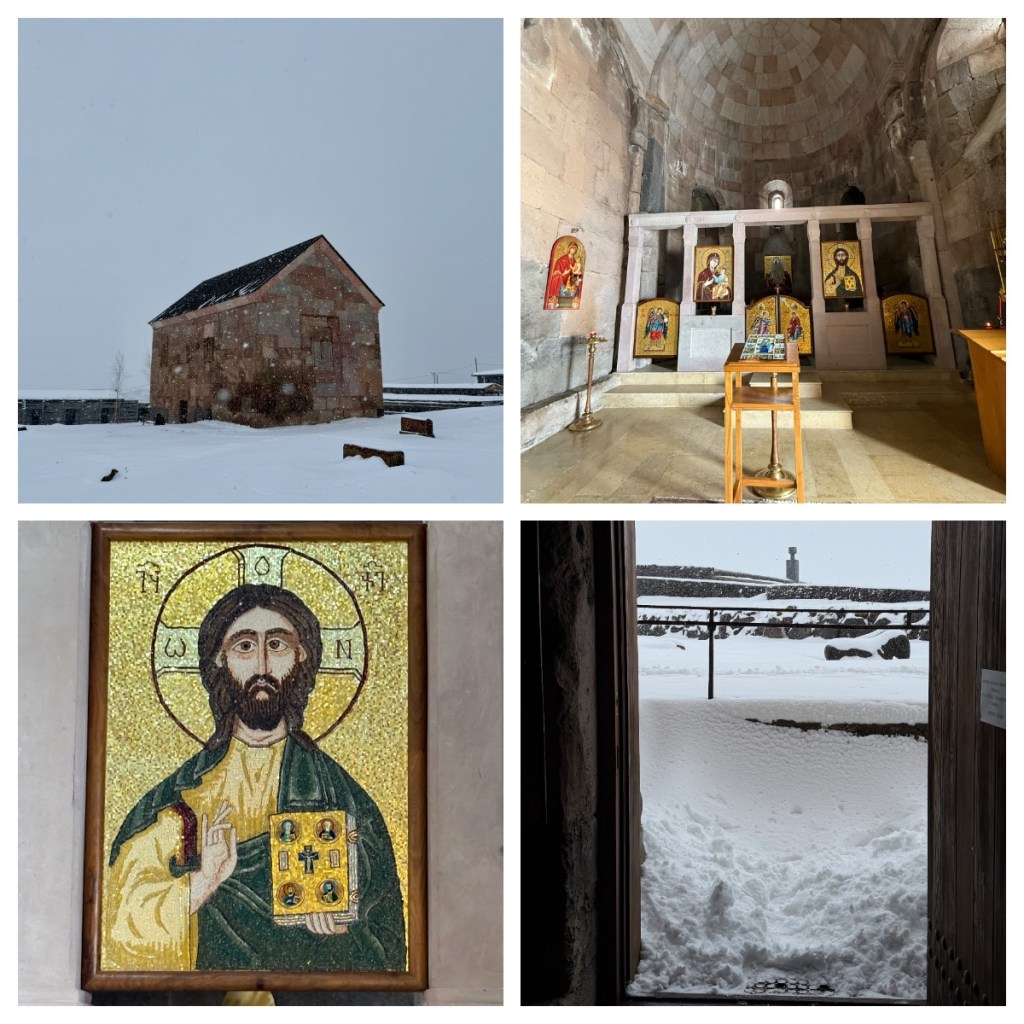
We continued on passed small, abandoned looking towns (apparently many only live here in the summer), until we reached the small village of Foka (I have also seen this written as Poka) and the St Nino Monastery.  Tazo went ahead to drag the nuns out in the snow to open their shop and the church for us to look around, as we trudged through the snow (now about 15cm deep)!   Again another moment I was grateful for my waterproof shoes but all in all I did not pack, and most definitely did not dress, for snow! 

The shop was selling a huge range of hand made products, including chocolates, biscuits, jams, oils, cheese, hats, ceramics and jewellery and given that they had been forced to come out in the snow we felt obliged to buy a few bits (mainly chocolate lol).

The Church here was built in the 11th century out of perfect cut square stone blocks and contains old carvings and fresco remnants as well as some beautiful icon imagery.

Back on the road through more deserted towns, we spotted whites storks nesting on the top of power poles.  I bet they wish they had held off their migration and nest builing for a few more weeks as they did not appear to be particularly happy! 

As we travelled down, we arrived back into the rain, but by the time we got down into the valley, we finally saw the sun!  It was hard to imagine that less than 2 hours before we were in the snow.


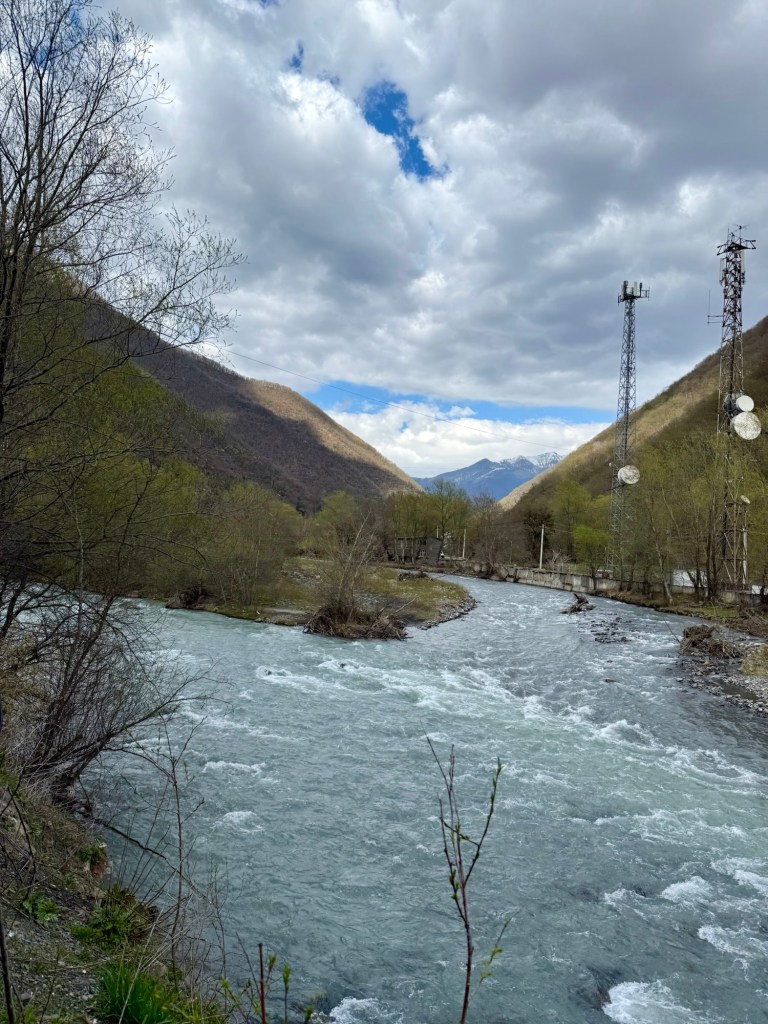
After a quick photo stop at the 4th century Khertvisi Fortress (we will return for a visit a little later), we followed the Kura River (that runs through Tiblisi and also through Azerbaijan out to the Caspian sea) down the valley.  During the stone age, most people lived near the rivers, hence the numbers of fortresses and watch towers in the valleys along the rivers.  Even Alexander the Great apparently travelled down this valley on his march towards India. 

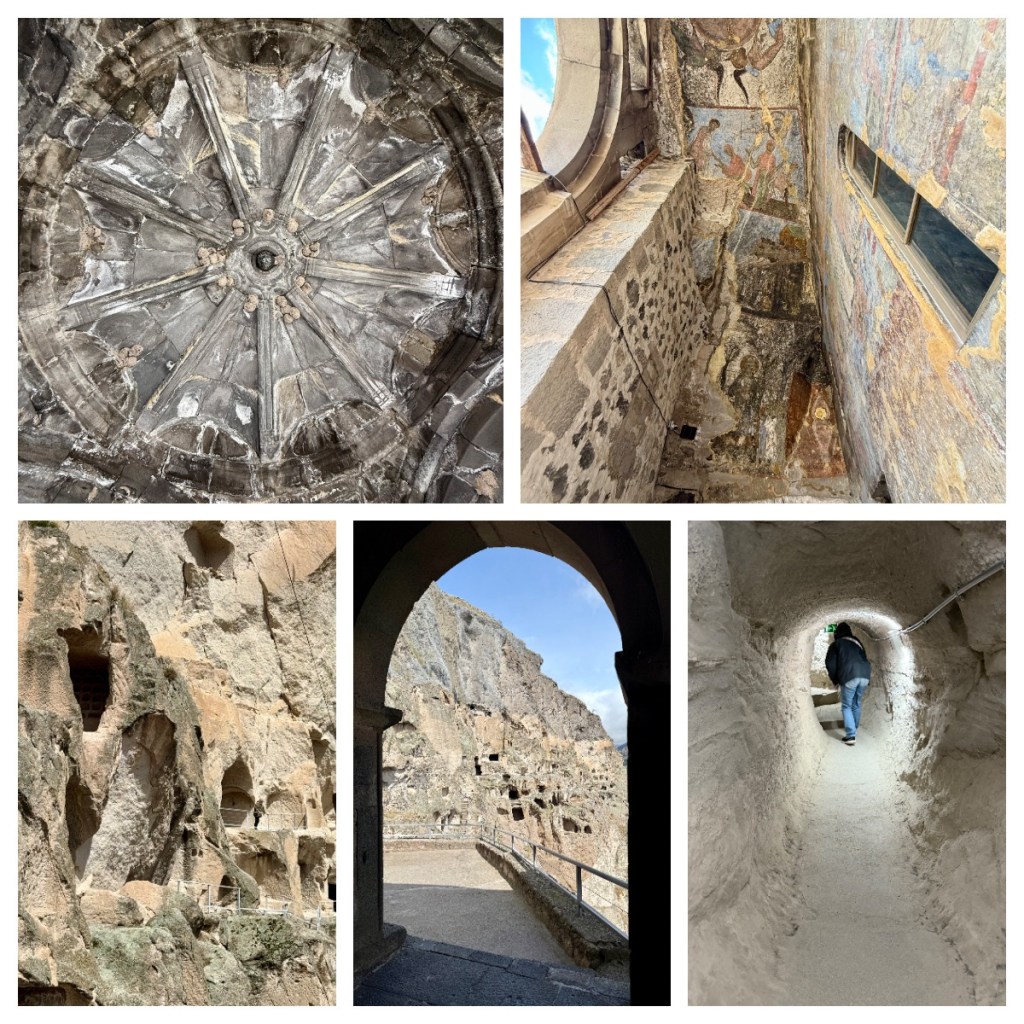
One of the sites we were most excited to visit in Georgia was the Vardzia Caves, one of a number of cave complexes in Georgia.  It is thought that the cave complex was built in a number of phases, starting in the second half of the 12th century, during the reign of King George III.

According to the legend, the King’s daughter, Tamara (who went on to become Queen Tamara) was playing in the caves as a child.  She lost sight of her Uncle and called out ā€œAk var dziaā€  – ā€œI am here uncleā€.  The words var dzia echoed around the complex (which was under construction) and were heard by the King who decided it should be named this way. 

Before I move on, let’s take a moment to meet Queen Tamara, one of Georgia’s greatest medieval monarchs who ruled from 1184 to 1213 CE.  She was the first female ruler of Georgia and was referred to as the ā€œKing of Kings and Queen of Queensā€.

Her father, King George III had no sons and was concerned about losing his power so named his daughter Tamara co-ruler at 18 years old in 1178.  By all accounts she was a badass who despite having to continually deal with resistance to her rule by clergy and noble men of the time, she went on to be responsible for Georgia’s greatest territorial expansion.

Back to Vardzia, the cave complex runs around 500m along the cliffs, is up to 19 tiers high and includes more than 250 rooms, 28 wine cellars and 3 churches.  There is also defences and irrigation systems including aqueducts and reserviors. After sustaining heavy damage in an earthquake in 1283, it was partially rebuilt before being mostly abandoned after the Ottoman invasion in the 16th century.

We took the free shuttle bus up to the first level of the caves and then had time to explore some of the caves, up and down stairs, some more like ladders.  I think we spent even more time admiring the beautiful views down the valleys and the blue skies which we had not seen for some time.

Back down at the car park we had some freshly squeezed pomegranate juice – it was very expensive (15 Gel or NZ$10 for a cup) and a little sour. I did enjoy it but would not rush to pay that price again.  That said it was probably tourist prices being a tourist site!  We also picked up some Georgian meat pies (I don’t seem to have made a note on the actual name) which were tasty and way better value than the juice!

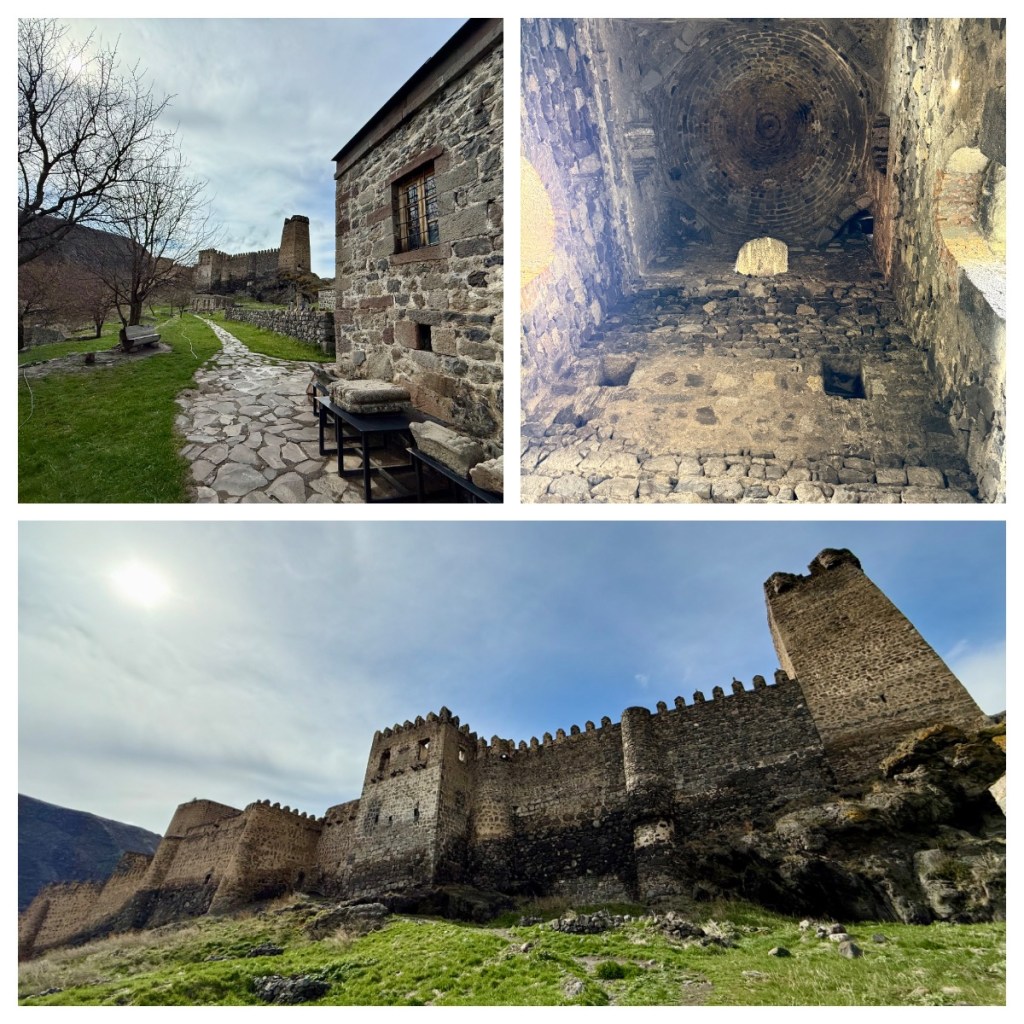
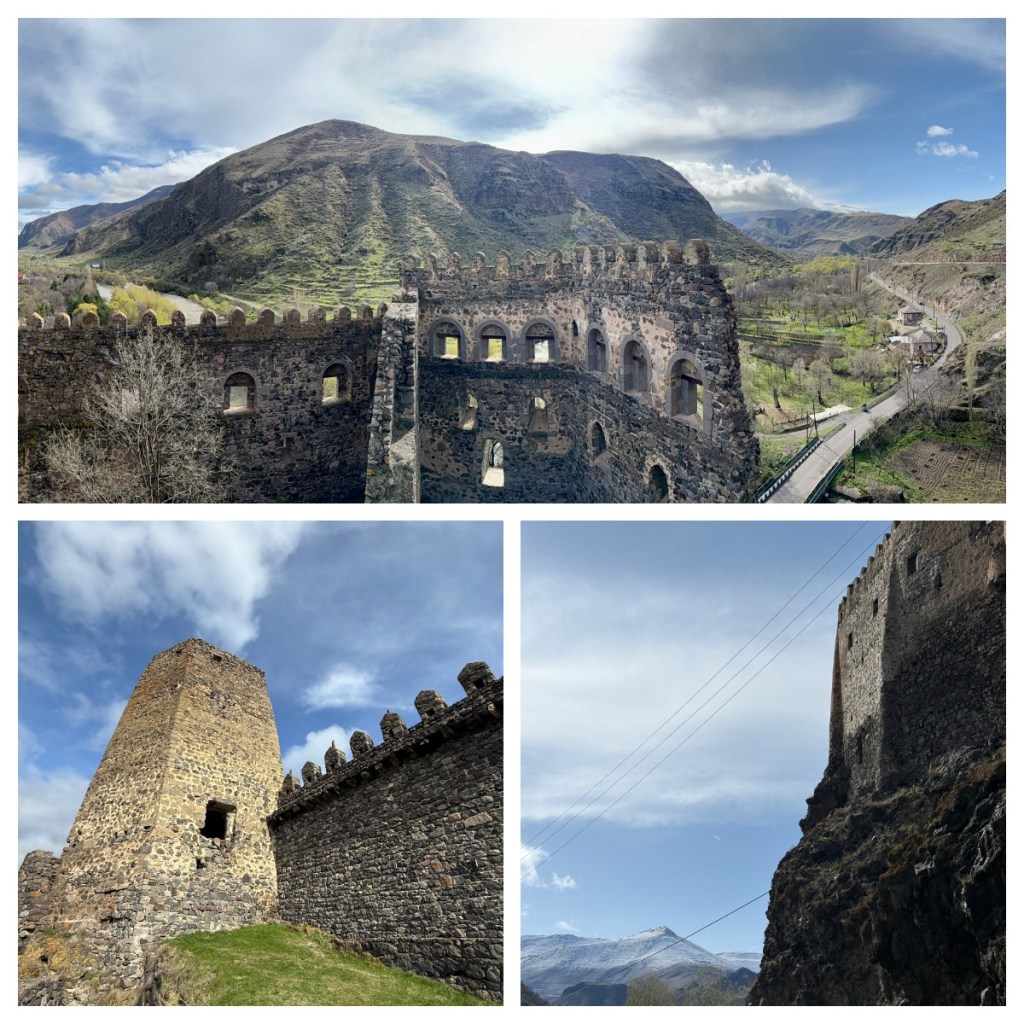
We then head back up the value and stopped at Khertvisi Fortress. One of the oldest and well preserved fortresses in Georgia, it has sat on this hill since the 10-11th centuries overlooking what was the Silk Road.  As with most fortresses in Georgia, there are many tunnels underneath – in this case they run down to the river to allow for water collection and also communications, not forgetting an escape route in times of siege.

Over the years as the town of Khertvisi was destroyed by Mongols, captured by Turks and then by the Russians, the fortress continued to dominate and its position as a military garrison was restored.

It was another full day and one full of surprises (mostly weather related lol) and we were exhausted by the time we arrived in Akhaltsikhe (our stop for the night). We could only muster the energy to pop to the local supermarket for some instant noddles for dinner before heading to bed! 


Museums & Wine of Kakheti

Georgia, April 2025

We woke to a cold and rainy day but, at one point, the rain cleared a little and I could see out to the beautiful snow-capped mountains in the distance and I was definitely excited for the next few days. Bur our first full day in Georgia was to be spent exploring in and around Telavi and avoiding the rain where possible.

I will warn you, today was a crash course in a small part of Georgia’s long history … and now I am sharing that with you so enjoy if you like that kind of thing šŸ‘šŸ»or just look at the pictures and move on lol.

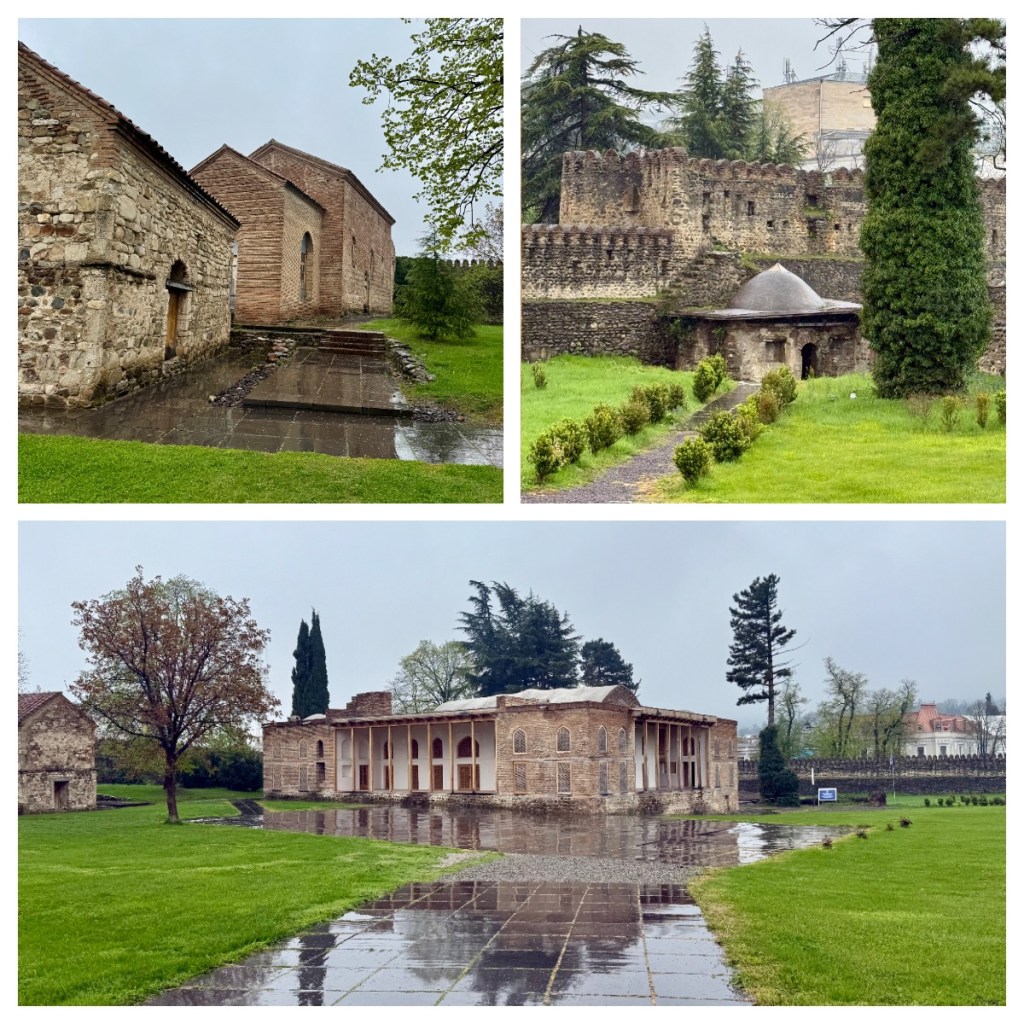
We started the day at the Telavi History Museum, a complex the includes the only preserved royal palace in Georgia, a church and a bath house, along with a museum and art gallery.  The museum had a great collection of historical artefacts and information about the history of ceramics, architecture, coins, clothing and the importance of grapes and wine.  It was interesting to see how the country has incorporated parts of its history, including Mongol, Russian and European, into its culture.

We then moved on to the art collection, a private collection of Ketevan Iashvili, a female cosmetologist born in the area in 1883.  She had an interest in fine art and collected it throughout her life (sometimes she was apparently given art in lieu of payment for her services by wealthy customers).  In the 1970’s she donated her collection to the museum and some of it can be seen here today.

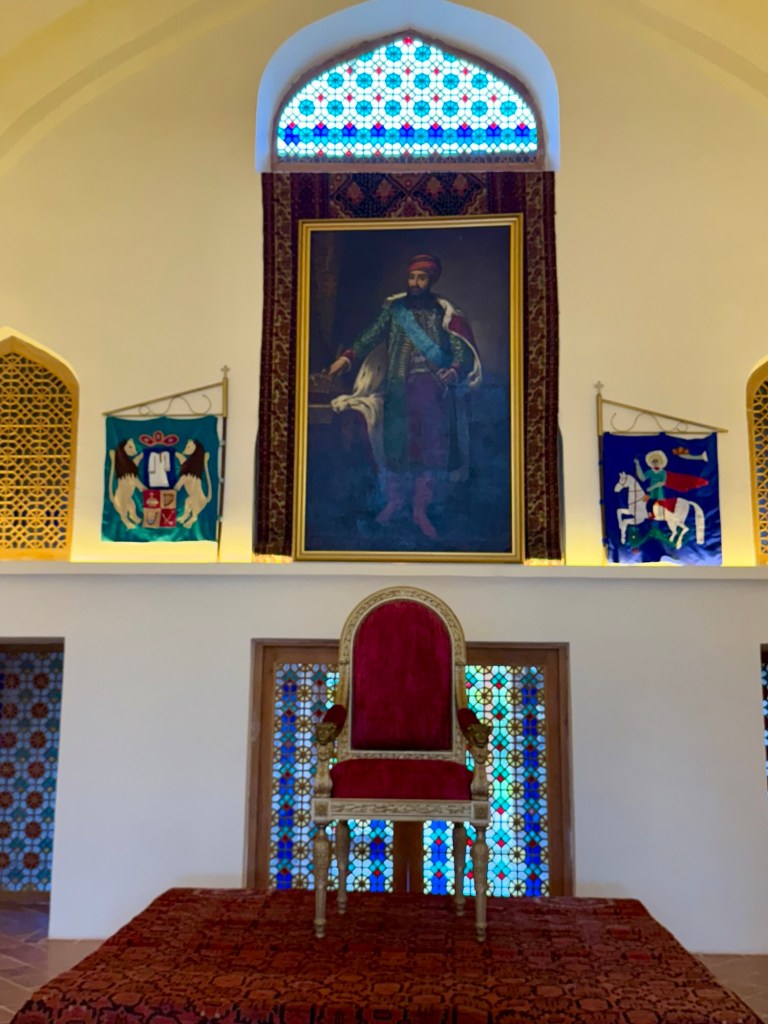
We then had to brave the weather and head outside to visit one of the most important parts of the museum complex, the Palace of King Erekle II (also known as King Heraclius II or the Little Kakhetian).  The much-loved King Erekle ruled Kakheti from 1744 to 1762, before uniting the regions of Kakheti and Kartli (upon the death of his father who was King of Kartli) and ruling both until his death in 1798.  He is considered one of the most important and powerful Georgian kings, modernising the Government, economy and military, but unfortunately, he was also part of the reason for its downfall.

He was known as a great diplomat, and in an attempt to keep his kingdom safe, he made a pact with Russia for protection, unfortunately it was not enough to save it from a Persian invasion in 1785. 

Construction on the palace started under King Archil II in the 17th century and what we see today was completed under King Erekle II, who turned a more simple palace (where he was born in 1720 and died, in the same room, in 1798) into a fortress with the construction of the 5m high walls. 

We had a local guide through the museum and the Palace and it was interesting to learn some more of the interesting facts about King Erekle and his palace. I have summarised what was a lot of information as best I can below:

  • The palace is a shadow of its former glory.  It used to be beautifully adorned with colourful walls and mosaic floors in a Persian style, all of which were destroyed by the Russians (Empire rather than USSR).  Unfortunately there are no images and very little written about how it looked so it cannot be restored. The Russians also used the great Audience Hall as horses stables as a further sign of disrespect.
  • King Erekle is considered the People’s King and form all accounts, he was liked by his people. He led from the front, literally, being 15 when he fought his first battle, and 75 when he fought his last.
  • A 17 year old Erekle was taken to Persia for 2 years.  He was a good diplomat and when he returned, ruling Persia allowed him to be King without giving up Christianity.  I should note that this part of Georgia was under Persian rule longer than the rest of the country, but they always remained Christian at heart.
  • Erekle was already King of Kakheti when his father, who was King of Kartli (the region where Tbilisi is) died, leaving Erkele to unite the two eastern Georgian kingdoms into a single state under his power.
  • After initially using the death of his Persian ally, Nader Shah, to his advantage by declaring independence, King Erekle then signed a protection agreement in 1783 with Russia (chosen because they were Christian).  Unfortunately, they did nothing to help when Persia did invade and in fact Russian troops went as far as to evacuate the area leading to a full invasion in 1795.  He went to his death in 1798 hoping that Russia would come to the rescue so Georgia could continue its existence, but unfortunately, just 3 years later, it was consumed into the Russian Empire.  
  • King Erekle had 3 wives (not at the same time) and a total of 28 children, most who died young or at birth. His last wife was a strong, intelligent woman whom he married when she was just 12 and she bore him 23 of his 28 children.  In the later years of his life, she had significant influence over his political decisions. She was not in favour of the agreement with Russia and was deported to St Petersburg in 1803 where she lived until her death.


In summary, he seems like he was a decent bloke, tried to do his best for his country and his people but was screwed over by his supposed mate!  In fact his dress sense denoted his diplomacy and he was often depicted wearing a Persian style hat, a European style cape and a blue sash to represent Russian. 

We did not explore much more because of the rain but could see the King’s personal Persian style bath house in the distance and churches in the grounds. One of the two churches actually dates back to the 9-10th centuries.  Much older than the palace itself.

We took a quick detour to see the impressive 900 year old Plane Tree that is all that remains of the forest that used to cover the area.  It is 46m tall and 12m in diameter and today, its health is closely monitored to ensure its ongoing survival.  It is apparently considered a symbol of Georgia’s strength and resilience and it might also be able to make dreams come true lol.

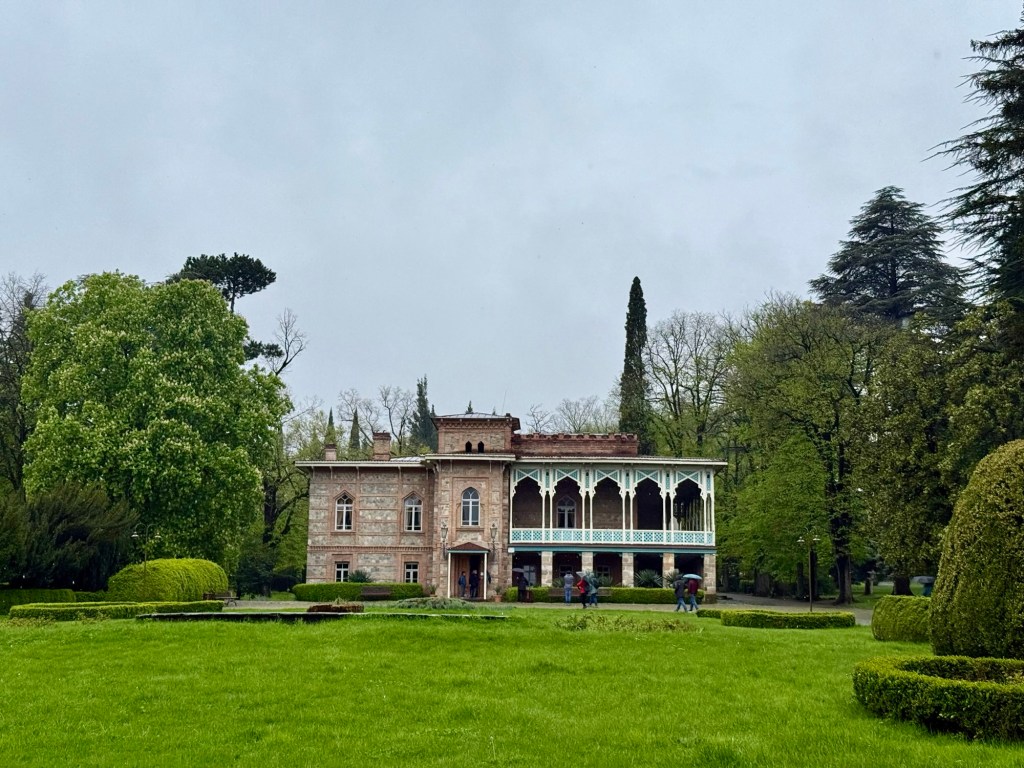
We headed slightly out of the city to our next stop at the Aleksandre Chavchavadze House Museum in Tsinandali.  Not surprisingly it was the home of Prince Aleksandre Chavchavadze.  Born in 1786 (to a noble father who was at one time ambassador to our friend King Erekle) he was Georgian poet, public benefactor and once colonel of the Russian Army and is considered the ā€˜father of Georgian romanticismā€.  He inherited the house from his father and turned it into the cultural and intellectual centre of the country. 

We had to wait for a tour in English so we braved the rain to run to the large building behind the house, which today is a Radisson hotel and the home of the estate’s wine collection and museum.  Another of Chavchavadze’s claims to fame is that he was the first to bottle Georgian wine in a European style. 

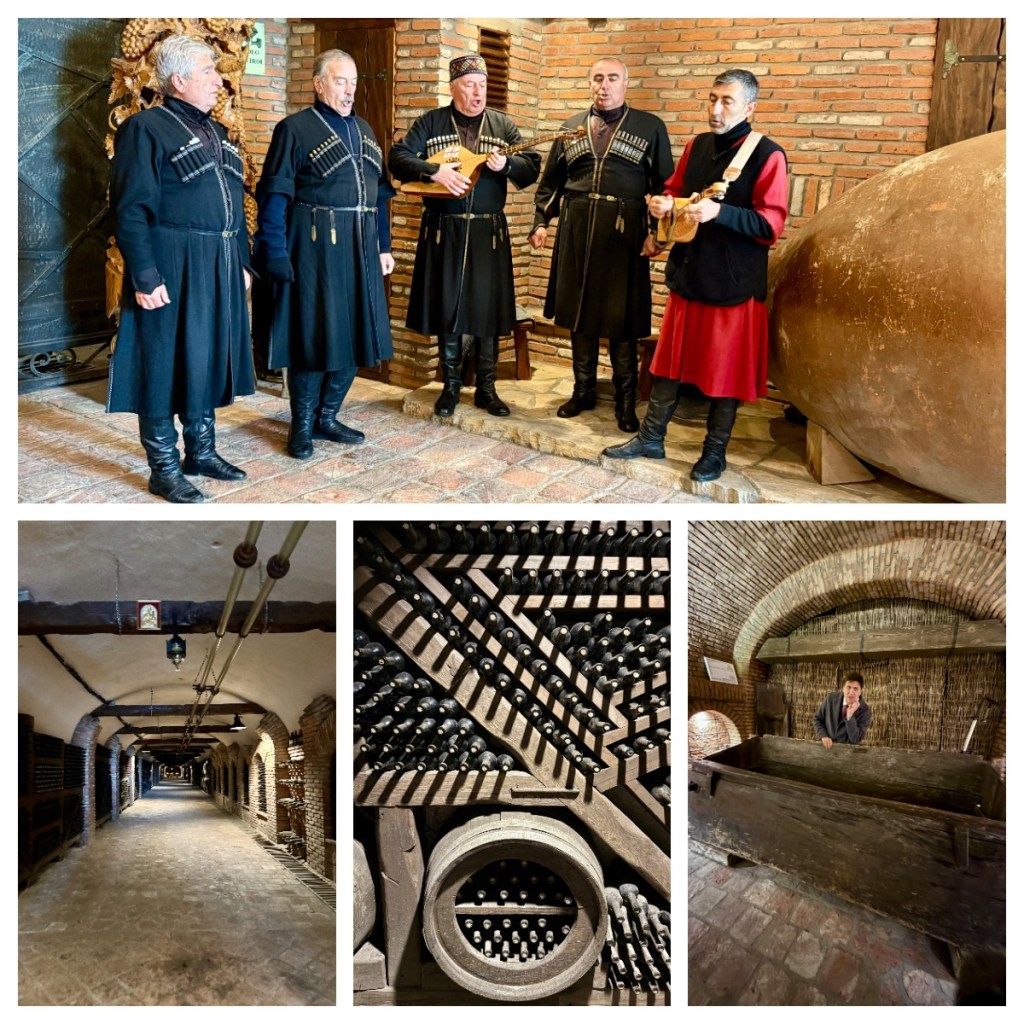
We were taken through a locked door and down some stairs into the estate’s vast historic wine cellar where more than 16,000 bottles of his personal collection are stored.  We learnt about the 8,000 years of Georgian wine making history and saw some of the early artefacts they had collected, including pressing equipment and fragments of clay pots (used in the Georgian style of wine making) dating back to the 6th millennium BC!

There are detailed written records for the wine, and the earliest bottle of Aleksandre’s wine is from the 1841 vintage.  Unfortunately, the early wine is no longer drinkable. (I wonder who dared to open a bottle to try it to come to that conclusion?)

Back in the house with our English speaking guide, we were taken around the rooms (no photos allowed inside) and given commentary about the family and the historical pieces on display.  Not all the pieces belonged directly to the family but all were beautiful luxury items from collected from all over Europe and Russia.  It included the oldest grand piano in Georgia and carpets from Azerbaijan.

As the story goes, in July 1854, the troops of a Chechnyan Muslim leader attacked the estate (avenging the family’s support for Russia), pillaging the house and kidnapping his relatives (including his son’s wife, her sister and their children).  It was not until March 1855, after complex negotiations, they were returned in exchange for a ransom and an exchange of other prisoners.

Disillusioned with Russia’s control over Georgia, he ended up joining the failed Georgian rebellion against Russia in 1832 which resulted in him burning much of his poetry written between 1820 and 1832 in fears that it would be used against him, but he was still exiled, before returning to the Russian army at the request of the Tsar.

Following his death in 1846 (officially an accident, unofficially by the hands of Russian assassins) and that of his son David, the ransom loan had still not been repaid and the estate was given to the Russian Imperial family as a summer house.  Summer seemed very far away on our visit as I am not sure the rain let up for a minute!

Finally the moment we had been waiting for was upon us – wine tasting. For this we travelled the short distance to the Kvareli Wine Cave which apparently have the largest storage of Georgian wine, which is stored in more than 7kms of tunnels. The tunnels were originally built in the 1950’s by the USSR army, allegedly as a missile base or a bomb shelter, before being converted into a wine cellar.  Apparently at the time they were also building bomb shelters in Tbilisi, saying they were building a metro system!

After a traditional welcome song, we joined our wine guide to learn more about Georgian wine and the winery.  In 1995 they started cultivating grapes and building wine making facilities and the existing tunnels made a perfect storage facilities – maintaining a standard 12-14C and 70% humidity. 

This winery has a lot of award-winning wines (apparently over 200 gold medal winners) and have vineyards around the country, as they only use their own grapes to allow them to control the quality. 


We learnt about the Georgian wine making process which mainly varies from the European style in that it is fermented in large clay pots, known as a Qvevri, Kvevri or Ch’uri.  The pots are a special shape to allow for circulation and they push the skins and twigs to the bottom daily.  When the bubbles stop, they seal the pot and then it sits for the required length of time.  When ready, they traditionally use a scoop (made from a dry pumpkin skin) for the first sip, which is drunk from a clay bowl (it needs to be drunk in full and not sipped)!

We sampled a number of different wines and decided that we liked the semi-sweet ones, and I am a little embarrassed to say I preferred the European styles over the Georgian styles.

Back on the road, we had more great car chats with Tazo covering a multitude of topics – this is exactly what we wanted in a guide! 

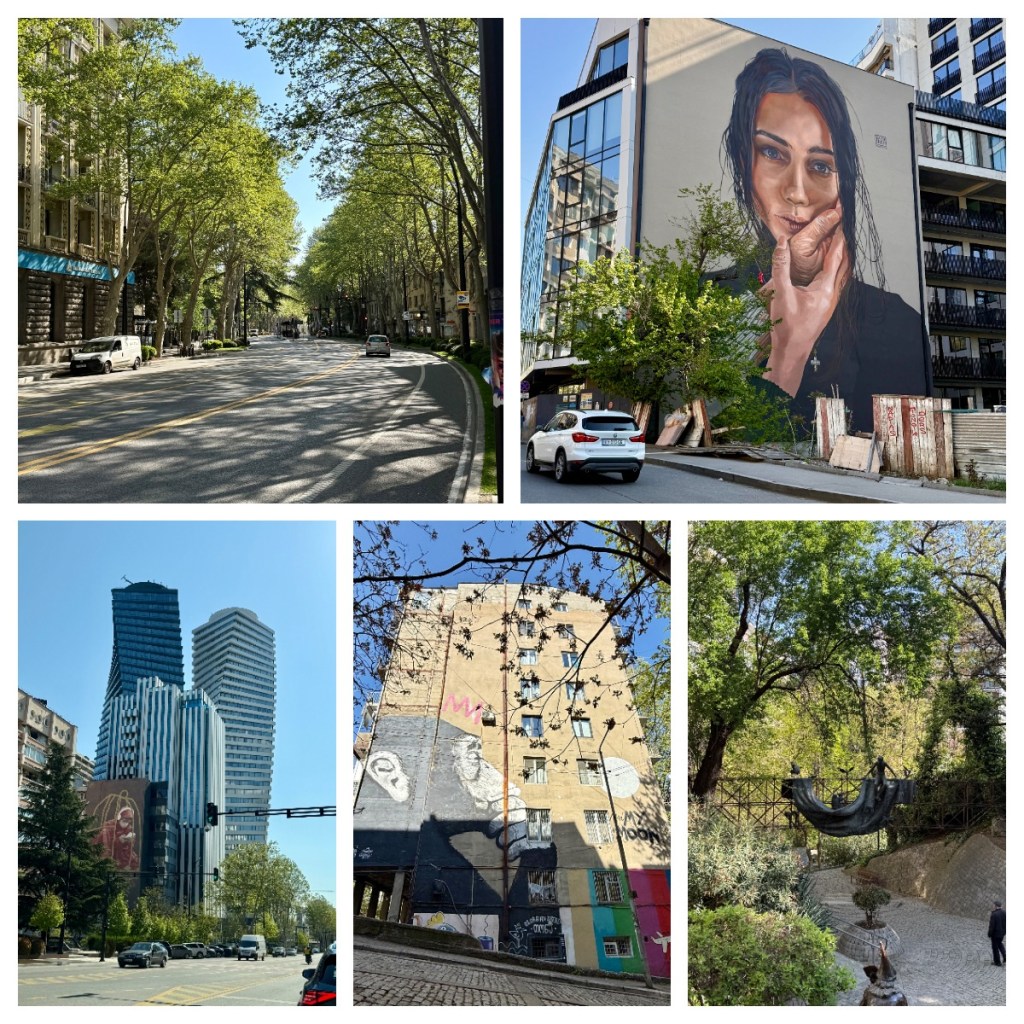
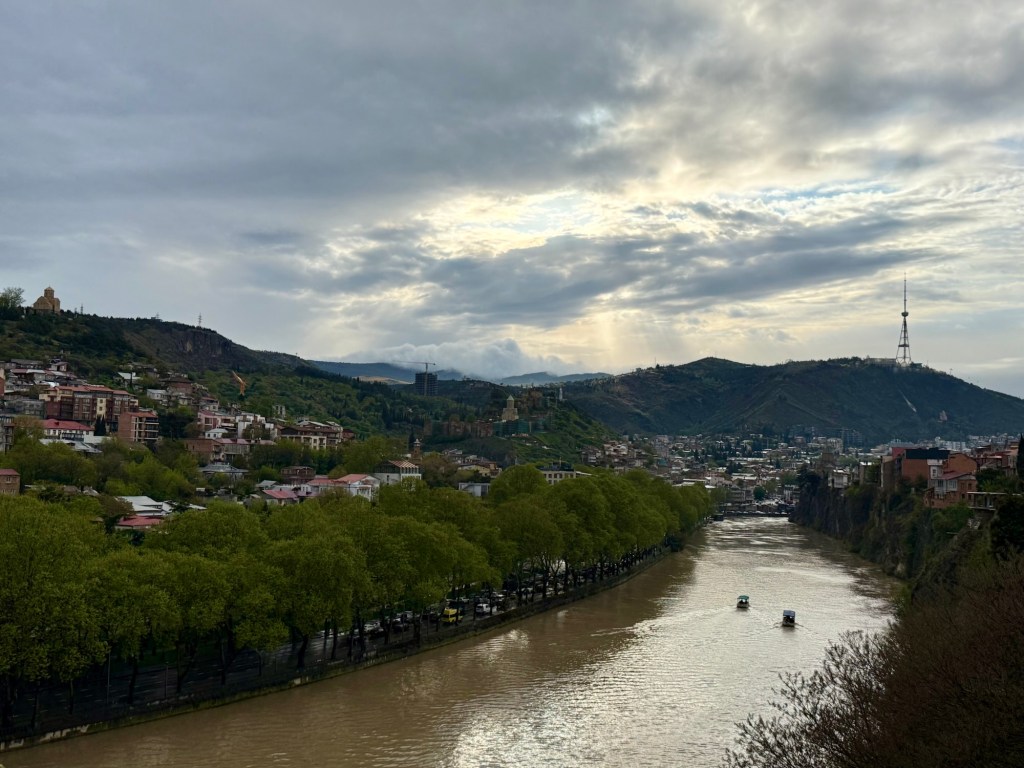
A quick stop at a random road side restaurant for a late lunch of a tasty Georgian beef soup and more Khinkali (I think most meals with include these lol)  before arriving in to the Georgian capital of Tbilisi. By the time we got to our hotel, the rain had eased a little and I even saw the sun for a moment so popped out to get my first glimpse of this beautiful city (we will have more time to explore in on another day).  


Goodbye Azerbaijan, hello Georgia

Azerbaijan & Georgia

April 2025

I was woken early by the Muslim call to prayer and to a misty morning. As I had now discovered the importance of the buildings just across the road from the hotel, I headed out for a quick walk and in search of coffee.

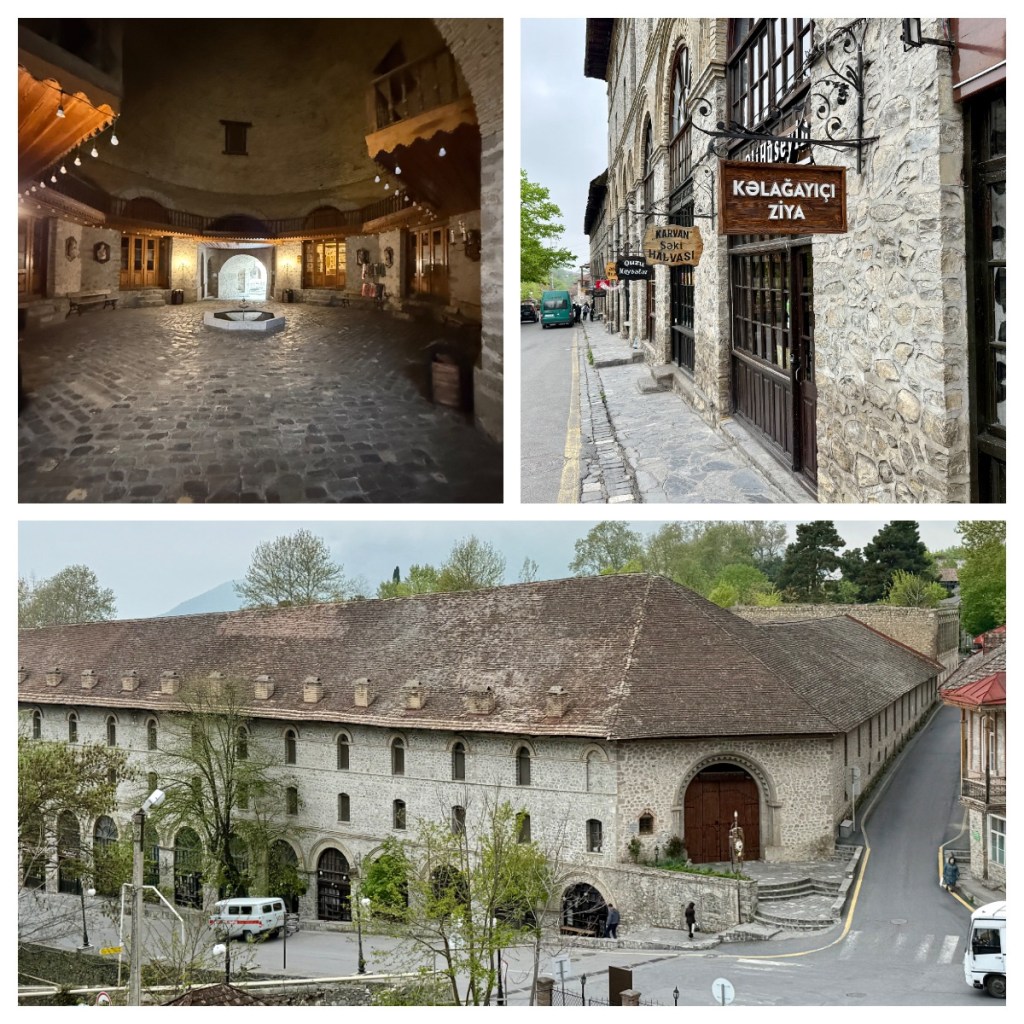
There are two caravanserais on the main road in old Sheki, the upper and the lower which both date back to the 18th-19th centuries.  They were built as fortified structures with just one gate, so they can be protected more easily. 

The Upper one is a tourist site, of course it was closed at 7.30am but I did manage to sneak in a small door (inset in to the big door) to have a quick look at the first courtyard.  As in time gone by, there are a lot of shops along the the outside and we had walked along them the night before.  Today they are mostly souvenirs and also some Halva shops, making a traditional local Halva (a sweet made from sesame paste and honey).


The Lower caravanserai is a hotel today, but more importantly for me (that sounds like a terrible thing to say šŸ¤“), there was a lovely coffee shop just across the road … and it was open!  I enjoyed a coffee and watched the local Ladas go by – they definitely rule supreme in this part of the country and I love it.

As we headed towards the border, we passed yet another Albania church on a hill side – I should note that the Albanian churches I see on this trip are not related to the Albania of today, but of the ancient Caucasus Albania which sat in the south eastern part of the Greater Caucasus mountains (most of which sits in modern day Azerbaijan.  The mountain landscapes were filled with wild braided rivers, shepherds grazing their sheep and as we neared the border, trucks, lots of trucks.

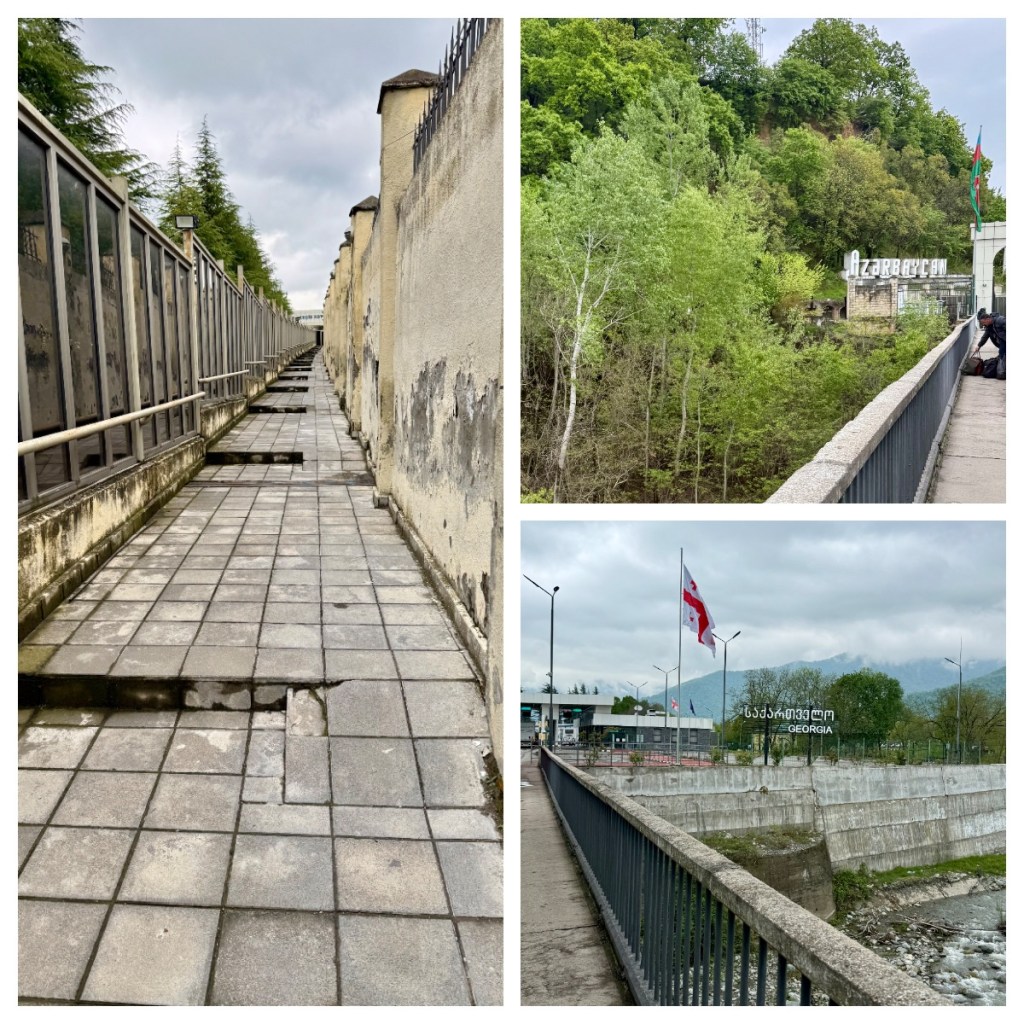
We said our goodbyes to Rugiya (our Azerbaijani guide) and our driver and walked to the border crossing.  It took around 45 minutes to depart Azerbaijan (only because we got caught behind a tour bus) and then walked the short distance across no mans land and into Georgia.  The Immigration guy was so excited to see a New Zealand passport – his exact comment was ā€œI did not expect this todayā€ lol.


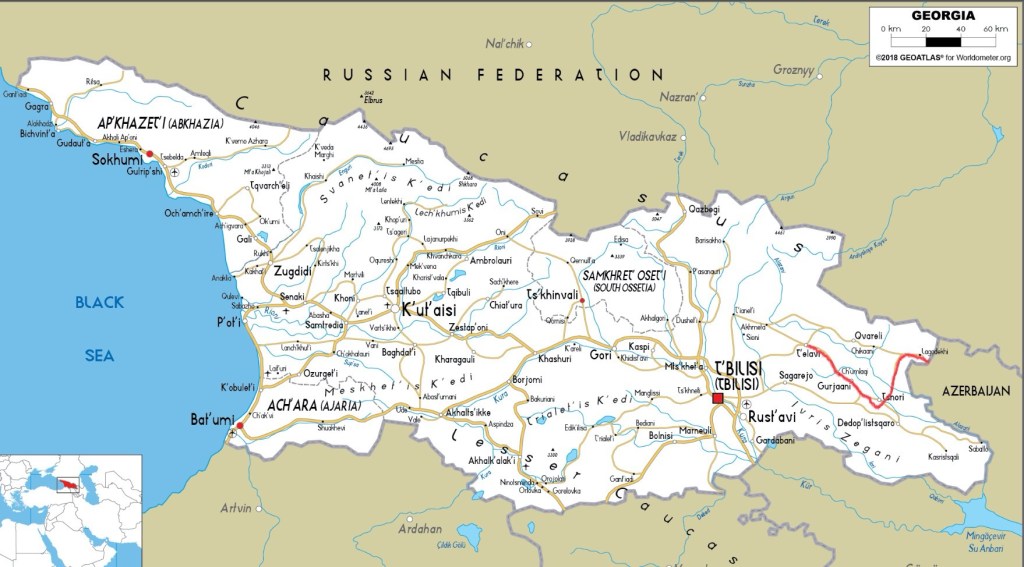
We found our Georgian guide, Tazo and hit the road on the next leg of our Caucasus’s tour. Let’s be clear, we are talking about Georgia the country, and NOT the state in American as many first assume!

The currency here is the Georgian Lari (GEL), NZ$1 = GEL1.6.

First, I little context. Georgia spans Eastern Europe and West Asia, bordering Russian, Turkey, Armenia and Azerbaijan.  It is a small country (only 69,000 km2 – compared to New Zealand’s 263,000 km2) with a population of around 3.7 million, 2 million of which live in the capital, Tbilisi.

As with most countries in this region, its history is complex and somewhat turbulent and even today, the geopolitics of the region continues to cause issues.  After adopting Christianity in the 4th centre, the Kingdom of Georgia remained strong until the 15th century when they succeeded to the Mongols, the Ottoman empire and Persia, before becoming part of the Russian Empire in 1801. 

After the fall of the Russian Empire, they had a couple of years as an independent republic before, once again, being invaded by the Red Army and becoming part of the USSR until 1991.  It was not until 2003 that they gained political stability and aligning themselves with the EU.   I will touch further on parts of this as we travel around and learn more.

The weather was less than ideal, but it was better than the forecast for the following day, so Tazo recommended that we visit the hilltop town of Sighnaghi today rather than tomorrow. A small town in the Kakheti region, Sighnaghi was built in the 18th century as a fortress but today it is referred to as Georgia’s ā€œCity of Loveā€ (though I am not sure I know why)!
We drove up into the cloud to the town and we did have to imagine the charm of the town, and of course the view – which apparently is beautiful and our imagination continued as we wandered down through the cobble stone streets to our lunch stop.    

In just a few short hours, we were already impressed with Tazo and he ordered a great array of delicious Georgian food for our first meal.  It seems that walnuts, cheese and bread play an important part of Georgian meals and this meal incorporated all of the above – eggplant stuffed with walnut paste, khachapuri (a few different varieties but the basic one is bread with cheese), tomato salad, BBQ pork and Khinkali (broth and meat filled dumplings). 

All were delicious and I washed it down with my first glass of Georgian wine.   (I will warn you now, food photography is not my thing – most of time we would be half way through eating before we remembered to take the photos šŸ˜‚.)

In just a few short hours we had already learnt some important information about Georgia and her people:

  • Georgian’s like food with flavour, and ā€œfood without salt is not foodā€ lol.
  • Georgia is the home of wine making (more about that another day) and it is important for Georgian people.  Without wine, nothing happens and almost everyone makes their own.
  • Georgia’s main exports are copper and other minerals/ore.
  • The Georgian alphabet is unique and in fact, there are 3 versions of it.  One is widely used, the other two are predominately for religious texts and inscriptions. 
  • I was the first Kiwi guest that Tazo had had

The cloud lifted briefly to allow a quick and hazy view of the valley below, with the green pastures and fish farms (which seem a little random to me in the middle of fields lol).  Apparently there are also lots of minerals in the soil here which are great for grapes. 

While Tazo ran back up the hill to get the car, we took a short walk along part of the 4 km defensive wall to a watch tower flying a very tatty Georgian flag in one of the 28 watch towers along its length.  Again, we had to use our imagination on the view!


I have to admit, I was in a bit of a food coma on the next part of the drive but we had lots of good chat with Tazo on the journey to Telavi, the main administrative centre of the Kakheti region and our stop for the night. 

Dinner was not required but we bit have a snack and some homemade Green wine (they use the grape skins during fermentation) to finish of the day. 

But, before I finish this blog, I thought I would touch on the country’s name of Georgia and the infamous St George.  Georgians actually call the country Sakartvelo, and although it is not entirely clear where the English name of Georgia came from, there are a number of theories mostly based around St George.

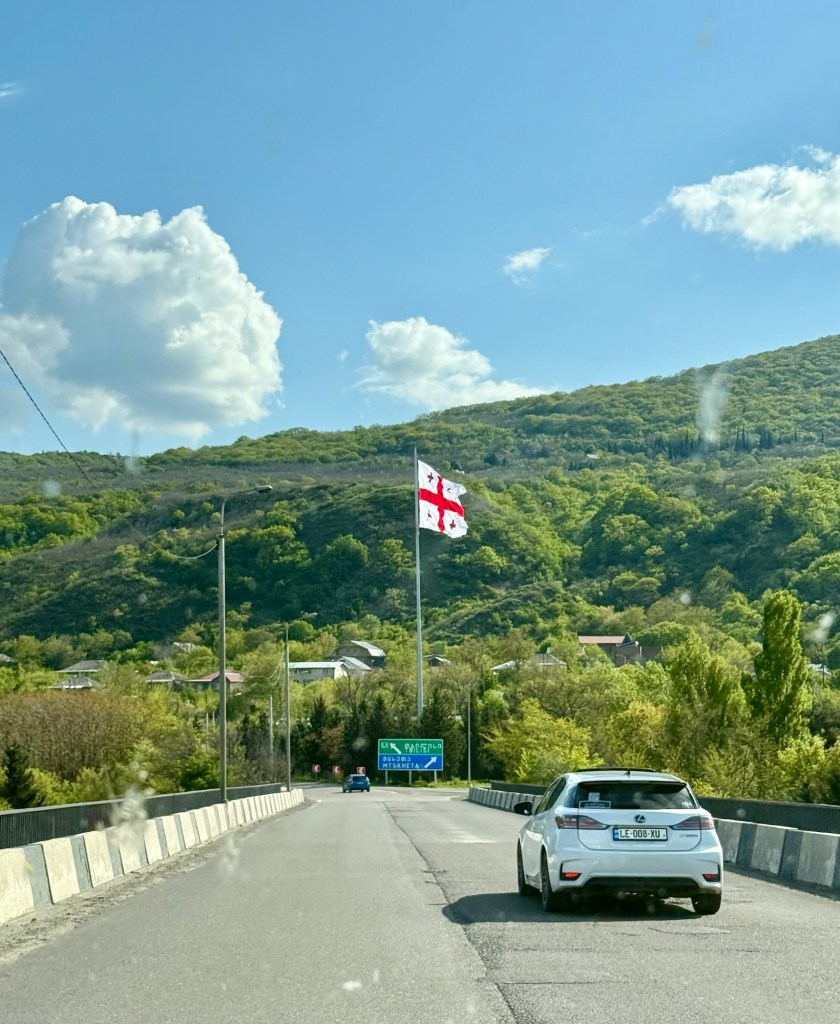
St George, an early Christian martyr, was born in Cappadocia in the second half of the 3rd century. He is the patron saint of the country (and many others), a large number of churches in the country are built in his name, George (or Giorgi) is one of the most common male names and the country’s flag features his red cross on a white background!  What more do you need to convince you of is importance to the country and its people and perhaps the English name.

When he started fighting dragons, and became the patron saint of England is another story entirely lol.


North west to Sheki

Azerbaijan

April 2025

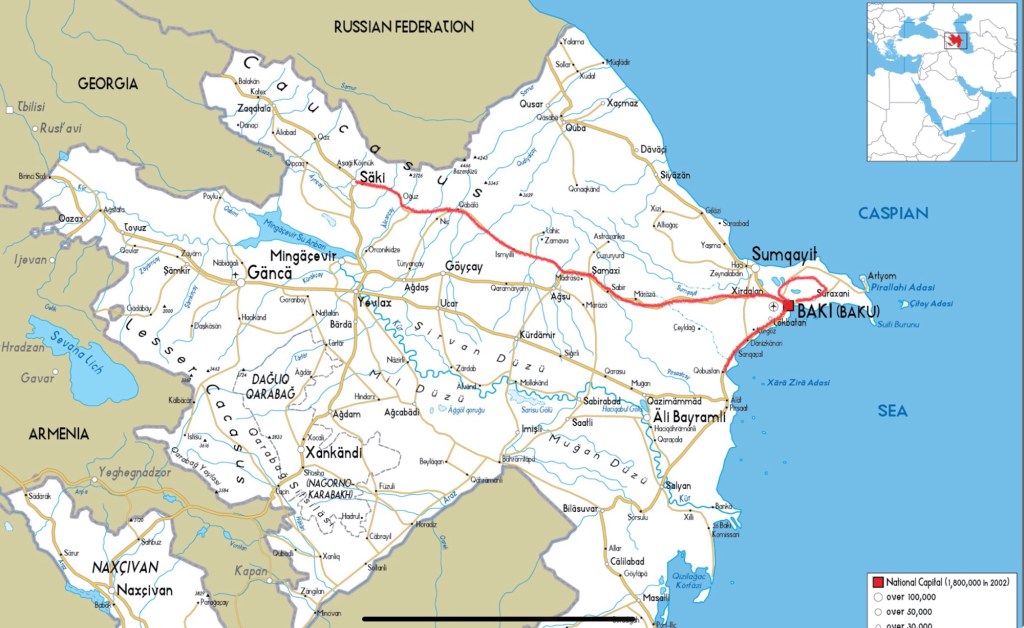
It certainly seems that things do not start early in this part of the world, so I always have time to do a little writing in the morning.  This morning’s pick up was 9.30am and this morning we left with our bags as we were leaving Baku behind and heading west.

Not sure if I have previously mentioned some of Azerbaijan’s more recent history.  The country gained independence from the Russian Empire in 1918, but it was short lived as the Red Army invaded in 1920 declaring Azerbaijan as part of the USSR.  The country finally regained independence again in 1991 (after the collapse of the USSR in 1989) and the first president of independent Azerbaijan was Heydar Aliyev.  As we headed out of the city, we not only passed many more photos of fallen soliders, we also saw many large billboards of Heydar Aliyev.

Ilham Aliyev, Heydar’s son, took power in 2003 and has been President ever since. In this time he has increased the president term from 5 to 7 years, and removed the limit of times he can be reelected. So far, he has been President for 22 years and his wife is actually vice-president! Take from that what you will.

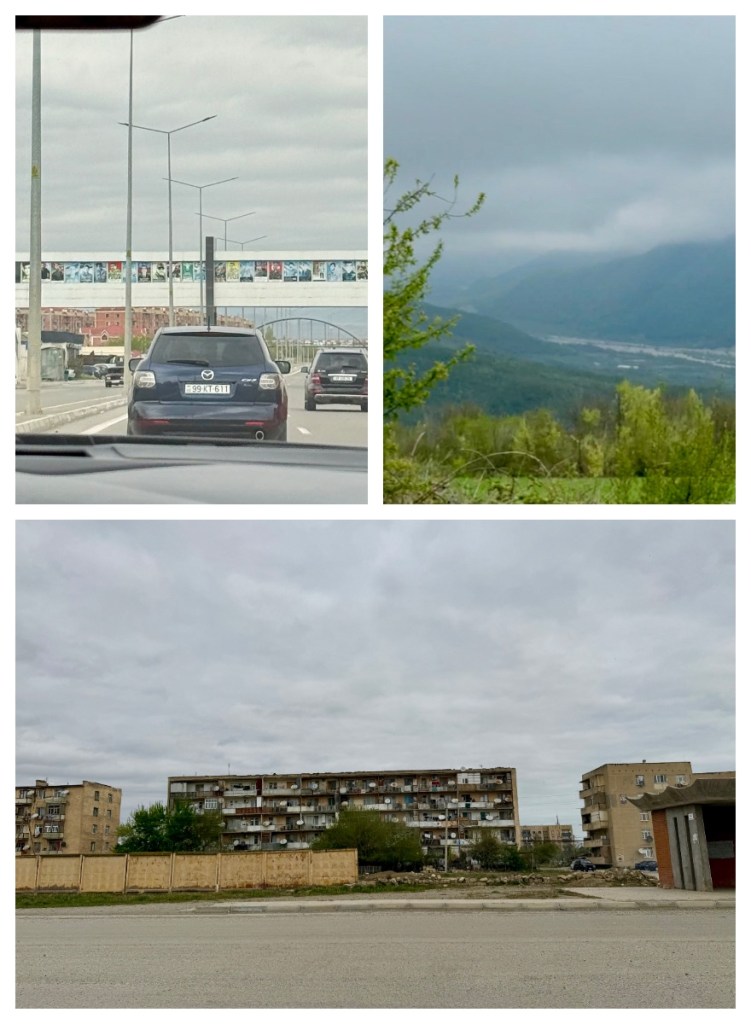
We did not see much in Baku that was a reminder of the Soviet times, but did see some old tower blocks as we drove out of the city.  Not only did the architecture change, but so did the landscape, and the further we got away from the coast, towards the Caucasus mountains, the more green the landscape became.

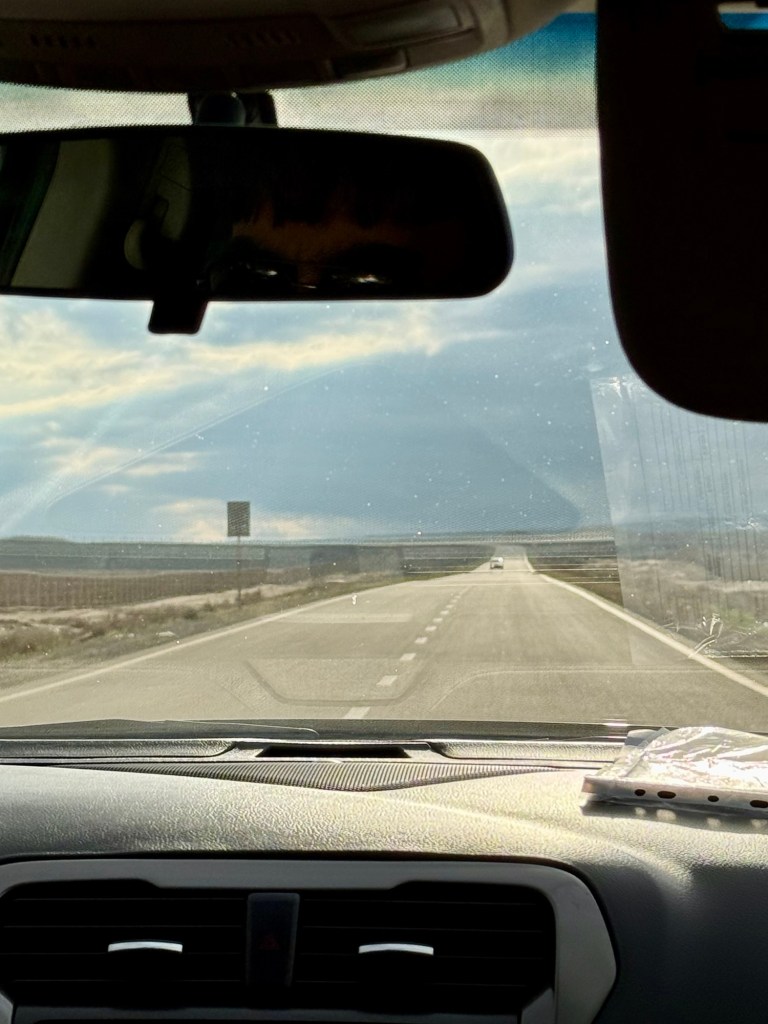
The long drive today gave me time to make some more observations about driving here.  Smoking and using phones whilst driving seem to be a national pastime ā€“ thankfully our driver did not smoke in the car but close enough to make it smell pretty bad.  Driving inside one lane and the use of seat belts appear optional (I think I have mentioned the lane driving part before!). The driver would put on his belt when passing police stations then take it off again.

The roads were actually way better than expected, except for a section were we travelled on a new road which was not finished yet.  Apparently, the new route cut over an hour off the trip and for some reason meant the driver had to go even faster.  In this case we were actually told this. At some points I had to close my eyes with some of the manoeuvres that the driver was doing.   I was thankful to arrive at our destination in one piece!

We were driving on the North West route, and the further we got out of the city the higher we climbed and the greener everything became.  Another observation was that the further we drove, the number of high end cars dwindled, and the number of Soviet era Ladas increased – (I love those things šŸ˜‚).

We had a toilet stop at a roadside supermarket.  The supermarket was lovely, full of fresh produce, bu the toilet was smelly and squat so we did not bother with those!  Instead I decided to sample one of the popular Tarragon Lemonade drinks which seem to be very popular.  It tasted a little more like aniseed to me but it was ok, I definitely prefer the pear version.

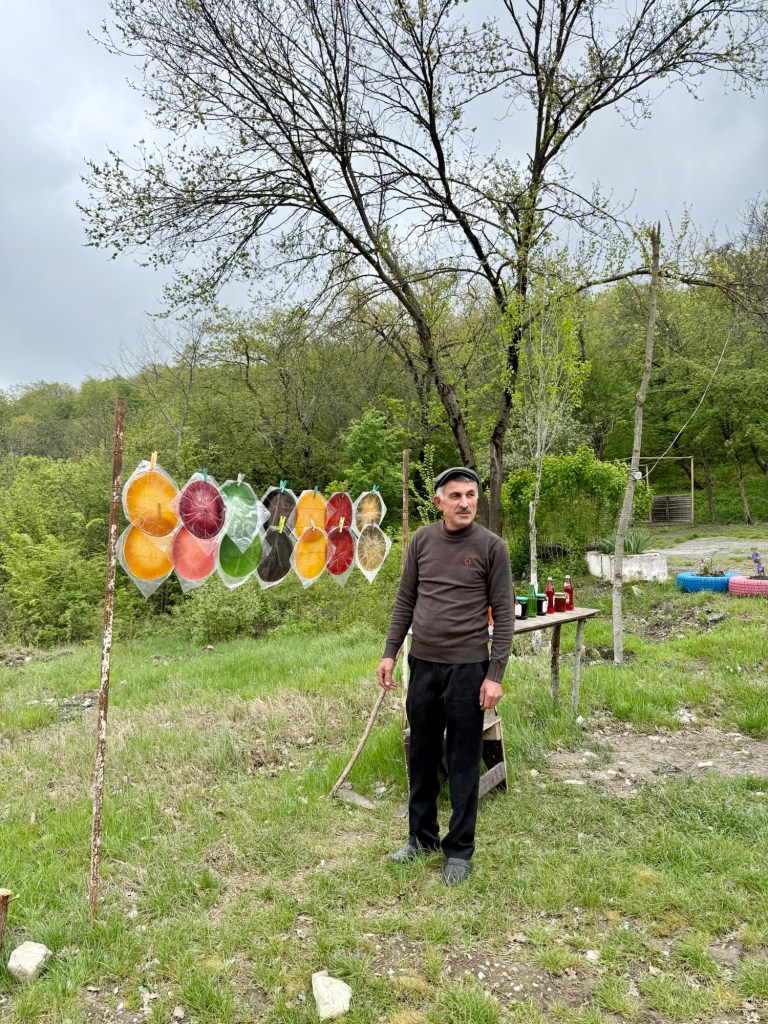
We started passing people selling fruit and vegetables on the roadside out of the back of their Ladas.  I wish I could have taken photos but at the speed we were going there was not much chance.  We did manage to stop at one to purchase a dried fruit thing, so at least there is one photo!  There were lots of Strawberries on offer, which looked lovely (from a distance) but apparently grown in greenhouses.

There are often times on my travel where landscapes are so like New Zealand, I could be at home and this was one of them.  The rolling green hills were so familiar and at one point we were stuck behind a truck full of sheep, making me feel right at home. The small quiet towns and cows grazing on the roadsides was like a different country to Baku.

We stopped for lunch at Nohur Lake, a beautiful lake surrounded by forest in the Greater Caucasus mountains.  I was surprised to learn, it is actually a manmade lake, to supply water to the local area, and is now a popular place for locals to visit.  It was a beautiful location, but not suprisingly, the restaurant on the lake was very expensive. I picked the cheapest thing on the menu, a chicken kebab for AZN16, every else was over 40!  I would rarely pay that for a causal lunch at home!

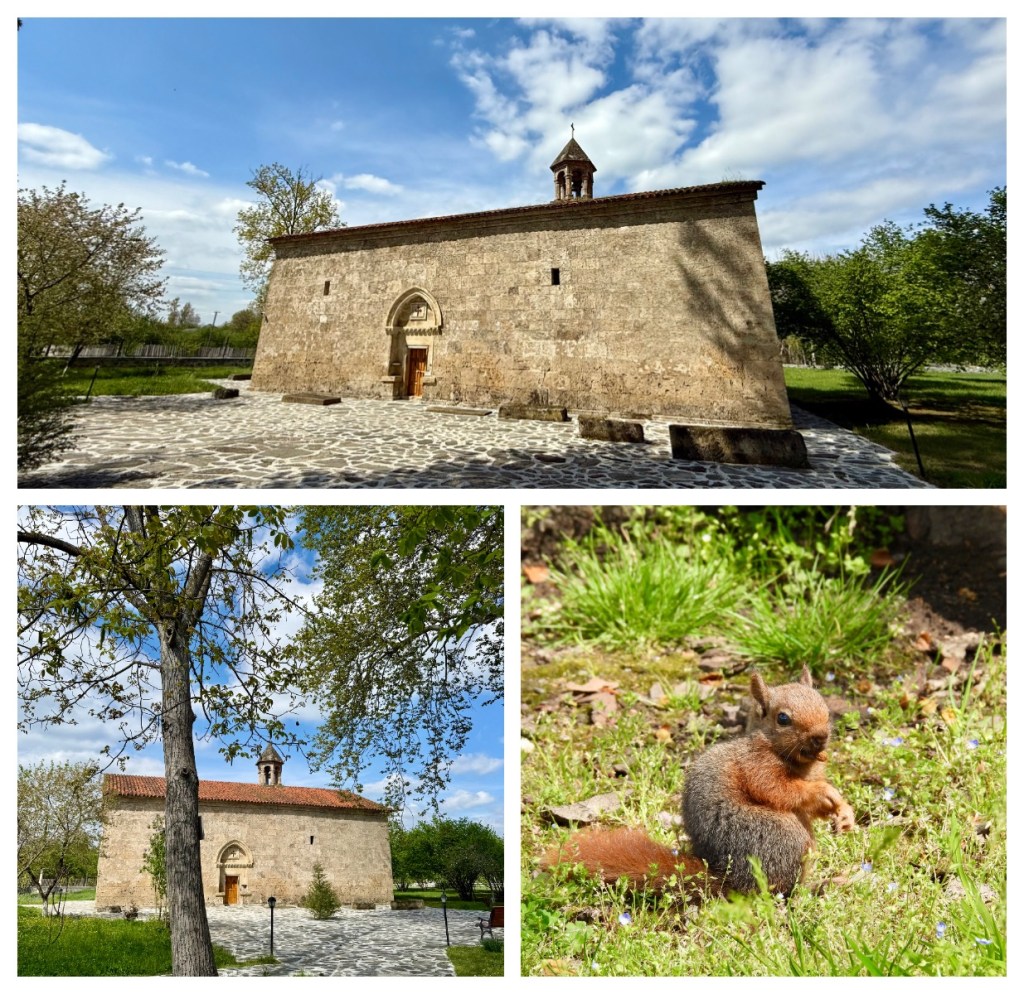
We stopped in the small town of Nij to visit Jotaari Church.  Initially an Armenian church, built in the 1820’s, it is now used by the Albanian-Udi population.  The Udi people were the native people of the Caucasus area and converted to Christianity in the 4th century.  There are only 10,000 Udi people today and around 4,000 live in this small village and still speak their own language.  Their Orthodox Christian church is open to the public, but as with many churches, no photos are allowed inside. 

In the church grounds there are a number of large Hazelnut trees, Hazelnuts being one of the main crops for the area.  We had a cute little wildlife encounter with a cute little squirrel foraging around under the trees which was an opportunity to bring out the camera – these days most of my photos are taken on my phone.

Now in the countryside, Ladas are definitely more prevelant and are often loaded down with stuff – sometimes it appears to be everything except the kitchen sink or perhaps including it!  Actually horse power also seems to work fine in this part of the country with people riding horses down the road, along with horses pulling carts. 

We had passed many police checks but were not stopped until we were just entering Sheki, our destination for the day.  Not really sure what they were checking but it seems very common. 

Sheki (also known as Shaki or Şeki) sits in the shadow of the snow capped Caucasus mountains, in the north west of Azerbaijan, was once a stop on the Silk Road, connecting east and west. 

Our first stop was the small nearby village of Kish and the Church of Saint Elishe, what was a Georgian Orthodox Church dating back to the 12th century. It subsequently became a Caucasus Albanian church.  The Sheki region was once one of the biggest Caucasian Albanian states in the region. 

To get to the church, we abandoned our car and jumped into a bright blue Lada driven by a lovely lady.  We zipped up the narrow cobbled streets with Azerbaijani music pumping – I loved it!  When we got to the top she kindly offered us samples of her homemade pomegranate wine and cognac from her shop before we went in to visit the church.  It was a beautiful spot and very peaceful.

Back down in Sheki old town, we visited the Khan’s Palace.  After it’s Caucasus Albanian era, the town became the capital for the powerful Sheki Khanate.

The palace was built at the end of the 18th century by master craftsmen (many from Iran) and there are intricate designs and details both inside and out.  Unfortunately, we could not take photos inside so you will have to believe me when I tell you of the wonders of the detail inside.  (I should note we were constantly watched by guards to ensure we did not take photos šŸ˜„.)

Each of the rooms are beautifully painted with murals including pomegrantes (the tree of life), Iris’s (apparently bacteria can’t survive in a room if it has Iris’s in it, or silk for that matter, one of the reasons they often had silk wall hangings).  Images of battles filled the throne room along with images that indicated the kind king that he was e.g. dragons breathing flowers rather than fire and goats playing with wolves.


One of the key features of the palace are some of the best examples of ā€˜shebeke’, the Azerbaijani stained-glass windows that are made without the use of glue or nails.  It was initially made with very fine glass imported from Venice, but today the glass is more than 3mm thick. They use small pieces of glass which slot into the wooden frames and some of the panes contain 1,800 pieces of wood and glass and weigh up to 40 kg.

After our palace visit, we went to the Shebeke workshop to see the master at work. He insisted we tried to put one together and then I felt obiliged to buy the one I made šŸ˜ .  No, of course I was not obliged, I wanted it, I just wish I could have afforded a bigger one as they really are so beautiful and such an incredible skill. 

Also on the palace grounds is the Russian Orthodox Nukha Three Saints Church.  Today it seems to be more of a backdrop for dress up photos!


Back in town and we were dropped off at our hotel – the adeptly named Sheki Palace.  The photo does not do justice to the enormous room we had here.  We were on the top floor, which seemed a little attic like.  The windows were tiny but what a lovely view across the old town. 

 Sheki was an important stop on the Silk Road and the most obvious reminder of this is the two great caravanserais that dominate this part of the city.  Unfortunately, when dropping us off, Rugiya neglected to tell us the importance of these buildings so when we were wandering around the souvenir shops that occupy the bottom part of the Upper Caravanserai, we had no idea of the importance of the building itself!  And by the time we did realise, it was too late to go inside. I get very lazy when I have a guide and don’t really do much of my own research on places – lesson learnt!

Upon questioning, the driver did recommend a small local restaurant near our hotel, where we finally got to try the local Qutab, a stuffed flatbread. More commonly served for breakfast or as a snack, we tried all three types for dinner – meat, cheese and herbs, along with some dolma and compote (water with fruit) and it was all very tasty and a fitting way to end our last night in Azerbaijan.


Anicent Azerbaijan

Republic of Azerbaijan

April 2025

Nobody seems to start early here, so our pick up was not scheduled until 9.30am.  As I am still waking up at 5am, it gives me plenty of time to have a relaxed breakfast and do some writing before the day begins, which is not a bad thing.  

We got back in the car (which smells like stale smoke – smoking is very common here) with dark tinted windows (again very common). In fact, yesterday we had asked if we could get a car without the tint as we couldn’t see anything out of the windows when we are driving. They ended up taking the tint off the windows and yet they are still not clear -at least we can now see something!

Our first stop for the day was the historical ethnographic reserve of Qala Village, an open air museum, featuring petroglyphs from the 2nd and 3rd millennia BC to the Middle Ages, remnants of ancient residential complexes (above ground – a Dolmen, and below ground – nomads shelter) and demonstration buildings.  In the house there was a carpet making demonstration and an opportunity to give it a go.  It apparently takes about a year to make a room size carpet using the local method (using a tool like a crochet hook) and I think I can safely say, I will never be a carpet maker.   


Outside, under a 300 year old pistachio tree, there was a potter, demonstrating the use of the traditional potting well with the local clay and in the kitchen we were shown the art of baking lavash (an unleavened flatbread).  The wedding house showed the traditional dĆ©cor for the wedding night and finally the farm with camels, sheep and donkeys.  They used the camels for wool and meat, but not milk.

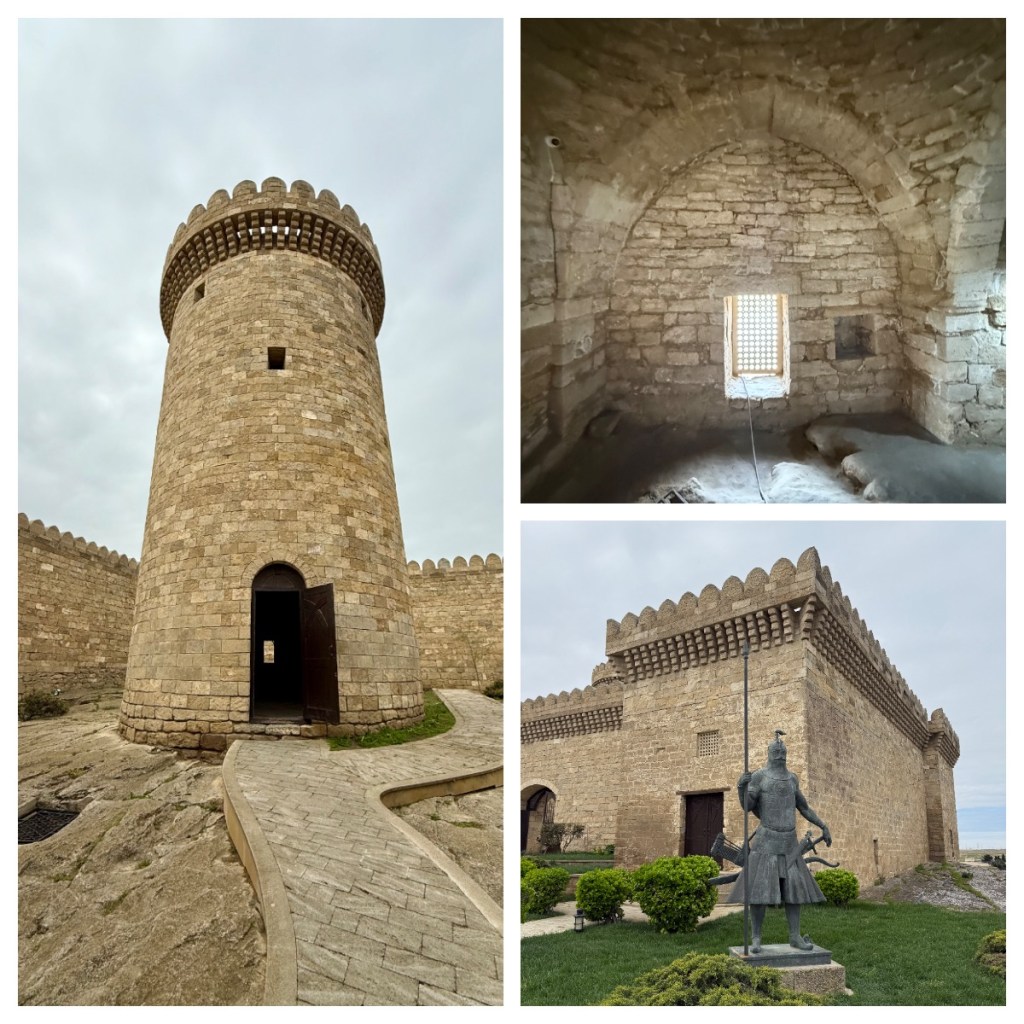
From the village, we headed over to the Fortress which dates back to between 10-14th century and includes a tower (for surveillance and defence) and a strong hold.  Apparently, the foundations and tunnels are oringal and we were told that the tunnels go all the way to Baku but are not used today because there are too many snakes in there!


In another building in the same complex there was a random ā€œTrash Museumā€.  As the name notes, it is a museum of displays made out of trash.  Some were actually really good.  My favourites being an octopus made from pencil shavings and a human figure made from typewriter keys.

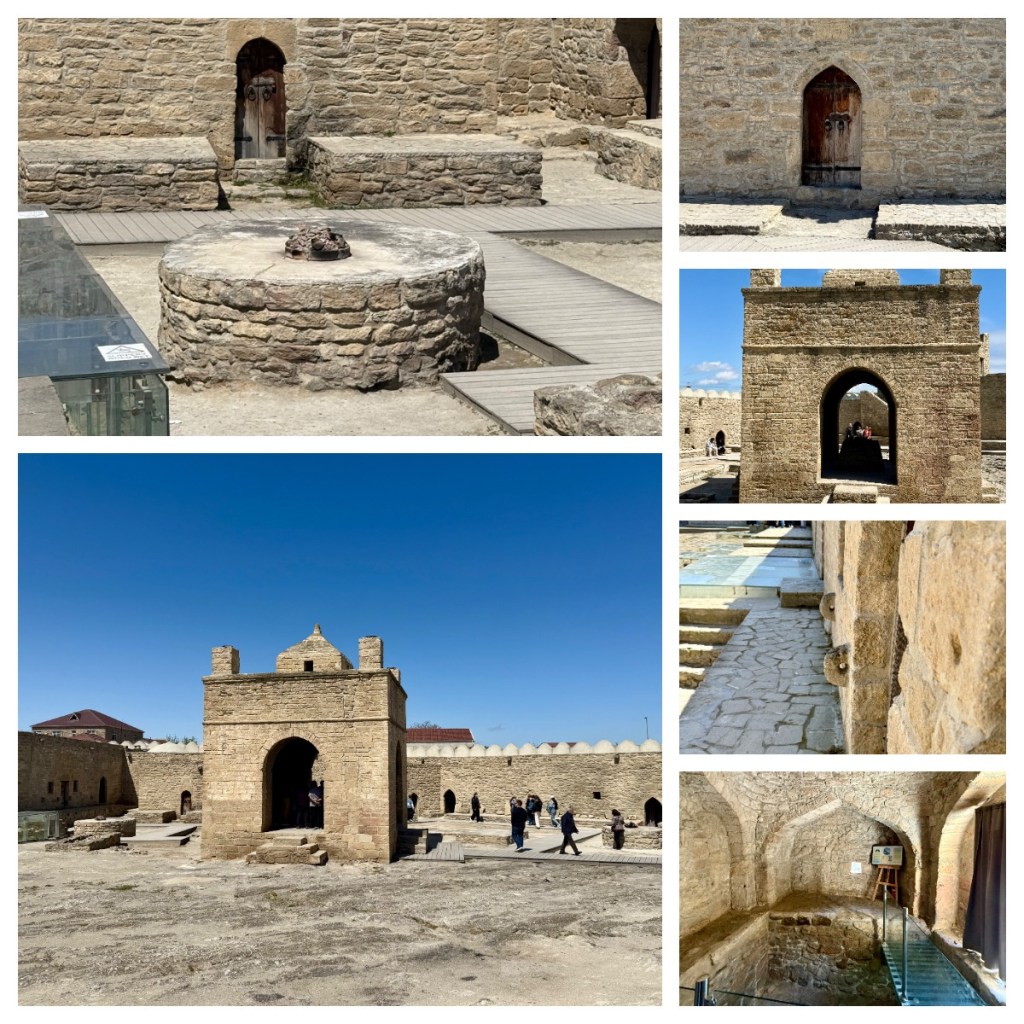
Our next stop was the Temple of Ateshgah, also know as the ā€œFire Temple of Bakuā€.  Although there has been a temple on this sight since the 10th century, the current temple was built in the 17th and 18th century.  The temple was used as a Hindu, Sikh and Zoroastrian place of worship the complex consists of a courtyard surrounded by cells for monks and pilgrims to stay with their animals. In the centre is an altar with an eternal flame.  Fire is an important symbol in the Zoroastrian religion, representing the light of God and purity.

The temple was abandoned as a place of worship in the late 19th century and apparently the natural flame went out in 1969 so it is now lit by gas, piped from the city nearby.

It was interesting to see the back streets, small shops and people going about their day to day business as we drove to our next stop.  In all the small towns, there are large posters of local men (mostly very young) who died in the 2020 war with Armenia.  Many of them would have been doing their 12-18 months of military service and are now considered martyrs.

We  also passed soooooooo many oil pumps on the side of the road.  Did you know that at the beginning of the 20th century, Azerbaijan was the world’s leading petroleum provider, producing 11.4 million tons of oil in 1901, more than half of the world’s production at the time.  Since that time, Azerbaijan’s place in the oil industry has declined, as other countries have increased and it is now about the 19th biggest producer of oil.  That said, oil & gas still make up 95% of the country’s exports. 

Apparently, all oil belongs to the Government.  Even if you find it in your garden the Government take it and maybe your garden and your house as well.  You will get some compensation though!🤨

As if just to show off, our next stop was Yanar Dag, the ā€œburning mountainā€, a natural gas fire that blazes continuously.  Apparently it has been burning for thousands of years and it alledgedly was started by a lightning strike in the 7th century. Of course, it is a symbol of the country’s natural wealth but also considered by some to have healing powers. 

It is decreasing every year so it is possible that it will stop burning at some point.  It was no Darvaza Gas Crater in Turkmenistan, but still interesting and of course it has been burning for much longer.

To get to our next stop, we had to drive right back through the centre of the city and back into the terrible traffic and out the other side but it gave us an opportunity to stop for lunch.  We had said that we wanted to have local food, and after an initial problem finding the place, and then working through what is local food on the vast menu (found by using QR codes on your phone) we had dolma (meat wrapped in vine leaves), Dusbere (a soup with little dumplings – in fact the smaller the dumplings the better, you should be able to fit 10 in one spoon), lamb kebab and a delicious Pear Lemonade.

Our post lunch drive took us out of the city along the coastline and through the incredible barren landscape (it is hard to picture that Baku used to look like this).  We passed industrial areas including ship building and metal, glass and cement manufacturing.  We also passed the abandoned building site of what was going to be Baku’s answer to the Dubai palms.  Unfortunately the pandemic brought the construction to halt and it has never restarted. 

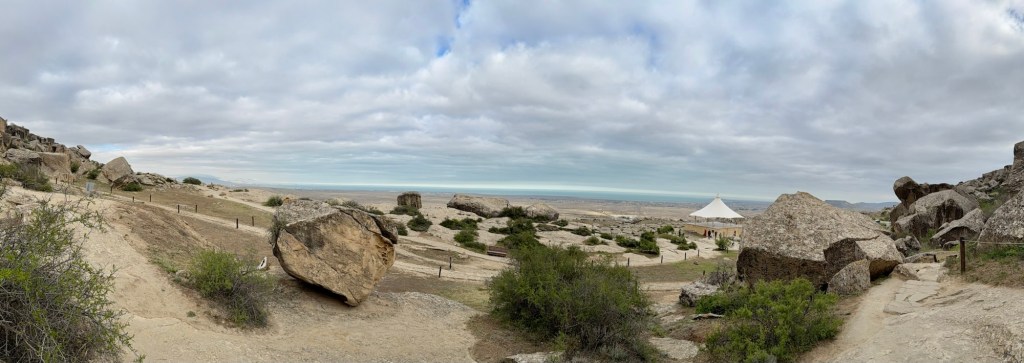
Our first desintation for the after was Gobustan, another UNESCO site, where a rocky plateau is home to a staggering 6,000 rock engravings, spanning over 40,000 years of human inhabitation.  They were found in the 1930’s.

The landscape has changed over time.  At one time the sea once covered the landscape and other times the area was rich with flora and fauna.  The petroglyphs show life through out these years including images of boats (looking a little Viking like), hunting, animals, people, rituals etc.

They were amazing, but unfortunately we only had a short time to spend in the great museum before we were back in the car driving further through the barren landscape (at 110 kph in a 60 zone 😬) to our final spot of the day, the Gobustan mud volcanos. I don’t think I had ever heard of mud volcanos.  We have boiling mud from geothermic activity in New Zealand but these are completely different and Azerbaijan have the most of any country with over 350.

Mud volcanoes happen when pressurised mud, fluids, and gases erupt through the Earth’s surface and they normally happen where there are fault lines or, as in this case, a build up of gas and fluids under pressure.  

Again, there was another great museum that we did not have time to look around properly before heading out to see the ā€˜volcanos’.   I was surprised to learn that they are not necessarily hot and the bubbles are created by the methane gas.  The landscape was amazing and they were so cool to see.


It was an incredible afternoon and it was already 6.30 before we started back to the city, over an hour’s drive away (we were supposed to be back at the hotel by 6pm). But, we ran out of petrol!  Our Driver had to get a taxi to the petrol station for petrol šŸ˜‚ .  Thankfully there was one not too far away and it did not take him too long before he was back and he and the taxi driver put the petrol into the tank while enjoying a cigarette šŸ™„.

So, 30 minutes later, even with fuel, the car would not start – apparently he did not buy enough. Perhaps now is a good time to note just how cheap petrol is here – approximately $1.10 per litre to the $2.50 per litre in New Zealand!  The driver had headed off again to get more petrol, this time returning in a taxi driving down the side of the road (on the wrong side of the road) šŸ˜‚ we had to laugh, if we didn’t we might cry.  Second time lucky and the car started and we finally reached our Baku hotel around 8.30pm!  Another great day with another fun transport adventure.


Welcome to Baku

Republic of Azerbaijan

April 2025

Currency – Azerbaijani Manat

NZ$1 – 0.99 Manat

Welcome to Baku, the capital of Azerbaijan – the Land of Fire.

Firstly, settle in for a little background. Azerbaijan is a country in the South Caucasus area of Eurasia, bordering on Russia, Georgia, Armenian, and Iran.  Its capital, Baku sits on the shore of the Caspian Sea (which I think I have mentioned in a previous blog, is technically a lake).

Like Turkey, it straddles Asia and Europe and Baku really shows this blend of cultures, looking like the love child of Dubai and Vienna with wide European style boulevards, flanked by very European style buildings; towering, hypermodern, geometric glass buildings and historic Silk Road caravanserais.

The country has a population of approximate 10 million, 4 million of those living in the capital of Baku.  90% of the population are ethnic Azerbaijanis and most are Muslim (although it does not appear to be practiced strictly).

The country has an incredibly complex history and I am not sure I will even be able to scratch the surface in the short time I have in the country, but as always I will do my best to get in to it , and bring you along for the ride.

I had a pretty good nights sleep and enjoyed a decent breakfast at the hotel – an interesting range of cheeses, vegetables, cake, and a few things I didn’t know what they were 🤨. After breakfast, I meet up with my friend Ania, who had arrived from Dublin the night before, and we met up with our local guide, Rugiya, who would be with us for our time in Azerbaijan.

As we navigated the traffic of the city (yes, I can confirm traffic is bad!), Rugiya gave us a little background of the country and city (which I will try to explain over the next couple of blogs). 

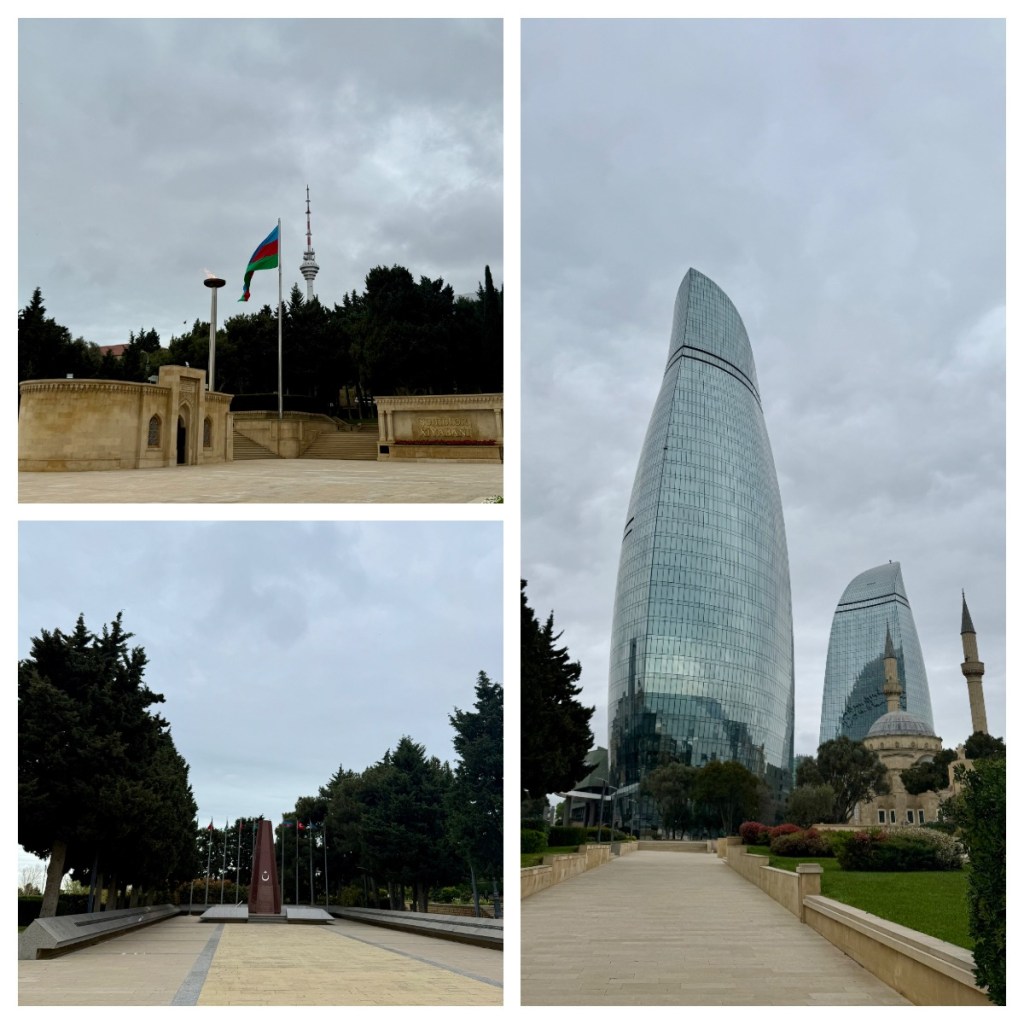
Our first stop for the day was at Highland Park, the highest point of Baku, giving a panaromica view across the across the city and the Caspian Sea.  The beautiful, peaceful park also houses a number of memorials to fallen soliders.  

The soil in the area is very salty and it’s impossible to grow anything (we will see more proof of this when we travel out of the city).  When wanting to beautify the city with green areas, soil had to be brought from other parts of the country. 

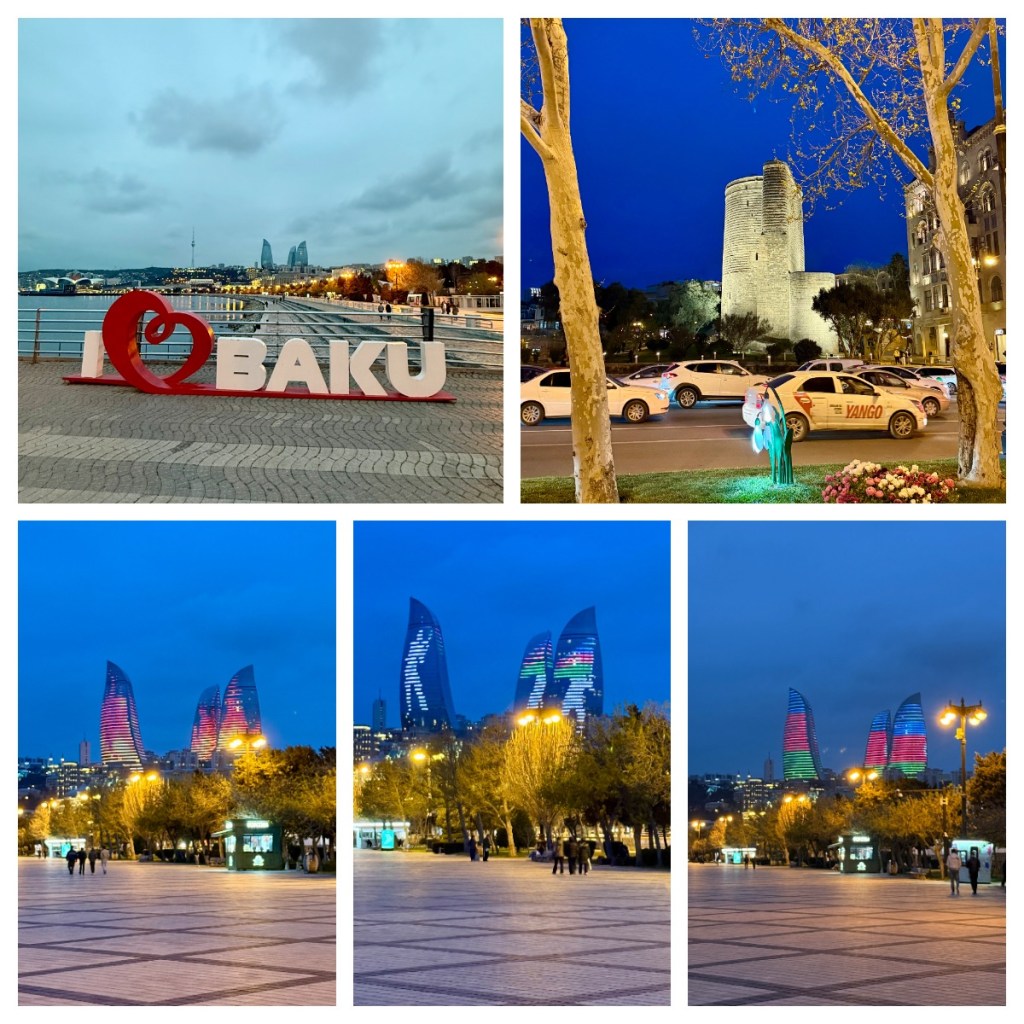
It is probably at this point I should mention Baku’s most iconic buildings – the Flame Towers, 3 flame shaped towers (the tallest being 182m tall) completed in 2012.  The flame shape symbolises the ā€œLand of Fireā€ – from natural gas that comes up from the ground around the country, and the Zoroastrian religion that considers flames to be a symbol of the divine.  The buildings house apartments, a hotel and offices and dominate the city skyline by day, and by night (we will see more on that later in the day).  

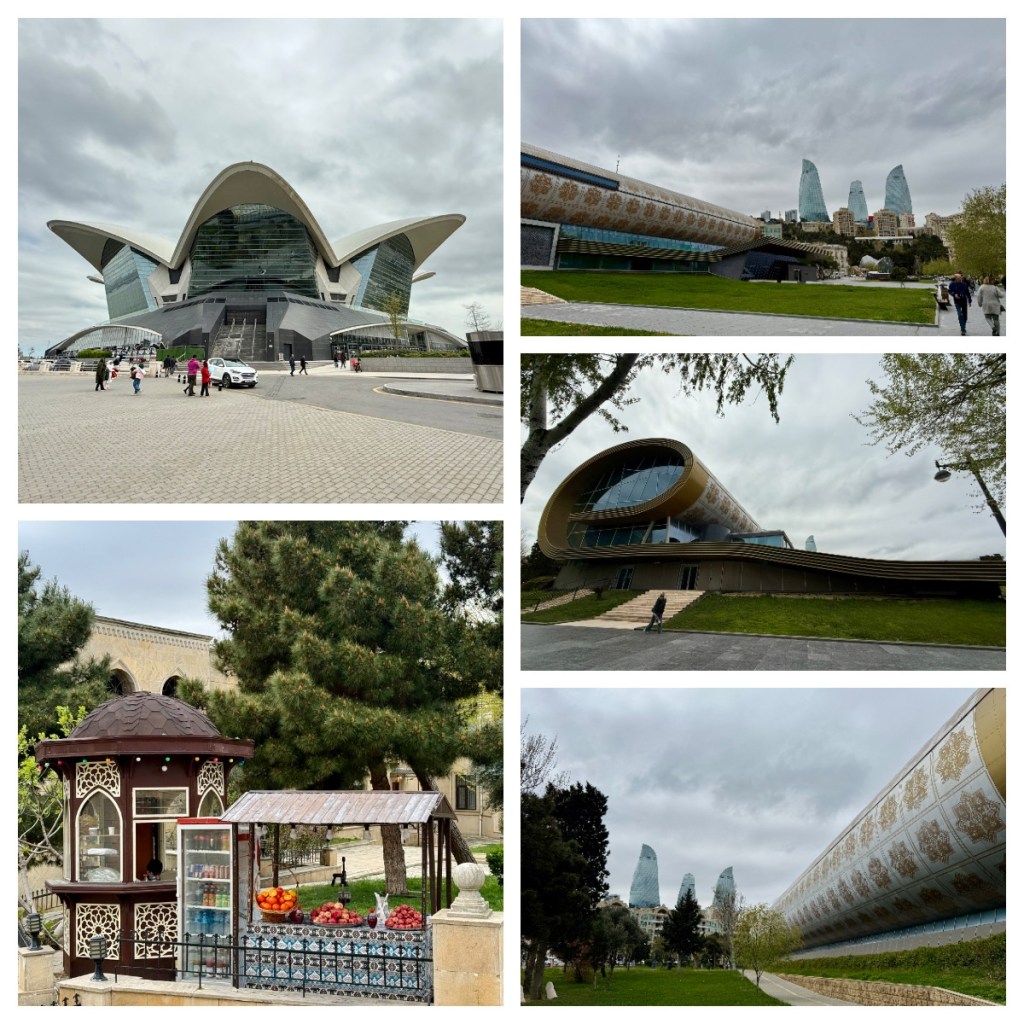
From the view point in the park, we could see down the coast, from the 2nd highest flag pole (it was the first until the one in Tajikistan was erected); the Cyrstal Hall, built for the Eurovision contest in 2012; the ā€œBaku Eyeā€; and the Sydney Opera House like, Deniz Mall. We could also see down to the new Crescent building (that I had seen the day before). When open, it is apparently going to be a 7 star hotel.

From the park, we headed down to the the UNESCO World Heritage Old City, which is still surrounded by the reconstructed, 12th century fortified walls, passing through the double gates, featuring the coats of arms of the ancient city of Baku. There are various versions of its meaning. It features a Bull’s head (believed to be linked to cattle breeding, replacing growing crops which was impossible in the salty soil) and therefore a symbol of the ancient city.  There are also two lions, probably as a link to the city’s orient culture, or a symbol of the Safavids, who took the city from the Zoroastrian’s.   

It is widely believed that old city construction started in the 12th century, with various buildings ranging up until the 16th century. But buildings such as the Bukhara Caravanserai are believed to date back as far as the 8th century, when the location grew in importance due to it stragetic location on the Silk Road and the shores of the Caspian Sea. 

Many of the old buildings have been carefully restored and reconstructed (following the strict UNESCO rules to maintain authenticity) and the area is so clean … and full of very friendly and well looked after stray cats.  Unfortunately both the large Caravanserai’s were closed for recontruction.  (If you have read some of my Central Asia blogs, you may remember that a Caravanserai was an inn that provided lodging for Silk Road travelers, merchants and caravans of camels). It was interesting to learn that the door of the Caravanserai has two knockers, a large one for men and a small one for women.  This way the people inside knew who were outside and who should open the door (remember most were Muslim and therefore men and women did not mix.)

It was clear from many of the items in the souvenir shops, that Pomegrantes are important to Azerbaijani culture and tradition.  They are not only the national fruit, but they symbolise abundance, blessing and fertility.  We will go on to see them depicted in decoration of buildings, as well as being used in many local dishes and wine.

We climbed the 12th century Maiden Tower (Gyz Galasi in Azerbaijani), one of the icon symbols of the city.  It is 28m tall, but oddly, because the Caspium Sea is actually 28m below sea level, when standing on the top of the tower, you are at sea level.  When built, it was on a rocky ledge that jutted out in to the sea, but today it sits 200m from the waters edge.   I should probably note there is some dispute about when it was actually built – with views ranging from as early as the 5th century,  through to the 12th (and in some schools of thought, a combination of those).

The eight levels, reached by winding staircases, are now filled with information about the old city and the tower itself and from the top there are panoramic views over the city (though sadly today there is a perspex barrier between you and the view).  The walls are made of thick brick and it even has its own well.

As the year of construction is debated, so is the tower’s purpose.  Too small for it to be defensive, too many windows for warfare.  Perhaps a Zoroastrian temple and definitely a beacon for ships in the 18th and 19th century.  Or perhaps we will just stick with the legend of the king who was forcing his daughter to marry a man she did not love.  She asked her father to first build a tower for her, which she then committed sucide from, by jumping from the top of it!  Perhaps we will never know.

An oddity of the city is the Miniature Book Museum.  Apparently the only one in the world and hold a Guinness Book of World Records for the largest private collection of miniature books. 

The next stop on our whirlwind tour of the city is the Palace of Shirvanshahs.  Unfortunately the fast pace meant we did not have much time in the museum which was a shame.  We definitely would have liked longer, but such is our itinerary, time is not always on our side.

The Palace is thought to have been built in the 15th century and is descibed by UNESCO as ā€œone of the pearls of Azerbaijan’s architectureā€.  The complex consisted of the main palace building, the shah’s mosque, Seyid Yahya Bakuvi’s mausoleum and the remnants of a bath house.  Not forgetting the great view across to the Flame Towers, highlighting the cities complex relationship between the passed and the future,

Before we entered the Palace, we took pause in front of some bullet pock marks on the side of the building. A reminder of the 1918 Azerbaijani genocide, where it is said, Aremnian Dashnaks, supported by the Russian Bolshevik leader Lenin, started a mass extermination of Azerbaijanis.  During 3 days, they attacked and killed all Azerbaijanis they encounter and approximately 2 million people were killed.  The site we saw at the castle mentions a number of 12,000 but that was probably only in the old city.  I guess a little understanding of this history helps put the ongoing troubles on the border in perspective.  It will be interested to understand the other perspective of the conflict when we get to Armenia in a couple of weeks time. 

A couple of points of interest that I noted as we rushed through the museum was that women’s belts were an indication of age – the bigger the belt, the older the woman.  And second was the changes in the language over the years … the spoken language has remained the same, but the written language has changed from Arabic to Cryillic to Latin over the course of the centuries. 


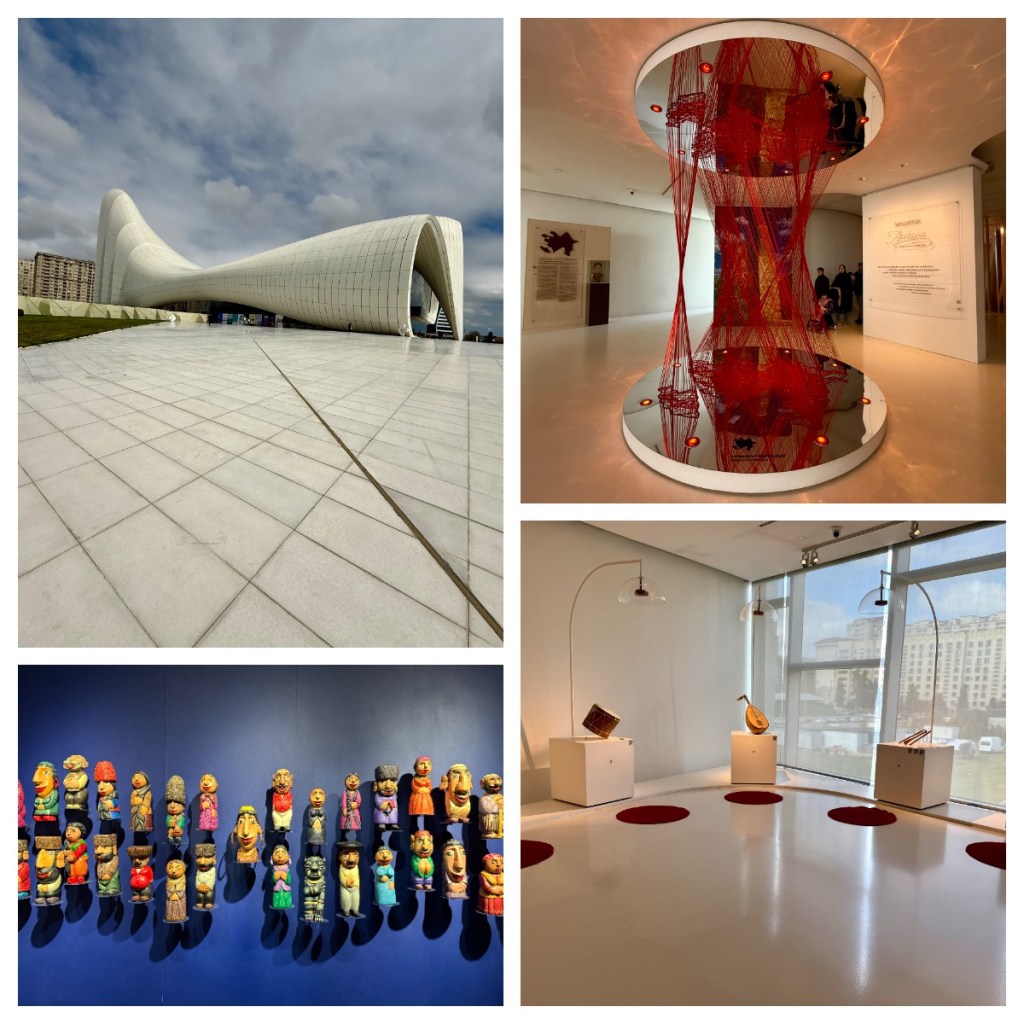
We spent a few minutes around the Carpet Museum on the Seaside Boulevard, another of Baku’s iconic buildings – this time shaped as a rolled up carpet.  Carpet weaving was listed by UNESCO as an Intangible Cultural Hertiage of Humanity.  We did not have tickets (or time) to go in, but we would see some carpets in our next destination, yet another icon landmark of the city – the Heydar Aliyev Center.

The Heydar Aliyev Centre was as unique on the inside as it is on the outside and housed an interesting range of international temporary exhibitions and permanent local ones on traditional clothing, musical instruments, dolls and carpets – some of the most beautiful carpets I have ever seen.  An finally an exhibition about Azerbaijan’s model of tolerance – excepting all people, race and regilion.

 After a short break back at the hotel, Ania and I headed out for an evening stroll along the boulevard.  The cold wind we had coped with throughout the day had died down, and it was a beautiful evening for a walk.  The Baku Boulevard was initially established in 1909, running parallel to the cities seafront and is over 5km in length.  Depisted being a Friday evening it was fairly quiet and peaceful.

The main reason for the walk was to see the buildings lit up, in particular the Flame towers and we were so excited when they came on, with images ranging from the flag, flames and people waving flags.

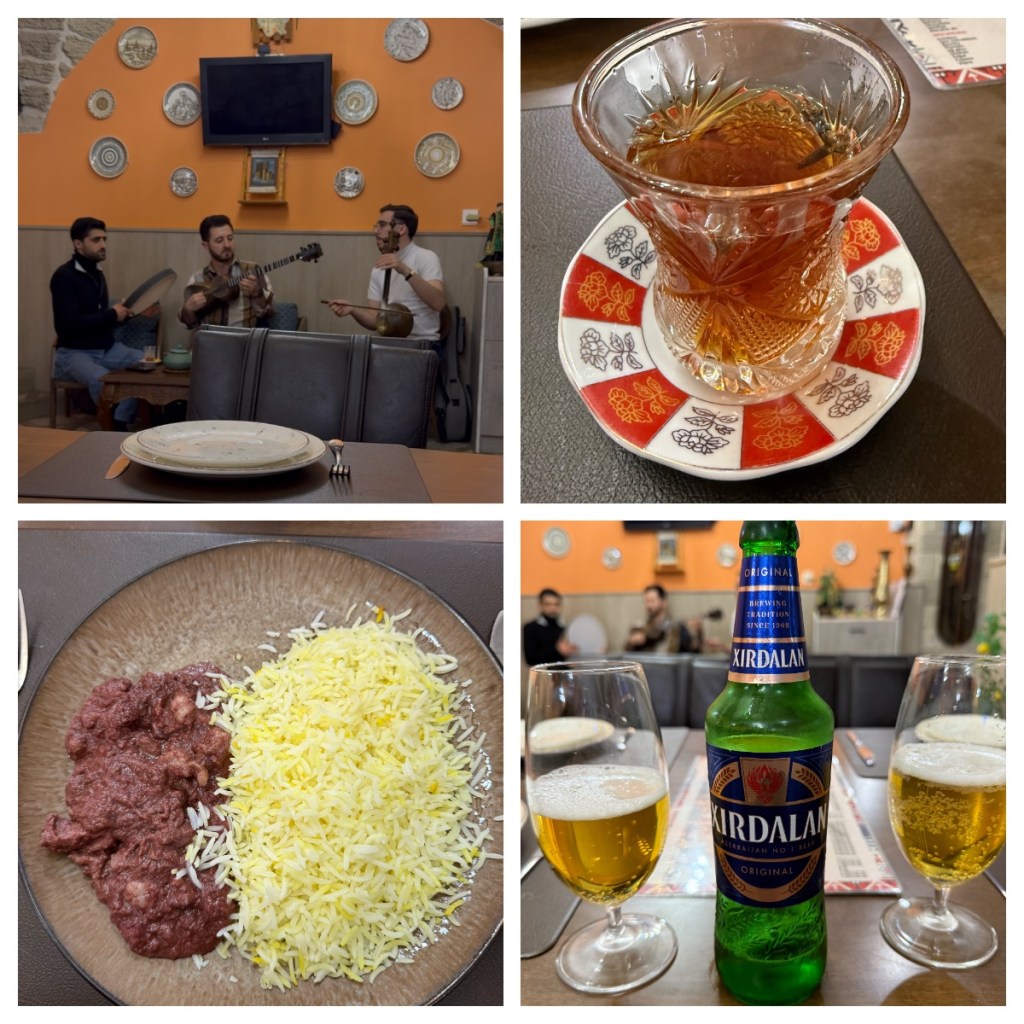
Even at almost 8pm in the evening, the traffic was insane, and there were very few places to safely cross the busy multi lane road (it seems driving in lanes is optional so there may be 4 lanes, or maybe there are 6 🤨 – who knows).  After backtracking a little, we finally made it across and headed up in to the old city to found our way to a random restaurant with local food and live traditional music.  Communication was a bit of a challenge but we ended up with pilaf (rice) with lamb and a cherry/pomegranate purĆ©e and a random drink made from Feijoa, local beer and tea.  It was not attractive or particularly cheap (around NZ$25), but it was tasty. 

We decided to be smart and use a bolt taxi to get back to our hotel (like uber) so we could just put in the destination into the app and not have to speak – epic fail!  The taxi did not show up, but the app said it was at the pick up point and then the driver starting calling but he did not speak English.   Not knowing where the driver was, and not being able to communicate, we had to cancel (but be still charged) and ended up getting a normal taxi at x3 the price with a driver who told us in broken English that all Bolt drivers are drunk or on drugs!   We were probably ripped off, but at least we made and it back and that would enough adventure for one day.  šŸ˜


On my way – Caucasus edition

April 2025

Travel day is always exciting, but I could not get too excited until I finished work for the day. Luckily, I had put my out of office response on my emails the day before so I just had to tidy up loose ends and it was not too stressful. That said, I really need a holiday! 

The hype for this holiday was great.  I loved telling people I was going to the Caucasus and see their blank face, as most people don’t know where it is. Even when I named the countries, some were still none the wiser. I love going to unique places!

Today I was flying on the Emirates A380, straight from Christchurch, It’s a great route and a good plane, but I will miss the luxury of the lounge and perks I get with Star Alliance flights. Thankfully, I didn’t have any long stopovers scheduled so I knew I would survive.  (I didn’t know it then, but this would come back and bite me later in the journey.)

It’s been a few years  since I have had to pass time in the tiny Christchurch International area – 4 shops and 2 eating places lol.  Still, there lots of places to sit, and I managed to occupy myself for the almost 3 hours by moving around the seating areas, reading my book and having a sneaky glass of bubbly.

My first flight for the day was just under 3 hours, from Christchurch to Sydney. I did have a window seat but it was over the wing so not such a good view, but could still enjoy the beautiful sunset over the mountains as we took off.

After a couple of hours on the ground, I boarded my second flight, almost 15 hours to Dubai. Thankfully I managed to get some sleep to pass the time, and chatted with my seat companions – a couple who were on their way to a wedding at Antelope Aark in Zimbabwe, where I used to live! A lovely small world moment.

This is where my 2 hour layover bit me!  In Dubai, I had been told, I had to catch a bus for 20 minutes to the next gate for my FlyDubai flight (Emirates budget airline).  So we left behind the flashy Dubai airport as this side was more like a bus stop than an airport. The bus actually took closer to 30 minutes and by the time we arrived, my flight boarding had begun, and the mayhem started as soon as I got off the bus.

We had more security, with a long queue and lots of people pushing and shovelling …. so I joined the pushing and shovelling to get to the front so I could get to my gate.  No time for the toilet or to fill my water bottle and oh, the cruelty of seeing a Starbucks but had no time to get a coffee.  

To add to the connection stress, I was trying to confirm a pick up time for a night tour I had booked. The first message I received told me that pick up time was 2pm at the Old City gate … ummm but my tour starts at 6.30 and has a hotel pick … ok, they reply, we will pick you up at your hotel at 8.30!

Again, but my tour starts at 6.30 – and finally they said, we have changed the time because of the traffic!  Is traffic is always bad at that time?  If so, why sell a tour to start at that time, or were they randomly predicting it will be bad? A gentle reminder not to try and find logic as sometimes there just is none!

Sadly I had to cancel it as it was something to help me kill time before I could go to bed – the chance of me staying awake that late was very small, and I have 2 more nights in Baku so will hopefully be able to do it another night.

After all that stress, I was on my my final flight that took me from Dubai to Baku, the capital of Azerbaijan, sitting on the shores of the Caspian Sea.  I was on the wrong side of the plane to see the sites of Dubai but got great views of the barren Middle Eastern landscapes and on to snow capped mountains.

Heydar Aliyev International Airport in Baku was modern and clean, and within 10 minutes of landing I was through immigration, waiting for my bag.   (For Azerbaijan, I needed to get an evisa in advance so entry was easy with that in hand.) I changed a little money (to Azerbaijani Manat) while I waited for my bag, and 35 minutes after deplaning, I had my bag, found my driver for my pick up and was on my way to my hotel.

Initial views of the city were a mismatch of buildings ranging from Soviet style to hyper modern and wide European boulevard type streets.  I am sure I will learn more in the coming days.

The hotel is nice, and after dropping my bag, I went for a walk to explore the area. Just down the road I came across a serious high end shopping mall, but thought it best to cross the street and go in to the more normal looking mall (with shops like Zara and Mango).   It was cold, with a howling wind (I did not know that Baku is sometimes known as the windy city!) so I was grateful to be inside.


Was it wrong that my first meal in Azerbaijan was McDonald’s?   Probably, BUT, I navigated the order in Azerbaijani and … it came with an incredible view that I may not have seen if i did not go there. So I think that balances out.

 More to come soon …


Get Outlook for iOS


The long route home – A quick stop in Iceland

Iceland

September 2024

Never one to shy away from making the most of a stopover, I has decided to take the opportunity to get off the charter flight in Iceland, rather than travel through to Denmark.Ā  I said goodbye to everyone as I left the plane (there was only a handful of us disembarking there) and arriving in to Iceland was so easy.Ā  There was no immigration and I didn’t even see any customs.Ā  I just walked right through, bought a bus ticket and within about 30 minutes of getting off the plane I was heading in to the city of Reykjavik.Ā Ā  (The bus was definitely the best option but was not cheap, at around $45 one way, better than a taxi that apparently cost $200!)

Despite Reykjavik not being a large city (population around 120,000 with only 400,000 in the whole country), after two weeks in small isolated villages, it was really like being back in the big smoke with all the people, traffic and American takeaway chains etc!Ā  The Airport Bus stopped at main bus station and then I took a small shuttle to the other stops in the centre of town (all included in the one price). I was pleased to see that the shuttle stop was just outside my guest house/hostel.

What a come down from my room on the ship 🄓. This is definitely back to reality with a bump but more like travel as normal – a crappy room in a large city 🄓.  Still the location was good and I was going to be out most of the time.   Once I dropped my bag my first task was to get some food and I found a nearby hotdog place (there seems to be a lot of hotdog places around).  I am not sure how Icelandic the ā€Iceland hotdogā€ is, but it was good and I was hungry!

It had already been a long morning and I was ready for a quick nap before heading out to take a look around the city.  Unfortunately I was too late in the day for any of the city walking tours so I googled some walking maps to get a general idea of what to see and where it was. 

I started by walking up the ā€œRainbow Streetā€, or SkólavƶrưustĆ­gur (as it is more formally known) one of the city’s main streets which has been painted as a rainbow to celebrated the Rekjavik Pride movement.   The area is also well know for it’s colour houses, street art and art installations.

The top end of the street is dominated by the famous HallgrĆ­mskirkja church.  At almost 75m tall, the church actually dominates the city skyline as it is among the tallest buildings in the country.  Completed in 1986, the Evangelical-Lutheran church’s unique design is an ode to the Icelandic landscape and was named after the 17th century clergyman HallgrĆ­mur PĆ©tursson.

From the church I headed back down to the sea, and to the  ā€˜Solfar’ or ā€˜Sun Voyager’ sculpture.  It is a beautiful sculpture on the seafront apparently represents “a dream boat and an ode to the sunā€ however I think I join with most and thinking it looks like a viking ship – makes sense given that we are in the land of the Vikings.

I continued along the sea front to the next architectural marvel – the Harpa, Reykjavik’s concert hall which is home to the Iceland Symphony Orchestra and the Icelandic Opera.  Completed in 2011, the glass faƧade of the building is made up of geometric shapes that represent the natural basalt columns you can see around the country, and the colour of these panels change with the light of the day. 

I wandered around the harbour, into the small Ingólfur Square and around to the City Pond – a rather large ā€˜pond’ near the city centre.Ā  I walked through an area filled with tourist shops, tourist bars – English and Irish pubs etc. šŸ¤¦šŸ»ā€ā™€ļøand a pizzeria thats marketing was based on getting a terrible review on TripAdvisor lol.

As I had a long day trip planned for the next day I tried to have an early night, but the down side of having some a central location is that it was very noisy with traffic and nearby bars and clubs!  So, after a terrible nights sleep, a terrible coffee from a local convenience store (no coffee shops open early enough) and a shower in sulphur smelling hot water I was ready for the day lol. 🄓 (Apparently the water in Iceland is so pure it can go through taps without processing – I am not so sure as it also had a slight sulphur taste to it!)

The pick up point for the tour (and as it appeared every other tour in the country) was right outside my door, and I was glad that the guide had sent through the vehicle details so I did not have to rush up to each vehicle that arrived and we were soon on our way out of the city.  I had been to Iceland before, many years ago, so choose to avoid the main touristy sites (which I had seen on my first trip) and the large bus tours and do a full day, small bus, south coast trip.  Its worth noting that this choice was influenced by a google screen saver for an Icelandic waterfall I saw a couple of weeks before my trip  lol.   I had really wanted to see puffins but unfortuantely they had already left for the  winter 😢, there is always next trip 🤣🤣.

Out Icelandic guide was called “Al” – kindly, Icelandic people always seem to anglize their names so of us who are linguistically challenged don’t have to try and butcher their actual name!  Al was great, and full of interesting information, starting with some general facts. 

Reykjavik, in the early 1900’s, was a small town focused on farming and fishing, but this all changed with WWII when the British built an airport (now the domestic airport, pretty much in the centre of the city) and then the Americans came bring more infrastructure and jobs.  After the war, the airport was ā€˜given’ back to the country and Reykjavik soon became the thriving metropolis we see today.

We headed out of the city on the ring road, which – not surprisingly, you can drive all the way around the country on it (if you have 6-7 days) and we learnt about the volcanic nature of the country.Ā  Now everyone knows that Iceland is full of volcanoes and of course eruptions in Iceland have caused flights disruptions, not only in Iceland but around the world!Ā  What I did not know was that they pump the hot geothermal water straight in to houses for hot water and heating – that will explain the sulphur smell in the shower!

Apparently the weather this summer has not been great and we were blessed with an almost perfect day for this little outing and the landscapes we passed through were beautiful, ranging from volcanos, remains of old eruptions and beautiful volcanic cliffs lined with waterfalls to lots of beautiful green fields with horses (the famous Icelandic horses) and very shaggy sheep.

A couple of fun factors about Iceland according to Al:

Ā·       It’s unofficial motto is ā€˜it could be worse’ lol

Ā·       Beer was illegal until 1989!  You also can’t by alcohol in the supermarket (so it is not too easily accessible), BUT you can get it on line and it will be delivered within the hour lol.

On the way to our first stop we passed the unimposing but infamous Eyjafjallajƶkull volcano, that caused all the travel issues back in 2010.  It was know as E15 in the international press as no one could pronounce the proper name šŸ˜.  And finally our first stop, the google screensaver waterfall – Skógafoss.  With a drop of around 60m and a width of 25m, it is one of the largest waterfalls in Iceland and today we were so lucky to have perfect conditions for the waterfall spray to create a double rainbow.  I could have walked to the top, but by the time I finished taking photos from the bottom I didn’t have time 🤣.  It was stunning.

As we continued along the the south coast, we Ā passed more stunning landscapes of glaciers, towering cliffs and waterfalls until we arrived at the famous black sand beach – Reynisfjara.Ā  It is famous for not only it’s black volcanic sand, but also for it’s tower basalt columns. Science tells us that these were formed by cooling lava and if you prefer a good local legend, they are actually two trolls turned in to stone as a curse.

As I previously mentioned, the puffins that nest here are already gone for the season but there were lots of Fulmars and gulls still hanging out on the cliffs surrounding the beach. 

The beach is also famous for ā€œsneaker wavesā€ and there are warnings posted everywhere to watch out of these deceptively powerful waves that surge up the beach from calm looking seas. 

Next we had a quick stop in the southernmost town in Iceland – Vik Ć­ Myrdal (more commonly know as Vik) to see the 1877 white, wooden church.  Interesting the church seats around 450 people, and there is only around 600 living in the town.

This was our turn around point and we headed back towards Rejavik but not without a couple of other stops.Ā  First at the most unique glacier I have ever seen – Sólheimajƶkull.Ā  The glacier and the icebergs in the glacier lake are actually striped, with layers of black volcanic ash through the ice!Ā  As with glaciers around the world, the glacier has been receding at a fairly fast rate and the lake we see today at the foot of the glacier has only been created in the last 25 years.Ā  That said, this glacier extends back around 14 km to the ice cap.

Our final stop for the trip was Seljalandsfoss, another iconic waterfall and this one we walk behind. Another 60m high waterfall but this one we could walk behind which was a little damp but fun.  By now the clouds had rolled in  now and the waterfall spray masked the rain that started to fall šŸ˜‚ .  It was a long day but great way to spend my one day in Iceland.  I rounded it off my shouting myself Hard Rock Cafe for last dinner of the trip – not Icelandic but who I am going to kid thinking I am going to enjoy Icelandic fish – not me that’s for sure šŸ¤£šŸ¤¦šŸ»ā€ā™€ļø.

I had called early in the day to book my pick up for the airport bus to be told my pick up would be at 3am 🄓 and I was so glad the stop is right outside the hotel!  The early bus meant I arrived at the airport at 4.20am and after using the self check in, I easily made my way through the airport until I was ā€˜detained’ my the immigration guy as he told me a long winded story about some random guy in the 1800s who moved to Hobart – not sure if he thought Hobart was part of NZ or that NZ was part of Australia šŸ¤”. Thankfully, there was not a long queue behind me! It was nice to have another stamp in my passport as I haven’t officially  left Denmark, Canada or Greenland 🤣

As I boarded my first flight on the long trip home I was amused to hear Icelandic Air playing a Bjƶrk song as we boarded – classic 🤣. So that is it for my big trip for another year, now on to booking my big trip for 2025.  Something for all readers to look forward to 😜.

Greenland – final days

Itilleq and Kangerlusaaq

September 2024

Our final full day in Greenland was spent sailing south whilst we had couple of talks.Ā  Firstly we were given a briefing about the disembarkation process for the following day and house keeping that needed to take place e.g. return boots, pay bills etc, followed by a talk on the Geology of Greenland.Ā  This was followed by a session with Julien, the incredibly accomplished guide I have previously written about.Ā  It was basically a Q&A entitled ā€œeverything you need to know about Greenland and moreā€.

He covered topics from the development of Greenland (mainly fishing in the north and farming in the south), I quote ā€œno one is living in igloos wearing polar bear pantsā€šŸ¤£ He went on to say that education is a problem – most people just fish or have technical education and that boys work with their father or uncles so don’t see point of higher education. 

Most high school teachers are from Denmark and many children don’t speak Danish these days, as more and more are speaking  English.  For this, amongst other reasons, many fail at school and give up.  Most educated people in the country are women who stick it out at school longer than the boys.

We pulled into our last stop during lunch and I spotted the chef fishing for dinner šŸ¤” off the ship lol.

The afternoon was spent in the small town of Itilleq, located on a small island just of the coast of the mainland Ā – Ā population around 100!Ā Ā  The island has no fresh water, so they have a facility for desalination of the sea water and as with all Greenlandic towns, there are no roads to get here, and in fact the closest airfield (for planes) is in Sisimiut, 45 km away across the sea.Ā  The town does however have a helipad for on-demand air services and emergencies.

The main trade in the settlement is fishing and hunting, with a fish factory being the main employer in the settlement. There is one store in the town – the local Pilersuisoq store.

It was a quaint town surrounded by beautiful mountains and after some time to wandered around we had an opportunity to go into one of the locals house’s for tea.  The house had a 70s vibe decor and it was not dissimilar to houses in Fiji with colours, dĆ©cor and religious icons.

Our hosts did not speak English well, but we had one of our guides with us who had lived in Greenland as a child.Ā  She explained that after World War II, the Danish government started 5 companies including Royal Greenland (the fishing company), Royal Artic Line (shipping), Air Greenland (transportation) and Pilersuisoq (a chain of general stores).Ā  Apparently, these companies must operate in all towns, even if they run at a loss.Ā  By law, Air Greenland must operate flights, even if the planes are empty.Ā  If this is the support currently given by the Danish government, I am not sure if Greenland will ever want, or be able to sustain true independence?

As all the village kids played in the Jacuzzi on the ship, ā€˜crowds’ gathered on shore for the all important football game between the town and the ship.Ā  Even the local fish factory closed early so the workers could play!Ā  All players welcome, any age, any size and any number of people were on each team lol!Ā  It was a lot of fun and a great way to end the day and the trip.

After our final dinner, it was time to finish up packing as our large bags had to be left outside our room before 11pm.  As annoying as that was, it meant that it was taken up to the lecture room for the morning where we would be joined by check in staff from the airport who would then whisk our bags away to the airplane later the next morning. 

I must admit I felt a little like a fish out of water on this trip with 95% of passengers not having English as a first language, hardly any other solo travellers – in fact I think there was actually only 1 other travelling on their own, and 4 travelling with a parent. Anywhere I sat for dinner threw out the dynamics of any of the tables as they were all set for 2,4, 6 or 8.Ā Ā That said, it did work in my favour a lot as it meant I got my own room when I had paid to share.

On top of that, most of the other passengers were Danish couples in their 60-70-80s (clearly a marketing thing) so it was not easy to get involved in conversations!  Despite all of that, I met some lovely people and the ship and trip has been amazing.  And lets be honest, if I was not comfortable with my own company, I would not travel solo!   Next time, however, my next expedition cruise will be more wildlife focused 🄓

Our last evening saw us sailing south in to the mist, just how we had set off a couple of weeks earlier when we arrived and the final morning was bitter sweet.Ā  As I mentioned above, our flight check in was done on the ship and it was then time to jump into the zodiacs and leave the ship for the last time.Ā  Can I just say I won’t miss my waterproof pants 🤣!

Back in Kangerlussaq, I had booked to do a tour of the ā€˜city’ (I had booked all the extras in advance, not wanting to miss anything lol).  I am not sure if I would have booked this tour now,  but there is nothing else much to do there while waiting for the plane so I was happy to have something to do.    

We jumped in to a big bus and headed out of town on Greenland’s longest road which starts at the harbour where we got out of the zodiacs.  This is actually 14 km from the ā€˜town’ as the silt build up from the melting glaciers means this is as far as the large ships can get to town.  At low tide, a small channel needs to be dredged to allow the zodiacs to get to shore!

From the town, it is a further 36km to the ice cap (which we had driven on our first day) making the road 50km in total.  Apparently, part of the gravel road was built by Volkswagen in the late 90’s as a venue for car endurance testing.  They had planned to extend the road on to the icesheet itself, but the plans were abandoned in 2005 and it is now mainly used for tourism.

We did see a couple of Artic hares on side of road (šŸ‘šŸ»šŸ‘šŸ» yay for some wildlife) but I did not have my camera on this trip so no great photo 🄓,  but I saw it and I was happy!

We drove back through the town towards the airport and to be honest we didn’t learn too much more as the driver was from Denmark and had only been here for 2 months!  Anyway, the little excursion killed some time and we were dropped back at the airport for our plane.  

The trip had some ups and downs but overall it was amazing and it is no surprise that I would love to come back to explore other parts of the country or experience it at a different time of year. 

I had visited this year as I had suspected that the new airport being built in Nuuk would result in direct flights from American – making these remote places more accessible is great I am sure for the country itself, however it makes it a little less adventurous for me, not to mention it being overrun with Americans who are only there because it is ā€˜easyā€!  My suspicions came true this week when direct flights were announced for Summer next year!  Greenland will never be quite the same again.