Into Bolivia

We left Puno at 7am on a bus to the Bolivian border, along the shores of Lake Titicaca – about a 3.5 hour journey.  The bus was not as nice as others we have had before but it was not too bad.  We had one final stop in Peru to change any spare Peruvian money before heading to the border at yet another dry and dusty border town – this time Desaguadero.

It was such an easy border crossing.  There was hardly anyone there which helped, we got off the bus, joined a short queue to leave Peru, then a similarly short queue right next to it to enter Bolivia.  After a cursory baggage check we were in the “Plurinational State of Bolivia” and back on the same bus with our new Bolivian guide – the whole process probably took no longer than 30 minutes!

We then continued on for an additional 2.5 hours through the Andean highlands (again) to La Paz.  Today’s increible landscapes included farmlands edged with massive snow-capped mountains (all over 6000m!)!!  As we came around a corner in the bus, the city of La Paz was sprawled out in the valley beneath us surrounded by more snow-capped mountains, an exclamation of ‘wow’ echoed around the bus.

As soon as we arrived, we went out on a quick orientation walk, ending up in the ever present Plaza de Armas.  As it was officially the last day of this part of the tour and two people were leaving us, we went out for a great group dinner at a local steak house.

The following morning, and our first full day in Bolivia, most of us went on a tour of the city tour and surrounds.  First thing to note about La Paz, is that is it NOT the highest capital in the world as many people think.  The city sits at an elevation of 3,650m, and although it is the seat of government, it is not in fact the constitutional capital – that title goes to Sucre!  It has been a bone of contention between the two cities for centuries and continues to be so.

The city itself reminded me of Medellin in Colombia a bit – with the city sprawling around the hills and cable cars for public transport.  As with Medellin, the cable cars gave a great view of the city as you travelled along the lines – there are 7 in total currently with plans for another 7 or 8 lines in the coming years.  The city was buzzing, incredibly busy with so much traffic.

No visit to La Paz is complete without a visit to the Valle de la Luna (or Moon Valley).  The are is only 10km from downtown La Paz, but is like another world.  Here, erosion has worn away parts of one of the mountains leaving tall spires and other random rocky outcrops, leaving a moon like landscape.

Back in the city we went up to a view point for a panaramic view over the city (though no better than the views from the cable cars in my opinion) before walking around the oldest part of the city – I must admit, how much I liked La Paz was unexpected!

I had not been feeling 100% for a number of weeks (in fact since I had arrived in Peru) and a cough I had was just getting worse so the guide had arranged for me to see a doctor in the afternoon.  He was not happy with my cough, or a number of other symptoms and arranged for me to attend his private clinic the following day for a number of tests!

As it turned out, the doctor in question, was a world renown pulmonary specialist, specialising specifically with illnesses at altitude, and he was somewhat of a mad professor 😂!  Of course, the 4 hours of tests did not come cheap (and I am looking forward to making the most of my travel insurance!).  I think he must have tested pretty much anything and everything – urine, blood (from both a vein and an artery), ECG, respiratory function and oxygen levels and chest X-rays.  He found a number of issues and prescribed a number of things to treat them – he also took some convincing that I was ok to leave on our overnight night bus later that day, but thankfully he finally agreed I could go as long as I promised to keep in touch and take all my drugs!

Although the overnight bus was not the fanciest we had been on, it was one of the best as the seats went almost flat so I managed to get a pretty decent sleep.

As we neared Sucre (our next stop and the constitutional capital of Bolivia), there was finally some green on a landscape that had been pretty barren for the last week or so.

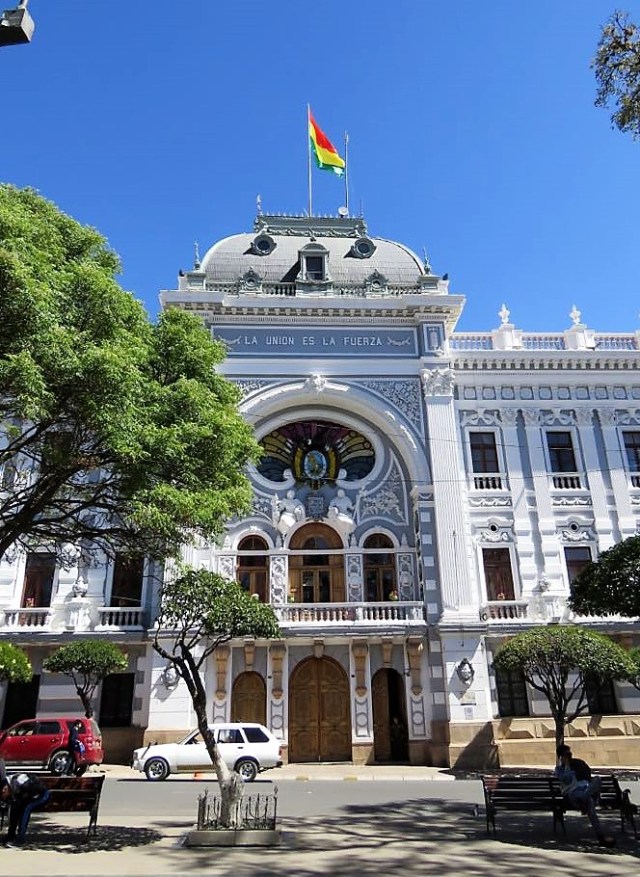
Sucre seemed to be yet another city full of unfinished buildings (apparently this is something to do with having to pay more taxes on finished buildings 🤔).    However, the historical centre of the city, around the Plaza del Armas where we were staying was full of beautiful colonial buildings.   Sucre is sometimes referred to as the “white city”, like Arequipa in Peru, due to the many white colonial buildings.
42

Sucre was founded in 1559 and was the centre of control for the production of silver and the residence of colonial Spaniards involved in the industry.

As many of the cities museums and attractions were to be closed on Monday (and we arrived on Sunday) we had to make sure we saw what we could that day.  We started with a quick but informative tour around Independence House, learning about the history of Bolivia and its many battles (but internal and with their neighbouring countries – in most of which Bolivia lost land).


We then jumped on the Dino Bus to Parque Cretacico (Cretaceous Park) – home to one of the largest collections of dinosaur footprints in the world (over 5,000 of them)!   The footprints were discovered on the grounds of a local cement company who were mining the area before finding the perfectly preserved footprints of about 15 species of dinosaurs, and turning the area in to a themed-park which includes a museum about the findings and a collection of life-size dinosaur models.

It was incredible to think that 68 millions years before, a diverse population of dinosaurs were stomping around in the soft clay shores of a vast ocean inlet which covered large areas of what is now Bolivia, Argentina and Chile.  As the clay dried, the footprints turned in to stone and disappeared under layers of sediment.

Subsequently, shifting tectonic plates pushed up the Andes mountain range, pushing the ocean back thousands of kilometres and what was once a flat clay beach is now nearly vertical.

Back in town we had a free afternoon, but being Sunday most of the shops were closed.  Despite that the plaza was buzzing, due to a joint wedding taking place – we must have seen at least 10 brides arrive as we waited for the Dino bus to leave … apparently, they do that church service on mass to save money! The street outside the church was crammed with double parked, decorated wedding cars 😂.

We all enjoyed a Salsa class after dinner though I think there was more laughing than dancing done!

The following morning we headed out on a walking tour of Sucre, starting at local cemetery which was an eclectic mix of grand mausoleums (some of Bolivians who played an important role in the creation of the country) and small and humble graves decorated with personal adornments.  Walking around the pristine gardens of the cemetery, there was a strange sense of peace.

After a walk through the oldest part of the city, we hit the local market for chorizo (spicy sausage) sandwiches and fresh juice.  Recharged, we started the climb up to a view-point – any type of exertion at this altitude takes that much more effort than at sea level!  Of course, after smashing the Inca Trail, anything is doable these days lol

Life after the Inca Trail …

I thought I would be relieved when the Inca trial was over but in fact I am almost sad – I am not sure I can express in words what an incredible experience it was!  But as I continue to learn, as one good thing comes to an end, I have to move on in search of the next good thing!

After our jovial end of trek lunch and the lovely train journey from Agua Caliente, we were to spend the night in Ollantaytambo, in the Sacred Valley of the Incas.  Exhausted, I had hot chocolate at the Chocolate Cafe next door to the hotel and was asleep by 7pm despite the Friday night music pumping!

Still on trekking time I woke early and so Portia and I went to see the remains of the royal Inca estate that the town has been built around.  It was a strong hold of Manco Inca Yupamqui and it provided lodging for Inca nobility – Hiram Bingham also stopped there in 1911 on his journey up the Urubamba River in search of Machu Picchu.  Even though the site opened at 7am, it seemed the ticket person was not going to arrive till 7.30 so they let us in and said to pay later!

One of the many ‘stray’ dogs around the entrance, a beautiful border collie cross, joined us on the walk around the site.  She escorted us around the entire site so we named her ‘Manny’ after our favourite Inca Trial guide – she didn’t talk as much but she was still pretty funny!

We then joined the rest of the group for breakfast before jumping on our private bus to a local community that the tour company I am travelling with, Intrepid, support.  Our visit helps support the communities financially and also allows them to show us their way of life – first we were dressed up in local dress (never my favourite activity but there is never an opt out option!) and joined one of the women in a field to dried sort fava beans from the stalks.  Next was lunch and then we were shown how they prepared and dyed the wool (sheep and alpaca etc) before weaving.  All the dyes were natural, coming from plants, and some even from beetles!

Our final stop for the day was at the Pisac and its large handicraft market.  We were there as a big thunder storm rolled in and given that I did not want to shop, I sort refuge in a coffee shop with a coffee as the rain came down.  Thankfully it finished as quickly as we started and we were all soon back on the bus and on the way to Cusco where a few of us enjoyed a night of dancing in a local club to celebrate the end of our trek.

Our final day in Cusco was a few day and I really did very little except to recover from the night out and watch yet another massive parade!  This one went on for hours, starting with what appeared to be veterans of some sort, before the children joined in!

The next day we were back on a bus – 7 hours to our next stop in Puno, on the shores of Lake Titicaca.   We travelled with a different bus company but it was just as comfortable as others we have been on and the scenery for this day time bus was incredible!  We passed through the alpine country side, with snow topped mountains surrounding us,  lot’s of small houses, people working in the fields and lots of political party slogans for the election later in the year.  With vast landscapes and vast skies – truly stunning.  I also managed to spot a few flamingos in one of the rivers along side the road!

As much as I dislike long bus journeys, it is a fantastic way to see the landscapes of the country

Puno is a relatively small town of around 140,000 people and is the capital of an important agricultural and livestock region (mostly sheep, llamas and alpacas).  For us it was the starting point for our final days in Peru.

After a quick walking tour (as it was late and getting dark), we stopped at a supermarket to buy some staple food items as ‘gifts’ for our homestay hosts for the next night.

40194753_489121391564117_3604706579120652288_n (1)

4 of us had decided to get up early for sunrise canoeing on the lake – it was definitely well worth the 5am pick up!  We drove to a hotel at the edge of the lake and boarded our outrigger canoe and headed out in to the lake.  We started with a beautiful view of the city as the sky lightened and that turned in to a spectacular sunrise over the reed filled lake.  The reflections of the clouds in the lake were beautiful as the sun rose higher – it was such a beautiful and peaceful start to the day.

As I am sure all of you are aware, Lake Titicaca is the ‘highest navigable lake’ in the world, sitting at approximately 3800m above sea level in the Andean highlands.  The name comes from the Aymara language and one of the official languages of Bolivia and parts of Peru (and the language the inhabitants of the Uros floating Islands speak).  The name can be translated to mean gray/lead coloured puma and these use to roam the shorelines of the lake.

As we entered the Uros floating islands, it was like entering the world out of the movie ‘Water World’ – there was something very surreal about it.  As we were still so early, we were the only people there as the island inhabitants woke up and went about their morning routines before the hoard of day trippers arrived.

40168583_1016811628480882_4319555820560842752_n (1)

The islands themselves were fascinating.  There are approximately 120 floating islands built almost exclusively of reeds. Once built they can last approximately 15 years before needing to be discarded and rebuilt.  Of course, the beauty of the islands is that they can be moved if there is danger, or in fact just arguments with the neighbouring islands!  Depending on the size, the islands house between 3-10 families each.

It takes months to build each island but harvesting blocks of reeds and roots, which them get lashed together to form floating reed ‘boats’ before being piled high with more reeds.  It is constant work to keep the islands and their houses covered in fresh reeds.

According to our canoeing guide, the original settlers moved here to avoid the Incas invasion but others seem to tell different stories of the origins of the islands.

Despite still struggling with Spanish, this day we had to get our heads (and tongues around 2 new languages) – Aymara and Quechua (although Quechua should not be new as this was the first language of our porters on the Inca Trail.

After our Uros Island visit (where the people spoke Aymara), we joined the rest of the group on a larger boat (that we did not have to paddle ourselves) and headed to Capachica on peninsula.  Over the peninsula, over 25,000 people live in 16 communities – it was one of these communities where we were to stay the night with Quechua speakers.

After a 20 minutes walk to the community leader’s house, we were introduced to our host families for the visit and we were quickly dispatched to our homes for lunch.  Our house is lovely – a cluster of small rooms around a central area where our ‘mama’ often sits doing her spinning or knitting.

After a lunch of soup, omelette, rice and chips it was siesta time 👍🏻 then time for work!  Each of our hosts had tasks for their guests and I think Julia (my roommate) and I were lucky.  While others had plough/dig fields, we got to sit and peel mushy potatoes (that I think she said grew in the water) with our hand!  Not incredibly pleasant and I am not sure we did a particularly good job but our Mama seemed happy enough.  She then left the peeled potatoes in the sun to dehydrate them – this is a popular ingredient here for soups and stews.

Next on our agenda was a volley game with people from the community which they won (not surprisingly as I am sure they are used to playing at altitude whilst we are not)!

After another dress up session (this time in attire appropriate to our marital and social status), our final task for the day was chopping lots of vegetables for our communal dinner before an early night.  The room and beds were simple but comfortable with lots of heavy blankets to keep warm – unfortuantely it actually made it hard to move in but most of us managed to get a decent nights sleep.


In the morning, we met our ‘Papa’ before he headed off on his 1 hour walk up in to the hills to tend his animals – thankfully their basic Spanish, combined with my basic Spanish was enough for us to communicate to some extent and we shared some pictures of our homes with them.

Our final stop on the lake was Taquile Island, famous for its knitting men!  Around 2,200 live on the island and we were told about the way the Taquileños run their society based community collectivism in line with the Inca moral code – don’t steal, don’t lie, don’t be lazy (in Inca times, the failure to abide by one of the moral codes would result in death)!  Regional leaders are appointed each year and are not allowed to be re-elected to avoid any corruption.

As with the other communities we visited, clothing here also indicated the social and martial status of the wearers.  In most cases, it was the hat that indicated the marital status and other items of attire including the belt and jacket/shawl would also indicate status in the community.

After lunch, overlooking the ocean (a view somewhat similar to some places in Greece), we were back on our boat to Puno for our last night in Peru.

Next stop – Bolivia!

Cusco and beyond

We left Arequipa at around 8.30 in the evening and were all set for our first real overnight bus of the tour.  Thankfully it was yet another very comfortable bus – in fact even better than others we had used up until this point.  The seats were large and comfortable – only 3 seats across rather than the normal 4,  but for some reason the temperature fluctuated from very hot to very cold so it did not make for a great night’s sleep.  Apparently, the drivers changed every 4 hours as the bus winds its way over the Andes but of course it was dark so we could not see anything – some might say that is not a bad thing as a lot of the driving on these narrow mountain roads has a lot to be desired!

As I have mentioned before, the buses and bus stations are trying very hard to rival the airplanes and airports.  This bus station was no exception – here we had to pay Terrapuerto tax (literally ground-port tax rather than airport tax) and we got to enjoy the ‘executive’ lounge! 😂

Despite the fluctuating temperatures, I did not sleep too badly considering I have not been sleeping well the last few nights – whether it was altitude, the altitude sickness tablets I have started taking (to avoid getting altitude sickness I hope) or sheer fear of the upcoming hike … or perhaps a combination of all 3!

We arrived in Cusco fairly early in the morning but thankfully could get straight in to our rooms before heading out for a walking tour around the main sites and to learn a little of the city’s history.

Cusco sits high in the Andes at around 3,400m above sea level and was once the capital of the Inca empire from the 13th century until the 16th century Spanish conquest.  Many of the colony buildings were built on top of Inca buildings and/or places of worship so it is still possible to see some of the incredible stone work the Inca’s are famous for.  During our walk around we managed to experience all the weather Cusco has to offer … cold, hot, rain and sleet!!  We hoped it was not what we were to experience on the upcoming hike!

That evening we had a meeting with our guide for Inca trial – we were to have  3 guides, 16 porters and 2 cooks for a total of 10 people, 5 people from our group and 5 from another group.  It seemed like a lot of staff but I guessed they knew what they were doing. After the meeting it was straight down to packing.  We had been given a duffel bag which we could put 6 kgs in  for the porters to carry (including the 2kg sleeping bag I am hiring).  Anything else we carry ourselves – at least my bag was lighter than in Colombia but I was sure I had still over packed!

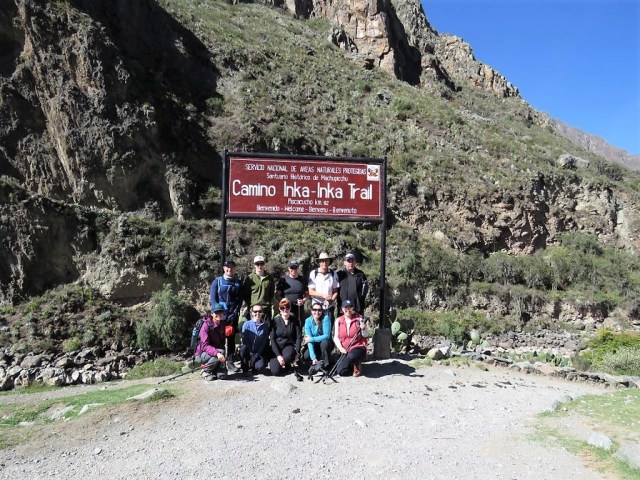
Day 1 of the hike and were picked up at 5.15am (but not before they weighed the duffel bags to ensure they are no more than 6kg) and we then headed off to Ollantaytambo in the Sacred Valley, 2 hours away, where we picked up the rest of the group before the final stop at Piscacucho to meet our porters, complete our passport formalities – one for the National Park, one for the National monuments and start our trek.

40053755_252984965552029_3384859645758668800_n

Day 1 – 12 km 2650-3000m

As we had been told, the first day was relatively flat with only a few short steep uphill parts but we stopped regularly to see Inca remains (including Ilactapata) and admire the incredible views that surrounded us in every direction.

Our main guide is an archeologist and mountain climber so perfect for the job. He also looks just like a Spanish conquistador and his name is very aptly Juan Manuel – that said, he also speaks fluent Quechua so perhaps he is not a true conqueror.  Either way, his enthusiasm, enjoy and continually jokes certainly helped me get through the toughest parts of the trek.

The porters go ahead of us, each carrying 25kg each, some in bags almost bigger than they are!  Some stop at our lunch stop, get tents set up and cook lunch, whilst others continue on to our overnight stop to start setting up our camp!  Some of them almost run up and down the track which is incredible and a little scary!

Our first night as spent at Wayllabamba, at 3000 metres above sea level.  It had been a beautiful day but as the sun set it quickly got cold.


As far as first days go, it was not as hard for me as the Colombia trek first day – maybe it was easier, maybe I am fitter?? Who knows, the only thing I know for sure is it was not so hot and humid!

We arrived at camp to have our tents all set up for us and were quickly served afternoon tea of hot chocolate and crackers, followed only an hour later by a 3 course dinner – definitely can’t complain about the food as lunch was also 2 courses!

Day 2 – 12km 3000m – 4215m- 3600m

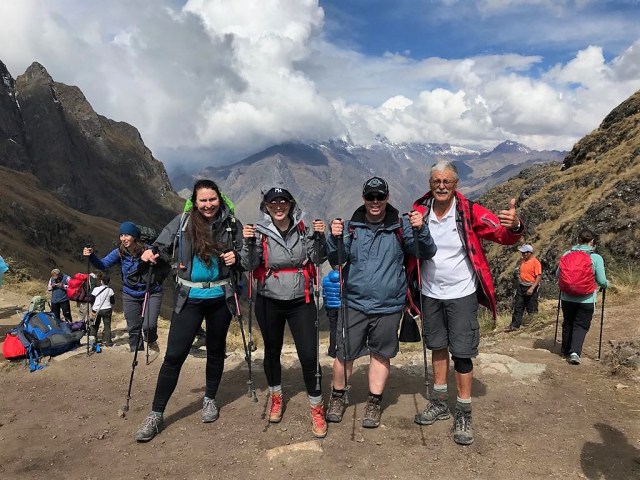
We had a 5.45 start for breakfast and then an introduction to all the porters before setting off. If you speak to anyone about the Inca trial, they say the second day is the hardest – not because of the distance but because of the elevation.  They were not wrong, as we trekked 6 hours up hill, walking through cloud forest to the tree line and beyond to reach the highest elevation of the trek – 4215m at Dead Women’s Pass.

39993395_1887980187947049_3898942663876935680_n
The fab four at the top of Dead Women’s Pass

It was incredible to think that Mt Cook Aoraki is only around 3700m and at that elevation, instead of looking down on things, we were still looking up at the mountains surrounding us. Despite the massive physical effort and lack of oxygen, I t was stunning with the Andes extending around us for miles.  (FYI 2 of the guides always carry oxygen just in case it is needed – on our trek, it was not!)

I must admit, I was so fearful of the day and it was by no means easy, but it was not as hard as I had expected and reaching the summit felt like such a massive achievement.

39964256_308843013001555_2359135491703439360_n
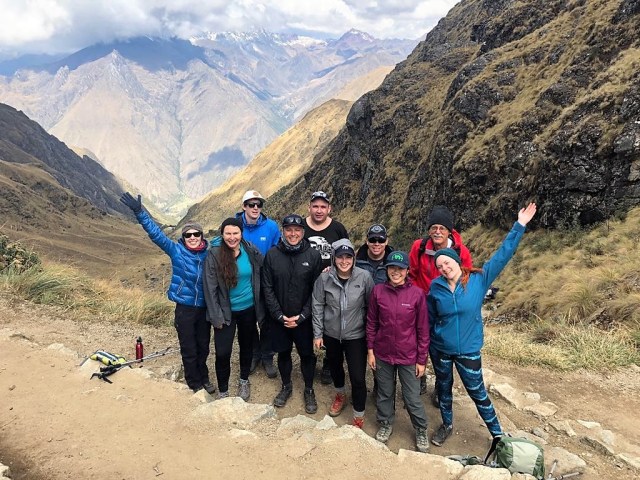
The full crew at the highest point of the trek

After reaching the summit we had 1.5 hours of steep downhill and I was very thankful for the poles I had hired. We arrived into camp at 3,920m around 3.30 and back in our routine of a small wash with warm water before afternoon tea, dinner and bed!

Day 3 – 16km 3,920m – 3,600m

I loved day 3 – it was the longest day and it started with 1.5 hours uphill but we passed through so many different ecosystems, from bamboo rainforest (with the cutest little hummingbird) to damp cloud forest full of ferns and moss.

Not to mention the different Inca remains we passed on the way – including Runkuraqay and Intipata (I think) and walking on original Inca path ways and craze steep big steps

And the views ….  the Inca Trail is really so much more than just Machu Picchu on the last day!

It had rained most of the night and had we left at around 6.15am in the mist and we could not see anything but it strategically cleared to allow us to see some amazing views – the pass we had walked over the day before, Inca remain, Machu Picchu mountain below us and a stunning view of the mountains with a rainbow.  We got to camp just before 5 and straight away headed off to see the most stunning remains near our camp (Phuyupatamarca) – Juan Manuel (our guide) was particularly enthusiastic about these remains.  They were well preserved and hardly any people go there which makes them extra special.

40072675_661521787555829_344750492204662784_n.jpg

We have been lucky most days not having to walk with too many other groups despite there being 500 on the trail each day (but that includes porters, guides etc and considering we have over 20 support staff for 10 people).  Today the track was busier as we all stayed at the same camp.

It was soon dinner and time to say goodbye to our Porters who will leave us when we head off at 4.30am!  It was hard to believe that the trek was almost over.  All the anticipation and it turned out to be so much fun and over far too quickly.  Our guides were incredible – Juan Manuel is as hilarious as he is knowledgeable, and Eddie is not far behind.  Klever is a bit shyer but very sweet.

Day 4 – 6.5km 2,650m – 2,430  – 2,643m

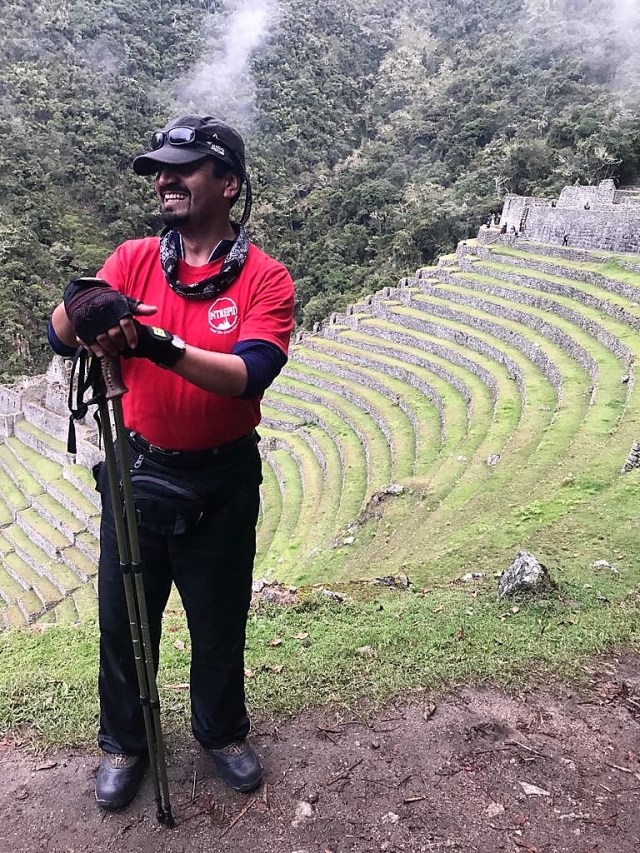
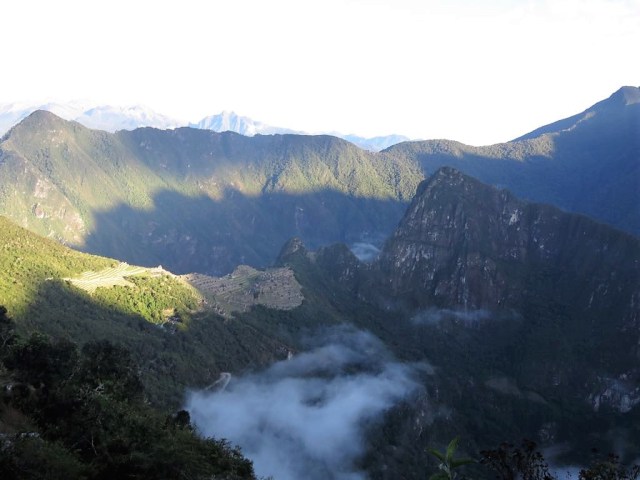
The fourth and final day of the trek and we were up at 3.30am – not to start walking, but just because the porters had to pack up camp and get a 6.30am train back to town! We walked in the dark around 10 minutes and joined the queue of follow hikers who were waiting for the archaeological site gate to open at 5.30am. Then we were off – I don’t know if it was the adrenaline or something else, but I was in the front of our group most of the way for the 1.5 hour hike, including up the stairs they call the ‘gringo killer’ which I didn’t even think were bad – I was still waiting for the hard stairs when Juan Manuel announced we had reached the Sun Gate and we got out first glimpse of Machu Picchu with the first rays of morning sun coming over the mountain and hitting it – it really was so worth every ache and pain (although there were far less of those than I had expected)!

39970213_295743961205801_176061691694415872_n

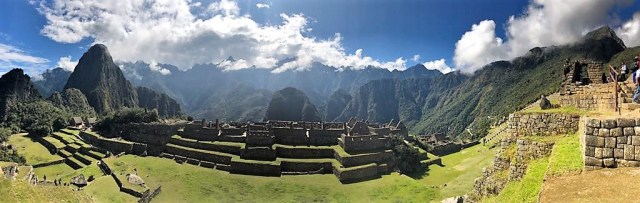
In a nutshell,  Machu Picchu is  a15th-century Inca City situated on a mountain ridge 2,430 metres above sea level above the Sacred Valley.   Most believe that Machu  Picchu was constructed as an estate for the Inca emperor Pachacuti (1438–1472) and it is the most familiar icon of Inca civilisation. It  remained unknown to the outside world until American historian Hiram Bingham brought it to international attention in 1911.

Machu Picchu was declared a Peruvian Historic Sanctuary in 1981 and a UNESCO World Heritage Site in 1983 and in 2007, Machu Picchu was voted one of the New Seven Wonders of the World in a worldwide Internet poll!

From the sun gate, we then walked down to the site itself and took a few photos before continuing down to check in to the site self and for Juan Manuel to give us a tour of the site – I think we were all just in awe of the site and the incredible mountains surrounding it.

40086249_309490029813583_3206399541246951424_n
Our fab 3 guides – Klever, Eddie and Juan Manuel

After our tour, we caught the bus down to Agua Caliente where we had lunch with our hiking group and guides – we had all had such an amazing time and probably spent most of lunch laughing so hard we cried, recalling our funniest moments of the trip.  I will really miss the guides as not only where they sweet and knowledgeable and incredibly funny but also very well organised – unlike the main guide for our trip!  Accordingly to Juan Manuel – there are two kinds of illnesses on the Inca Trail; altitude sickness and attitude sickness.  Thankfully we had neither!

39959114_474490873030694_3884525429326872576_n

Words can’t express how happy I am to have done the trek, particularly considering how much I had dreaded it before hand.

40006422_1905073689788299_3397052615530381312_n

Arequipa and the Condors

As the bus started off in daylight, we could enjoy the varying landscapes – desert to coast, cliffs above the Pacific Ocean and finally some greenery.  The only good thing about bus journeys at night is that you arrive in the dark and wake up to see where you are … Arequipa did not disappoint.  We are staying in the old centre and it is a beautiful town surrounded by snow covered mountains with beautiful warm sunshine.

38985058_1948727088517426_1589310527140528128_n

Arequipa is truly a beautiful city situated at 2325m above sea level in the desert mountains of the Andes.  It is Peru’s second largest city, though it only has a population of just under 1m inhabitants.  Founded in on August 15th, 1540 (we could see the city getting ready to celebrate its anniversary) it prospered during the Spanish times and became even more important after Peru gained its independence as it was the capital of Peru between 1835 and 1883.

The historic centre is another UNESCO site and is the main draw for the many tourists that visit the town.  It has the nickname the ‘White City’ apparently due to the white volcanic stone used to build the old part of the city, though we have also heard it is because only Spaniards (white people) were allowed to live within the city in colonial times – you decide what to believe!

The city is flanked by several snow-capped volcanos – Chachani (the Beloved), Picchu Picchu (the Top Top) and the impressive El Misti (the Gentleman).

As in most new places we started with a walking tour around the old city centre, starting in the Plaza de Armas which was just down the road from our hotel.

We walked around the area, getting a brief history from our guide before finishing up in the market which is always a great way to see the locals go about their normal daily activities.  We tried the local chicha, which was delicious and Queso Helado – literally Cheese Ice Cream – before you panic it is only named this as it looks like cheese, not because it has cheese in it!  This was also delicious.

We had the rest of the afternoon free and a few of us decided to go to a museum across the road from our hotel which is dedicated to Juanita the Inca Ice Mummy.  It was a great exhibition, culminating in seeing the mummy itself which is kept frozen to preserve her – unfortunately we could not take photos in the museum.

Juanita was sacrificed as an offering to the Inca Gods sometime between 1450 and 1480 when she was 12 or 13.  Her frozen body was found on Mt Ampato in 1995 – unfortunately she had fallen out of her tomb in to the crater of the volcano when some of the ice melted so her body was partially damaged but most of her remains (including skin, organs, hair, stomach contents etc), garments and the objects left with her were well preserved.  Apparently, they have since discovered another 9-10 similar child sacrifices like this on Ampato and other mountains and there is likely to be more.

That evening we sat on a roof top terrace, drinking Arequipeña beer and watching the sunset over the Plaza de Armas.

After only one day off travel we were back in a bus the next day.  This time it was a private minibus which meant we could stop when and where we wanted which was a blessing!  We were going up in to the mountains and higher up in altitude and had been told to ensure we were drinking plenty of water – what comes with drinking plenty of water?  Plenty of toilet stops!

It was going to be a 5-hour journey in total and I had hopped to sleep a little as I had had a terrible night sleep the night before, which I put down to the altitude sickness tablets I had started taking to avoid getting altitude sickness!  I did not get to sleep but only because there was just too much to see and I did not want to miss out on anything.

I finally got my erupting volcano.  OK, so there was no lava flowing but there was smoke and ash being puffed out at regular intervals.  Nevada Sabancaya has been in this state for 2 years now so it really is nothing spectacular but an erupting volcano nevertheless.

Our first stop was to see the smallest of the camelid family (the family that includes llama and alpaca), the Vicuña.  I do not know how I have never heard of these guys as they are super cute.  They only live in the high Andes and produce small amounts of extremely fine wool, which is very expensive.  Apparently, they can only be shorn every three years and must be caught from the wild.  Its actually the national animal of Peru and appears on the Peruvian coat of arms!

Next stop was for toilets and to drink some Mate Inca tea – a mixture of coca and other leaves to create a tea that is supposed to help with altitude sickness, energy, digestion, stomach problems – pretty much a magic potion that did not taste too bad.  Another common habit hear that we tried was chewing coca leaves – here they take it with a little bit of natural sugar to make it taste less bitter but again it was not too bad.  It is another thing that is supposed to be really good for altitude sickness so I can see myself having it at every opportunity!

Our next stop was at our highest point of the journey – 4,910 metres above sea level!!  I did feel a little light headed but other than that I seemed to be ok with the altitude thankfully and we only stopped for around 145 minutes to admire the view.  And what a view it was.  Some of it reminded me of New Zealand, but on steroids as everything was that much bigger and higher!

As a slight aside – it is probably time to mention that the theme of 80s/90s American music is going strong in Ecuador and Peru – in buses, in bars, all over the place.  It is always amusing to pass a shop and hear an old Bryan Adams song blasting out. 😂

We were to spend the night in Chivay, at 3600m and the provincial capital of the region.  It was a small, dusty tourist hub and the 3 fights of stairs climb to our room had me panting – I really had no idea how I was going to manage the Inca Trial in a few days’ time!

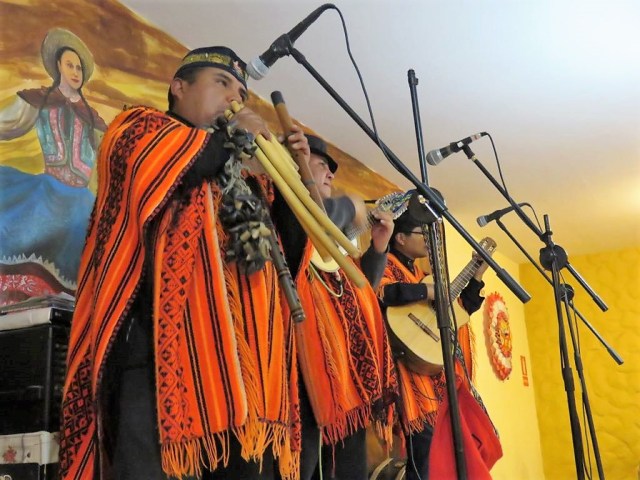
We had time to enjoy some rustic hot springs within the Colca Canyon before going to a music and dancing show over dinner.  It was all rather amusing and thankfully we left before the audience participation part!  Of course, the musicians had the expected pan pipes (nice to see Peruvian pan pipes in Peru rather than in every other capital of the world!) but one of them also had a rattle/shaker made from alpaca hooves!  Later, we saw them for sale in the market!  That said, we did have alpaca steak for dinner so at least they are making good use of all the animal 😂.  FYI Alpaca steak is good!

39594058_1975428459421942_5347948274588319744_n (1)

The next morning, we joined the tourist trial in to the Colca Canyon – I must say, this is the first time in my trip that I really feel like I am on a tourist conveyer belt and our first stop in Yanque was no exception.  It was a tiny town, full large buses trying to manoeuvre through the narrow, cobble stone streets which were definitely NOT designed for buses!

I was really not keen on all the photo opportunities with women and their llamas and alpacas – for money of course) – as cute as the animals were.  Despite the fact it was 6.30am, there were children out in traditional custom, dancing traditional dances in the plaza for all the tourists!

After the tourist circus stop we continued to drive through the Colca valley and in to the canyon – one of the deepest canyons in the world. We made numerous stops to admire a small section of the 20,000 hectares of agricultural terraces – some dating back to pre-Inca times and which are still used today.

39569916_684549768568172_2093773222242680832_n (1)

Of course, everyone knows of the Inca wonders in Peru but there was so much happening prior to the Incan times e.g. the Nasca and Paracas cultures and their lines and cultures with massive agricultural and head deformities (the technique of head flattening by binding wooden planks to the head of babies to distort normal growth).

But back to the Colca Canyon and the main reason we went there – the Andean Condors, the largest vulture in the world with a wingspan of 2.1 – 2.7 metres.   We were lucky to see 2 young ones sitting by the road when we first arrived and then 4 adults soaring around the cliffs of the canyon on the air currents.  There were truly wonderful to see.

Again though, the shortest of uphill walks and I was getting out of breath!!   Damn this altitude!

On our way back through the canyon, we stopped at a road side top where women were selling the usual souvenirs as well as ice cream made from cactus fruit.  Oddly, the fruit looked just like a kiwi fruit inside but was very very very sour!

From here, we headed back across the mountains to Arequipa where we had a free day.  We don’t get them very often on this trip so I took the chance to try and catch up on coffee and blogs.   I did take time out to visit the Santa Catalina Convent – hands down it must be the most picturesque covenant in the world!  It was founded in 1579 and covers 5 acres!

Next up … a night bus to Cusco and the feared Inca Trail!

Epic Nazca

Turns out I had so much to say about the epic Nazca lines that they get their own blog post!!

Thankfully our next stop was only 3.5 hours away by bus and we drove through the desert with the Andes soaring above us on one side, through dry valleys with fertile oasis at the bottom, from reddish soils to whites.  I am not sure what I expected of Peru but I don’t think it was this!

We passed many small, roughly built and what appeared to be barely finishes houses, but of course they all had satellite dishes on the barely their roof!🤔

Our next stop was Nazca and as seems to becoming a habit on this part of the trip, we had no time before we had to go out on a tour to see the Nazca Lines – the whole reason we were in Nazca.  Unfortunately, it was already almost 4 in the afternoon so we did not have a lot of light left in the day and it was all very rushed.

38926491_2054023894927806_7754900332982829056_n

Now for the history lesson, the Nazca lines (sometimes referred to as Nasca lines) are distinct white lines which appear in the tan/red earth of varying complexities – some are just a mass of geometric lines and shapes, whilst others depict very distinct shapes e.g. a hummingbird, whale, monkey etc.

To date, a total of over 800 straight lines, 300 geometric shapes and 70 animal and plant designs have been discovered, ranging from 15m – 365m in length.

The lines were first studied in 1926 by a Peruvian archaeologist, but as they are virtually impossible to identify from ground level, they were really only bought to public awareness when lanes started flying over Peru in the 1930s.

German mathematician and archaeologist Maria Reiche made studying the lines her life, she spent 40 years studying them and became know as the Lady of the Lines.  She fought for recognition of her theories on the lines astronomical and calendrical purposes and single-handedly battled to protect the lines.  In our whirlwind tour we had time to visit a small museum dedicated to her and her work which is located in the small house in which she used to live.

The majority of the lines, or geoglyphs and biomorphs as they are called, are considered to be the work of the Nazca people who flourished between around 1-700AD.  It is still debated as to exactly why they were created but current general consensus is that the lines and geometric shapes were related to water rituals (the area only gets 20 minutes – 1 hour of rain a year!) and the animal and plant shapes are indicative of the animal symbolism common throughout the Andes e.g. spiders are signs of rain, hummingbirds are associated with fertility etc.

As well as the Nazca lines, there are the Palpa lines created by the Paracas people, which could potential pre-date the Nazca lines by 1,000 years!  It was one of these Palpa line figures that was our first stop on our tour.  As these are on a hillside, they are far easier to see from ground level, or small platforms or hills.  Unlike most of the Nazar lines, they show humanoid figures, in fact a high priest family.  Charmingly the young boy is depicted holding up heads of human sacrifices!

38948694_1721414244595029_2319882475620270080_n

We finally got to the viewing platform overlooking a couple of the Nazca lines just before sunset but had got their just after a large tour bus so we had to wait to be able to ascend the tower.  Whilst we waited a few of us created an alternate rock, paper, scissors game called Lizard, Tree, Hand, in honour of the 3 figures we were supposed to be able to see from the tower.  Thankfully it made the 10 minute wait seem much quicker as we struggled to play the game whilst laughing hysterically.

We finally made it to the top of the tower just as the sun began to set and had a decent view of the tree and the hand but could not real see the lizard in the quickly darkening desert.  The brief glimpse we had convinced me that I had to take the flight over the lines the next day as it really was the only way to properly see multiple biomorphs. (Note that all of the photos except for the two directly below were taken from the airplane.)

It was already dark when we returned to Nazca, a small dusty town, that reminded me of other small dusty towns I have been but could not a finger on exactly which one or why – it was just very familiar. Perhaps it was a combination of places around the world.  Due to the incredibly low rainfall, residents only get 2 hours of water a day (thankfully hotels pay for more)!

Only two of us signed up for the flight (though I am sure after they saw our photos, others wished they had joined us) and we were due to be picked up at 11am, so we arranged a short tour to Cahuachi, a major ceremonial centre for the pre-Inca Nazca civilisation.

Our guide told us that only 5% of area has been excavated and it was incredible to imagine how vast the site is.  It was initially though to the be capital of the Nazca state, but as the population appeared to be quite low, it is now considered to have been a ceremonial site.  Unfortunately the site is proving popular for grave robbers who are continuing to find and loot previously undiscovered tombs.

On the way to the site we passed the production of two surprising exports from the region – asparagus and seaweed powder (which is brought from the sea to the desert to dry before powdering and exporting for use in beauty products).

Agricultural in the area is still possible, due to the incredible aqueducts built by the Nazca people, most of which are still functioning today.

Our flight was scheduled for midday, but this was pushed back due to high winds, which stop the light aircraft from flying.  Our new scheduled time was 1.06pm, literally the last time slot we could have to land in time to catch our 2pm bus.

Thankfully there were no further delays and we took off dead on 1.06pm.  The flight was incredible and definitely worth the money to see the amazing figures from the air.  There was definitely no terrestrial view that could match it.


We had been told to run as soon as we landed to get our transport to the bus station, so run we did.  Typically, the others involved in our transfer were on ‘chicha’ time – as in Ecuador, Chichi is a local alcoholic drink, here made from maize and much better tasting than the Eucadorian jungle cassava Chicha (although I did not mind that either!).  ‘Chicha time’ is in reference to things happening at a laid back pace!

Our driver was late and then stopped to pick up a couple of nuns on the way!  Thankfully they must have blessed us and we got to the bus station just in time to catch our next bus – 7 hours to Arequipa.

In to Peru

We left Cuenca at 3.30am and thankfully I managed to get a few hours’ sleep before arriving at the border town of Huanquillas 4 hours later.  It was poor timing as the Super Rugby final was on at the exact same time.  My team, the Crusaders, were playing and I was trying to keep up with their progress on the journey but unfortunately, we had no reception for half the journey through the mountains!  When we finally got to the border I was pleased to see they had won which is the most important thing right?

It is odd but border towns all over the world seem to be the same and this one had a familiar feeling to it.  I was trying to think back just how long it has been since I have done a land crossing at a border and concluded it was probably Ghana to Togo back in 2012 (but that’s another story!).

After queuing 1 hour to leave Ecuador we took a crazy fast taxi across no man’s land to Peru immigration – I am sure the taxi driver halved the 10-minute journey to 5 minutes despite speed humps and an open boot with suitcase precariously balanced in the back.

Our guide managed to convince the border control staff to let us in to the Ecuadorian immigration queue so we could avoid all the Venezuelans (fleeing the current crisis in their country) in the other queue we but still a wait of more than 1.5 hours for our entry stamp – it seems that Ecuadorians are not good at queuing and we had to spread ourselves widely across the line with elbows out to stop other people pushing in front – they were not subtle about their queue jumping.

As the guide was not with us, I got the opportunity to use my now vast (ok, a slight exaggeration) Spanish immigration vocabulary to help the others in the group through the questions about previous visits to Peru, length of stay etc.  Unfortunately, they were not happy with the paper work help by a Chinese boy (in the other group we were travelling with) or the Hong Kong girl in our group as Chinese typically need pre-approved visa for entry.

39020287_306624710090961_2929614677413462016_n
Arthur & Owen at the border

The downside of small town border crossings is that the staff are not normally up to date with the details of the visa requirements of all the different nationalities as they normally only deal with local immigration and in fact, both did have the correct paper work.  Thankfully it only took 10-15 minutes for them to allow Florence (from Hong Kong) in to the country, however the Chinese boy was not so lucky so we had to continue on  him so we did not miss our flight.

We had a 20-minute drive to the airport to Tumbes (described by the Lonely Planet as one of Peru’s top 10 shit holes)! A couple of us were worried we would be stuck there as for some reason we were on standby while the rest of the group had confirmed seats  on the one flight a day to Lima 😬.  Thankfully everything worked out ok, we all got seats on the plane, and at the last minute the Chinese boy turned up, having finally been allowed in to the country.  I was surprised to also be able to get a coffee so I was happy as starting to fade after only a couple of hours sleep.

Upon our arrival in Lima we meet our new guide (Jorge) and later, the four new group members (2 of the Ecuador group left us).   The four new ones are all Australian, making a group of 8 Australians and 2 Kiwis.

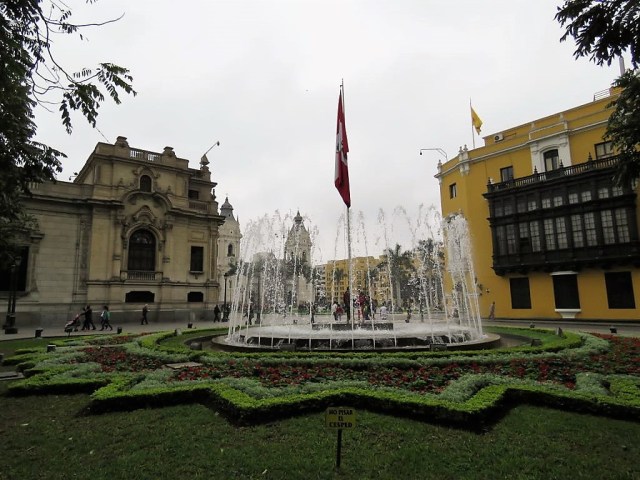
We only had one day in Lima and we spent most of it on a walking tour in the city centre which was declared a UNESCO World Heritage site in 1988 for “its originality and high concentration of historic monuments constructed in the time of Spanish presence”.

We caught the very efficient bus system in to the centre, with fancy bus stations and its own bus land right through the city and were greeted by yet another parade.  It seems South Americans love a good parade.  This time is was more of a dance off between groups, each dressed in bright, sparkly customs (male and female), accompanies by their own marching band.  It was massive with over 50 different groups ‘competing’.   It all seemed very friendly so it was a little disconcerting that there were riot police standing by!

We later discovered that August 5th is when Peru celebrates the Festival of the Virgin of Copacabana with a series of religious and social activities and this is what we had stumbled across.   The festival also meant that there were special church services at the main churches in the city.

After spending way to long watching the dancing, we got back to the tour and our guide spent some (read too much 😩) time talking about the evolution of balconies in the city!😬😂 Yes, there are a lot of different styles of balconies in the city of Lima!

38836073_1829210483810828_8894831219376652288_n

We then timed it perfectly to see the changing of the guards at the presdential palace – full of the pomp and cememony I have come to expect from South America!

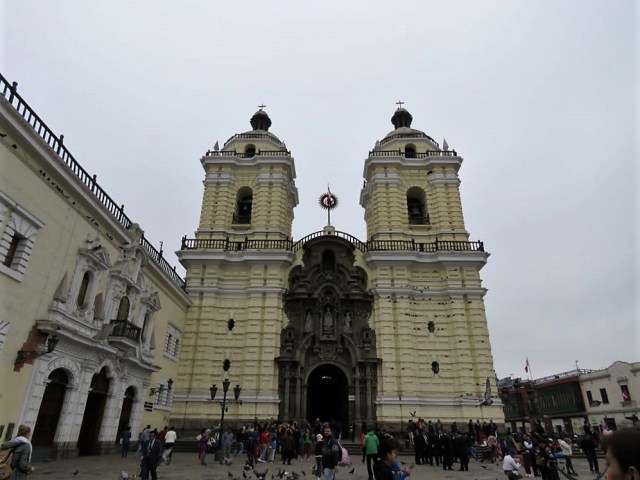
Next, we went in to the church of San Francisco and were just in time to join one of the Catacombs tours in English.  The church itself is one of the best preserved in the city (and there are a LOT of churches) and was built in the baroque style of the 1600’s, having been established in 1540.

38840316_658217387897133_6803784506797981696_n

We started the catacombs tour in the adjoining monastery that has an incredible collection of ancient religious books, some apparently bought over by the first Spanish settlers.  The rest of the monastery was also beautiful, with beautiful tiles and frescos.  But, what most people come for are the catacombs which are part of Lima’s original cemeteries, which were built under churches.  Apparently, there are approximately tens of thousands of people buried under San Francisco and many of the remains are exposed, stacked in strange patterns and/or arranged by body part so it is very difficult for them to determine the exact amount of people buried there.

After lunch and amazing churros filled with dulce de leche (a local delicacy – much better than worms!)  we headed back to our hotel to get ready for our 6am pick up for our trip back to the bus station.

In Peru is seems that bus stations run more like airports – we needed to get our bags weighed (and they charged for bags over 20kg!) and show our passports to ‘check in’.  Thankfully the buses were also like airplanes with pillows, blankets, reclining seats and seat back tv screens (definitely an upgrade from the Ecuadorian buses we travelled on – not that they were bad).  And we even got a meal onboard!  Ok, it was just a sandwich and small piece of cake but it was still food!  The best thing was the glass of the infamous Inca Kola – which tasted like a cross between IronBru and Cream Soda and nothing like Cola.

It was a 4-hour journey to our next stop – Paracas, a small town on Peru’s west coast, and a gateway to our next activities at Paracas National Reserve and the Ballestas Islands.

39051731_363854210817098_309804203037949952_n

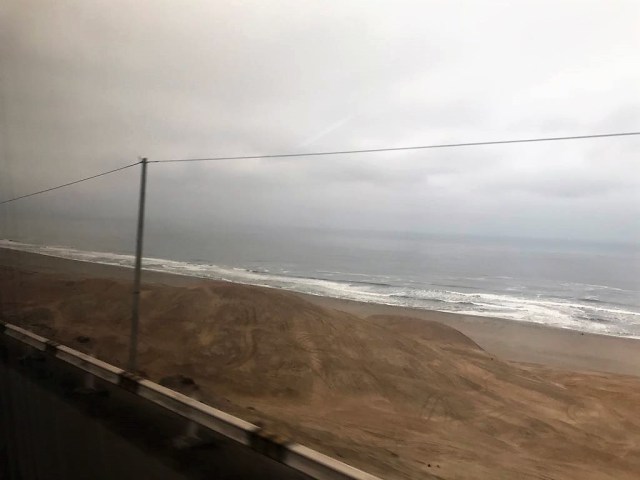
It was a very strange desert landscape along the coast line with fog most of the way though we did pass some small villages with white buildings by the sea – a little reminiscent of small villages in Greece.

Upon arrival in Paracas, we walked out the back of the bus station and our accommodation was right there – there really is not much to the town of Paracas! 😬  (To be fair there really is more than that but it did not seem so at the time lol.)

We were quickly rushed off on a tour of Paracas National Reserve – our local guide Luis, was amazing and had a great presentation style that made us all think.  He described the reserve as “a cold desert by the sea, in the tropics, that has clouds but never rains, and is home to a colony of penguins”!

There were shell fossils from 40 million years ago but absolutely no plants and all the birdlife was concentrated on the waters edge.  Apparently, the reserve has the largest concentration of bird life in the world, but that of course includes the islands which we were to visit the next day.

I did still manage to spot the beautiful Inca Terns, the not so beautiful Turkey Vultures and Peruvian Boobies flying around the coast line.

38831525_221728571846799_5255130475088838656_n
A stunning Paracas sunset

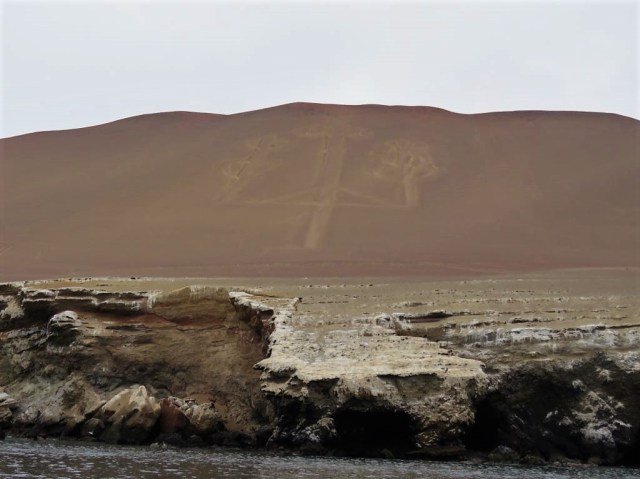
The following morning, we headed out by boat to visit the Ballestas Islands – sometimes known as the poor mans Galapagos, as it is much cheaper to get here!  First, we stopped along the mainland coast to see the Paracas Candelabra – a prehistoric geoglyph.  Apparently, the design is cut 2 feet in to the soil with stones placed around it and is 180m tall.  Pottery found nearby has been dated to 200BC, the time of the Paracas culture, but no one really knows who or why it was created.

38879509_511737522594276_3602677799778779136_n

We then headed out to the islands, situated just a short boat journey off the mainland coast,  the large speedboats (holding 40 passengers) certainly did not get up to the speeds those in the Galapagos did so it was relatively smooth ‘sailing’.  The islands are home to thousands and thousands of birds, mostly notable, Peruvian Boobies, Peruvian Pelicans, Inca Terns, Red legged Cormorant and the most infamous of all, the Humbolt Penguins who are really the star of the show!

We came across a group of 10 or so, who delighted us by lining up to jump in to the water right in front of us.  As wonderful as it was, personally it still ranks second to my Galapagos Islands!

38770625_989846444533593_356247776058671104_n


With no time to spare, we were back on another bus heading further south.

The end of Ecuador (for 2018)

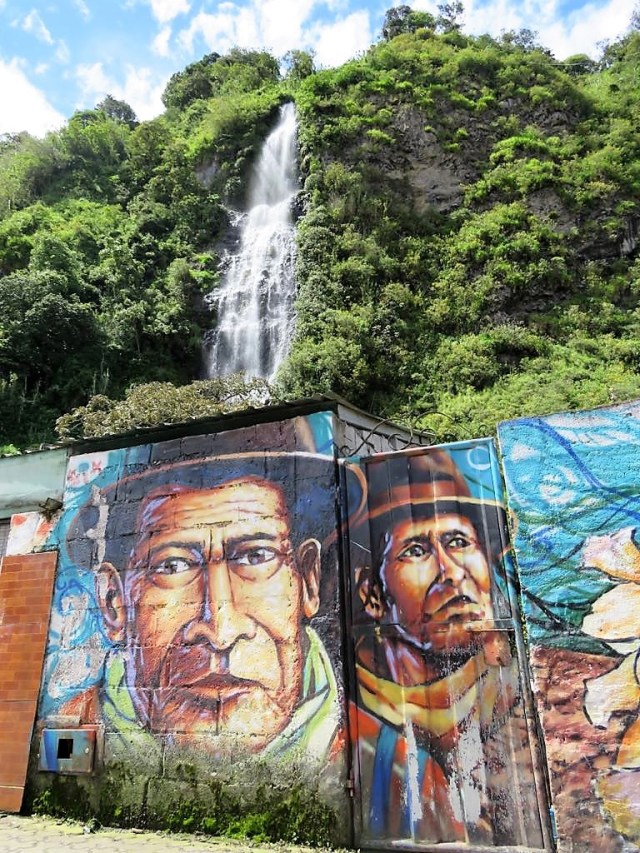
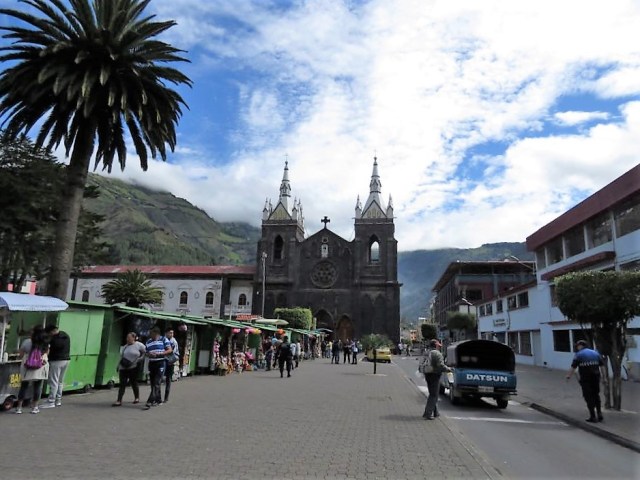
Baños de Agua Santa is an Andean town which is situated right by the active Tungurahua volcano (which was covered in cloud the whole time we were there).  It is famous for its mineral-rich hot springs, dramatic waterfalls and its adventure activities which brings many tourists (predominately local) to the town.   It reminded me of Queenstown in New Zealand.

38504361_643756779344528_6673463250438324224_n.jpg


For the afternoon, 4 of us decided to brave the ziplining, but this was no ordinary ziplining!  First up, we ziplined across the canyon, then we had to walk across a ‘bridge’ along the side of the canyon above the roaring river.  I put ‘bridge’ in inverted commas as it was less of a bridge and more of metal stepping stones (just big enough for your feet).  It was not too bad until someone else got on behind you and it started bouncing around.  Next, and the most difficult (for me anyway) was the ‘rock climb’ – again in inverted commas as the rock face did have metal steps in it to help, but the shear climb certainly got by heart racing, especially as we were in charge of ensuring out safety harsh was properly connected at each section.  Finally we ziplined back across the canyon.  All in all a lot of fun.

Full of adrenaline from the days activities, we spent the night dancing away in one of the many bars in the town.

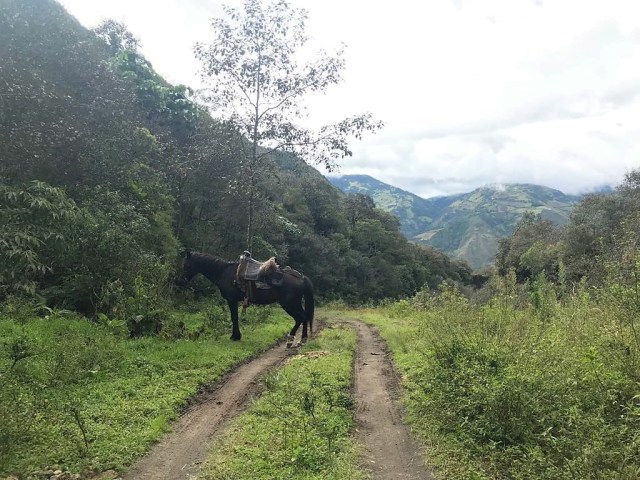
I had a late start the next day before taking a leisurely stroll around town.  A few of us had booked a horse ride for the afternoon but everyone else dropped out at the last minute – I thought that would mean I could not go but as it turns out the owner of the company fancied going out for a ride so agreed to take me.  It actually made for a very enjoyable afternoon as we walked/trotted/cantered up in to the mountains chatting about all sorts of things.

38448873_608839336179843_1996680169347088384_n.jpg


Jose, my guide, is a local man who has lived and worked in many other countries and had some amazing stories to tell of treks in the Andes, driving an overland truck through Africa (with a Kiwi co-driver) and working in Interlaken in Switzerland.  To top it off he clearly loved his animals and his horses were very well cared for (always a worry when riding in other countries).

38458036_525235214602047_7448486392444747776_n.jpg

As we rode up towards the volcano he stopped at a natural spring to fill up a water bottle – amazingly the water tasted carbonated.

Back from the ride, it was time to soak in the thermal hot pools, probably perfect activity to ensure I am not to sore after the ride (given that I have not ridden for a couple of years I expected to be in pain)!

Our last morning in Baños we visited two of the main sites of the town – the first was Pailon del Diablo (or the Devil’s Cauldron).  A large waterfall with a churning bowl of water at the bottom.  You could get fairly close to the rushing water if you were prepared to get soaking wet – in fact you got pretty wet not getting close either!

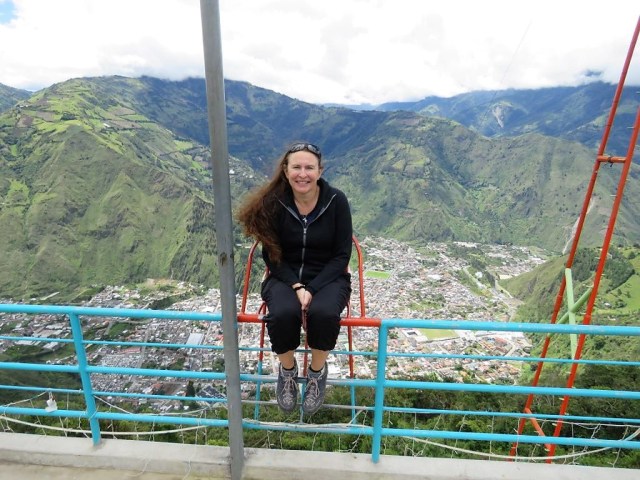
Our next stop was at the “Swing at the end of the world” – obviously not really at the end of the world, but off the end of a cliff, that, if the weather is clear is right in front of the volcano!  It was made famous by a National Geographic photo in 2014 of someone on the swing with the volcano erupting behind!  It was certainly rather scary swinging off the edge of the hill side but of course it had to be done!

38471815_830977057292123_7907309283295887360_n.jpg

At 4pm we set off on our 7 hour bus journey to Cuenca – our last stop in Ecuador.  The bus was not too bad but I struggled to slept and was grateful for all my snacks and netflixs!

Cuenca (full name Santa Ana de los Rios de Cuenca) is a city in the southern part of the Ecuadorian Andes and is know for its handicrafts, in particular Panama Hats.  Incidently, did you know that Panama Hats actually come from Ecuador?  Many Ecuadorian workers joined others from all over the world to help build the Panama canal and with them they took their hats to keep the sun off their heads.  Other workers also liked the hats and so they bought in more hats for other workers to wear.  When the Panama Canal was officially opened by US President Theodore Roosevelt he saw how popular they were and assumed that the hats were Panamanian – the rest, as they say, is history.


We spent the morning seeing the sights, including a Panama hat factory/shop and a view point over the city before stopping for lunch at a busy local road side restaurant, whose speciality was pork and cuy (guinea pig to you and me!).  I opted for the pork but tried the cuy and it was not bad – a cross between chicken and pork in my opinion.


We spent the rest of the afternoon relaxing before heading out for dinner and a few drinks in an effort to stay awake until our 2.30am departure.

I must admit, this additional time in mainland Ecuador was a bit of an after thought in my trip planning as Ecuador is really part of the standard tourist route as other South America countries, but as with Panama, it turned out to one I am really glad I did and I look forward to coming back to explore the country further.

So it was not really goodbye, just see you next year!

Back to Ecuador

(Waring: this blog post continues numerous photos of insects & spiders)

So I found myself at back at another the airport with very little sleep questioning why does the bag drop (after online check in) take longer than the normal check in line in South America?  That said, I should know better than to try to find logic where there is none.

There were a few minutes of slight panic when I finally reached the check in desk as they decided if it was ok for me to enter Ecuador without an outbound flight (as I leave by bus) 😬 but they worked it out in the end and let me board!

Although my Spanish vocab is still not great, I have been pleased that I have been getting more of a chance to try it out. I spoke Spanish at check in in Santiago and again at customs in Ecuador.  In the Galapagos Islands everyone quickly switched to English if they can if they see I am struggling with Spanish but I guess I am now somewhere were fewer people speak good English.

My hotel in Quito was in beautiful old building in the old part of the city built in 1698 – apparently the breakfast room was in tunnels that were used to hold inquisition prisoners.

I was to meet my new travel group at 2pm so spent the morning wandering around the city, enjoying the sunshine and the busy weekend city plazas – music in one plaza, a protest of sorts in another.  There was a real buzz around the area.

Back in the hotel I meet up with my group for the next 8 days – only 8 people and a mix of nationalities (but mostly Australians) – it is stark constant to Colombian group being majority male, majority older!  After the welcome meeting we headed out on a walking tour.  Unfortunately, by this time it was already 4pm and many of the buildings were closed so we could not go in much but it was nice to hear a little more history of the city and the buildings.   We ended the walking tour at a roof top bar with a lovely view over the city and of the full moon rising over the city.

The next morning we headed for the bus station in the south of the city to catch the public bus to Tena.   It was a very modern bus station but the bus was not as fancy as some we have seen – that said it was not bad.  It was a 5 hour drive through the Andes driving through various weather systems (from Quito’s blue sky to cloud covered mountains and heavy rain to jungle humidity) and up to 4,000m as we climbed through the mountains before going back down the other side in to Tena, the capital of the Napo province and the gateway in to the Ecuadorian Amazon.

Amusingly, the advertised air conditioning turned out to be small windows that someone came through and closed every time it rained 🤪.

From Tena we were picked up by a couple of twin cab utes and were taken to the small town of Misahualli on the banks of the Napo River.  We stopped here briefly to enjoy the local delicacy of Chontacuro – big fat wriggly worms!  The apparently are very popular with the locals as one of the shops were sold out, but our guide managed to track down some and half the group (including myself) agreed to try them.   I actually think that watching the preparation process was worse than actually eating them. She bought them out in a bowl of water, alive and wriggling before stabbing them on to a skewer (still wriggling) and them placing them on to the grill … yes, you guessed it, still wriggling.  Thankfully they had stopped wiggling before we ate them!  They were fairly salty and very greasy but an interesting experience nevertheless!

38411896_666721237014003_5361851491747364864_n.jpg

From Misahualli we continued in to the jungle the lovely Suchipakari Lodge.  After a 3 course lunch we headed out in to the jungle for a walk.  Unfortunately it was already 4.30 and the light was not great once we got in to the jungle but we did see a very cool frog that looked just like a leaf and heard some toucans. To continue with the bug eating, we tried ‘lime’ ants – straight out of the leaf they live in 😬- true to their name they tasted just like lime 👍🏻.

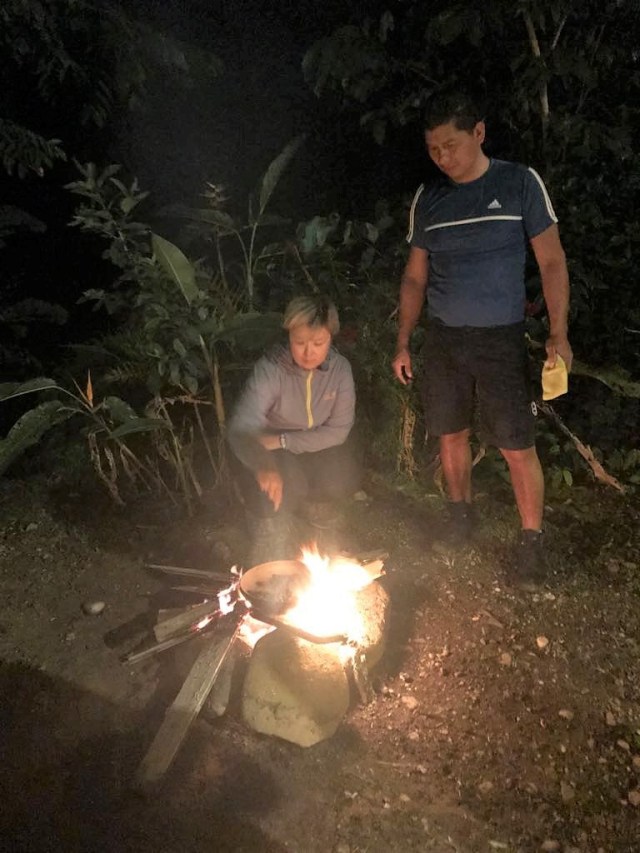
For some reason I was the only one who wanted to go on a walk after dinner and I am glad I went as we saw a scorpion spider and a tarantula.  As it was just me and the local guide, we spoke Spanish most of the time.  Of course it was still a pretty basic but between his English and my Spanish we had good conversation (as I later discovered he actually spoke pretty good English, and French as well as Spanish and his local Kichwa dialect so he really did put my language efforts to shame). I loved the peacefulness of the jungle at night with just the noise of the insects and frogs.

Next morning, true to its name – it rained in the rain forest, but it stopped by the time we were ready to leave the lodge for our activities and what a wonderful day it turned in to.

After walking for about 30 minutes (carrying our tubes for later in the day) we reached our small river boat and started down the Napo river (although we were technically in the Amazon rainforest, the Amazon river does not actually cross in to Ecuador so we were travelling on tributary rivers (Napo and Misahualli).

Our first stop was a small town to see how the Kichwas make their ceramics before moving on to a house deeper in the jungle to practice our blow darting (through a 2 metre long blow pipe!) and learn how to make the local alcoholic Chicha out of Yaca (cassava).  It was actually very similar to the local maize based drink I had had in Zimbabwe and I quite liked it – others in the group did not!! lol

Next up was a short jungle walk, stopping by a small lake to spot caimans and as always, I was distracted by the beautiful dragon flies (which I love).  As we continued down the river we passed a huge troop of Squirrel monkeys jumping through the trees on the side of the river.  In some places there was a massive jump for them (excuse the very poor action photo below) and we spent a good 10 minutes cheering them on as they jumped.  One misjudged the jumped and almost ended up in the water – the whole troop started calling and another monkey quickly when back to help the less fortunate one.  They really were amazing to watch.

Then came tubing – it was just magical to sit in the tube floating down the river.  Some places we went fast through small rapids, other places setting a very leisurely pace as we enjoyed the tranquillity of the jungle.  We caught back up with our Squirrel monkeys and also passed a troop of much larger Woolly monkeys.

38514671_565700507178552_579955580077080576_n.jpg

That evening before dinner we had the opportunity to make some chocolate – from the dried bean to the finished product which we enjoyed with banana and strawberries.

38521642_2206490126301825_2464771165831299072_n.jpg

This evening I had managed to persuade some of the others how amazing the night walk was so we headed out again and it was even better than the night before. Along with the resident big spiders, we spotted some very cute frogs, giant owl moths (which can disguise itself as an owl or a snake) and an alien like cockroach type creature that had glow in the spots on its back that looked like eyes – it was amazing incredible!  After the walk a couple of us lay on the ‘beach’ near the river listening to the jungle sounds till it started to rain and we had to go back to the lodge.

The following morning we sadly had to leave the jungle – I could have stayed a couple of days more at least and of course now I am trying to work out how I can fit a return there in to my itinerary for next year 😂😬

We left at 7.30 as we were supposed to be catching the local bus from Tena at 9am, but it turned out we could have left a couple of hours later … another tour group at the lodge had their own bus which was not being used that day so their driver offered to take us all the way to our next stop – Baños de Agua Santa.  Not before stopping in Misahualli again, thankfully not to eat worms this time, but to check out the town’s resident Capuchin Monkeys.

Chilling in Chile

I left the Galapagos Islands with a heavy heart nd it did not help that I had such a hectic travel schedule … taxi, boat, bus, 3 flights, taxi … I could only console myself with the fact that I know I will be back next year … and I will be meeting someone special for the next week in Chile 👍🏻😊.  Otherwise I may just have stayed 😬

The first two of my three flights were delayed which resulted in me having to run through Lima airport to catch my last flight – thankfully it was the same airline so they were waiting for me (and my bag managed to make the transfer as well!).  By this time, it was late night and I am not sure I have ever looked out an aircraft window and seen so many stars – including my beloved southern cross shining brightly.

The immigration and customs process in to Chile was easy and quick, helped I am sure by the fact that it was 3am in the morning and I was quickly in a cab in to the city centre and my accommodation.

After just a few hours sleep I was awake and ready for a run/walk around the city.  As I went out in to the street, I walked straight in to a military parade which the city had kindly put on to welcome me 😂- I later learnt that it was for the changing of the guard at the near by presidential palace and it happens every second day!

Santiago de Chile is a big cosmopolitan city (with a population of over 7m) and it was a bit of a culture shock for me after feeling so comfortable in a town with a population of just over 12,000!  It was also very cold which was yet another shock to my system!  There had been times in the sweat filled days in Colombia that I had dreamed of a cooler climates – now I was there I would give anything to get back to the heat!

My run was not particularly successful as there were too many people and too many roads to cross and I managed to get lost just as my phone was dying – slight panic set in as without my maps.me app and the photo of the apartment address I would actually be lost with no clue of where I was or, more importantly, where I was staying!  Thankfully I managed to find my way back just before the phone died which was a huge relief!

I just had time to have a quick shower before heading to the airport to meet my partner in crime who travelled all the way from New Zealand to spend the week with me – I should note that he only had to take 2 flights to my 3!

One of the first things I like to do in new cities is a walking tour and most of the cities I have been in recently have a ‘free’ one (based on tips only).  Santiago was no exception so Saturday morning we made our way to the meeting point for the tour.  Not without stopping for a coffee on the way.  We decided we would try one of the many large coffee shops we had passed, unknown to us at the time, we were sampling the famous “café con piernas” or “coffee with legs”.   It was not good!

It is apparently a uniquely Chilean, mainly Santiagan, tradition of large city centre coffee shops that service a combination of generally mediocre coffee and an ‘erotic’ ambience designed to promote a subtle sexual frisson between client – predominately male – and waitress – predominantly young and attractive!  We stuck to Starbucks after this experience though we did take on the personas of Jose and Elena to avoid name issues with the servers! 😂

As always, the walking tour was informative, taking in the main sites and facts of the city.  From the indigenous sculpture in the Plaza de Armas symbolising the breaking of land and people to the story of Salvador Allende who was a revolutionary who wanted to overtake the country not with violence, but with red wine and empanadas 😂.  (He committed suicide after the presidential palace was bombed in a coup backed by the USA).

We paused for a moment outside Londres 38 (the interrogation and torture centre of Pinochet’s regime), with the names of the missing on plaques on the footpath outside before walking through one of the centre city parks admiring the rather fat street dogs in their winter coats – they are even given kennels!❤️

After the walking tour we had something to eat along with one too many pisco sours (the most famous local alcoholic drink) before walking back to the apartment for a relaxing evening, ready of our early start on Sunday.

37923952_10155453980131790_584253506605547520_n (1).jpg

We were picked up at 7am for our road trip Cajon del Maipo in the Andes which very much reminded me of New Zealand’s Southern Alps on steroids 👍🏻.  It was a relatively slow drive up, stopping for hot chocolate and cake at a local café and to hire some cold weather gear for those who did not have enough – the guide estimated it would be -2C where we were headed.

The stunning gorge of the Río Maipo starts just outside Santiago and as we learnt, is a popular destination on weekends for Santiaguinos – it was Sunday and there were more people heading up the mountain side to the reservoir than up the Rapaki track on a public holiday at home (that is one of the many short hikes up the Port Hills in Christchurch which is always very popular).

The short hike warmed us up but it was truly bitterly cold at the top, certainly not the temperatures I have been used to but perhaps those to which I need to once more grow accustom to!  Of course, it was beautiful in the sun shine.

Back down to the road and our guide had set up a small tasting table of local produce – red wine (of course we are in Chile after all), cheese, olives, bread etc.  It was delicious and I had eaten far too much cheese to really enjoy the very large empanada we had at our last stop before heading back in to the city after an 11-hour day!

For our last day in Santiago we had a fairly lazy one, starting with a short walk up a small hill for a view, and ending with a trip to the other side of town to see the sunset – it actually isn’t the sunset you go for, as you can’t actually see it, but it is the beautiful colours on the mountains as the sunsets on the other side of the city.  It was a little surreal as we were the only people in this rather swanky bar, at the top of a rather swanky hotel with a beautiful view.

The next day we headed off to catch the bus to the coastal city Valparaiso.  I am pretty sure that all my Spanish lessons to date were leading up to buying bus tickets as I had run through that scenario many times in class!  She did not ask me if I wanted a window or an aisle seat but other than that the conversation ran pretty much to script.

Valparaiso is Chile’s second largest city and it’s bohemian and colourful, maze of hills has long inspired poets and writers and now backpackers!   Every blogger who has been there has raved about.

The historic quarter of this historically important port city was named a UNESCO World Heritage site in 2003, but despite this, there is still a vast contrast between the nicely refurbished buildings and areas and those that are still very run down – as you go up and down the historic (and very steep!) funiculars (or if you are brave, the stairs) it is easy to see the contrasts.

Valparaíso is also home to Chile’s legislative Congress and the headquarters of the Chilean navy and was a key stop on the way up the south American coast before the Panama Canal opened.

We had a lovely couple of days here exploring the historic city before heading back to Santiago and onward flights … for the next 6 weeks I will be hitting the road hard so it has been good to have a more relaxing laid-back week chilling in Chile.


Galapagos – the end is near (too near)

So my final week of lessons arrived and I broke up the week with a dive on Tuesday.  Another amazing dive at Gordon Rocks where our safety stop was surrounded by 15 reef sharks!  Some got a little too close for comfort but they are perfectly safe!  At one point a sea lion started annoying them but they basically just ignored it and got on with their slow circling in the current.


We saw  a very large sting ray resting on the bottom, so well disguised that a turtle almost sat on it, as well as an amazing school of yellow fish, more barracuda to swim through, school of tuna … and of course hammerheads ❤️🦈

How am I going to go back to normal life when this has been my life for a month 😔

As always I was in awe of the amazing array fish, sharks, turtles (so many turtles) sea lions etc. etc.

I also managed to catch up with the guide from last years cruise. 👍🏻  It was lovely to see him again if only for a couple of hours as he is in town with another tour group.

I watched the football world cup semi final between England and Croatia and you can not help but love the  South American (or maybe they are Spanish) commentators.  It doesn’t matter who scores, the announcement is “gggggggggoooooooooooooooooooooaaaaaaaaaaaaaaaaaaaaaaaaaaaaaaaallllllllllllllllllllll” … I am not really sure if that is long enough 😂

My 4 weeks of Spanish lessons have come to an end and I can safely that say I am closer to speaking a second language than I ever have been before …. but I guess that is compared to nothing 😂 so is not really saying much! Still I definitely feel like I have increased my knowledge and vocabulary but I am still not confident to speak much.

Have been helping the dive guides with English and it is surprising how many Spanish words I know when they can not come up with the English word 👍🏻

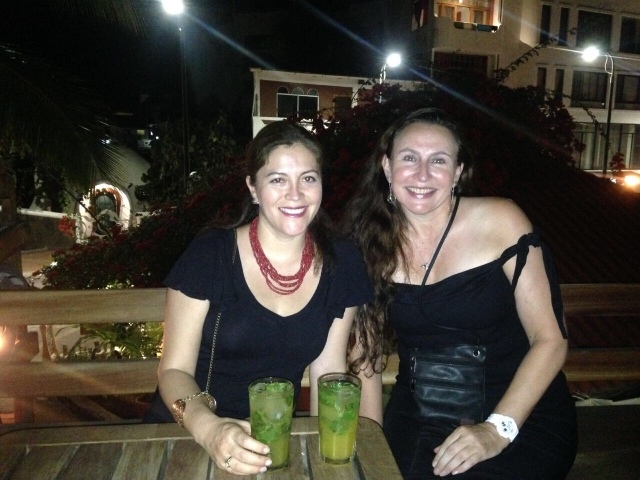
For my last Friday night in Puerto Ayora, I went out with Patricia my host, and a couple of others.  We had a great night of dancing which ended with me  bumping in to a couple of the teachers (not my teacher) from my language school so it was nice to get to know them a little outside the school.

bb9ca609-ad61-41a8-b3eb-7be3de250d3b

Recovery day Saturday and I took a short boat trip across the harbour and then walked to along the volcanic rock path and through scrubby bushes to Las Grietas – a stretch of inland crystal clear emerald green water at the bottom of an earth fracture!  It’s over 10 meters deep, 7 meters wide and 100 meters long and apparently is fed underground by a river from one end and ocean water from the other so the water is cool and brackish. There are cliffs of dark volcanic rock rising up on each side which make a dramatic contrast against the emerald green water.

There were so many people there, I decided not to swim, but walked back a short distance to a small beach where I sat and watched the marine iguanas coming and going in to the sea.

Sunday was family day and I took my host family on a discovery dive as I though it would be great the diving experience with them as I was doing it so often. They were all very nervous and in the end only 2 made it under the water! I spent 30 minutes on the bottom at around 3m holding hands with Maria Gracia – the youngest (11) but certainly the bravest of them all!

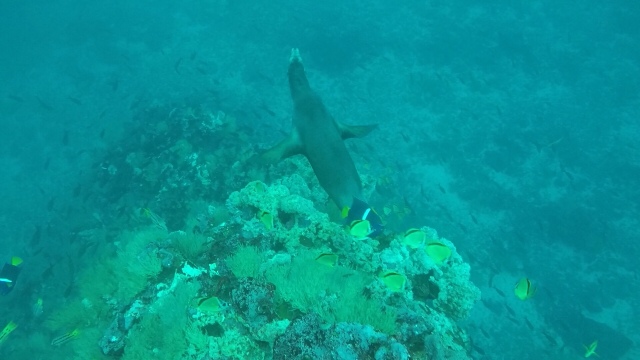
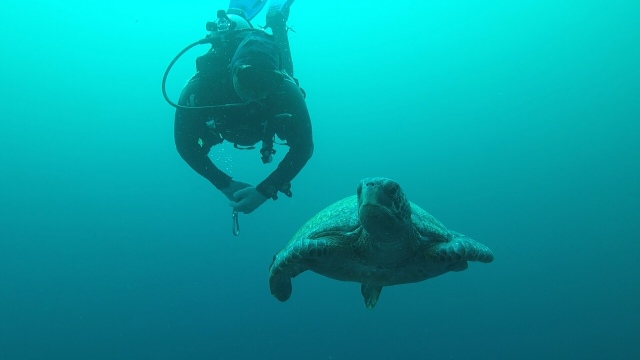
After the discovery dive, they went snorkelling and I went on a proper dive.  Highlights being so many turtles, one came so close it was almost impossible not to touch it and a sea lion who followed us around for most of the dive (I am pretty certain it was the same one the whole time). You could also tell when it was going I appear as the fish scattered as it shot through the water!!

gptempdownload-20

My last dive was back at Gordon Rocks – if you haven’t noticed I have LOVED the diving.  I got the grand send off from a large group of Hammerhead sharks, 15-20 golden rays, turtles, sooooo many fish of all sizes as well as a big group of large jack fish.

gptempdownload-21

The current was pretty strong but I know have so much more confidence than when I started – I just hope that it sticks around until I can get back in the water.

I had a bittersweet last dinner with my family, it is sad saying goodbye but I know I will be back in the not too distant future so that helps soften the blow a little.

3ddf154c-48a6-497d-9203-2a4e2caa4931

I am writing this as I sit in the airport in Quito, waiting for my second delayed flight of the day and really am pretty sad about leaving the islands.  I guess the longer you stay somewhere the harder it is to leave so maybe it is best that the rest of my trip will be made up of much more travelling!

The Galapagos Islands are truly a special place – as I think I commented in an earlier blog post, just when you think you have seen the best the islands have to offer, they surprise you with something even more amazing!

What won’t I miss about the Galapagos islands?  Appalling slow wifi and washing my hair in the dark in cold water!

What will I miss? Everything else 😢 oh who am I kidding – it’s this 😭