
Armenia
April 2025

The hotel restaurant was on the 9th floor of the hotel with a view out over the city and Mt Ararat. When I went up for breakfast, it slowly came in to view under the clouds. Unfortunately, by the time we came to leave for our day of activities it was raining.
Levon recommended we switched our activities around because of the weather … and so we headed out of town to the Garni Temple complex. The roads were terrible. Apparently they were fine last week, but with some sustained heavy rain, they had turned into rivers with huge potholes!
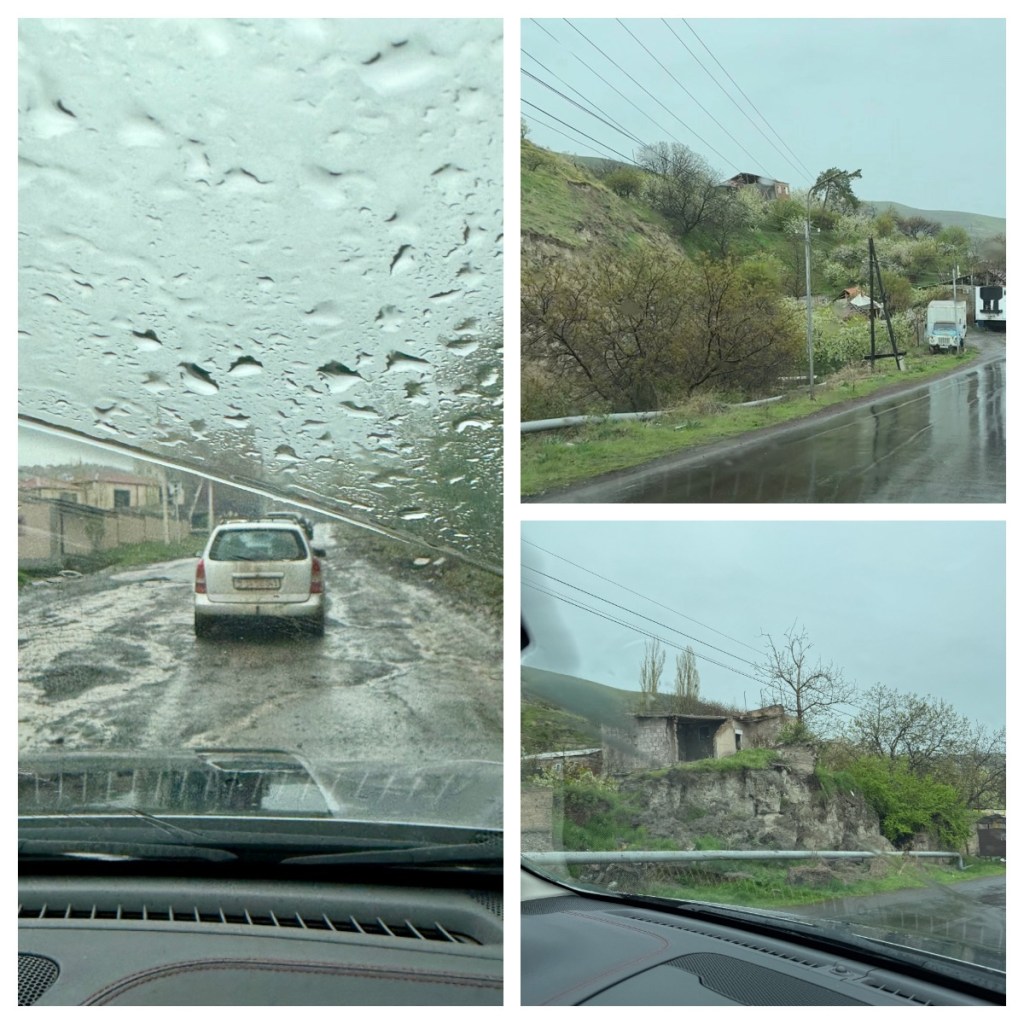
The locals joke that some of the potholes are so deep you loss cell phone reception if you go into one lol. If the potholes were not bad enough, part of the route was also in a landslide zone, where the ground and the buildings built on it, were slowly sliding down the hill!
The Garni Temple is the only preserved pagan temple in Armenia and it is thought to have been originally built sometime between the years 100-300AD (remembering they became Christians in 301).
The temple itself is a combination of Greek and Roman architecture and has 24 columns to symbolise 24 hours in a day, and 9 steps to symbolise the 9 social classes accepted in ancient Armenia. For some reason, on this site, instead of destroying the pagan temple and building the Christian church on top (which happened everywhere else), the temple was kept, and the church built beside it.
Unfortunately, after surviving Christianity and multiple invasions, the temple succumbed to an earthquake in 1679. It was restored in the 1970’s, using its original basalt stones, to what we see today.
They were obviously setting up for a concert and not only were all the lighting and cables ruining my photos, they also seemed pretty unsafe. All the electric cables were sitting out in the rain and they were also a massive trip hazard as we climbed over them to get around the temple! Armenia health and safety at its finest! 😜
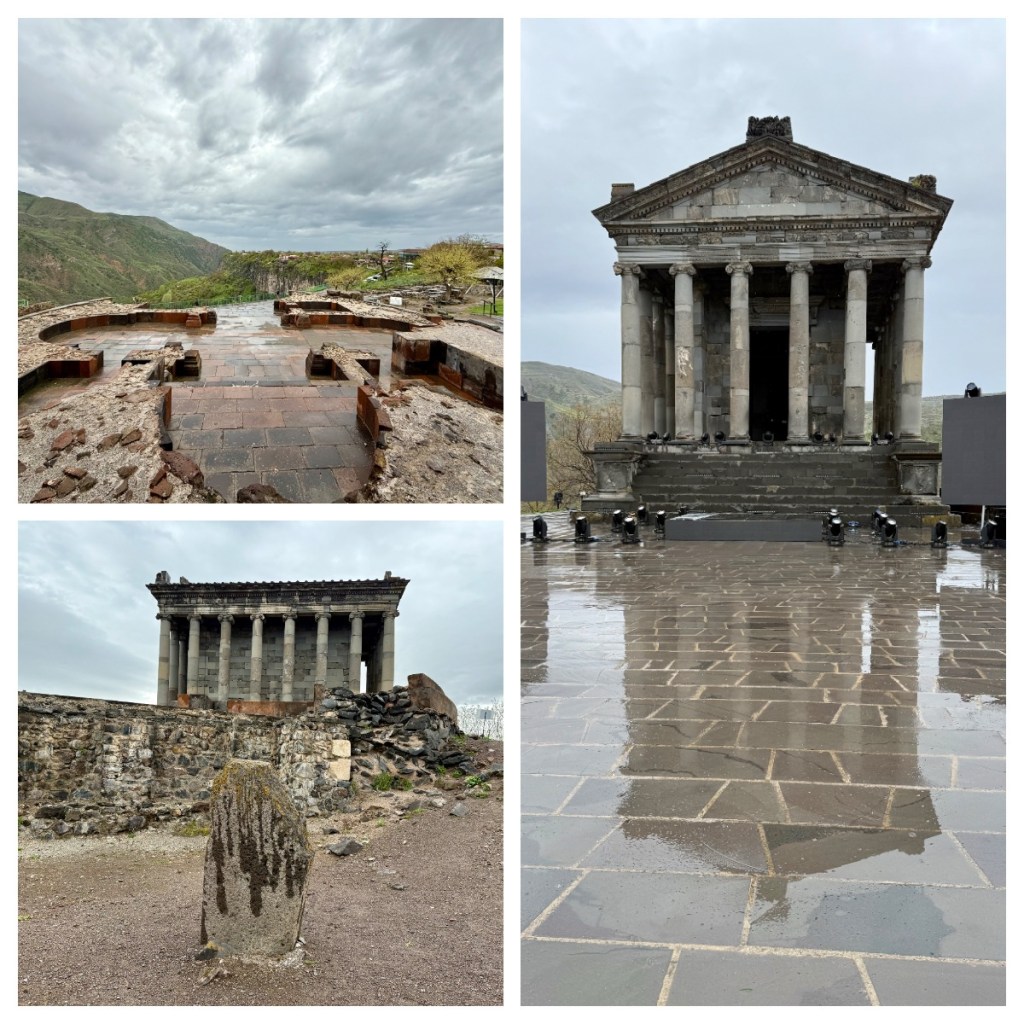

The site also served as a royal summer palace with a bath house/sauna and palace buildings. The remains of the bath house has beautiful Greek style mosaics and one image that looks like a woman holding a smart phone?? They actually piped in the water for the bath house from 5km away in clay pipes.
One of the most important artefacts at Garni is the Dragon Stone or vishapakar, a monolith that predates the Khachkars. It is believed that these date back to the Kingdom of Urartu, that dominated the Armenia highlands (which now extends over modern day Turkey, Iran and Armenia) from the 8th to 6th centuries BC. It is crazy that this incredibly important artefact is just sitting out here with no protection from people or the elements!
You can see why this was a favourite spot for royalty, with it stunning views down the valleys on both sides (also making it hard to invade). You can also see down to the “Symphony of Stones”. Armenia’s version of the hexagonal (and some pentagonal) basalt columns, some nearly 50m high, that I have seen in recent years in Northern Ireland and Iceland. They are now protected but were once cut to make the paving stones we were walking on.

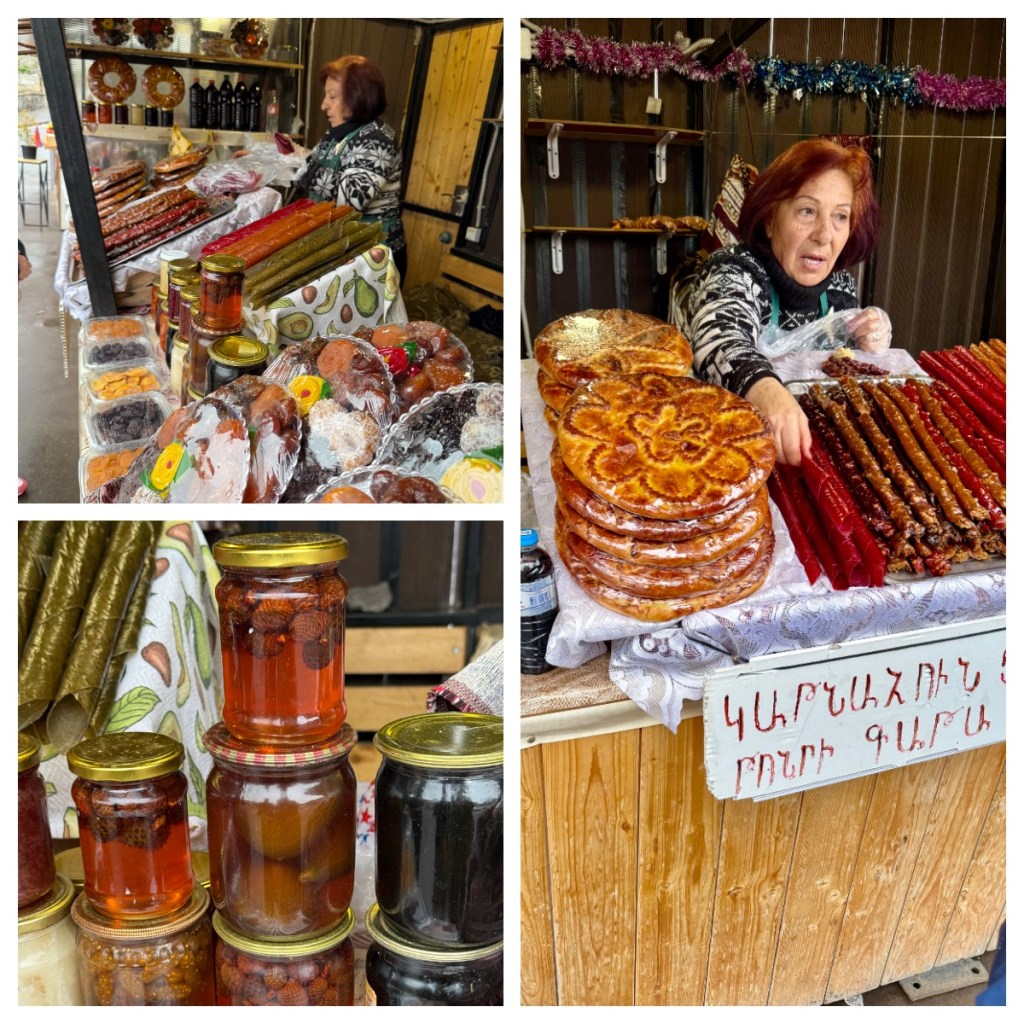
As we exited the site, we passed more stalls with people selling their beautiful homemade products. As with all our experiences in Armenia, they all wanted us to try their products even if we were not going to buy. I always felt bad doing this but Levon told us they would be offended if we did not try lol.
It was odd to see how interested people were when they found out that we had been to Azerbaijan. They would always ask what were the people like and what did they say about Armenians. It really does seem that they are afraid of each other. Levon said that people felt like they would be killed in the streets if they somehow found themselves in Baku! I can’t image what it must feel like to have such fear of a neighbour.
The rain had let up a little by the time we got to our next stop – Geghard monastery. Another medieval monastery, this time partially carved into the cliff. The complex was founded in the 4th century by our friend Greogry the Illuminator on the site of a sacred spring in a cave, that is still there and locals collect water from it. It is believed that Gregory lived here for some time.
The name, Geghard, means spear, and allegedly, the spear which had been used to wound Jesus when he was on the cross, was brought to Armenia by the apostle Jude and it had been stored on this site!
Some parts of the complex are dug entirely into the cliff, others are stand alone structure, most built between the 10th and 12h centuries but as with most sites in this part of the world, it has suffered from invasions and earthquakes, in this case, also fire!

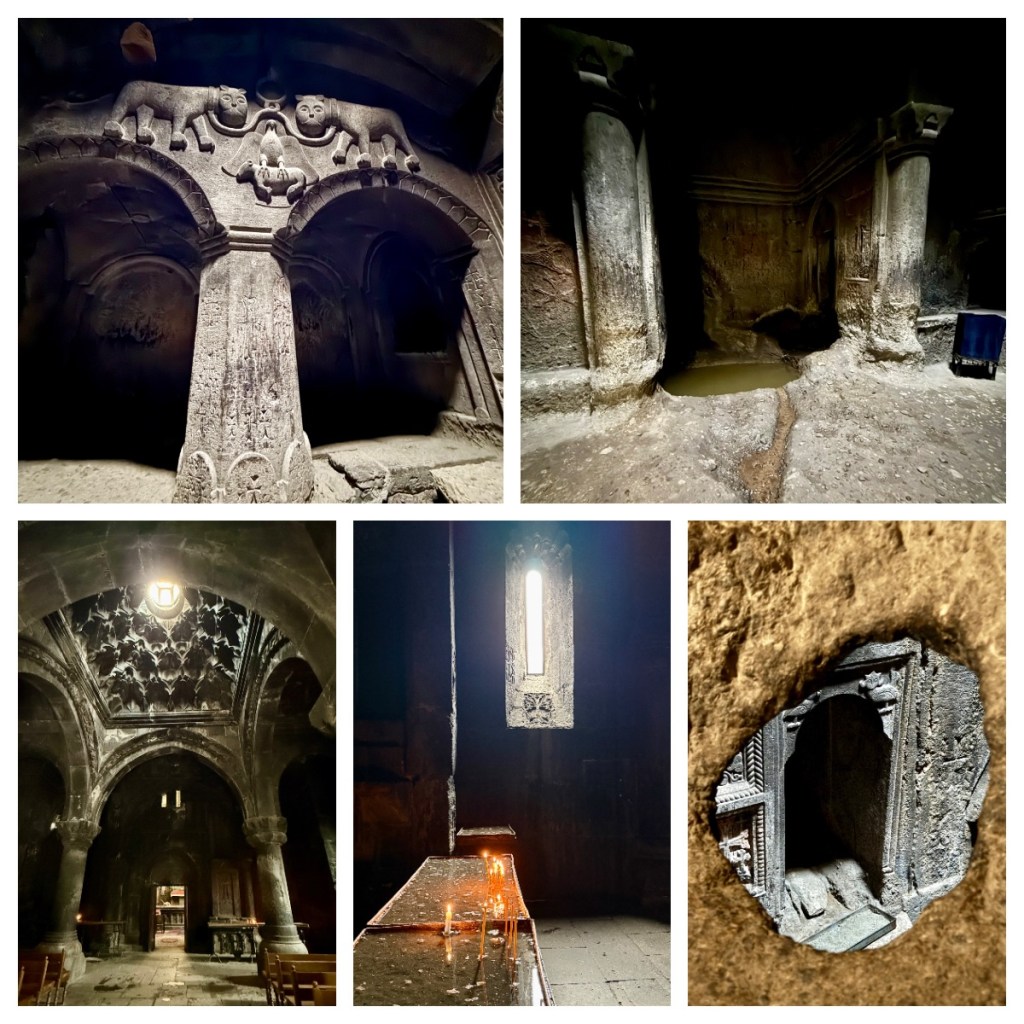
There are many Khachkar’s here, lining the rock faces and in some places the stones are carved directly into the rock walls and the main church is adorned with carvings of grapes, pomegranates, doves and a bull fighting a lion, thought to symbolise the prince’s power! Apparently it took 40 years to build the cave monastery, digging it out from the top down and it had lovely acoustics. (We convinced Levon to do a demonstration of said acoustics lol.)
From one of the upper tombs, there is a hole down in to one of the downstairs tombs. Not sure if it is natural or manmade but it makes a good photo opportunity.
The rain came again so we ran back to the car and travelled through the now substantial surface water back into Yerevan. It is clear that they have very poor drainage systems that can’t cope with heavy downpours and we were grateful to be driving in a suitable vehicle!
Back in town we stopped at the large “GUM”market (named after a nearby department store). It was huge and mostly indoors (which was great on a day like this one). It reminded me of markets I have seen in Kazakhstan. Shoes, clothes, suitcases etc could be found upstairs, and food downstairs – fresh and dried fruit, nuts, vegetables, spices, meat, cheese, herbs ….
Again, we got lots of free samples and thankfully Ania bought some to take home, and I bought a little to eat today! We have seen churchkhela around Armenia and lots here in the market. Apparently here they call them the “Armenian Snickers” as they are sweet and nutty. They are spiced here (with a little cinnamon I think) and I prefer them to the Georgian ones. You can also buy them in small pieces, rather than just in the long sausage shape which is much better for me.
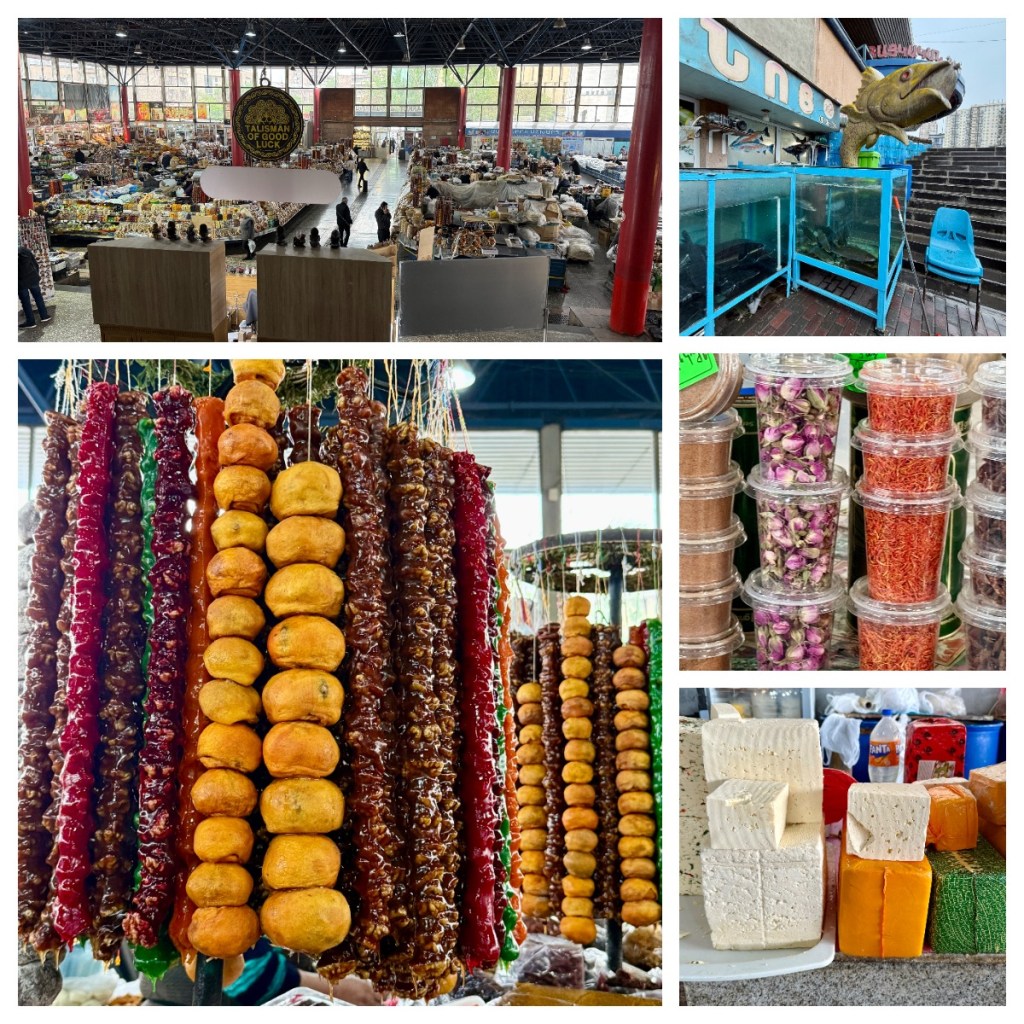
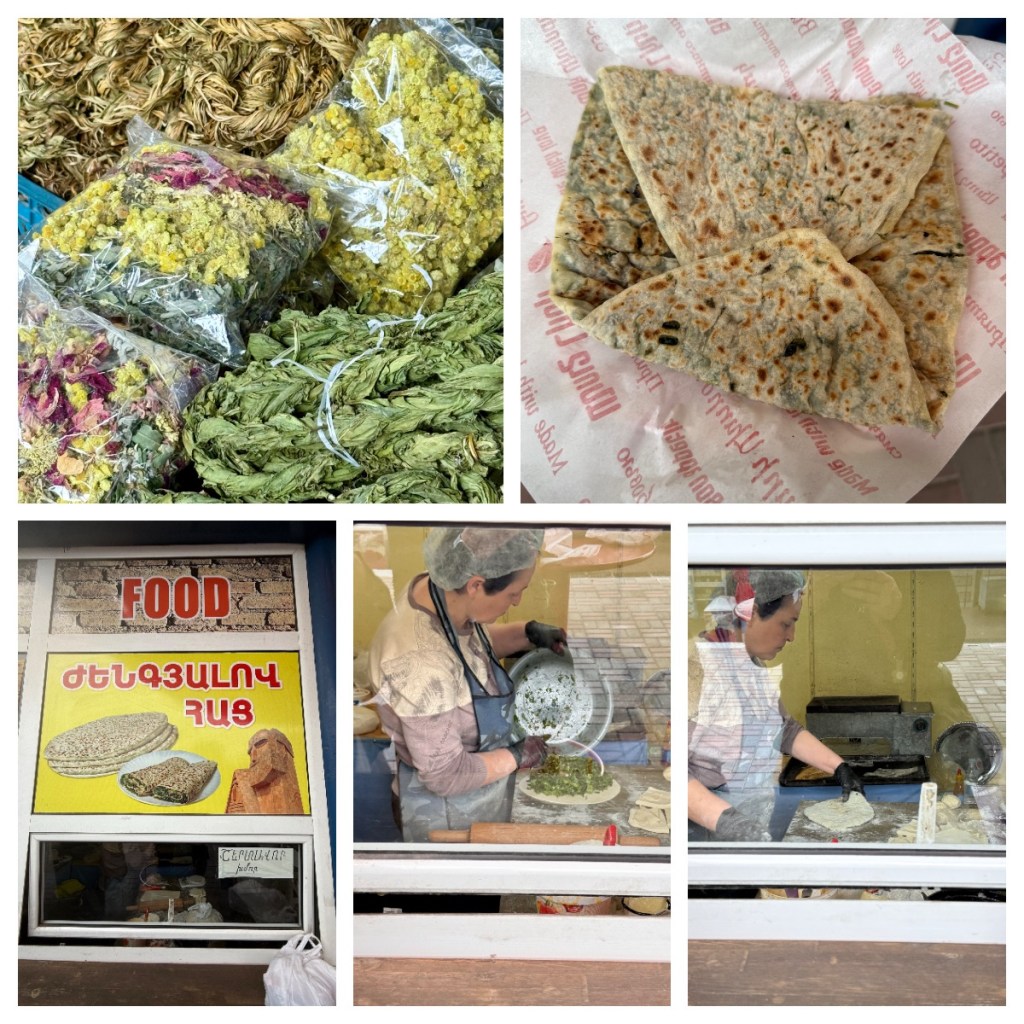
We wandered through the market, sampling many of the products and Levon recommended we had lunch at one of the ‘hole in the wall’ places on the edge of the market. We were also keen to try local food so were happy to take him up.
As is normal, I did not make a note of what it was called (but I did take photos of the lady making them in the small hole in the wall shop. It was basically a lavash bread dough, with 15 types of herbs rolled in to it. One site I came across on the internet called it Jingalov Hat (in English) so we will go with that. It was delicious, what ever it was called.
From the market we headed in to the centre of the city. Yerevan is clearly a city where the old and new stand side by side, although its seems that much of the old is being demolished to make way for more of the new! It is also a place where Teslas coexist with Soviet era Ladas!
Yerevan is one of the oldest continuous settled cities in the world, starting in the 8th century BC with the building of the fortress of Erebuni. It has been destroyed a number of times by earthquakes and only became the capital of the First Republic of Armenia in 1918. I will probably touch more on this in the next blog.
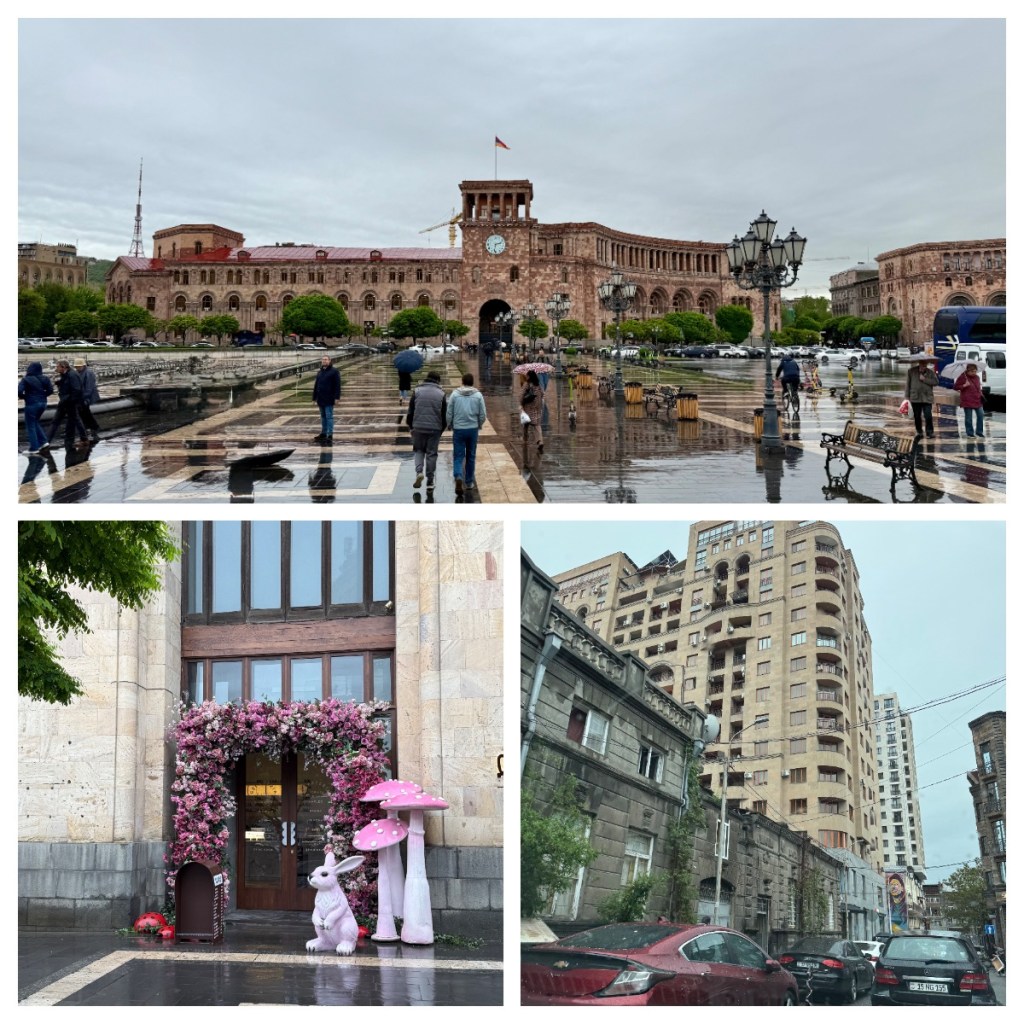
Parking is definitely at a premium and we did have to park some distance from our destination. At least this gave us the opportunity to walk through the streets, passed lovely looking cafes, breweries and fancy restaurants. It is most definitely a cosmopolitan city today.
Republic Square, the central town square was our destination. The “square” (its not really square) is surrounded by five major buildings, built in the pinkish “tuff” (local volcanic stone) which includes Government House, a hotel, and the History Museum of Armenia. There are also musical fountains but unfortunately, we were too early in the year for them to be operating.
Construction of the ‘new’ city started here in 1923, though these buildings were not complete until the 1950s. Not surprisingly, during Soviet times, it was called Lenin Square, it had a large statue of Lenin and was the location of many Soviet parades.
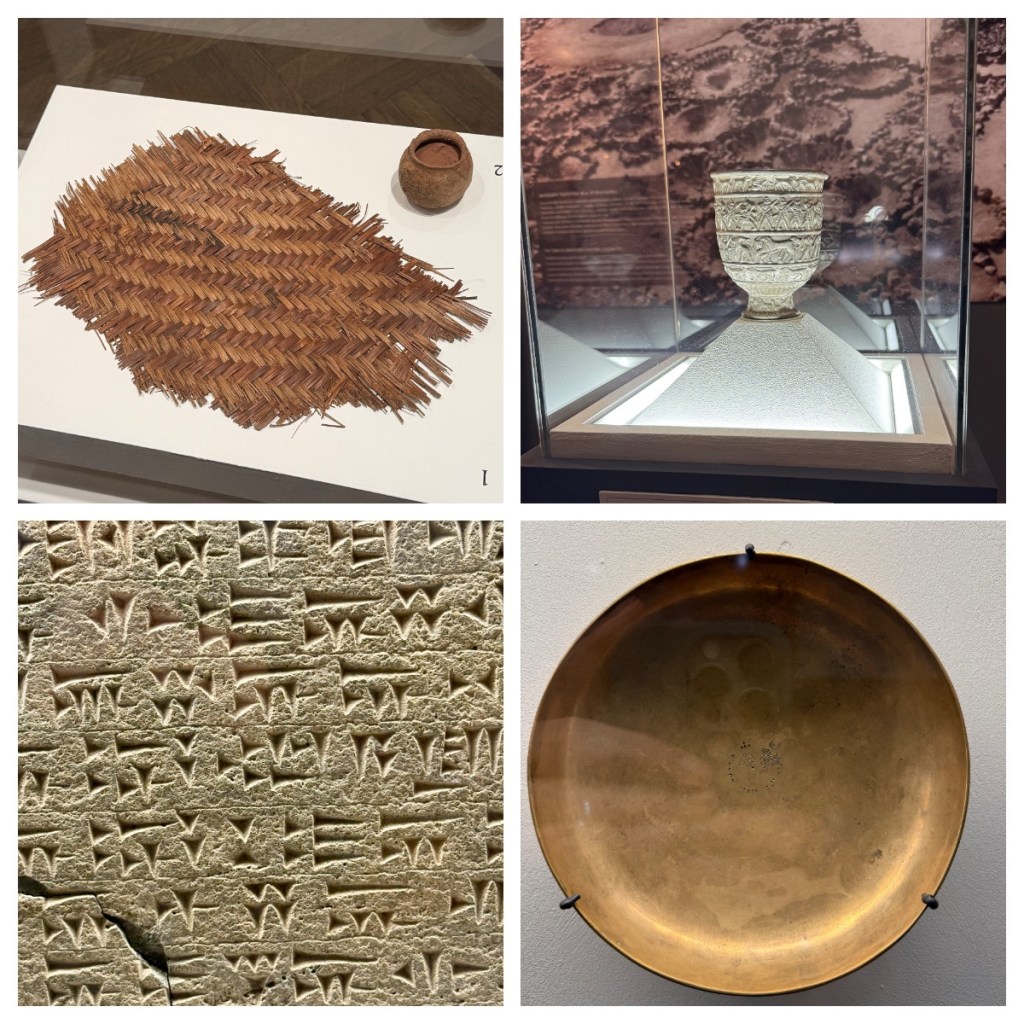
We were in the square to visit the History Museum which was vast with so much information to take in. We had a guide, who was French/Polish young man who was in Yerevan on a youth exchange but he had certainly done a lot of work learning about all the history.
I noted a few of the most interesting things we heard/saw:
- The museum houses a 15th century door that once lived at the Sevan monastery.
- The earliest settlements outside of African were in the Armenian highlands and had many ancient civilisations that I had never heard of!
- We saw the actual leather shoe that was found in the Areni-1 cave we had visited the previous day.
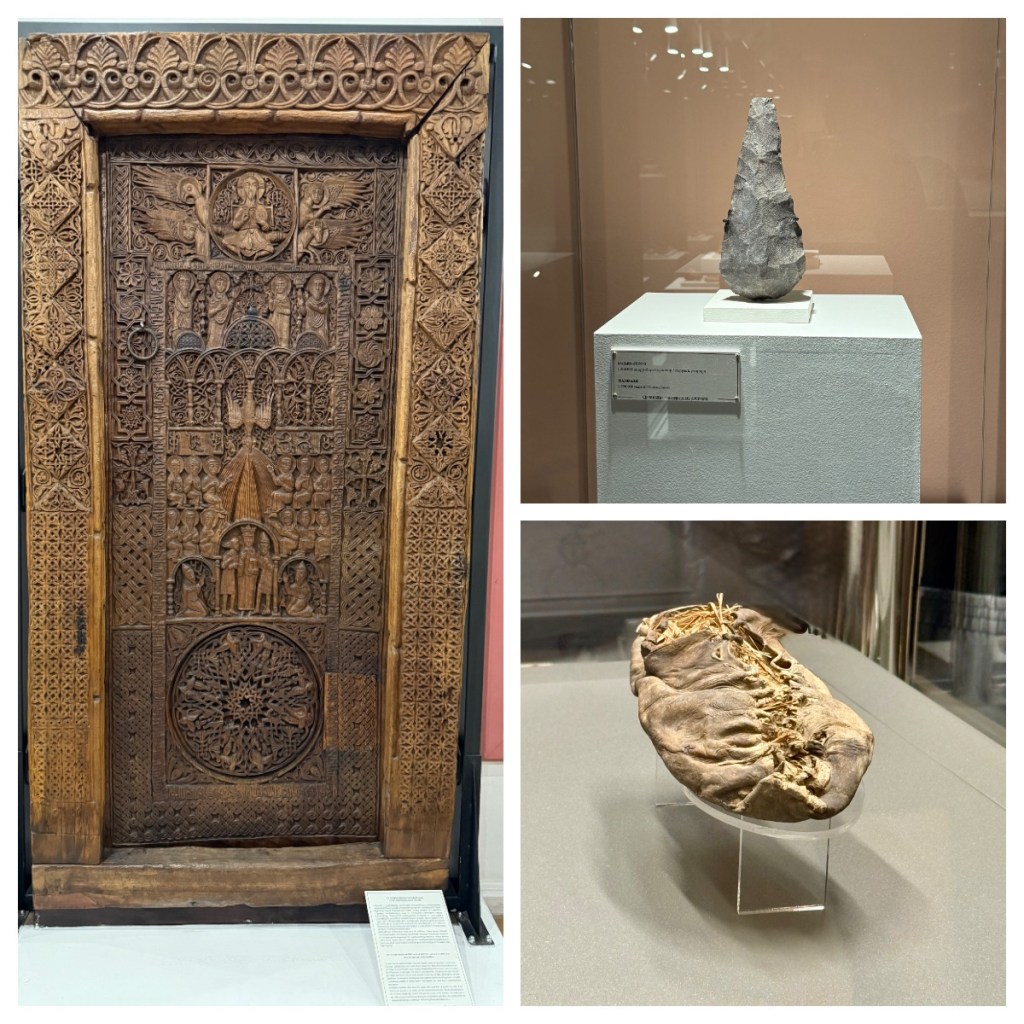
- Apparently, there were lions in the Armenia highlands until the 12th century are there are still leopards (the rare Caucasian or Persian Leopard) today.
- The Urartu Kingdom, also known as the Van Kingdom (which we had met earlier in the day at the Garni temple) were very powerful and had their own unique language.
- Wine is part of the culture (I think we knew that already lol).
- First Armenians were seen in the 6-4 centuries BC, under Persian domination. The took advantage of Alexander the Great’s death to get independence.
- Tigranes the Great (or King Tigranes II) became ruler at 14 and ruled from 95 to 55 BC. He lived until 85 and is still considered a great ruler.
- Armenian’s are very proud of their Christianity and it helped them get their freedom from the Zoroastrianism Persians and Pagan Romans. Along with Gregory the Illuminator, apostles Thaddeus and Bartholomew were also instrumental in the formation and spread of the Armenian apostolic church and creation of the Armenian identity.
- The Armenia alphabet was oral until the 5th century when a monk was asked to create a written language. The 36 symbols or letters he came up with are based on the phonetic principles of “one symbol for one sound”. Having a written alphabet was of great political and cultural importance.
- The Bagratid Armenian Kingdom once ruled most of present day Armenia and eastern Turkey and it’s capital , Ani (from 961 to 1045) was of strategic importance and was one of the world’s largest cities in its heyday. Unfortunately, today, it sits in eastern Turkey which makes it difficult for Armenian’s to visit but they still consider it a symbol of Armenian national heritage.
It was definitely a lot of information to take in, in just one short hour but definitely worth a visit. Before finished up for the day we had a quick look around a derelict building which is currently being used as a bar and small shops by some Russians – at least until the entire building is knocked down to make way for another new tower block!

Yet another busy day ended up back at the hotel for a couple of hours before going out for dinner – I even changed and got a little dressed up, the first time on the trip! Every day was so busy we were always exhausted and too tired to doing anything except eat 😂 . (This is not a problem for me lol.)
We had a lovely dinner in the very busy Yerevan Tavern before wandering back down to Republic Square via a pedestrian mall. The rainy day had turned into a lovely evening so it was nice to join the Friday night crowds for a while.
We finished up in the bar on the 9th floor of the hotel for a view up to Mother Armenian and the ‘Yerevan eye’ lit up for the night.


 Cockneykiwi takes flight