
Armenia, April 2025


I was back in fine form today and I was ready for our busy day ahead. Our first stop was at Zorats Karer, also known as Karahundj, or the Armenian “Stonehenge”. Despite it already being around 9.30am, the site was closed and after waiting for a short time, taking in the beautiful morning surrounded by mountains and bird song (and the toilets with a view), we went on a mission to get in!
This resulted in us walking through the field next door, through thick clay like mud that stuck to our shoes – by the time we got to the fence on the other side our shoes were sooooo heavy, caked in this mud!! We then had to slide under the fence, and I was very grateful I did not put clean trousers on today 😂 – it was all part of the fun though and there was no way we were going to miss out on this.
Unlike the English Stonehenge, which you can now only view from a distance, this megalithic site is free for us to roam around, despite the fact that these stones are thought to be 3,500 years older than the English equivalent!!
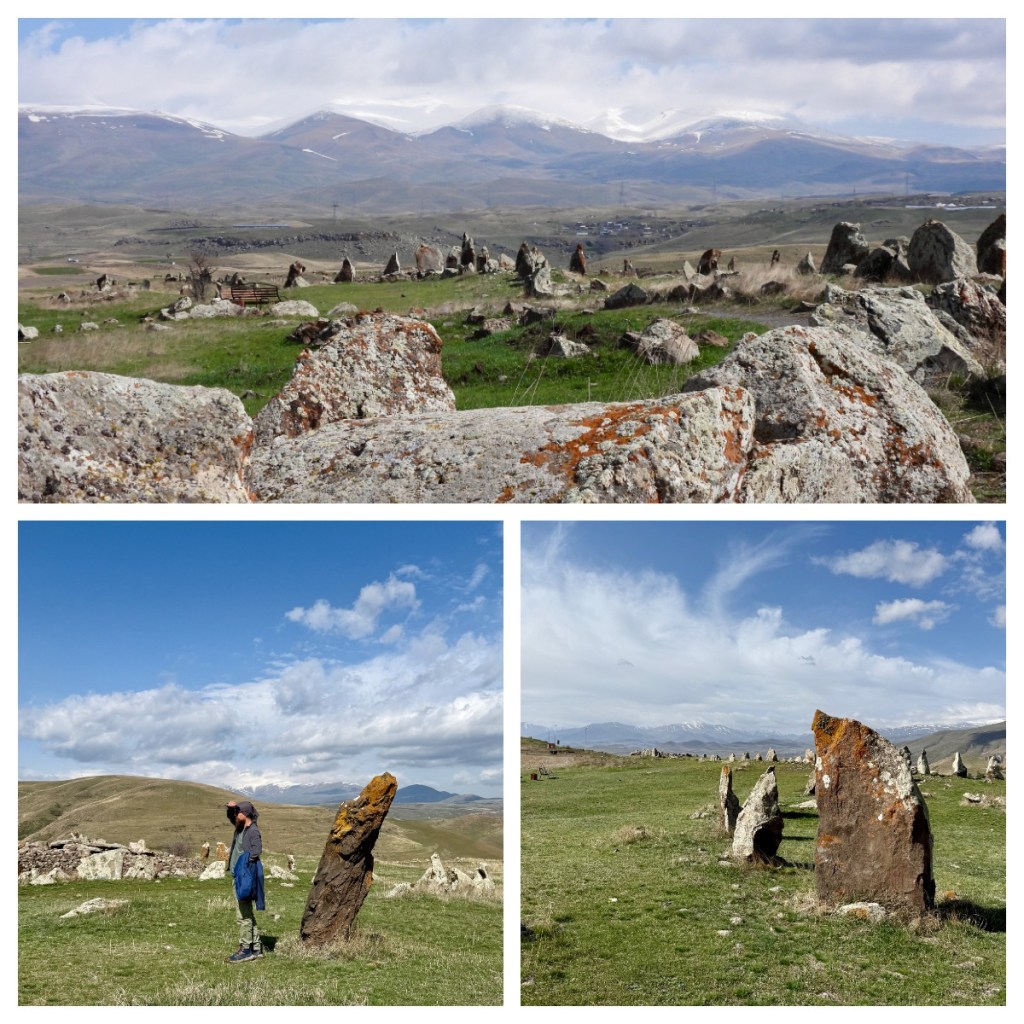

There are over 200 large stone monoliths, 80 of which have distinctive holes bored near the top edge and the purpose is still being debated. Most consider it an ancient astronomical observatory (it was one of the world’s first), but other theories include a Monument to the Sun God and/or a burial site or sanctuary for soldiers.
It was an incredible site to see and by the time we had finished looking around, the site caretaker had turned up and unlocked the gate (so we did not have to walk through the field again to get out). Of course she did tell us off; to be fair she only told Levon off, for effectively breaking in 😂 .
Every day in Armenia seems to bring windy mountain roads and spectacular views and today was no exception as we continued on through the countryside, passing through more small towns. Most with friendly stray dogs, some with Storks, nesting on power poles (as we saw in Georgia).

Our next stop was Areni-1 Cave complex, named after the endemic Areni grapes, which grow in the area with very little water. This particular cave complex became renown in 2008 when a PhD student, researching the early Bronze Age site, found an old shoe! Not any old shoe, perhaps the oldest complete leather shoe found in the world, being dated to approximately 5,500 years ago! Despite its age, it is in pretty good condition due to the cool and dry conditions in the cave, and the layer of sheep dung it was sealed in! The actual shoe is now kept in the museum in Yerevan.
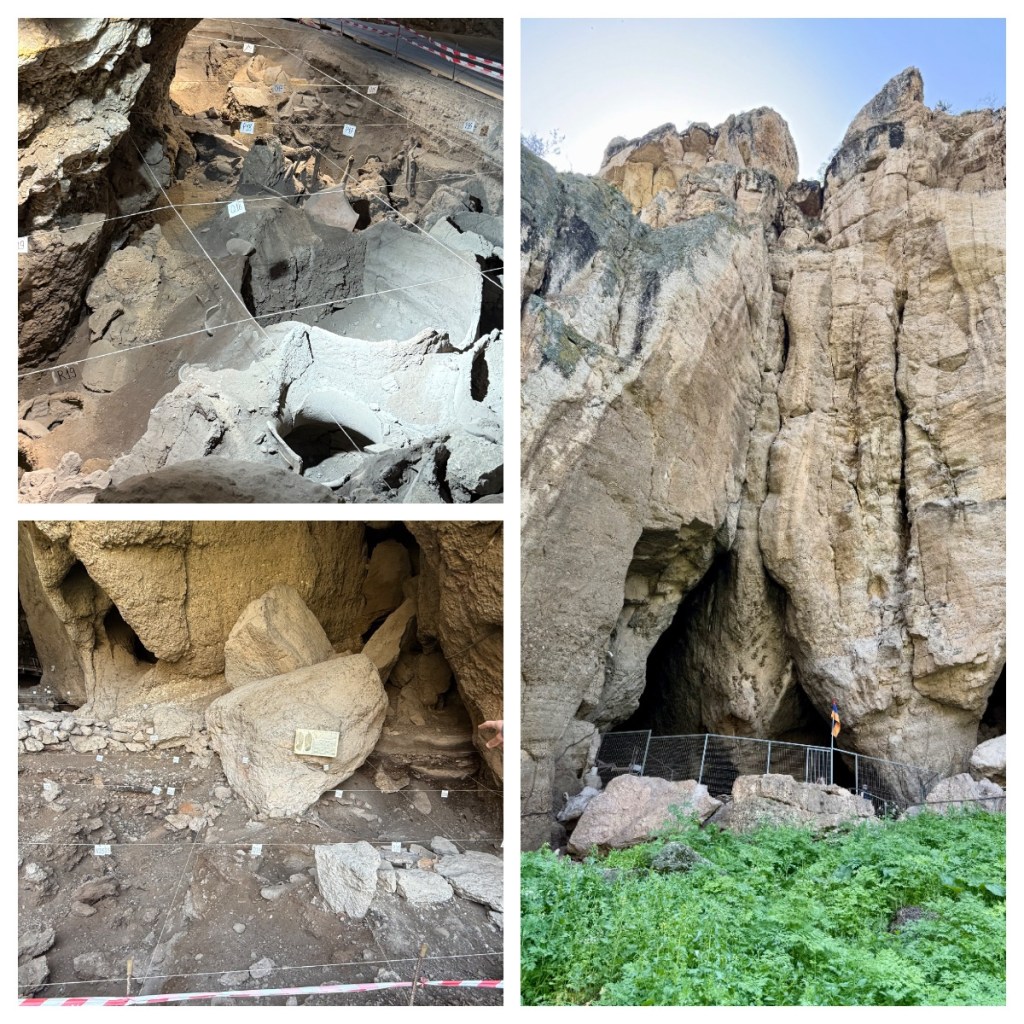
Other artefacts found in the caves include weapons, jewellery, ceramics, petrified grains, apricots and grape seeds, burial jars with human remains. They also found wine making artefacts dating back more than 6,000 years! Only 10% of the cave complex has been excavated so there are likely to be more exciting and important finds in the future.
As a side note, Levon told us that during Soviet times, the Soviet rulers insisted on all the winery’s making Brandy rather than wine and Armenian brandy was some of Stalin’s favourite. He actually supplied Churchill with it!
We had lunch in a lovely café covered in beautiful wisteria and this time Levon recommended something with buckwheat and mushrooms (Emmer Pilav), something with the wild herbs that we have seen people picking on the road side and egg (Mandak)and then a meat dish which can be served cold (which is very fatty) or hot cooked with egg which we opted for.
If I recall, this is a very traditional dish, where the meat is cooked with lots of fat and then stored in clay pots to preserve it (dating back to harsh winters before refrigeration and war time). Google tells me it is called Ghavurma. Having it cold with all the fat was a stretch too far, but cooked with the eggs it was pretty tasty.

It is quite clear to me that I will never be a food blogger! I forget to take photos before we start eating and/or I forgot to properly note what we are eating! Whatever it was, it tasted good!
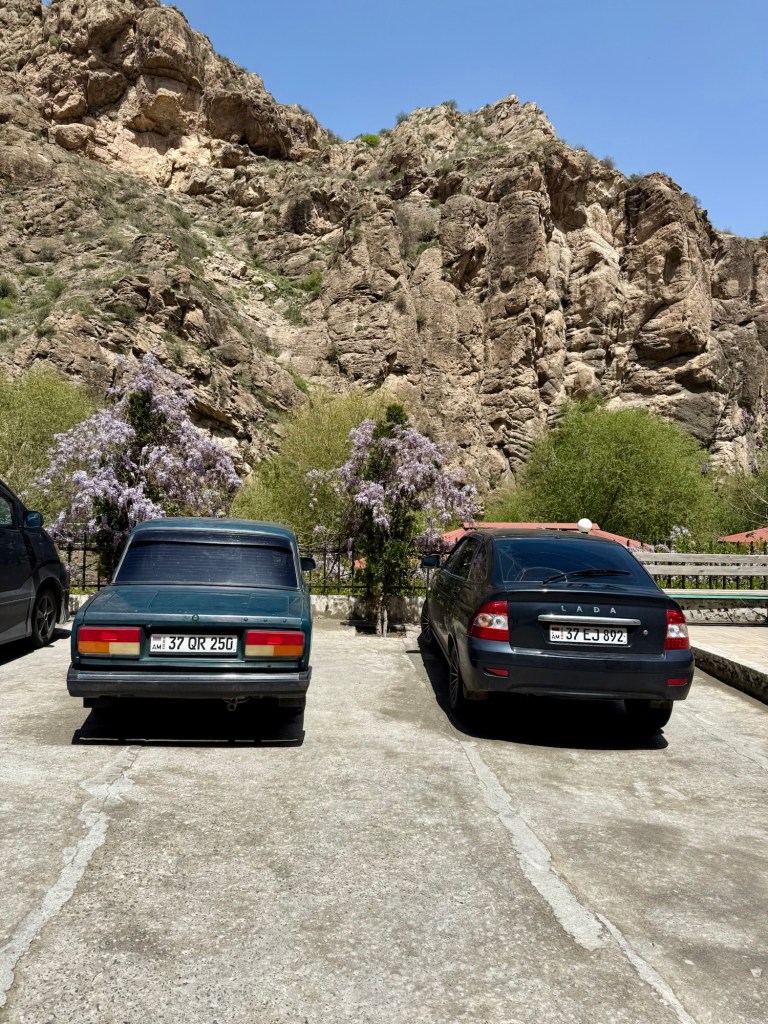
I might just note that there are more Lada’s here, and even a new one, so they are clearly still making them. I bet they won’t last the many decades the old ones do!
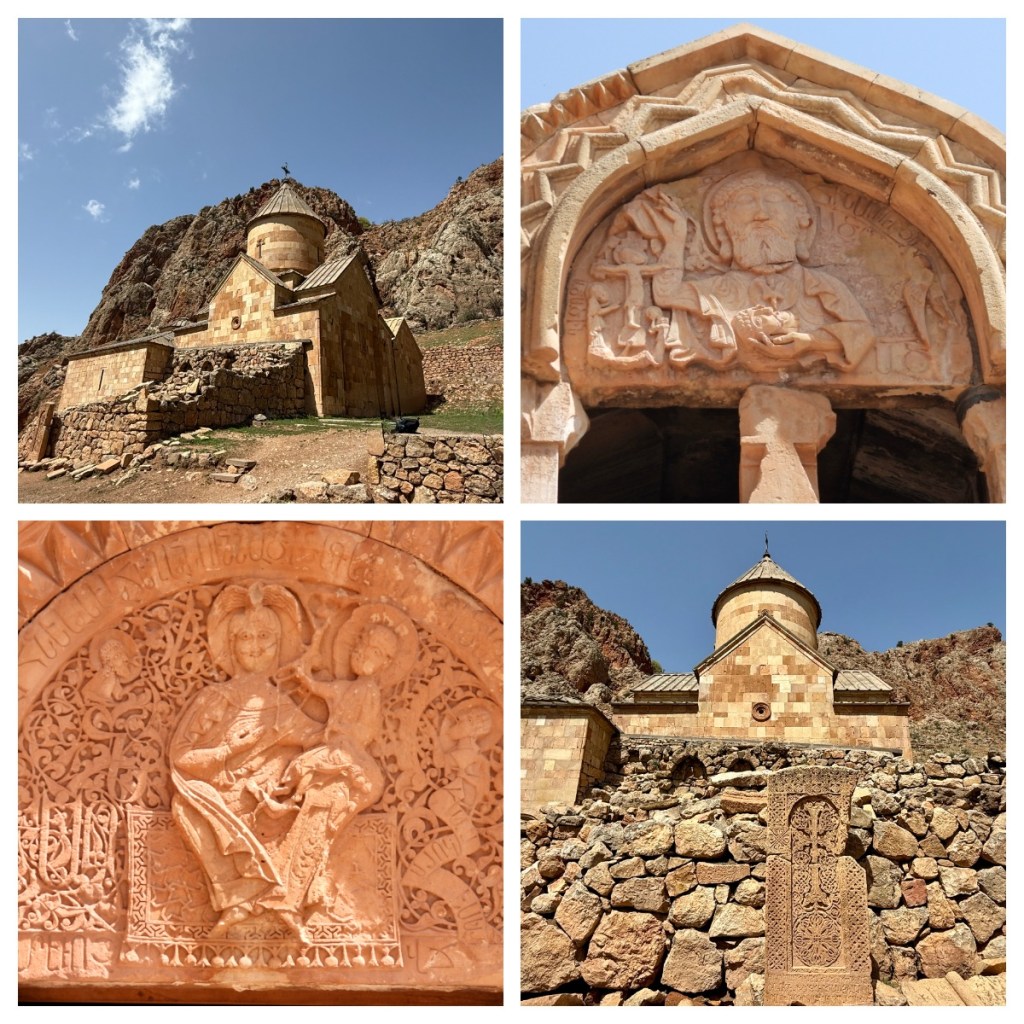
From our lunch spot we drove through the stunning red cliffs of Noravank Gorge to the Noravank Monastery complex. The area actually sits in the Noravank Sanctuary which covers a number of diverse ecosystems, as well as being home to Bezoar goats (or ibex) that are native to this region.
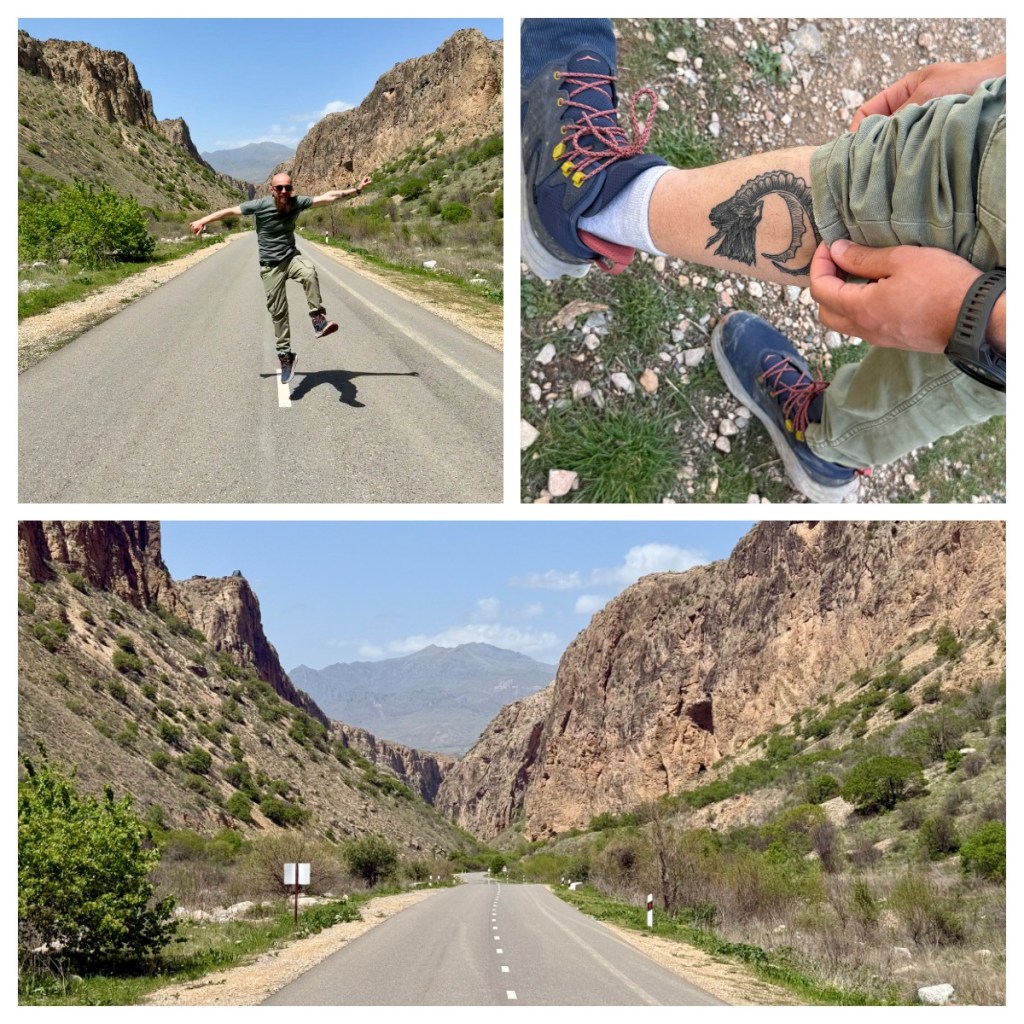
We did scour the higher areas to see if we could see one, but sadly not – thankfully Levon has one tattooed on his leg, so we kind of saw one?? Super guide Levon comes through for us again lol.
The monastery itself dates back to the 12th and 13th centuries (after the earlier 9th structures were destroyed in an earthquake) and was the residence of Orbelian princes and now the resting place of kings. It is much more ornate that most Armenian churches and is the only church which has an image of God in human form (a practice that is against the Armenian Apostolic Church’s rules). In the intricate carving, he is apparently holding Adam’s head in his hand and it was supposed to be a simple explanation of the bible for those who could not read.


After exploring the complex, we headed back down through the gorge (stopping for photos and taking video as directed by Levon lol) and it is time for wine tasting at Areni Winery. A family run business that manufactures around 250,000 bottles a year from local grapes, some in the traditional clay pots and some in the European barrel method.
As in Georgia, I preferred the barrel method wines, but perhaps it is because that is what I am more used to? They also had a number of fruit wines (peach, raspberry, blackberry, cherry and pomegranate), all of which were very strong.
My favourite here was the semi-dry red, and I decided to purchase a bottle. Not just any bottle. One dressed in the costume of a traditional Armenian man lol. The outfit cost a lot more than the wine but I must admit I love him – and have named him Armen. Armen the Armenia wine guy 😜 .

After a few days of low cloud, rain and cold, it was lovely to have some warmth and sunshine again as we drove through a small part of the country that bordered on Turkey, Iran and part of the Azerbaijani occupied territory of Artsakh. The good weather meant we got our first glimpse of Little Ararat, and her famous big sister, the mighty Mt Ararat of biblical fame – where Noah’s Ark landed after the flood.

We continued to pass cars and trucks that looked so old and so battered that we were surprised they could be on the road. Levon told us that although there are ‘fitness’ checks for vehicles, if they were extensive (like they are in other countries) there would be hardly any cars on the road! Apparently, they only check brakes and lights and sometimes even those checks are falsified!
As we were close to the border(s) we talked more about the ongoing territory conflicts in the area. It turns out that not only is Levon a superstar guide, but he is also a bit of hero! Back in 2020, he and a number of friends went over the border into Artsakh in the middle of the night to save khachkars from likely destruction. Some of those saved were over 1000 years old.
We stopped at the perfect photo stop with the Khor Virap Monastery over shadowed by Mt Ararat and the beautiful Armenian flag flapping in the wind. Unfortunately, the lighting wasn’t perfect but it was still a stunning view! From here we could also see how close we were to the border with Turkey (see the white mosque).
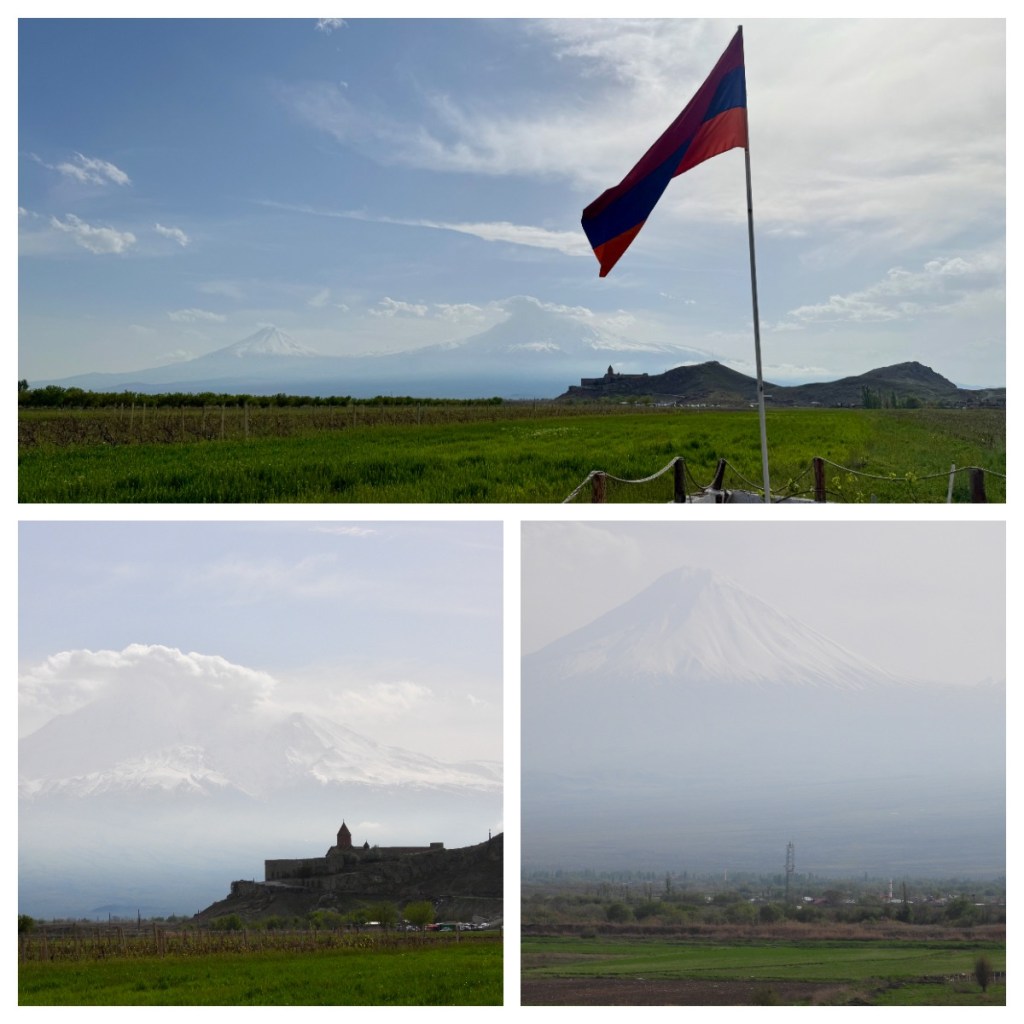
Despite being right on the border with Turkey, there is no open land border crossing between the two countries and to enter Turkey, you actually have to travel up to Georgia and then cross from there. This is testament to the tense relationship between the two countries since WWI.
The Khor Virap monastery was one of the most touristy sites we had visited on the whole trip, with a huge line of souvenir stalls lined up on the pathway to the monastery. Thankfully it was not that busy at the time we were there, but it is one of Armenia’s most important religious sites.
As I have mentioned in previous blogs, Gregory the Illuminator brought Christianity to Armenia in 301AD. Ironically, he was assistant to the pagan King Tiridates III and initially, the King tortured him for his Christian beliefs and then imprisoned him and left him to die when he heard that Gregory’s father had murdered his father! His dungeon, and home of 13 years was at Khor Virap, which actually means “deep dungeon” or “bottommost pit”.
But he did not die, and 13 years later when the King became sick (apparently because he ordered the death of 40 women preaching Christianity), his wife dreamt that only Gregory could save him. So he was brought out of the pit, cured the King, was given salvation and the King accepted Christianity! Well, that was the story we were told.

I have read some variations on this but the gist is the same. Punished by the King for being Christian, someone had a dream Gregory saved the life of the King, the King converts … the end. The pit that St Greogry was allegedly kept in is still open for people to climb down, via a steep ladder. There was a bit of a queue so we did not bother!
The first chapel was built on the site, in a mark of respect to St Gregory in 642 and this has been repeatedly rebuilt over the centuries until 1662. Today you can see inscriptions on the buildings which apparently is graffiti from people fleeing the genocide in 1917/18.
From Khor Virap we continued on the 45km to Armenia’s capital, Yerevan. It looked huge as we drove towards it, a great sprawling city, housing over a third of the country’s population.

We checked in to a lovely hotel here, I even had a view of Mother Armenia from my window! It had been yet another awesome day. Armenia truly has been full of laughter and kindness.
 Cockneykiwi takes flight