
Republic of Azerbaijan
April 2025
Currency – Azerbaijani Manat
NZ$1 – 0.99 Manat

Welcome to Baku, the capital of Azerbaijan – the Land of Fire.
Firstly, settle in for a little background. Azerbaijan is a country in the South Caucasus area of Eurasia, bordering on Russia, Georgia, Armenian, and Iran. Its capital, Baku sits on the shore of the Caspian Sea (which I think I have mentioned in a previous blog, is technically a lake).
Like Turkey, it straddles Asia and Europe and Baku really shows this blend of cultures, looking like the love child of Dubai and Vienna with wide European style boulevards, flanked by very European style buildings; towering, hypermodern, geometric glass buildings and historic Silk Road caravanserais.
The country has a population of approximate 10 million, 4 million of those living in the capital of Baku. 90% of the population are ethnic Azerbaijanis and most are Muslim (although it does not appear to be practiced strictly).
The country has an incredibly complex history and I am not sure I will even be able to scratch the surface in the short time I have in the country, but as always I will do my best to get in to it , and bring you along for the ride.
I had a pretty good nights sleep and enjoyed a decent breakfast at the hotel – an interesting range of cheeses, vegetables, cake, and a few things I didn’t know what they were 🤨. After breakfast, I meet up with my friend Ania, who had arrived from Dublin the night before, and we met up with our local guide, Rugiya, who would be with us for our time in Azerbaijan.

As we navigated the traffic of the city (yes, I can confirm traffic is bad!), Rugiya gave us a little background of the country and city (which I will try to explain over the next couple of blogs).
Our first stop for the day was at Highland Park, the highest point of Baku, giving a panaromica view across the across the city and the Caspian Sea. The beautiful, peaceful park also houses a number of memorials to fallen soliders.
The soil in the area is very salty and it’s impossible to grow anything (we will see more proof of this when we travel out of the city). When wanting to beautify the city with green areas, soil had to be brought from other parts of the country.
It is probably at this point I should mention Baku’s most iconic buildings – the Flame Towers, 3 flame shaped towers (the tallest being 182m tall) completed in 2012. The flame shape symbolises the “Land of Fire” – from natural gas that comes up from the ground around the country, and the Zoroastrian religion that considers flames to be a symbol of the divine. The buildings house apartments, a hotel and offices and dominate the city skyline by day, and by night (we will see more on that later in the day).
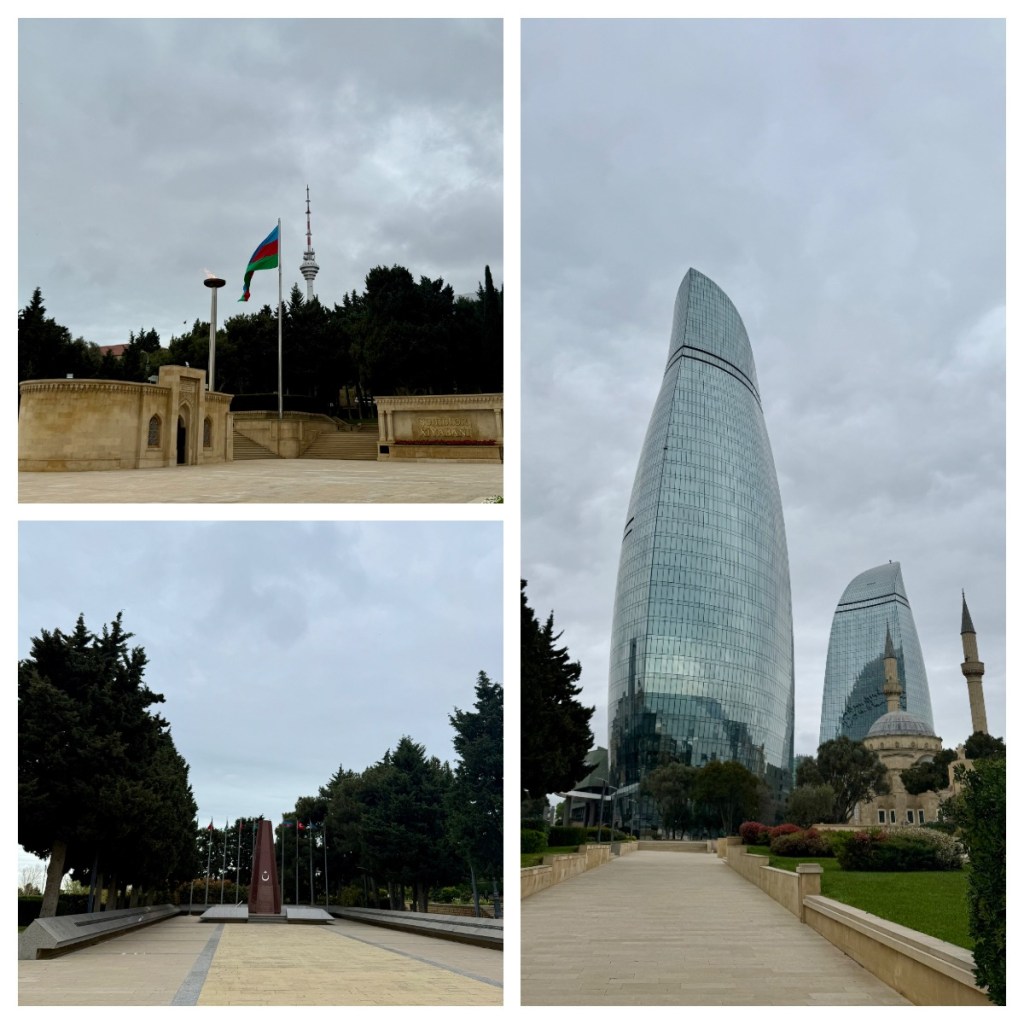

From the view point in the park, we could see down the coast, from the 2nd highest flag pole (it was the first until the one in Tajikistan was erected); the Cyrstal Hall, built for the Eurovision contest in 2012; the “Baku Eye”; and the Sydney Opera House like, Deniz Mall. We could also see down to the new Crescent building (that I had seen the day before). When open, it is apparently going to be a 7 star hotel.
From the park, we headed down to the the UNESCO World Heritage Old City, which is still surrounded by the reconstructed, 12th century fortified walls, passing through the double gates, featuring the coats of arms of the ancient city of Baku. There are various versions of its meaning. It features a Bull’s head (believed to be linked to cattle breeding, replacing growing crops which was impossible in the salty soil) and therefore a symbol of the ancient city. There are also two lions, probably as a link to the city’s orient culture, or a symbol of the Safavids, who took the city from the Zoroastrian’s.
It is widely believed that old city construction started in the 12th century, with various buildings ranging up until the 16th century. But buildings such as the Bukhara Caravanserai are believed to date back as far as the 8th century, when the location grew in importance due to it stragetic location on the Silk Road and the shores of the Caspian Sea.
Many of the old buildings have been carefully restored and reconstructed (following the strict UNESCO rules to maintain authenticity) and the area is so clean … and full of very friendly and well looked after stray cats. Unfortunately both the large Caravanserai’s were closed for recontruction. (If you have read some of my Central Asia blogs, you may remember that a Caravanserai was an inn that provided lodging for Silk Road travelers, merchants and caravans of camels). It was interesting to learn that the door of the Caravanserai has two knockers, a large one for men and a small one for women. This way the people inside knew who were outside and who should open the door (remember most were Muslim and therefore men and women did not mix.)


It was clear from many of the items in the souvenir shops, that Pomegrantes are important to Azerbaijani culture and tradition. They are not only the national fruit, but they symbolise abundance, blessing and fertility. We will go on to see them depicted in decoration of buildings, as well as being used in many local dishes and wine.
We climbed the 12th century Maiden Tower (Gyz Galasi in Azerbaijani), one of the icon symbols of the city. It is 28m tall, but oddly, because the Caspium Sea is actually 28m below sea level, when standing on the top of the tower, you are at sea level. When built, it was on a rocky ledge that jutted out in to the sea, but today it sits 200m from the waters edge. I should probably note there is some dispute about when it was actually built – with views ranging from as early as the 5th century, through to the 12th (and in some schools of thought, a combination of those).
The eight levels, reached by winding staircases, are now filled with information about the old city and the tower itself and from the top there are panoramic views over the city (though sadly today there is a perspex barrier between you and the view). The walls are made of thick brick and it even has its own well.
As the year of construction is debated, so is the tower’s purpose. Too small for it to be defensive, too many windows for warfare. Perhaps a Zoroastrian temple and definitely a beacon for ships in the 18th and 19th century. Or perhaps we will just stick with the legend of the king who was forcing his daughter to marry a man she did not love. She asked her father to first build a tower for her, which she then committed sucide from, by jumping from the top of it! Perhaps we will never know.

An oddity of the city is the Miniature Book Museum. Apparently the only one in the world and hold a Guinness Book of World Records for the largest private collection of miniature books.


The next stop on our whirlwind tour of the city is the Palace of Shirvanshahs. Unfortunately the fast pace meant we did not have much time in the museum which was a shame. We definitely would have liked longer, but such is our itinerary, time is not always on our side.
The Palace is thought to have been built in the 15th century and is descibed by UNESCO as “one of the pearls of Azerbaijan’s architecture”. The complex consisted of the main palace building, the shah’s mosque, Seyid Yahya Bakuvi’s mausoleum and the remnants of a bath house. Not forgetting the great view across to the Flame Towers, highlighting the cities complex relationship between the passed and the future,

Before we entered the Palace, we took pause in front of some bullet pock marks on the side of the building. A reminder of the 1918 Azerbaijani genocide, where it is said, Aremnian Dashnaks, supported by the Russian Bolshevik leader Lenin, started a mass extermination of Azerbaijanis. During 3 days, they attacked and killed all Azerbaijanis they encounter and approximately 2 million people were killed. The site we saw at the castle mentions a number of 12,000 but that was probably only in the old city. I guess a little understanding of this history helps put the ongoing troubles on the border in perspective. It will be interested to understand the other perspective of the conflict when we get to Armenia in a couple of weeks time.
A couple of points of interest that I noted as we rushed through the museum was that women’s belts were an indication of age – the bigger the belt, the older the woman. And second was the changes in the language over the years … the spoken language has remained the same, but the written language has changed from Arabic to Cryillic to Latin over the course of the centuries.

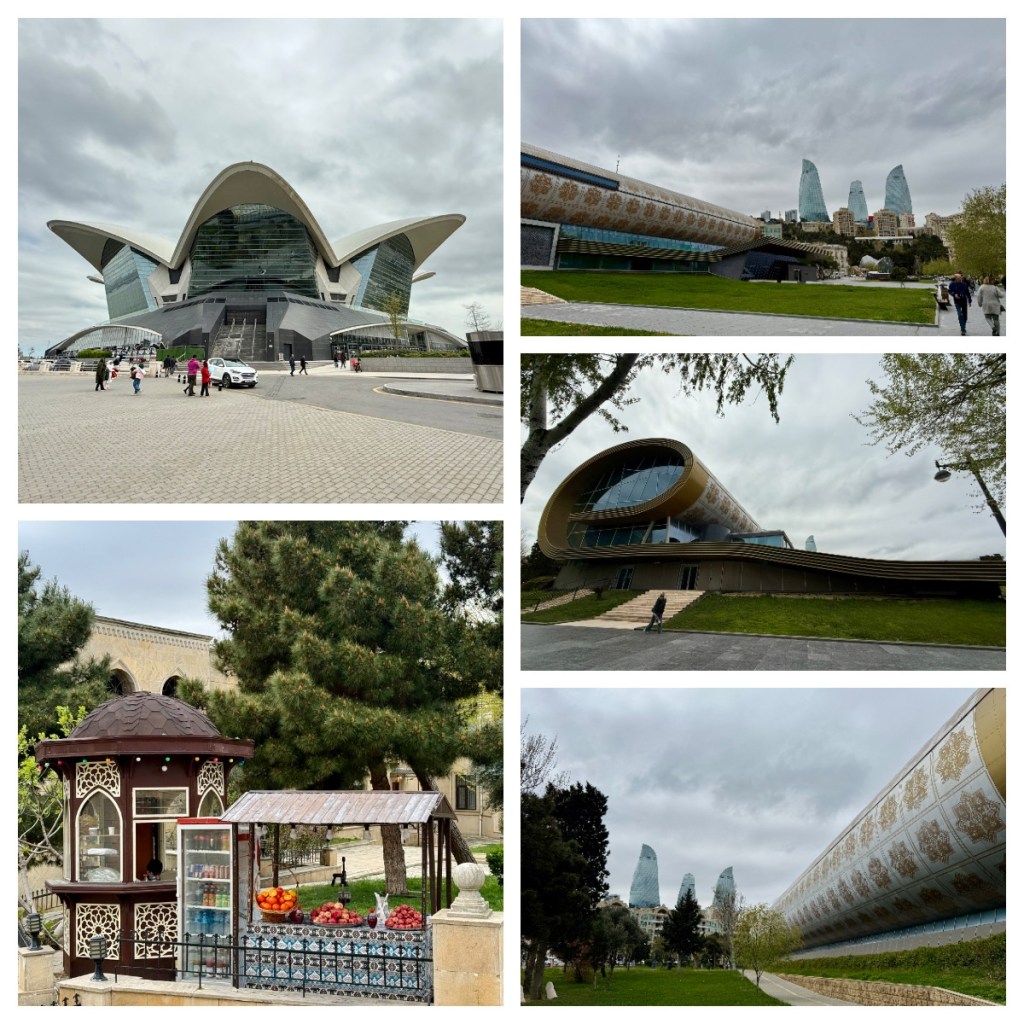
We spent a few minutes around the Carpet Museum on the Seaside Boulevard, another of Baku’s iconic buildings – this time shaped as a rolled up carpet. Carpet weaving was listed by UNESCO as an Intangible Cultural Hertiage of Humanity. We did not have tickets (or time) to go in, but we would see some carpets in our next destination, yet another icon landmark of the city – the Heydar Aliyev Center.
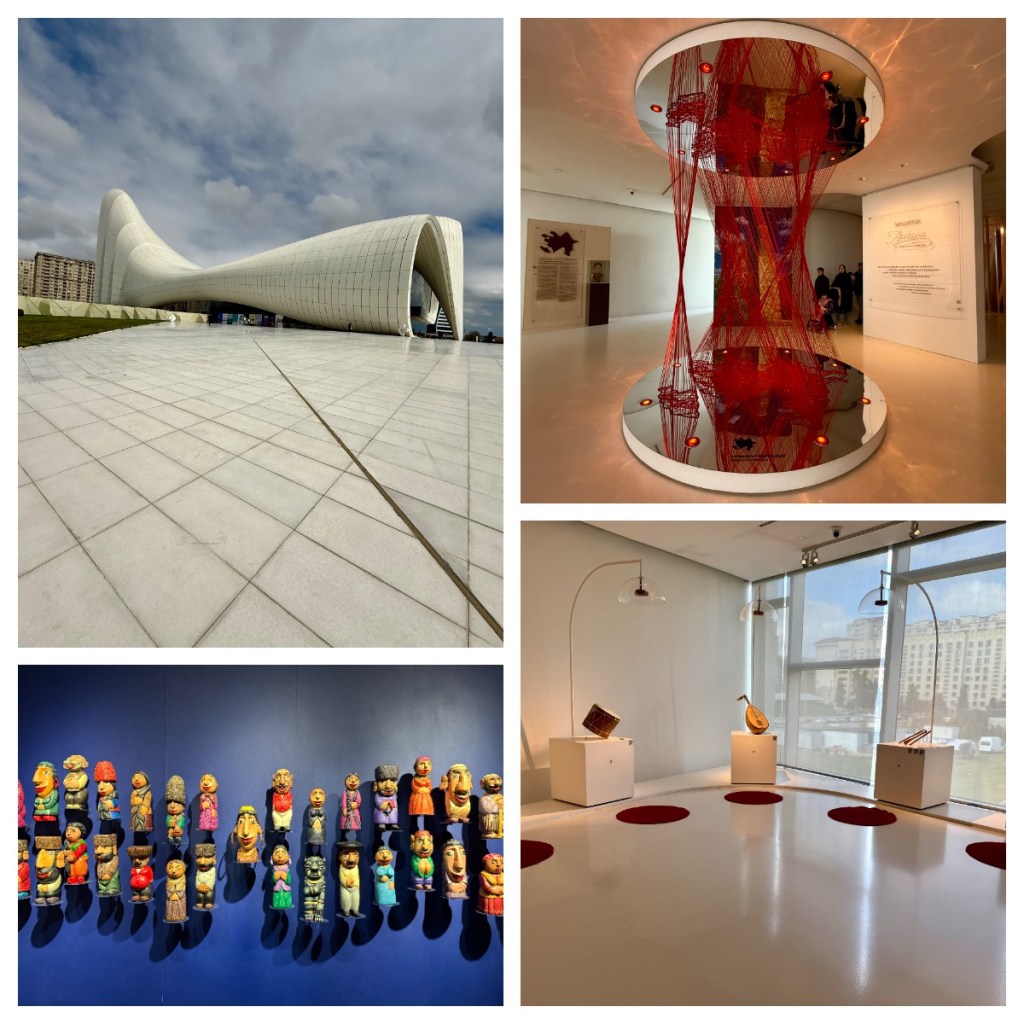
The Heydar Aliyev Centre was as unique on the inside as it is on the outside and housed an interesting range of international temporary exhibitions and permanent local ones on traditional clothing, musical instruments, dolls and carpets – some of the most beautiful carpets I have ever seen. An finally an exhibition about Azerbaijan’s model of tolerance – excepting all people, race and regilion.

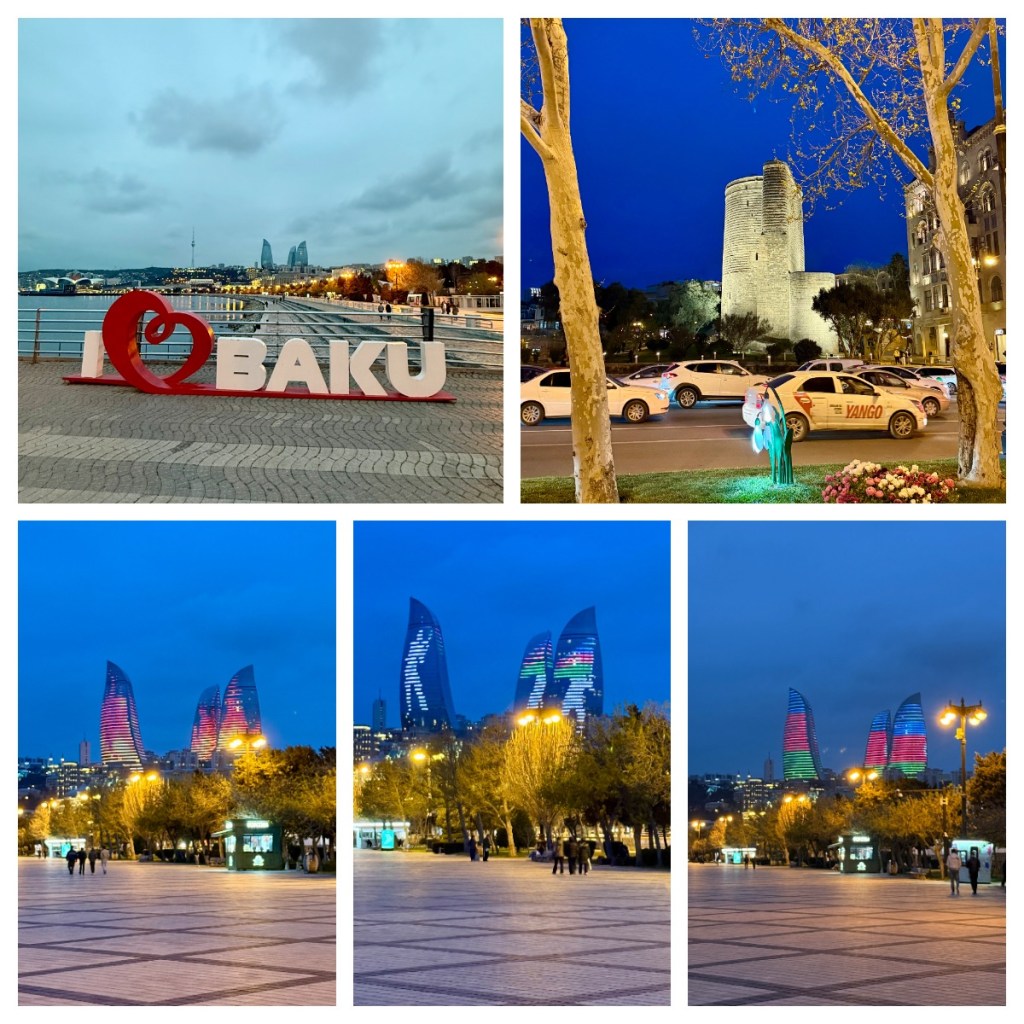
After a short break back at the hotel, Ania and I headed out for an evening stroll along the boulevard. The cold wind we had coped with throughout the day had died down, and it was a beautiful evening for a walk. The Baku Boulevard was initially established in 1909, running parallel to the cities seafront and is over 5km in length. Depisted being a Friday evening it was fairly quiet and peaceful.
The main reason for the walk was to see the buildings lit up, in particular the Flame towers and we were so excited when they came on, with images ranging from the flag, flames and people waving flags.
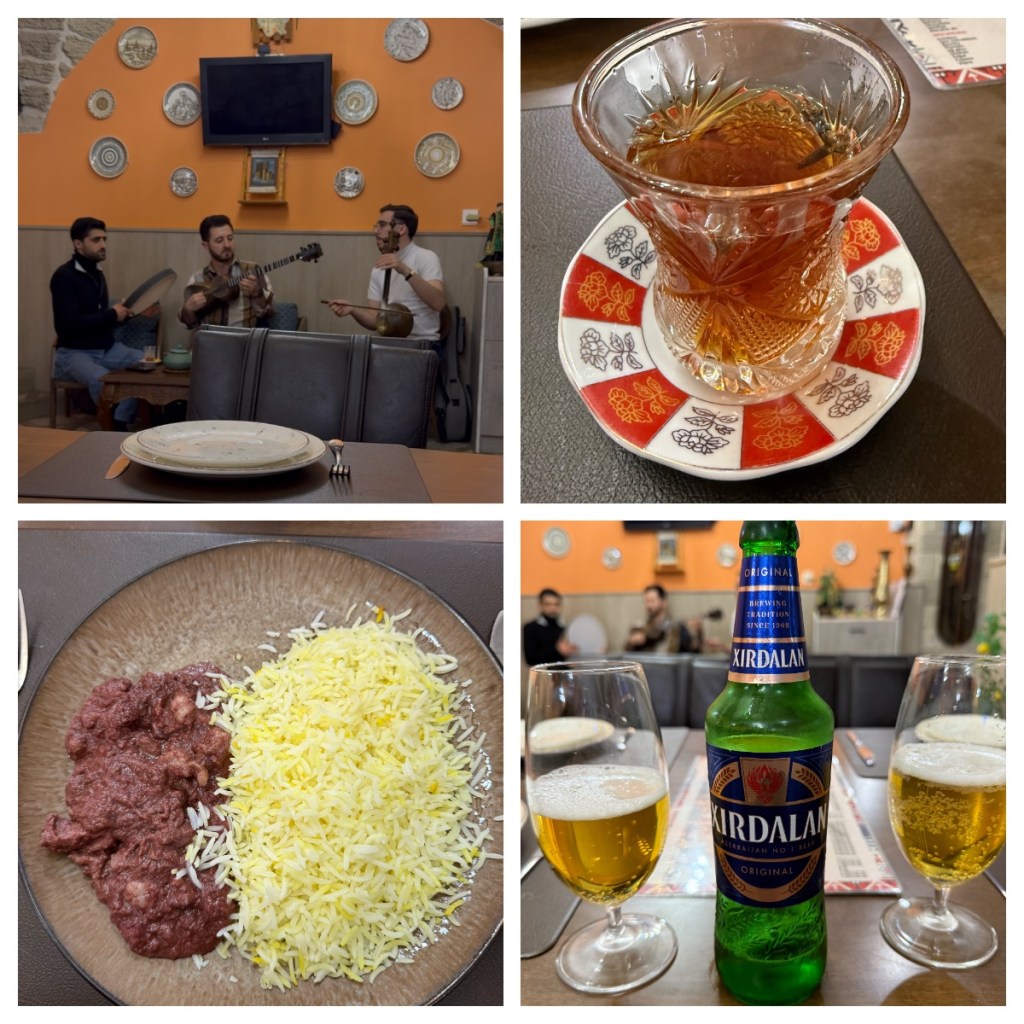
Even at almost 8pm in the evening, the traffic was insane, and there were very few places to safely cross the busy multi lane road (it seems driving in lanes is optional so there may be 4 lanes, or maybe there are 6 🤨 – who knows). After backtracking a little, we finally made it across and headed up in to the old city to found our way to a random restaurant with local food and live traditional music. Communication was a bit of a challenge but we ended up with pilaf (rice) with lamb and a cherry/pomegranate purée and a random drink made from Feijoa, local beer and tea. It was not attractive or particularly cheap (around NZ$25), but it was tasty.
We decided to be smart and use a bolt taxi to get back to our hotel (like uber) so we could just put in the destination into the app and not have to speak – epic fail! The taxi did not show up, but the app said it was at the pick up point and then the driver starting calling but he did not speak English. Not knowing where the driver was, and not being able to communicate, we had to cancel (but be still charged) and ended up getting a normal taxi at x3 the price with a driver who told us in broken English that all Bolt drivers are drunk or on drugs! We were probably ripped off, but at least we made and it back and that would enough adventure for one day. 😝
 Cockneykiwi takes flight
Wow, what a fascinating trip! Unusual but beautiful. Love the buildings and especially love the little book museum and the gorgeous carpets. I loved learning about this place Great travel writer
LikeLiked by 1 person