
Canada, August 2024
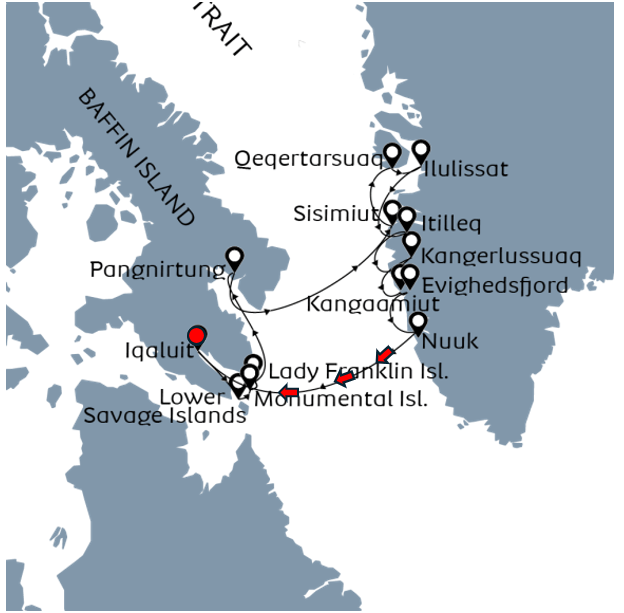
We all know how much I love a sunrise so I was pleased to be up just in time for it this morning. The time difference across the sea is 3 hours. So, to even that out, we put the on-ship clocks back two hour last night and a further one hour tonight.

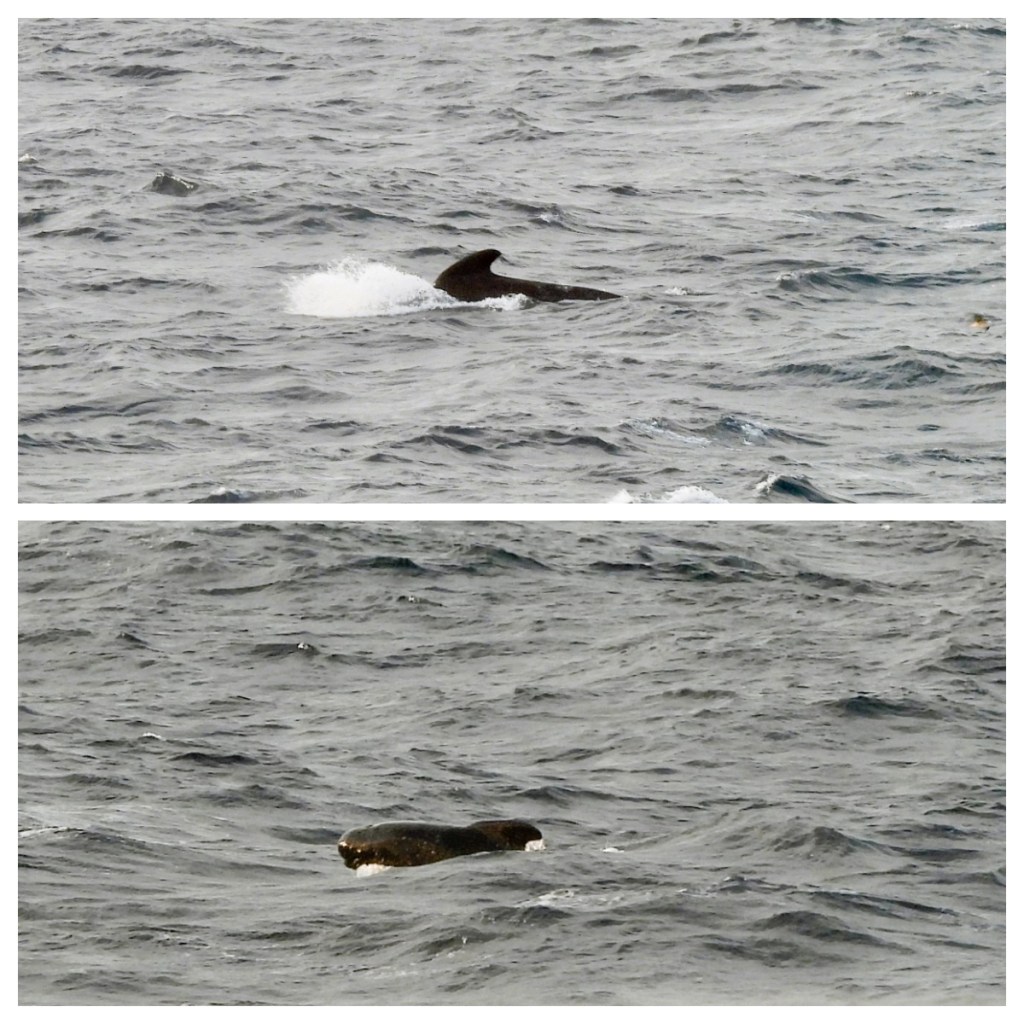
Clearly, last night was not the right time to skip dinner (which I had done because I had eaten so much during the day lol), as I was wide awake and starving early and there is no food to be had until what my body thinks is 9.30am 🥴 not even a biscuit in sight. Thankfully a pod of long finned pilot whales swam by to distract me a little 👍🏻. Whale sightings are always a great way to start the day.
As we crossed into Canadian waters we have a talk about seabirds. I must admit I was surprised by the lack of bird life so far. I am sure I remember in the Sothern Ocean, always being surrounded by large flocks of sea birds but here not so much. Despite that, I did spend some time on deck trying to take some bird photos and surprisingly got a photo of another whale. 😂. Not a good photo and it was hard to get an ID but possibly a Sei whale. I did also get a couple of half decent shots of the Northern Fulmars, who seem to be the most common birds we are seeing around the ship.


Being at sea meant a pretty relaxed day, and I think the jet lag was finally catching up with me so I took the opportunity to get some extra sleep but as the day wore on I had to head back up to the top deck to watch the big iceberg’s floating by on the generally calm seas. One of the icebergs had a large flock on kittywakes (I think) roosting on it which helped to give some perspective to just how large these icebergs are!


In the afternoon we had a talk on human migration in the region. An incredibly complex topic and one which I am not sure I fully understand, or could give any justice to here, but in a nutshell … many different Inuit people arrived at different times over the last 4,500 years and from different directions. They had various levels of success, the most successful seemed to be the Thule people who had bows and arrows for hunting, and were already using kayaks and dog sleds. They also used iron, some of which was sources from a meteorite which was found in the north of the Greenland.
Then came the Norse (basically Vikings) lead by Eric the Red in 982AD, a convicted murderer who had been banished from Iceland. Apparently, he is responsible for the name Greenland, thinking it would attract people to move from Iceland. They established two settlements and stayed around until the 1500s when another ice age meant they could no longer farm so had to move on.
The Dane’s arrived in south western Greenland in 1721, setting up seasonal trading posts and churches to convert the local Inuits. Today, despite being the ‘ruling’ country, Danes only make up 11% of the population, and only a similar amount speak Danish as a first or only language. Most of the Dane’s are in administration roles or are teachers/professors or skilled tradesmen.
I rounded off the day with some very cool icebergs and, just to top it off, a sperm whale 🐋. I must admit I was pretty pleased with my whale count for the day 👍🏻.

Despite arriving in Canadian waters yesterday morning, it was this morning we had to do the formalities once we arrived near Iqaluit (means Place of Many Fish) – a community in Nunavut, in the Canadian arctic.
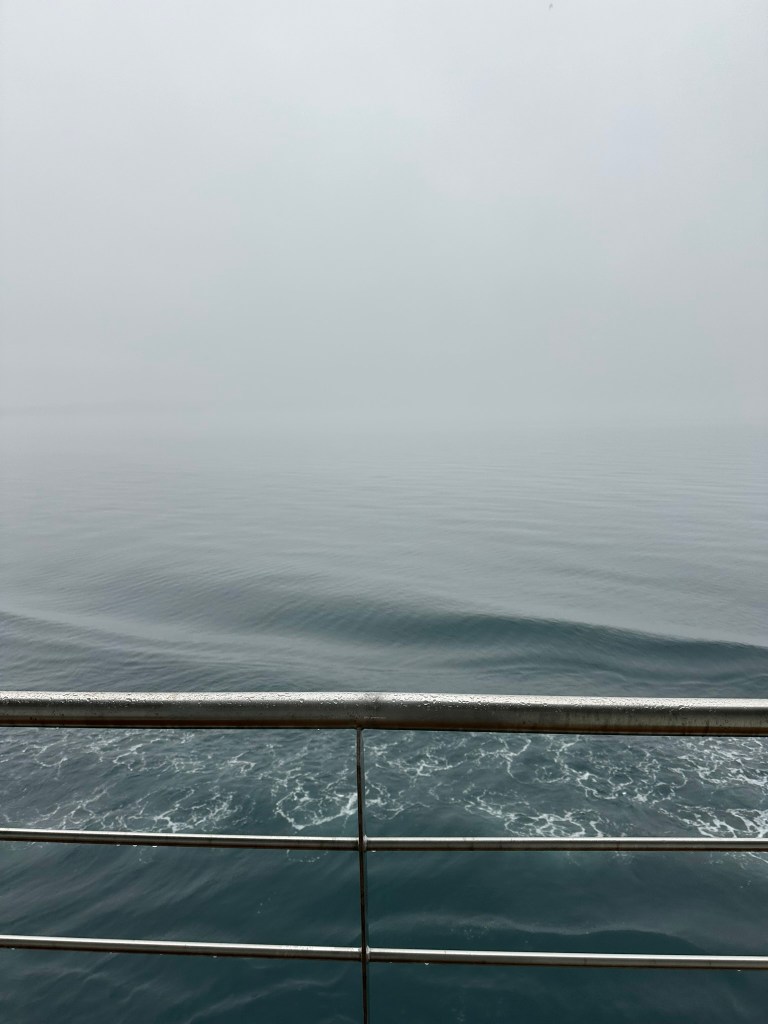
We had had another hour time change the night before so of course I was wide awake way to early again. I did get to enjoy an impressive thunder storm as we sailed towards the town, though we had little to no visibility due to the persistent rain and low cloud.
Nunavut (means Our Land), is Canada’s newest and largest territory, covering more the 1/5th of Canada’s land mass. It is made up of lots of islands and has a population of only 37,000 people. Apparently, there are 25 x more Caribou than there are people in the territory 😂 which is mostly ice cap and arctic tundra. And the area has very little rainfall so it seems that joke is on us, as my hike that had been planned for the day had to be cancelled due to the rain!
85% of the area’s population are indigenous (mostly Inuit) and there are four official languages – English, French, Inuktitut, and Inuinnaqtun. All signs have 4 languages on them and all officials have to speak all four! Interesting the written language for Inuktitut was developed by a missionary for the Cree language and it was adopted by the Inuit’s for the Canadian Inuktitut language.

We were not allowed to take any food off the boat, and, we had been advised not to buy things in the shops here as stocks in the town are very limited, so before departing the ship, we had 2 breakfasts! The first at 6.30am and the second at 9.30am! Unfortunately, it was closer to midday when Canadian entry requirements were finished and we were finally allowed off the ship.
Fun facts, Baffin Island is the 5th largest island in the world, and … Iqaluit has the second highest tide in the world (technically related to the highest tide variation in the world in the Bay of Fundy). A variation from low to high tide of 12 metres!!

The sea was relatively calm for our 3km zodiac ride to the shore but it was raining so we were fully kitted up in wet weather gear including gum boots for the first time. On the shore, we had a wet landing (meaning we had to get off the zodiac into the sea and then wade up) and we then boarded the old Canadian school buses for the tour.
Instead of the hike, I went on a so-called ‘cultural’ tour and the guide on my bus was a French Canadian called Benoit, who has lived in the town for 10 years. He seemed very connected with the area and it’s people despite being a Kablunaat (or foreigner). Now I am going to preface the rest of what I write on this visit to say that Benoit was FULL of stories. Stories that jumped from polar bears swimming to Greenland, to stories of things he has done e.g. cycling through Russia in the winter, teaching local children to ski, building a hut, working as polar bear protection on radar stations etc. I think many of these stories needed to be taken with a little scepticism. True or not, he was incredibly excited and enthusiastic about everything he told us.
Inuits have lived in this area for over 4,000 years, but the town of Iqaluit started life as a base for the Hudson Bay Trading Company called Frobisher Bay before being expanded by the US during the Second World War as a refuelling station of their planes. It was renamed as Iqaluit in 1987 and despite it being a somewhat modern ‘city’ it doesn’t work! Important infrastructure like roads, water and sewage all break in the weather conditions and permafrost. I can certainly voucher for the quality, or lack there of, of the roads!
Not only does not much work, but it is also very expensive to live here. It costs around C$5,000 a month to rent an apartment so many apartments have multiple families living in them. And not surprisingly, day to day items are 2 or 3 times the price they would be in the rest of the country.
After the war, the Hudson Bay Company moved in to the neighbouring valley of Apex. They were Canada’s biggest company and at that time, they ‘owned’ 75% of the territory. The company was incorporated in England in 1670, and were soon a leading company in the fur trade and this continued for over two centuries. Even in the 20th century they remained one of the largest fur trading and fur merchandising companies in the world and they did not drop out until 1991!. Today, the company still exists as a large conglomerate involved in real estate, merchandising, owners of large department stores and natural resources.
This commerce and development drew the local Inuits, who moved to the town for services such as hospitals, education and of course the hope of work. The population today is around 8,000, and according to Benoit, there are 5 types of people living here: Misinformed, Missionaries, Mercenaries, Misfits and Manhunters 😯. In reality, the Inuits are the more permanent residents, with the rest only normally stay for a few years.
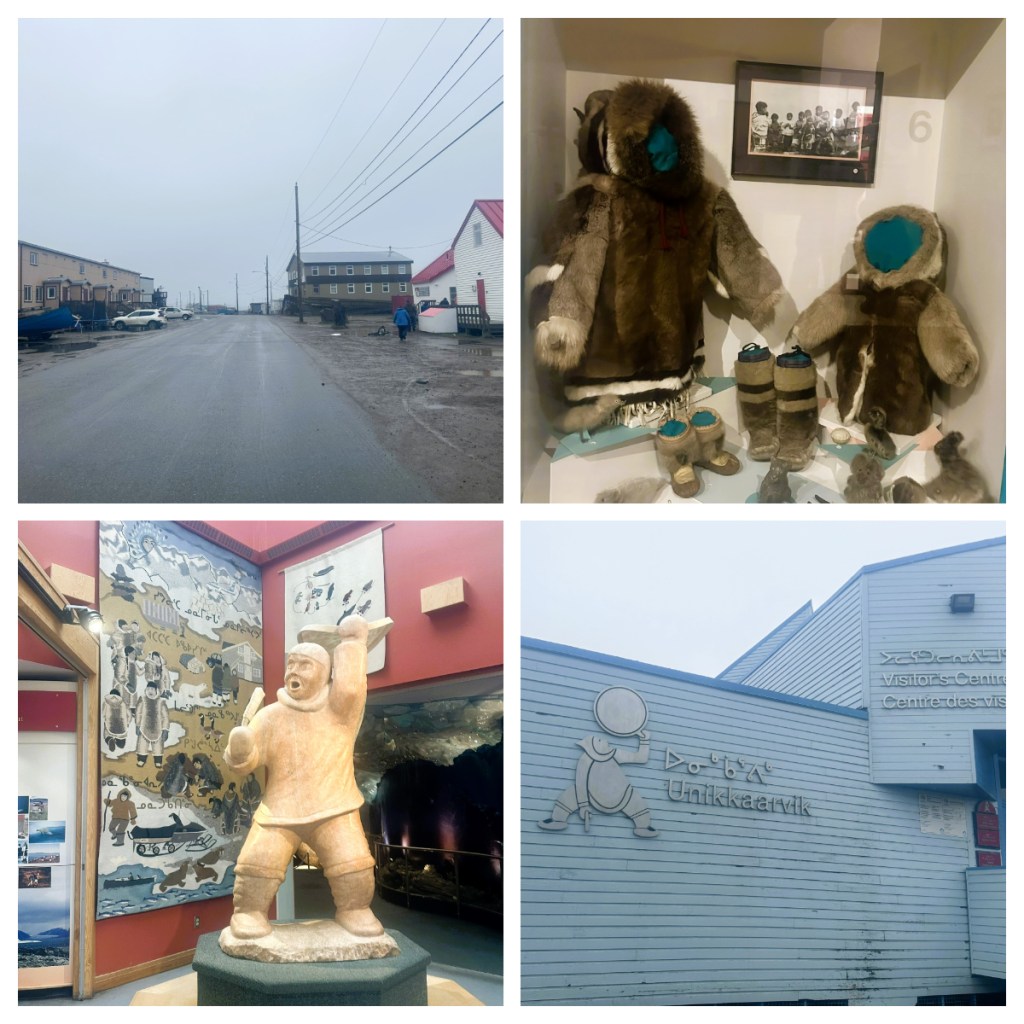
We started our ‘cultural’ tour with a short time to look around the museum and visitors centre. The guys working in the visitors centre were so excited that I was visiting from New Zealand 😀 but unfortunate there is not much I can buy in the way of souvenirs so far as most things are made out of seal fur or reindeer antler which could be problematic when it comes to going home.
The low cloud and constant rain probably did not help with my view of the town, but it was really depressing! Muddy, potholed roads, lots of rubbish in the streets. Apparently, much of the rubbish is brought in by the construction companies, which is then just left behind when they leave! The mayor has started an initiative this year to make the city more beautiful and I do hope they are successful.

It was hard to see much as we drove around the town in the bus as it was still raining and now the bus windows were fogging up due to all the moisture inside (that moisture being us 😂). We did manage to spot St Jude’s Cathedral, built in 1972 and often just referred to as “the Igloo” (due to it’s giant igloo shaped dome) and an Elementary school that looks like a two story ice block!.
We drove out of the town and up to a view point, of course with no view. The site was an old military base, much of which has been removed now and an existing long range radar, one of many that are around the country. The Artic tundra is barren – oh so barren. But, when you took a minute to look at the ground in more detail the small plants and mosses are actually quite colourful.


Back down through the town to a beach, we passed an old Hudson Bay building in what appears now to be the ‘suburb’ of Apex. From here we had to stop at the first traffic light in the Artic to get across a one lane bridge before making our way to Sylvia Grinnell National Park, were we were supposed to have our walk (the rain really had not stopped so probably not a bad thing not to be walking!). We quickly walked up to the viewpoint over the river where a couple of locals were fishing for Char, the main local catch, apparently it is like Salmon but better!
Our final stop was to see the Baffin huskies. Being working dogs, they are not kept in people’s houses, but are all keep in one area on the outskirts of town. Apparently, this breed of dog are strong and not particularly fast but they work well together to pull sleds in the winter.


We headed back to the ship in the mist, just in time to have some afternoon tea. The tour was not my first choice of activities for the day and it was unexpectedly bazaar, but rather wonderful in its oddness 😂. They weather really did not clear all day but the ocean was so calm and looked beautiful through the mist.
 Cockneykiwi takes flight