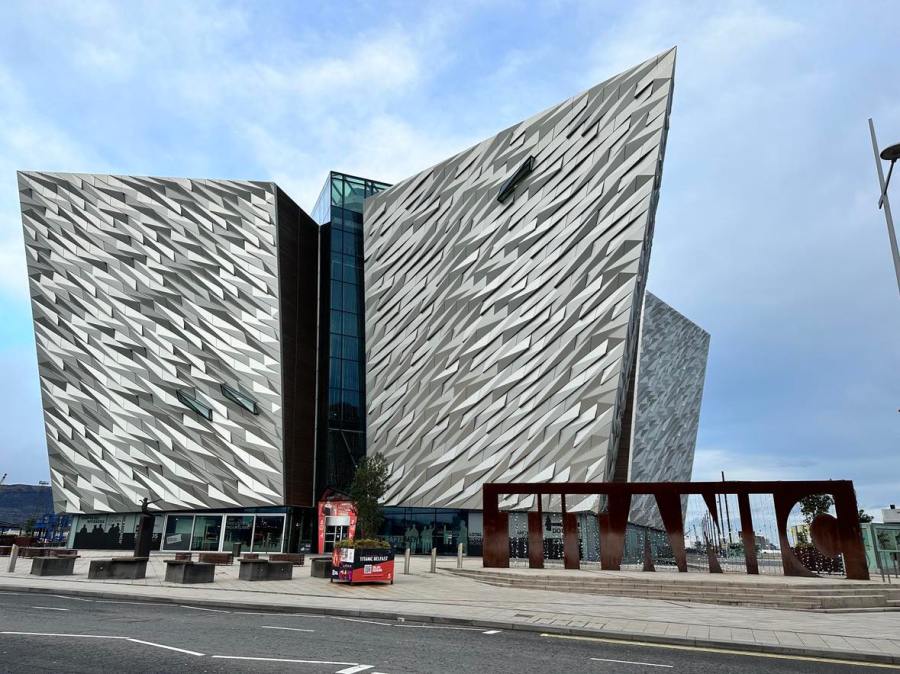
Northern Ireland, December 2023
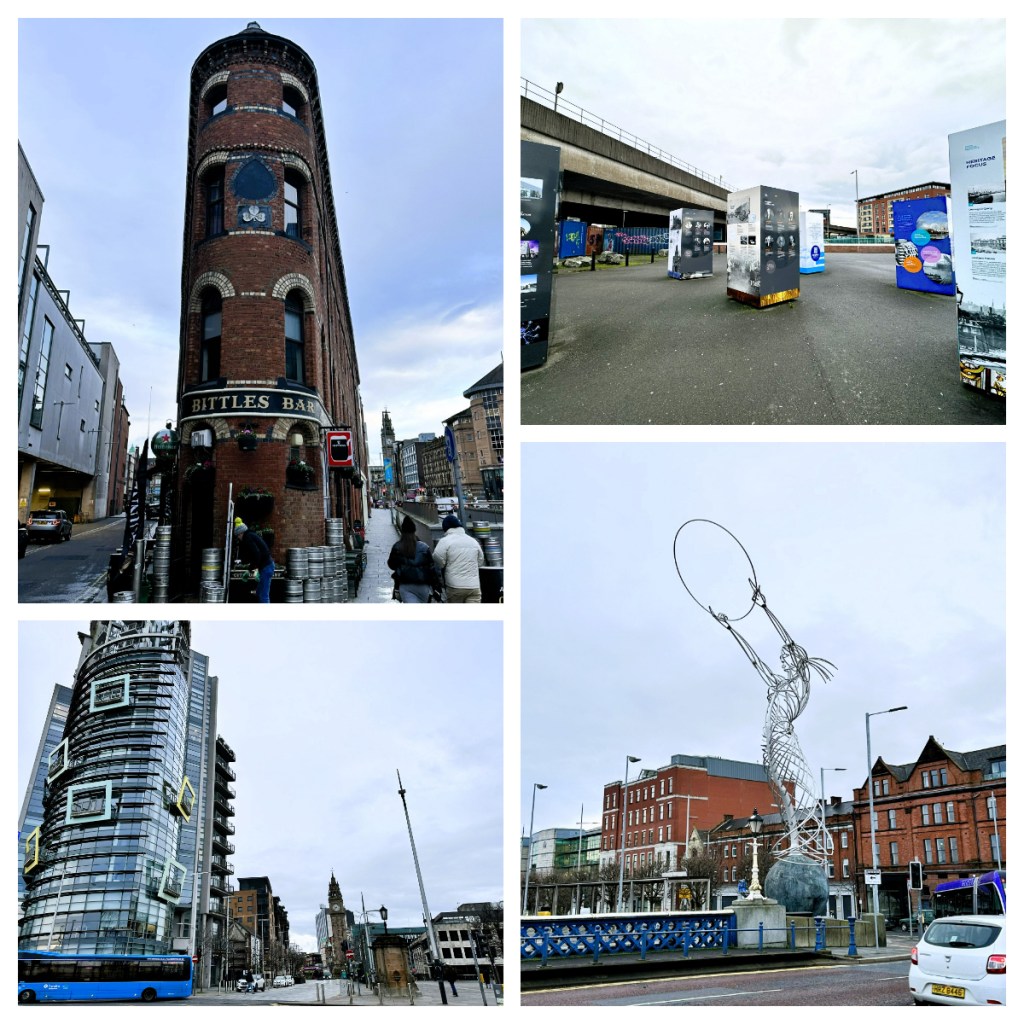
Awaking refreshed from a very comfortable night’s sleep and not a single regret about my room upgrade lol. I had two main things booked for the day – visit the Titanic Museum in the morning, and a Black Cab politic tour in the afternoon. As I was now staying centrally, I took the opportunity to wander around first thing. There is not much commentary to photos I took as I wandered, I just took photos of things I liked the look of and planned to find out more about the locations later!
I came across City Hall which was beautifully decorated for Christmas. I wish I had explored a little more last night as I arrived just as they were in the process of dismantling the Christmas market in front of it (which had finished before Xmas) and taking down all the decorations. So I got some lovely photos with lots of trucks in the pictures 🥴.
I paused for a hot chocolate at the large indoor Victoria Centre (a shopping centre) before continuing my wandering in the general direction of my first stop. This took me across the river Lagan on to the Titanic Trail. There were lots of very informative signs about historical Belfast and its ship building industry and I even spotted a couple of “city” seals in the river 😂.

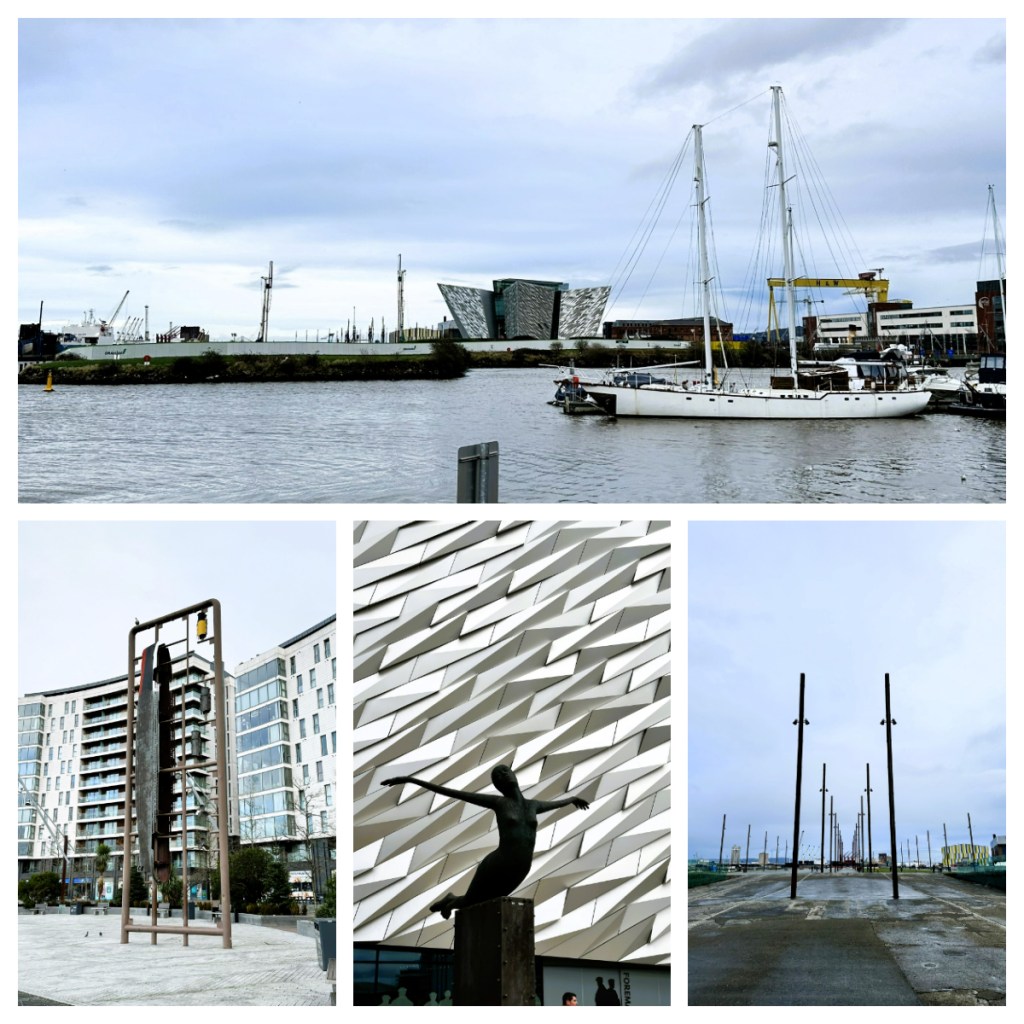
When I arrived at the museum there were a lot of people gathered outside. Thinking it was not open yet, I took the opportunity to explore the outside area and the Olympic slipway where the Titanic was “born”. In fact, it was actually security alert that had evacuated the building 🤦🏻♀️. Thankfully I did not have to wait long before we were allowed in as it was bitterly cold.
I had prebooked online which meant I could walk straight in and that I also got an audio guide. Although it was not really necessary as there was plenty of good information around the museum, I enjoyed listening rather than having to try a read the sometimes crowded signs.
The museum covered the history of the city including key trades such as linen, rope making, tobacco and ship building. At one time, Belfast had the largest ship yard and glass blowing manufacturers in the world!
After going though the original gates from the Harland and Wolff shipyards we joined a short ride through a re-creation of the shipyards of the time to experience the heat and noise the workers had to endure. Incredibly, the Titanic had more than 3 million rivets in it, most of which were put in by hand!


Now, I am pretty sure everyone knows the story of the Titanic. Launched in Belfast in 1912, it was the largest ship afloat at the time she was launched by the White Star Line. Her inaugural journey was to take her from Southampton in England to New York with some of the wealthiest people of the time on board, as well as hundreds of European emigrants, travelling to build a new life in North America.
But, as we know, she never made it to her destination. On April 14th, she hit an iceberg mid Atlantic and sank in around 4 hours. Touted as unsinkable, crew and guests were ill prepared for such a catastrophe and the ship only had life boats for about half the people on board!
The audio guide took me through the exhibits, hearing emotional stories from survivors and displaying artifacts from the ship herself. It seems that the disaster was the result of a domino effect: weather, ice warnings, the lookout did not have binoculars, the ship was going too fast for the conditions, flooding in low bulk heads, not enough lifeboats, no emergency drill … After the sinking of the Titanic, much was changed in maritime legal requirements, some of which remains in place.

The last part of the museum goes through all the modern day exploration of the wreck, with some incredible images of the wreck in recent years. Even if you only have a short time in Belfast, I would highlighy recommend allowing a couple of hours to visit the Titanic Museum.
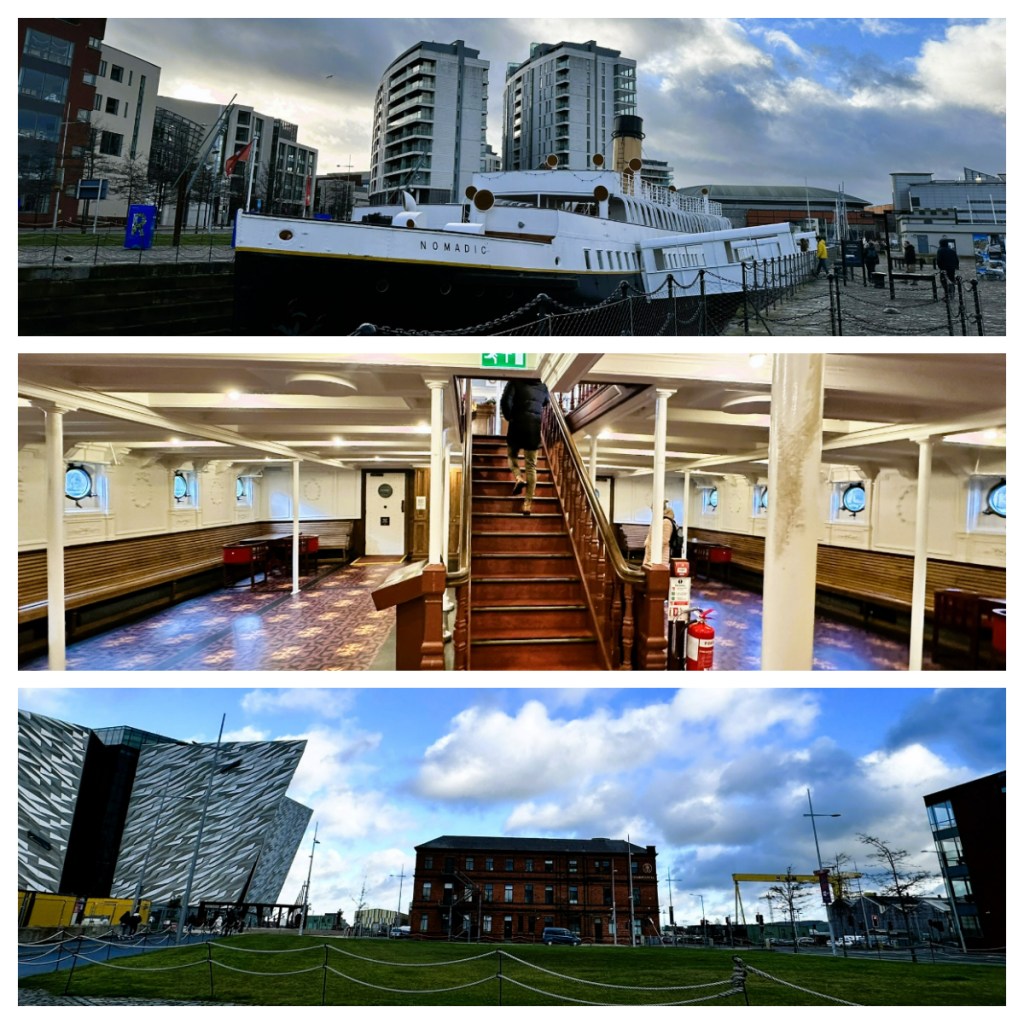
As part of the ticket for the Titanic Museum, you also can visit the SS Nomadic. Launched the year before the Titanic in 1911, she was used as a tender, to transfer passengers and mail to and from the Titanic and her sister ship, the Olympic. She is the only White Star Line ship left today and is moored in a dry dock just across from the museum.
She is a beauty and if only the tender, I can only imagine how beautiful the Titanic herself was.

By the time I had finished in the museum the sun had come out, but it was still bitterly cold for the 30 minute walk back across the river to where I was staying and on the hunt for somewhere to have some lunch. I had googled “where to eat in Belfast” and ended up at the Crown Liquor Saloon. Described as a “gem of Victoriana”, the Crown Liquor Saloon was apparently one of the best gin palaces in the British Isles! It dates back to 1826 and is apparently now owned by the National Trust who has ensured it has been sympathetically restored.
Unbeknown to me, I was only a couple of minutes walk from my hotel and in fact, I had passed it on my brief walk the evening before, but had rejected going inside as it looked dodgy 😂. Now there is a prefect example for not judging a book by its cover! Coincidentally, my pick up for my afternoon tour was at the hotel I was now staying in. Still definitely no regrets for moving accommodation (ask me again when I have to pay my credit card bill 🥴).
My afternoon tour was one of the famous Black Cab political tours, another “must do” when in Belfast. Not surprisingly, the tour is in a Black Cab and the driver, your guide, is a local who lived through “the Troubles” of the city.
I will preface what I am about to right by saying that my guide, Billy, started off my telling me that he is Catholic, and therefore the stories he told me would be from his perspective, growing up during the worst of the city’s troubles. It’s also important to note that the issues in Northern Ireland are incredibly complex and we real owned scratched the surface of the issues and my only regret was that I did not book a longer tour!! That said, this is what I was told/learnt …
In 1921 the partition of Ireland lead to the creation of The Republic of Ireland and Northern Ireland. Generally speaking the Protestants aligned themselves with Great Britain/UK, whilst the Catholics were staunchly Irish. As Northern Ireland became part of the UK, the Irish population were discriminated against. Not being allowed to speak Irish, play Irish sport, practice their religion etc. They could not have a proper education, nor were they allowed certain jobs. 1969 was not the beginning of the troubles in Northern Ireland (they date back to the partition), despite be earmarked as the start of the 30 year-long “Troubles”.
The Falls Road area of Belfast was (and I think still is) 100% catholic, though in the 60s/70s the city’s population was around 65% protestants who had all the positions of power. It was here on Falls Road in August 1969, a Civil Rights march (in support of those in the Battle of Bogside in Derry) was attacked by Protestant loyalists, resulting in the death of 7 people (apparently the police fired bullets above the crowds, but in some cases they went in to buildings, killing innocent people inside). 100’s more were wounded many Catholic owned homes and businesses were destroyed. The police sided with the so called loyalists and failed to protect the Catholic people and areas.


The British Army were deployed to restore order and they ended up staying for 37 years (finally leaving in 2007, despite the official cease fire happening in 1994) and the riots led to the formation of the Provisional Irish Republican Army (the Irish led IRA), and the growth of loyalist paramilitaries e.g the Ulster Volunteer Force (UVF). Accordingly to my according to Billy, there were 2-3 months in 1969 when it was not safe for Catholics to leave there homes and he missed a lot of school as a child in the early 70s as it was not safe to go.
Divis Tower is the only remaining building in what was a complex of 29 terraces and flats and it was used by the Police and British Army as a look out point and sniper nest. They took over the top few floors and left Catholic families living in the lower 17 floors to protect them. However this also meant that they could only gain access by being dropped on the roof by helicopter. Apparently they stayed there until 2005!
I must admit I was completely unaware that Belfast had walls, known as Peace Walls, separating parts of the city!! The building of these started in 1969 to keep the two communities apart and today there are still around 30 walls left, around 13 miles of walls. They were called Peace Walls as everyone understood that they were to keep the peace by minimising inter-community violence and therefore each side could feel safe in their homes. Even today some of the gates in the walls are closed at night, others are just closed if there are increased tensions.
My guide was sure to point out that the walls have been built in Catholic gardens and very close to Catholic houses (in some cases as little as a metre from the house) – they were never built in protestant gardens!
These days, things are much calmer and are far less black and white (or Irish and British) as they once were. Even inter-community marriages are not uncommon today. Despite this, although there have been discussions about taking the walls down, the majority of the communities still feel more comfortable keeping them in place and today they are covered in murals, old and new, some of which are now famous landmarks of the city.
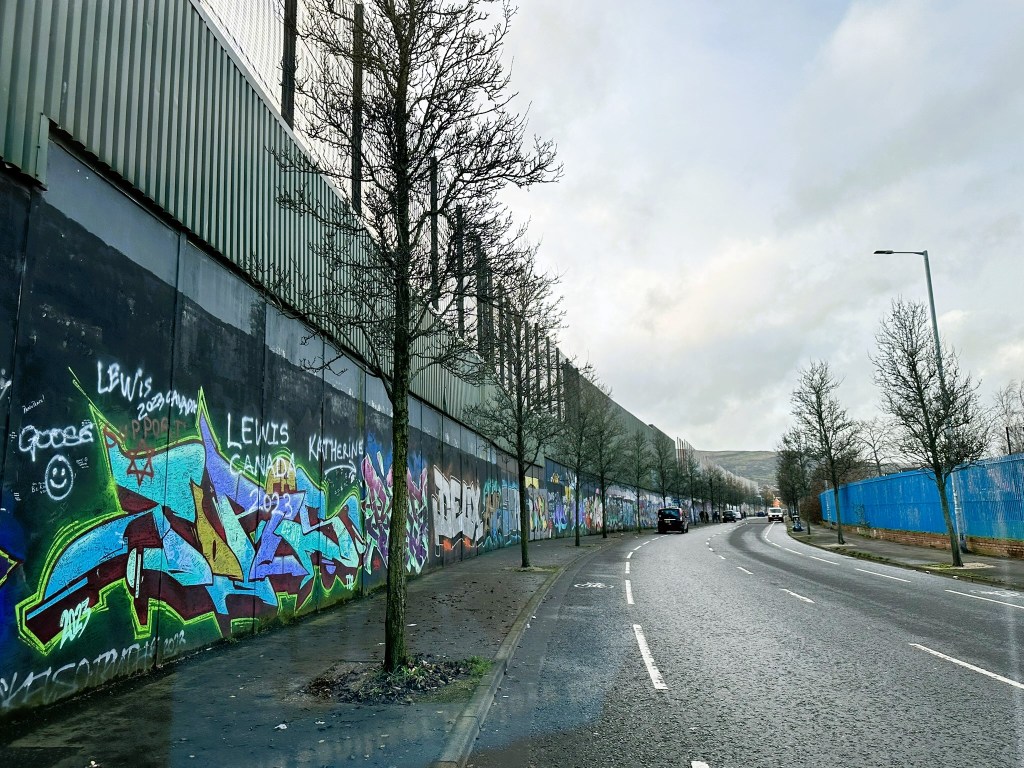
We spent some time looking at the murals on both sides of the walls. They ranged from more historical murals showing the victims of the 1981 hunger strikes to much modern murals showing support for the Palestine/Israel conflict – with the Catholics supporting Palestine (as they feel they are being persecuted in the same way that they were) and the Protestants supporting Israel. On some of the more abstract murals, more like graffiti, visitors are encouraged to sign their names.
Today, in more peaceful times, the Sinn Fein politic party continues the fight in the Houses of Parliament on both sides of the border for a unified Ireland and in Belfast there are neutral zones where people are not allowed to fly flags of any kind or support any specific side or party. That said, according to Billy, they are still at least two generations away from real peace, as those who lived through the Troubles still remind their children to “remember who you are, where you come from and what you have lost”.
I found this tour particularly interesting as I grew up only hearing the British side of the story, and living in London in the 1990’s, I experienced the fear of IRA bombs in the city (at least 3 went off in hearing distance). I found it important to finally hear the other side of the story and be reminded that all stories have two sides.
During my wandering, I had discovered that my hotel was right next to the Grand Opera House and that there was a traditional UK Christmas pantomime on – I felt to round out my cultural experience for the day I should attend, and I managed to nab one of the last tickets. The Opera house is a beautiful example of Frank Matcham architecture opened in 1895 and today it was showing Snow White and the Seven Dwarfs and as with all pantos, although they may be touted for children there is plenty of double meanings for the adults 😉and it was great fun.

And to top it off, it turned out that I was sitting right by famous Northern Irish actress and singer Rachel Tucker – star of the West End. All in all, a perfect way to finish up my few days in Northern Ireland.
 Cockneykiwi takes flight