
Yerevan, Armenia
April 2025

And so we had come to our last full day on holiday and the day started with a perfect mountain view from breakfast. Despite being in another country (Turkey), Mt Ararat (little and greater) dominate the Yerevan skyline.
We first headed to the Cascade complex were we first met Alexander Tamanian, the architect responsible for much of the Yerevan we see today. He created the first plan of the modern city which was approved in 1924 and transformed the small city into a modern capital. His statue at the bottom of the Cascade has earnt him the nickname “the DJ of Yerevan” – do you see it? 😂
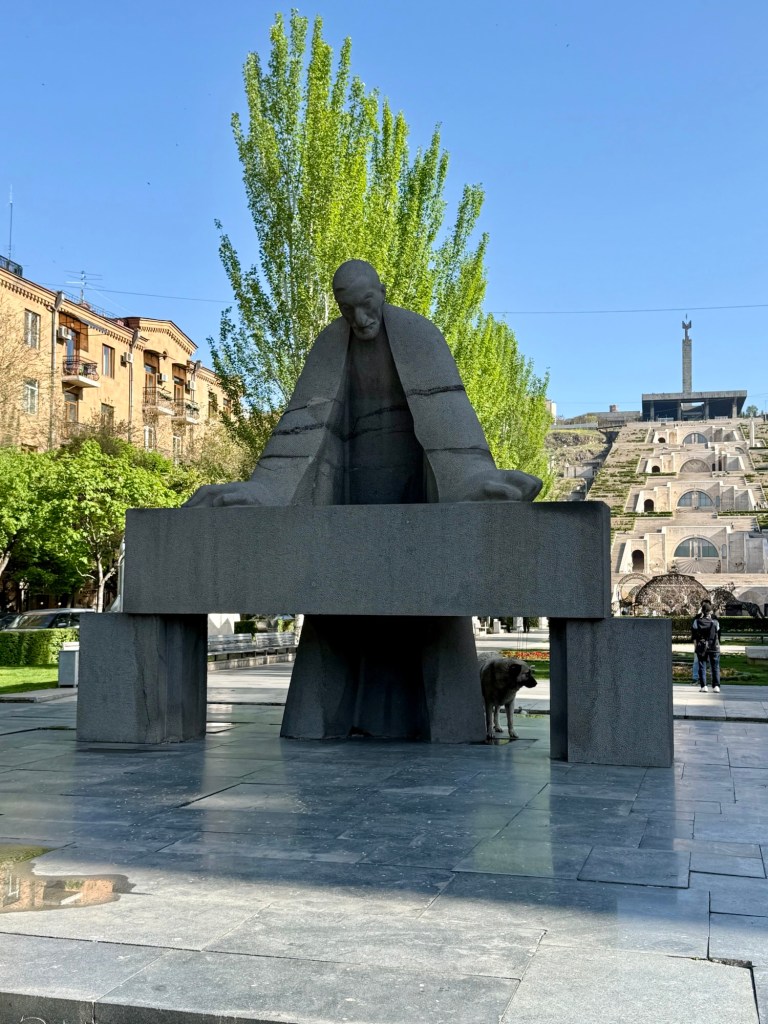
When he started, the city only had a population of 45,000 and he had the foresight to plan for a city of 500,000 but the city grew so rapidly, it now has a population of over 1,000,000!
We walked through the formal gardens of Cafesjian Sculpture Garden which holds a collection of sculptures from all over the world. The private collection included a large lion made of old tires, I spotted a Botero (from Colombia) and was pleasantly surprised to meet the first other kiwi I had met on the whole trip – this one was a very large blue one, and part of the exhibition.
The Cascade’s formal name is the Cafesjian Centre for the Arts and was originally the idea of Tumanian to connect the city together, but the plan was forgotten. After a few false starts, in the 70’s, 80’s and 90’s, the complex was finally completed in the early 2000s, funded by Gerard Cafesjian, an American Armenian who funded over $120m of projects in the country.


From the bottom to the top of the Cascade it is 300m high, with an escalator on the inside (with different galleries and event rooms on each level) and over 550 steps on the outside. We went up the escalator and then wandered slowly down the stairs admiring the views across the city to Mt Ararat.

As it dominates the city, Mt Ararat dominates the centre of Armenian coat of arms, along with Noah’s ark balanced on the top. Apparently, the Turks said that the Armenian’s couldn’t have Mt Ararat on their coat of arms as it is not in Armenia! Their reply was, well you can’t have the moon on yours as it is not in Turkey … lol. So Turkey has the moon and Armenia has Mt Ararat lol.😝
Our next stop was the Matenadaran – the Museum of Ancient Manuscripts. Established in 1959, it not only houses a huge collection of historical manuscripts (from Armenia and around the world), but also a scientific research institute. We had a guide to take us around and introduce us to some of the most important books. Some of the standouts to me were a 5th century Armenian manuscript on animal skin parchments, the largest book from the 14th century, weighing in at 28k (which took the skins of 660 newborn animals to make) and the smallest book from the 15th which weighs 19g and took only 1 newborn lamb to make.
The animal population of Armenian must have been pleased when they moved to using paper for books! Apparently, Armenia was the 3rd country in the world to use paper after China and Arabia).

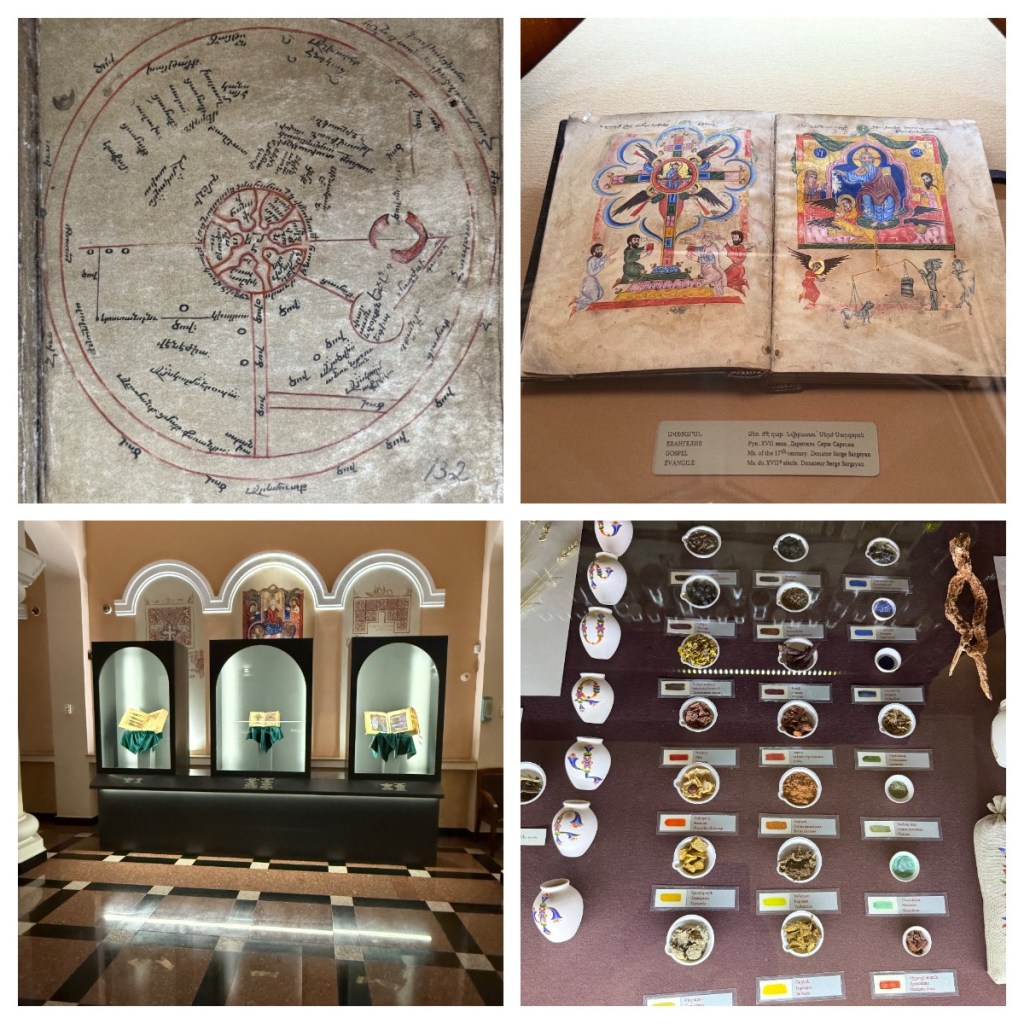
They had a wide collection of beautiful, colourful religious books, some made in the ancient Armenian Kingdom of Cilicia. They used gold leaf, garlic juice and beetles for the red colour. Apparently, it took 1000 beetles to make 1 gram of colour!
It was an interesting visit and it hard to imagine that they only have 1-2% of their collection on display!
Levon had recommended a local sweet shop to purchase gifts to take home – New Zealand has very strict biosecurity rules and everything needs to be commercially made with country of origin and ingredients listed, so we had a quick pit stop at this amazing candy land type shop that sells chocolate coated dried fruit and nuts.

After securing my purchases we headed to the equally candy land themed café next door to sample some freshly cooked ponchik – a filled, fried sweet dough. I can confirm they were delicious.
We wandered back down towards the city centre, pausing for a moment in the ‘musical quarter’ – the home to Conservatory Park and the Theatre of Opera and Ballet. One of the prominent statues is of Komitas, a priest, composer, singer and the pioneer of Armenian folk music. He would walk from town to town compiling local folk music.
During the Armenian genocide in 1915, he was arrested, along with hundreds of other Armenian intellectuals, and deported to a prison camp. He was allegedly saved by the French ambassador but suffered from PTSD and spent the rest of his life in a psychiatric hospital in Paris. He is not only considered the saviour of Armenian music but also thought of as a martyr of the genocide.
Although we were walking around the central city today, Yerevan does have a Metro system – well, system may be a strong word, they have one, single Metro line that does not connect anything particularly useful! It was built in the late 70’s and at the time, Yerevan only have a population of around 40,000 people. Not nearly enough to justify the costs! Apparently, they staged fake traffic to justify getting the money from the Soviet Union for the build! 😂
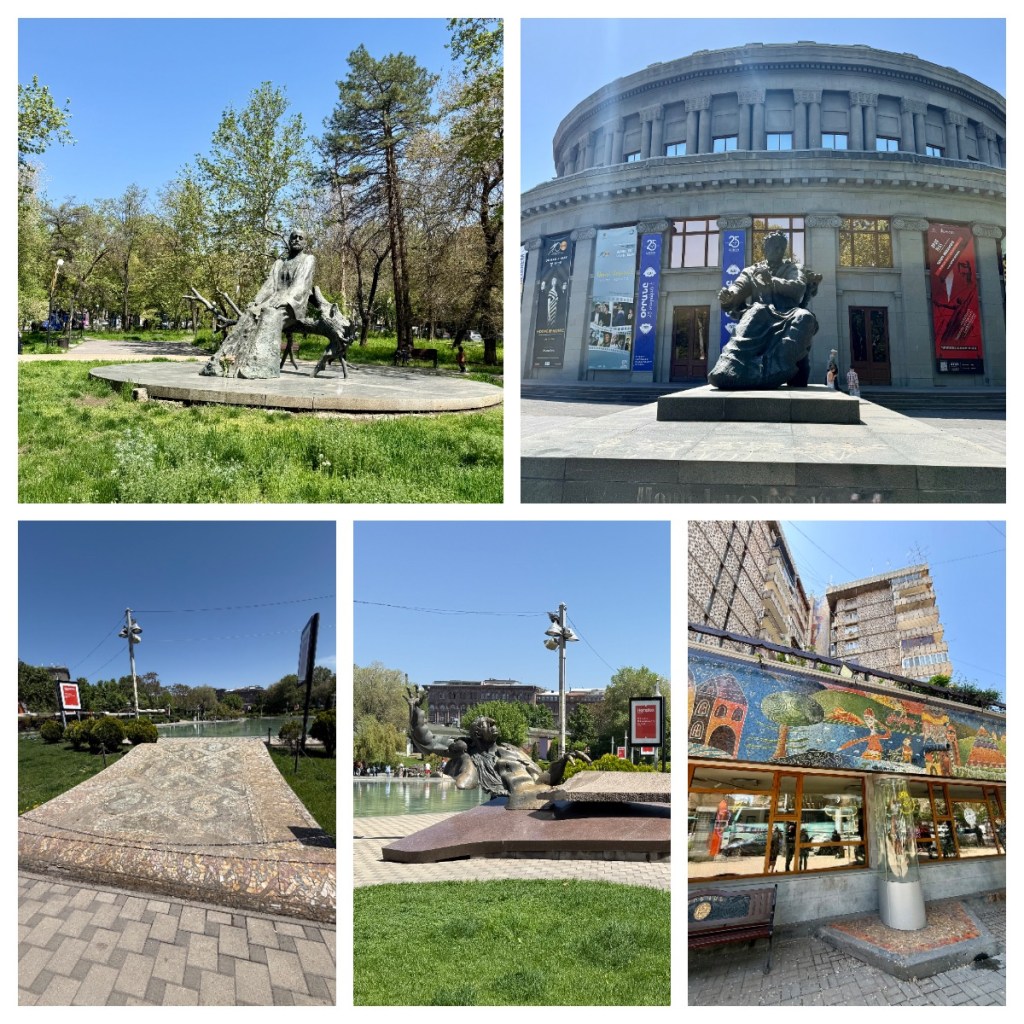

Our wanderings took us past the large carpet ‘statue’ we had seen the night before, the puppet theatre with it’s beautiful mosaic tiles and the oldest surviving church in the city (13th century I think). We passed a mural of Edgar Alan Poe, that was painted by Levon’s wife, the 1936 “Moscow” cinema and continued down a beautiful tree lined street that is lined by some of the oldest buildings in the city (which to be honest are not that old as the city has been destroyed many times).
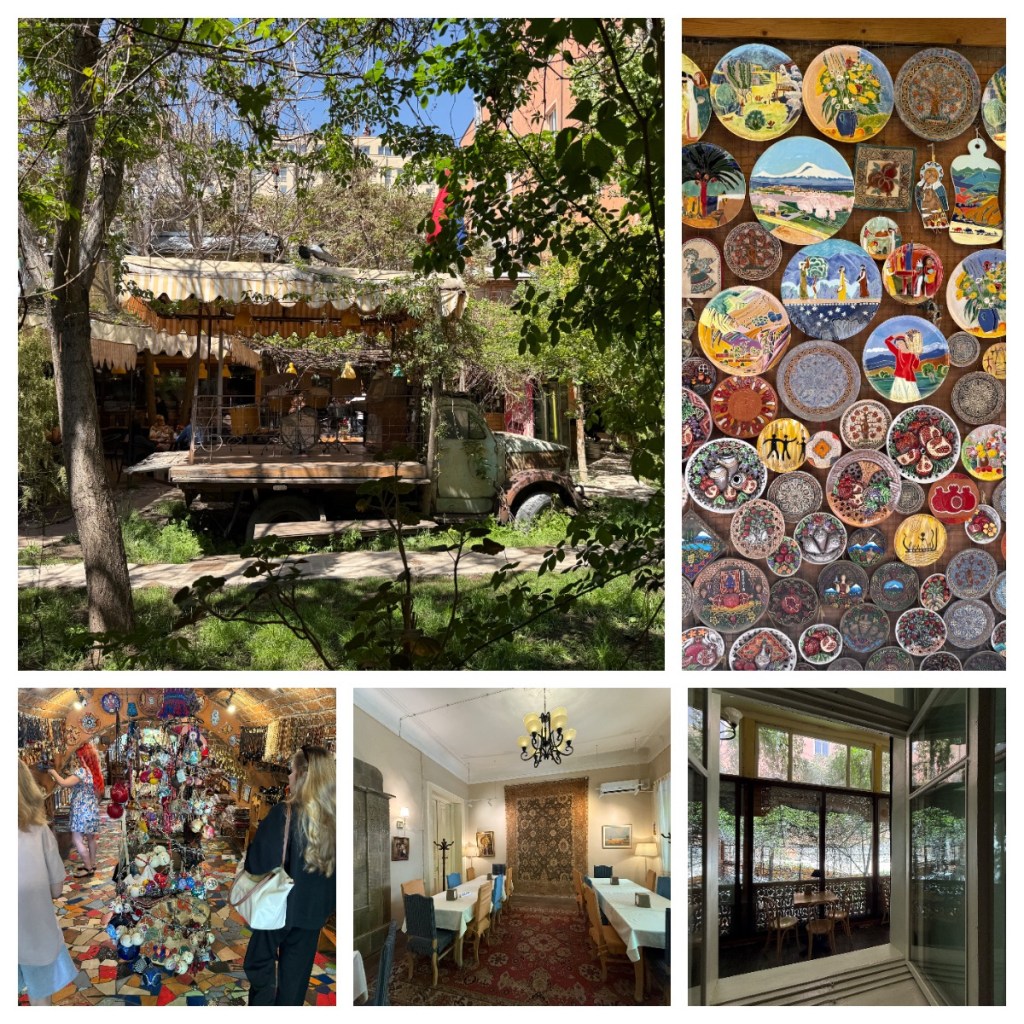
There was a beautiful building from 1915 that once housed the first private hospital in the city and then an 1880’s traders house that today is home to the Dalan Gallery and Restaurant. From the street it just looks like a souvenir shop, but you can walk through the shop into the courtyard out the back into the restaurant and upstairs to explore the old house.
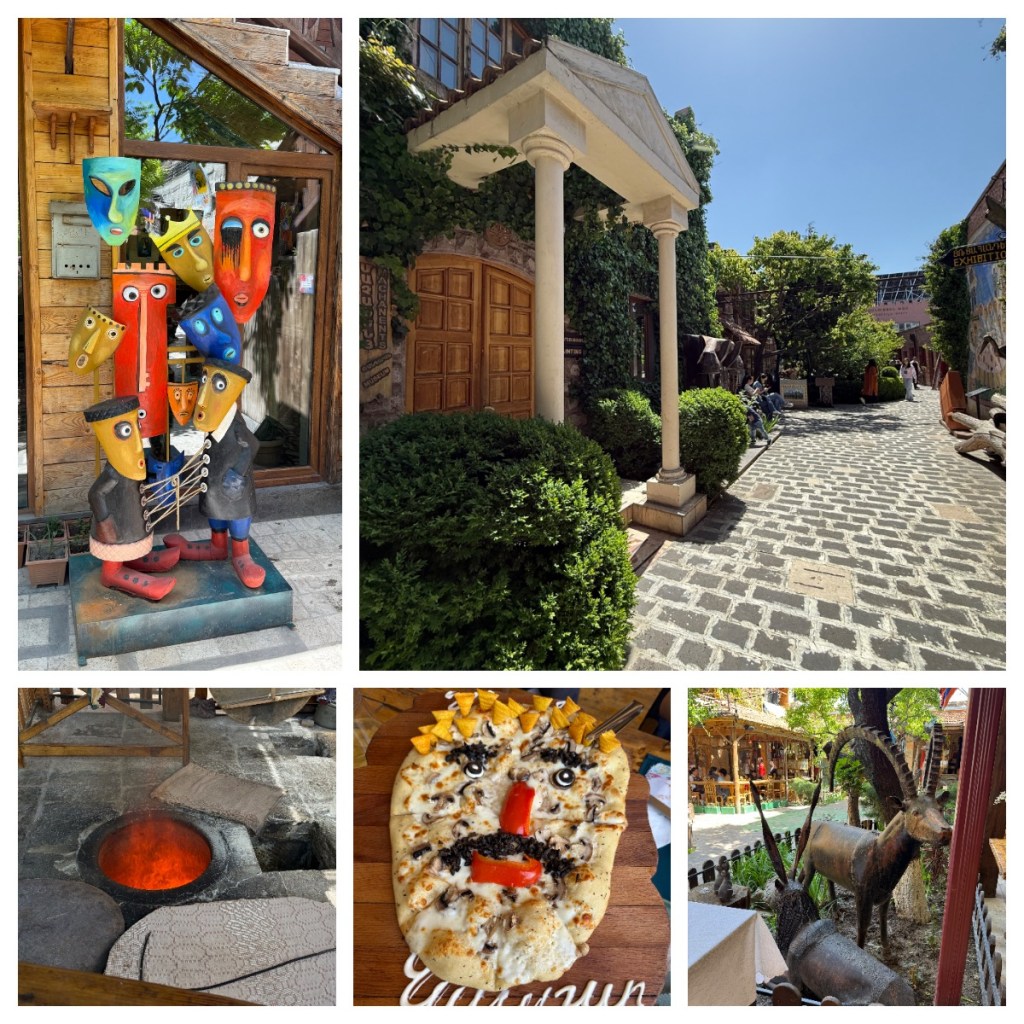
Back in the car, and we headed out of the city for our lunch spot at Vagharshapat, the Machanents House. It is old house that has been turned into a social enterprise, providing artesian lessons in weaving and pottery, theatre and a national cuisine school, mostly for disabled people. There is also a popular restaurant where we enjoyed lunch (which included a pizza face ☺️).
The main reason for our visit to Vagharshapat was not lunch, but the large religious complex that is considered the seat of Armenian Christianity and that houses the residence of the Armenian churches pontifical, as well as the oldest Armenian church that isn’t in ruins – the Etchmiadzin Cathedral. Built in the early 4th century, it is believed to be the oldest cathedral in the world and is still a site of major pilgrimage today, as was evident from the amount of local people visiting.
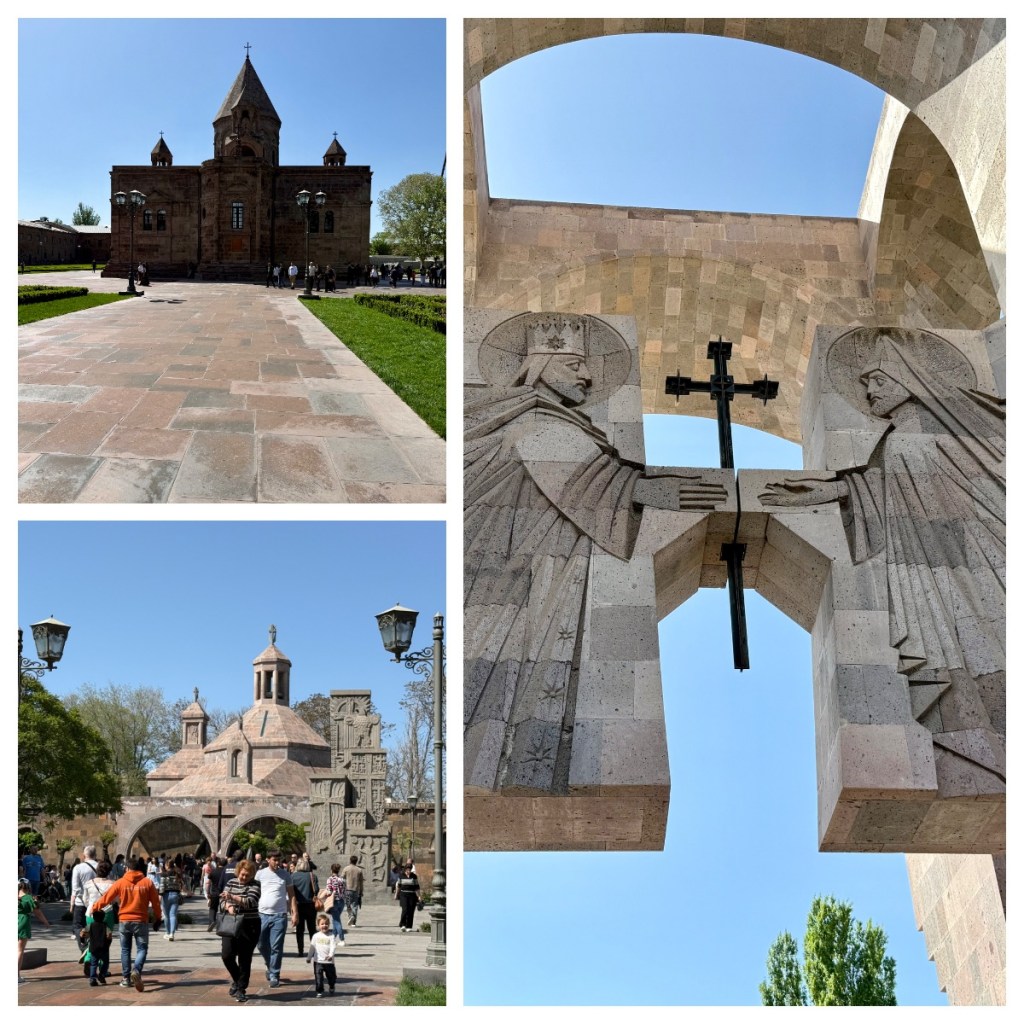
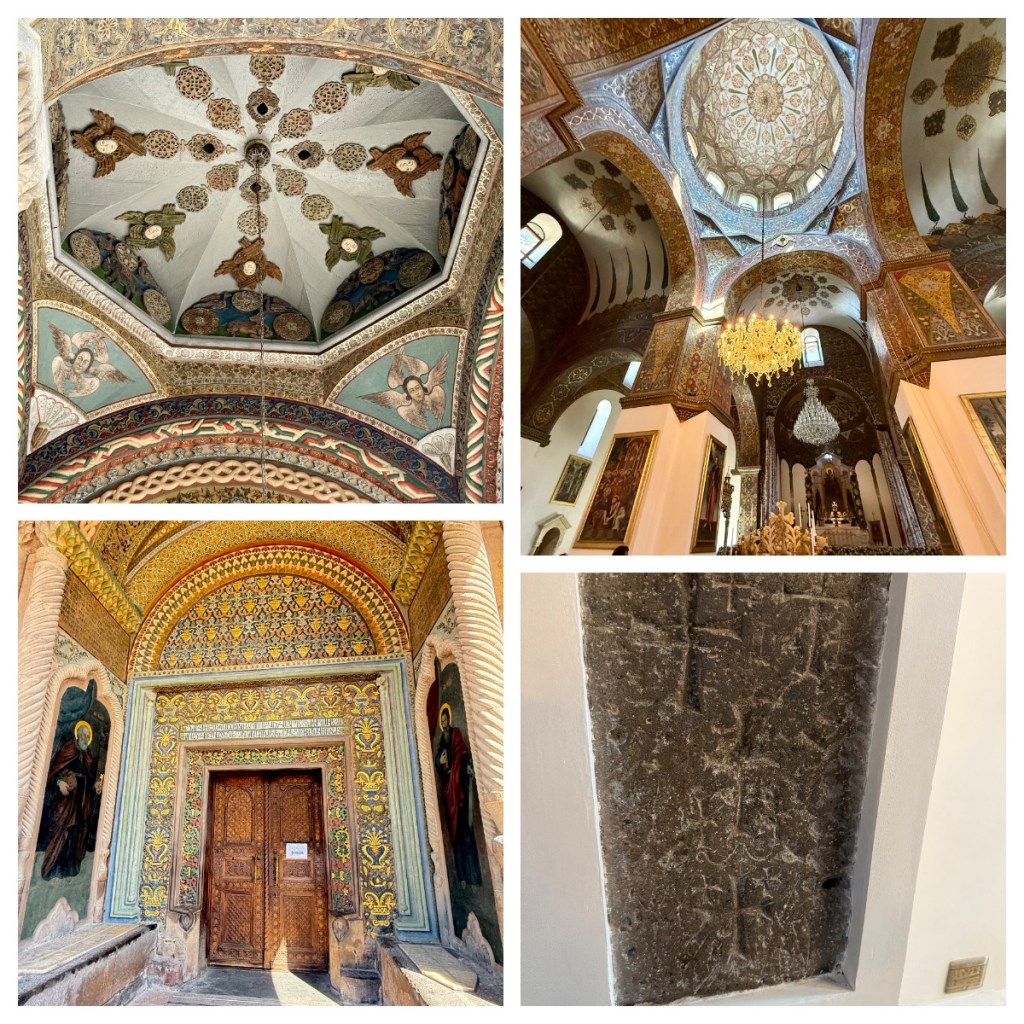
The Etchmiadzin Cathedral is considered the mother church of the Armenian Apostolic Church and was thought to have been built by our old friend Greogry the Illuminator (in fact you are greeted by life size carvings for Gregory and the King as you enter the complex through the imposing gates). Not surprisingly, the cathedral has seen various iterations over the years due to earthquakes, plunderings and general neglect, so what we see today shows a number or different styles of architecture and seems to be fairly recently refurbished inside and it was stunning.
The Cathedral was beautiful and to be honest all looked rather new, but there were Perspex areas on the floor where you can see a small part of the 4th century foundation. This was in stark contrast to our next stop, just a short drive away at the ruins of the 7th century Zvartnots Cathedral.
This Cathedral was unique in its circular shape and that fact that it had a multifloored design and stood at around 50 metres tall. Unfortunately it only stood for 320 years before collapsing in the 10th century, probably as a result of an earthquake, despite being designed to last 1,000 years!
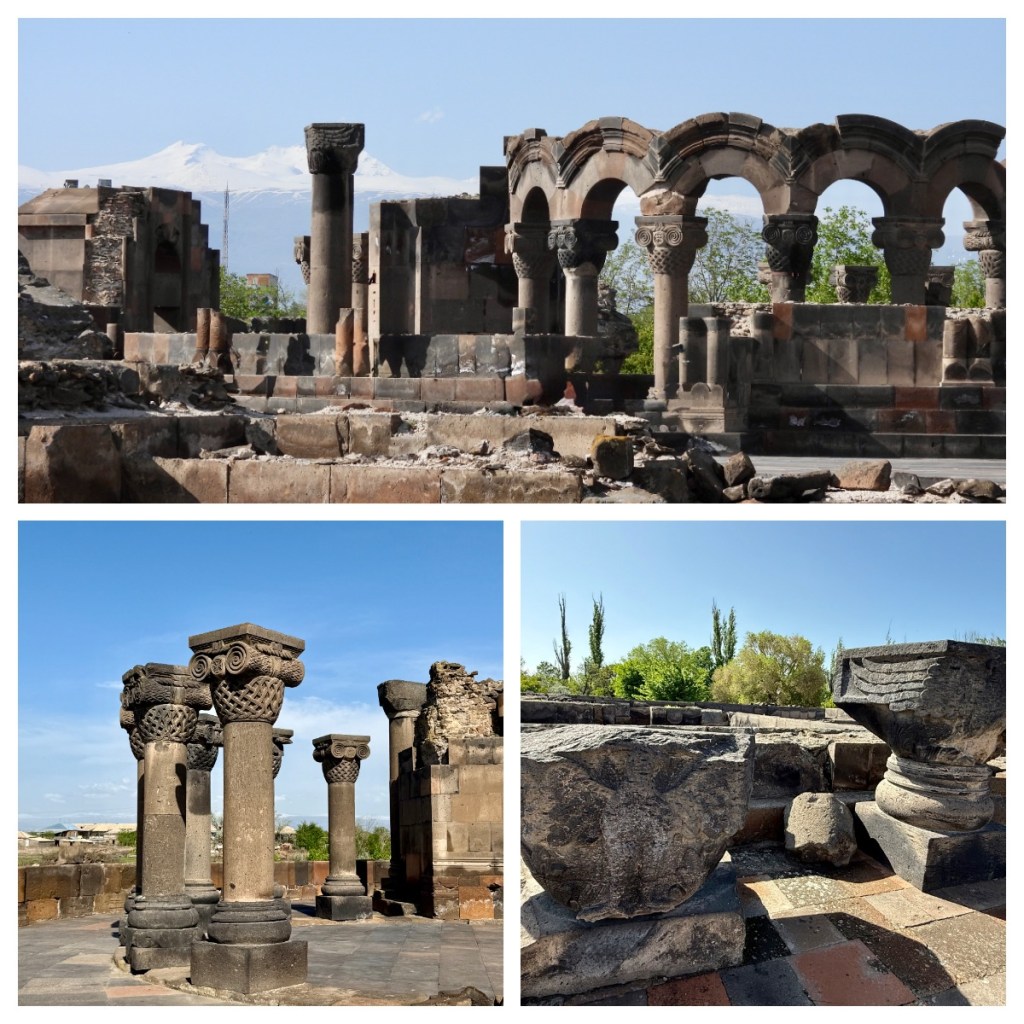

There was a small but informative museum on site that had a scale model of what it would have looked like and wandering around the site itself was really interesting. At 25C it was our hottest day of the trip and we could see out to Mt Ararat (over 5,100m) on one side and Mt Aragats (over 4,000m) on the other.
Apparently, Armenian’s say that Mt Aragats is the highest mountain in the Republic of Armenia, but Mt Ararat is the highest mountain in Armenia, referring to all the land that was once part of Armenia!
As we drove back to the city, we made a brief detour to the Armenian Genocide Memorial complex. We did not have much time so didn’t visit the museum but did a quick walk around the monument. We were visiting the day after the Genocide Remembrance Day, that remembers April 24th, 1915, when the atrocities started.
A quick history – the Armenia genocide refers to the annihilation of ethnic Armenian’s from the from April 1915 through to September 1916 by the Ottoman empire. They started by rounding up academics, politicians, musicians, artists etc in one night and killing them all. Then those menof army service age were sent to work in prison camps, many dying later of starvation, exposure and disease. Children were forcibly removed from their families and forced to convert to Islam. It is reported that over 1 million people were killed.

The Ottoman Empire did not recognise the genocide and say it was just part of WWI when lots of people died. Even today, many countries including Turkey, do not formally recognise it as genocide. Despite that, its impact on Armenia and its people is everywhere, and the reason that there are such large diaspora communities around the world as they fled the genocide and its aftermath.
The monument itself is made up of three different parts. Firstly the 44m spike which symbolised the national rebirth of Armenia. Secondly, 12 slabs in a circle, representing the 12 lost provinces (which are now in Turkey) and it’s eternal flame. There is also a long wall that lists all the areas and towns that were lost and people killed or removed.
I am not 100% sure what happens on the Remembrance Day but the whole area must have been covered in flowers and there were large groups of people cleaning them up and piling them high around the eternal flame. It was a sobering site but an important part of understanding part of the history of Armenia – a country and a people that we had definitely grown to love.
It was sadly now time to say goodbye to Levon as he dropped us back at our hotel. We had thought it would be tough to match Tazo, our Georgian guide who was amazing, but Levon managed to do that. If you want a guide in Armenia, who’s not only knowledgeable but funny, kind and prepared for ever eventuality, he is your guy!

Being our last night, we decided to head out for a lovely last glass of Armenian wine and see the Cascade at night. As we enjoyed our wine, thunder and lightning started cracking around us and despite deciding to try and get back to our hotel before the rain came (about a 15-minute walk), we did not get far … and when the rain came, it came hard!!!
(We might have got back before it started to rain if we had not stopped for 10 minutes to try and take photos of the lightning ☺️.)
We took refuge in a bank ATM vestibule, or maybe it was a package collection place, either way we thought we could and wait out the worst of it. We could not, so made a break for it and although the rain had subsided a little, the footpaths and roads were rivers that we had to wade through so there was not hope for the shoes.
When I had got back to the hotel in the afternoon, my room was incredibly hot (almost 30C) and the reception just told me to open my windows … of course I did not close them before going out and now the floor is also soaking wet … nothing that a towel on the floor won’t fix by morning , I hope 😉.) Armenia was certainly full of excitement right till the very end ❤️. (We thought we had it bad, Levon sent us a video of him driving on roads that were completely flooded!)
The long trip home was relatively uneventful. A little confusion for my airport pickup (they waited outside the hotel, I waited inside lol), but the airport was relatively small and quiet so plenty of time for immigration to scrutinise every page of my passport. A slightly diverted flight to avoid flying through very high cumulus nimbus clouds.

6 hours in Dubai airport (at least I did not have to rush for the 2 buses and then a train to change terminals this time). 14 hours to Sydney and a lovely view of the city coming into land, and then the final hop across the Tasman Sea and home.
I really enjoy writing these blogs and I do hope that someone enjoys reading them and/or finds them informative lol. It gives me an opportunity to look back at photos and remember what we did each day whilst it is still relatively fresh in my mind. This was definitely an incredible trip, one that I would highly recommend and in fact would love to come back again to dig deeper. There is always so much more to see.
 Cockneykiwi takes flight