Greenland – you saved the best till almost last

Disko Bay & Ilulissat

September 2024

Our next stop was at Disko Bay, a large bay sitting above the Artic circle and we started on the island of Qeqertarsuaq (“Big Island”), also know as Disko Island.  The island is the largest island in Greenland, and has a population of around 850 people.  Once known as Godhavn or Good Harbour, it served as the political and economic capital of Northern Greenland, it’s economy being based around the whaling industry.  As the whaling industry collapsed, so did Qeqertarsuaq’s importance and the government functions were all moved to Nuuk.

This part of the country is now sea ice free all year round, this line used to be much further south, around Sisimiut.
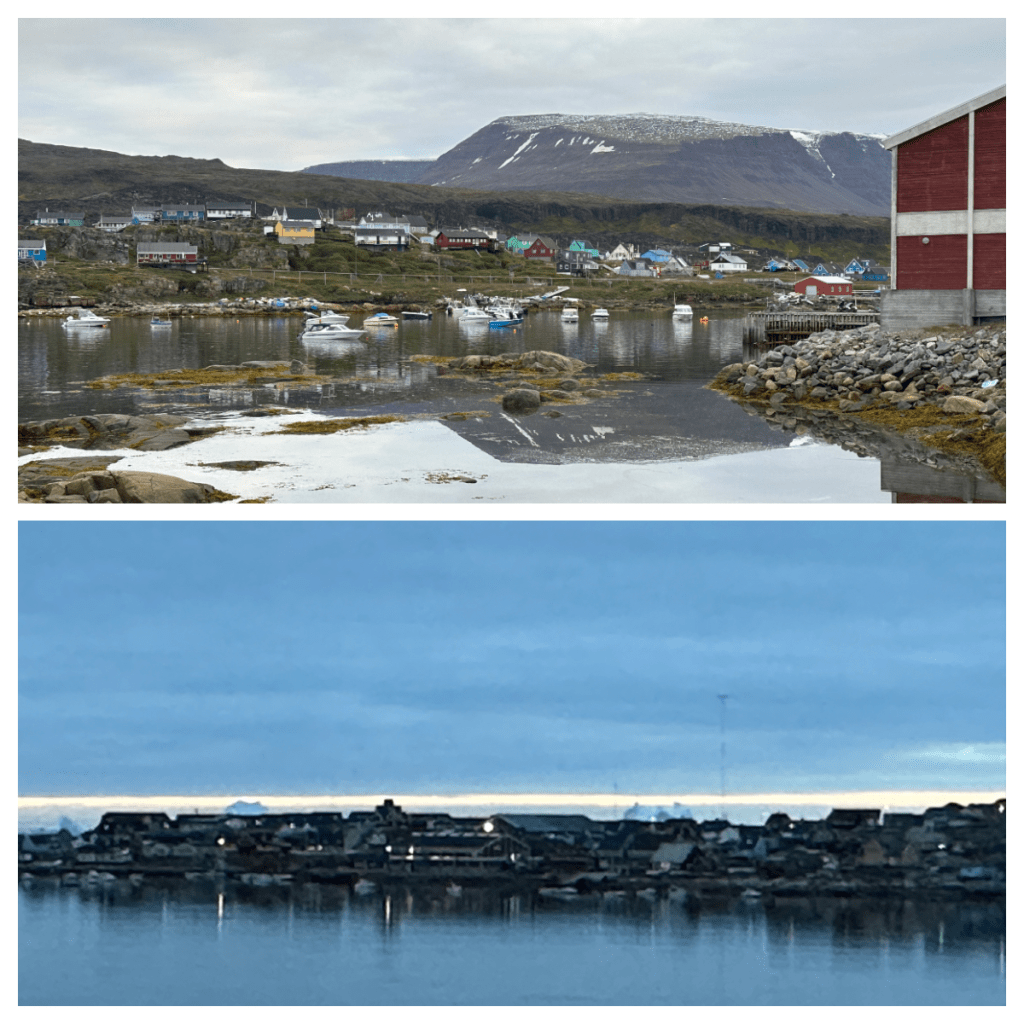
Unlike the Greendland mainland, Qeqertarsuaq consists of volcanic rocks, mainly basalt which means the soil is much more furtile leading to the island being much more green and lush than the rest of the country.  It also provides some spectacular rock formations.

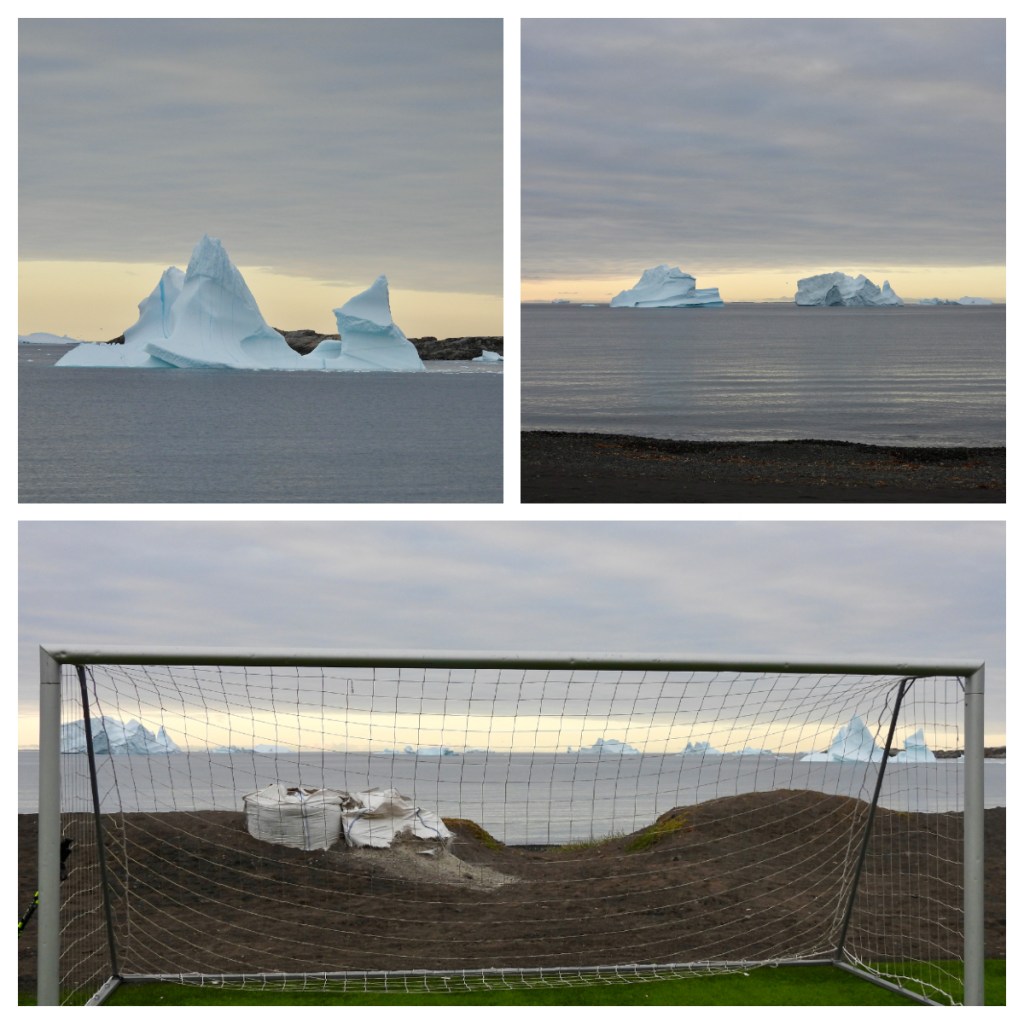
As we pulled in to the harbour of the small town I saw what I thought was hills/mountains in the background.  It was in fact icebergs, floating on the other side of the land 🤯.  So cool.

I had chosen to go on the long walk today, and for a change, it was fairly long.  We started by strolling through the small picturesque town and then out the other side, passed what can only be described as one of the coolest, if not the coolest football fields in the world.  Where else could you play a game of football and watch huge icebergs float by, just off the shore.

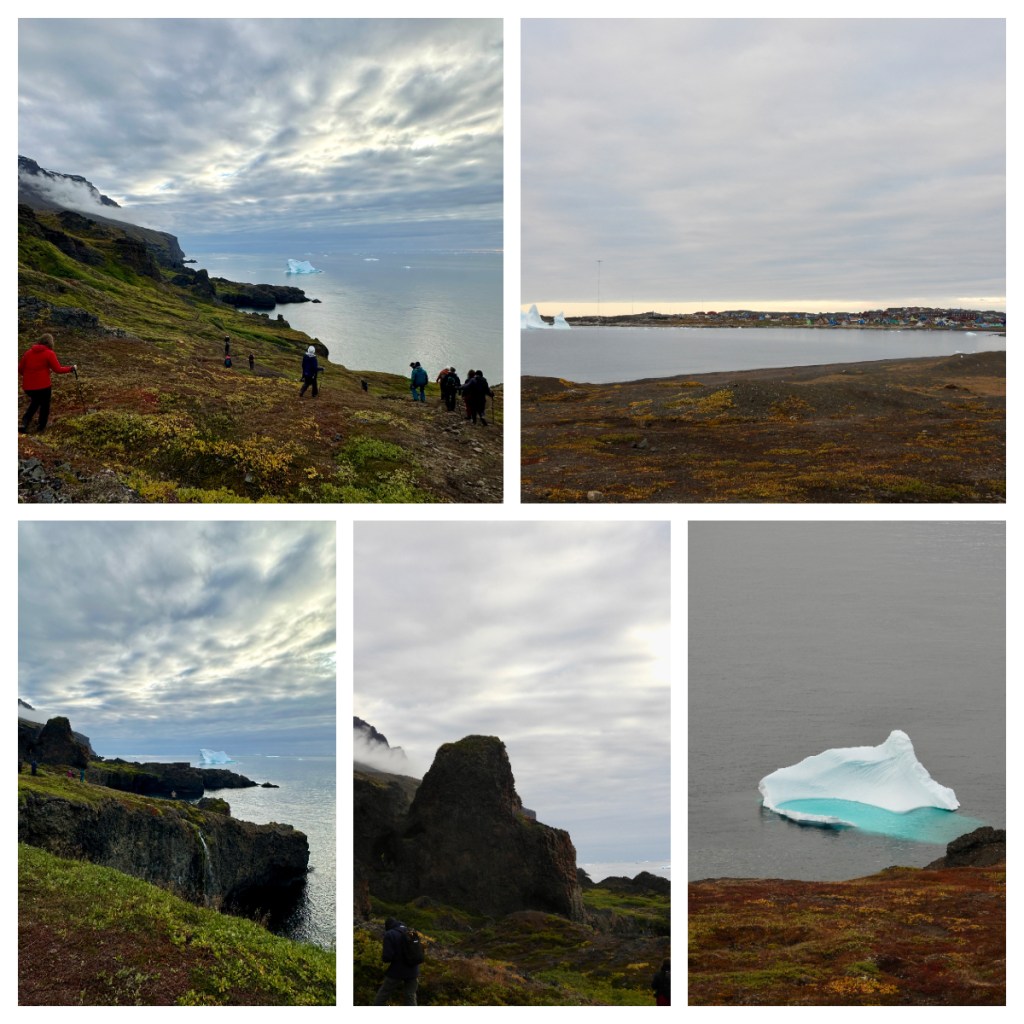
We then walked across a beautiful plateau and up in amongst the rock formations.  There was only one really steep part, and the rest was relatively easy, but WOW, what views.  From the high balsalt cliffs on one side, to the ocean and large icebergs on the other.  The landscape just blew me away I wished I could have more time.  As it was, I stayed out so long, I did not have time to look around the town and was actually in the last zodiac back to ship.  I must admit, the photos really do not do this place justice!
I decided to have lunch on Deck 8 today so I could enjoy the views of the icebergs as we sailed out of the harbour.  Finally a day where I felt like I earnt my lunch with a 10km walk!  The short journey took us around the side of the island to the area of Kuannit, where we had walked along in the morning. 

I had to wait until 3pm for my turn on the zodiacs this afternoon but it was worth the wait.  The landscape was spectacular as we zipped up the coastline and around (and in one case through) the icebergs.
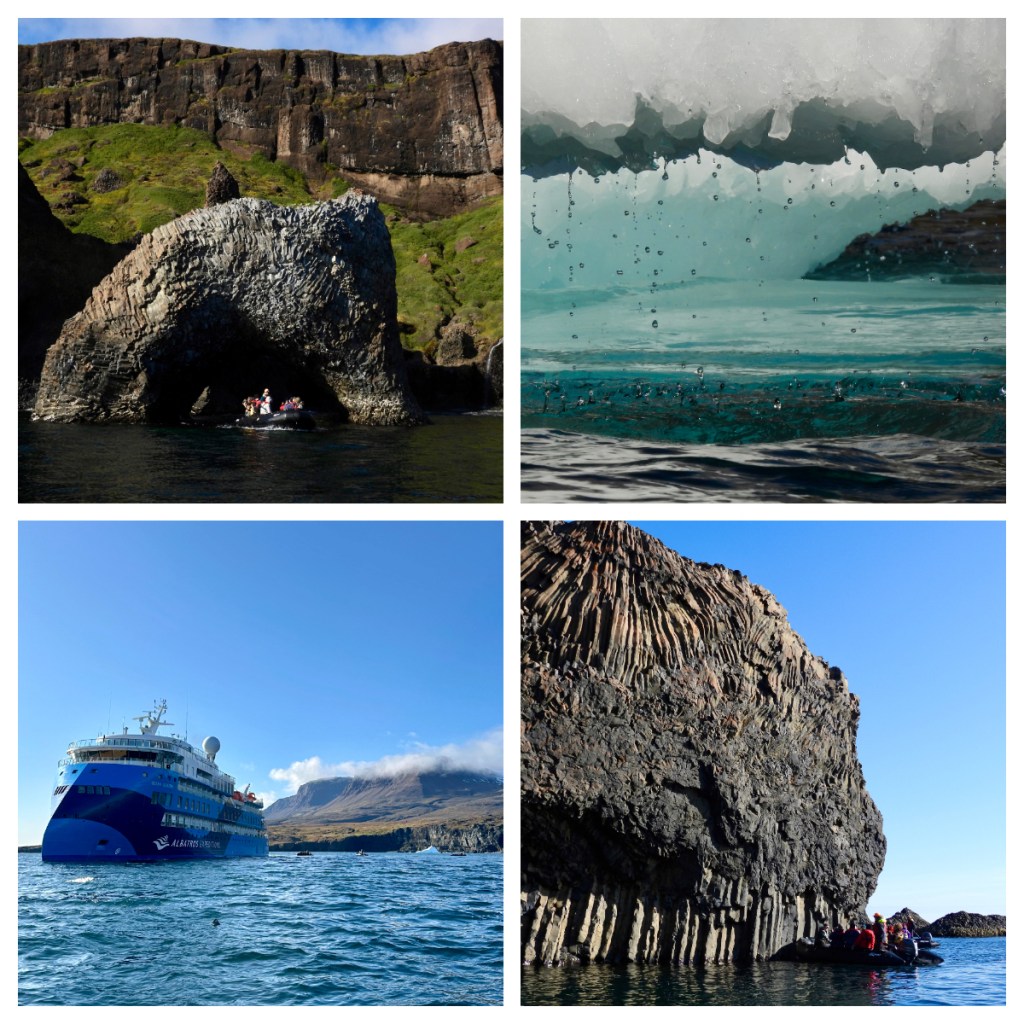
As mentioned previously, Disko Island was formed differently, geologically speaking, than the rest of the country.   While the rest of Greenland is made up of really ancient rocks (billions of years old), Disko Island is relatively young, at only 60 million years old.  It was formed as the mainland was splitting apart from North America and is more similar to the volcanic rocks of Iceland.

There are lots of visible rock layers, including some red bands that are from lava flows which have become iron filled soil.  Where rock has eroded, basalt columns have been formed and the next lava flows fill in the gaps and cools to form the swirling patterns in the rock we see today.

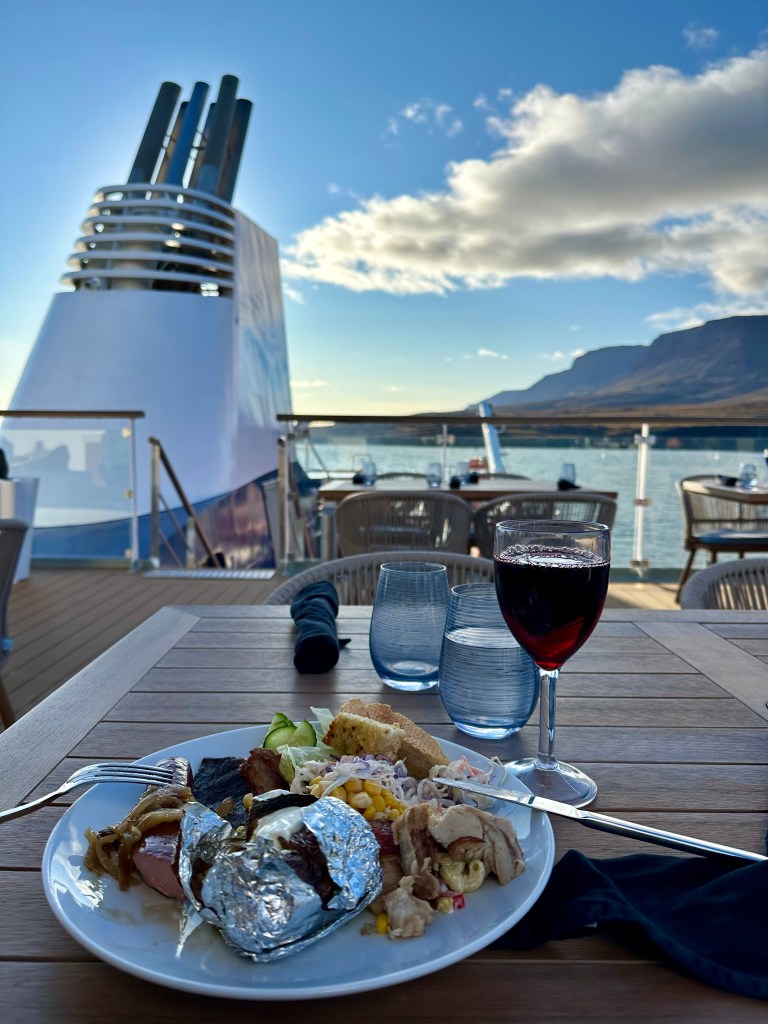
Back on the ship and I wish everyday was like today. To top it off, we had a BBQ dinner with mulled wine on the deck💚.  Greenland was definitely saving its best till last!  But wait, if I thought our day on Disko Island was amazing, the next day was possibly even better!
The next day saw us arrive offshore of Illulissat, 250km north of the Artic Circle, population around 4,500 and known as the Iceberg Capital of the World. In fact Illulissat is the Kalaallisut word for Icebergs!   The Illulissat Icefjord is the source of most icebergs in the North Atlantic and the most likely source of the iceberg that sunk the Titanic!

The Illulissat Icefjord is one of the few places the Greenlandic ice cap reaches the sea and has been on the UNESCO World Heritage List since 2004.   My plan for the day was to see it from the air, land and sea.

The Zodiac to shore was an assault on the senses as we arrived in to the harbour to the aroma of  fish and fat filling the air 🥴.  I am not a fan of the smells from the fish processing plant, but it has been the key industry here for 100’s of years.  Today, Tourism is catching up.

First up on my agenda for the day was a scenic flight over the icefjord and I was picked up, along with my 4 flight companions from the pier and taken out to the airport for our preflight briefing.  I must admit I was kicking myself for not coming out early for a walk around the town before my flight  … I think 10 days on the ship have made me lazy! 

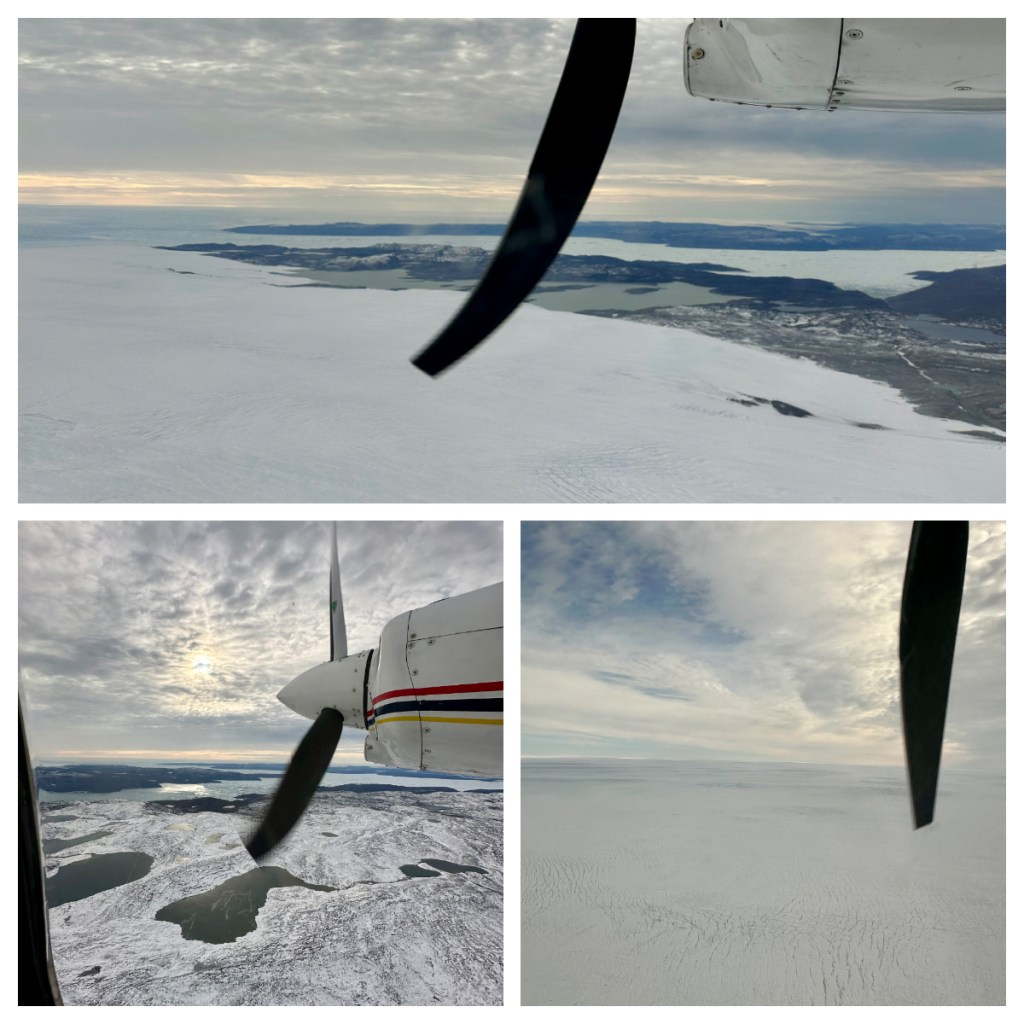
We took off in our AirZafari Vulcanair Partenavia P68 airplane, with only 6 seats (including the pilot), everyone got a window seat, although my view was a little obscured by the propellor which appears in many of my photos lol.  The conditions were great, a little bumpy in the take off but smooth once we got in to the air. 

As we flew out of the airport and over the glaciers, our pilot gave us a few facts:

  • The Icefjord is 75km long from glacier wall to sea
  • It is 17km wide and the most productive glacier in the world

I could not stop taking photos – every time the light changed it was a different kind of beautiful 💚.   The flight was not cheap but it was an amazing way to see the glaciers and fjord full of ice and I have no regrets about splashing out on this.
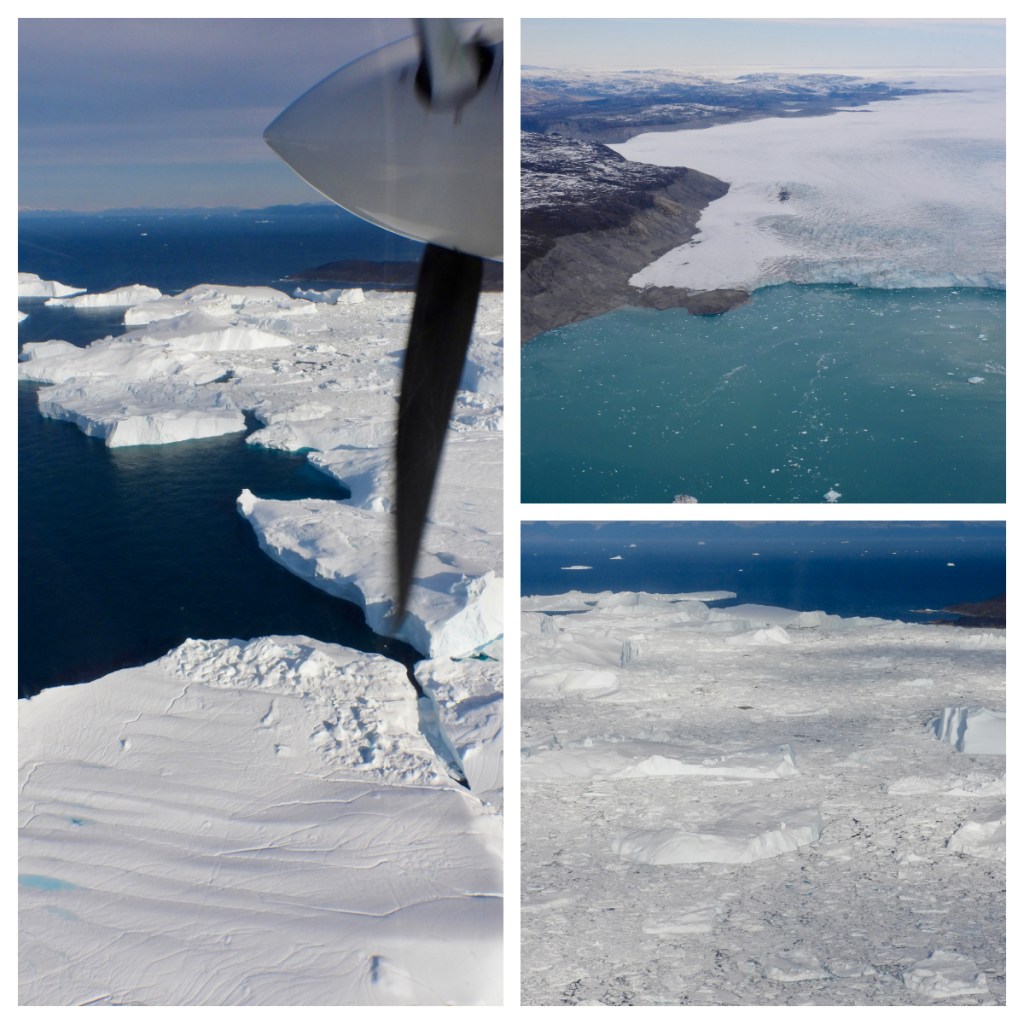
After our short flight, we were dropped back in to town and I shared a taxi with a couple of my fellow fliers to the Icefjord Centre a short distance out of town.   I had to be back on the ship for 2pm for a boat trip so was a little concerned about being short of time to walk both ways. 

The Icefjord Centre is a stunning building, apparently shaped like a “twisted structure miming the wingspan of a snow owl”.  I am not sure I got that, but it certainly fitted in to the landscape that surrounded it.  Inside, houses an exhibition of the “tale of ice” but as I was limited for time I had to keep on the move. 

A boardwalk weaves it way down towards the sea and the stunning icefjord beyond.  Even from the centre, you can start to see the icebergs floating by, and every step closer just brings more spectacular views. 
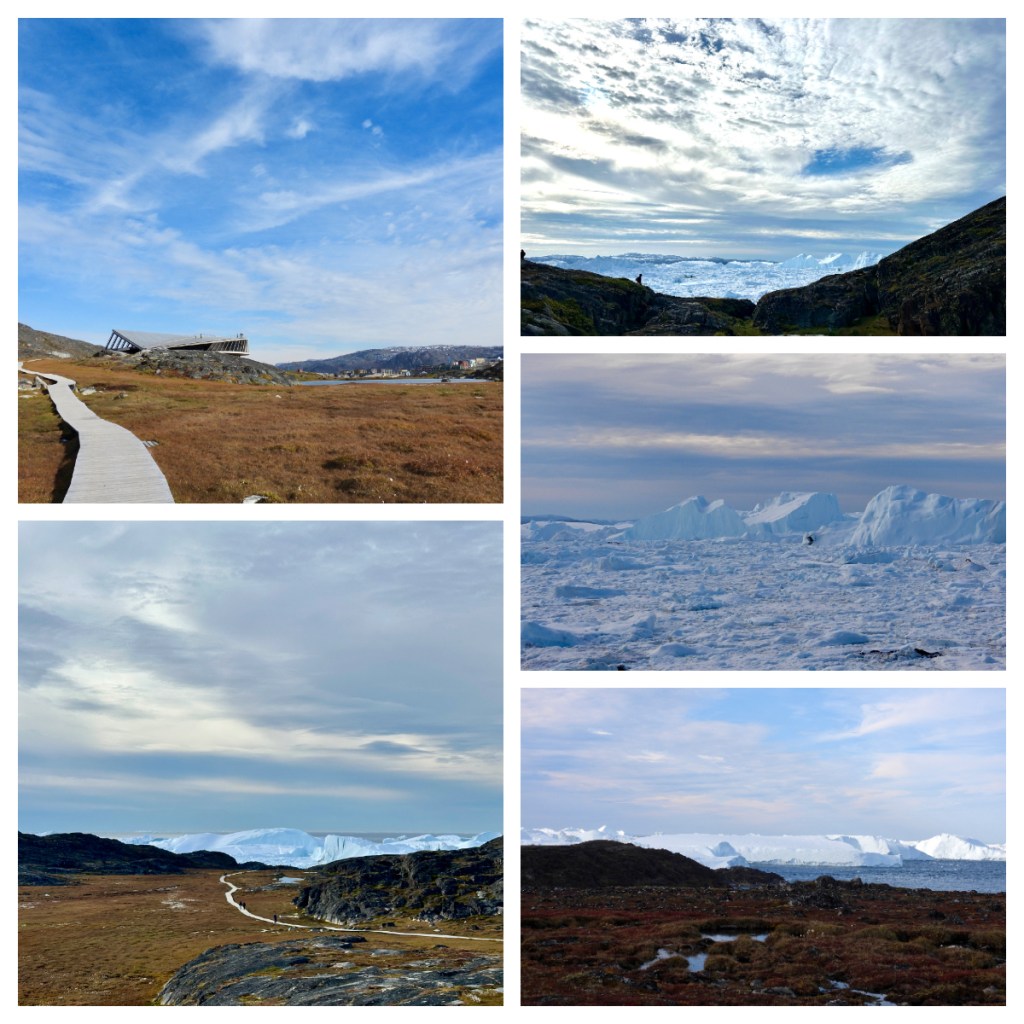
As with the flight, I took so many photos as every step gave me a different and equally impressive view.  The whole area was so well managed to protect the local flora while still providing the most amazing viewing opportunities of the towering icebergs.  Here we are seeing the icefjord at the point where it meets the sea and the pilot on the flight this morning had told us that the largest icebergs are so big they get stuck at the mouth of the fjord where it is shallower, and they sit there until they melt a little and can float free.  For this reason, some of the icebergs here are huge!

Unfortunately, as I was still rushing to get back in time for my boat trip, I could not loiter but I was pleased I go as far as I did and I still had a little time to walk down through town back to the pier.

I passed the dog kennels on the outskirts of town.  As with Canada, the working dogs are all kept together in an area outside of town, and it is also a way to keep them away from other breeds of dogs so not to contaminate their bloodline. Given that they are not far from the Icefjord centre, they could be heard load and clear!

Unfortunately, my trifecta of activities failed as I arrived back at the pier to hear that my boat ride had been cancelled due to the wave conditions. A real shame, but I was still thrilled to have seen the icefjord from air and foot.  After to speaking to someone who had been on one of the boat trips that did go out, I was grateful not to go as he told me it was so rough that they could not go outside the small cabin on the boat and people were throwing up!  Back on our stable ship, you would not have guessed it was that bad!

Another amazing day, and as we set sail south our evening briefing was interrupted as we passed the amazing icebergs – no one wanted to sit inside and listen when the views outside were so amazing!  💚

Las Vegas + Pyongyang = Ashgabat

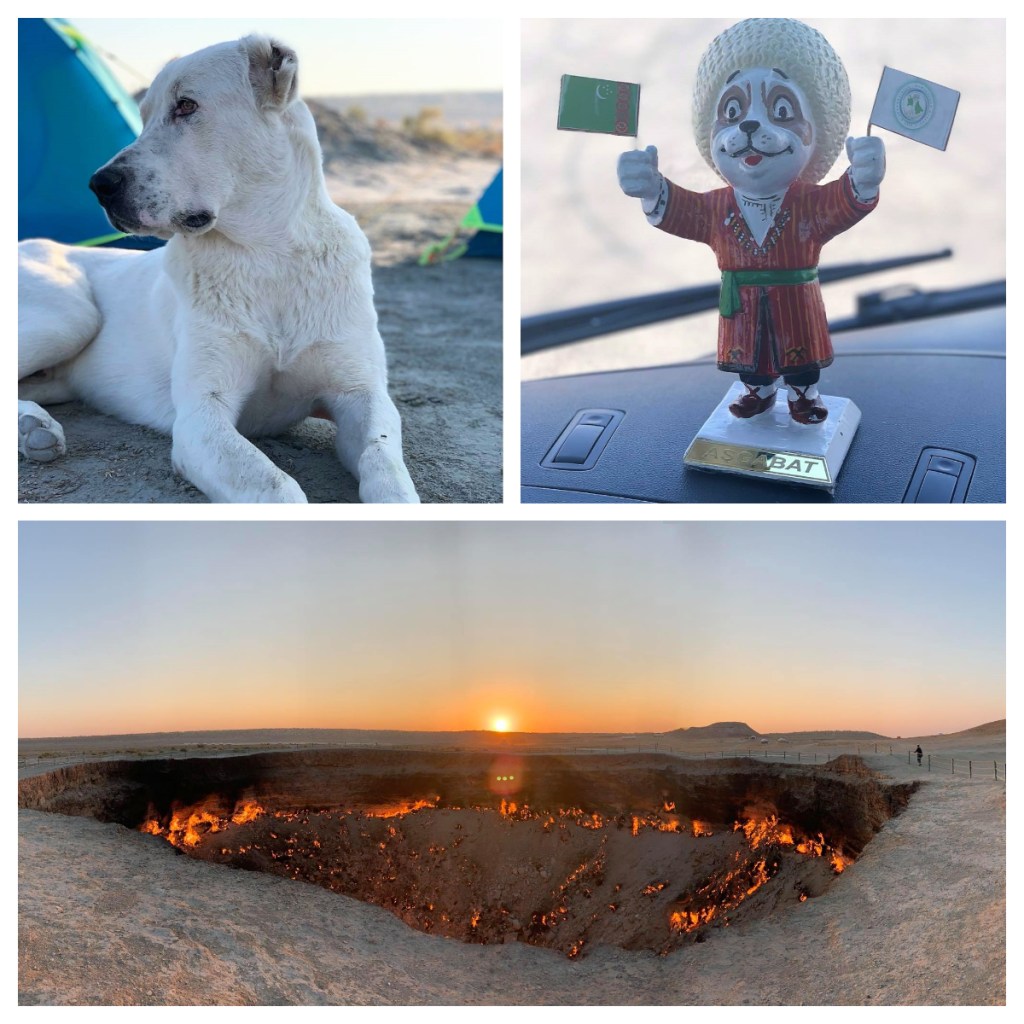
After a night’s sleep in a tent near the Darvaza Gas Crater, I got up early to watch the sunrise, with the company of the lovely Alabai dog who had just come off his nightshift lol.  (I forgot to mention that an Alabai was the mascot of the Asian Games held in Ashgabat in 2017!).

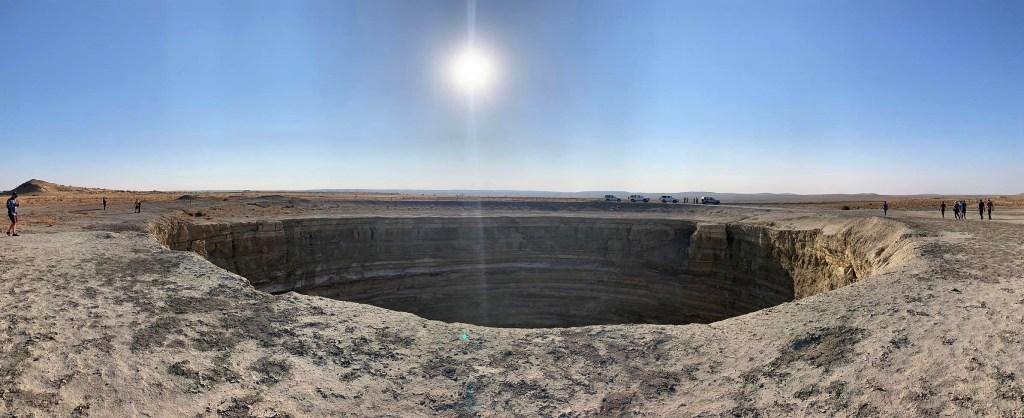
Too soon we were back on the road towards our final destination of Ashgabat, but not before a few stops on the way.  It is worth noting that the Darvaza crater is not the only crater in the region and there have been numerous other cave ins of drilling sites.  We stopped at a couple along the road, neither as large as the Darvaza, or burning.  One had a very distinct sulphur smell to it, and the second was full of water.  Apparently, they continue to get bigger.

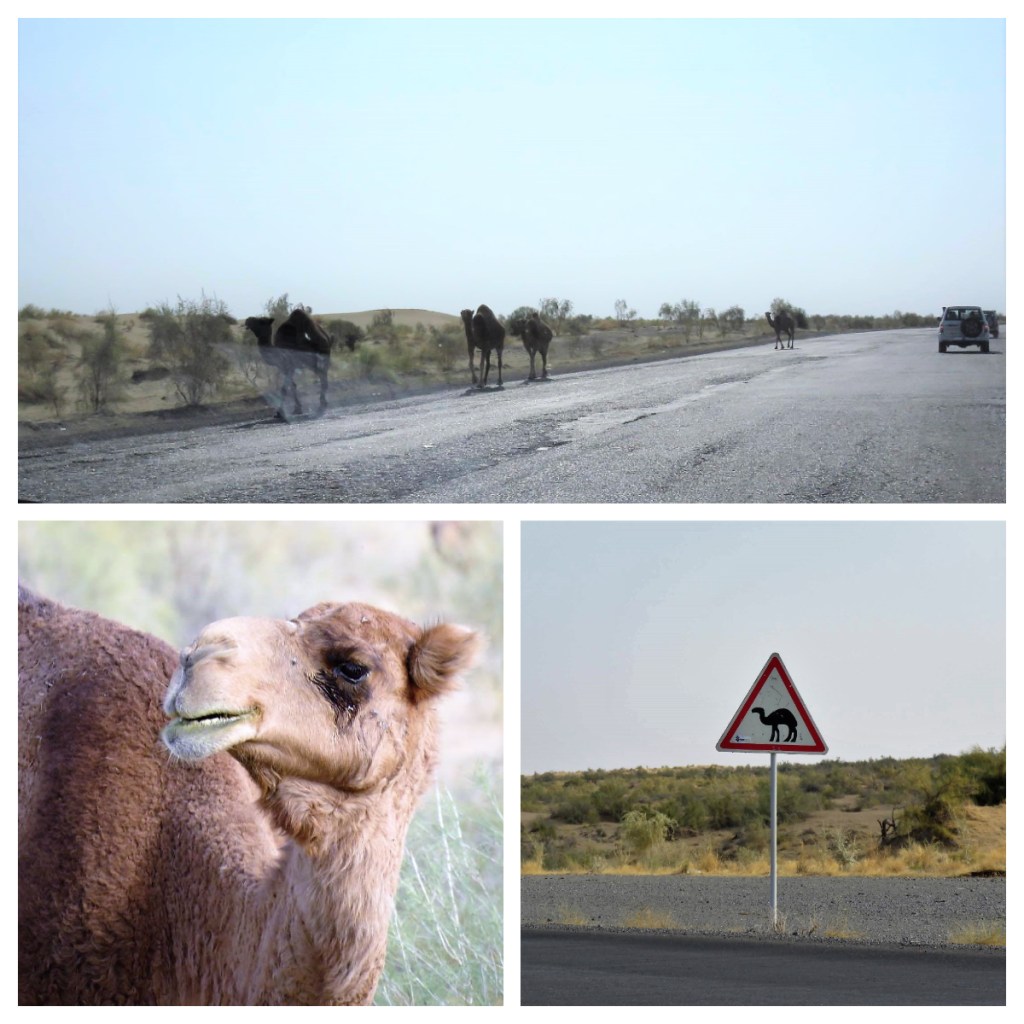
This stretch of the road continued through the Karakum desert (80% of the country is desert) with many more camels along the road – and a road sign warning of them (I am loving this ❤️❤️❤️).   Most of the camels we are seeing are dromedary (one humped camel) despite them being native to Arabia.  The original camels of the region were Bactrian (double humped) but as Arabs moved into the region, following the Silk Road over 4,000 years they brought with them their camels.  The camels bred with the native Bactrian camels and their dominate genes meant the resulting offspring were predominately single humped, almost wiping out the local Bactrian population.

After a quick dune toilet stop (not always easy to find a bush big enough to hide behind in the desert lol) we stopped at a small semi-nomadic village.  Most of the people who live here still continue with their nomadic way of life and breed camels for wool, milk and meat.  Camels can be worth between $5-6000! That said, these semi-nomadic villages are pretty well set up these days with running water, gas and electricity, schools and medical centres.

Do you know why camels’ are always looking haughty??  Legend has it, Allah has 100 names, 99 are known by mortals, but the 100th name, a very scared and holy name, Mohammed told to his camel – so they are always looking down on us because they know something we don’t know!

Back on the road, passing more camels along the way (have I mentioned that I am loving all the camels lol), of course our next stop was the car wash – a large industrial place where all the vehicles entering the city could get washed.  As with Dushanbe, dirty cars were not allowed into Ashgabat, the capital of Turkmenistan.  Clearly, they did not care so much about dirty people as we were all pretty dirty by this stage. 😂

Sadly, we had to say goodbye to our jeeps and drivers and the amazing time in the desert and move on to our final days in the incredible city of Ashgabat. 

As I mentioned in my previous blog, Turkmenistan has been populated since ancient times, being conquered by various armies and empires, including Alexander the Great in the 4th Century BC, the Parthian Kingdom (who’s capital was Old Nisa where we visit later), Arabs (bringing Islam in the 7th century AD), the Seljuk Empire, Genghis Khan, Temur and many more until Tsarist Russia invaded in the 1880’s under the guise of freeing Russian slaves. 

After numerous bloody battles, Imperial Russia took control in 1894 and through to independence, Russia followed by the USSR exploited the countries mineral resources. Still today Russia has a monopoly over gas from Turkmenistan – allegedly they buy it for cheap and sell it on as Russian gas at a higher price.

There have also always been tribes of horse-breeding Turkmen who drifted into the area and whose ancestors remain today – again, more about these men and their horses later.

As with other USSR states, Turkmenistan declared its independence in 1991 and today the country is considered a sovereign state. It was ruled by ‘President for Life’ Saparmurat Niyazov until he died in 2006.  After his death, it was decided that his successor would be selected through public elections and Gurbanguly Berdimuhamedov was elected (although apparently the election did not meet international standards).

The country remains with limited contact to the outside world, with most popular social media sites banned (e.g. Facebook, Instagram etc.) unless on a government sanctioned domain and the government has full control of all media outlets, however more recently the Government has started to rewrite its legislation with a goal of meeting international standards.

I also mentioned in my previous blog, farming is still managed along the Soviet lines of collective farming, as is most of the economy with industry almost entirely dominated by government-owned entities, including all the incredible construction we see in Ashgabat.

And so, to Ashgabat, were to start … today Ashgabat’s population is around 1 million people although how it got there was an interesting story.  Not so long ago, the population of the city was 400,000.  Apparently, they were awarded the Asian games, but then realised the city was supposed to have a population of over 1 million to host the games … so they just expanded the city borders almost overnight, so the population was big enough!

As we entered the city, we passed another area of government built housing (they all have green roofs so are easy to spot!) and then we were in to the beautiful wide (and almost car free) boulevards and white marble buildings.   Apparently, the president had wanted the ‘whitest’ city in the world – white marble buildings, white lamp posts, white cars (are preferred).  Apparently, Turkmenistan purchased so much white marble (from Turkey and Italy) during the construction, the world price went up by 30%.  The city even made it into the Guinness Book of World records in 2013 for having the highest concentration of white marble clad buildings!  Almost 600 in the city centre.  Lonely planet describes the city as Las Vegas meets Pyongyang and they are not far wrong though I think Dushanbe comes a close second 😂

Most of the city was destroyed in a massive 7.3 earthquake in October 1948, the extent of it was not widely reported by the USSR, but it is believed that more than 110,000 people were killed.  The USSR were also pretty cash poor at the time (due to the funds spent on WWII), because of this, they quickly built an area of cheap, temporary housing with the intention of replacing them when they had more money.  Not surprisingly this rebuild never happened!  This means it is really a city of two parts – the old (built in the 40s-50s) and the new (built in the 90s).   

These days, most people live in the older part of the city and don’t come out till after 6pm because of heat (today is only 33 and it is autumn!).   Although life may seem somewhat controlled based on our ‘western’ opinion it is worth noting  that their life is not so bad … they have very low taxes and cost of living, all forms of public transport is subsidised, free health care (mostly) and utilities (gas, electric and water) costs $16 per year!  Rustam explained that if you have 6 children or more you get given a free house!!! He was on child number two and had great hopes for the future lol.

We arrived at our beautiful hotel, right across the road from the Presidential palace – such a contrast from the night before, spent in a tent in the desert!  Unfortunately, photography of the presidential palace and some other key buildings, as well as uniformed police and or military is forbidden.

With very little time left of our trip, after a brief break for a much needed shower we headed out on some afternoon sightseeing, starting with the National Museum of History which showcases the concise history of the country back to BC3000!!

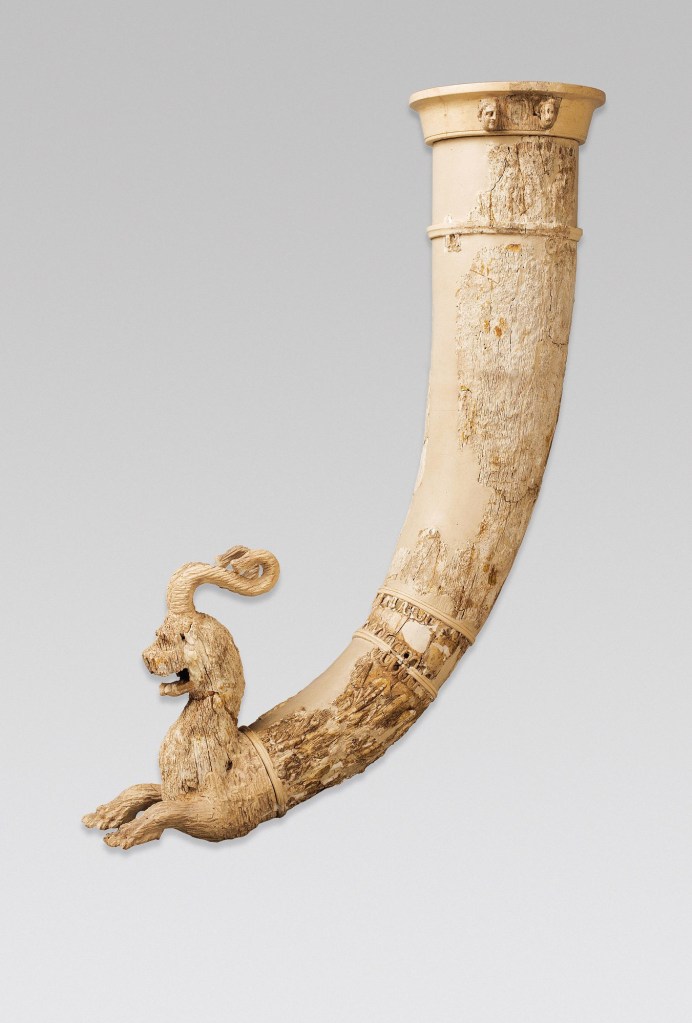
Here we were introduced to Rhytons – ancient drinking horns, often elegantly carved and sometimes made from ivory like those we see in the museum that were found in nearby Old Nisa (more about that later).

Just outside the museum is what is now the 5th highest flagpole in the world, proudly displaying the Turkmen flag.  It was once the tallest but has now been overtaken, even by the flagpole in Dushanbe which comes in in 3rd place!

Our next stop was at the Arch of Neutrality (not technically an arch lol).  When the Soviet Union collapsed, Turkmenistan was left without any support or protection and with Afghanistan and Iran just over the border (Ashgabat is only 15 minutes to the Iranian border) and people were scared.  So, in 1995, the government declared the country in a state of permanent neutrality to contribute to the “peace and security in the region”.  Ultimately the intent is that no other country can send troops into the country and if they do, it is expected that the UN will defend them, if they are attacked. 

The country is very proud of their neutrality and even prouder of their Arch of Neutrality.  A 75 metre tall rocket shaped tower topped with a gold statue of the first President – the icing on the cake is that the President’s statue rotates so his face always faces the sun.

Our final sightseeing stop for the day is Independence Park.   Beautifully manicured flower beds, marble stairs (of course there is marble), pathways lined by five headed eagles, fountains and statues of national heroes.  Of course, the centre piece is the Independence Monument – the lower part of the monument is shaped like a huge yurt and at the top of its 118m tower is a crescent moon with five stars representing the unity of five Turkmen tribes.

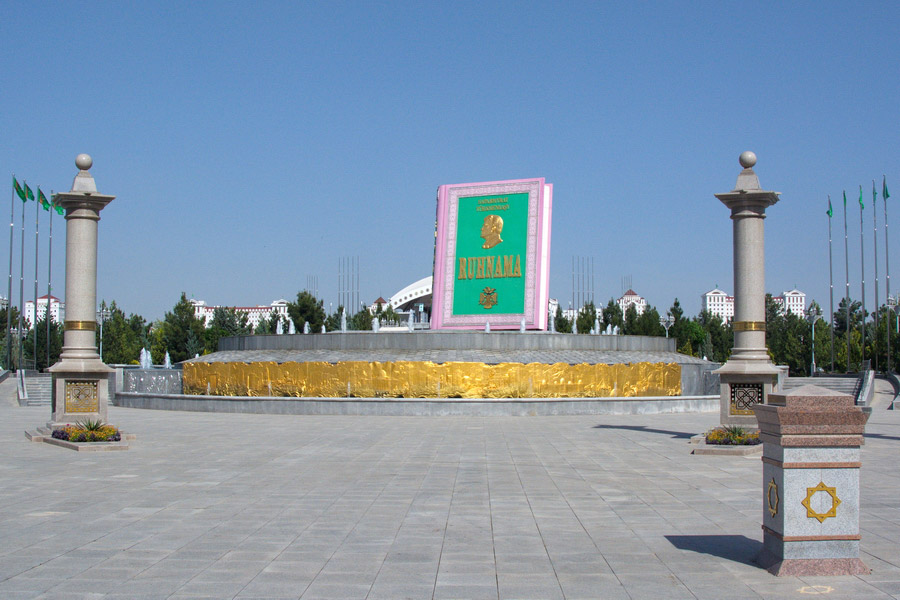
Also, in Independence Park we found a huge statue/model of a book – “Ruhnama (The Book of Soul)”.  This book was written by the first President and is apparently a combination of spiritual/moral guidance, stories and poems, information about Turkmen history and traditions and the definition of “moral, family, social and religious norms for modern Turkmens”.  

The book was initially rolled out in schools and libraries, but then its teaching actually became part of the driving test and potential government employees (FYI the government is the largest employer in the country) were tested on it at job interviews!!  In 2005, part of the book was launched in to orbit so that it could “conquer space” and it is expected to orbit the earth for 150 years

In 2013, the book was removed from the school curriculum and people were no longer tested on it and despite it having been translated in to many (depending on sources somewhere between 45-75) languages today you can’t find a copy anywhere 🤔🤔🤔

Despite the fact the wind brings sand and dust from the desert into the city, the city so sooooooo incredible clean (as of course you would expect from Central Asia lol.

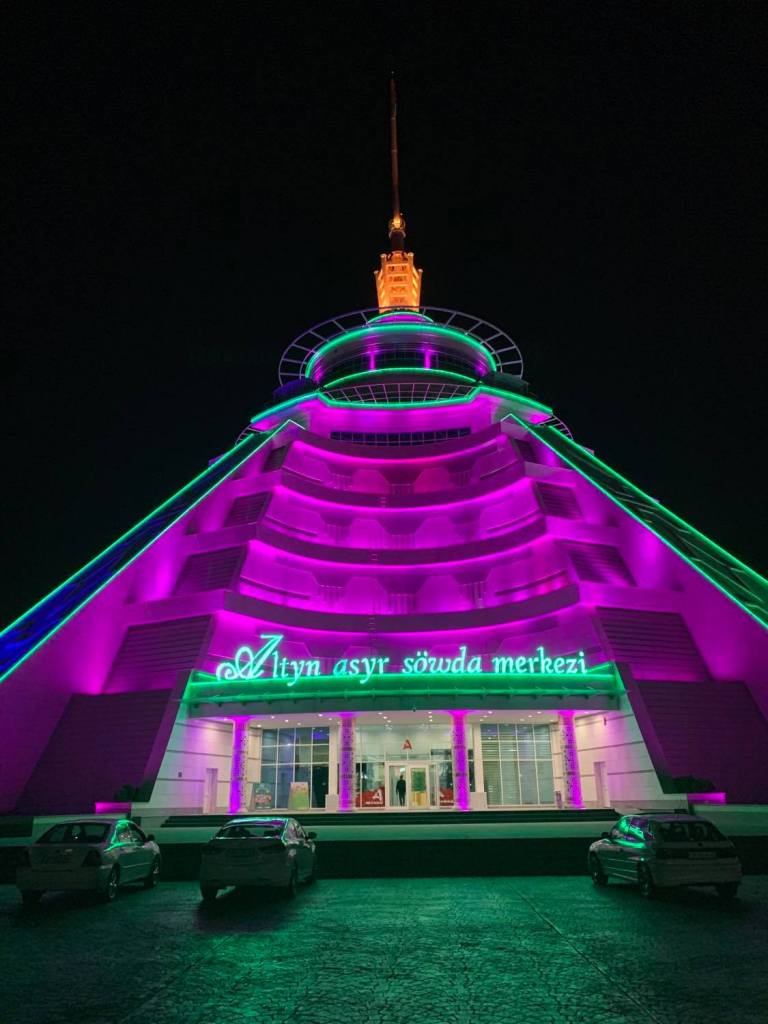
We had dinner in a restaurant with an amazing view  of the sunset and then the neon lit monuments and buildings – it was a beautiful warm night and I would have loved to stay longer as it was technically the last night of my holiday but sadly as no one else wanted to so I had to head back to the hotel and was in bed by 9.30pm again!  One of the down sides of group tours – especially when everyone is so much older!  And apparently, I was also foiled by an 11pm curfew in place in the city (this is normal practice), but to be honest I would have been happy with 11 instead of 9 🥴😂