Georgian capitals old and new

Georgia, April 2025

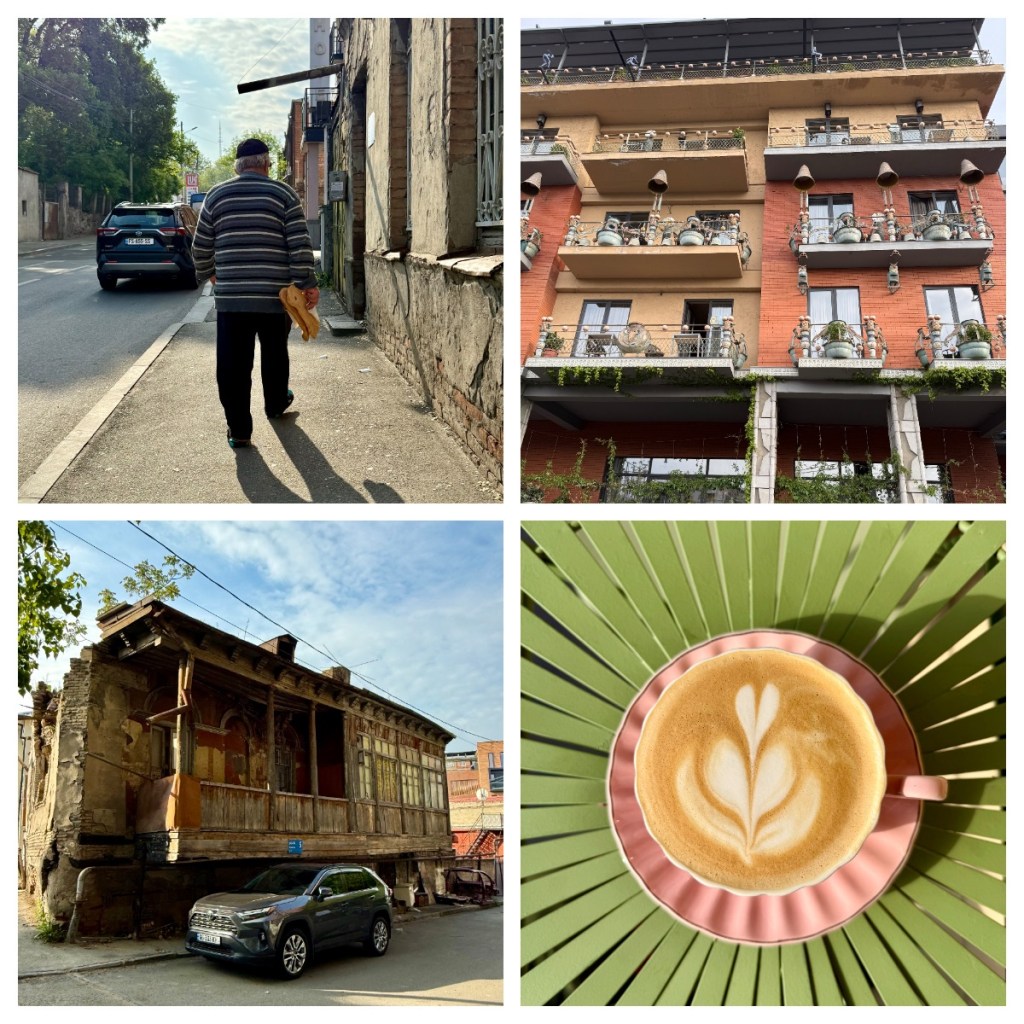
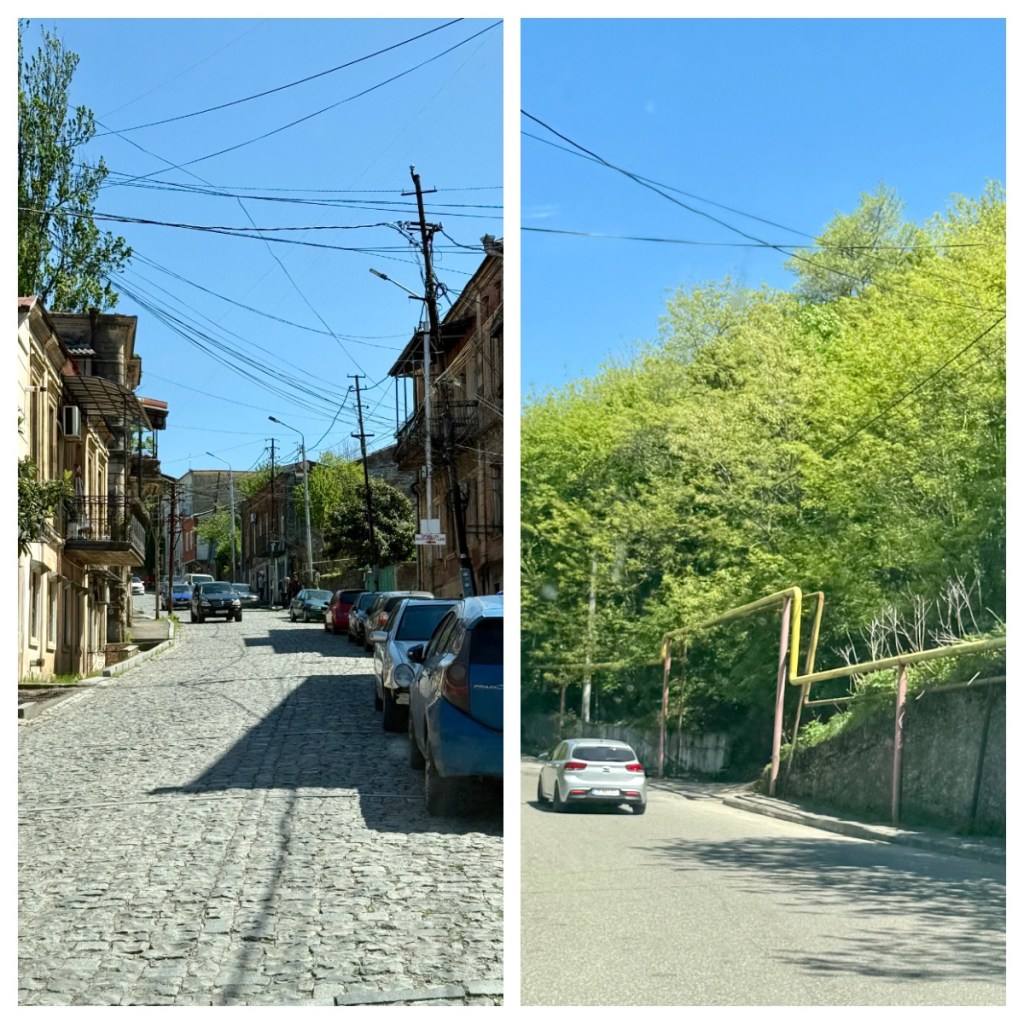
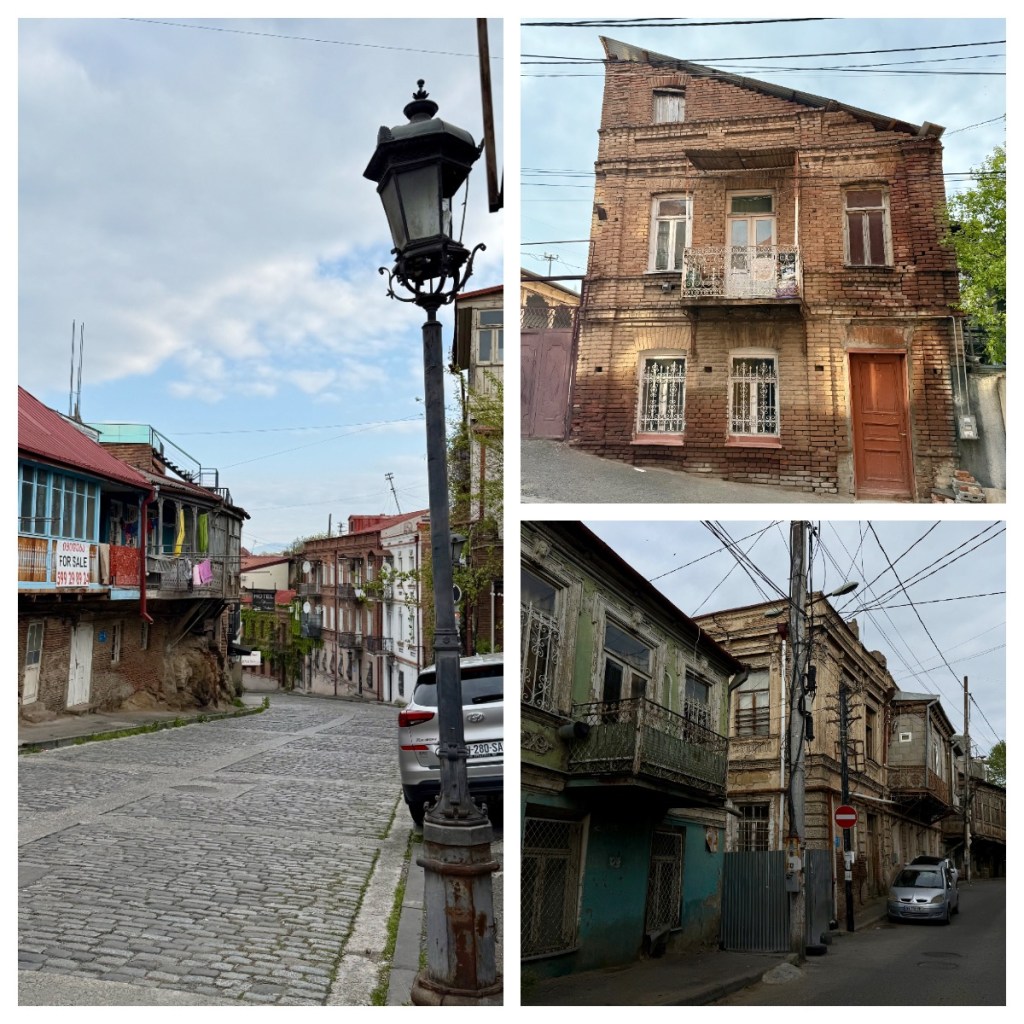
Today was Easter Sunday and I finally made it out for a morning walk through the now silent streets.   Our hotel is in a fairly residential area, with narrow potholed streets, lined by small ramshackled houses – in fact, many of the streets I walked were like this.

What I didn’t notice until I looked back at my photos that I could fulfil all my gun needs just down the road from my hotel lol.

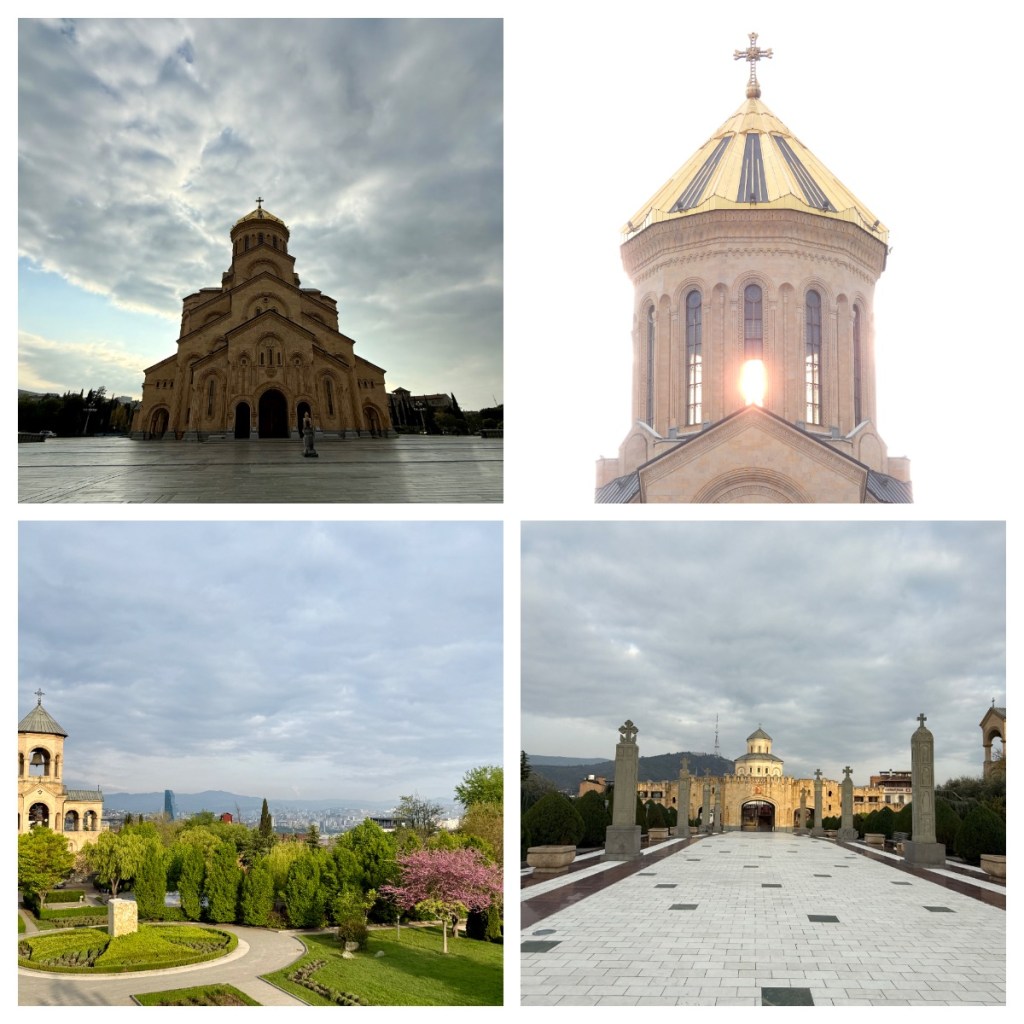
Being so pleased with the photos I had taken from my hotel room the night before, my destination was the Holy Trinity Cathedral of Tbilisi, the head church for the Georgian Orthodox religion.  Given it was Easter Sunday, I was conscious of having a look around and being on by way before the Easter rush began.  I did not even attempt to enter the church, as although it was open, I was definitely not dressed for it!

Despite the early hour, there were already vendors out selling candles and icons and of course, the standard stray dog guarding the doorstep lol. 
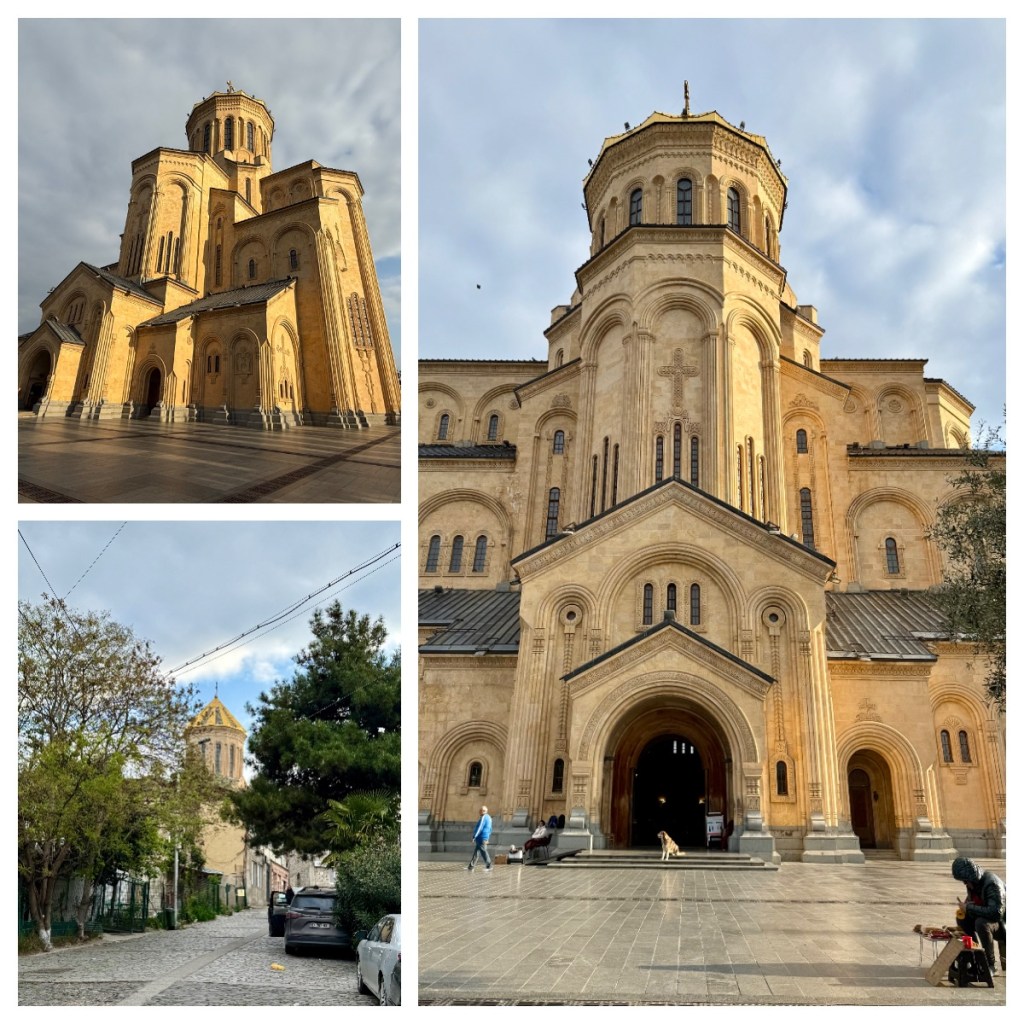
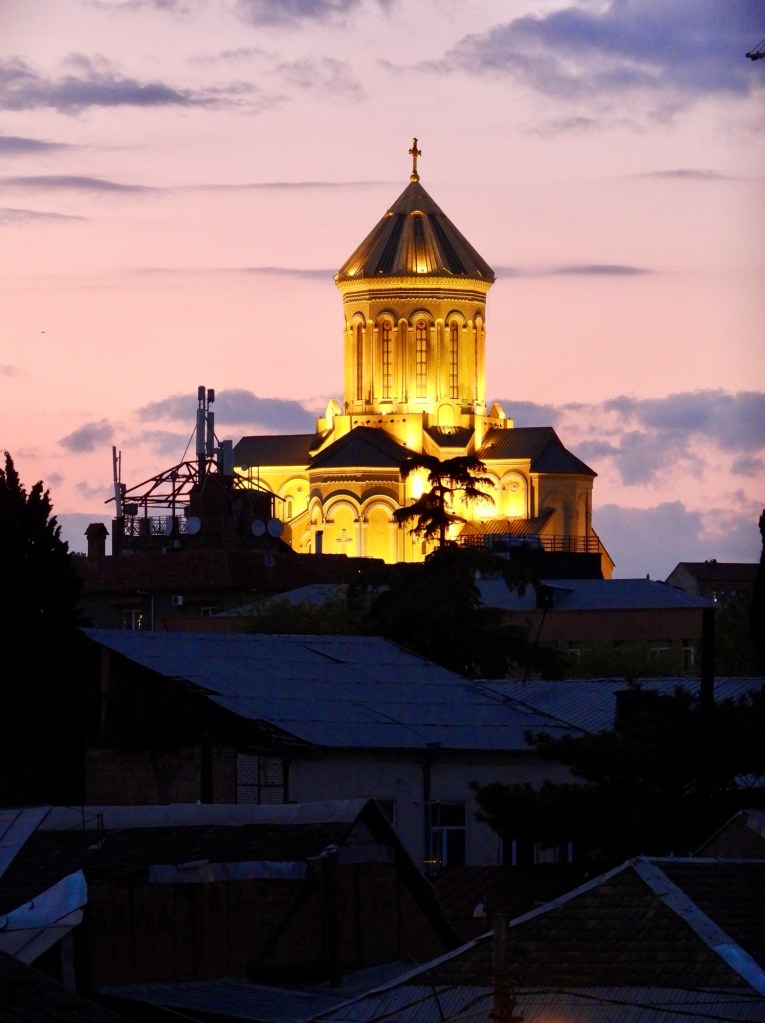
The cathedral, finished in 2004, is the tallest church in the country (at 101m high) and its golden dome dominates the Tbilisi skyline on this side of the Kura River.  Although it was finished in 2004, construction actually started in 1995 and the first service was in 2004 and it was somewhat controversial as this was during the “12 years of suffering”, when most of the population was struggling to survive.  

It is definitely an imposing structure and I managed to perfectly align the sun, rising behind the cathedral to take what is perhaps one of my favourite photos.  This was actually only the second time I had taken my actual camera out with me and I was regretting not having got it out earlier!  Although I am normally happy with the quality of my phone photos, the quality of those taken on the camera is another level. Why did I wait? 

As I wandered back down through the streets I was shocked by the contrast from one street to the next.  One street is full of run down and ramshackled buildings (with the cathedral towering over the neglected houses) and then the next is full new builds.  The old buildings have real character so I do hope they chose to refurbish some, rather than just demolish them to make way for modern tower blocks. 

It seems that not much opens before 9am here, even hotel coffee shops did not appear to be open, but I did finally manage to stumble across a cute little café which was open.  Even better, the aesthetics were almost as good as the coffee ❤️.
Tazo picked us up at 11am and we joined the traffic again heading out of town – apparently today many would be visiting cemeteries in the villages. 

Our first stop of the morning was the Jvari Monastery, a 6th century monastery sitting on the edge of a cliff, overlooking the ancient capital of the Kingdom of Iberia, Mtskheta.   The name translates to “the cross” and legend says that the cross of Saint Nino, who we met a few days earlier, was placed here (over a Zoroastrianism sanctuary) as she converted the people in the capital city below to Christianity. 

Subsequently a church was built on that site.  Although some of what we see today dates back to that original church, it has also been through a lot restoration work over the years – this has been a challenge given the state of the original building and the loss of the building records in a fire!

That said, it is still considered a site of great importance and one of the most sacred sites in the region. 

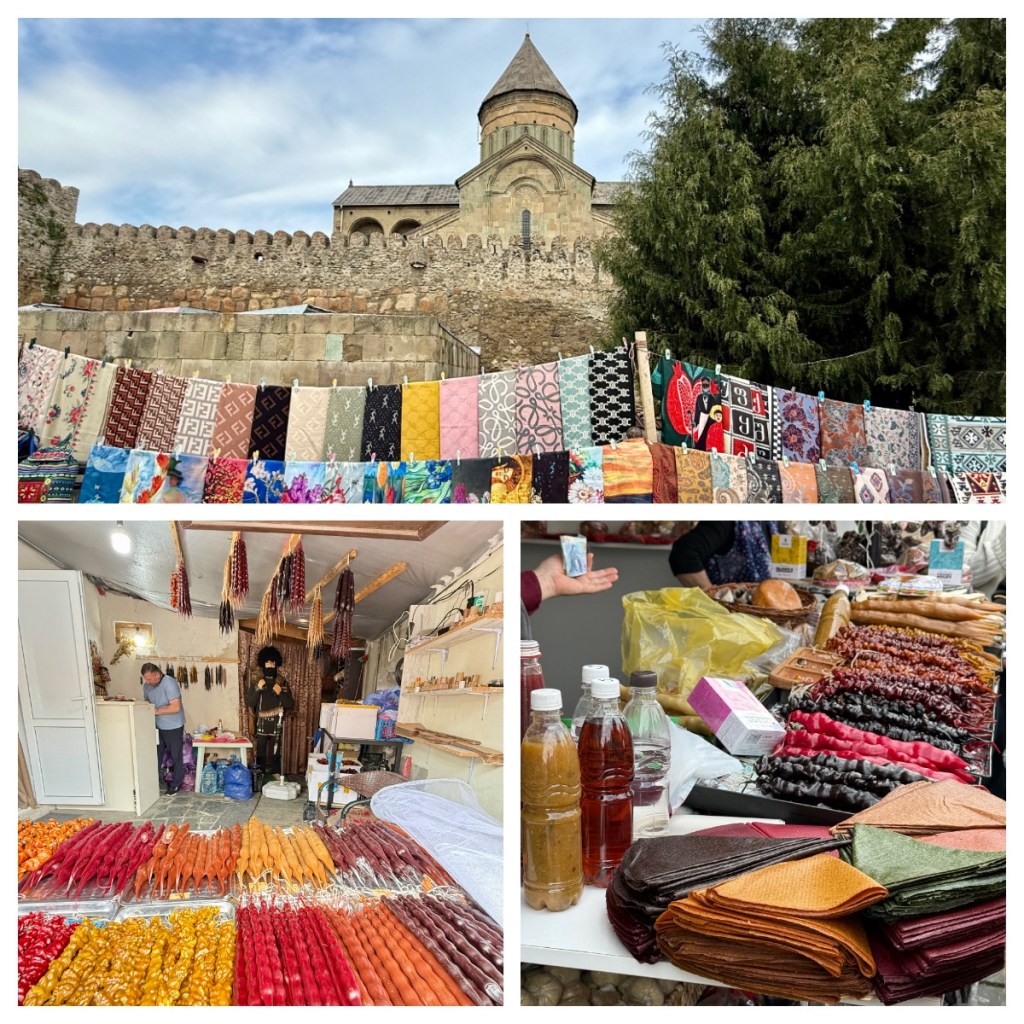
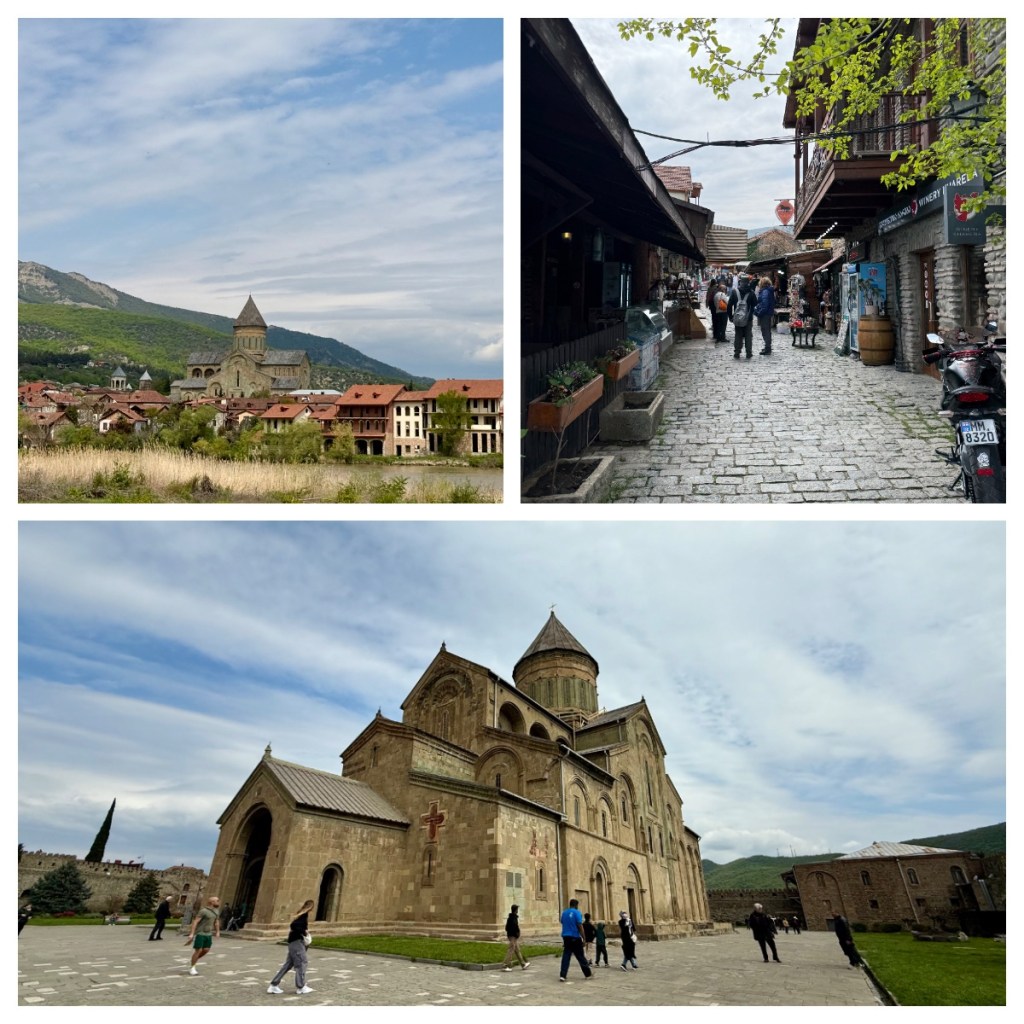
We then went down into Mtskheta, once a grand capital city, today more of a tourist capital and quite possibly one of the most touristy places we have been with many stalls selling souvenirs lining the narrow, cobble stone streets of the old town. 

Mtskheta is not only one of the oldest cities in Georgia, but also one of the oldest continuously inhabited cities in the world (along with Kutaisi) and it is believed that the original settlement was founded by the ancient Meschian tribes in the 5th century BC.  As I mentioned above, from the 3rd century BC to the 5th century AD, it was the capital of the Kingdom of Iberia.  It is also considered the birthplace of Christianity in Georgia.

The Svetitskhoveli Cathedral is the second largest church in Georgia, after the Holy Trinity Cathedral I had visited earlier in the morning, and what we see today was built around 1010 on the site of one built in the 4th century.  Unfortunately a lot of its frescoes were lost due to whitewashing by the Soviet imperial armies over the years.  

The town has been referred to as the second Jerusalem due to its status as a Holy city and is the burial place of Georgian Kings. Legend has it, it is the resting place of Jesus’s tunic, brought to the city by a Georgian Jew who had witnessed the crucifixion.  
Given its holy significance, it was no surprise that this church had a higher dress code than others we had visited and we were provided with scarves to cover our heads.

There is apparently a tunnel that connects Svetitskhoveli Cathedral to Jvari Monastery on the hill above, along with a spring and space for 1,000 people to hid in case of attack (which came frequently over the years). 

We walked back through the gauntlet of tourist shops and stopped to purchase some churchkhela – a sausage shaped sweet we had seen all over the place.  It is traditionally made of walnuts, surrounded by concentrated grape juice, but other varieties have different nuts and different fruit juices.   Apparently, Georgian soldiers used to carry them with them as they contained enough calories for one man of day!  That was not great as I had to eat what I bought before I left as I could not take them home with me.  

Apparently many that are sold these days are mass produced, but one seller here still makes them in the traditional way so we made sure to purchase from him.  I really liked them but they were very sweet.

As we drove back in to Tbilisi, we passed some small protests happening around parliament.  Apparently, there is some discontent with the last election held in October 2024 which re-elected the Georgian Dream party who have been in power since 2012.  A number of international organisations have noted problems with the election and so opposition parties and many of the Georgian people have refused to recognise the results and have taken to the streets daily in protest.

These intensified when the current Prime Minister announced he was suspending talks on Georgia’s bid to join the EU.  Currently Georgian’s have visa free access to EU countries and this could be impacted by this move.

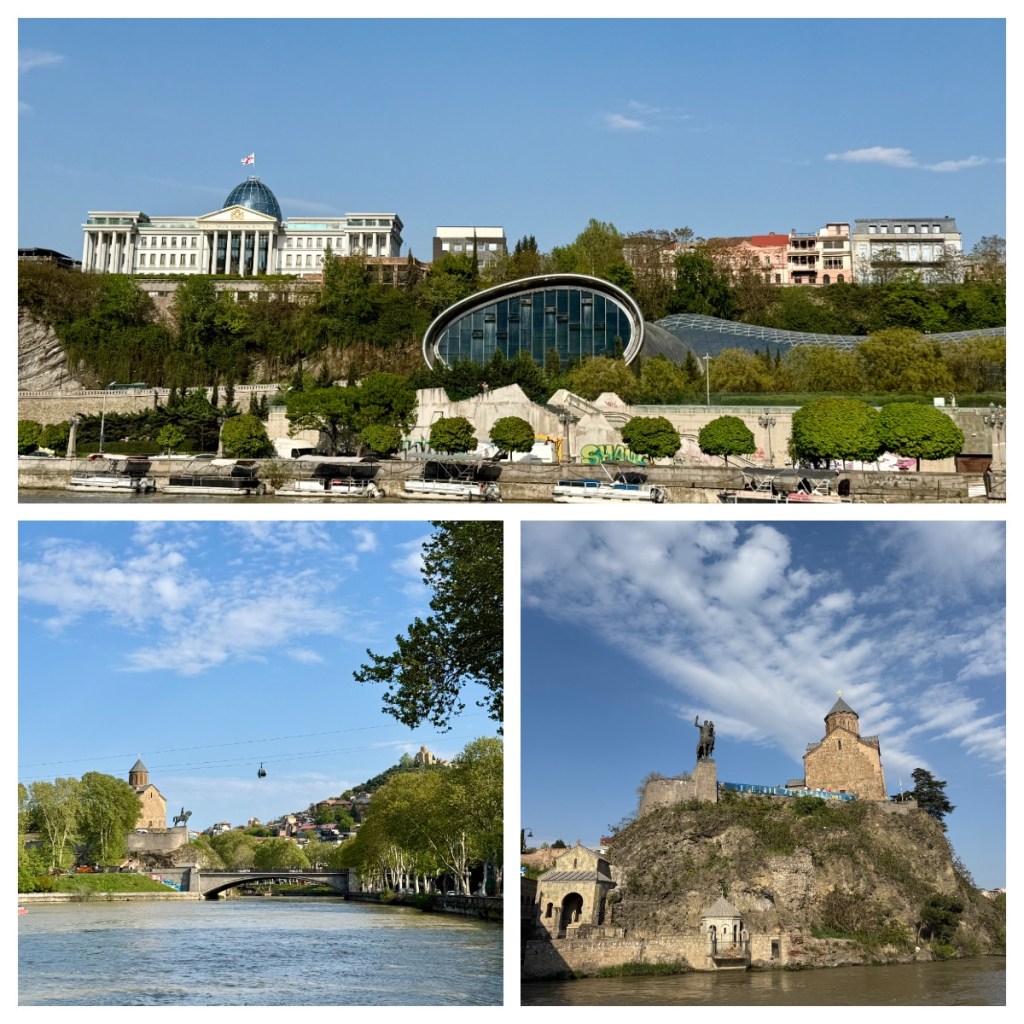
We continued on past a golden St George (on a very high plinth) before finding a parking space near the Metekhi church on the left side of the river.  It is one of the oldest churches in the city and a great viewpoint across the river to the old city. 

From here we walked down to the cable car station in Rike Park to travel 5 minutes over the river and old town and up to Narikala Fortress, perched on top of the hill, with great views of the city on the way.  The cable car is a very popular way to get around for locals and tourists alike.

There is a beautiful panoramic view from the top, including a close-up view of Kartlis Deda or Mother of Georgia.  Unfortunately the way she is situated you actually only get a close-up view of her behind!  The “Mother of” is actually a soviet concept and many ex-USSR countries have one.  The 20m Georgian monument was erected in 1958 and made of aluminium.  It depicts a Georgian woman in national dress, holding a bowl of wine in her left hand to greet people who come as friends, and a sword in her right had for those who come as enemies.  I am glad we got the wine lol

Instead of visiting the fortress (we have seen a fair few) we walked down through the National Botanical Gardens which lie in a gorge on the other side of the hill to the city.  They cover around 160 hectares and it was a beautiful day for a stroll passed the waterfalls and trees with their spring blossom and even more great views – this time back across to the Narikala Fortress.

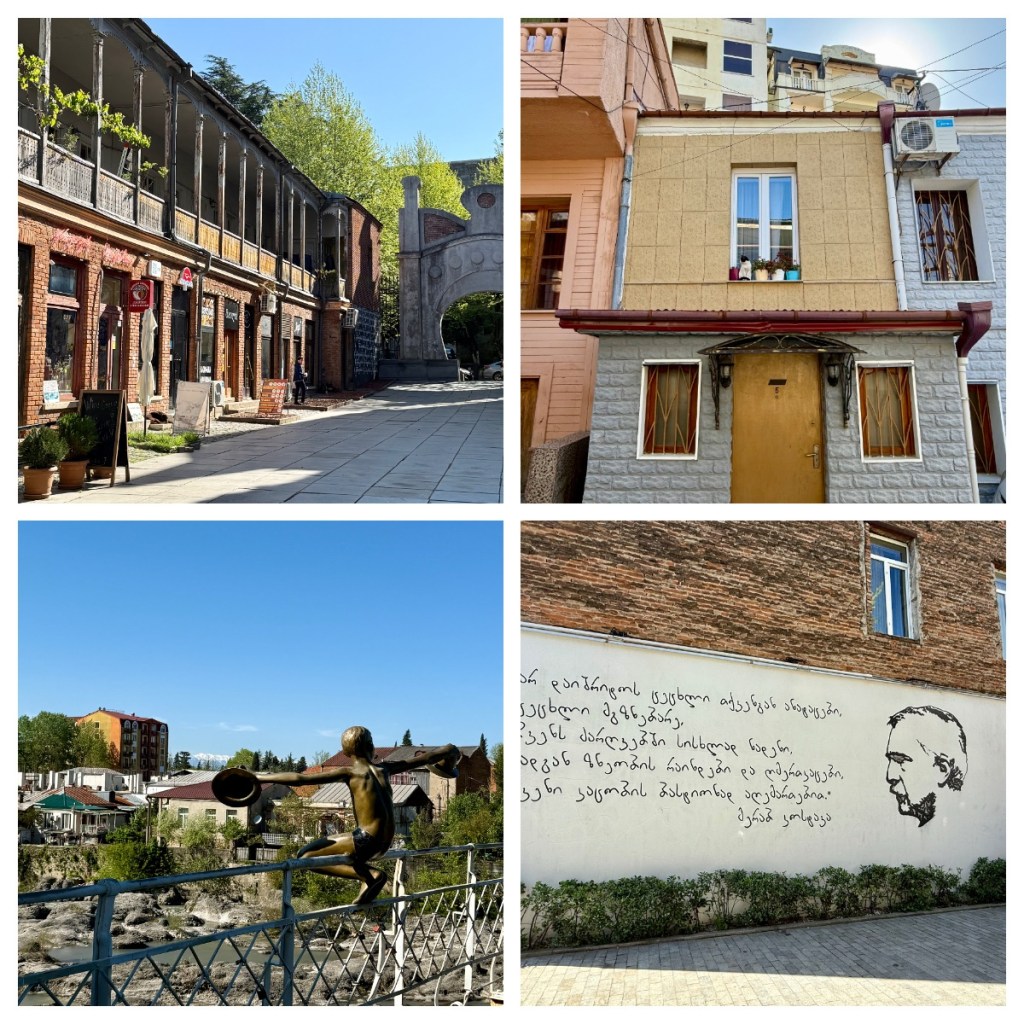
We ended up in the Tbilisi’s old town and spent a little time exploring the narrow, cobbled streets.   Passed the famous painted houses with carved balconies, the very Islamic looking sulphur baths and views back across to the cathedral on the other side of the river.


We passed through the very tourist targeted area filled with bars, night clubs and cafes, before stopping to admire the Tamada statue.  We had seen a smaller version of him on the fountain in Kutaisi, but this time he is much larger and a cultural landmark of Tbilisi.  If you missed the Kutaisi blog, the Tamada is a toastmaster and is a symbol of Georgian hospitality.  He is responsible for leading feasts, offering toasts and is considered a person of wisdom, wit and respect.  A should also note, that the sculpture is based on an 7th century artifact found in Vani.

By this time it was almost 4 o’clock and we had not stopped so definitely time for some food.  We found a cute café, and tried a couple of Georgian dishes we had not yet had.  Pkhali, a dish of chopped up spinach leaves combined with ground walnuts and herbs (it tastes much better than it sounds) and another type of Khachapuri, this time Adjarian Khachapuri. 

Perhaps the most iconic of the Khachapuris, the Adjarian Khachapuri looks like a boat of dough filled with melted cheese, butter and an egg!   I was not really sure how to eat it but ended up using some of the dough to mix the egg and cheese together and then scope the filling.  You do have to be careful of where you take the bread pieces from at the beginning so you do not get a flow of cheesy goodness all over the place.  Again, I think it tasted way better than it sounds. Lol.

We washed this down with some wine for me, and a fresh tarragon lemonade for Ania (who is still on antibiotics).  The wine was good but the tarragon lemonade was amazing, sooooo much better than the sugary fizzy stuff in a bottle.

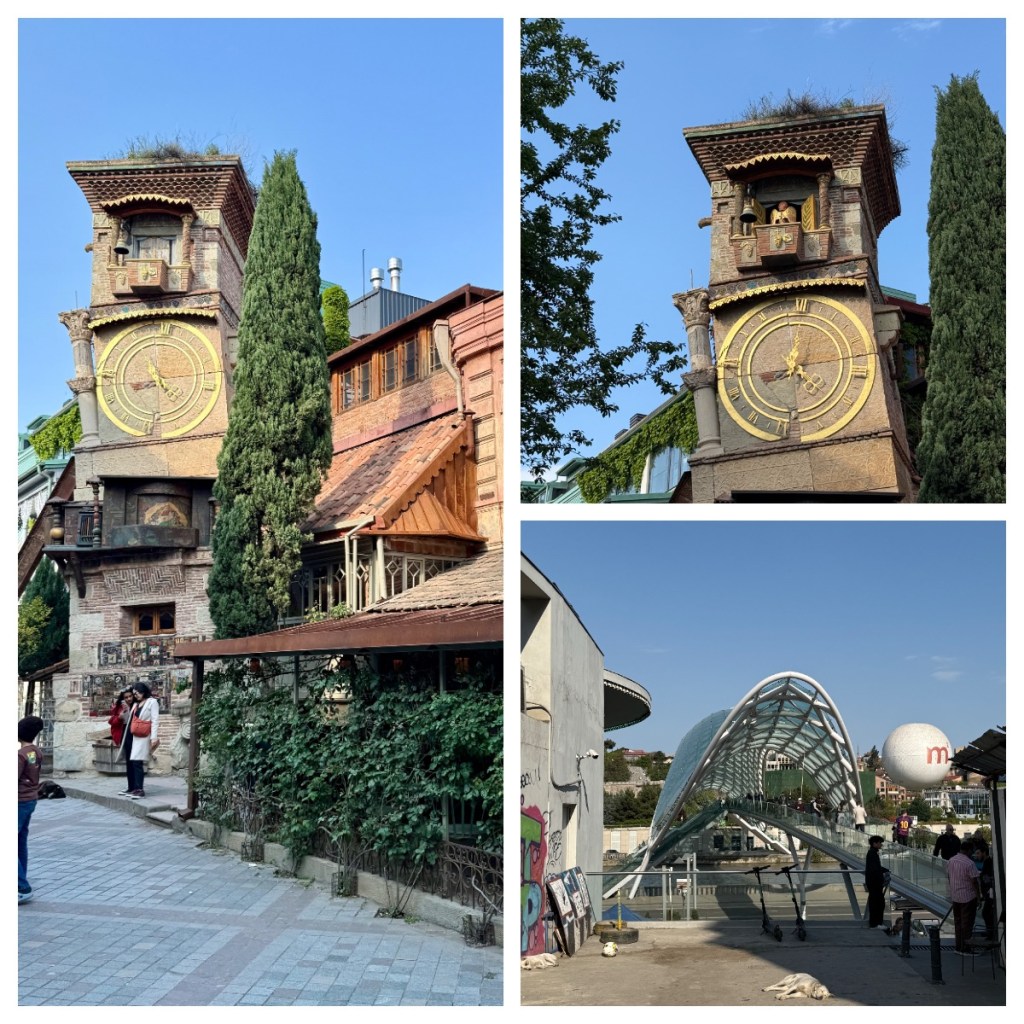
This part of the city felt with European and we continued on passed the Peace Bridge and ended up at the Gabriadze Clock Tower, more commonly know as the Leaning Clock Tower or Wonky Clock.  We happened to stumble across it just before 5pm so were just on time to see the angel comes out and strike the bell on the hour.  It is actually part of the puppet theatre building which was also created by Georgian director, screenwriter and artist Rezo Gabriadze.

We slowly made our way back to our hotel and over 20,000 steps later I was ready for a relaxing evening of packing and preparing for our next destination tomorrow.
 

Back to the mountains … more snow and traffic jams


Georgia, April 2025

Today Tazo picked us up in his 3rd car – a second landrover, this time with LPG!  Apparently, it is cheap to have cars so many people have more than one, or in Tazo’s case, more than two.

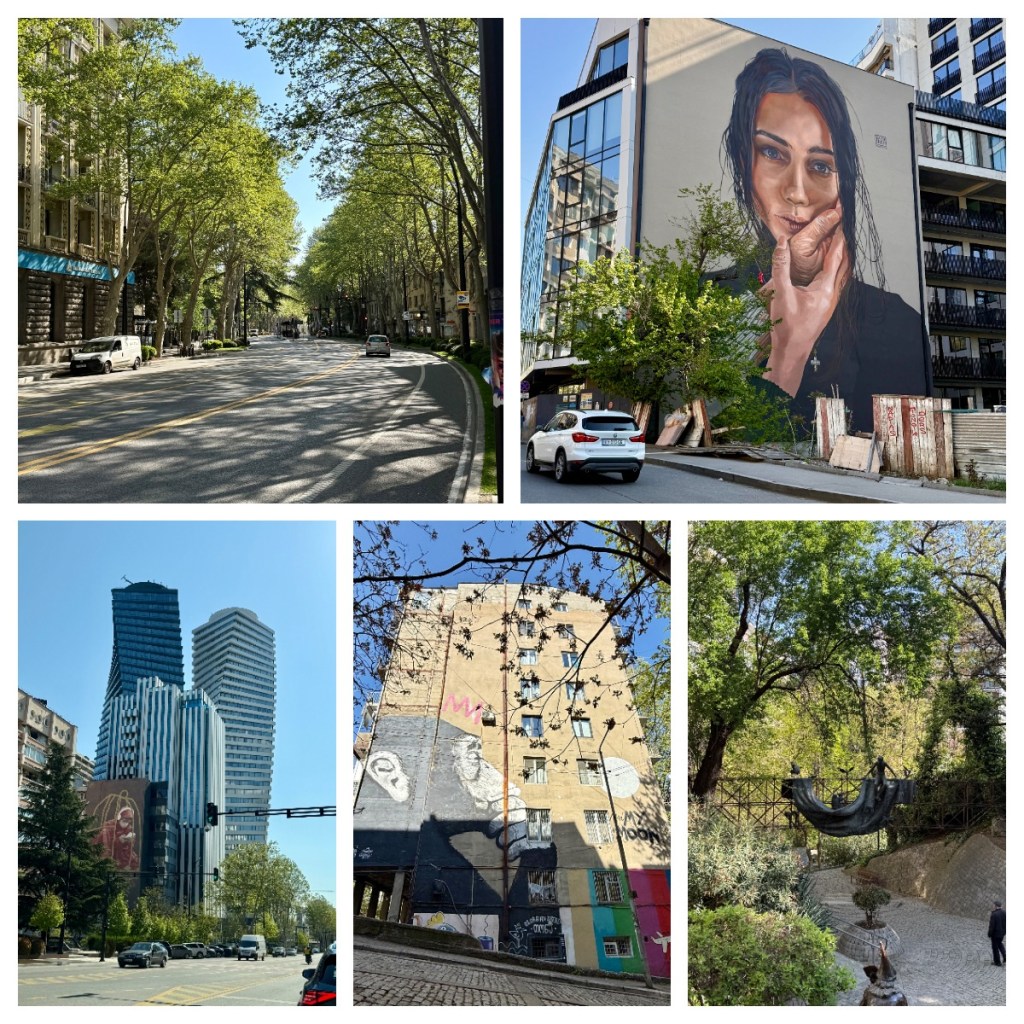
Unfortunately Ania was in more pain this morning so our first stop for the day was another emergency dentist.   Our search for a dentist took us to a beautiful part of the city with wide tree lined streets flanked by beautiful buildings, including universities, shops and apartments.  There was also some lovely street art.   At least we got to see a part of the city we would not normally! 

It took a while but we found a dentist that was open and they were so kind and did not charge her for their time.  They did give her a prescription for stronger antibiotics and stronger painkillers, but did recommend that she needed a tooth extraction which she was not keen on doing in Georgia (though I am sure it would be much cheap) so she just needed to get the pain and infection under control.

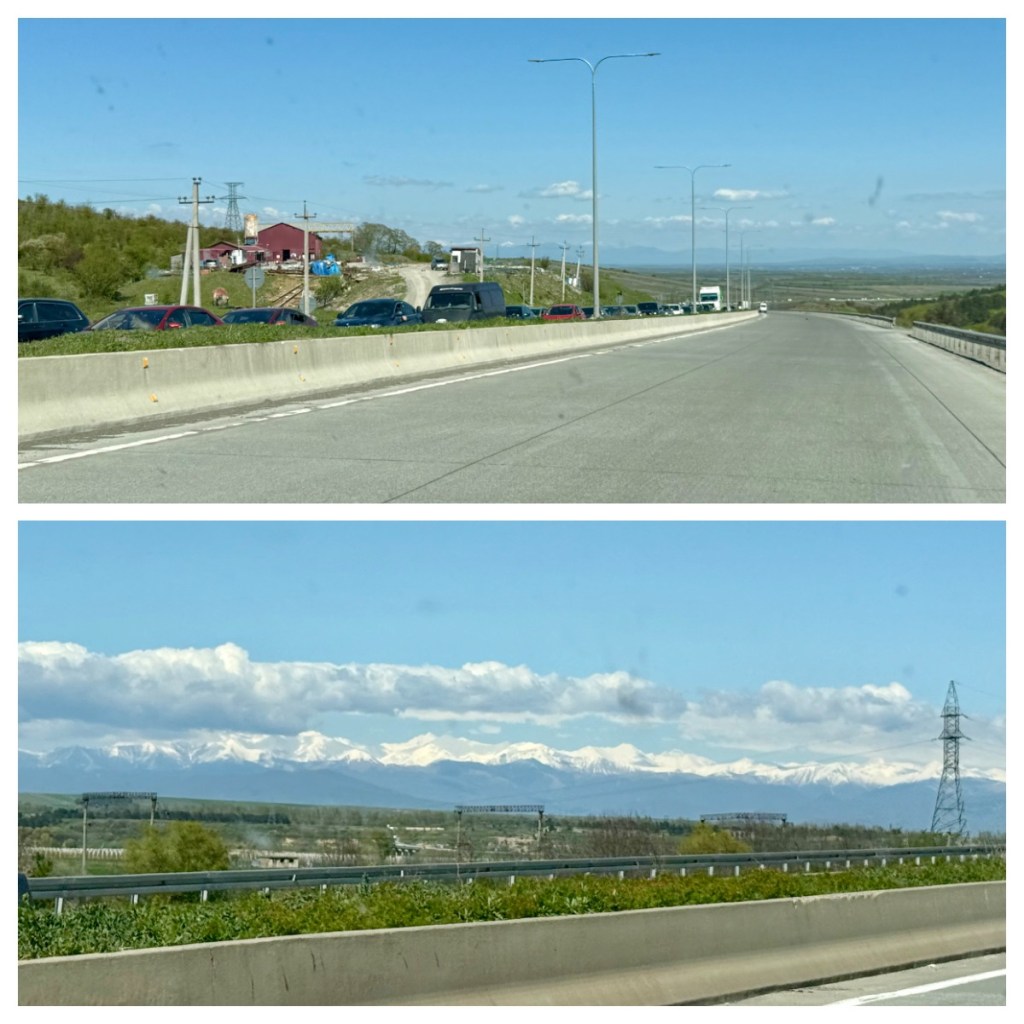
We finally left the city at 11am and not far out of the city we got caught in traffic!  Not sure where it was all going, but it was pretty slow for a period of time.  It is a crazy place when you just pass a random 6th century fortress on a hill as you drive down the road! 

Tazo got us more delicious roadside hot Georgian bread, today in the form of puri.  Puri is a savoury bread, baked in the same tone as the sweet bread we had the day before.  The bread was long and shaped like the curve of the tone and is actually called shotis puri.  It was steaming hot and really tasty.  Honestly, in my opinion, you cannot go wrong with a country that thrives on bread, cheese and wine!

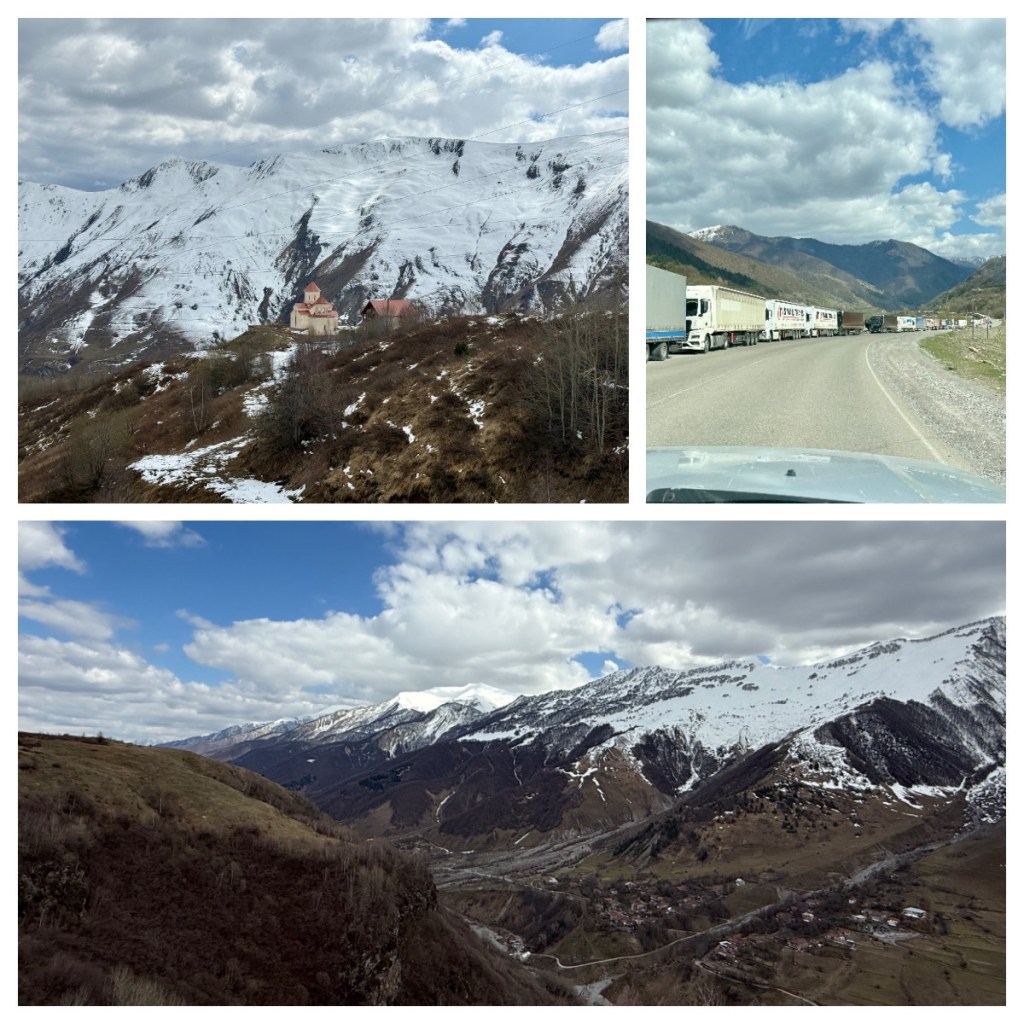
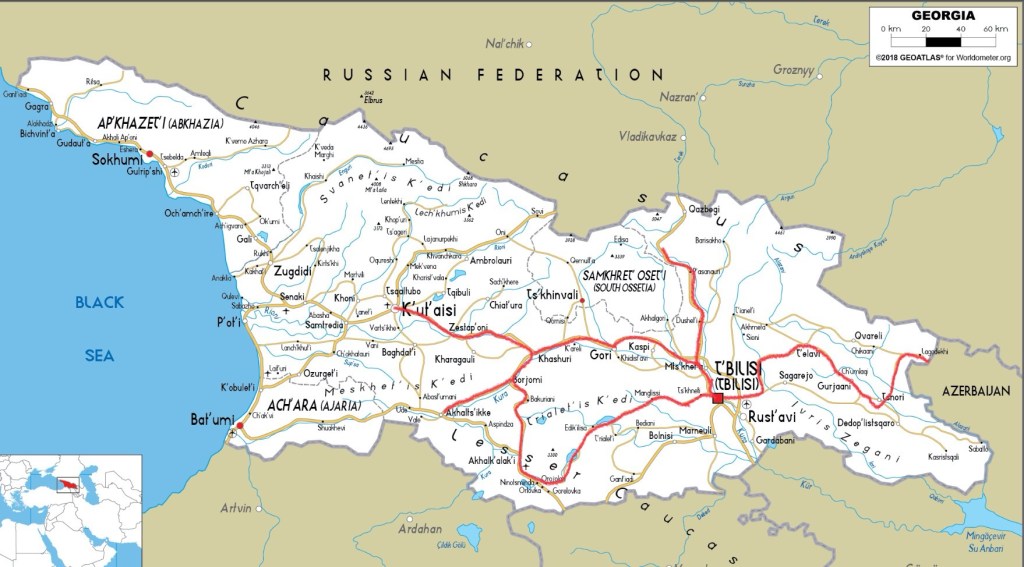
The road we were on today is called the Georgian Military Road and it runs 212 km from Tbilisi to Russia.  In fact, today it is the one and only remaining open land border with Russia.  This meant the road had an eclectic range of vehicles from all over the region, including Kazakhstan, Uzbekistan, Armenian, Russia ….  And there were trucks, oh so many trucks!  Despite still being 150km from the border we started passing trucks parked up on the side of the road, queuing for the border.  Apparently, the lines are controlled by police, who move them on to the next stop point all along the road.  Tazo mentioned that they let the trucks cross in one direction in the morning and the other direction in the afternoon and that we did not want to get stuck behind them!! 

Back in 1914 this road was described as one of the most beautiful mountain roads in the world but I am pretty sure that was before it was full of trucks!  Some of the trucks started moving and try as we may, for every truck we passed, there were another 10 in front of us making the journey much slower than it should be.

In our attempt to beat the trucks, we could only stop for a brief photo at the Zhinvali Reservoir.  An artificial lake created by a nearby hydroelectric dam which was built in 1985.  The lake itself provides much of the water used in Tbilisi.  With the surrounding mountains and forest covered slopes, it was quite beautiful. 

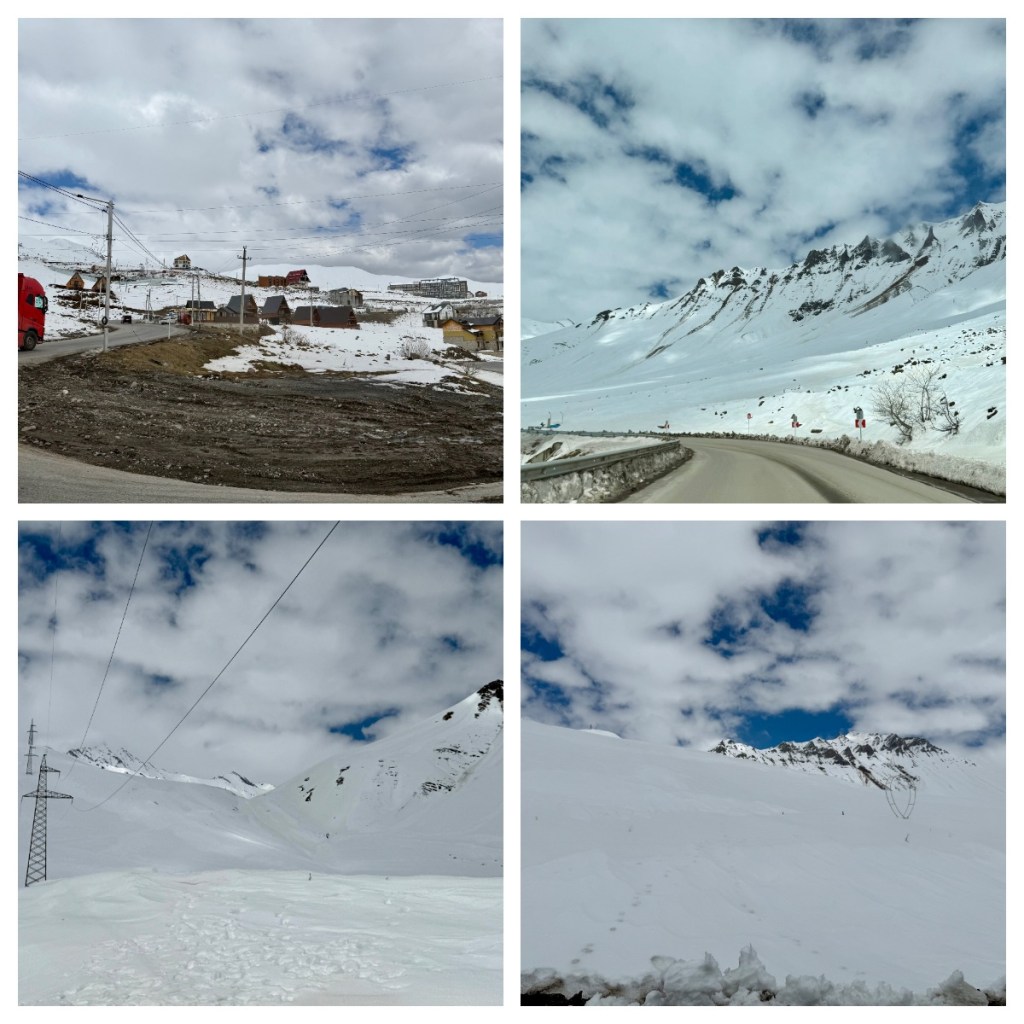
We wound our way up the mountain, with the road narrowing as we climbed, till we reached the popular ski resort of Gudauri, at an altitude of around 2220m above sea level.  Apparently, it is the most popular ski resort in Georgia and has over 70 km of ski runs and it is the highest settlement along this road.  Because of the warm March, much of the town was closed up as two weeks ago there was no snow, but today it was covered in snow again.   We thought we had some serious snow the other day, but they must have had a lot more here given what was left on the ground. 

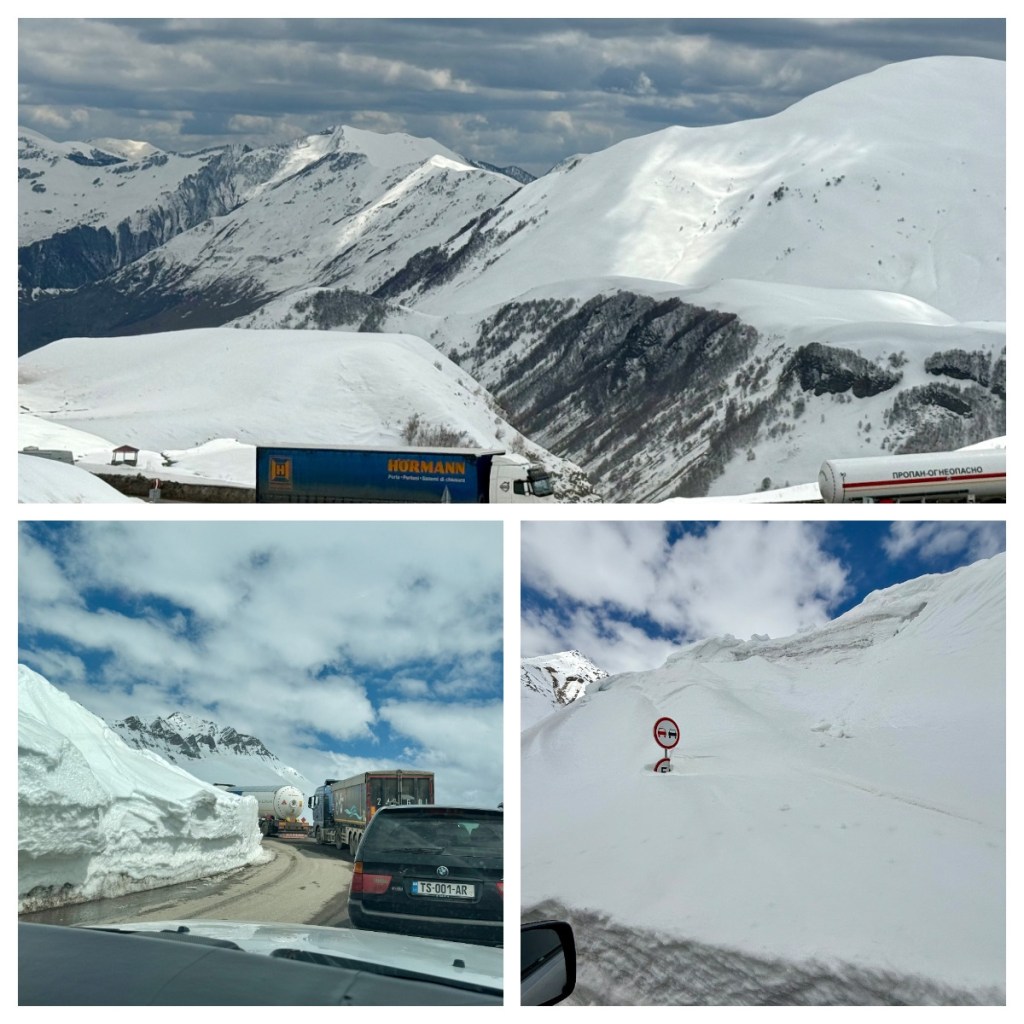
As we were still on a mission, we passed straight through town and only to be stuck in a traffic jam, mostly of trucks!  So picture this – we are now stuck on a narrow windy stretch of mountain road – with a 2-metre-high snow back on one side, and a drop of the mountain side on the other.  The traffic is at a standstill.    Apparently, some of the tunnels ahead can not fit two trucks side by side so traffic can only go through one way at a time causing these huge backups. 

Unfortunately as we had left Tbilisi a couple of hours later than planned, Tazo had to make the call that we just could not make it to our final destination of Kazbegi – he actually said that the traffic is so bad these days that he would never recommend trying to get there as a day trip, even without the snow! 

Of course this traffic has only been an issue since the Russia – Ukraine war started and all other countries closed their land borders.  Prior to that this was not the problem it is today.  They are currently in the process of building a new tunnel through the mountains to the border which should definitely solve part of the problem (although the route definitely won’t be so scenic)!

As disappointing as it was not to get to Kazbegi, the views from our traffic jam were absolutely breathtaking and I could get out of the car to take some photos before Tazo managed to make a crazy U turn in a tight space to head back down to Gudauri and the Russian-Georgia Friendship monument.

We parked in a small, snow filled car park and my slight deviation from the well walked tracked found me in knee deep snow – and of course, again I was not dressed for snow!!  At least this time I was using my sunglasses for the sun (and the glare from the snow)!

The Russian-Georgia Friendship monument was built in 1983 to mark the 200th anniversary of the Treaty of Georgievsk, which we learnt about when we met King Erekle II in Kakheti a few days early.  This was the treaty he signed with Catherine the Great to try and strengthen his kingdoms independence from Persia. 

The large round, structure overlooks the so-called Devil’s Valley and its mural depicts scenes from Georgian and Russian history and was designed by Georgian architect George Chakhava.   

The views were just stunning, but there may have been the most tourists we have seen in one place on the entire trip!  Throw in their buses and minibuses in the small car parks and narrow roads and now add snow, and it was all a bit chaotic! 

One more quick stop in town for more breathtaking views of the mountains and down the valleys, including a classic “Georgian church on a hill” before we continued back down the mountain and out of the snow. We continued to pass trucks, so many more trucks than we passed on the way up. With all the trucks on the side of the road, and another 500 sitting in a roadside truck park, they must have numbered in the thousands! 
By this time it was almost 4pm and most definitely time for lunch, Tazo knew just the place.  In fact, this food stop was one he had told us about on our first day with him as this area, called Pasanauri, is sometimes referred to as the ‘cradle of khinkali’ – that is, where they originated and where you get the best ones!   

Not being an expert, all I can say is that were definitely the best we have had, and this time we paired it with a Mkhlovana (I think), basically a Khachapuri with cheese and herbs inside which is a speciality of the east Georgian mountain regions.  It was probably also my favourite of the Khachapuris! 

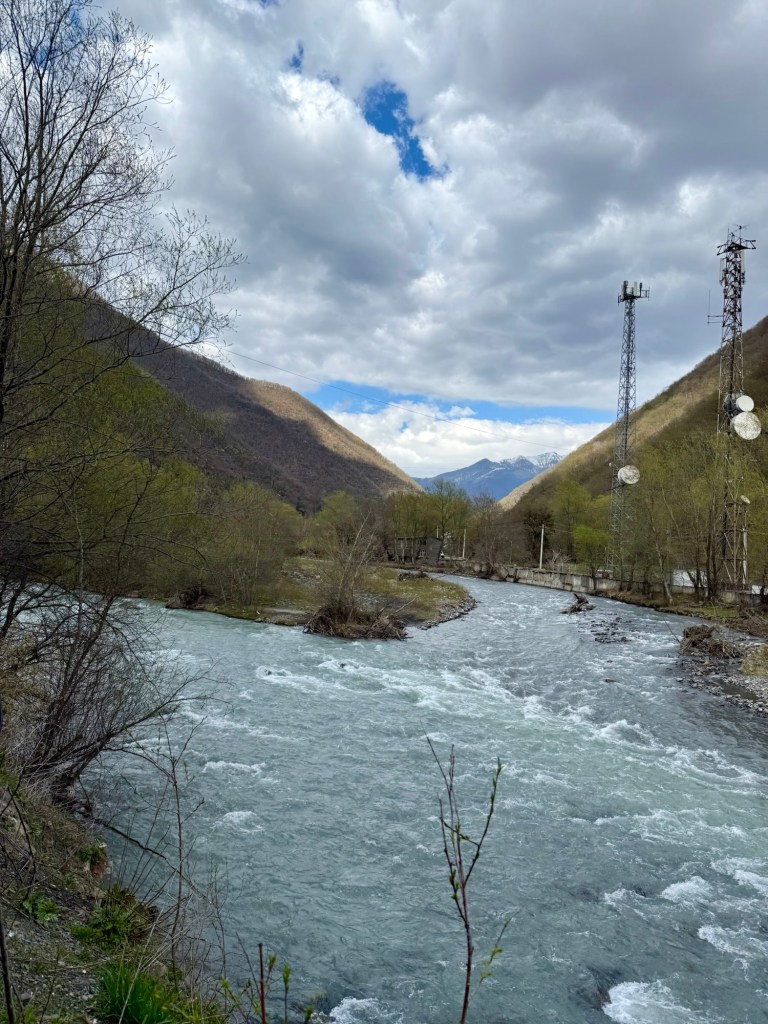
Back on the road and in less of a hurry we could do a couple of stops.  The first was at the convergence of two rivers – helpfully known as the Black Aragvi and the White Aragvi lol.  The white is due to sediment rich in limestone and the black from organic material and silt.

Now I have seen amazing images of the two rivers meeting and the different colours flowing side by side but as you can see from my photo that was not our experience!  You can almost make out a slightly different colour but it definitely was not amazing, possibly due to the river being fairly full and fast flowing. 

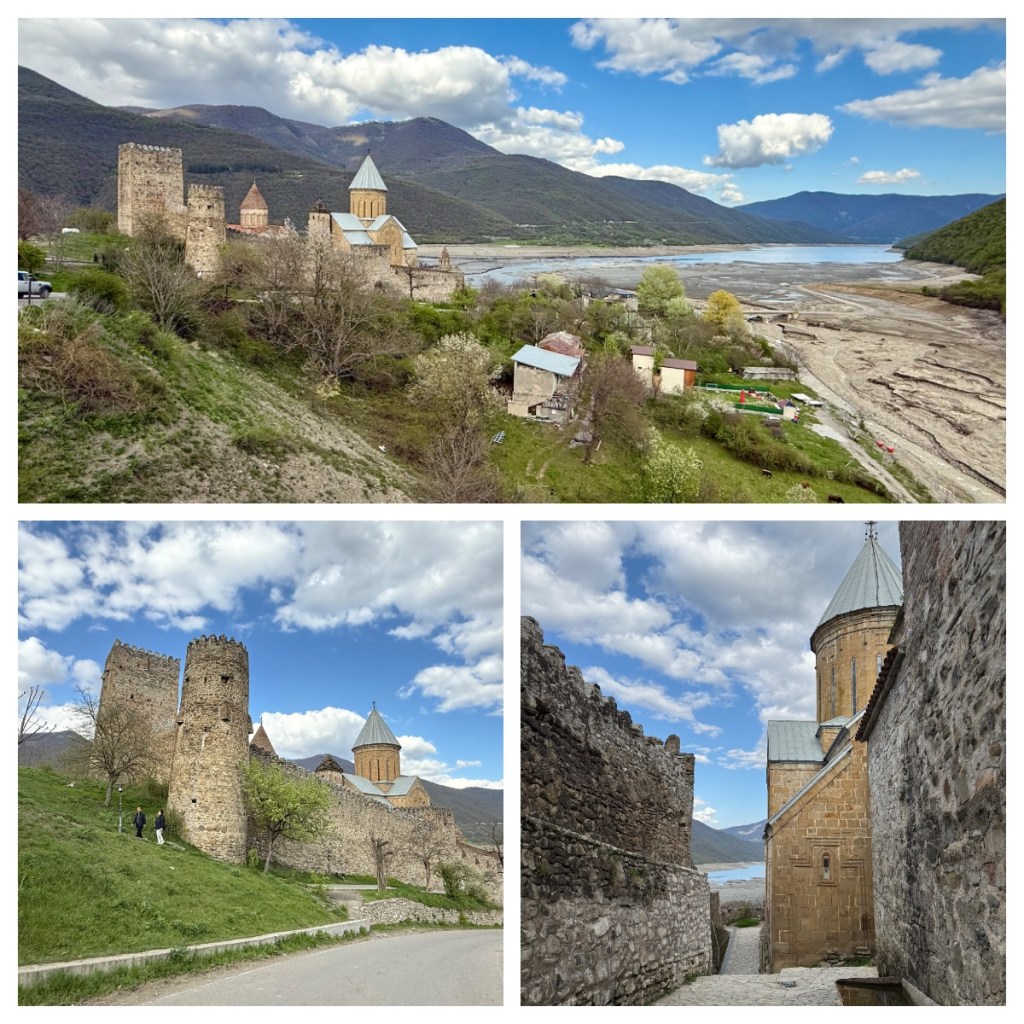
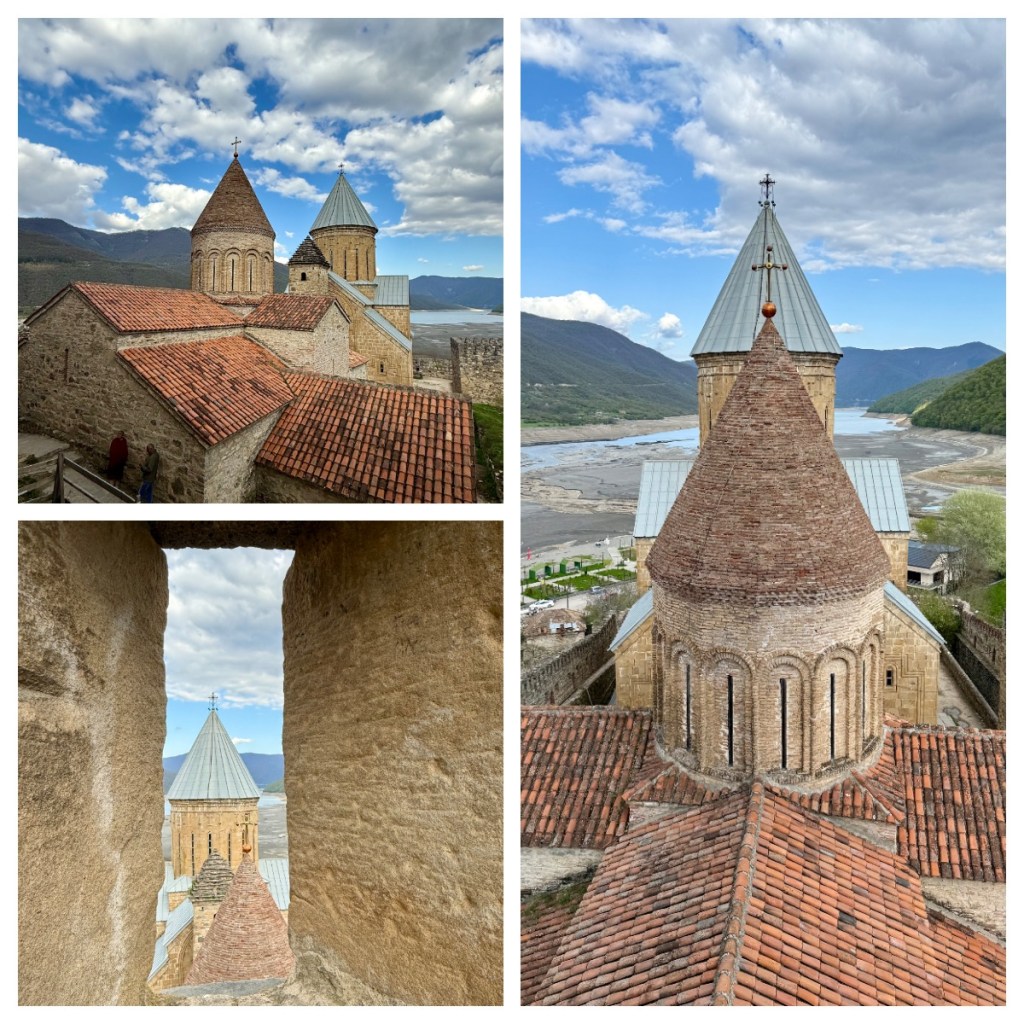
We also had time to have a quick stop at the medieval Ananuri fortress, on the shores of Zhinvali reservoir.   Original built in the 16-17th centuries, the fortress includes an Orthodox monastery, bell tower and three churches. It was apparently still in use until the beginning of the 19th century and as with other fortresses we have seen, there are secret passages down to the water to allow people under siege inside to get water and food.

Despite damage from battles and fires during the year, the fortress still retains beautifully carved facades.

I am not sure I have mentioned previously, Tazo’s driving music is an eclectic mix of old school music ranging from jazz and swing to soul.  On today’s playlist we were listen to “Georgia on my mind” by Ray Charles.  Obviously, it was written about a different Georgia (the state in USA) but  Georgia (the country) was definitely in my mind ❤️.

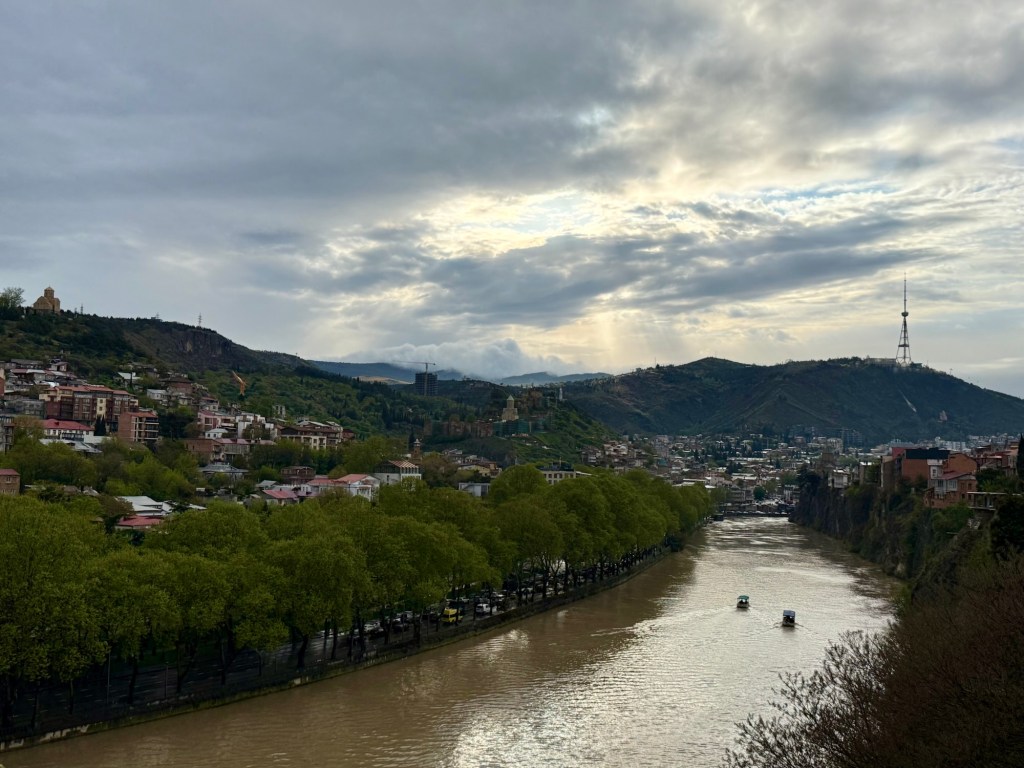
Given we had had lunch so late, I did not go out for dinner, but I did have a lovely view out to the cathedral from my room and was very happy with the photos I took just out of my window as the sun set!


Monasteries and myths

Georgia, April 2025

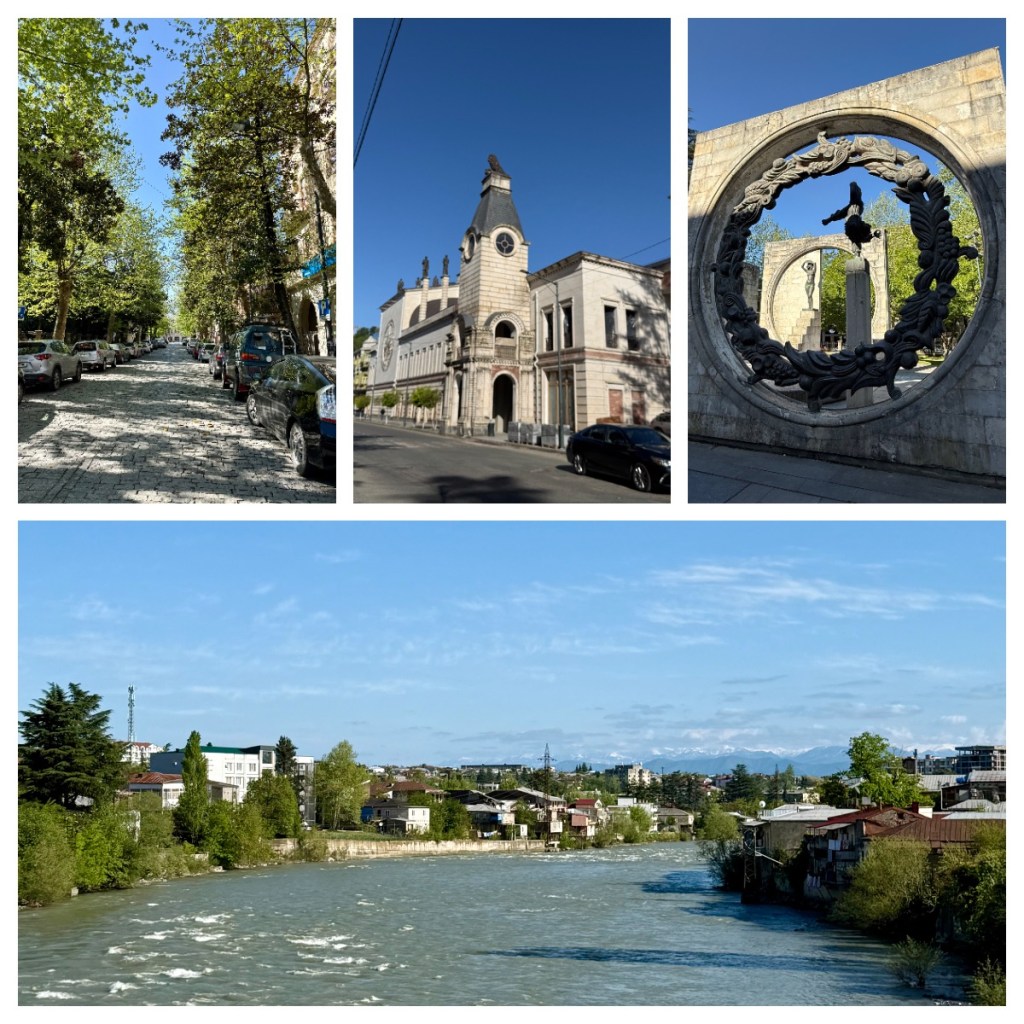
Today was Red Friday (as I explained in my previous blog) and Tazo’s family were near by, so he spent the morning with them, and we had some free time to explore the town of Kutaisi, one of oldest cities in the world having been continuously inhabited since 1,400BC.

With a population of around 135,000, Kutaisi is Georgia’s 4th largest city, and it was an important political centre in the Middle Ages and the capital of Georgia from the 8th century BCE to the 11th century. Not only that, it was actually the seat of the Parliament of Georgia from October 2012 to December 2018 in an effort to decentralise the Georgian government. The move was not particularly popular and in January 2019, it was moved back to Tbilisi.

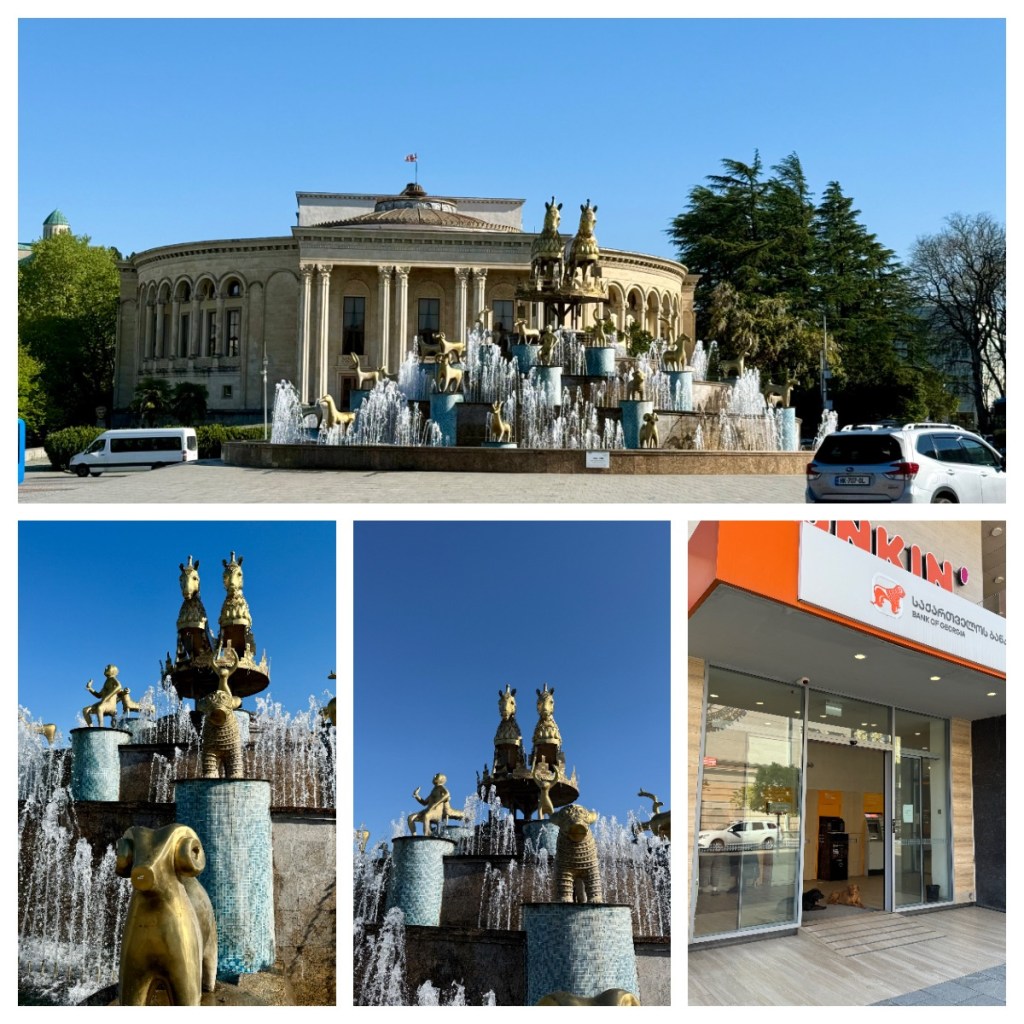
One of the main sites of the city is the Colchis fountain, so that was our first stop.  It is basically on a roundabout, in amongst the business city traffic so it was good to go early when we could easily cross the road to get to it! 

The fountain itself celebrates the ancient Kingdom of Colchis and has 30 large copies of famous gold jewellery, discovered at nearby Vani archaeological site. The figures include animals and ancient Georgian figures, including the lion that features on the Bank of Georgia logo and Tamada.  Tamada is thought to be representative of the Georgian toastmaster tradition and the original little bronze statue dates back to the 7th century BC. 

According to Greek mythology, Jason and his Argonauts visited the city, sailing down the Rioni river from the Black Sea to claim the Golden Fleece – today the river certainly does not look like a large ship could sail down it!  As well as leaving with the gold, he also left with the King’s daughter Medea who became his wife!

From the fountain we wandered passed the Opera House and Theatre, down some of the beautiful tree lined boulevards and across one of the bridges to admire the view out to the snow-capped mountains.  The old part of town was lovely and it was nice to have some free time just to wander. 

Unfortunately our time was cut short as Ania, my travel companion, had a toothache and we needed to find a dentist for her.  Despite being a public holiday, we found a 24 hour dentist just around the corner form our hotel and she could just walk in and see someone (although she did have to call Tazo for some translation services lol).  Armed with some antibiotics and pain killers we went back to the hotel to check out and meet Tazo to continue our journey.

Before leaving Kutaisi, we visited a couple of local sites, just outside the city, the first being the Bagrati Cathedral.  Originally built in 1003 by King Bagrat III, it is a symbol of a united Georgia and of the city itself.  It was on the UNESCO World Heritage site list, but then removed as reconstruction work over the years did not meet with UNESCO standards to maintain the integrity of the original structure, most of which had been destroyed through battles and subsequent decay. 

It is still an active church today, and so we could not take any photos inside but the main thing of note was some priests doing some DIY and some relics, including a human skull!  Outside there was a beautiful view across the city and out to the mountains beyond.

I am also back on Lada watch, with some great examples of their longevity and sturdiness being seen around the city!!

As we drove along narrow, cobbled streets to our next destination, I noticed the above ground gas pipes, as previously seen in Kazakhstan.  In some places they run about 30 centimetres of the ground but then go up to around 2-3 metres to allow for vehicles to pass under them.  Most were installed during Soviet times, so not surprise you see them in other ex-Soviet countries.

The 8th century Motsameta monastery is not only beautiful, perched on a cliff overlooking the Tskaltsitela river, but it is also where Tazo was baptised so he was excited to show it to us.    The name means the “Place of Martyrs” which relates to two brothers of a noble family who organised a rebellion against the occupying Arabs.  When their rebellion failed, and they refused to convert to Islam, they were tortured, killed and their bodies thrown in the river.    Subsequently they were recognised as saints and their remnants are kept in the nearby Gelati monastery.

Apparently, there is a secret (or perhaps not so secret) tunnel between Gelati and Motsameta monasteries used during wars and the crypts of both are said to hold relics such as bones of saints, including the brothers.

The monastery was beautiful inside and out, with purple flowers growing out of the rocks outside and lovely murals on the inside.

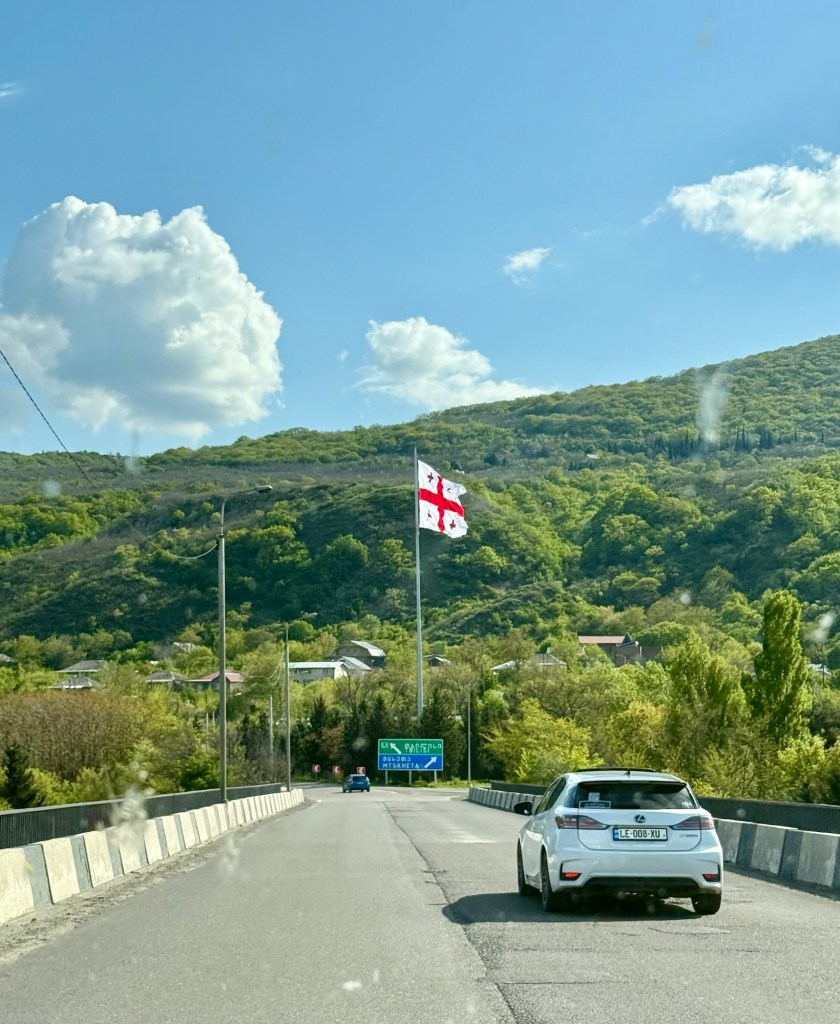
We were then back on the road to travel the 220km back to Tbilisi, and for a while we did not see the Easter holiday traffic that Tazo had predicted – but then we did!  Thankfully it was all on the other side of the road, travelling away from Tbilisi and for some time it was at a complete stand still.  Thankfully there was hardly anyone travelling towards the city so we were grateful to be going that way!

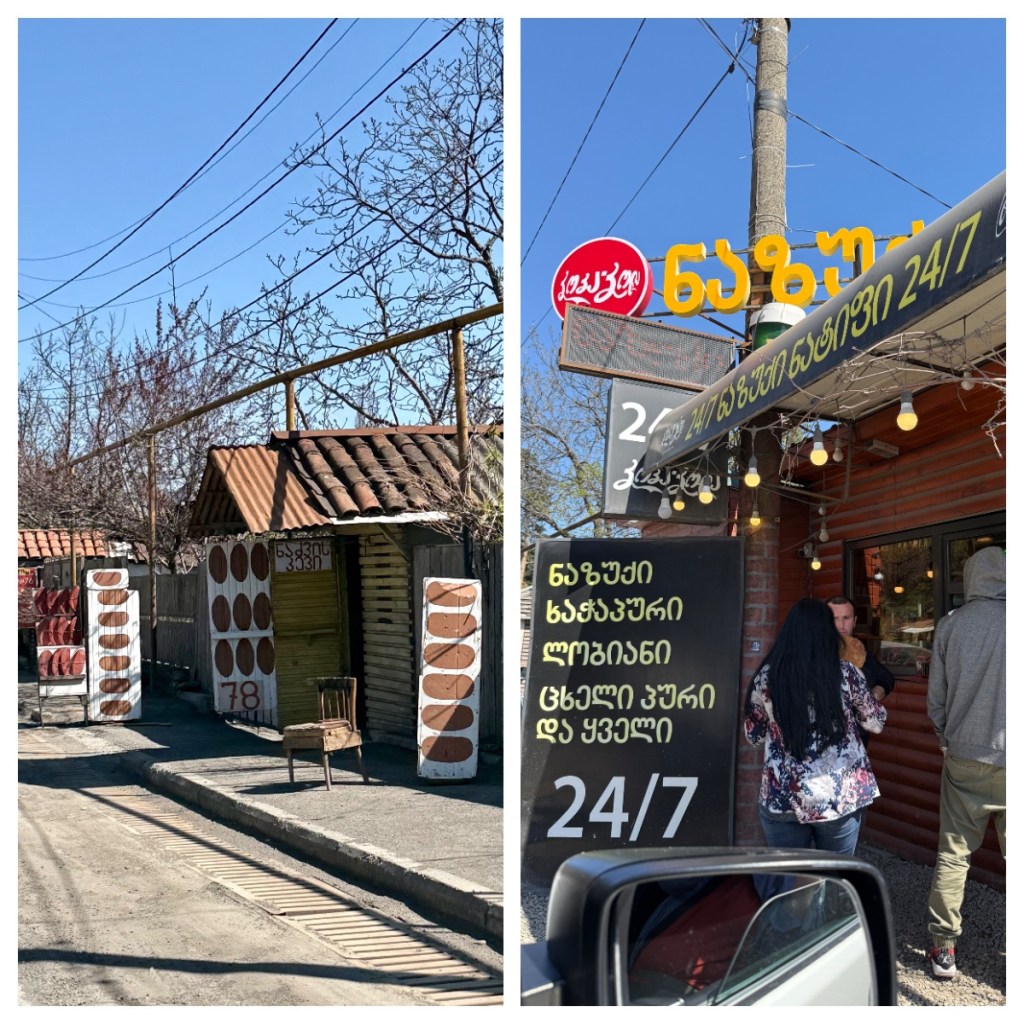
As it had been a busy day (since Tazo had picked us up) we had not had time for lunch, so we stopped on the road side to buy some Nazuki, a delicious, warm spicy sweet bread – there were lots of road side stalls selling it, advertising it with signs of brown oval blobs!  The bread was not brown, but I guess it was oval shaped and it was definitely tasty! 

Nazuki dates back centuries and its name translates from Persian as “exquisite”.  Traditionally they are cooked in a tone oven (a clay tandoor oven where the bread is stuck to the side) and in this particular area (called Surami), is called Nazukebi, a 1 Km stretch of Nazuki sellers.  Apparently a lot of these were set up during period of great economic struggles, allowing people to support their families by baking and selling nazuki. 

Also along this stretch of motorway, we passed very close to the Russian occupied state of South Ossetia, and I mean really close.  Tazo pointed to a village not far aware and noted that it was occupied by Russians!  It is crazy to think that life goes on so close to the contentious “border”.

We arrived back in Tbilisi and Tazo dropped us back at our hotel just after 5pm and thankfully I had much nicer rooms than we did for our one night stay – I even had a little enclosed balcony.  This time we are here for 3 nights so it was time to do some washing and realign the packing.  As we have been constantly on the move, I tend to alternate the same two outfits (rather than unpack my bag) so it was good to remind myself what else I had packed and get those out to wear.

Ania was not feeling great so I went on the hunt for somewhere to have dinner and came across a lovely Italian restaurant.  I felt a little guilty having Italian food in Georgia but made up for it by having a glass of Georgian wine.🍷

Museums & Wine of Kakheti

Georgia, April 2025

We woke to a cold and rainy day but, at one point, the rain cleared a little and I could see out to the beautiful snow-capped mountains in the distance and I was definitely excited for the next few days. Bur our first full day in Georgia was to be spent exploring in and around Telavi and avoiding the rain where possible.

I will warn you, today was a crash course in a small part of Georgia’s long history … and now I am sharing that with you so enjoy if you like that kind of thing 👍🏻or just look at the pictures and move on lol.

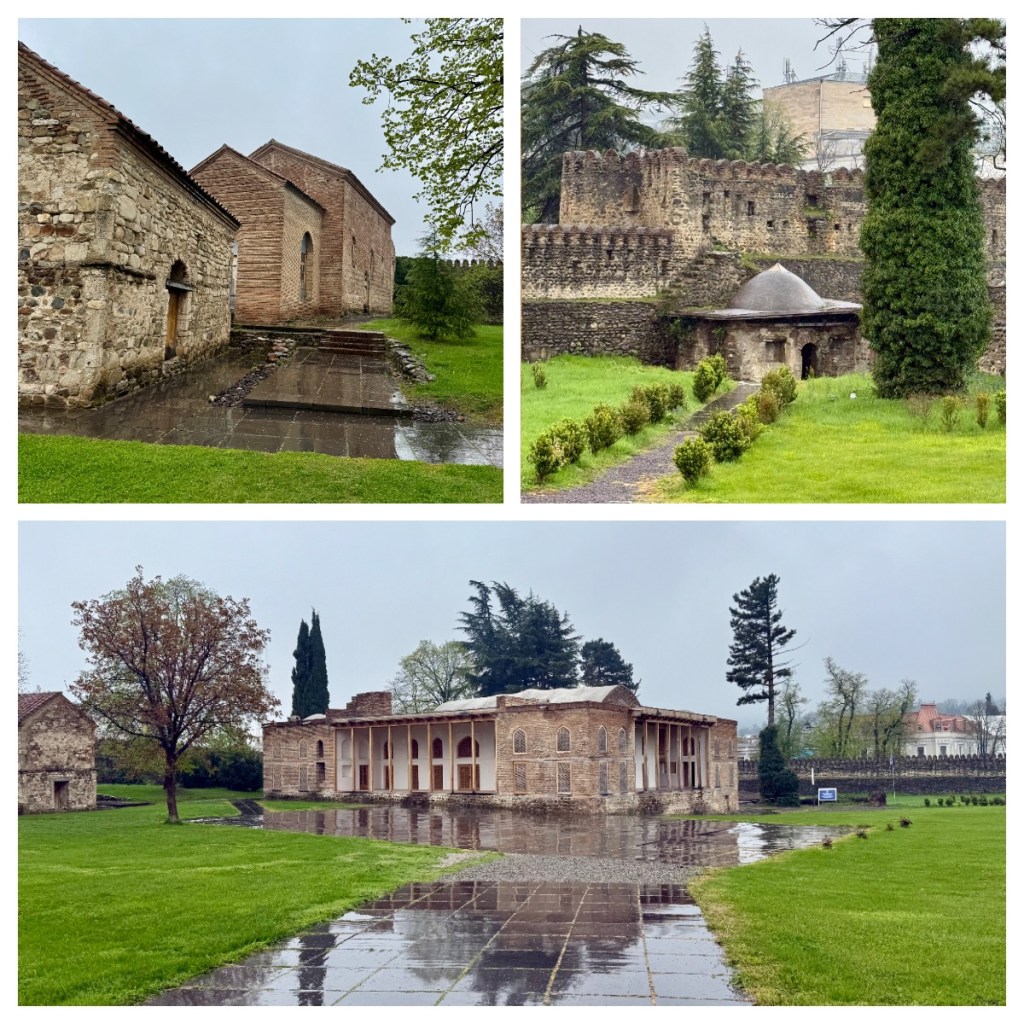
We started the day at the Telavi History Museum, a complex the includes the only preserved royal palace in Georgia, a church and a bath house, along with a museum and art gallery.  The museum had a great collection of historical artefacts and information about the history of ceramics, architecture, coins, clothing and the importance of grapes and wine.  It was interesting to see how the country has incorporated parts of its history, including Mongol, Russian and European, into its culture.

We then moved on to the art collection, a private collection of Ketevan Iashvili, a female cosmetologist born in the area in 1883.  She had an interest in fine art and collected it throughout her life (sometimes she was apparently given art in lieu of payment for her services by wealthy customers).  In the 1970’s she donated her collection to the museum and some of it can be seen here today.

We then had to brave the weather and head outside to visit one of the most important parts of the museum complex, the Palace of King Erekle II (also known as King Heraclius II or the Little Kakhetian).  The much-loved King Erekle ruled Kakheti from 1744 to 1762, before uniting the regions of Kakheti and Kartli (upon the death of his father who was King of Kartli) and ruling both until his death in 1798.  He is considered one of the most important and powerful Georgian kings, modernising the Government, economy and military, but unfortunately, he was also part of the reason for its downfall.

He was known as a great diplomat, and in an attempt to keep his kingdom safe, he made a pact with Russia for protection, unfortunately it was not enough to save it from a Persian invasion in 1785. 

Construction on the palace started under King Archil II in the 17th century and what we see today was completed under King Erekle II, who turned a more simple palace (where he was born in 1720 and died, in the same room, in 1798) into a fortress with the construction of the 5m high walls. 

We had a local guide through the museum and the Palace and it was interesting to learn some more of the interesting facts about King Erekle and his palace. I have summarised what was a lot of information as best I can below:

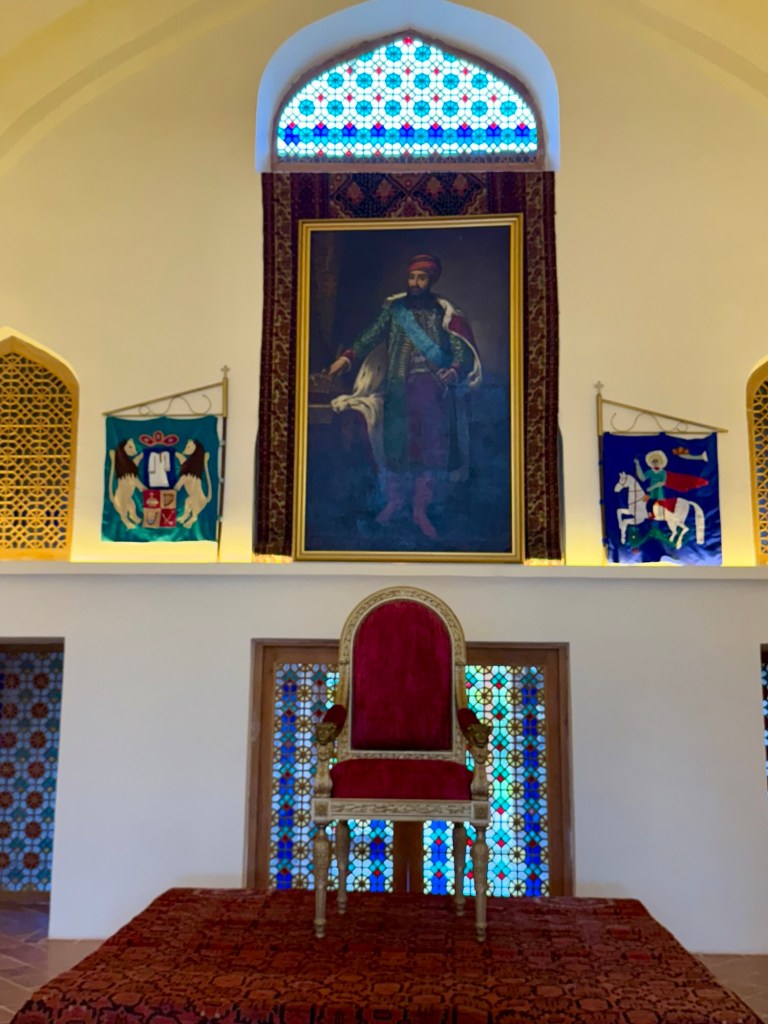
  • The palace is a shadow of its former glory.  It used to be beautifully adorned with colourful walls and mosaic floors in a Persian style, all of which were destroyed by the Russians (Empire rather than USSR).  Unfortunately there are no images and very little written about how it looked so it cannot be restored. The Russians also used the great Audience Hall as horses stables as a further sign of disrespect.
  • King Erekle is considered the People’s King and form all accounts, he was liked by his people. He led from the front, literally, being 15 when he fought his first battle, and 75 when he fought his last.
  • A 17 year old Erekle was taken to Persia for 2 years.  He was a good diplomat and when he returned, ruling Persia allowed him to be King without giving up Christianity.  I should note that this part of Georgia was under Persian rule longer than the rest of the country, but they always remained Christian at heart.
  • Erekle was already King of Kakheti when his father, who was King of Kartli (the region where Tbilisi is) died, leaving Erkele to unite the two eastern Georgian kingdoms into a single state under his power.
  • After initially using the death of his Persian ally, Nader Shah, to his advantage by declaring independence, King Erekle then signed a protection agreement in 1783 with Russia (chosen because they were Christian).  Unfortunately, they did nothing to help when Persia did invade and in fact Russian troops went as far as to evacuate the area leading to a full invasion in 1795.  He went to his death in 1798 hoping that Russia would come to the rescue so Georgia could continue its existence, but unfortunately, just 3 years later, it was consumed into the Russian Empire.  
  • King Erekle had 3 wives (not at the same time) and a total of 28 children, most who died young or at birth. His last wife was a strong, intelligent woman whom he married when she was just 12 and she bore him 23 of his 28 children.  In the later years of his life, she had significant influence over his political decisions. She was not in favour of the agreement with Russia and was deported to St Petersburg in 1803 where she lived until her death.


In summary, he seems like he was a decent bloke, tried to do his best for his country and his people but was screwed over by his supposed mate!  In fact his dress sense denoted his diplomacy and he was often depicted wearing a Persian style hat, a European style cape and a blue sash to represent Russian. 

We did not explore much more because of the rain but could see the King’s personal Persian style bath house in the distance and churches in the grounds. One of the two churches actually dates back to the 9-10th centuries.  Much older than the palace itself.

We took a quick detour to see the impressive 900 year old Plane Tree that is all that remains of the forest that used to cover the area.  It is 46m tall and 12m in diameter and today, its health is closely monitored to ensure its ongoing survival.  It is apparently considered a symbol of Georgia’s strength and resilience and it might also be able to make dreams come true lol.

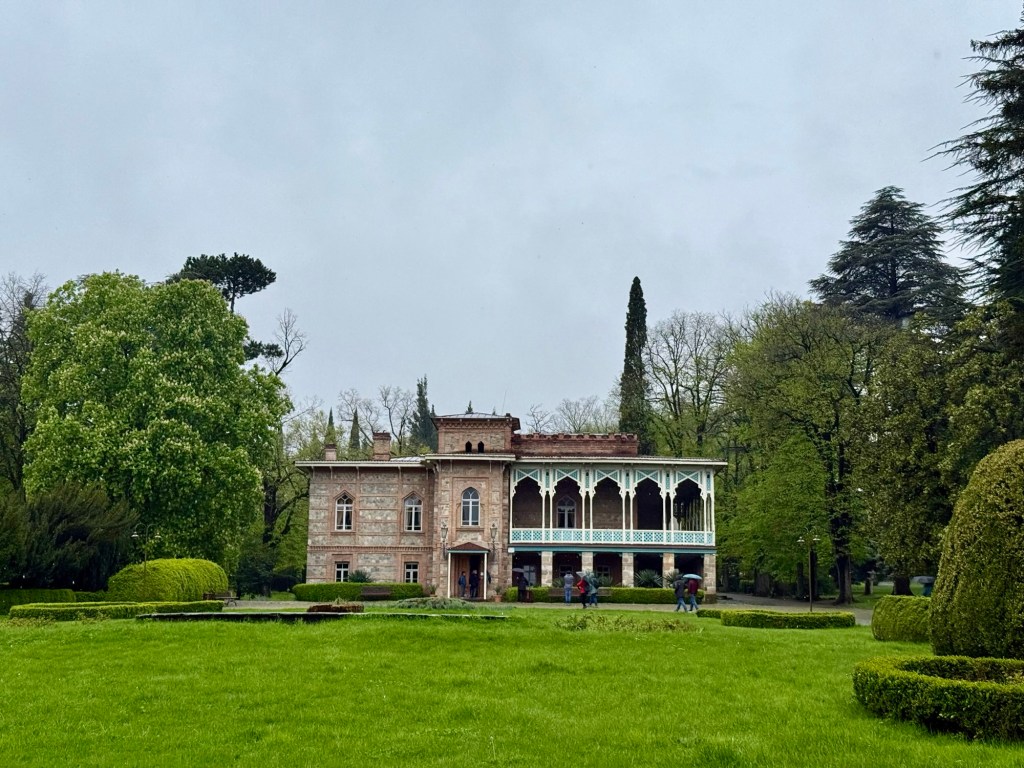
We headed slightly out of the city to our next stop at the Aleksandre Chavchavadze House Museum in Tsinandali.  Not surprisingly it was the home of Prince Aleksandre Chavchavadze.  Born in 1786 (to a noble father who was at one time ambassador to our friend King Erekle) he was Georgian poet, public benefactor and once colonel of the Russian Army and is considered the ‘father of Georgian romanticism”.  He inherited the house from his father and turned it into the cultural and intellectual centre of the country. 

We had to wait for a tour in English so we braved the rain to run to the large building behind the house, which today is a Radisson hotel and the home of the estate’s wine collection and museum.  Another of Chavchavadze’s claims to fame is that he was the first to bottle Georgian wine in a European style. 

We were taken through a locked door and down some stairs into the estate’s vast historic wine cellar where more than 16,000 bottles of his personal collection are stored.  We learnt about the 8,000 years of Georgian wine making history and saw some of the early artefacts they had collected, including pressing equipment and fragments of clay pots (used in the Georgian style of wine making) dating back to the 6th millennium BC!

There are detailed written records for the wine, and the earliest bottle of Aleksandre’s wine is from the 1841 vintage.  Unfortunately, the early wine is no longer drinkable. (I wonder who dared to open a bottle to try it to come to that conclusion?)

Back in the house with our English speaking guide, we were taken around the rooms (no photos allowed inside) and given commentary about the family and the historical pieces on display.  Not all the pieces belonged directly to the family but all were beautiful luxury items from collected from all over Europe and Russia.  It included the oldest grand piano in Georgia and carpets from Azerbaijan.

As the story goes, in July 1854, the troops of a Chechnyan Muslim leader attacked the estate (avenging the family’s support for Russia), pillaging the house and kidnapping his relatives (including his son’s wife, her sister and their children).  It was not until March 1855, after complex negotiations, they were returned in exchange for a ransom and an exchange of other prisoners.

Disillusioned with Russia’s control over Georgia, he ended up joining the failed Georgian rebellion against Russia in 1832 which resulted in him burning much of his poetry written between 1820 and 1832 in fears that it would be used against him, but he was still exiled, before returning to the Russian army at the request of the Tsar.

Following his death in 1846 (officially an accident, unofficially by the hands of Russian assassins) and that of his son David, the ransom loan had still not been repaid and the estate was given to the Russian Imperial family as a summer house.  Summer seemed very far away on our visit as I am not sure the rain let up for a minute!

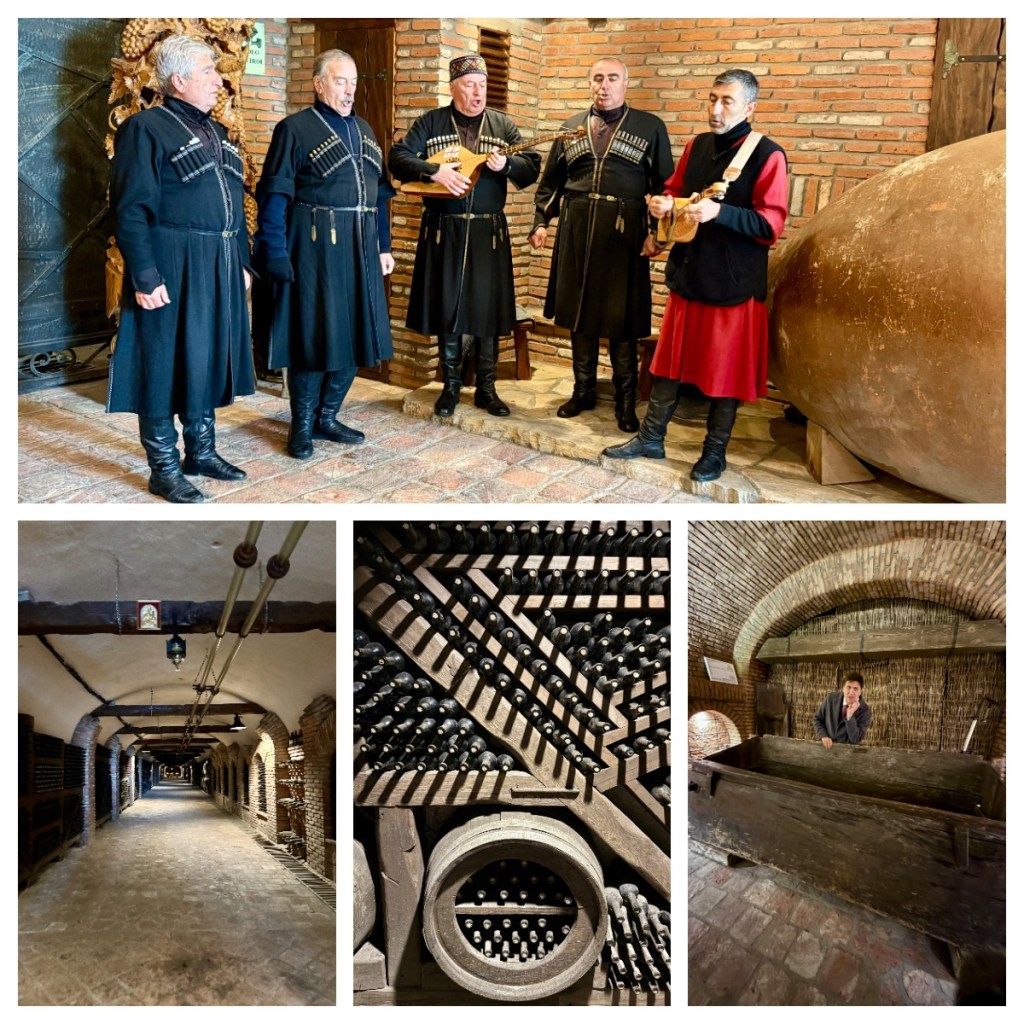
Finally the moment we had been waiting for was upon us – wine tasting. For this we travelled the short distance to the Kvareli Wine Cave which apparently have the largest storage of Georgian wine, which is stored in more than 7kms of tunnels. The tunnels were originally built in the 1950’s by the USSR army, allegedly as a missile base or a bomb shelter, before being converted into a wine cellar.  Apparently at the time they were also building bomb shelters in Tbilisi, saying they were building a metro system!

After a traditional welcome song, we joined our wine guide to learn more about Georgian wine and the winery.  In 1995 they started cultivating grapes and building wine making facilities and the existing tunnels made a perfect storage facilities – maintaining a standard 12-14C and 70% humidity. 

This winery has a lot of award-winning wines (apparently over 200 gold medal winners) and have vineyards around the country, as they only use their own grapes to allow them to control the quality. 


We learnt about the Georgian wine making process which mainly varies from the European style in that it is fermented in large clay pots, known as a Qvevri, Kvevri or Ch’uri.  The pots are a special shape to allow for circulation and they push the skins and twigs to the bottom daily.  When the bubbles stop, they seal the pot and then it sits for the required length of time.  When ready, they traditionally use a scoop (made from a dry pumpkin skin) for the first sip, which is drunk from a clay bowl (it needs to be drunk in full and not sipped)!

We sampled a number of different wines and decided that we liked the semi-sweet ones, and I am a little embarrassed to say I preferred the European styles over the Georgian styles.

Back on the road, we had more great car chats with Tazo covering a multitude of topics – this is exactly what we wanted in a guide! 

A quick stop at a random road side restaurant for a late lunch of a tasty Georgian beef soup and more Khinkali (I think most meals with include these lol)  before arriving in to the Georgian capital of Tbilisi. By the time we got to our hotel, the rain had eased a little and I even saw the sun for a moment so popped out to get my first glimpse of this beautiful city (we will have more time to explore in on another day).