After a decent nights sleep, being lulled by the gentle rocking of the ship I was up early to hit the gym. Given that I always eat way too much on these trips, I am trying to keep some balance by going to the gym most days. (We will see how long that lasts!)
Thankfully, the ship also has an earlier riser breakfast (not all the fancy cooked food, but fruits and muesli which is enough) which means I can also enjoy a coffee and breakfast early. This morning it was as we pulled in to the Taiwanese port of Hualien.
Hualien (Taiwn’s second largest city) appears to be a relatively major port for cruise ships, and we had to go through customs like we were arriving in Taiwan for the first time – which maybe the case for some cruises. We were also all gifted with a box of tea, which I guess I will either have to use before we get to Australia, or give away!
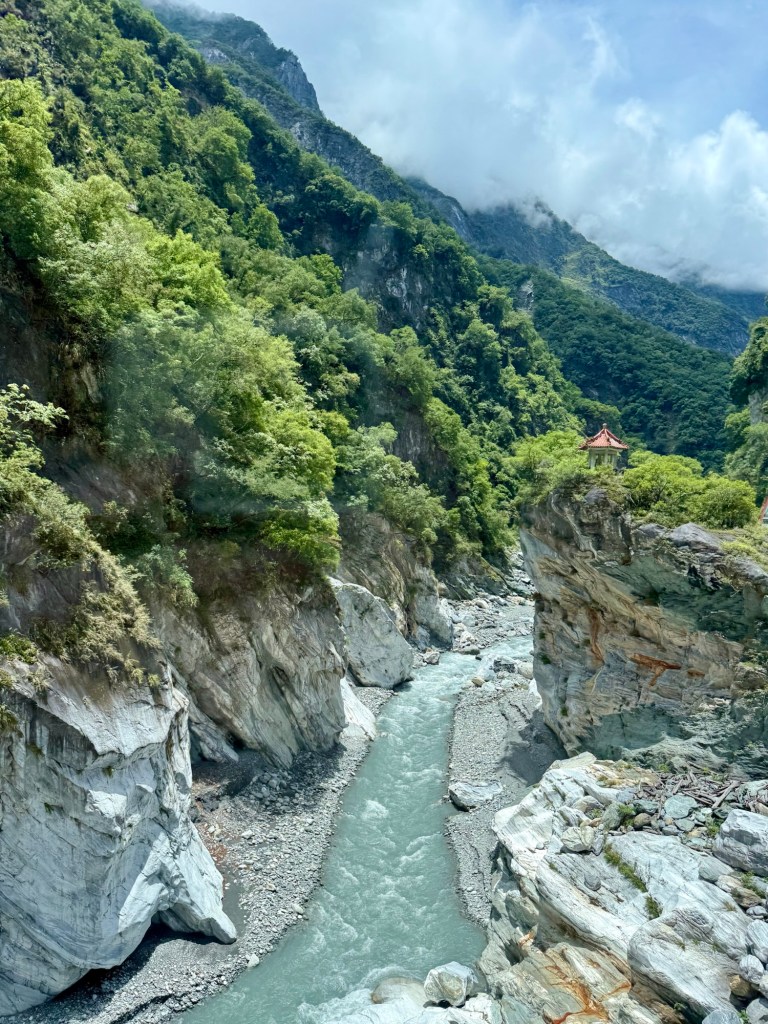
Once the formalities were complete, we were back on a bus and off to Taroko National Park and the famous Marble Gorge. Despite the rain and grey sky, the lush green mountainsides were still beautiful.
We learnt a little about the indigenous tribes of Taiwan, astronesians who spread across the Pacific, but 16 tribes remained in Taiwan. Each leave on a different mountain and speak a different language. I found this fascinating and wish I have time to dive more deeply into these cultures.
2 years ago, the area suffered a huge earthquake, which caused significant damage to the gorge and its surrounds. There is still some obvious damage and a lot of strengthening works going on. The road into the gorge is also now only one way in parts, so we needed to adhere to strict timings to ensure we could get in and out in the allocated time windows.
Our first stop was a photo stop at the Taroko Arch for a photo opportunity before heading into the Visitor Centre. I was a great source of information and included a video about earthquake and typhoon damage the area (including the cross-island highway) has sustained recently.
Back on bus and we made our way into the gorge where in some places, the marble walls are 300m high, soaring over the valley floor and the Liwu River. By the time we reached out stopping point the sun was out and it was a beautiful day. (We had been told that the sun was always shining in the gorge and they were right!)
The Xiangde Temple was built in the 1960’s as part of the construction of the cross-island highway and it sits high above the valley. The many steps to get up to the pagoda was the first test to show the mobility of the people on the trip (most who are significantly older than me, and I am old!)
We had some time to explore the temple and surrounds and enjoy the antics of the local top of Formosa Rock Macaques. Also know as the Taiwanese macaque, they are endemic to Taiwan (but have also been introduced to Japan) and are the only native primate in the country (besides humans).
We drove back through the gorge, and back to the port, where we officially exited Taiwan, got heat scanned by Philippine officials and the set sail. As we had an afternoon at sea, I settled in to ship life and the lectures started.
The first being on Astronesians and their expansion across the Pacific. I must admit I am pretty ignorant when it comes to these people, so it was fascinating to learn that most Polynesians are linked back to these early people from Taiwan.
The term Astronesians actually refers to a family of languages (over 1,200 languages), as well as the seafaring people who speak them. They stretch from Madagascar to Easter Island and everywhere in between and it is believed that they originated in Taiwan around 5-6,000 years ago.
Using outrigger canoes and using the stars to guide them, they carried out one of the greatest migrations in human history settling all across the Pacific (with the exclusion of Australia which was already populated)! People from Maritime and parts of mainland Southeast Asia, Micronesia, New Guinea, Melanesia, Polynesia (including New Zealand) and Madagascar can all trace their roots back to these great seafarers, as well as ethnic minorities from countries such as Vietnam, Cambodia etc.
As the afternoon continued, we sailed down the coast of Taiwan (I had no idea the country was so mountainous) as we had future lectures, followed by the Captain’s welcome drinks and an introduction to ship’s crew (we had met the expedition crew the night before).
I was settling in to life on board and eating too much! A big dinner welcome dinner and too much wine did not help!
No change to my normal routine, so I was early to breakfast and then took a short walk to get coffee. It was raining and not to hot and beautiful walk through a lovely park. I also stopped off at 7/11 to get a few snacks for my room on the ship (not that they would really be needed as there is always so much food). Now my official trip has started, I can switch my brain off and just follow instructions (I am very good at that lol).
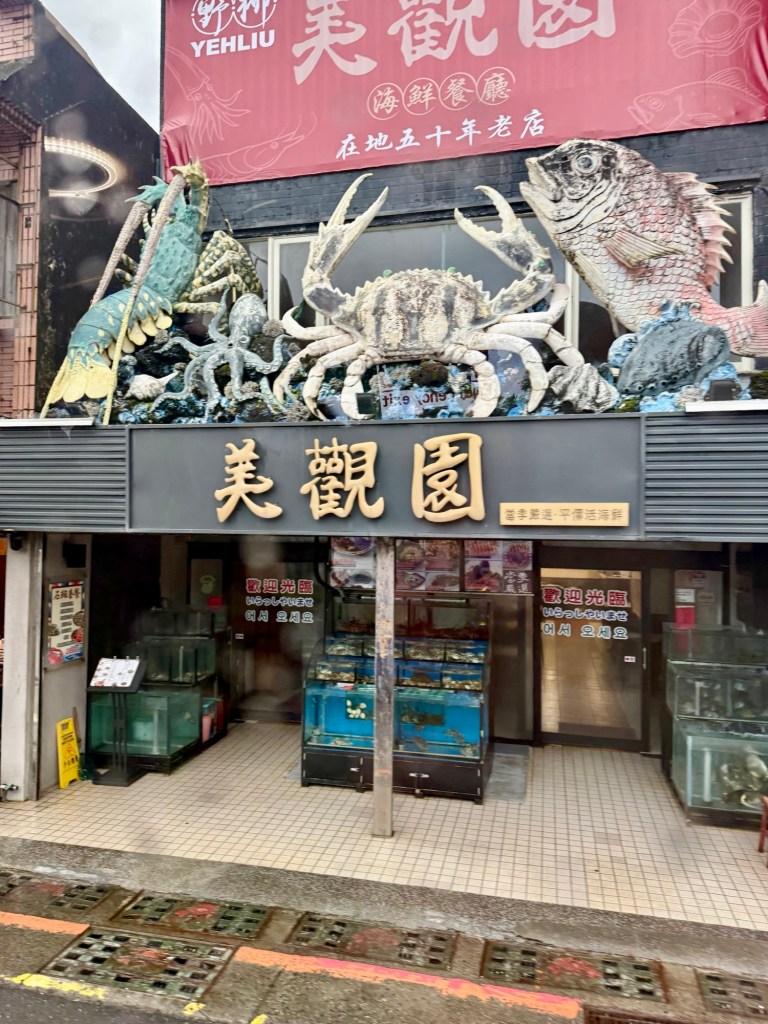
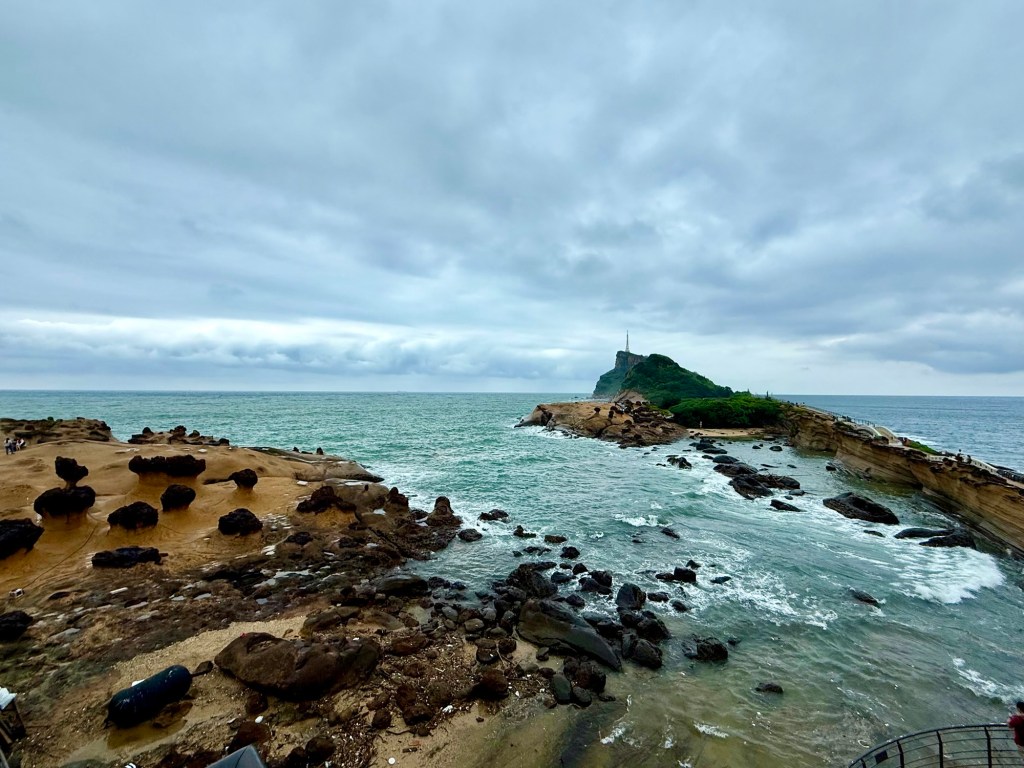
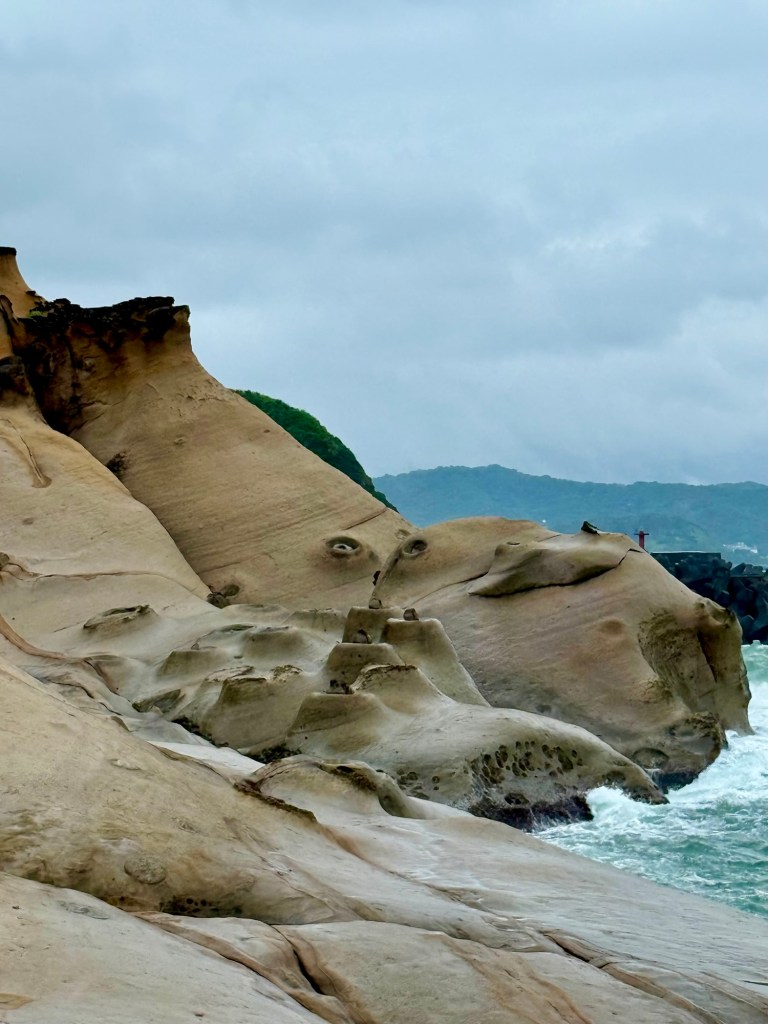
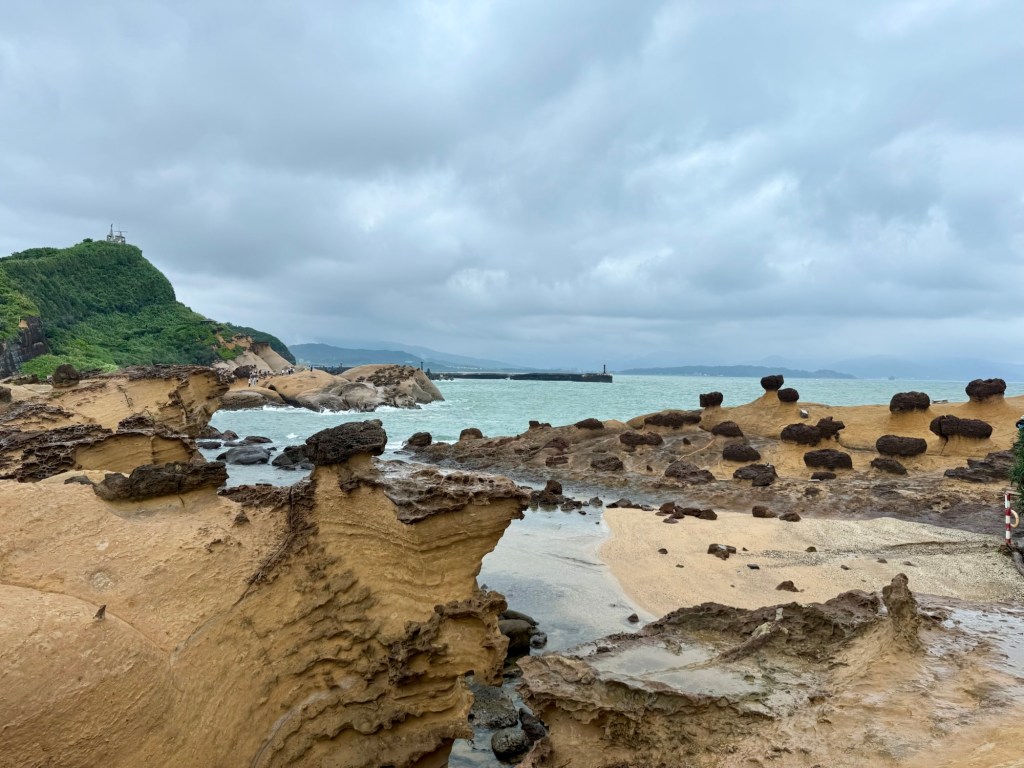
We started the day with a bus tour out of the city. I struggled to understand a lot of what our local guide was saying but I enjoyed the views as we left the city behind and drove in to the lush green bush covered hills and after passing through a small town with narrow streets lined with seafood restaurants with fish, crabs and other sea creatures in tanks, we arrived at our first stop – Yehliu Geopark on the northern coast of Taiwan. World famous for its eroded rock formations caused by the sea erosion and weathering of the sandstone and limestone in the area.
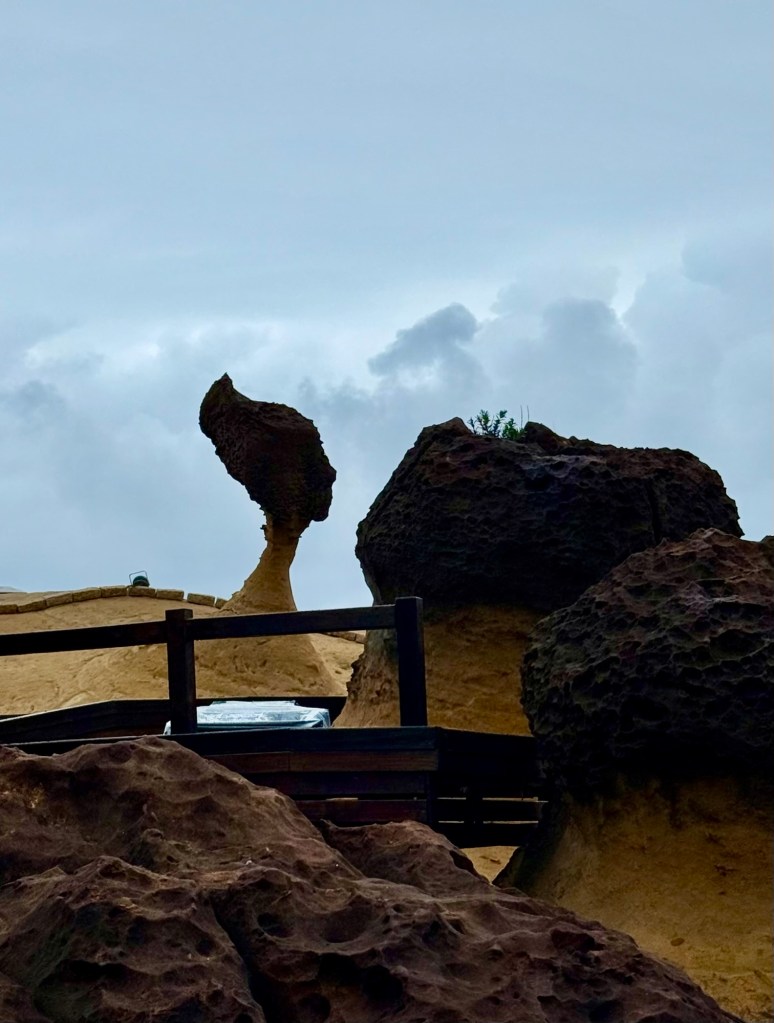
I decided to ditch the group, with the guide I could not hear and wandered around by myself. The most famous of the features is the Queen’s Head. She is so famous in fact, people queue to have their photo taken with her. Of course, I did not, but I did get a sneaky photo from afar without too many other people in it. You definitely need some imagination to see some of the figures but it was still very cool to see.
At the end of the park we were funneled through the souvenir stalls (with lots of dried seafood ) before we could get back on the bus for the 45 minute drive to our next stop at the historic mining town of Jiufen. The town boomed and busted based on gold mining, but was reintroduced to the world in the 1980’s when a movie was filmed here (“A City of Sadness”).
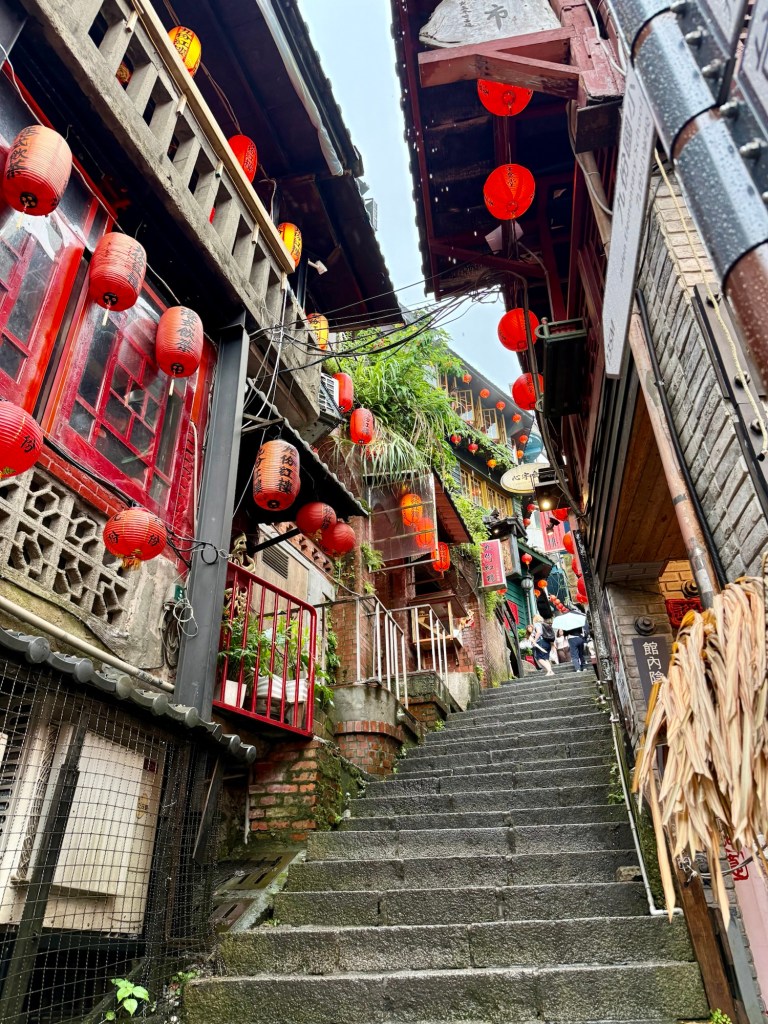
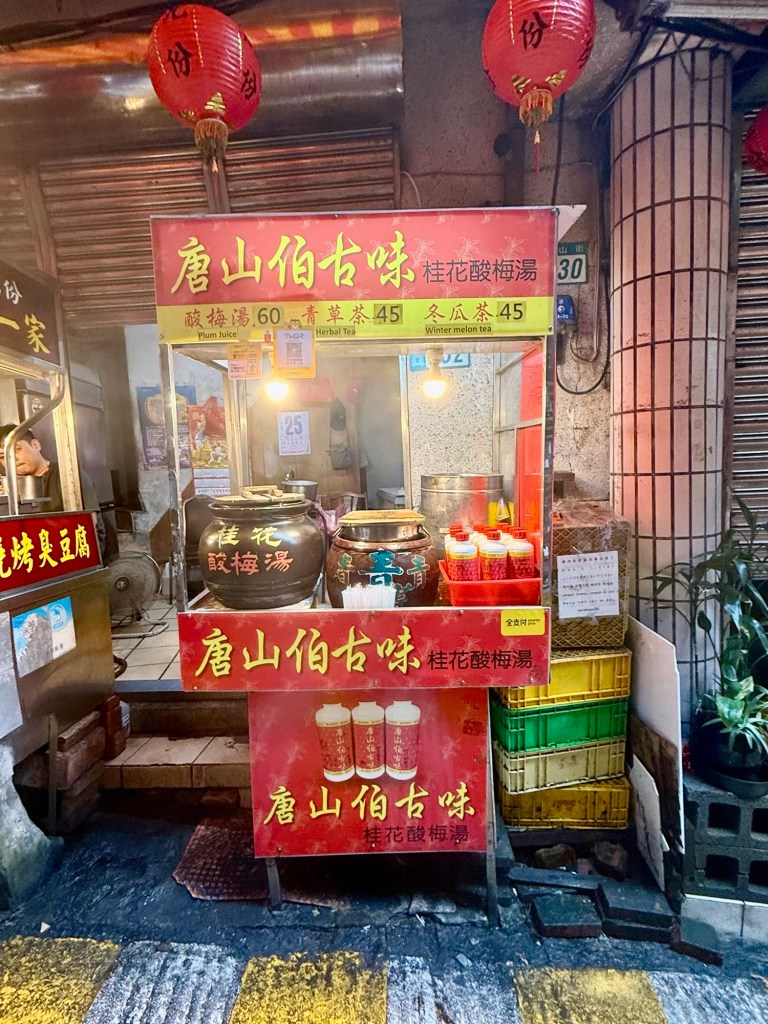
The narrow Juifen Old Street winds up a step staircase and down narrow side streets, lined red lanterns and with small shops selling souvenirs and traditional snacks and food. This was also our lunch break but rather than sit and wait for food, I went off exploring (I am definitely “that” person again)!
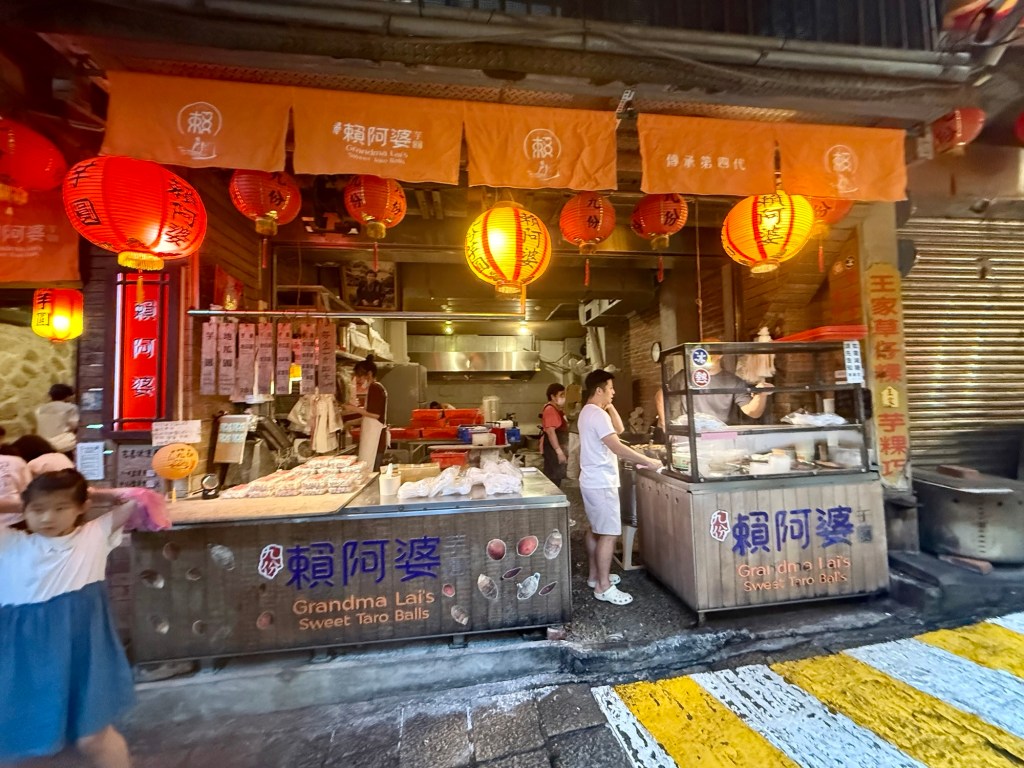
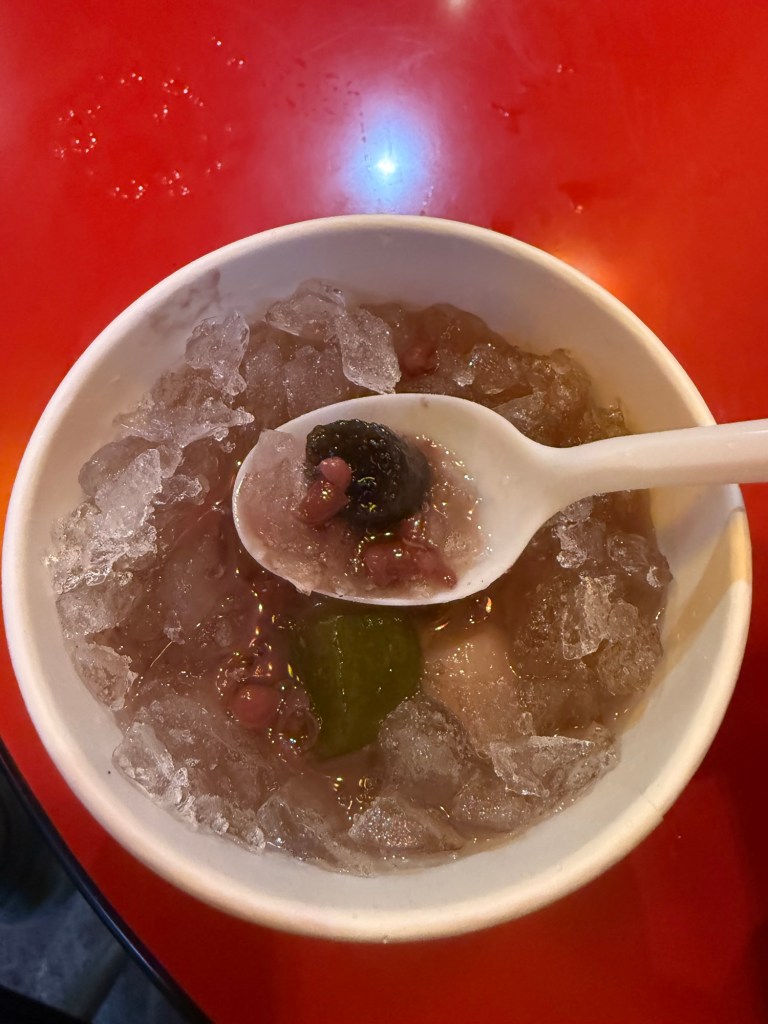
I tried some locally famous taro balls, they could be cold or hot but I opted for cold, as the sellers said it was their favourite (turns out it was just the hot ones covered with ice lol). It seemed like they were mixed with beans hich was a littl odd but the Taro balls themselves were tasty.
I also tried some delicious local fruit wine, lychee and apple, and an amazing mango cream cheese mochi. Sadly my purchasing was limited as most places only took cash and I was almost out! It was probably not a bad thing.
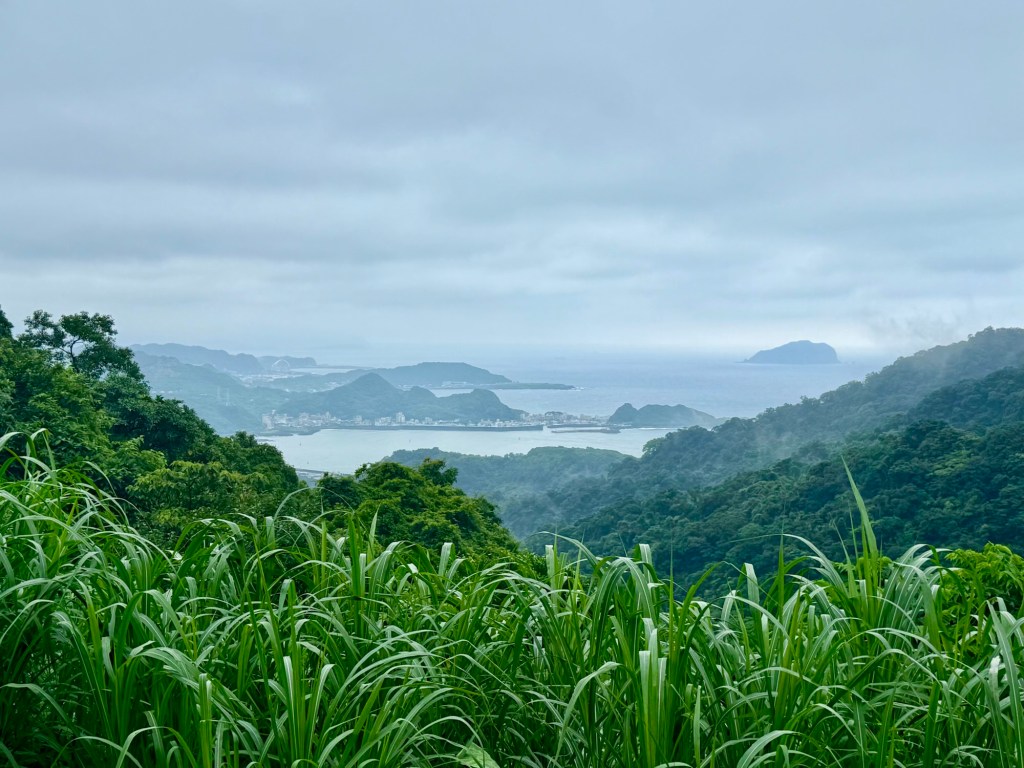
I wound my way through the narrow streeets lined with shops and ended up getting a little lost, but I just kept going down the hill (as the bus park was below the town). I have to admit I was not massively happy with some of my choices as I found myself walking down the narrow street with no footpath and big buses coming passed…. But I got there in the end and enjoyed the beautiful view out to the coast now that the cloud had cleared a little.
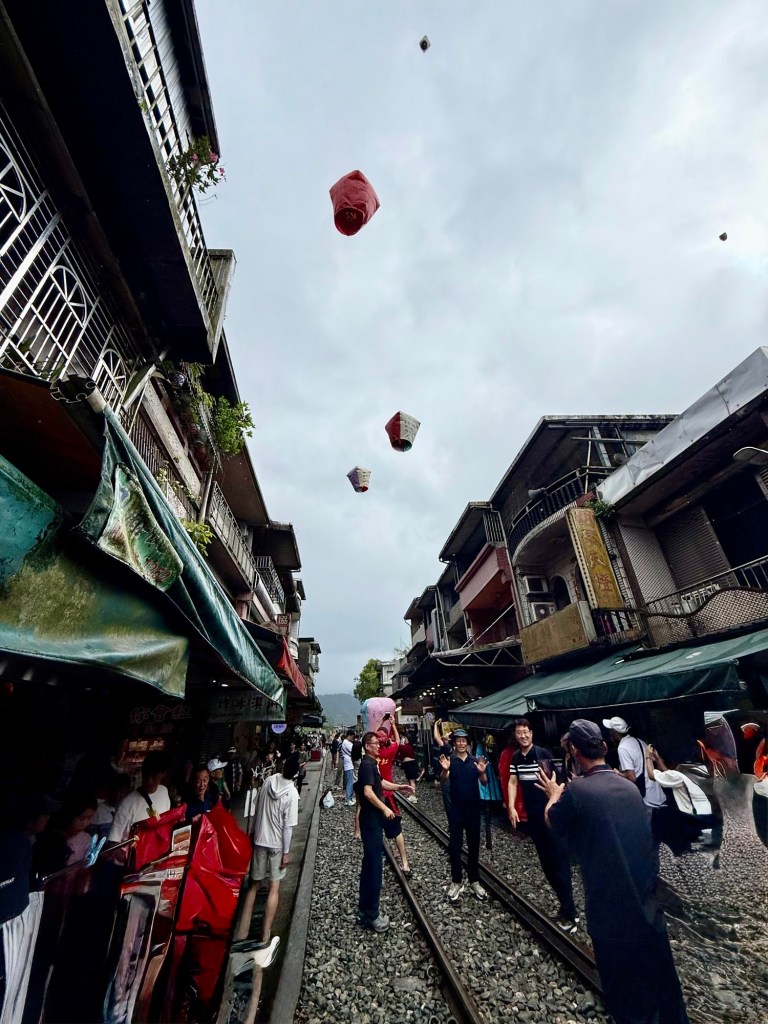
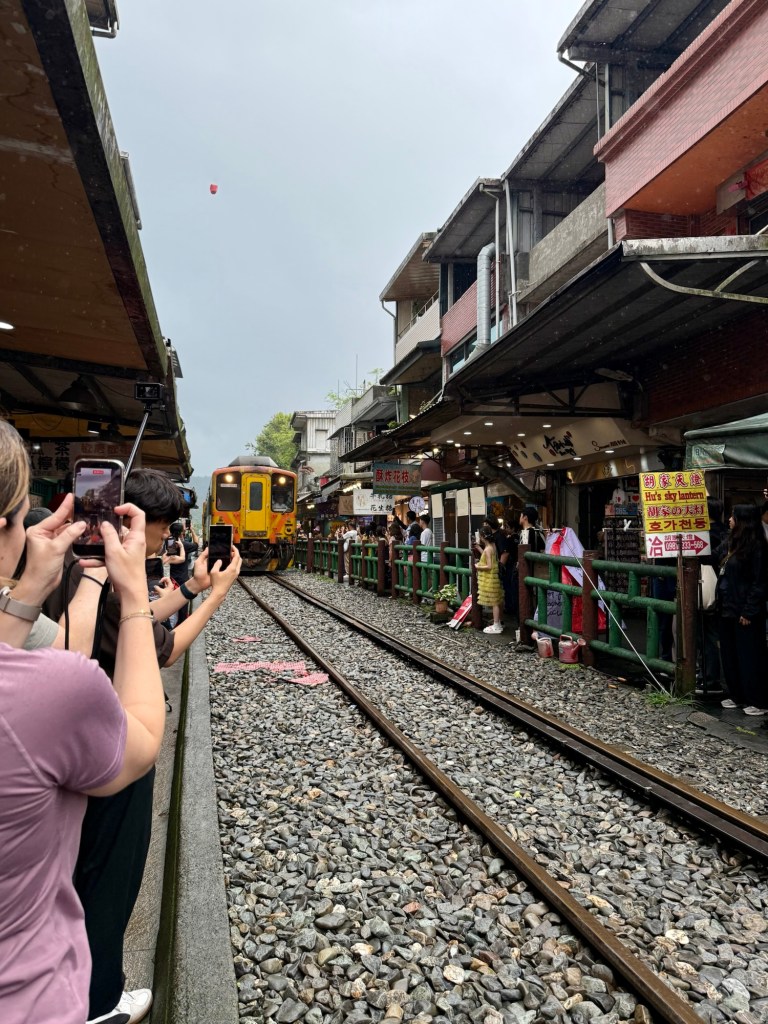
Back on the bus and we carried on through the windy, narrow mountain roads to our final stop for the say, Shifen Old Street. Another historic old town, this one with an active train line running through it. The draw here is for people to release sky lanterns.
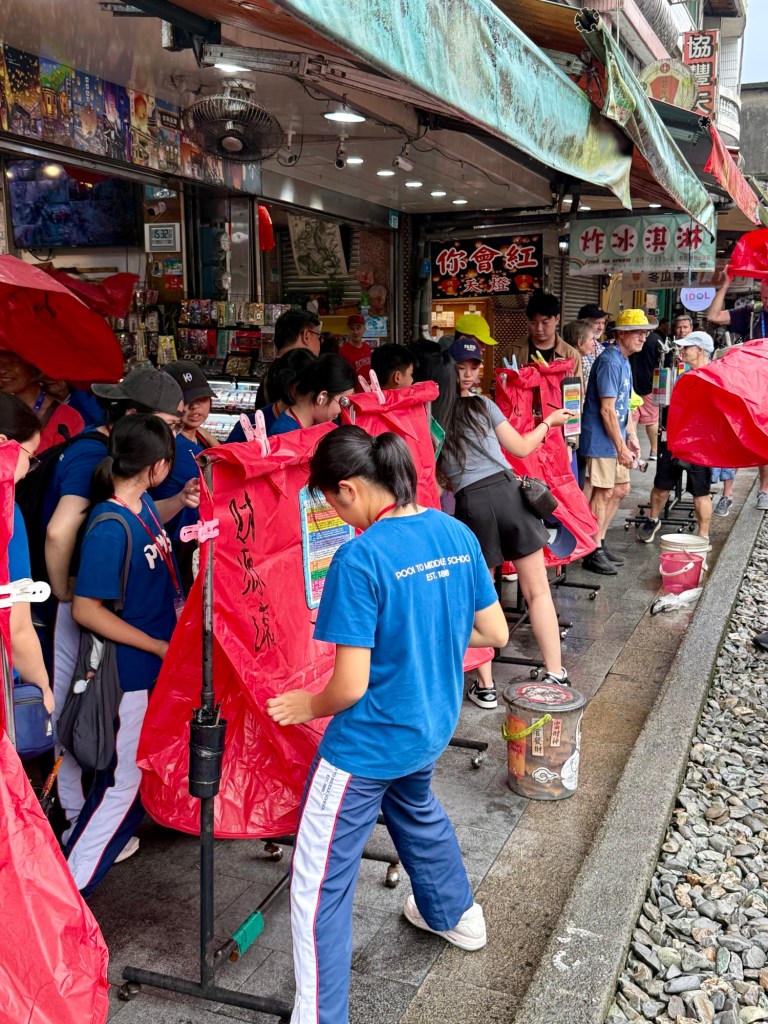
You write your wishes on the laterns which are about 80cm tall and then release them from the rail tracks (with everyone having to scramble off each time a train came through – which happened twice in the short time we were there).
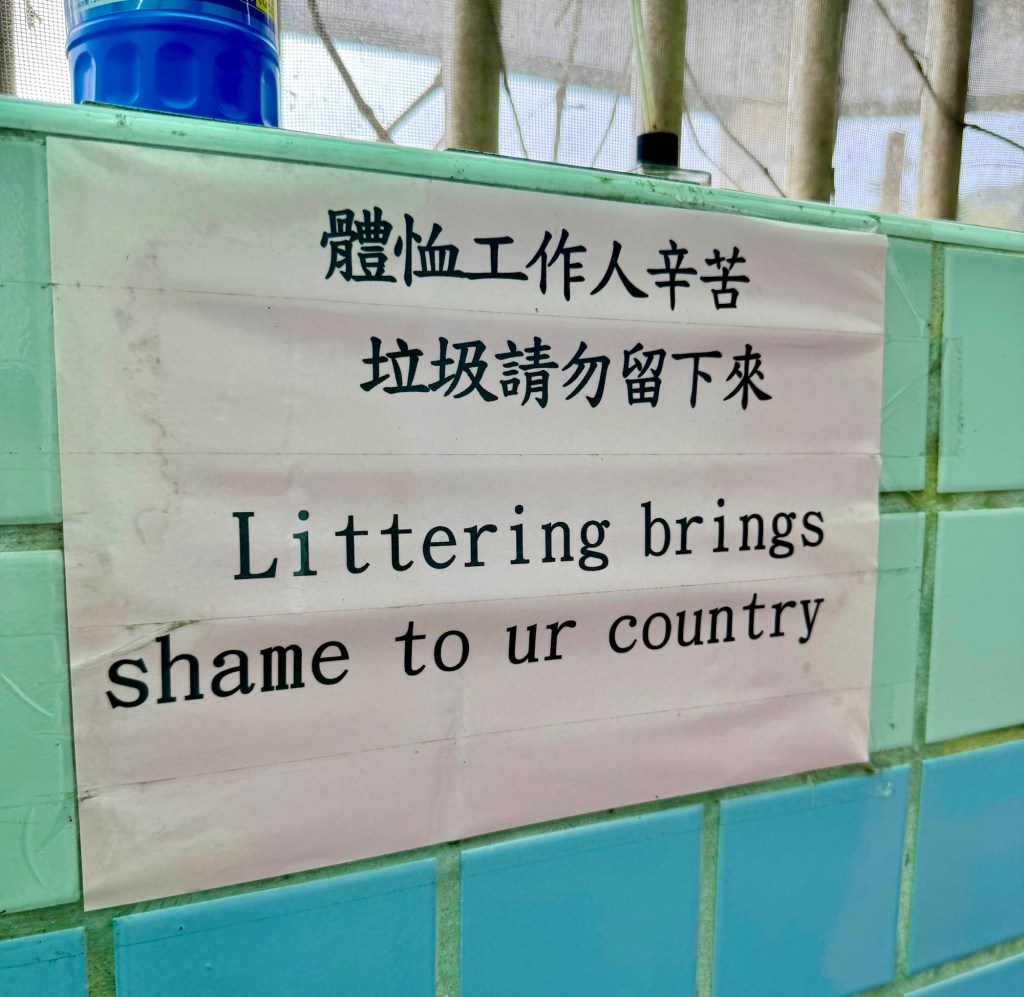
Apparently people get paid TWD10 (about NZD0.55) per lantern if they collect them where they fall and return them but we did see main littering the mountain side and in the river so I decided not to do one. There were certainly enough going up without me needing to be involved and I was happy taking photos.
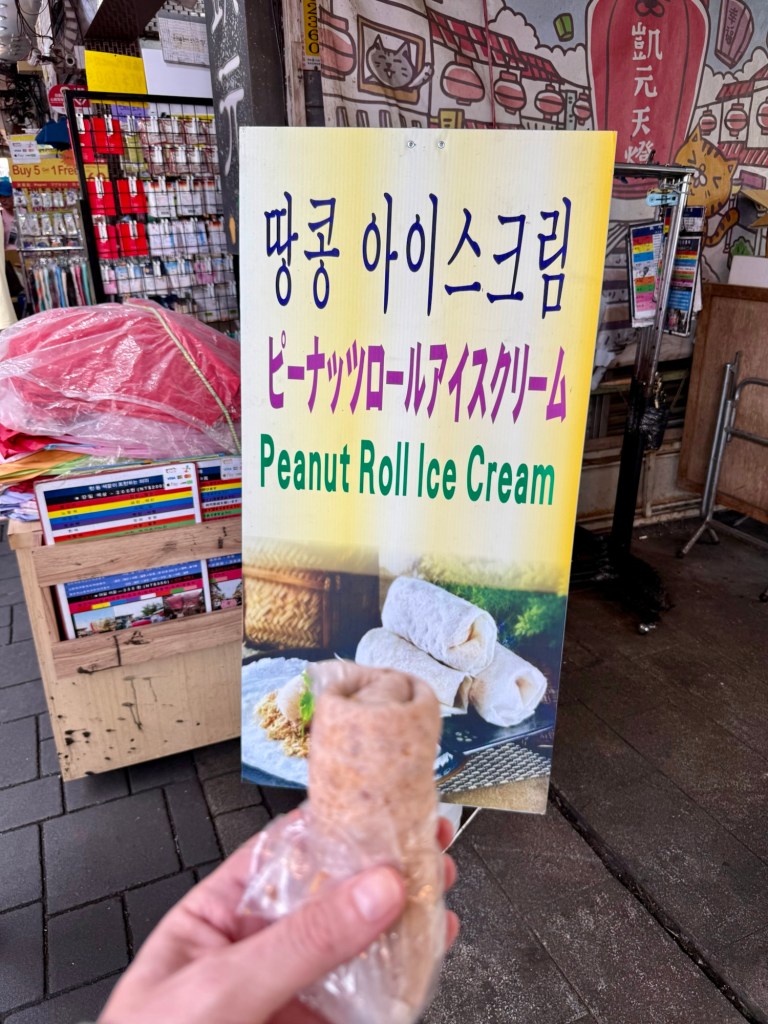
Again most of the shops only take cash so not shopping for me. Thankfully I did have enough to try the local peanut roll ice cream. I opted to have it without the cilantro (which seemed an odd combination to me) and it was pretty tasty.
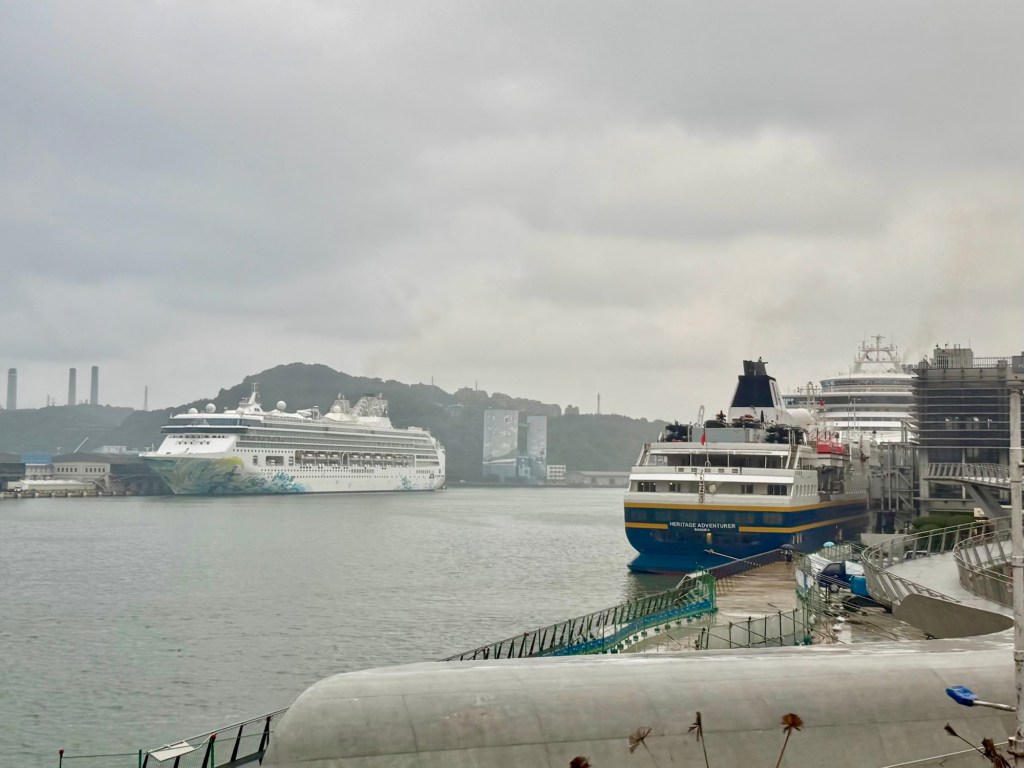
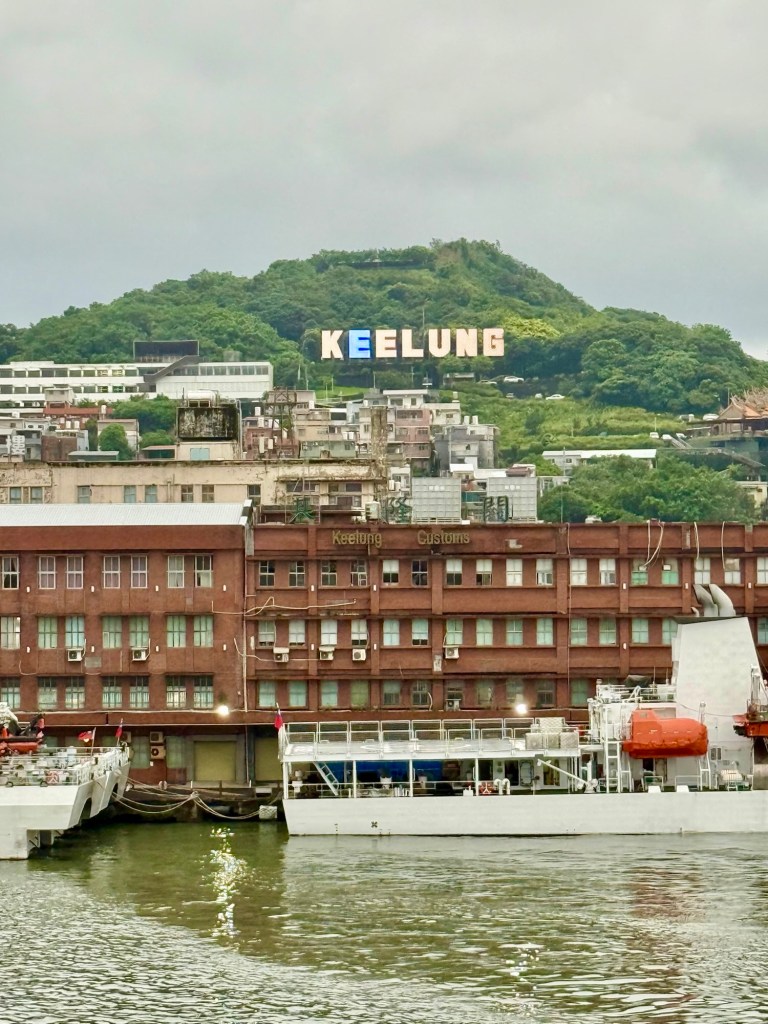
Back on the bus for the last time today, and we were off to the port of Keelung where we boarded the Heritage Adventurer, my home for the next 18 days. It is my second time on the ship and I was excited to see a couple of expedition crew members who I remember from my last trip, including my favourite naturalist.
I had booked the cheapest cabin (still not cheap) which was a lower level, triple share room – and luck was with me and I have it all to myself! What a great start to the trip. It was great to be able to unpack and get settled in before being interrupted by ship formalities – a life boat drill, welcome drinks and then a first briefing which included an introduction to the expedition crew and a briefing for tomorrow as we set sail out of the harbour and out on our adventure.
It seems like an age since I have written a blog. Of course, I have been out and about but for some reason nothing seemed blog worthy, but all that is about to change … so buckle up.
I travelled from Christchurch to Auckland a day early to avoid any early morning weather delays (which are not uncommon at this time of year) and then on to Hong Kong. On this flight I was in business class (through some upgrade vouchers) and I was soooo excited. Particularly as it was a day flight, around 11 hours long, so I had plenty of time to enjoy the benefits I had not paid for. Oh, and I did – champagne, delicious cocktails, duck red curry and pavlova for lunch … venison ragu and plum cheesecake for dinner with a lovely glass of Pinot. The food was amazing! I even had a nap on my lie flat seat (if I was going to sleep properly, I could have got a mattress too)!
Then, after an easy 1.5 hour transfer in Hong Kong, I was on my last leg to my final destination. I was flying Eva Air for the first time, and we got a full meal on a flight that was less than 2 hours! A tasty chicken curry and rice and an odd “Thousand Layer Cookie” in salted egg yoke flavour! It was a weird mix of sweet and savoury and was not unpleasant (expect for the slightly odd eggy after taste).
Landing in Taipei, Taiwan, and it took around 45 minutes to go through the landing formalities (including a 15 minute walk from the plane to the checkpoints) before I was released into the somewhat organised chaos of the airport arrives hall.
I had arranged a transfer to my hotel so there was a sign with my name (one of many) but that is only the first step – then some takes you out to the road chaos (and into the humidity) to try and find your driver and you are then on your way on the 30 minute drive into the city.
Thank goodness I had a driver as I don’t think I would have found the hotel – there were no signs on the street that I could see. In fact you had to go to 5th floor of a building and it was then clearly a hotel but I still didn’t see the name in English.
Despite the rock-hard bed, I had a good sleep until my alarm went off at 7am when I was supposed to be bounding out of bed to go to a view point up a hill. But I decided to take it easy and enjoy the nourishing snack of chocolate milk and a blueberry yoghurt sandwich (think Japanese sando vibes) I got from the convenience store last night … oh and it was pouring with rain so definitely not worth the extra walk!
Instead I made my way into the underground city that was part of the Taipei Main Station, and after getting lost many times, I decided I would jump on the Metro and find my way to my walking tour starting point and before finding coffee. Once I managed the payment system (I got a 1 day pass for T$150 which turned out to be a round token rather than a ticket) and found my train (thank goodness for online maps – they are an absolute god send in the madness that is Asian metro stations)!
There was lots of construction around the meeting place and no obvious cafes (I think I was too early for local places), but I did find a place open – a Starbucks! Not massively proud of that, but oddly it had no branding on the outside and I nearly walked past it! I decided that I would make up for having Starbucks coffee by getting some local bakery thing to eat – which ended up being a small, sweet rice bun!
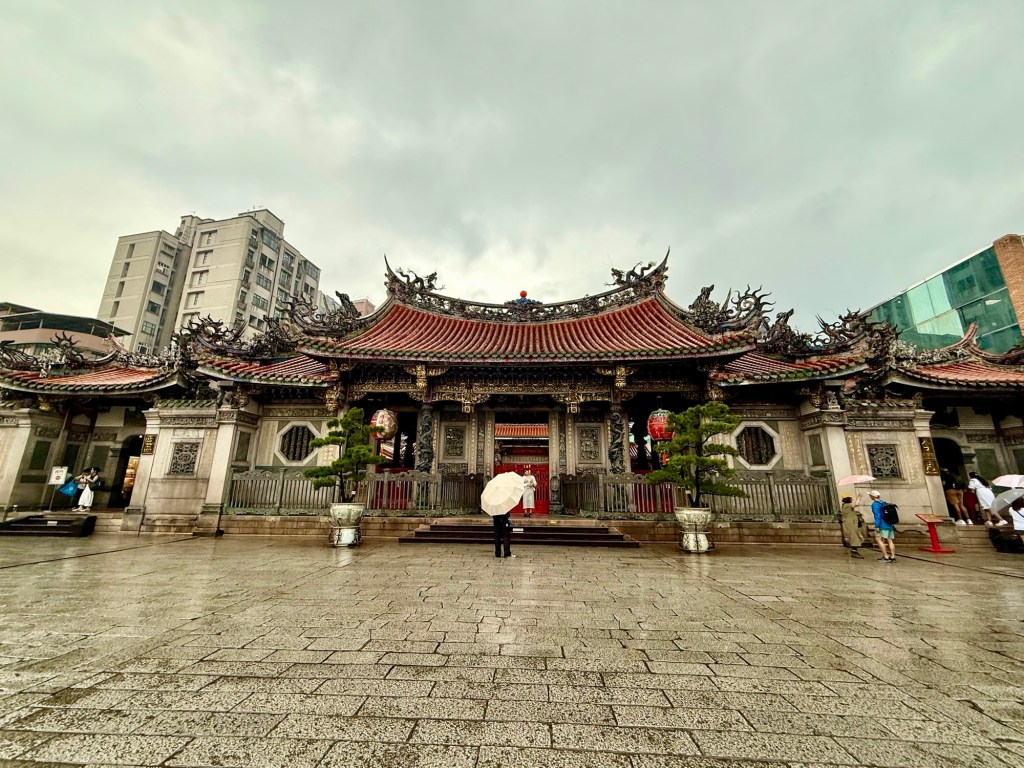
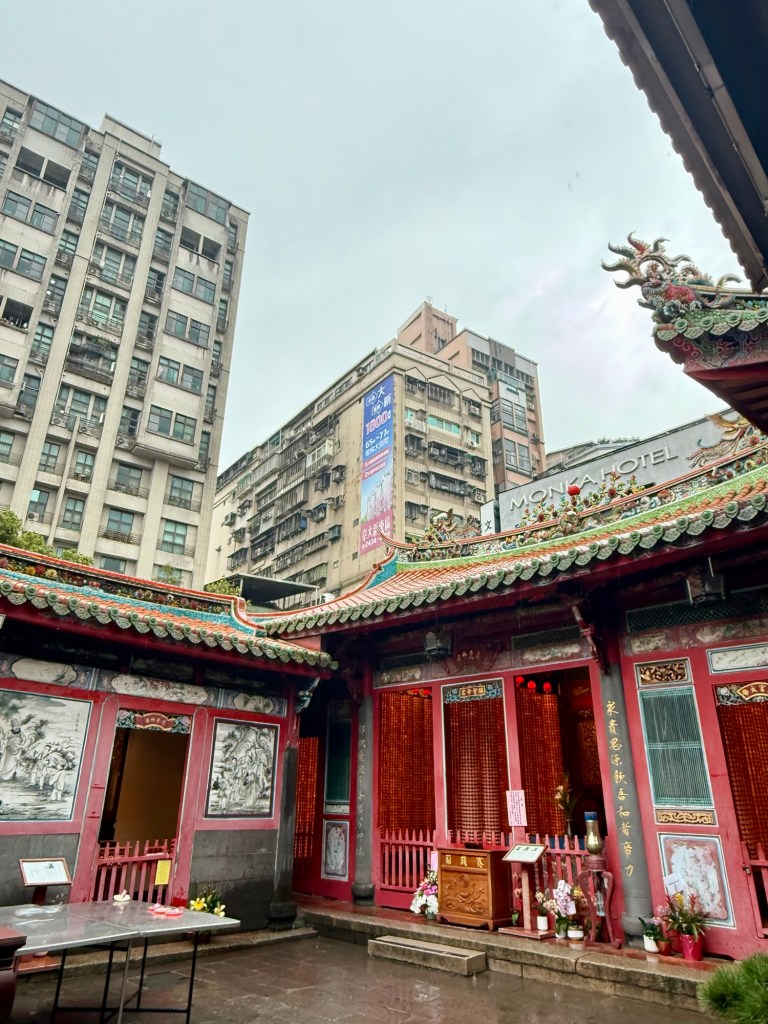
I meet my small group (only 8 of us) and our two young, enthusiastic local guides in the rain outside of Lungshan temple. They started with some basic history of the country, though to be honest, there is nothing basic about the history of Taiwan. Now officially the Republic of China (ROC), more commonly know as Taiwan, previously know as Formosa (derived from beautiful in Portugese) and they participate in international sporting events as Chinese Taipei!
Early Australasian societies settled the islands thousands of years ago, then the Dutch in the south in1624, swiftly followed by Spain in the north in 1626. 1662 saw the first of the Chinese dynasties, Ming, followed by Qing in 1683. Skip forward to 1895 and the Japanese invaded before having to cede the island to China at the end of World War II. More on that later.
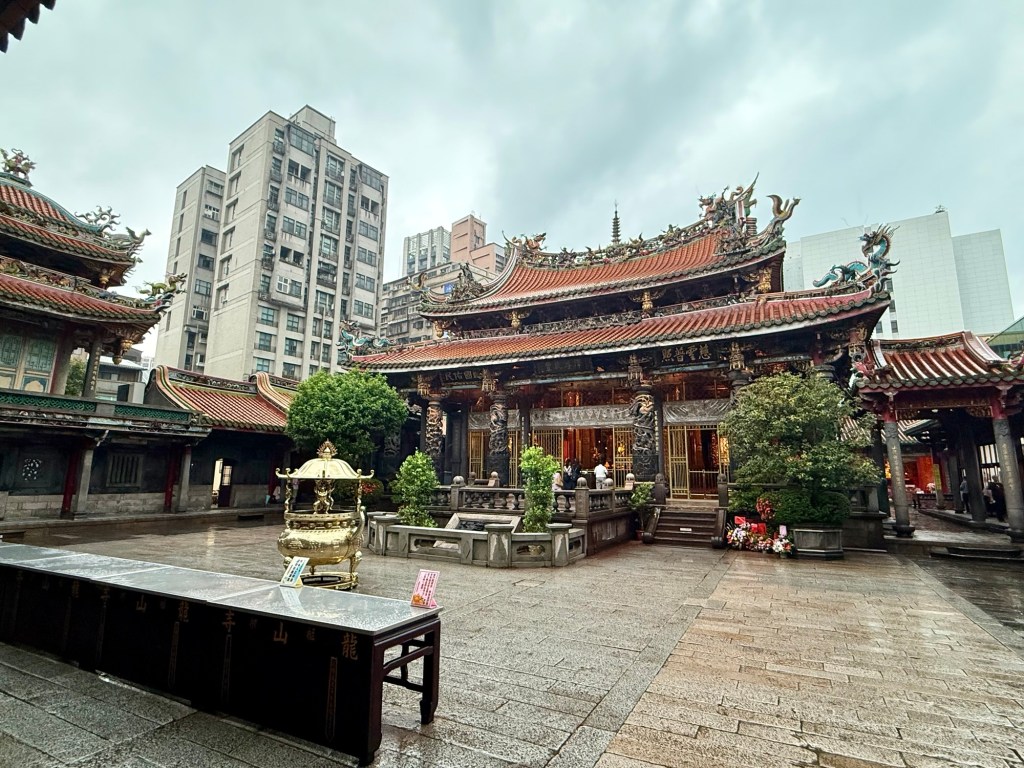
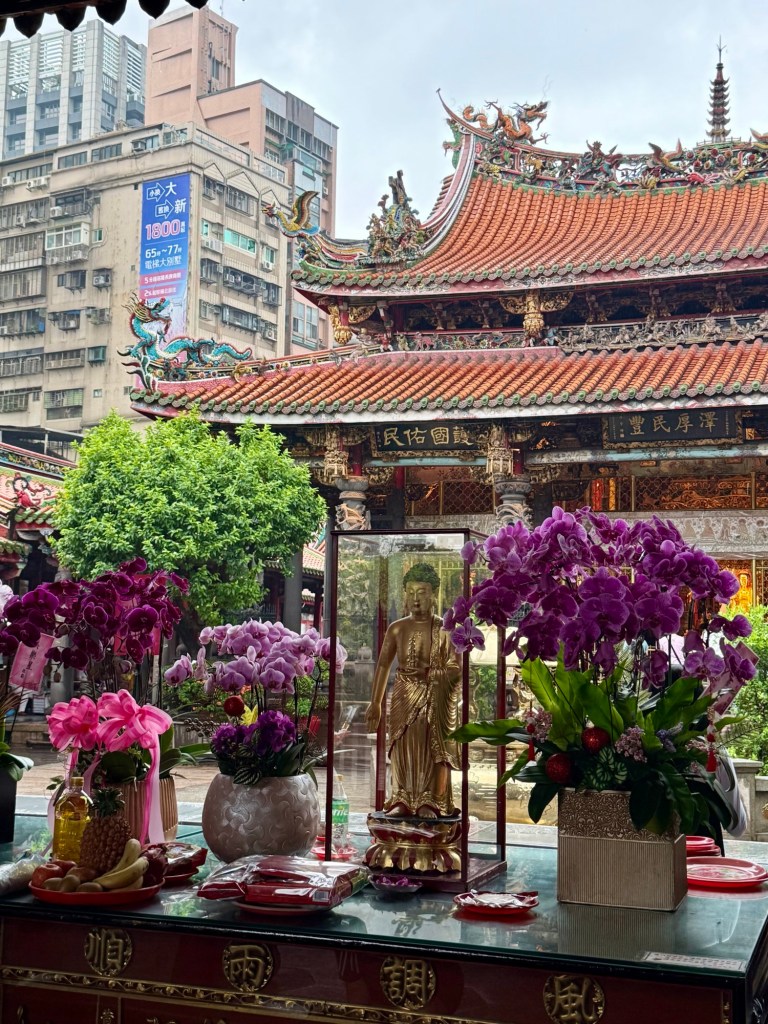
Our starting point of Lungshan (I have also seen this written as Longshan) Temple was built in 1738 as a place for Chinese settlers to gather. It was heavily bombed by Americans during the war so what we see today is more modern and worships a mixture of Buddhist, Taoist and other deities.
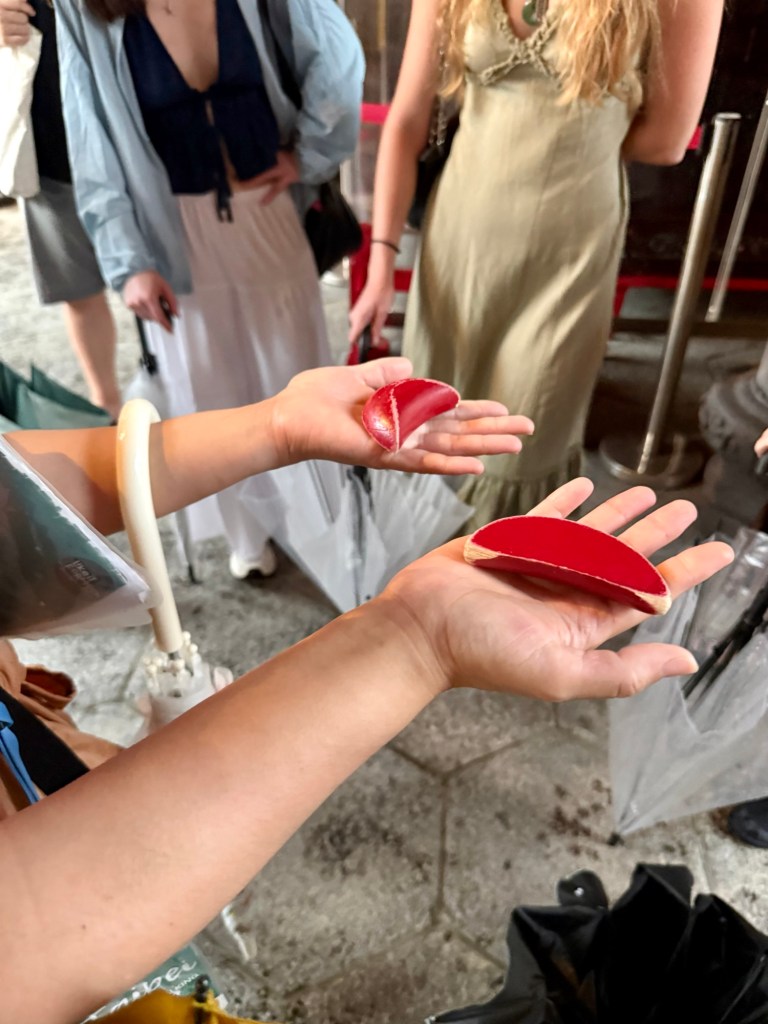
We entered through the gate on the right side, the Dragon Gate (you exit via the Tiger Gate on the left side and only Gods or Emperor’s can use the centre gate) and learnt about the various pray practices used by worshippers to get answers from the Gods. Some use incense sticks, other use Jiaobei or Moon blocks, red moon shaped blocks you throw on the ground and ask yes or no questions. Depending on how they land, the answer is yes, no or maybe.
Apparently there are also more complicated ways to communicate with the Gods and there are staff on hand to help you translate the answers.
Some of the more specific Gods at this temple was the God of Education (to whom you may give offerinings of celery/green onion or perhaps stationery), the Goddess of Child Birth (very important in an agricultural society when people wanted lots of children, predominately boys to work in the fields) and one of the most popular Gods with the younger generation – the God of Marriage and Romance. Also known as the “Old man under the moon”, he likes sweet things like chocolate and candy, and bubble tea! Along with your offerings (always given in pairs), you would leave your very specific list of attributes you are looking for in a mate e.g. you don’t just say tall, you say exactly how tall!
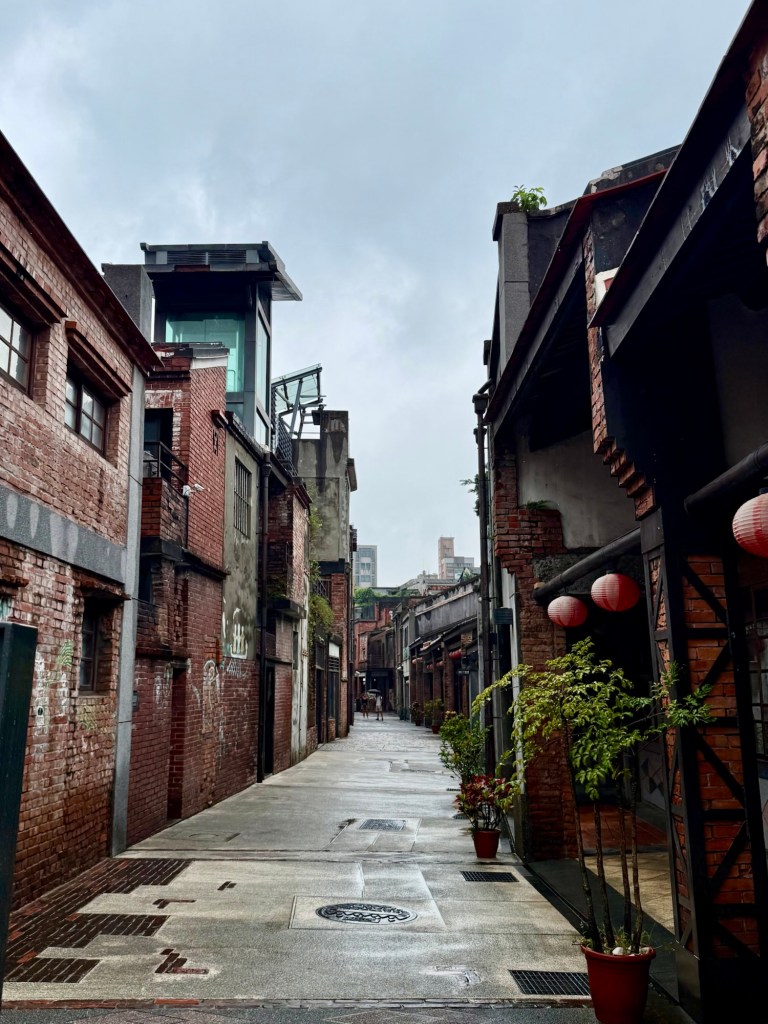
Leaving the temple, we walked down to a couple of streets of old town houses. All the houses are very narrow as tax was paid based on the width of the street front. The area used to be full of industry such as printing, tea shops and hotels.
We had a quick stop at a traditional ice cream shops where I tried all the traditional flavours – Taro, Red Bean and of course the old favourite – Chicken egg (actually kind of a vanilla custard). I am not sure any of them really tasted of much except for sugar but they were ok.
We spent a little time in the Xiamen Red House, built by the Japanese as an indoor market and has a unique construction, incorporating both octagonal and cruciform shapes. Today it houses shops, craft stalls, a tea house, and workshop and exhibition space.
From here we could see much for the mish mash of architecture in the city. The original city walls were demolished by the Japanese as they were restricting the city’s growth. They were also going to demolish the original Qing dynasty gates but public outcry meant they were saved.
Like many Asian cities, with a complex history of immigration and colonisation, Taipei is a contrast of wide tree lined boulevards, rundown narrow shanty like streets, grand European/ Japanese archecture and rundown Chinese temporary buildings. The city sustained considereable bombing during WWII, followed by an influx of Chinese refugees. These temporary buildings were constructed to accommodate them all, and many of these “temporary” buildings are still standing, just!
The Presidential Office building on the other hand is a beautiful example of Baroque style Japanese architecture (yes, apparently that is a thing) and it used to be the tallest building in Taiwan! It was here we learnt a little more about the complex situation Taiwan finds itself.
Although it functions as an indepdent, sovereign country, with its only democratically elected government, constitution, currency etc, the People’s Republic of China (PRC) claim it as it’s own as part of it’s “One China” principle, so it’s sovereignty is only recognised by 12 other countries. Despite being a founding member of the UN in 1971, the UN now no longer recognises it as an independent country!
We walked through the peaceful 228 Peace Park, originally called Taipei Park, the oldest park in the city and was renamed in memory of those who died in the so called 228 event in 1947 when civil unrest against Government corruption led to the massacre of 28,000 people including scholars, teachers etc and the subsequent “White Terror”banned non Mandarin speakers from working in any skilled jobs (most of the population at that time only spoke Japanese). The Martial Law in Taiwan lastest 38 years, only being lifted in 1987!
When martial law was lifted, Taiwan started to develop into the high tech global economy and a thriving democracy we see today.
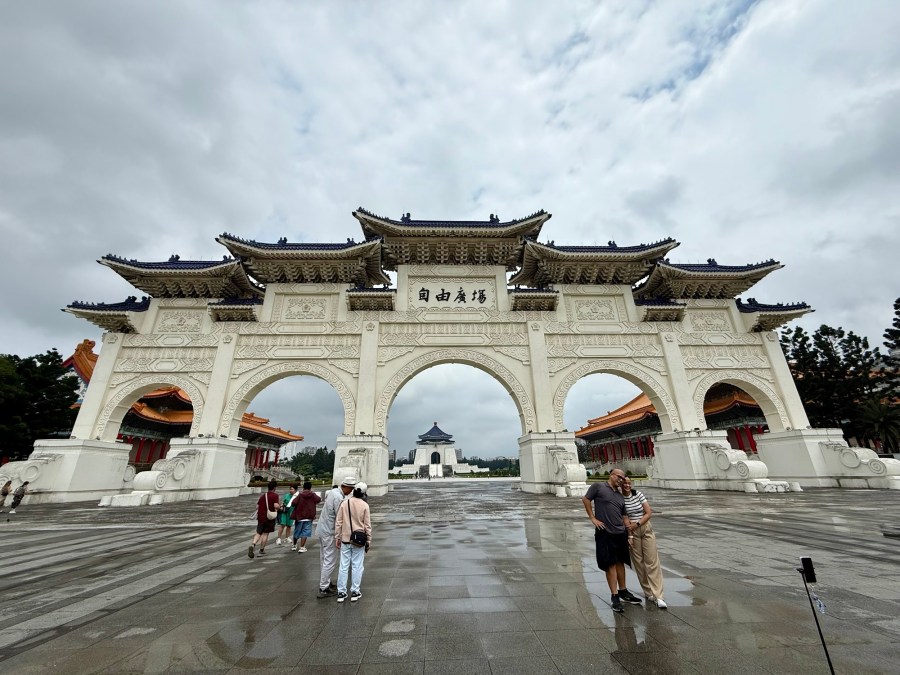
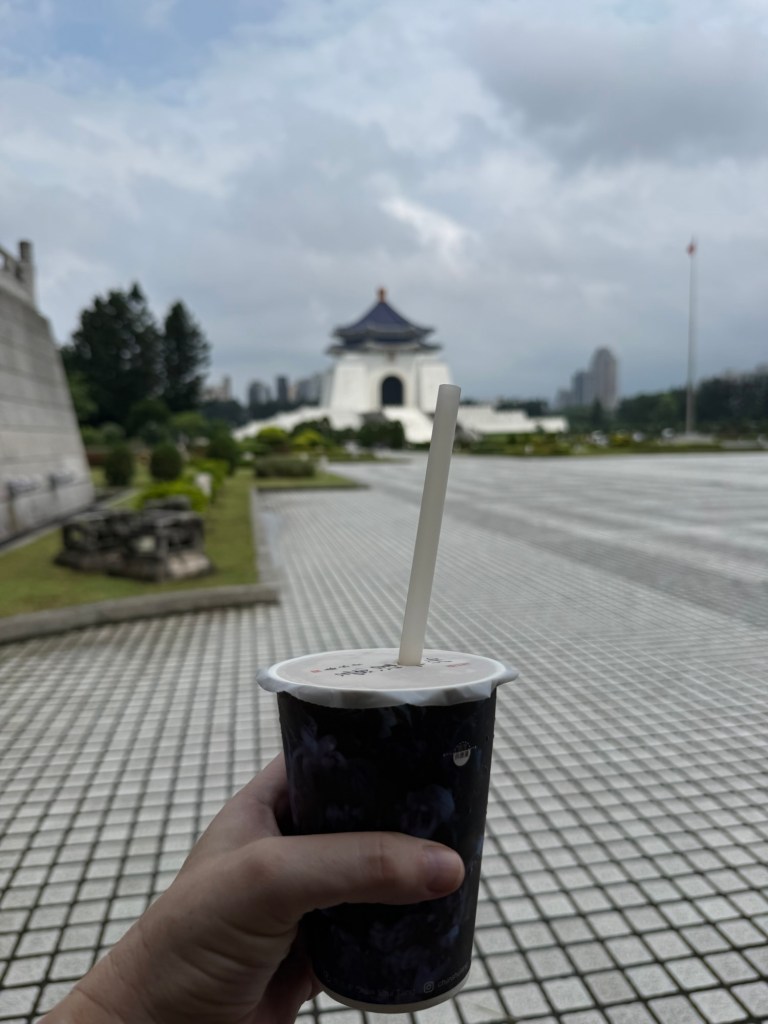
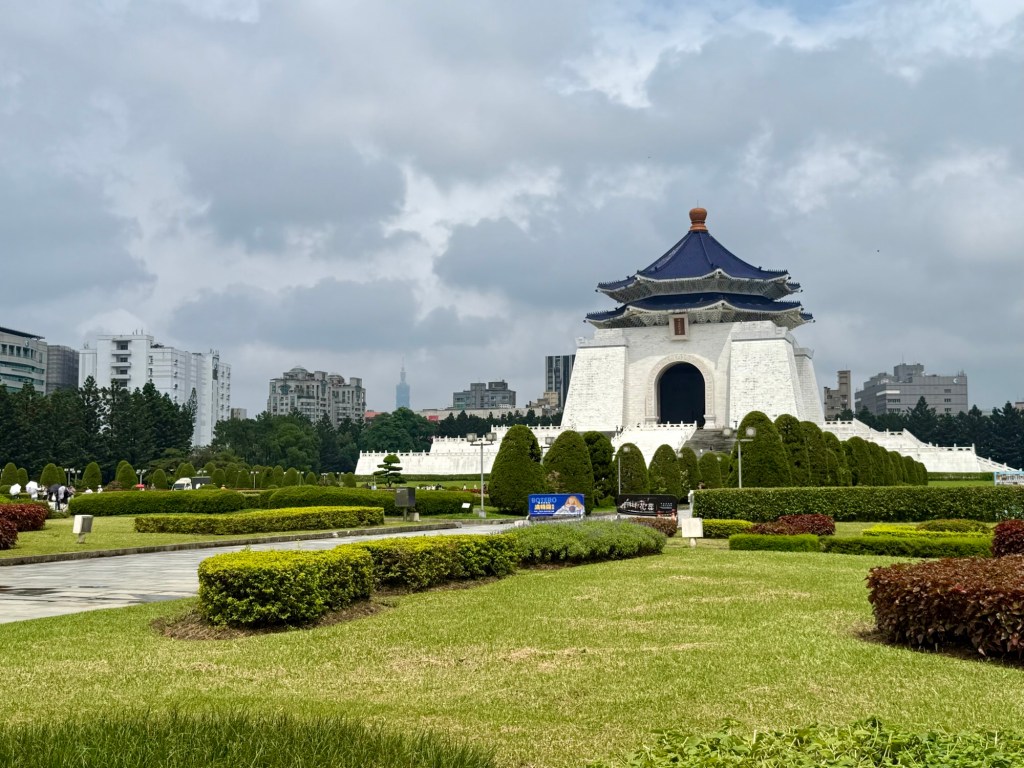
The final stop on the walking tour was the huge complex of the Chiang Kai-shek Memorial hall. (A Chinese military commander, revolutionary, and statesman who was President of the Republic of China (Taiwan) from 1948 to 1975.) A huge gate, looking out to the white and blue Memorial Hall (the colours are rare in Chinese architecture but are the colours of the ruling political party), flanked by two more traditional Chinese buildings housing the National Theatre and the National Concert Hall. It certainly was a wow moment.
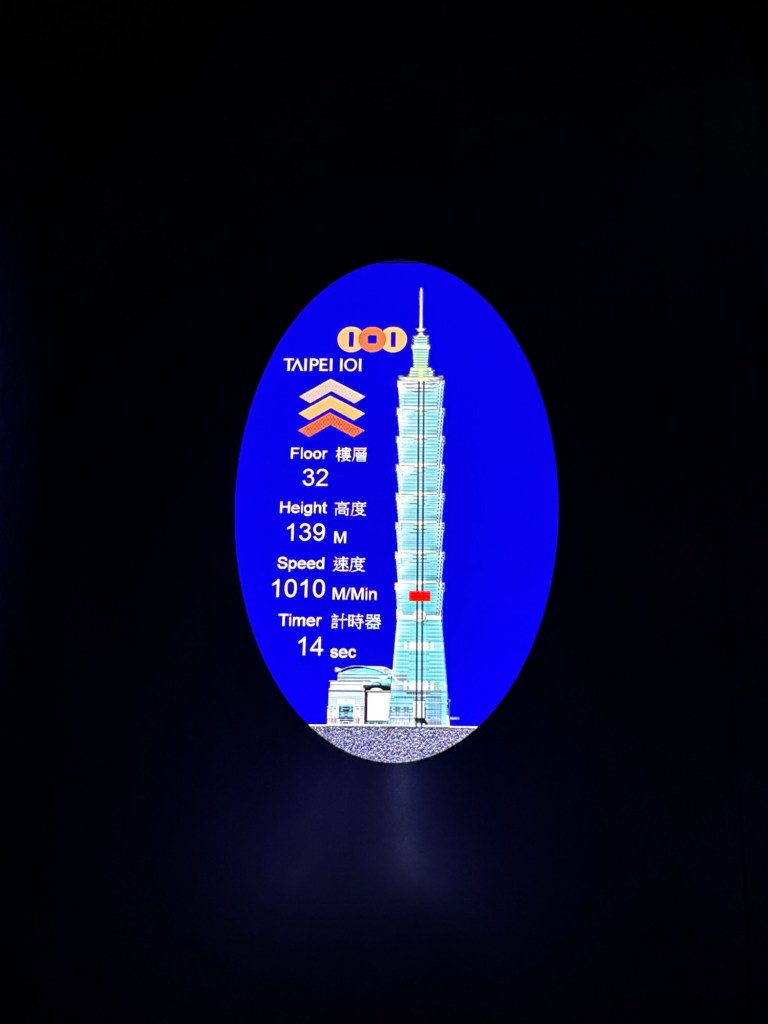
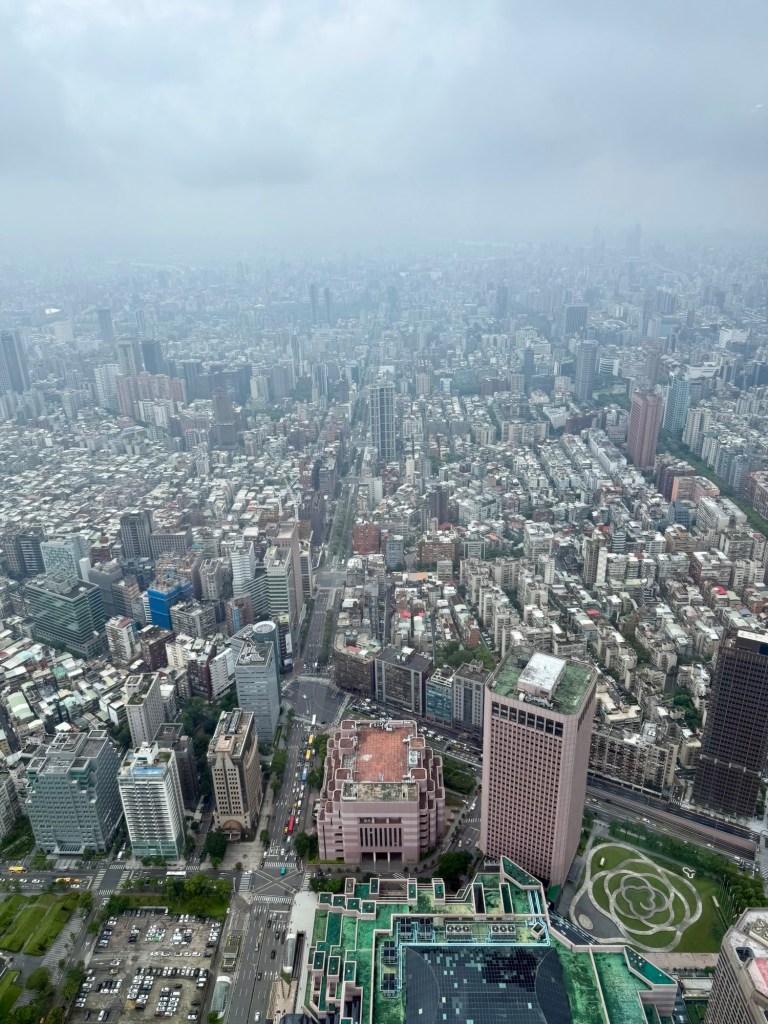
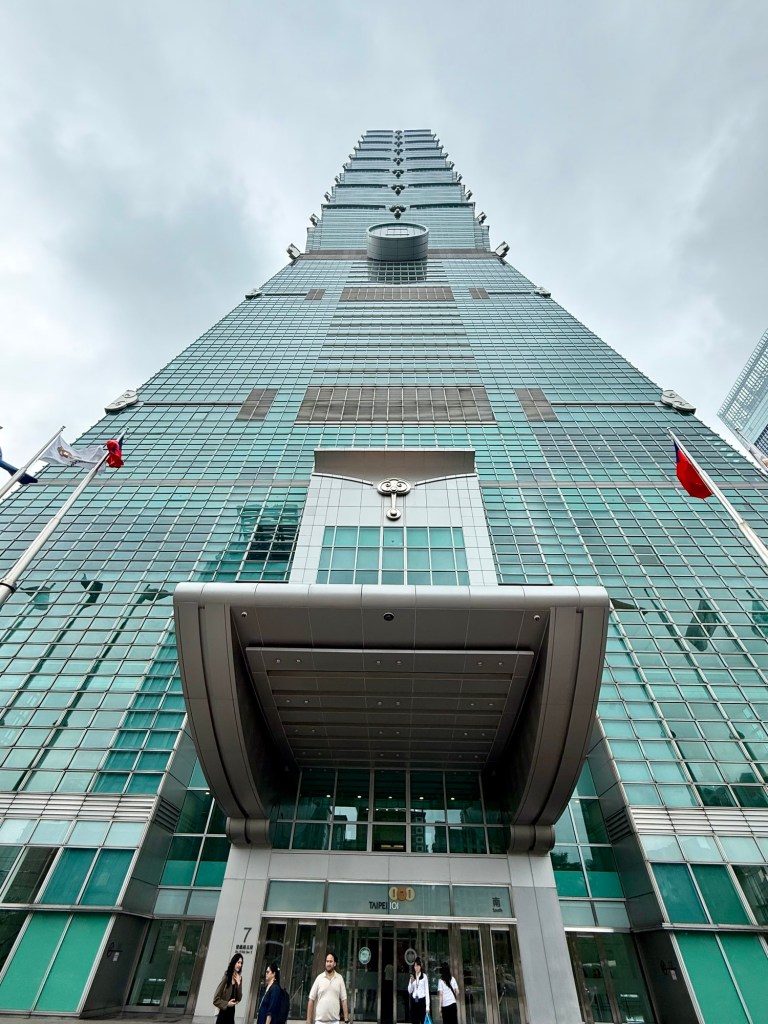
Our guide told us, that apparently the restaurant/café in the complex claims that it is the birth place of bubble tea, and therefore I had to get one before heading off to the nearest metro station to make my way to Taiwan 101. The tallest building in the city and the home of the fastest passenger elevator in the world, that takes you up to the viewing platform.
The cloud had lifted a little so I got a little bit of a view from the top before I was whisked back down, had a quick look around the shops (so many designer shops) before heading back to my hotel to pick up my bags before heading off to my new, and very much improved, hotel which was the meeting point for my trip which has now officially started.