
Azerbaijan & Georgia
April 2025

I was woken early by the Muslim call to prayer and to a misty morning. As I had now discovered the importance of the buildings just across the road from the hotel, I headed out for a quick walk and in search of coffee.
There are two caravanserais on the main road in old Sheki, the upper and the lower which both date back to the 18th-19th centuries. They were built as fortified structures with just one gate, so they can be protected more easily.
The Upper one is a tourist site, of course it was closed at 7.30am but I did manage to sneak in a small door (inset in to the big door) to have a quick look at the first courtyard. As in time gone by, there are a lot of shops along the the outside and we had walked along them the night before. Today they are mostly souvenirs and also some Halva shops, making a traditional local Halva (a sweet made from sesame paste and honey).
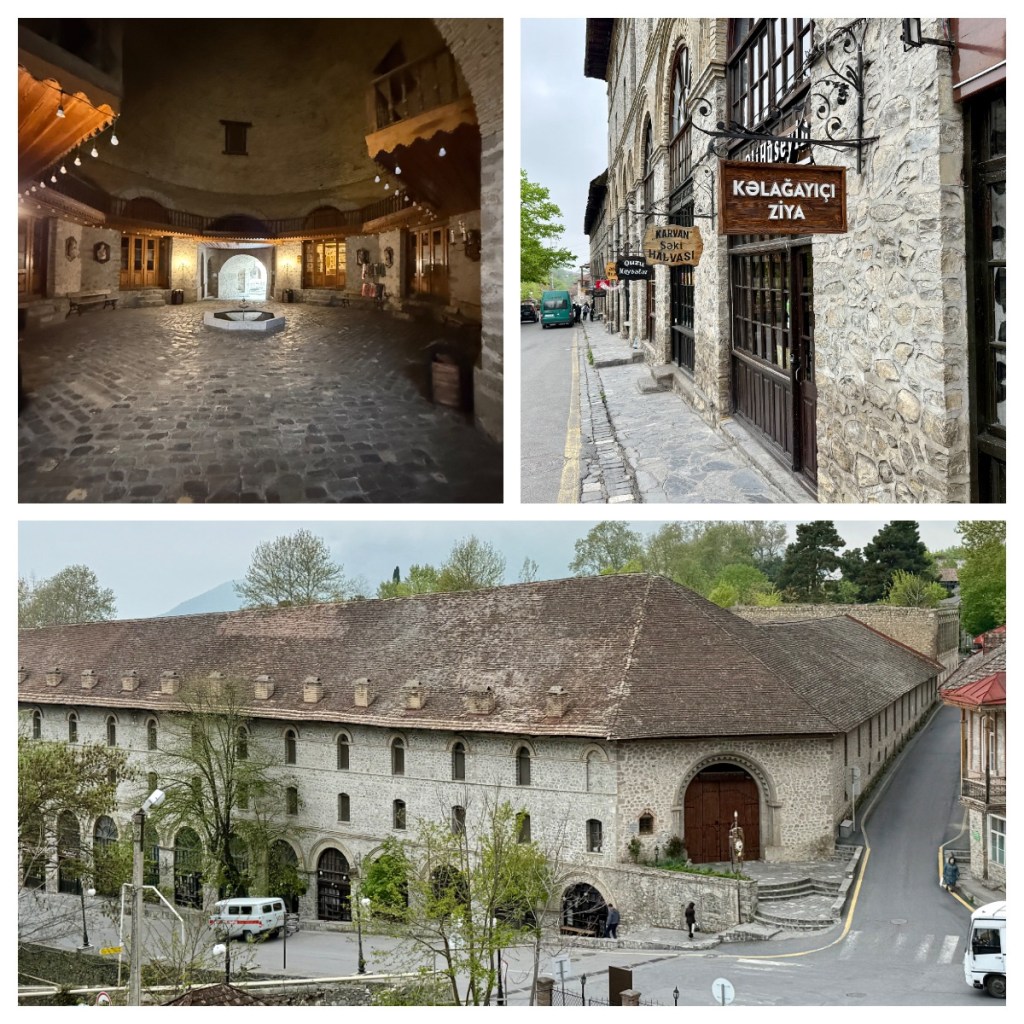

The Lower caravanserai is a hotel today, but more importantly for me (that sounds like a terrible thing to say 🤓), there was a lovely coffee shop just across the road … and it was open! I enjoyed a coffee and watched the local Ladas go by – they definitely rule supreme in this part of the country and I love it.
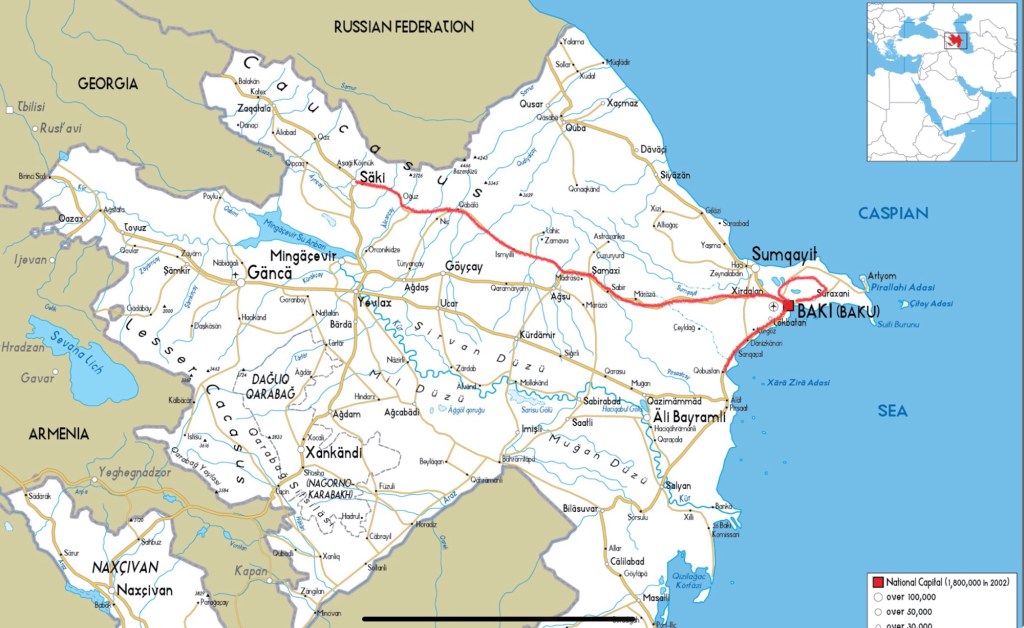
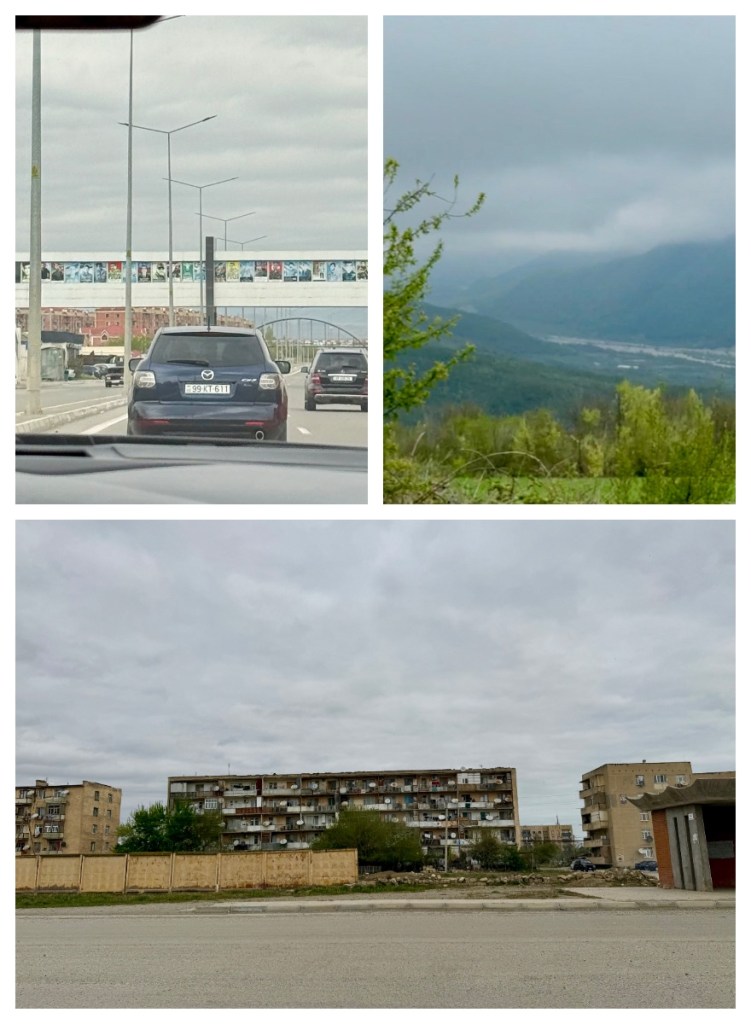
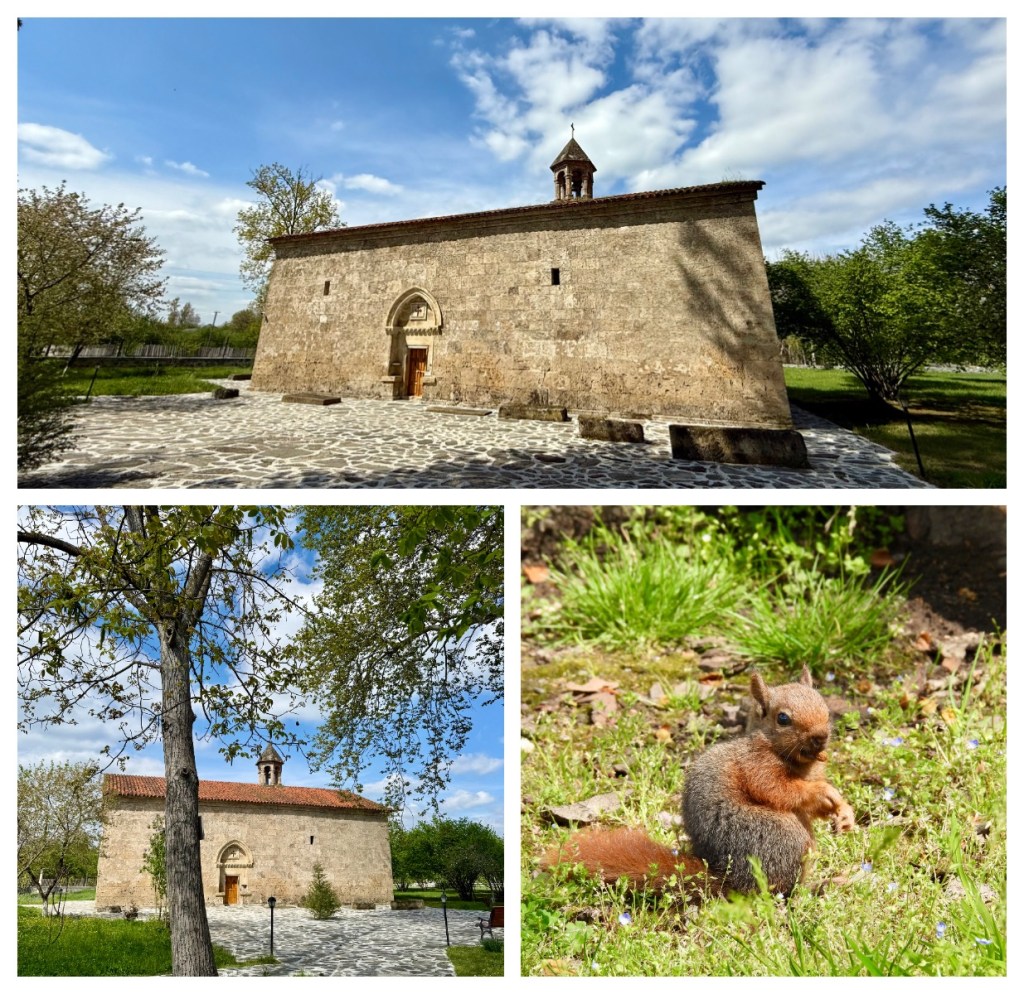
As we headed towards the border, we passed yet another Albania church on a hill side – I should note that the Albanian churches I see on this trip are not related to the Albania of today, but of the ancient Caucasus Albania which sat in the south eastern part of the Greater Caucasus mountains (most of which sits in modern day Azerbaijan. The mountain landscapes were filled with wild braided rivers, shepherds grazing their sheep and as we neared the border, trucks, lots of trucks.

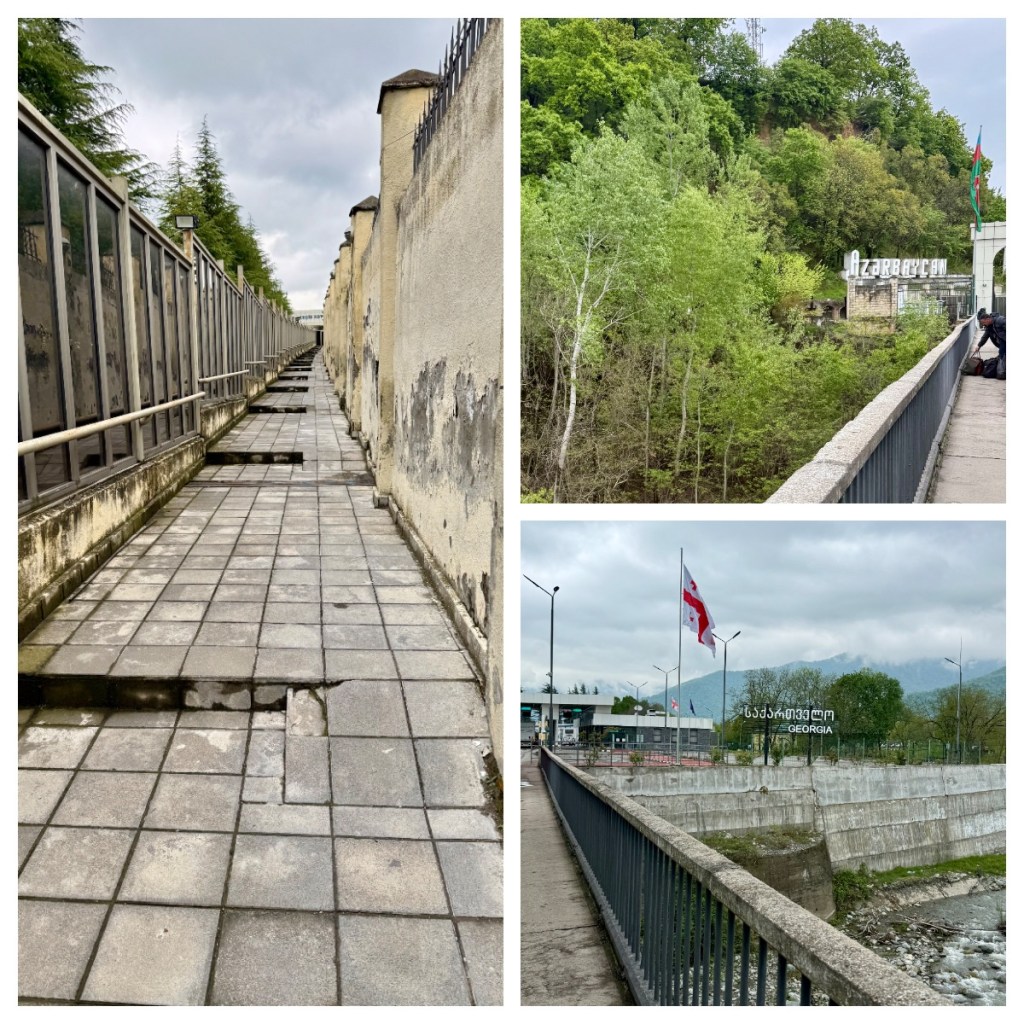
We said our goodbyes to Rugiya (our Azerbaijani guide) and our driver and walked to the border crossing. It took around 45 minutes to depart Azerbaijan (only because we got caught behind a tour bus) and then walked the short distance across no mans land and into Georgia. The Immigration guy was so excited to see a New Zealand passport – his exact comment was “I did not expect this today” lol.
We found our Georgian guide, Tazo and hit the road on the next leg of our Caucasus’s tour. Let’s be clear, we are talking about Georgia the country, and NOT the state in American as many first assume!
The currency here is the Georgian Lari (GEL), NZ$1 = GEL1.6.

First, I little context. Georgia spans Eastern Europe and West Asia, bordering Russian, Turkey, Armenia and Azerbaijan. It is a small country (only 69,000 km2 – compared to New Zealand’s 263,000 km2) with a population of around 3.7 million, 2 million of which live in the capital, Tbilisi.
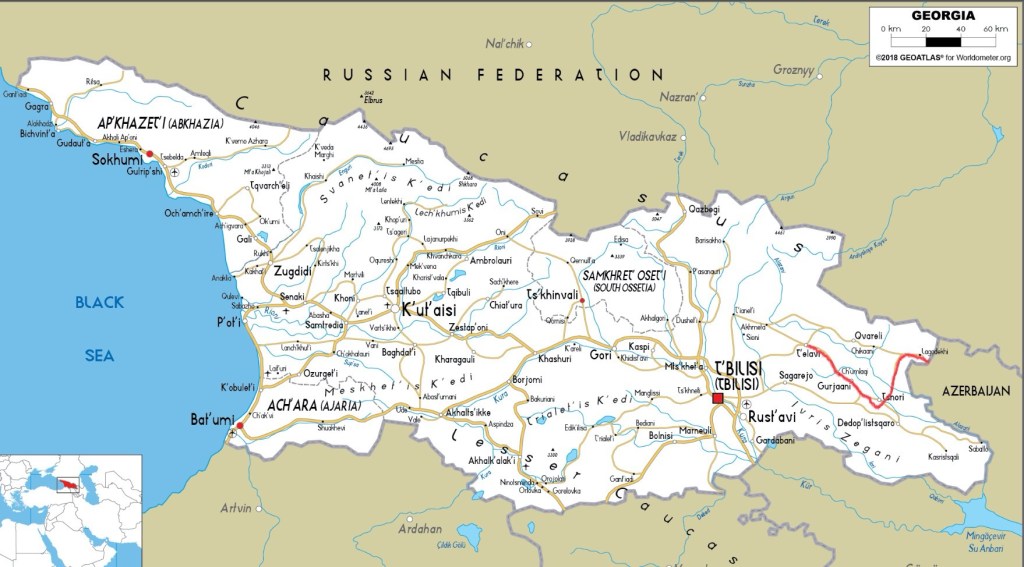
As with most countries in this region, its history is complex and somewhat turbulent and even today, the geopolitics of the region continues to cause issues. After adopting Christianity in the 4th centre, the Kingdom of Georgia remained strong until the 15th century when they succeeded to the Mongols, the Ottoman empire and Persia, before becoming part of the Russian Empire in 1801.
After the fall of the Russian Empire, they had a couple of years as an independent republic before, once again, being invaded by the Red Army and becoming part of the USSR until 1991. It was not until 2003 that they gained political stability and aligning themselves with the EU. I will touch further on parts of this as we travel around and learn more.
The weather was less than ideal, but it was better than the forecast for the following day, so Tazo recommended that we visit the hilltop town of Sighnaghi today rather than tomorrow. A small town in the Kakheti region, Sighnaghi was built in the 18th century as a fortress but today it is referred to as Georgia’s “City of Love” (though I am not sure I know why)!
We drove up into the cloud to the town and we did have to imagine the charm of the town, and of course the view – which apparently is beautiful and our imagination continued as we wandered down through the cobble stone streets to our lunch stop.

In just a few short hours, we were already impressed with Tazo and he ordered a great array of delicious Georgian food for our first meal. It seems that walnuts, cheese and bread play an important part of Georgian meals and this meal incorporated all of the above – eggplant stuffed with walnut paste, khachapuri (a few different varieties but the basic one is bread with cheese), tomato salad, BBQ pork and Khinkali (broth and meat filled dumplings).
All were delicious and I washed it down with my first glass of Georgian wine. (I will warn you now, food photography is not my thing – most of time we would be half way through eating before we remembered to take the photos 😂.)
In just a few short hours we had already learnt some important information about Georgia and her people:
- Georgian’s like food with flavour, and “food without salt is not food” lol.
- Georgia is the home of wine making (more about that another day) and it is important for Georgian people. Without wine, nothing happens and almost everyone makes their own.
- Georgia’s main exports are copper and other minerals/ore.
- The Georgian alphabet is unique and in fact, there are 3 versions of it. One is widely used, the other two are predominately for religious texts and inscriptions.
- I was the first Kiwi guest that Tazo had had
The cloud lifted briefly to allow a quick and hazy view of the valley below, with the green pastures and fish farms (which seem a little random to me in the middle of fields lol). Apparently there are also lots of minerals in the soil here which are great for grapes.
While Tazo ran back up the hill to get the car, we took a short walk along part of the 4 km defensive wall to a watch tower flying a very tatty Georgian flag in one of the 28 watch towers along its length. Again, we had to use our imagination on the view!


I have to admit, I was in a bit of a food coma on the next part of the drive but we had lots of good chat with Tazo on the journey to Telavi, the main administrative centre of the Kakheti region and our stop for the night.
Dinner was not required but we bit have a snack and some homemade Green wine (they use the grape skins during fermentation) to finish of the day.
But, before I finish this blog, I thought I would touch on the country’s name of Georgia and the infamous St George. Georgians actually call the country Sakartvelo, and although it is not entirely clear where the English name of Georgia came from, there are a number of theories mostly based around St George.
St George, an early Christian martyr, was born in Cappadocia in the second half of the 3rd century. He is the patron saint of the country (and many others), a large number of churches in the country are built in his name, George (or Giorgi) is one of the most common male names and the country’s flag features his red cross on a white background! What more do you need to convince you of is importance to the country and its people and perhaps the English name.
When he started fighting dragons, and became the patron saint of England is another story entirely lol.




 Cockneykiwi takes flight