
Georgia, April 2025

We woke to another day of cold rain, and due to the Easter holidays (where many things would be closed and traffic would be crazy), Tazo had managed to rearrange our itinerary, so instead of staying in Tbilisi for a few days, we were heading straight out again.
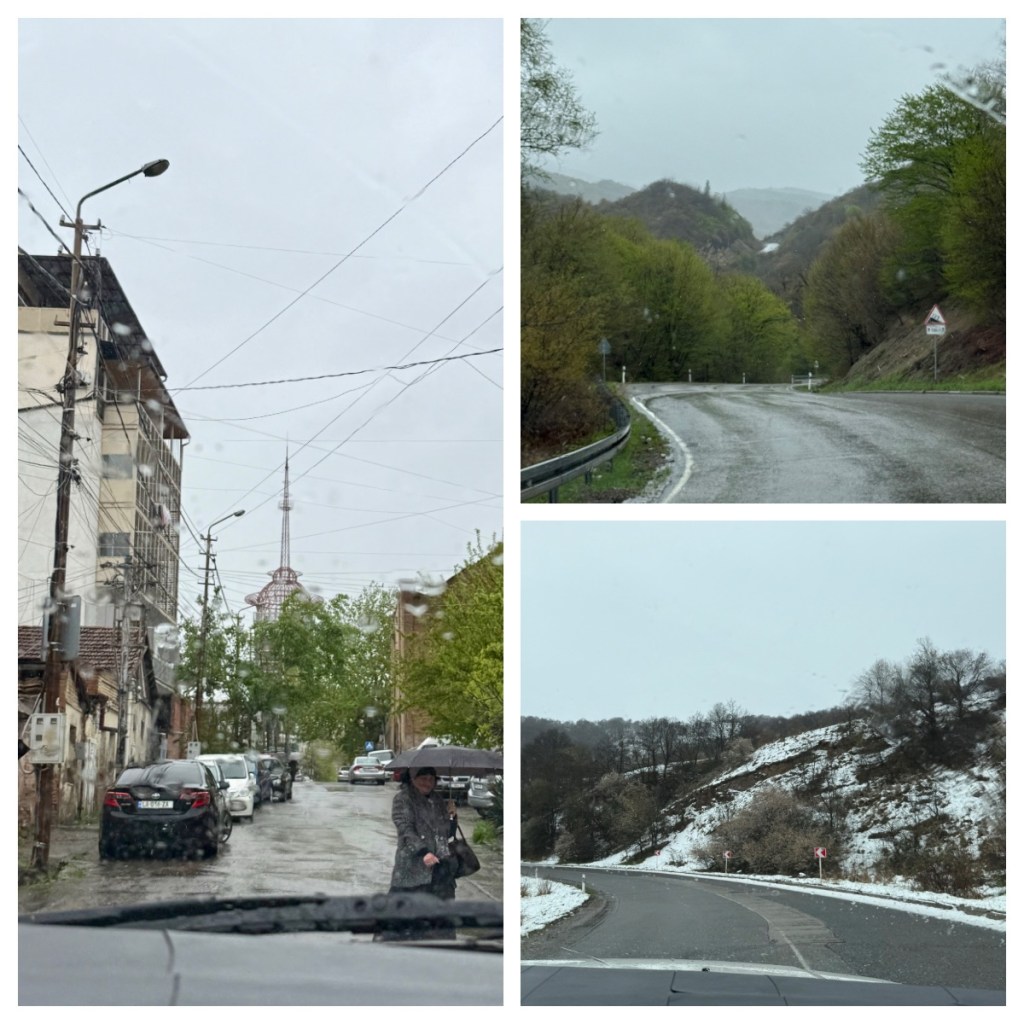
Today’s journey took us over the mountains of the Samtskhe-Javakheti region and we passed through beautiful mountain landscapes and small villages – neither were conducive to any good photos from a moving car …. in the rain! But as we drove higher we started to started to see snow on cars coming from the direction we were going in!
In “Car Chats” today we talked about Georgia’s fight to retain its territory and independence. Here, all men need to do 2 years military service and the last major skirmish, the Russo-Georgian war, was in 2008 when Russia took occupation of Abkhazia and South Ossetia. Still today, Russia and 4 UN states recognise these areas as independent states, whilst Georgia and most other UN states recognise it was part of Georgia, and therefore the EU, and the UN now recognise the areas as “occupied territories”. Despite that, Russian continues to build military bases in the regions, create borders along the boundaries of the disputed lands and refuse entry to any international monitoring missions.
Russia continues to claim that Abkhazia and South Ossetia are independent states and not occupied territories and citizens can have local passports (of Abkhazia and South Ossetia) but get Russian passports for international travel. Still today, tensions still run high along these borders and a permanent and peaceful resolution does not appear close.
Up into the snow we drove and at almost 2000m above sea level it was actively snowing. And it snowed and snowed, like serious snow! Apparently, March had been a very warm month and most people had changed to their summer tires so this was not ideal and it was not long before we came upon a traffic jam. Not sure if there had been an accident or if people had just decided they could not go any further, either way, the road was blocked!
Thankfully, Tazo had picked us up this morning in his Landrover, so we went off road to get past the jam (I enjoyed this very much lol). If we had not been able to do this, we would never have reached our destination for the day!
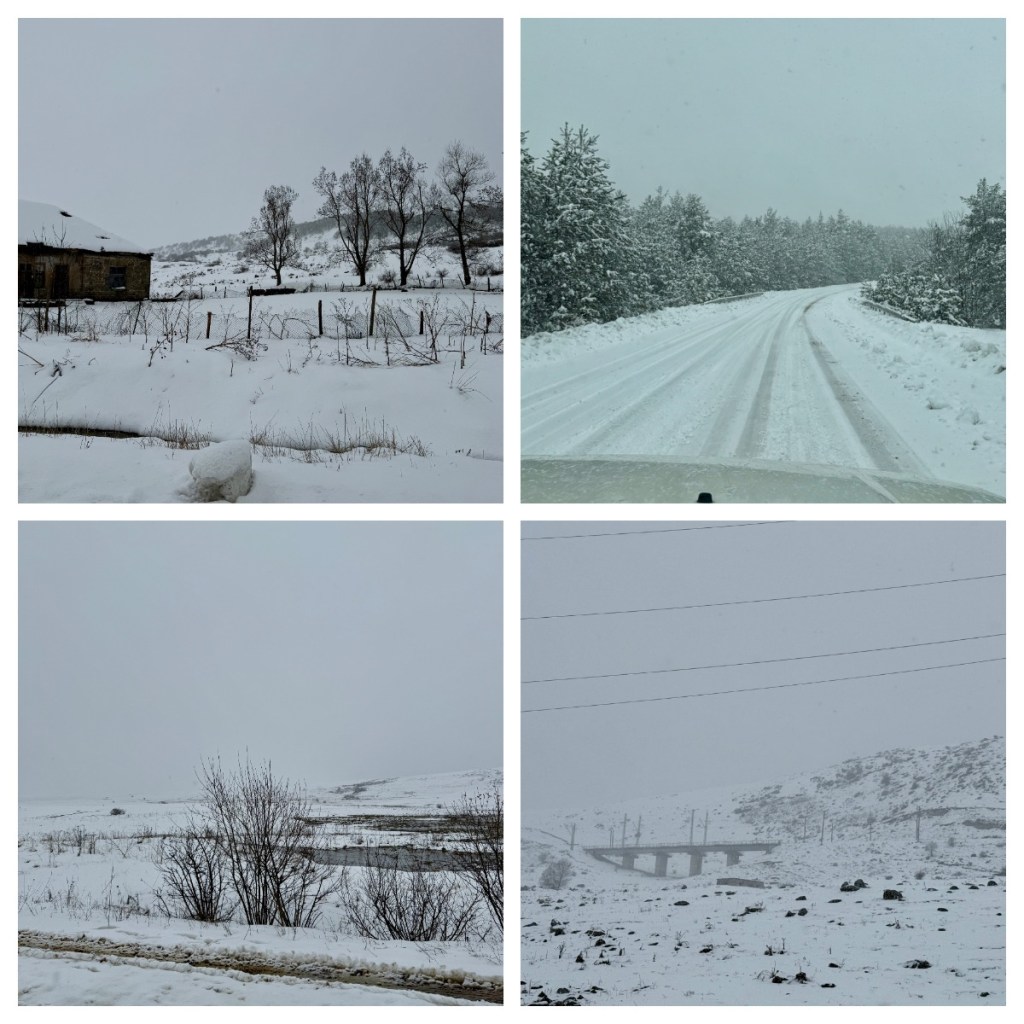
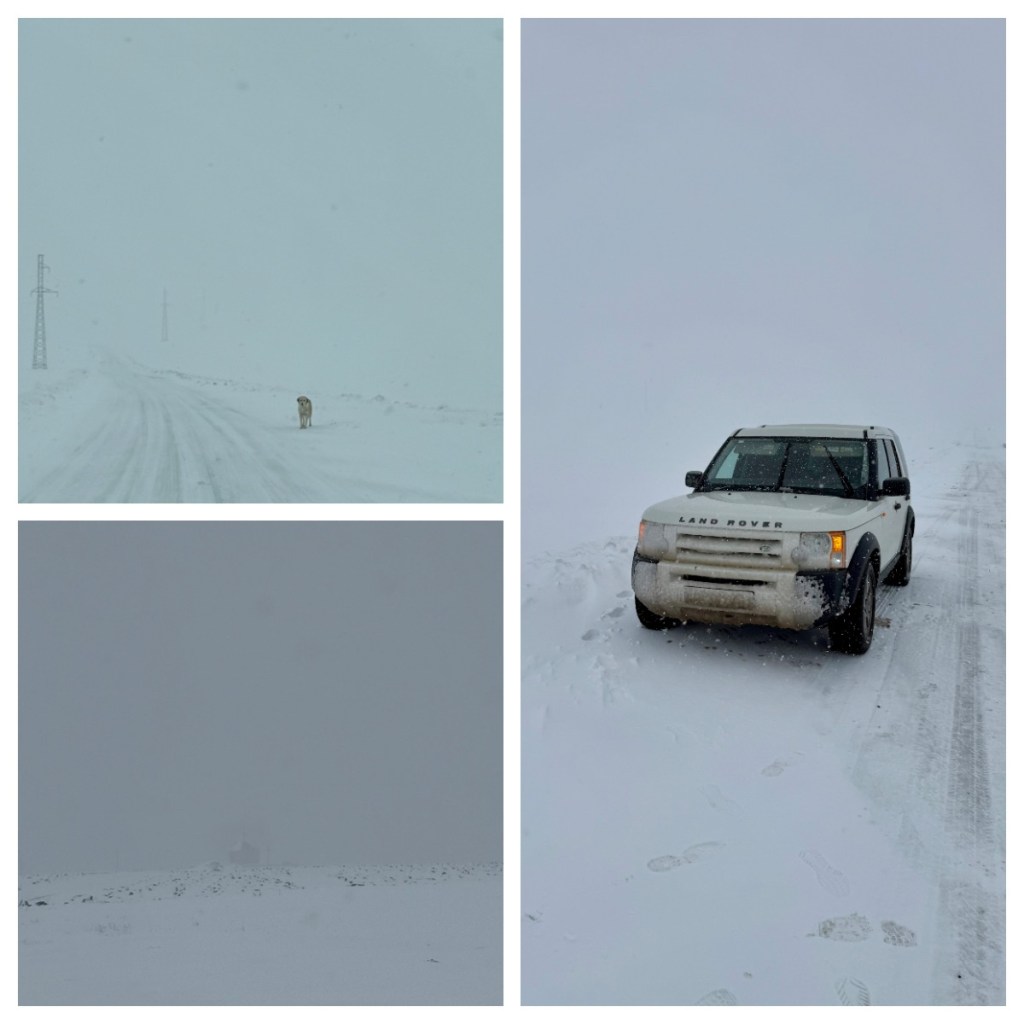
As we continued on, we got into almost a complete white out and the glare was insane! Who knew the first time I would need my sunglasses would be for the snow! We had now gone beyond the areas where the roads had been cleared and/or driven on by other cars and it was not always obvious where the road actually was!! Tazo was also very excited by the snow as in the winter they plough immediately so he doesn’t often see snow like this on the roads!
We were supposed to have a stop at Paravani Lake, Georgia’s largest lake which is apparently quite beautiful. Not only could we barely see the lake, but we could also not see the road that takes you down to the lake so a visit to the small chapel and wooden cross on the lake shore was not an option lol.
Today we learnt about Saint Nino, considered the “enlightener of Georgia”. Born in Cappadocia in around 296 to an Orthodox Christian family, and after studying the Holy Scriptures in Jerusalem, the Virgin Mary visited her during a dream. She gave her a cross made from vine branches and told her to spread Christianity across the region.
Saint Nino was joined by a number of other women her pilgrimage but they were captured by Tsar Trdat III who killed all the others. Nino managed to escape death and continued on to the shores of Paravani Lake to rest.
The lake and its surrounding landscapes left a profound impression on Nino, who found solace in its peace and beauty. She spent several days by the water, where the local inhabitants offered her food and shelter, allowing her to regain her strength before she set off for the capital city of Mtskheta where she was complete her mission of the conversion of the people from Zoroastrianism to Christianity. She is still one of the most revered Saints in the Georgian Orthodox Church and a grape vine cross is a symbol of Georgian Christianity.
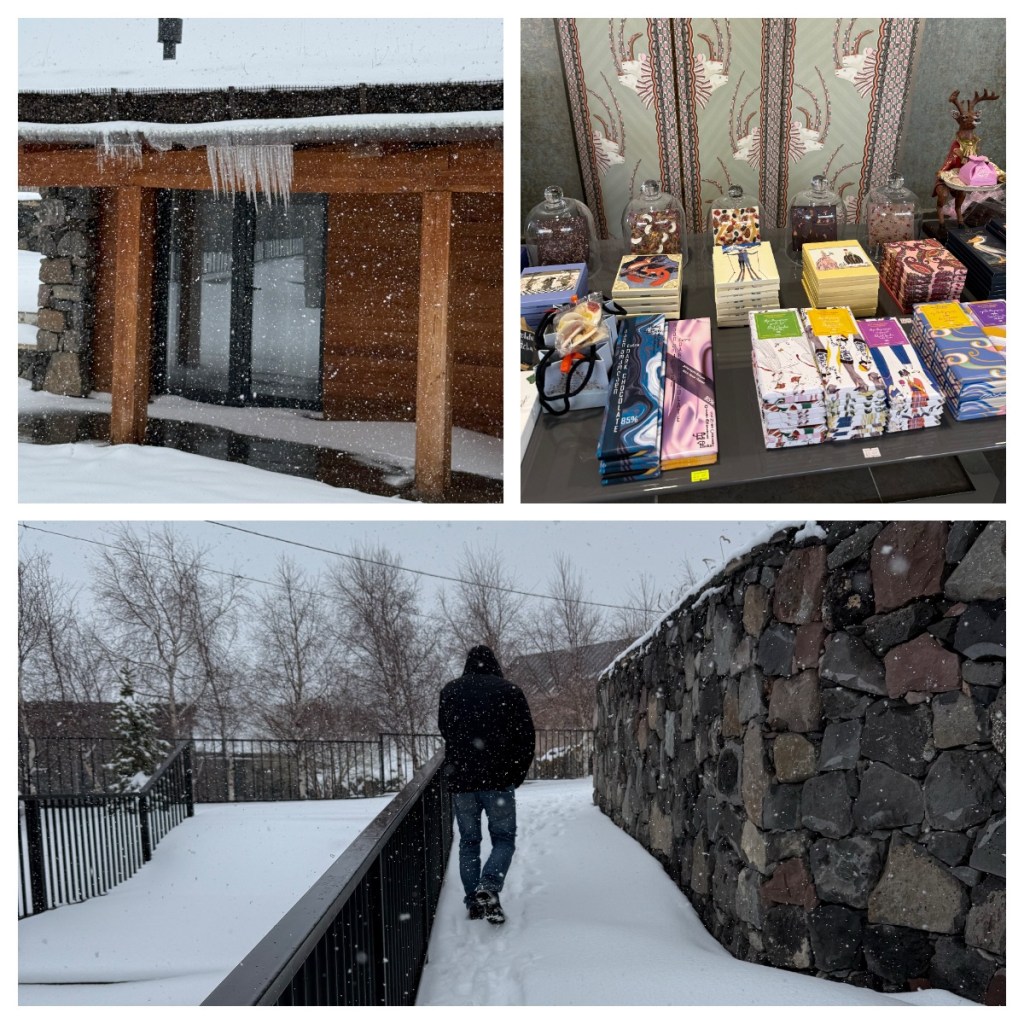
We continued on passed small, abandoned looking towns (apparently many only live here in the summer), until we reached the small village of Foka (I have also seen this written as Poka) and the St Nino Monastery. Tazo went ahead to drag the nuns out in the snow to open their shop and the church for us to look around, as we trudged through the snow (now about 15cm deep)! Again another moment I was grateful for my waterproof shoes but all in all I did not pack, and most definitely did not dress, for snow!
The shop was selling a huge range of hand made products, including chocolates, biscuits, jams, oils, cheese, hats, ceramics and jewellery and given that they had been forced to come out in the snow we felt obliged to buy a few bits (mainly chocolate lol).
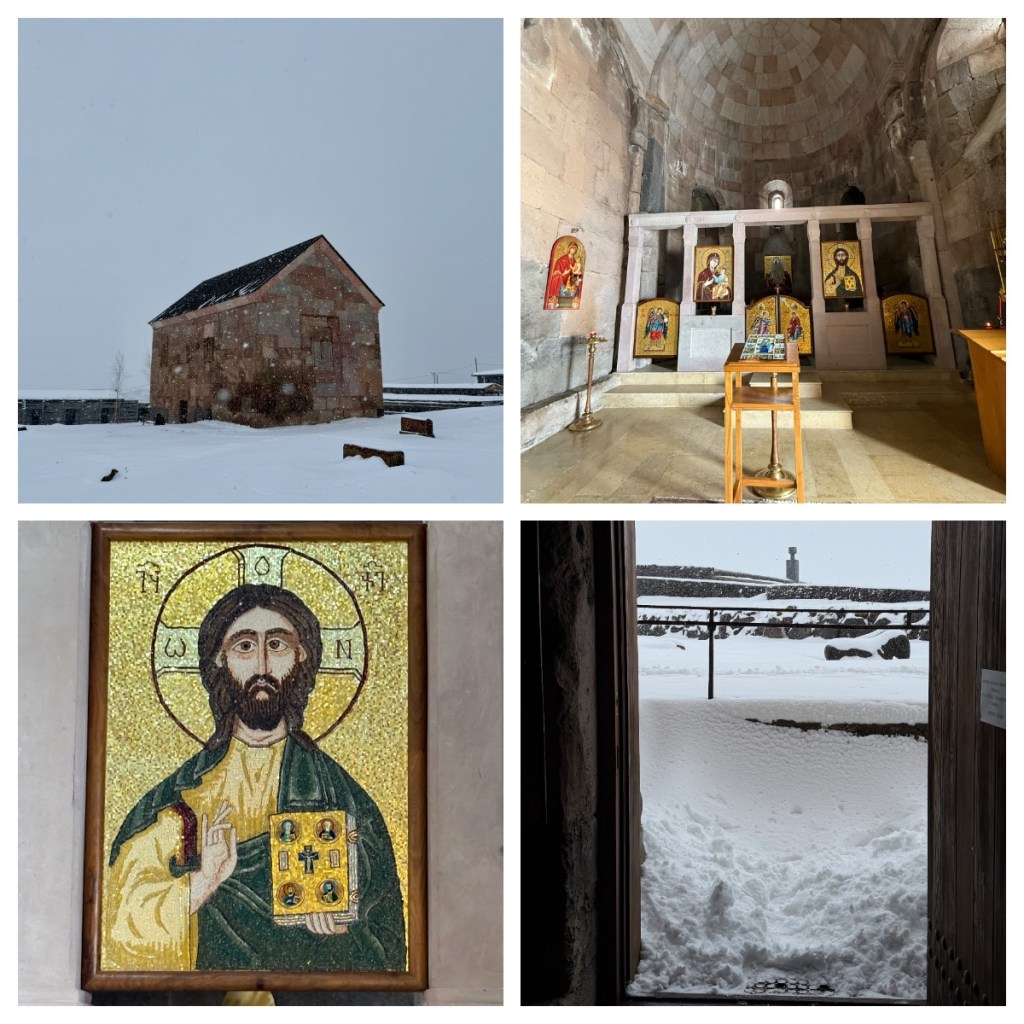
The Church here was built in the 11th century out of perfect cut square stone blocks and contains old carvings and fresco remnants as well as some beautiful icon imagery.

Back on the road through more deserted towns, we spotted whites storks nesting on the top of power poles. I bet they wish they had held off their migration and nest builing for a few more weeks as they did not appear to be particularly happy!
As we travelled down, we arrived back into the rain, but by the time we got down into the valley, we finally saw the sun! It was hard to imagine that less than 2 hours before we were in the snow.
After a quick photo stop at the 4th century Khertvisi Fortress (we will return for a visit a little later), we followed the Kura River (that runs through Tiblisi and also through Azerbaijan out to the Caspian sea) down the valley. During the stone age, most people lived near the rivers, hence the numbers of fortresses and watch towers in the valleys along the rivers. Even Alexander the Great apparently travelled down this valley on his march towards India.

One of the sites we were most excited to visit in Georgia was the Vardzia Caves, one of a number of cave complexes in Georgia. It is thought that the cave complex was built in a number of phases, starting in the second half of the 12th century, during the reign of King George III.
According to the legend, the King’s daughter, Tamara (who went on to become Queen Tamara) was playing in the caves as a child. She lost sight of her Uncle and called out “Ak var dzia” – “I am here uncle”. The words var dzia echoed around the complex (which was under construction) and were heard by the King who decided it should be named this way.
Before I move on, let’s take a moment to meet Queen Tamara, one of Georgia’s greatest medieval monarchs who ruled from 1184 to 1213 CE. She was the first female ruler of Georgia and was referred to as the “King of Kings and Queen of Queens”.
Her father, King George III had no sons and was concerned about losing his power so named his daughter Tamara co-ruler at 18 years old in 1178. By all accounts she was a badass who despite having to continually deal with resistance to her rule by clergy and noble men of the time, she went on to be responsible for Georgia’s greatest territorial expansion.

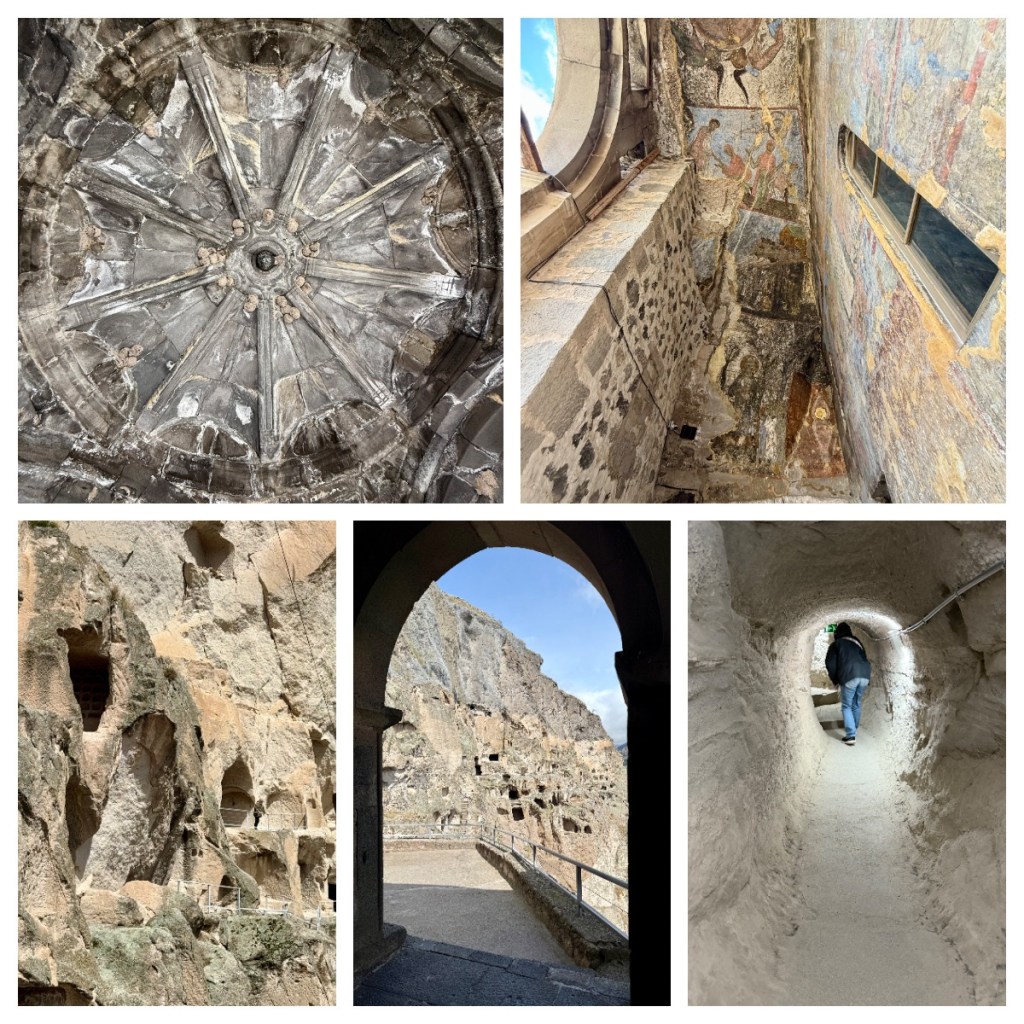
Back to Vardzia, the cave complex runs around 500m along the cliffs, is up to 19 tiers high and includes more than 250 rooms, 28 wine cellars and 3 churches. There is also defences and irrigation systems including aqueducts and reserviors. After sustaining heavy damage in an earthquake in 1283, it was partially rebuilt before being mostly abandoned after the Ottoman invasion in the 16th century.

We took the free shuttle bus up to the first level of the caves and then had time to explore some of the caves, up and down stairs, some more like ladders. I think we spent even more time admiring the beautiful views down the valleys and the blue skies which we had not seen for some time.
Back down at the car park we had some freshly squeezed pomegranate juice – it was very expensive (15 Gel or NZ$10 for a cup) and a little sour. I did enjoy it but would not rush to pay that price again. That said it was probably tourist prices being a tourist site! We also picked up some Georgian meat pies (I don’t seem to have made a note on the actual name) which were tasty and way better value than the juice!

We then head back up the value and stopped at Khertvisi Fortress. One of the oldest and well preserved fortresses in Georgia, it has sat on this hill since the 10-11th centuries overlooking what was the Silk Road. As with most fortresses in Georgia, there are many tunnels underneath – in this case they run down to the river to allow for water collection and also communications, not forgetting an escape route in times of siege.
Over the years as the town of Khertvisi was destroyed by Mongols, captured by Turks and then by the Russians, the fortress continued to dominate and its position as a military garrison was restored.
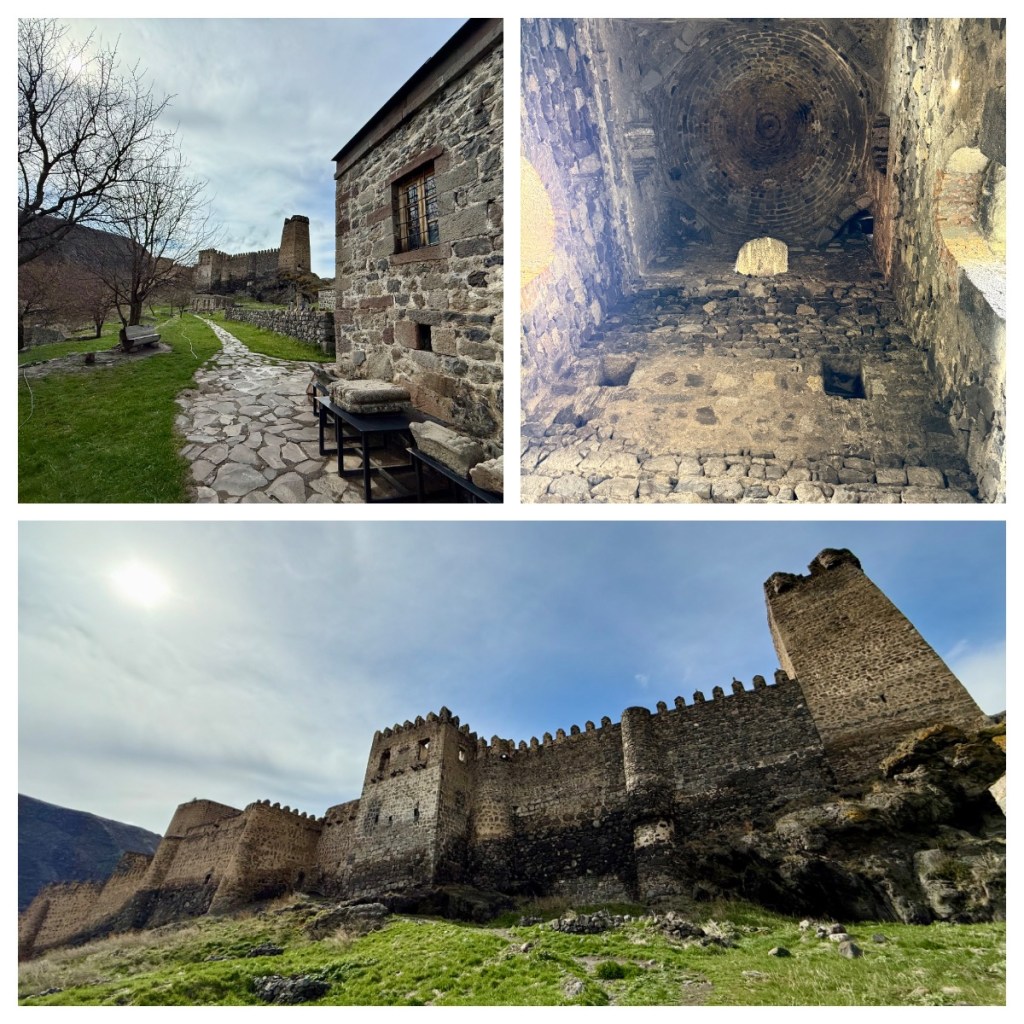
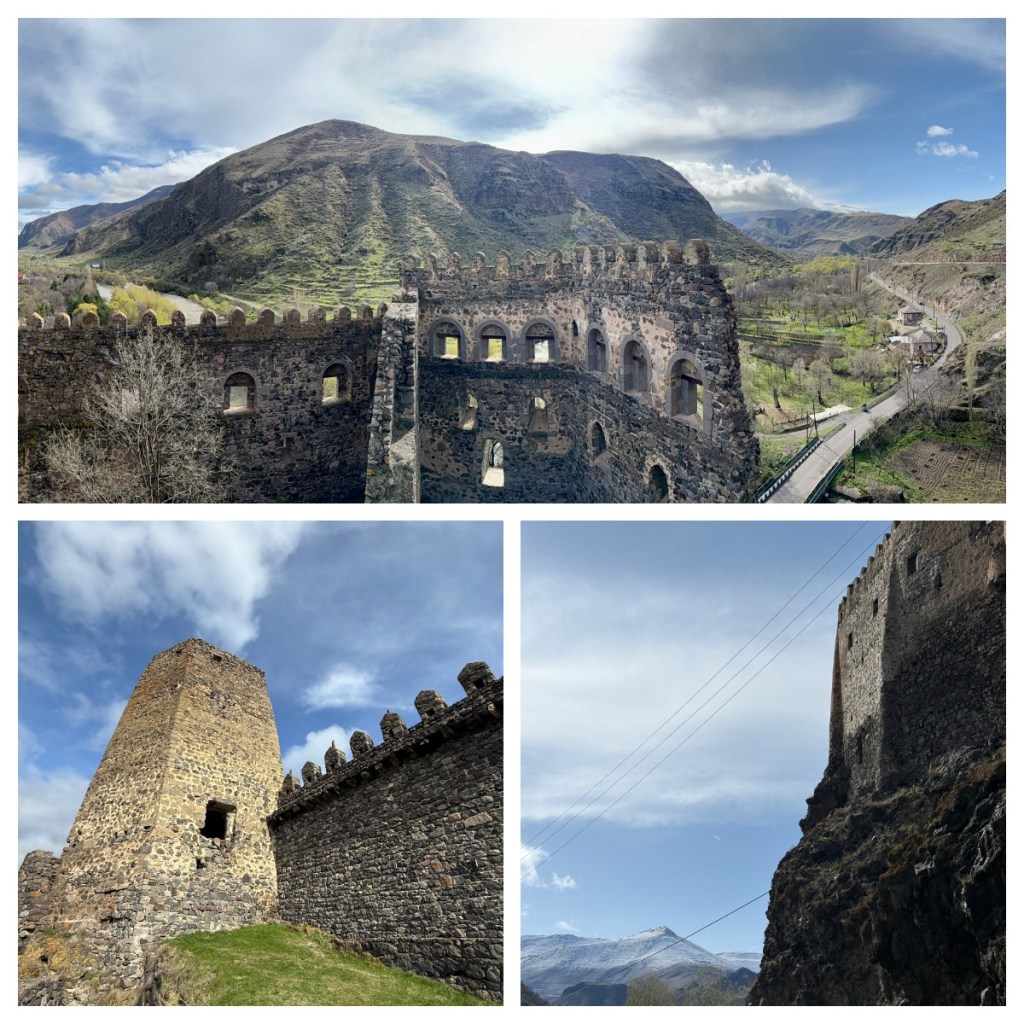
It was another full day and one full of surprises (mostly weather related lol) and we were exhausted by the time we arrived in Akhaltsikhe (our stop for the night). We could only muster the energy to pop to the local supermarket for some instant noddles for dinner before heading to bed!
 Cockneykiwi takes flight