

Republic of Azerbaijan
April 2025

Nobody seems to start early here, so our pick up was not scheduled until 9.30am. As I am still waking up at 5am, it gives me plenty of time to have a relaxed breakfast and do some writing before the day begins, which is not a bad thing.
We got back in the car (which smells like stale smoke – smoking is very common here) with dark tinted windows (again very common). In fact, yesterday we had asked if we could get a car without the tint as we couldn’t see anything out of the windows when we are driving. They ended up taking the tint off the windows and yet they are still not clear -at least we can now see something!
Our first stop for the day was the historical ethnographic reserve of Qala Village, an open air museum, featuring petroglyphs from the 2nd and 3rd millennia BC to the Middle Ages, remnants of ancient residential complexes (above ground – a Dolmen, and below ground – nomads shelter) and demonstration buildings. In the house there was a carpet making demonstration and an opportunity to give it a go. It apparently takes about a year to make a room size carpet using the local method (using a tool like a crochet hook) and I think I can safely say, I will never be a carpet maker.


Outside, under a 300 year old pistachio tree, there was a potter, demonstrating the use of the traditional potting well with the local clay and in the kitchen we were shown the art of baking lavash (an unleavened flatbread). The wedding house showed the traditional décor for the wedding night and finally the farm with camels, sheep and donkeys. They used the camels for wool and meat, but not milk.
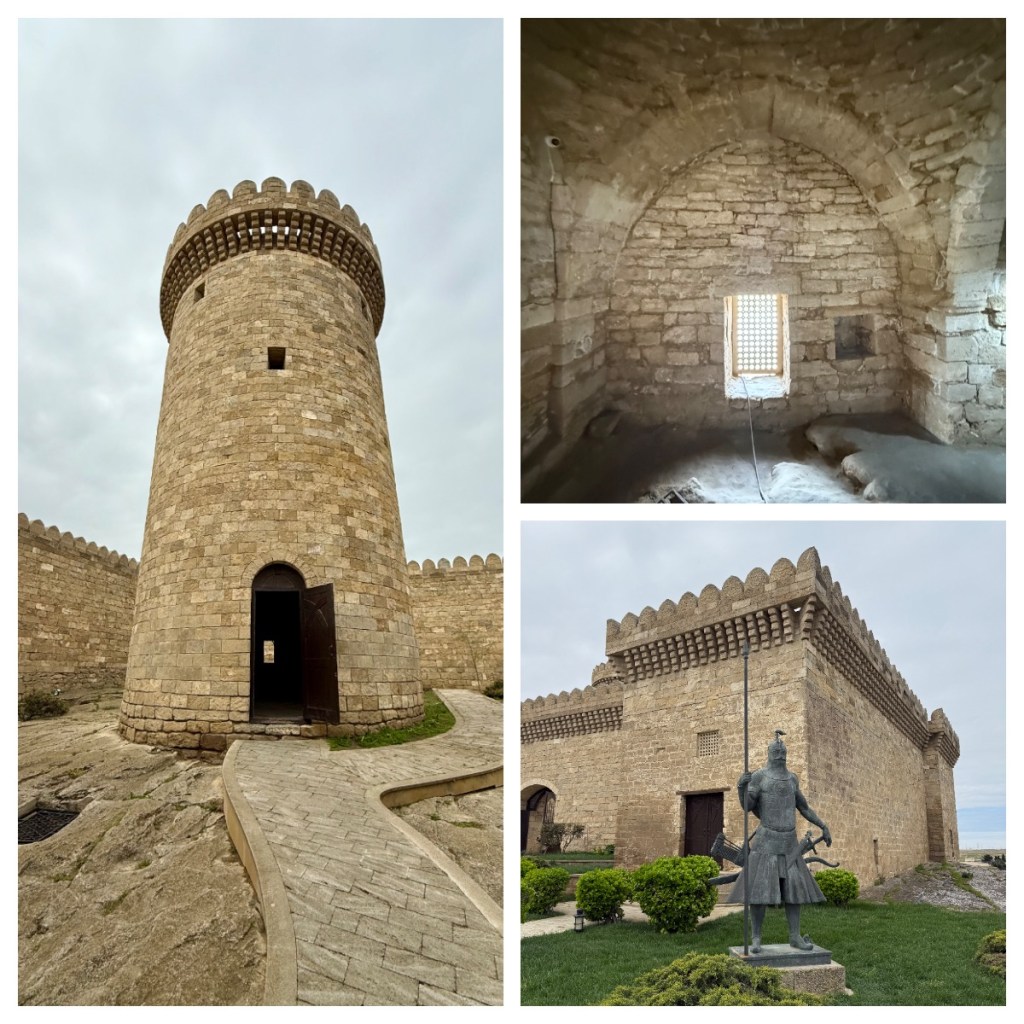
From the village, we headed over to the Fortress which dates back to between 10-14th century and includes a tower (for surveillance and defence) and a strong hold. Apparently, the foundations and tunnels are oringal and we were told that the tunnels go all the way to Baku but are not used today because there are too many snakes in there!

In another building in the same complex there was a random “Trash Museum”. As the name notes, it is a museum of displays made out of trash. Some were actually really good. My favourites being an octopus made from pencil shavings and a human figure made from typewriter keys.
Our next stop was the Temple of Ateshgah, also know as the “Fire Temple of Baku”. Although there has been a temple on this sight since the 10th century, the current temple was built in the 17th and 18th century. The temple was used as a Hindu, Sikh and Zoroastrian place of worship the complex consists of a courtyard surrounded by cells for monks and pilgrims to stay with their animals. In the centre is an altar with an eternal flame. Fire is an important symbol in the Zoroastrian religion, representing the light of God and purity.
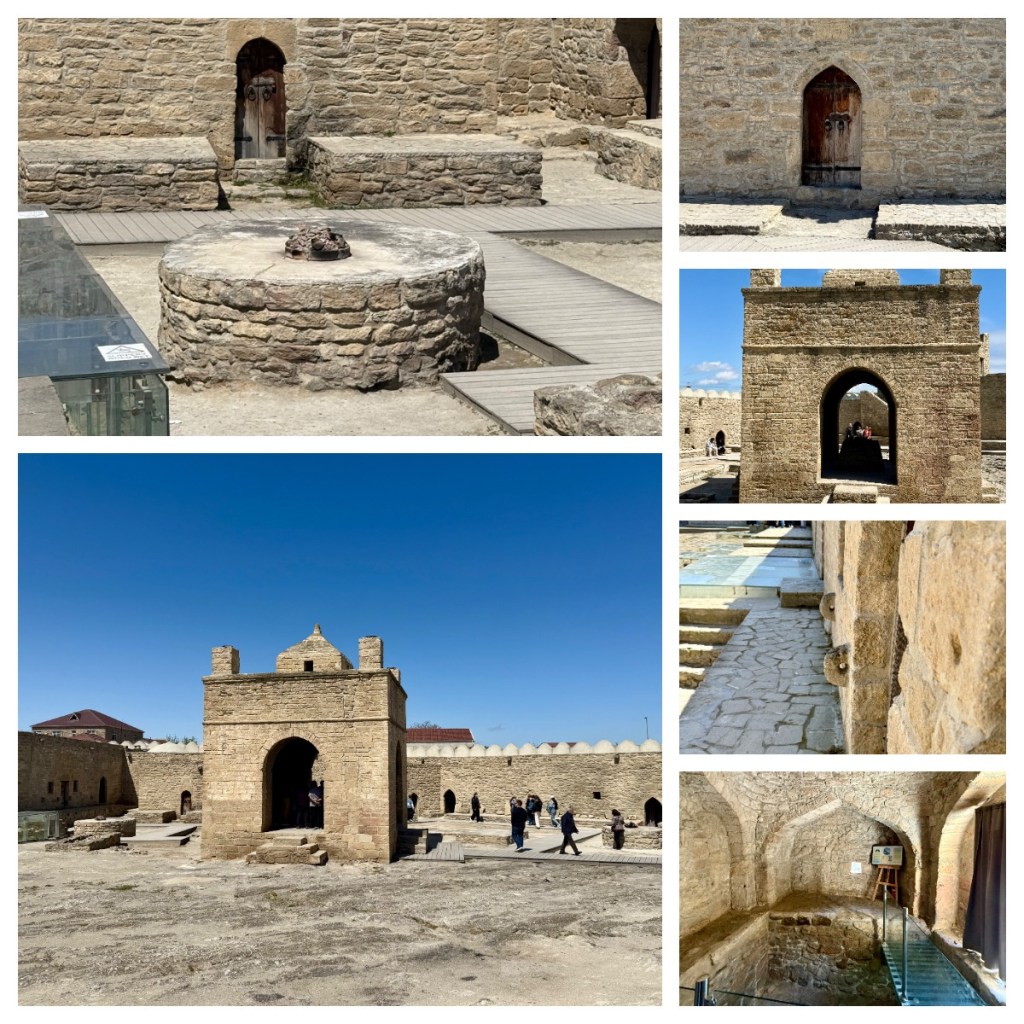
The temple was abandoned as a place of worship in the late 19th century and apparently the natural flame went out in 1969 so it is now lit by gas, piped from the city nearby.
It was interesting to see the back streets, small shops and people going about their day to day business as we drove to our next stop. In all the small towns, there are large posters of local men (mostly very young) who died in the 2020 war with Armenia. Many of them would have been doing their 12-18 months of military service and are now considered martyrs.
We also passed soooooooo many oil pumps on the side of the road. Did you know that at the beginning of the 20th century, Azerbaijan was the world’s leading petroleum provider, producing 11.4 million tons of oil in 1901, more than half of the world’s production at the time. Since that time, Azerbaijan’s place in the oil industry has declined, as other countries have increased and it is now about the 19th biggest producer of oil. That said, oil & gas still make up 95% of the country’s exports.

Apparently, all oil belongs to the Government. Even if you find it in your garden the Government take it and maybe your garden and your house as well. You will get some compensation though!🤨

As if just to show off, our next stop was Yanar Dag, the “burning mountain”, a natural gas fire that blazes continuously. Apparently it has been burning for thousands of years and it alledgedly was started by a lightning strike in the 7th century. Of course, it is a symbol of the country’s natural wealth but also considered by some to have healing powers.
It is decreasing every year so it is possible that it will stop burning at some point. It was no Darvaza Gas Crater in Turkmenistan, but still interesting and of course it has been burning for much longer.
To get to our next stop, we had to drive right back through the centre of the city and back into the terrible traffic and out the other side but it gave us an opportunity to stop for lunch. We had said that we wanted to have local food, and after an initial problem finding the place, and then working through what is local food on the vast menu (found by using QR codes on your phone) we had dolma (meat wrapped in vine leaves), Dusbere (a soup with little dumplings – in fact the smaller the dumplings the better, you should be able to fit 10 in one spoon), lamb kebab and a delicious Pear Lemonade.
Our post lunch drive took us out of the city along the coastline and through the incredible barren landscape (it is hard to picture that Baku used to look like this). We passed industrial areas including ship building and metal, glass and cement manufacturing. We also passed the abandoned building site of what was going to be Baku’s answer to the Dubai palms. Unfortunately the pandemic brought the construction to halt and it has never restarted.
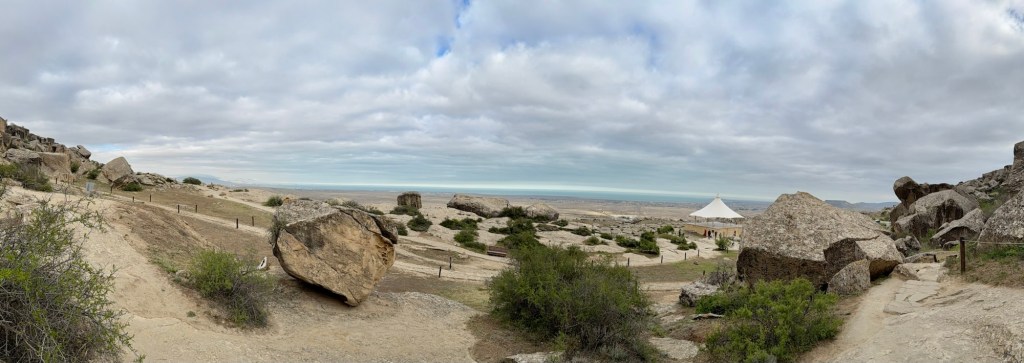
Our first desintation for the after was Gobustan, another UNESCO site, where a rocky plateau is home to a staggering 6,000 rock engravings, spanning over 40,000 years of human inhabitation. They were found in the 1930’s.


The landscape has changed over time. At one time the sea once covered the landscape and other times the area was rich with flora and fauna. The petroglyphs show life through out these years including images of boats (looking a little Viking like), hunting, animals, people, rituals etc.
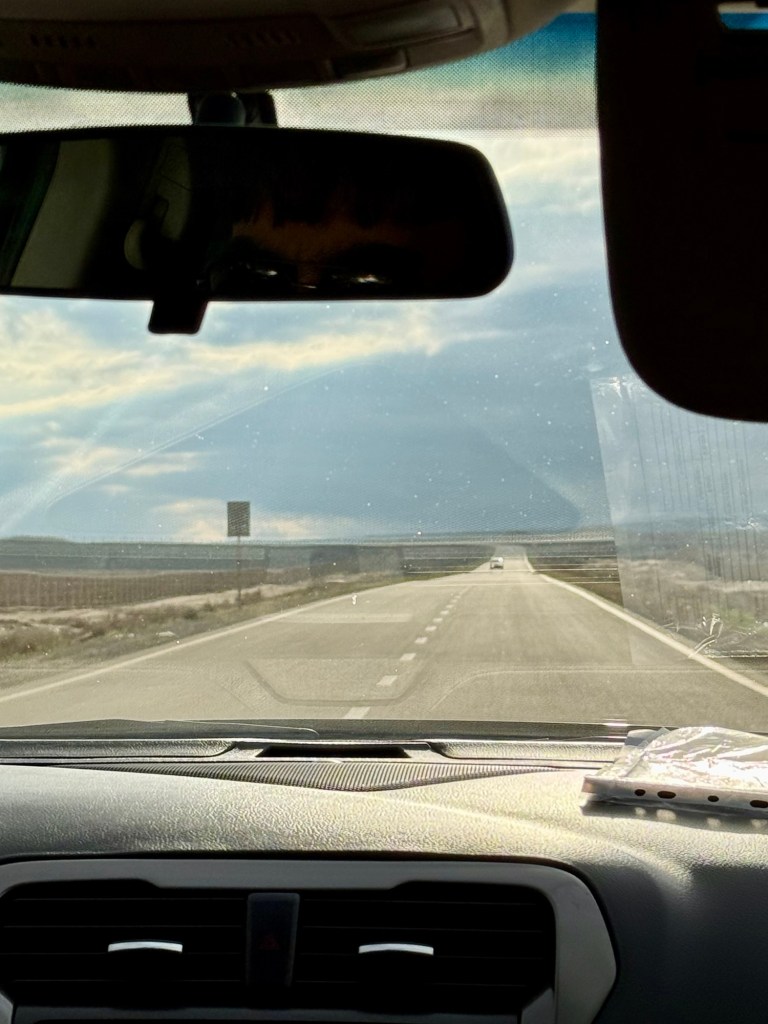
They were amazing, but unfortunately we only had a short time to spend in the great museum before we were back in the car driving further through the barren landscape (at 110 kph in a 60 zone 😬) to our final spot of the day, the Gobustan mud volcanos. I don’t think I had ever heard of mud volcanos. We have boiling mud from geothermic activity in New Zealand but these are completely different and Azerbaijan have the most of any country with over 350.
Mud volcanoes happen when pressurised mud, fluids, and gases erupt through the Earth’s surface and they normally happen where there are fault lines or, as in this case, a build up of gas and fluids under pressure.
Again, there was another great museum that we did not have time to look around properly before heading out to see the ‘volcanos’. I was surprised to learn that they are not necessarily hot and the bubbles are created by the methane gas. The landscape was amazing and they were so cool to see.

It was an incredible afternoon and it was already 6.30 before we started back to the city, over an hour’s drive away (we were supposed to be back at the hotel by 6pm). But, we ran out of petrol! Our Driver had to get a taxi to the petrol station for petrol 😂 . Thankfully there was one not too far away and it did not take him too long before he was back and he and the taxi driver put the petrol into the tank while enjoying a cigarette 🙄.
So, 30 minutes later, even with fuel, the car would not start – apparently he did not buy enough. Perhaps now is a good time to note just how cheap petrol is here – approximately $1.10 per litre to the $2.50 per litre in New Zealand! The driver had headed off again to get more petrol, this time returning in a taxi driving down the side of the road (on the wrong side of the road) 😂 we had to laugh, if we didn’t we might cry. Second time lucky and the car started and we finally reached our Baku hotel around 8.30pm! Another great day with another fun transport adventure.
 Cockneykiwi takes flight