
Armenia, April 2025
Before leaving Dilijan we took a quick look around, (after visiting a pharmacy for Ania to top up on drugs (I think she had a mission to visit a pharmacy in every country 😂) first passing a statue that plays homage to the Russian movie “Mimino”. Released in 1977, the movie is about friendships between Armenian, Russian and Georgian people. You can definitely tell which one is the Armenian one – with the prominent, Armenian nose!

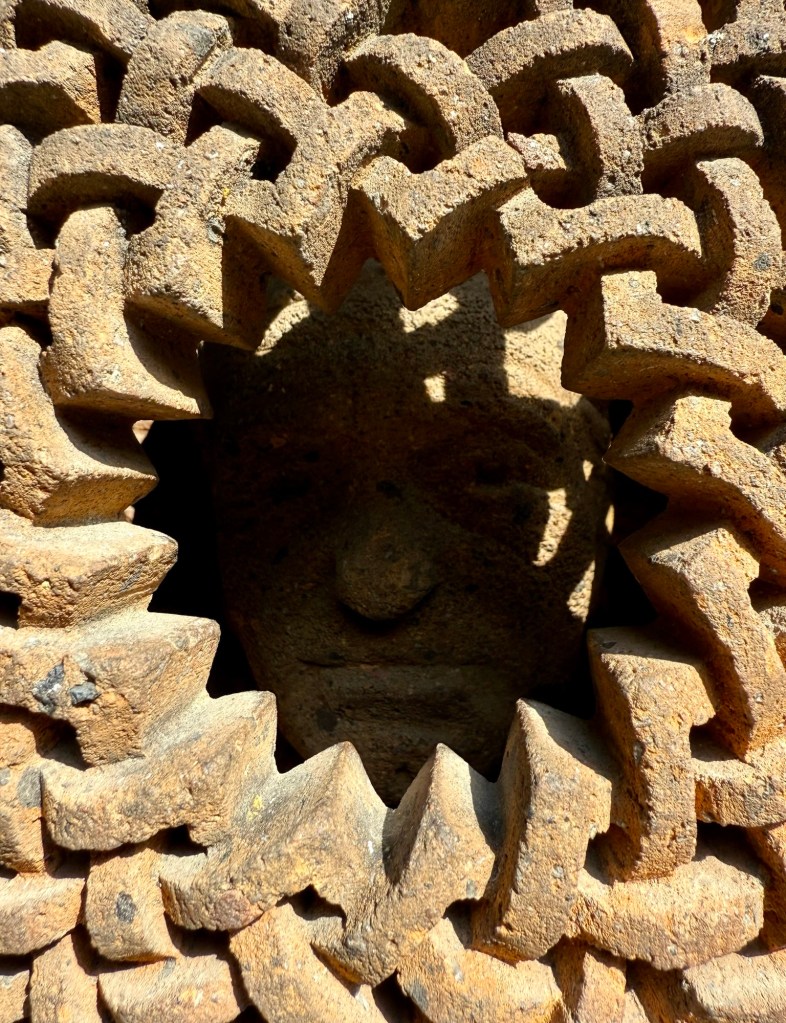
We then visited the quaint streets of the Old Town where the traditional Armenian houses have been refurbished and now house artesian workshops (ceramics, textiles etc.) and cafes. There is even a modern khachkar which, when you look in the central hole, you can see a hidden face of the person who commissioned it. Can you see it?

Back on the road and we stopped at a very nice road side shopping complex to try and change some money. Unfortunately the money exchange office was closed, but one of the workers in the supermarket where it was located said that they could change the money for us, so whilst we waited for them to return with our cash, we explored the rest of the shop where there were bakers cooking fresh lavish and other breads and a wonderful display of eastern style of sweets.
We went a bit crazy on those, spending way too much and now I had so many sweets to eat in the next 5 days!!
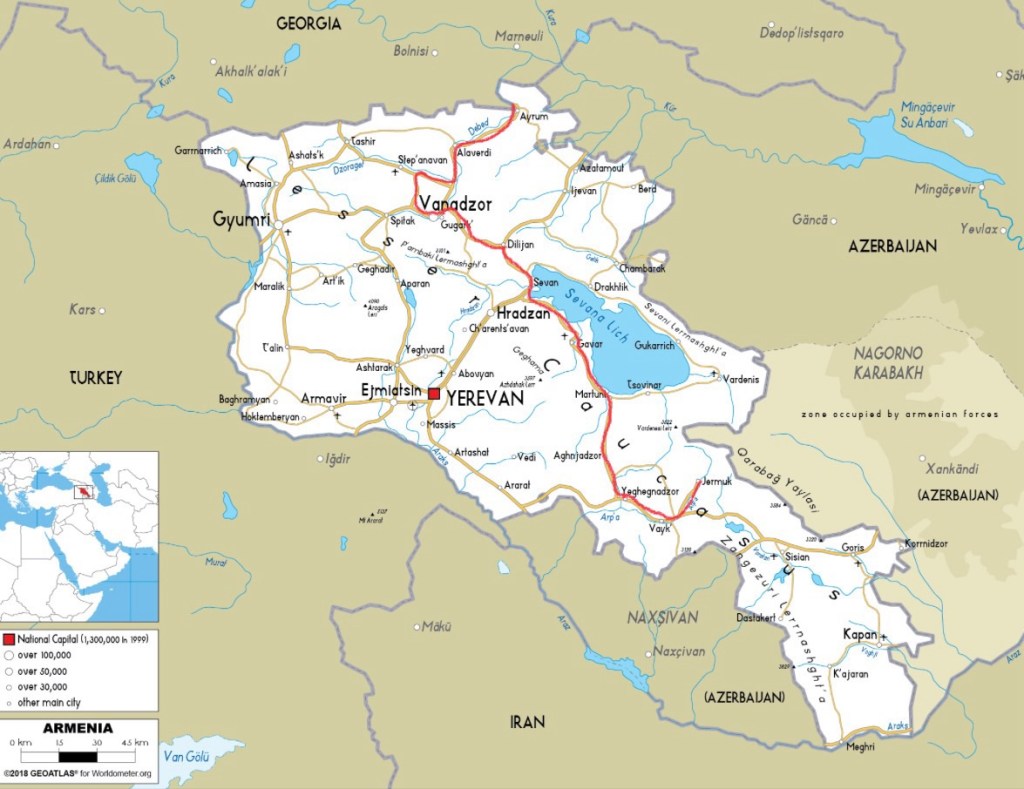
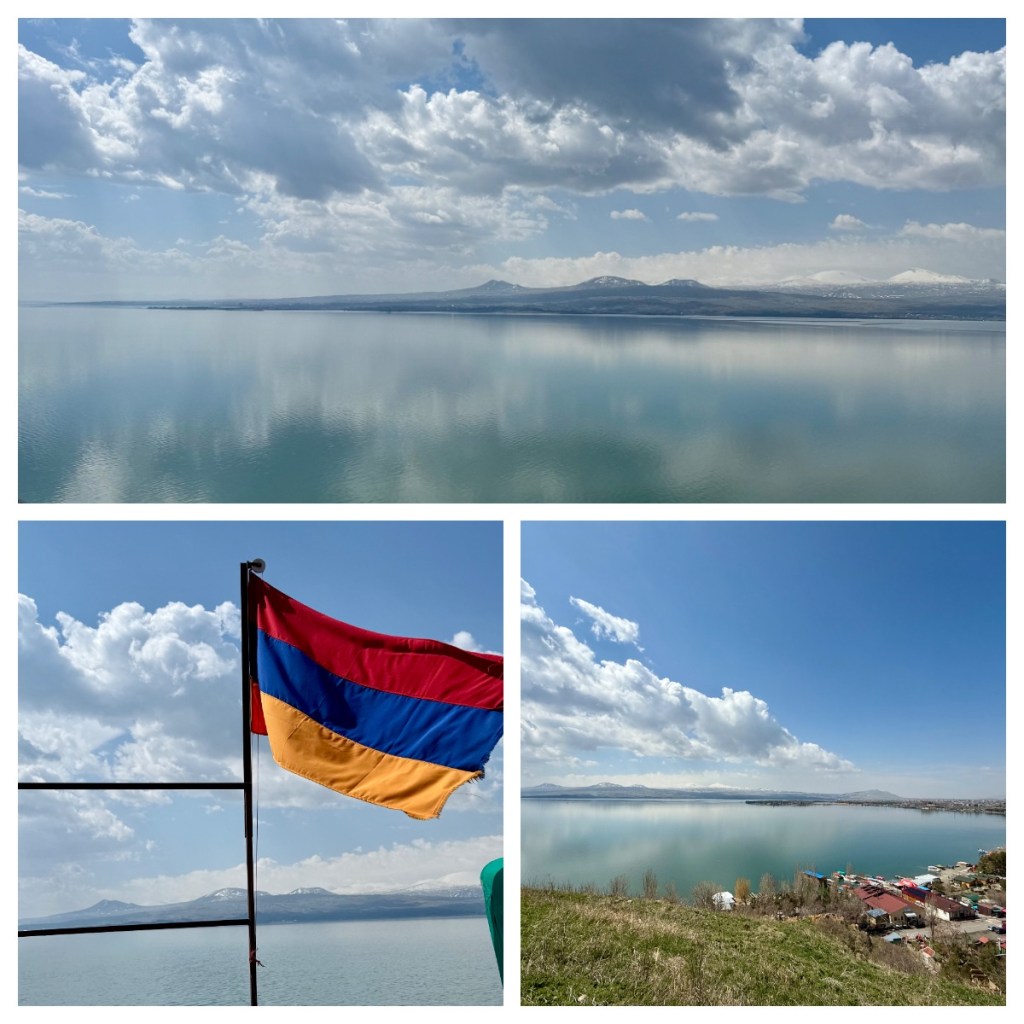
Armenian dram in hand, we were then on our way to Lake Sevan, a large, fresh water, high altitude lake, and the largest body of water in Armenia and the Caucasus region. It sits at 1,900m above sea level and is around 1,200 kmsq in size. It is fed by 28 mountain rivers which means it is cold all year round, but apparently people do still swim in it in the summer.
The lake has significant importance to the country as a site for fishing (90% of the Armenian fisheries comes from here), tourism, irrigation and hydro power. The later two heavily exploited the water, mainly during the Soviet era, and our destination, Sevan Monastery was once on an island, but is now on a peninsula due to the drop in water levels. Today, the water level is rising again and some structures and forests are already half underwater.
Legend has it, the first church at the Sevan Monastery or Sevanavank was built by Gregory the Illuminate in 305, on top of the ruins of a pagan temple. Gregory the Illuminator (C 257 – 331) was the founder and the first official head of the Armenian Apostolic Church and is responsible for the convertion of the population from Zoroastrianism to Christianity in the 4th century. Some say as early as 301, making them the first country to adopt Christianity as its official religion (earlier than the Georgians that is lol). We meet Gregory, his story, or one of his churches most days so I will save more of his story for later. Just note he is the original Christian!!!
The monastery on the site was founded in 874 by Princess Mariam, the daughter of Ashot I (who later became King) and the site was soon expanded to include a school and a library.


This site has the 2nd of the 4 Khachckars with an image of Christ. Dating back to the 13th century, this cross stone depicts not only Christ, but he is holding the hands of Adam and Eve, and fighting a dragon! Or so we were told.
The earliest buildings were destroyed by earthquakes and invasions (the Mongol and Timurid invasions) and today, Armenian churches are built for stability (and hopefully survive earthquakes) and function, rather than beauty.
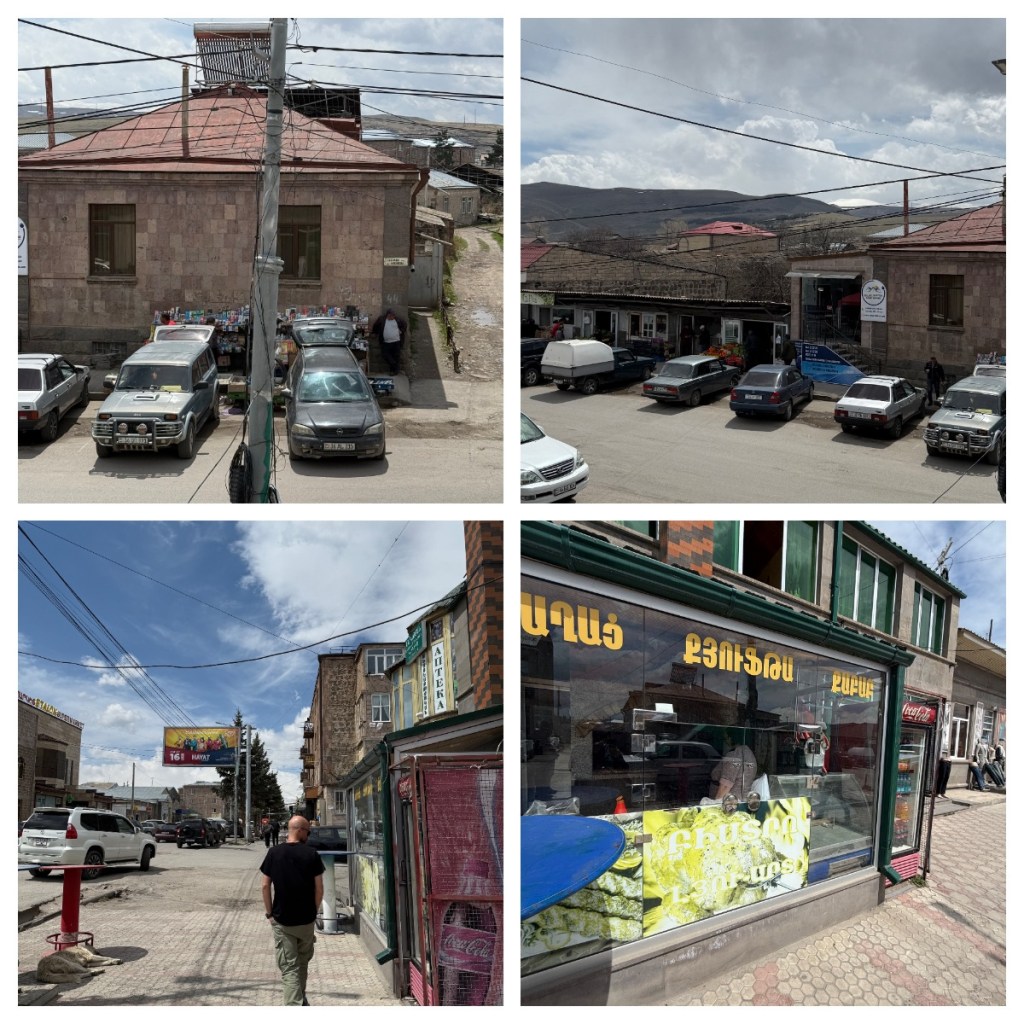
Our next stop was in a small town called Martinu where we had lunch in what was a very random kebah shop. They sent us upstairs to wait, but it was more like being in their house than in a resturant – in fact I think we probably were in their house . It was interesting to see everyone going about their lives in the small town, though it was very dusty as there was a lot of road works going on.
This time I had pork bbq in the lavish bread. The meat was really tasty but there was way too much bread! There were a lot of friendly stray dogs again, and clearly they are well fed as they turned their noses up at the bread, they were only hanging around for the meat!
It was hard to believe we were already at 2000m above sea level as we were on a plateau with mountains above us, and we continued to climb to 2000m as we drove. Most of the snow has now gone but it is clear they had a significant dump around the same time we were travelling through the snow in Georgia.
Generally, the road conditions have not been too bad, but this mountain pass went from good to bad (full of potholes) to really bad (virtual no road at all) and this is a major route through the country, not some back route we had taken. Levon said that you need to have bad roads to appreciate the good ones! What a nice way to look at it.

At the top of Vardenyats Pass we stopped to visit the 14th century Orbelian caravanserai, one of the most significant historical landmarks in Armenia. It was an important stop on the silk road and for travellers through the Mongol Empire. Although it did have some restoration in the 1950s, it is in much more of its original state than many caravanserai’s I have seen.
It was very dark inside lit only by small openings in the ceiling, with piles of snow on the ground (that had come through said small openings in the ceiling), and not surprisingly it was cold! It was clear to see where the people and animals would rest in the large hall but it can not have been comfortable!


The views from the site were beautiful, but what really made this visit was the old caretaker of the site and his wife, who were parked up nearby, selling treasures from their Lada. They had alcohol, jams, honey, fridge magnets, knives, jewellery – most of which were handmade. Of course, they insisted that we try everything but would not take any money for it so I pulled out a fridge magnet to give them but this resulted in them giving me a New Zealand fridge magnet in return! I am not sure how they would ever make any money but they certainly made our visit.
As we continued on through the mountain pass there were a lot of people parked up by the side of the road collecting herbs that they would then sell on the side of the road somewhere, normally out the back of a Lada!
We also passed something I had never seen or heard of before – anti-hail stations. Apparently, hail is a big problem for farmers, regularly damaging crops (sometimes leading to total loss of a season) so dotted around the country side are Zenith Hail Busters. These hail suppression systems can identify potential hail bearing clouds and automatically send a high powered, vertically propagating shock waves in to the atmosphere that impact the structure of the clouds reducing the likelihood of hail.
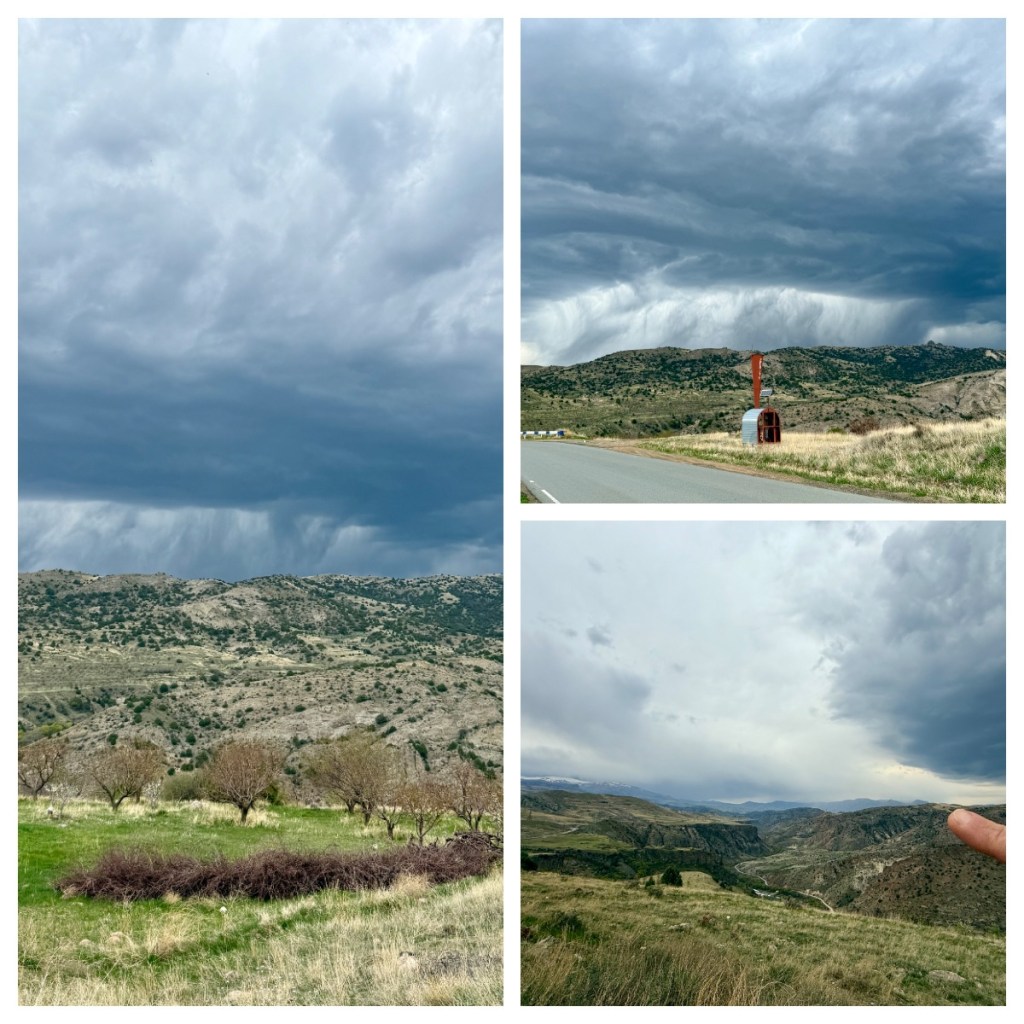

Coincidently, as we drove passed one of the Hail Busters, we looked back to see an incredible storm forming over the mountains behind us – amazing clouds, thunder and lightning. It was so impressive we had to stop for some photos. Levon was so keen for a photo he pulled over, left the car running and ran off down the road to get the best view. This was the first of his attempts to run away from us and this became a bit of a ‘running’ joke lol. (As was getting his finger in our photos lol.)
It was spectacular driving through the amazing mountain gorges and through the small farming communities which looked like they have not changes since the Soviet era and the rain finally caught up with us just as we arrived in Jermuk, where we were to spend the night. We did have to brave the rain to see the Jermuk waterfall, apparently one of the highest in Armenia (at 70m high). I must admit the waterfall itself was slightly underwhelming but there is an interesting legend behind the local name “Mermaids Hair”.

There was a princess who loved a son of a shepherd and to meet him (which she had to do in secret) she would throw a rope down the river gorge for him to climb up. When her father found out, he cursed her and said if she ever met him again she would be turned into a mermaid and never be able to leave the water. She defied her father, began a mermaid and her hair now flows down the gorge!
As we drove in to Jermuk, it appeared somewhat post-apocalyptic, with lots of abandoned buildings (mostly Soviet era) and the view from my hotel room was of a lovely little lake and massive abandoned Soviet music hall!
Being cold and wet we did not want to go far for dinner so ended up in the hotel restaurant. The menu was HUGE, but Levon recommended Harisa, a traditional dish that was like a chicken and wheat porridge. Thankfully it tasted much better than it sounds and looked! We also could not go wrong with a local khachapuri with beef and cheese – they are more like pizzas here but still delicious.

 Cockneykiwi takes flight