Goodbye Azerbaijan, hello Georgia

Azerbaijan & Georgia

April 2025

I was woken early by the Muslim call to prayer and to a misty morning. As I had now discovered the importance of the buildings just across the road from the hotel, I headed out for a quick walk and in search of coffee.

There are two caravanserais on the main road in old Sheki, the upper and the lower which both date back to the 18th-19th centuries.  They were built as fortified structures with just one gate, so they can be protected more easily. 

The Upper one is a tourist site, of course it was closed at 7.30am but I did manage to sneak in a small door (inset in to the big door) to have a quick look at the first courtyard.  As in time gone by, there are a lot of shops along the the outside and we had walked along them the night before.  Today they are mostly souvenirs and also some Halva shops, making a traditional local Halva (a sweet made from sesame paste and honey).
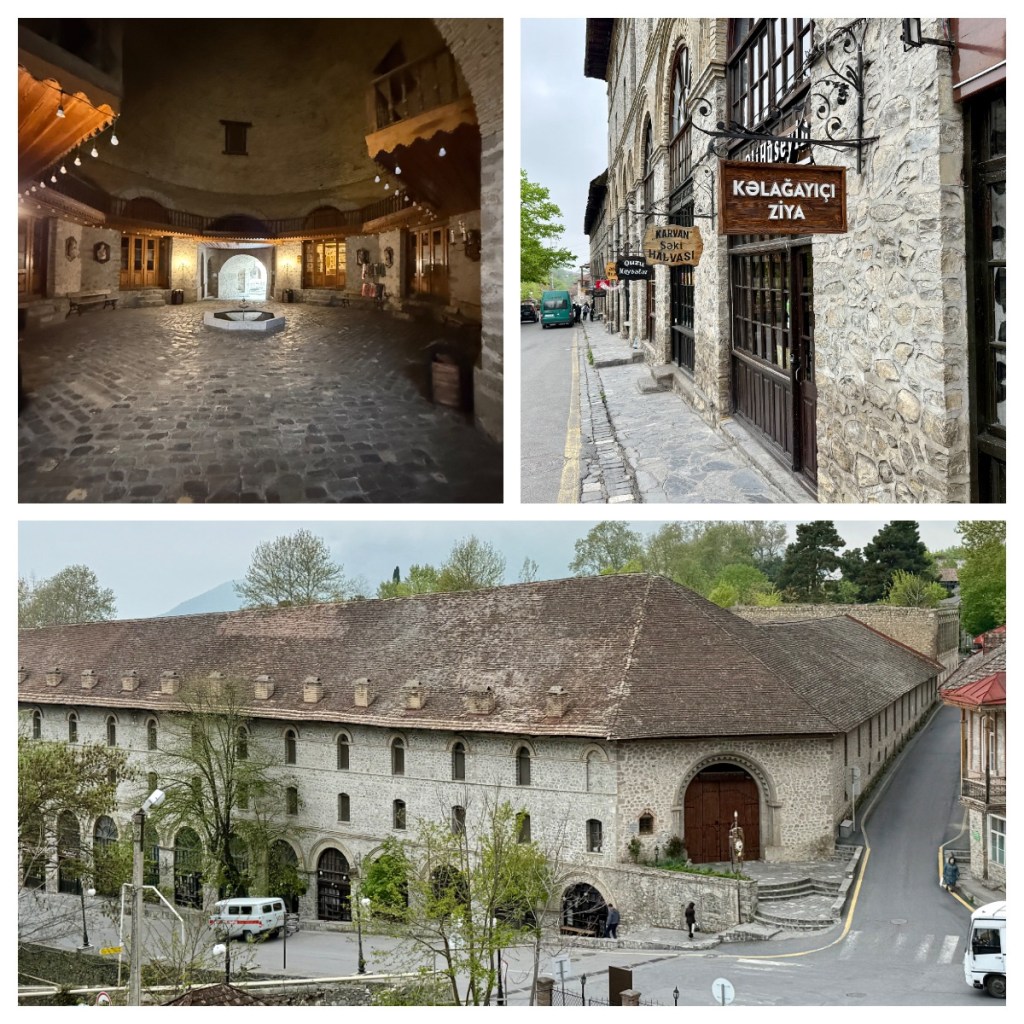
 

The Lower caravanserai is a hotel today, but more importantly for me (that sounds like a terrible thing to say 🤓), there was a lovely coffee shop just across the road … and it was open!  I enjoyed a coffee and watched the local Ladas go by – they definitely rule supreme in this part of the country and I love it.

As we headed towards the border, we passed yet another Albania church on a hill side – I should note that the Albanian churches I see on this trip are not related to the Albania of today, but of the ancient Caucasus Albania which sat in the south eastern part of the Greater Caucasus mountains (most of which sits in modern day Azerbaijan.  The mountain landscapes were filled with wild braided rivers, shepherds grazing their sheep and as we neared the border, trucks, lots of trucks.

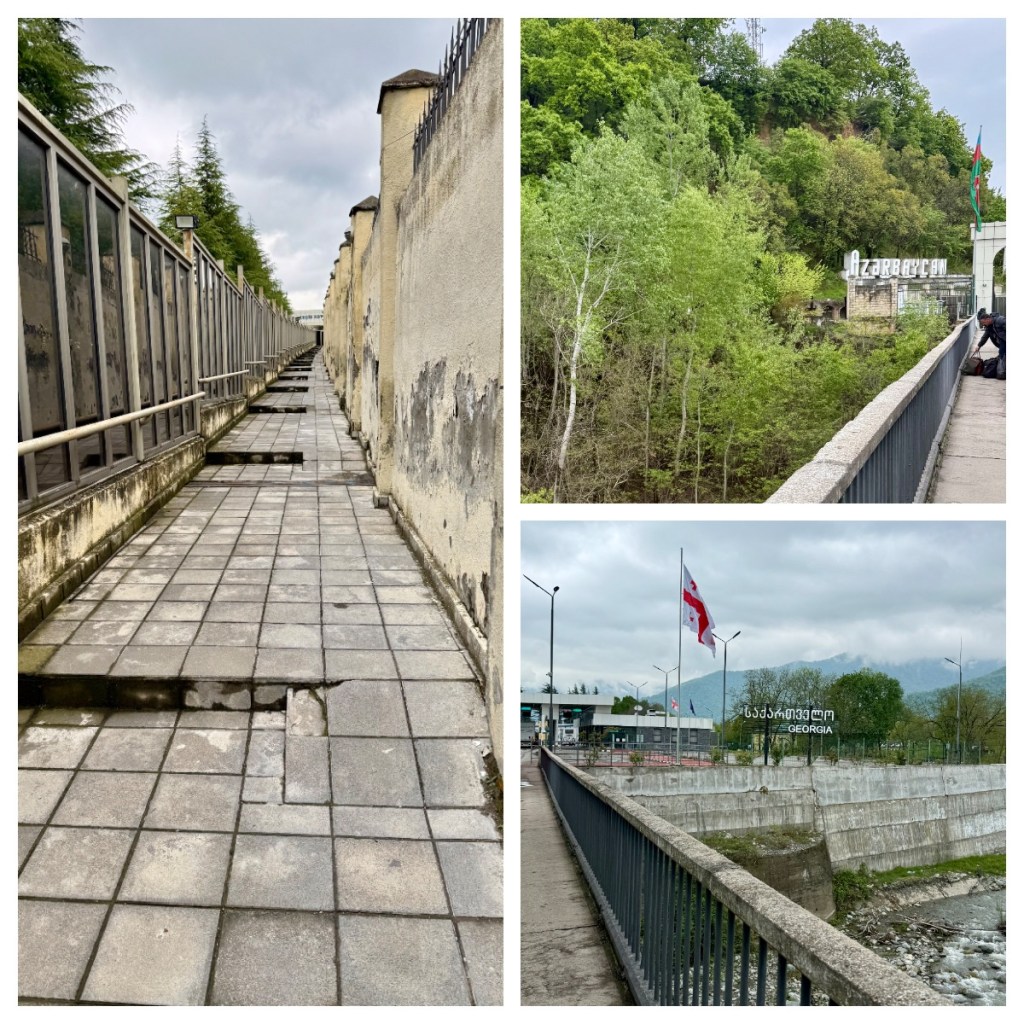
We said our goodbyes to Rugiya (our Azerbaijani guide) and our driver and walked to the border crossing.  It took around 45 minutes to depart Azerbaijan (only because we got caught behind a tour bus) and then walked the short distance across no mans land and into Georgia.  The Immigration guy was so excited to see a New Zealand passport – his exact comment was “I did not expect this today” lol.


We found our Georgian guide, Tazo and hit the road on the next leg of our Caucasus’s tour. Let’s be clear, we are talking about Georgia the country, and NOT the state in American as many first assume!

The currency here is the Georgian Lari (GEL), NZ$1 = GEL1.6.

First, I little context. Georgia spans Eastern Europe and West Asia, bordering Russian, Turkey, Armenia and Azerbaijan.  It is a small country (only 69,000 km2 – compared to New Zealand’s 263,000 km2) with a population of around 3.7 million, 2 million of which live in the capital, Tbilisi.
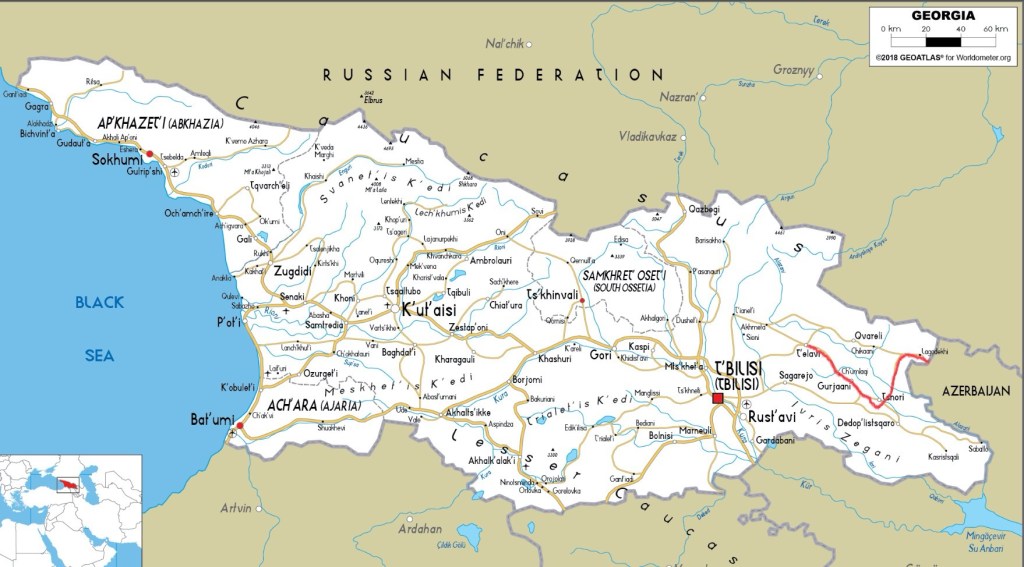
As with most countries in this region, its history is complex and somewhat turbulent and even today, the geopolitics of the region continues to cause issues.  After adopting Christianity in the 4th centre, the Kingdom of Georgia remained strong until the 15th century when they succeeded to the Mongols, the Ottoman empire and Persia, before becoming part of the Russian Empire in 1801. 

After the fall of the Russian Empire, they had a couple of years as an independent republic before, once again, being invaded by the Red Army and becoming part of the USSR until 1991.  It was not until 2003 that they gained political stability and aligning themselves with the EU.   I will touch further on parts of this as we travel around and learn more.

The weather was less than ideal, but it was better than the forecast for the following day, so Tazo recommended that we visit the hilltop town of Sighnaghi today rather than tomorrow. A small town in the Kakheti region, Sighnaghi was built in the 18th century as a fortress but today it is referred to as Georgia’s “City of Love” (though I am not sure I know why)!

We drove up into the cloud to the town and we did have to imagine the charm of the town, and of course the view – which apparently is beautiful and our imagination continued as we wandered down through the cobble stone streets to our lunch stop.    

In just a few short hours, we were already impressed with Tazo and he ordered a great array of delicious Georgian food for our first meal.  It seems that walnuts, cheese and bread play an important part of Georgian meals and this meal incorporated all of the above – eggplant stuffed with walnut paste, khachapuri (a few different varieties but the basic one is bread with cheese), tomato salad, BBQ pork and Khinkali (broth and meat filled dumplings). 

All were delicious and I washed it down with my first glass of Georgian wine.   (I will warn you now, food photography is not my thing – most of time we would be half way through eating before we remembered to take the photos 😂.)

In just a few short hours we had already learnt some important information about Georgia and her people:

  • Georgian’s like food with flavour, and “food without salt is not food” lol.
  • Georgia is the home of wine making (more about that another day) and it is important for Georgian people.  Without wine, nothing happens and almost everyone makes their own.
  • Georgia’s main exports are copper and other minerals/ore.
  • The Georgian alphabet is unique and in fact, there are 3 versions of it.  One is widely used, the other two are predominately for religious texts and inscriptions. 
  • I was the first Kiwi guest that Tazo had had

The cloud lifted briefly to allow a quick and hazy view of the valley below, with the green pastures and fish farms (which seem a little random to me in the middle of fields lol).  Apparently there are also lots of minerals in the soil here which are great for grapes. 

While Tazo ran back up the hill to get the car, we took a short walk along part of the 4 km defensive wall to a watch tower flying a very tatty Georgian flag in one of the 28 watch towers along its length.  Again, we had to use our imagination on the view!


I have to admit, I was in a bit of a food coma on the next part of the drive but we had lots of good chat with Tazo on the journey to Telavi, the main administrative centre of the Kakheti region and our stop for the night. 

Dinner was not required but we bit have a snack and some homemade Green wine (they use the grape skins during fermentation) to finish of the day. 

But, before I finish this blog, I thought I would touch on the country’s name of Georgia and the infamous St George.  Georgians actually call the country Sakartvelo, and although it is not entirely clear where the English name of Georgia came from, there are a number of theories mostly based around St George.

St George, an early Christian martyr, was born in Cappadocia in the second half of the 3rd century. He is the patron saint of the country (and many others), a large number of churches in the country are built in his name, George (or Giorgi) is one of the most common male names and the country’s flag features his red cross on a white background!  What more do you need to convince you of is importance to the country and its people and perhaps the English name.

When he started fighting dragons, and became the patron saint of England is another story entirely lol.
 

The Wild West (& West End)

Galway, Ireland & London, England

Dec 2023/January 2024

After a full Irish breakfast (pretty similar to a full English breakfast but perhaps with Irish Soda bread) I met up with my friend Suzanne to drive from Dublin in the east to Galway in the west – a nice 3 hour drive through the countryside.

Galway grew up around a fortification built in 1124, today, despite being the 4th largest city in the Republic of Ireland, Galway only has a population of around 86,000. It is a very popular tourist destination due to its strong artistic and musical traditions, its lively atmosphere, great food and nearby dramatic landscapes.   

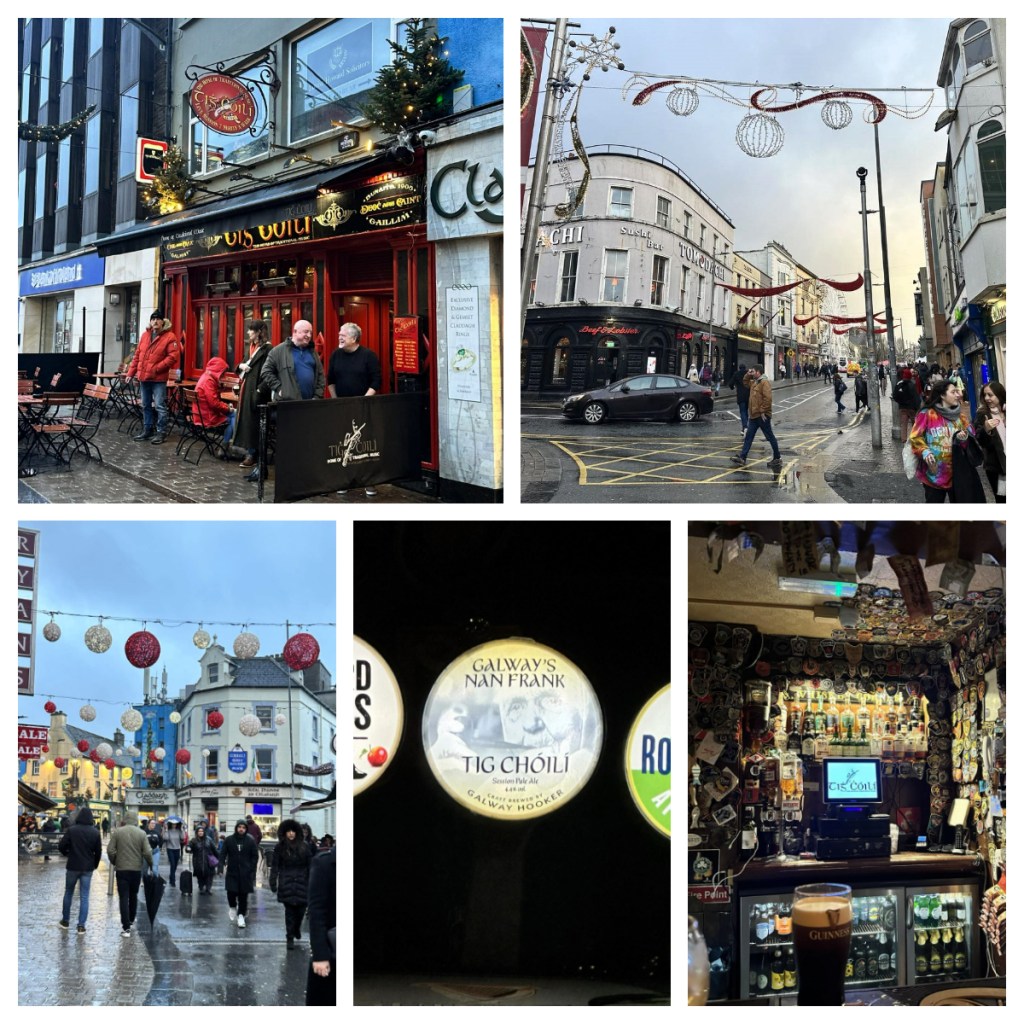
By the time we had arrived it was already midafternoon, so after checking to our hotel we headed out for something to eat.  There was a small Christmas fair in the central square and lots of beautiful Christmas lights around small old town and the light rain was not going to put us off exploring – in fact it was a great excuse to check out Tig Choili.  Touted as the home of traditional music it did not disappoint as they had a live trad music session going on as we arrived.  The small bar was packed with people and atmosphere.

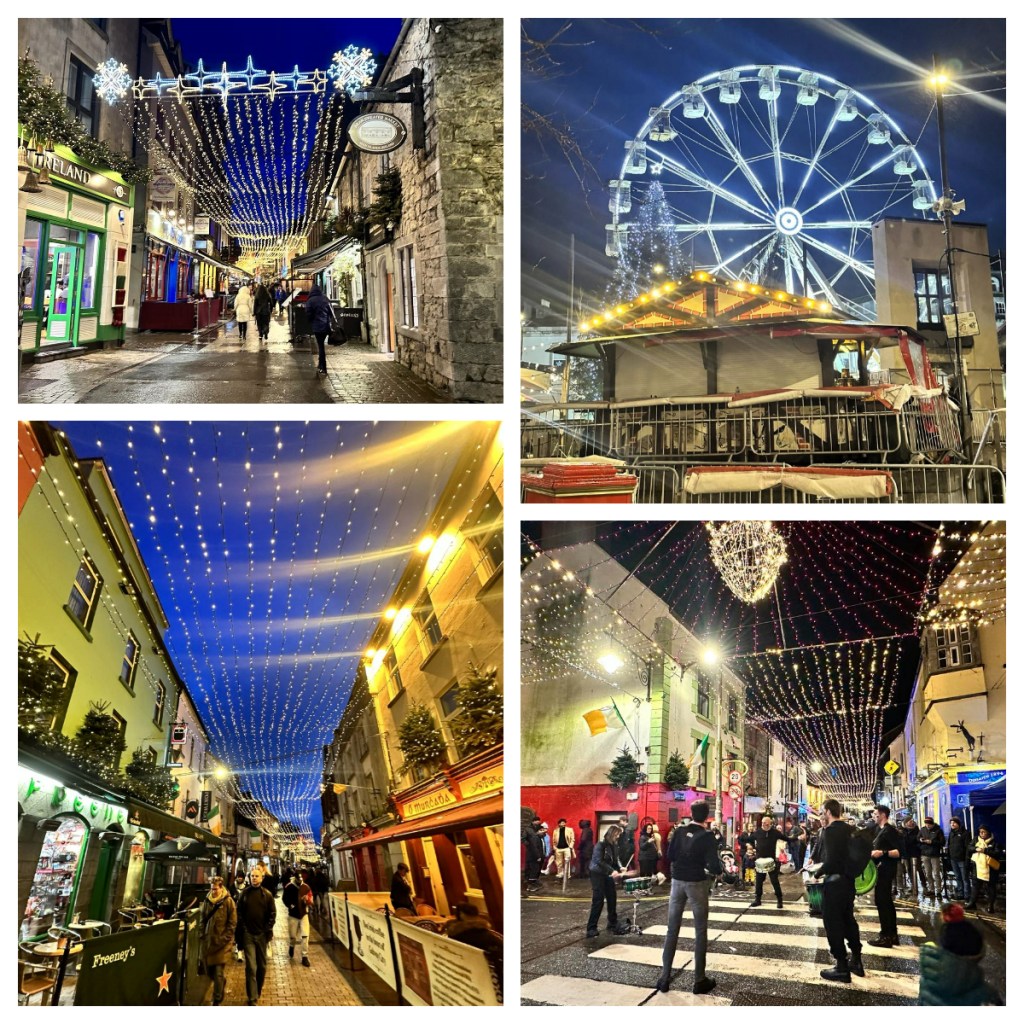
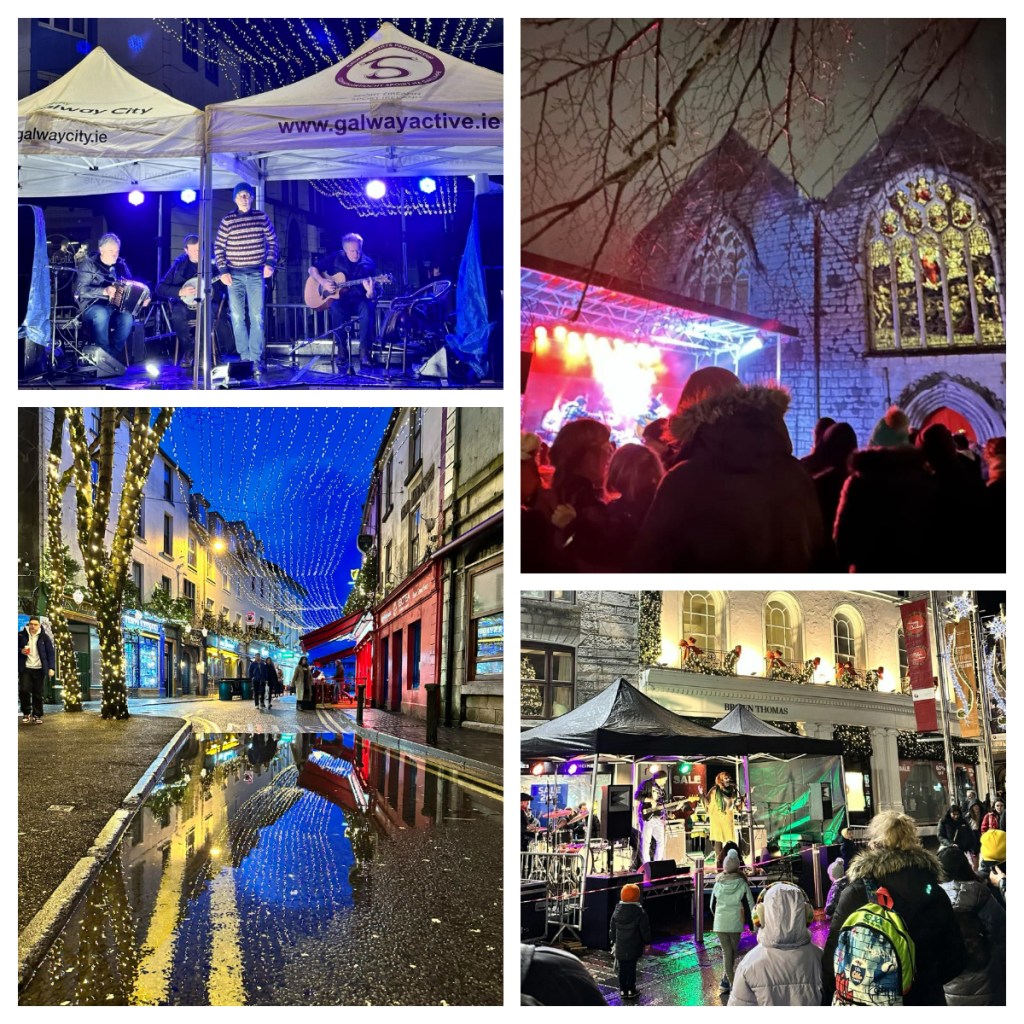
As it started to get dark, the lights came on and the puddles were filled with reflections (we all know I love a good reflection) and, as it was New Years Eve (did I mention it was New Years Eve?)  there was a programme of buskers set up around the old town.  We spent time wandering around the different stages enjoying the music – ranging from drumming, soul to trad.  (If you are on Instagram, check out the reel I did about the evening).  It was a great event.

We headed back to the hotel to get changed and before going back out to Monroes, a popular live music venue who were hosting Kíla, a popular Irish folk music group.  We had planned to stay here till midnight, but a friend of Suzanne’s who lived on the nearby Aran Islands was in town as asked us to join him at a small French restaurant across the road.  We did and it was fabulous – they were obviously hosting a 1920’s themed New Years eve dinner and we sat on the side, enjoying champagne and singing around the piano.  It was a great way to top of the evening and ring in the new year.

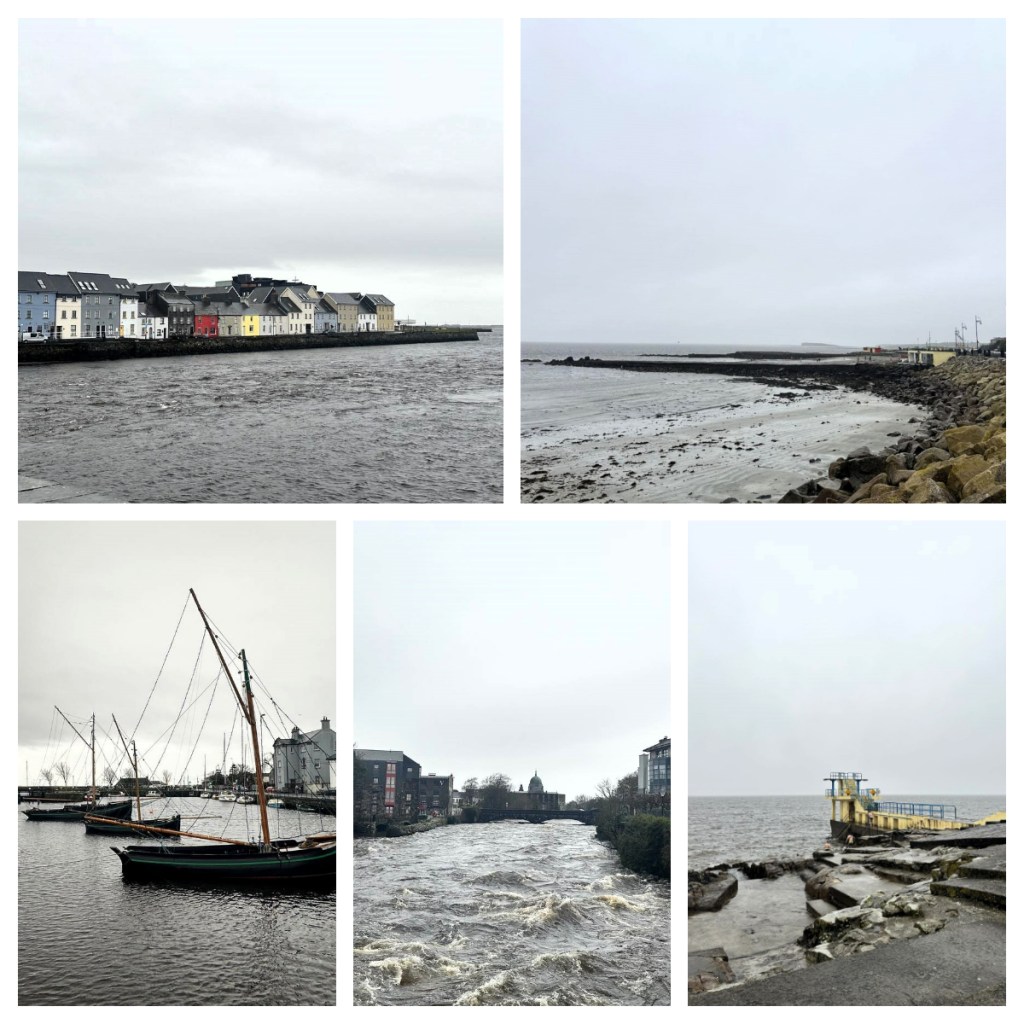
The hotel breakfast the next morning included another full Irish (it would be rude not to) before we decided to walk the 3km out to the Salthill Promenade.  Unfortunately, the rain really got us this time, setting in about 10 minutes into our walk … but we preserved and fully made it out to meet up with some other friends of Suzanne’s who were out here for a traditional New Years Day swim!! Ah, these Irish are a funny lot lol. 
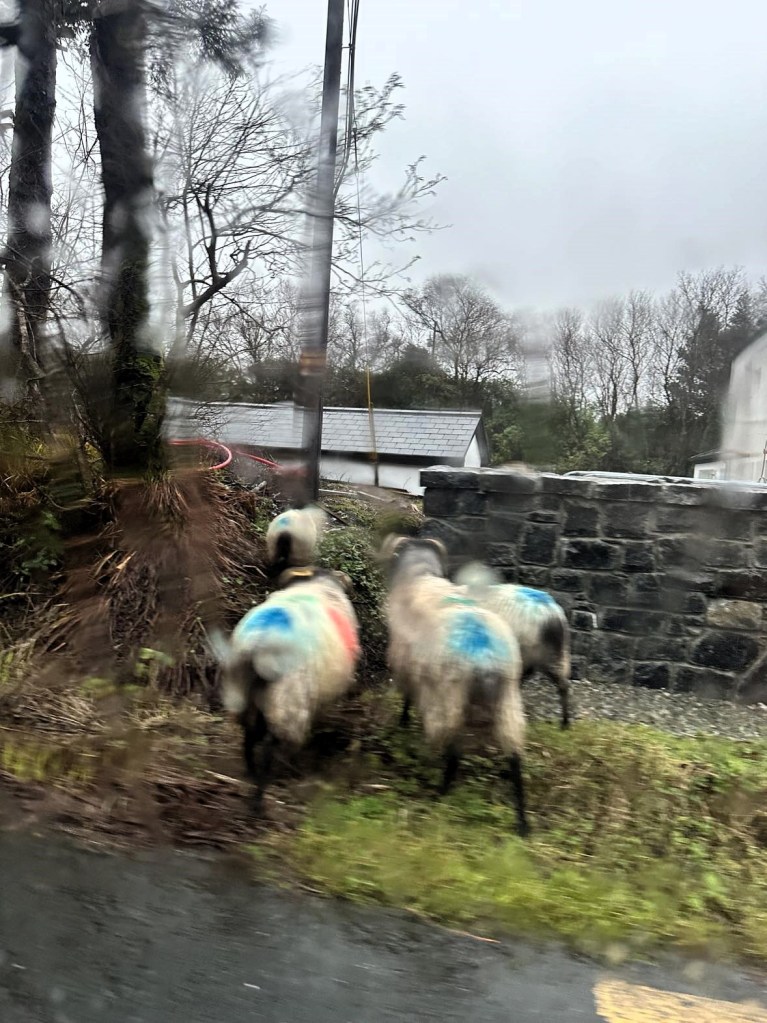
After a chat over coffee, it was time to hit the road again, this time to Clifden, the so-called capital of County Connemara.  The morning rain continued as we drove the 1 hour 20 minute drive through some surface flooding and sheep on the road – made me feel right at home lol. 
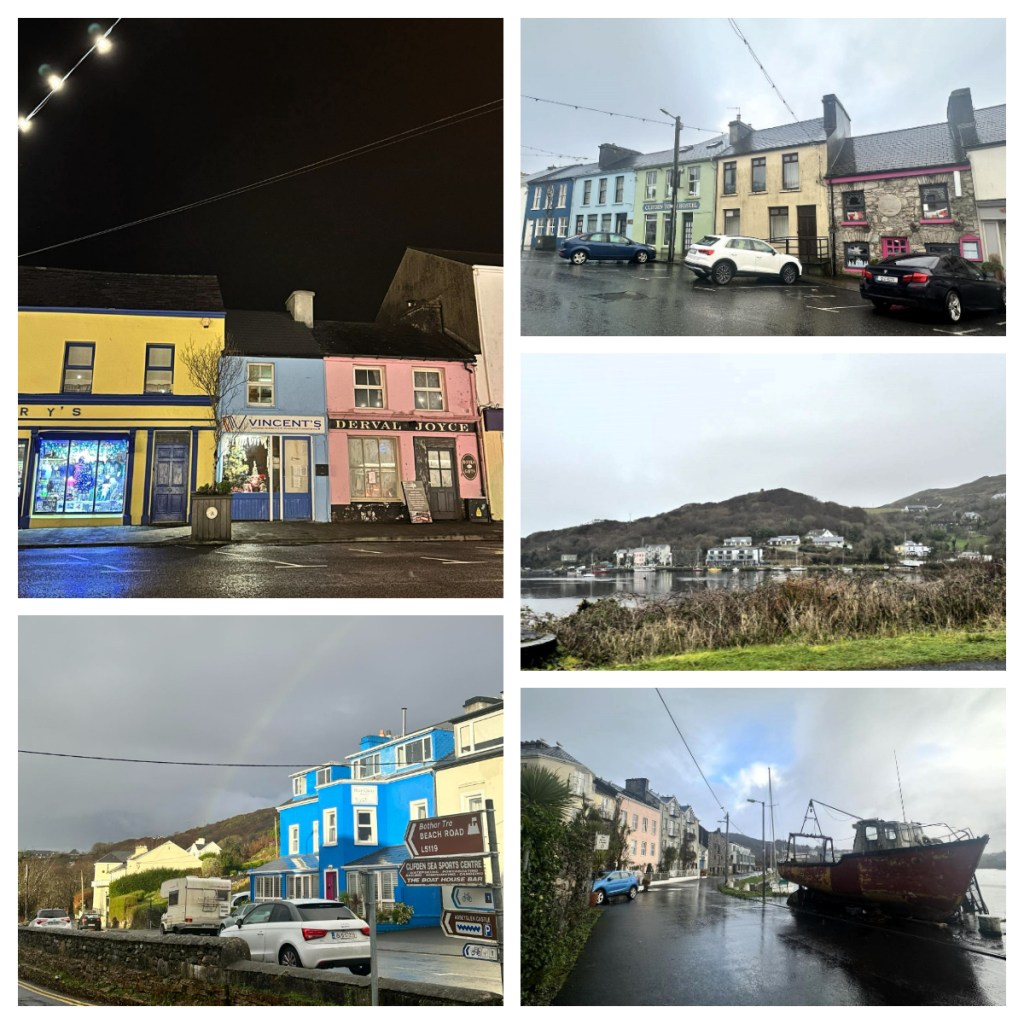
Despite its size (population around 2,500) it is the economic capital of the area and is the base for some of the best sites around this part of the west coast.  After a lovely dinner and a couple of drinks, we settled for an early night.

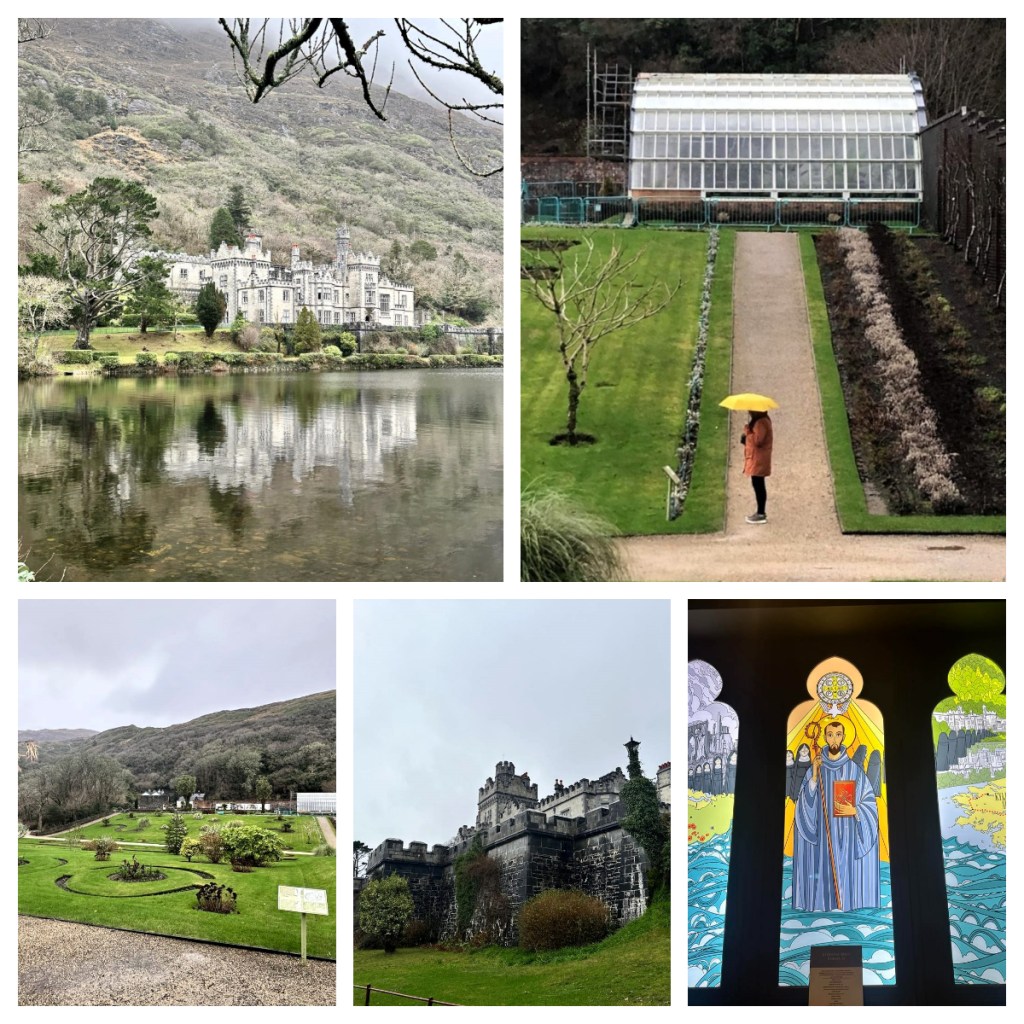
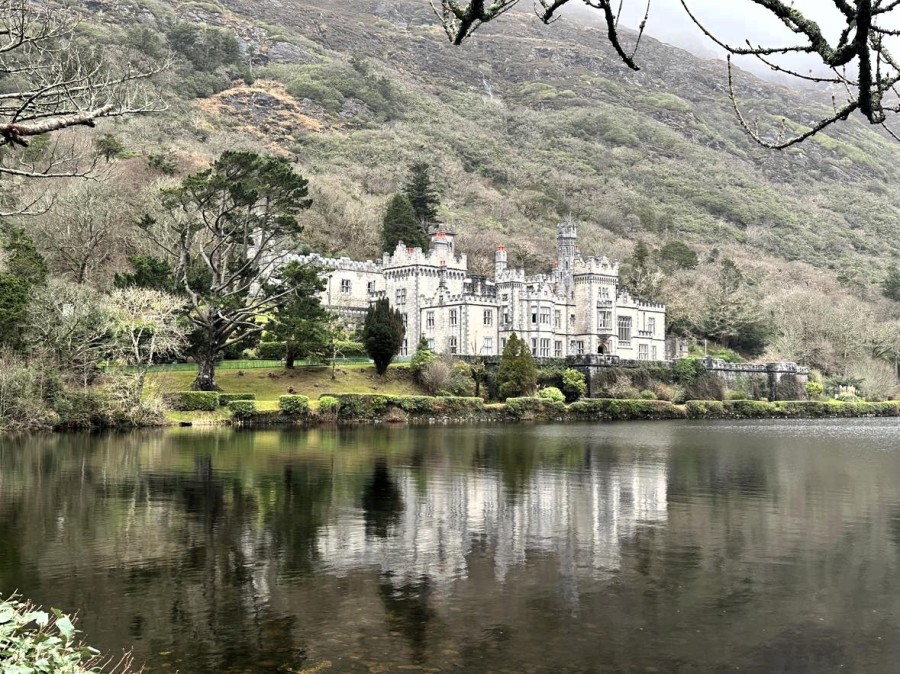
January 2nd, we set out to explore the area.  It was still overcast with a little rain, but we were not going to let us stop us.  First stop was the beautiful Kylemore Castle.  We were lucky enough to have a break in the weather and managed to get a moody version of that icon reflection view but decided to start in the Victorian walled garden as we were unsure how long the weather would hold! 

But first some history … Mitchell Henry, a wealthy doctor from London, built Kylemore Castle in 1868 for his wife Margaret after they feel in love with the area on their honeymoon in the 1840s.  The castle took 100 men 4 years to build and had 33 bedrooms, 4 bathrooms (which is a crazy ratio in today’s world), 4 sitting rooms, a ball room and of course rooms for all the servants.

When his beloved Margaret died in 1874 (of a fever she contracted in Egypt), Mitchell spent less and less time at Kylemore.  He did however build a Gothic chapel and mausoleum which holds the bodies of Margaret and Mitchell.

In 1903 the estate was sold to the Duke and Duchess of Manchester who lived there for a few years before having to sell it to repay gambling debts!! 

In 1920 the site was purchased by Irish Benedictine nuns after they had to flee their original location of Ypres in Belgium because of the war.  They ran a farm on the site and opened a school in 1923 which attracted the children of nobility from around the world as boarders (including an Indian princess and even Madonna tried to get her daughter in) and local girls as day students (for whom it is free).  Sadly, the school was forced to close in 2010 due to lack of students. 

Back to our visit … we caught the shuttle bus the short distance to the gardens and enjoyed a strolled around it, learning abouts its history from its informative panels.  The 6 acre garden was created along with the castle in the late 1800s.  In its heyday, it had 21 glasshouses and 40 gardeners!! 

After many years of neglect, the nuns brought the gardens back to life and feed the nuns and the students from the school from the produce grown here, but it was not until 1995 when a group of historical restoration consultants, garden archaeologists and architects were brought together to bring the gardens back to their former glory.

After a short walk around the gardens, we caught the shuttle bus back to the reception area and took a short walk to the castle to join a history tour.  Our guide was so enthusiastic about the castle and it’s story, and it was fascinating learning more about the castle in a more personal way. 

We learnt about the fantasy fairytale exterior design and all the modern trappings it was built with inside including electric lights, gas heating and indoor plumbing.  In fact, it was one of the first private homes to have self-sufficient electricity from an onsite hydroelectric turbine.

Kylemore was great, but we had more to see before it got dark, so we moved on for a brief lunch stop in Letterfrack, a village founded by the Quakers in the mid-19th century, before continuing down narrow country lanes, through beautiful moody landscapes to Claddaghduff, the ‘jumping’ off point to reach the tidal island of Omey Island.  The island is said to have been one of the last lingering strongholds for pagans, before the monastery, Feichin’s Church was built in the 7th century. Subsequently it has supported some successful farms over the years.  Currently, the population is listed as 5!

At low tide, you can walk across the sand to the island, and in fact you can even drive!  Despite being there at low tide, there was still a few fairly wet spots and although my shoes were waterproof, I didn’t want them covered in saltwater so decided to wander around the foreshore while Suzanne went over to the island to explore.   My choice did not disappoint as I enjoyed just strolling around the beautiful wild beach and was awarded by a stunning rainbow. 🌈

Back in Clifden, now the New Year rush is over, many of the bars, restaurants and even hotels were closing up until February or March.  Thankfully we had one more night to have a couple of drinks in a couple of the local pubs, ending up in the bar by the hotel where there was live music and then to the hotel lobby where there was a piano player – actually the same guy who was playing the piano in the bar we ended up in on New Year’s Eve – small world lol.
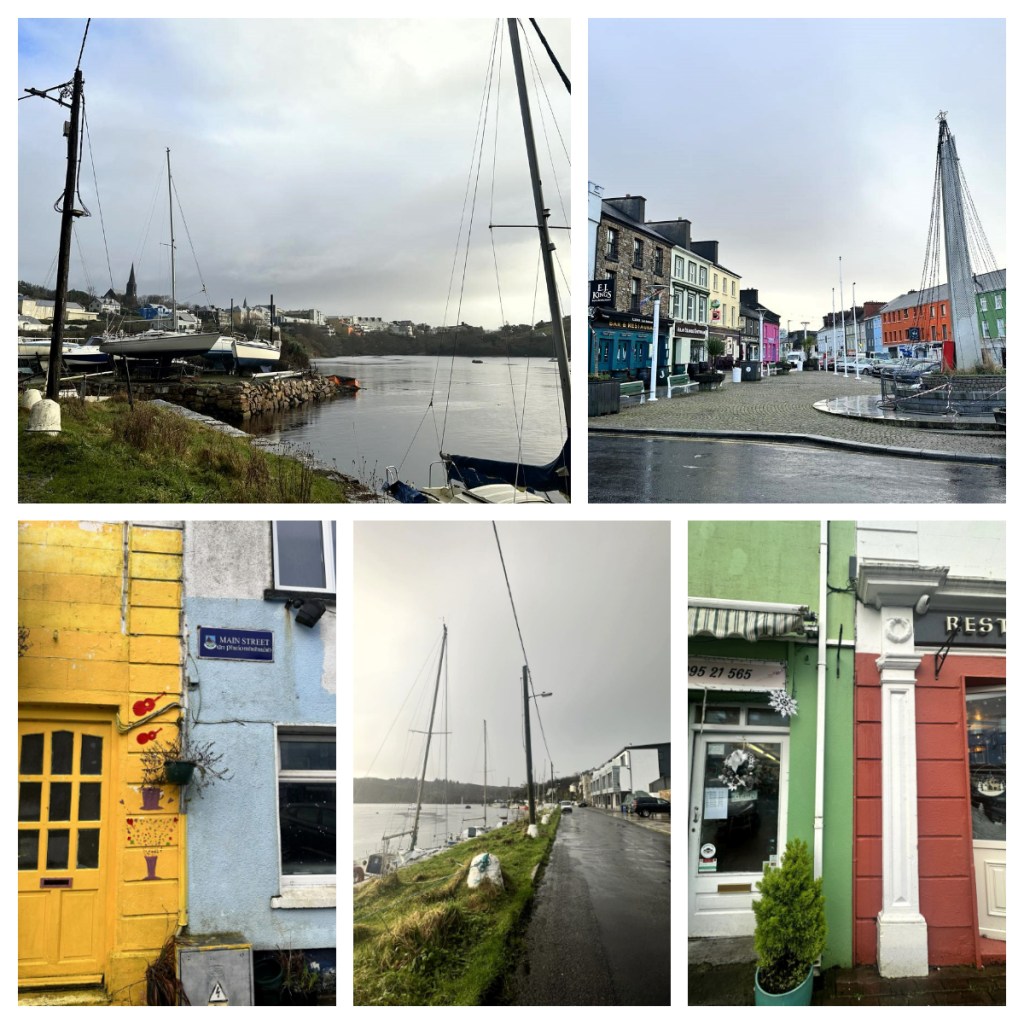
On our final morning away, Suzanne was not feeling well, so I got up and despite the rain, I headed out for a morning walk through the town and down to the waterfront.  Clifden is not a big town, but it was nice to stretch the legs before we headed back to Dublin, via a quick stop at Ireland’s oldest pub – Sean’s Bar in Athlone.  Established in 900AD!  I admit I do love the Irish pub atmosphere – dark, cosy, warm fire – nothing like it in the winter.

As well as Suzanne starting not to feel well, Ania, who I was supposed to stay with back in Dublin, tested positive for covid (Covid – disrupting plans since 2020)!  Despite feeling sick, Suzanne kindly offered a bed in her place for the night and it definitely an early night all around! 

Next morning I headed just around the corner to the airport bus stop.  It only ran from this area every 2 hours, so I went super early.  It was a lovely morning for my last trip through the city and I was lucky enough to get an earlier flight to London for my last couple of nights.

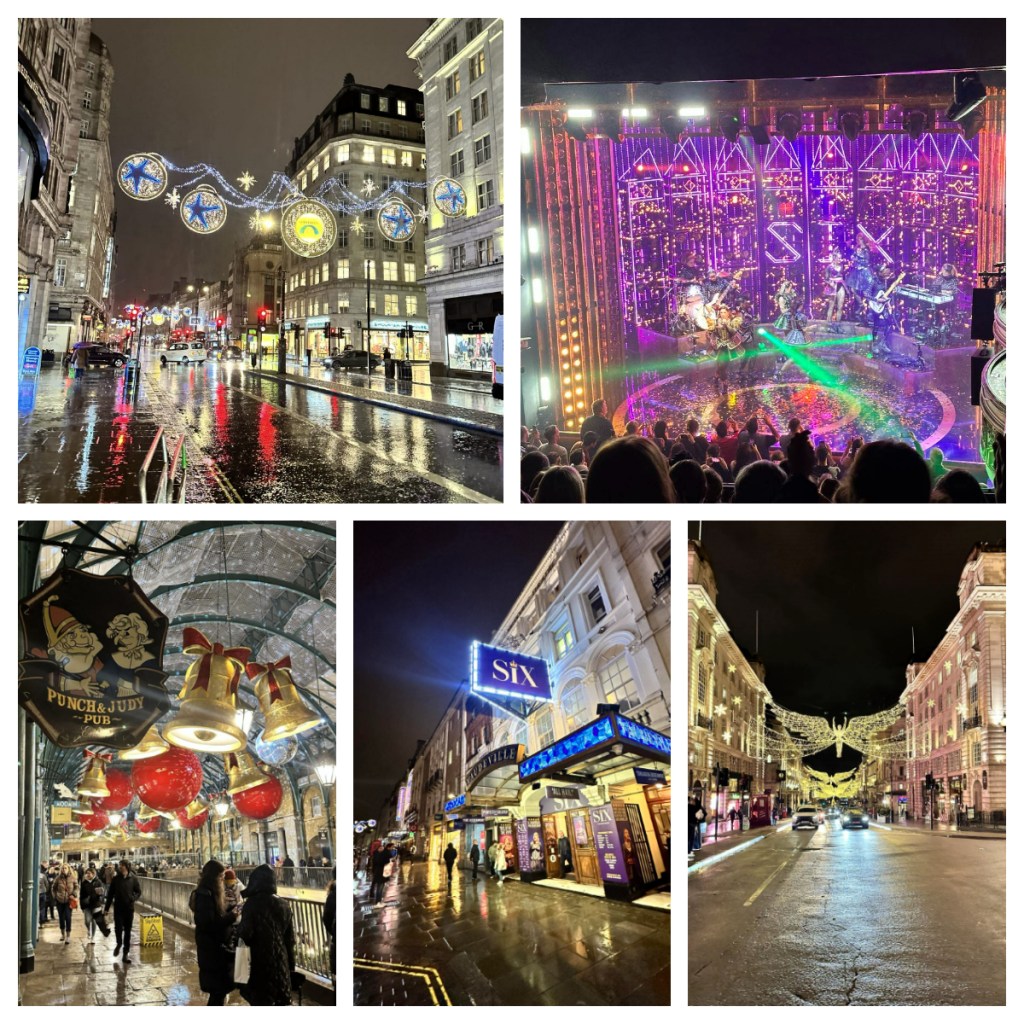
I caught the tube into the city to my hotel in Piccadilly – it was called a cocoon room, and it was true to its name in size, but it was clean, comfortable and in a great location, so I was happy.  By this point I felt like I was fighting to keep those Irish germs at bay and as the day went on, it became clear I was losing the battle.  After a quick nap I managed to head out in the torrential rain to see the Christmas lights, enjoy a bite at Pizza Express (an old favourite) and see Six – The Musical.   The musical was great fun and despite not feeling the best, the evening reminded me just how much I love London. 
The next morning, I managed to make it out for a walk around some of the central tourist attractions – around Trafalgar Square and down Pall Mall, just in time to catch the procession for the changing of the guard.  It was incredible to see how many people come to watch the regular event.  Just a great bit of English pomp and ceremony. 

In the afternoon I made my way out to the west of the city to visit an old friend and it was wonderful to catch up her, but I did have to have an early night and sadly felt even worse the next morning.  All final day activities were cancelled due to this unwanted Irish souvenir, and I had to book a day room in hotel at airport were I basically slept all day, until it was time to head to the airport for my flights home.

Despite the Irish germs, it was a great trip exploring new places and catching up with friends.

Back to the Republic

Ireland

December 2023

After another great night’s sleep, I left Belfast and drove south, back across the invisible border to the Republic of Ireland – there was not sign indicating the border on this road either!

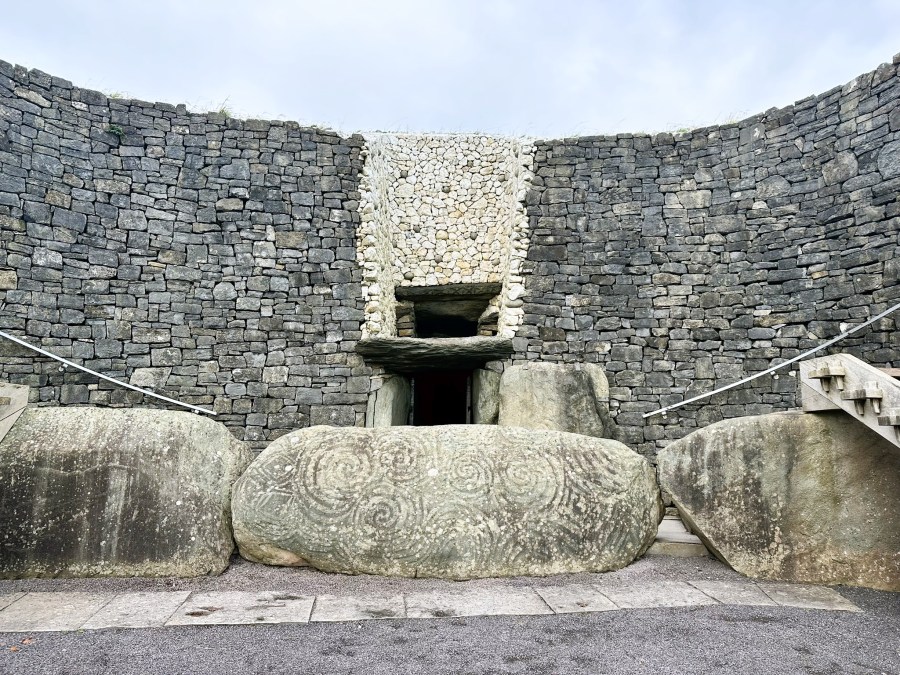
My destination the Boyne Valley in County Meath and the World Heritage Site of Brú na Bóinne.  Until I started researching for this trip, I was completely unaware of the Neolithic history of Ireland and that there are various stone age sites that you can visit – Newgrange being touted as “the jewel in the crown of Ireland’s Ancient East”.  Created around 5,200 years ago (3,200BC), it is older than Stonehenge, the Egyptian Pyramids at Giza and even the ancient city of Petra in Jordan!!  This blows my mind!

To visit Newgrange, the most well know of the passage tombs in the complex, you must start at the Brú na Bóinne Visitor Centre.  It was a cold day and the visitor’s centre was fairly quiet but given the staffing levels I assume they have much busier days/moments – there were 3 people within about 10 metres of each other, first to check my booking, the second to give me my ticket, and a third to check the ticket I was just given (in front of them) 🤔😂.  I have not seen such a great job creation scheme since the small shops in Japan!

Your visit to the site includes a bus from the visitor’s centre to the site itself and as you enter you are allocated to a specific bus time.  I had around 30 minutes to explore the really interesting exhibits and information.  Apparently, the Boyne area has many Neolithic sites which date back to the “new stone age” era when humans started farming and living in settled groups.  For them, Brú na Bóinne was a sacred place.

From the visitors centre, it was around a 5 minute walk across the River Boyne to the bus stop where I joined a group of people on the bus to the site itself.  A short ride down narrow country lanes and we got our first glimpse of the passage tomb of Newgrange. 

It is understood that passage tombs were used to contain the remains of the dead and it is likely that they were actually built over the bodies, rather than the bodies placed in afterwards.  However, Newgrange is considered to be more than just a passage tomb and is considered more likely an Ancient Temple with astrological, spiritual and ceremonial importance. In fact, this site has amazing examples of megalithic art on a scale not found anywhere else in the world!

We had time to wander around the mound, around 85m in diameter and 13m high (covering a total of around 1 acre) before meeting the guide for our time inside the tomb.  Unfortunately you could not take photos inside the tomb, which is a shame as the engineering that went in to the building of the tomb was amazing, as were the unique artworks. 

One of the most special things about the site, is that on the winter solstice, the passage and burial chamber are lit with the sun as it rises.  As we stood in the passage, which these days is lit with electrical lights, the guide turned off the lights and recreated the moment of the sun rising on the winter solstice.  As with other ancient wonders like the pryamids of Giza and those in the South American Mayan world, the astronomical knowledge of the architects, engineers and astronomers who built them is incredible.

It was a really interesting visit and the countryside was beautiful despite the freezing weather, I was just grateful it wasn’t raining.

From Brú na Bóinne it was only a short drive (down more narrow country lanes) to Slane where I was to spend the night.  I was a little early to check in to my accommodation so headed first to the Hill of Slane. 

Legend has it, in 433, St Patrick lit a fire on the hill, in defiance of the law of pagan High King Laoire, who forbade the lighting of any fire before his fire, on the nearby Hill Of Tara, was lit on the spring equinox. Despite being angry, the King was impressed by St Patrick’s devotion, he allowed him to continue his missionary work which brought Christianity to Ireland (basically putting the putting King out of a job)!

The hill is only 158m high and from the carpark it was just a short walk to the top which today houses the ruins of a Franciscan Monastery dating back to 1512 as well as those of a college built to house four priests.   From the ruins, there were also beautiful views out over the countryside.

From the hill I headed back in to the small village of Slane (population around 1,500) for lunch at the Village Inn and a quick visit to the nearby 18th century castle.  It was unfortunately closed so could only admire it from the outside, but I did pop in to it’s neighbouring whiskey distillery to do a little souvenir shopping before I made my way to my AirBnB. 

I had thought about heading to the pub later for some dinner but it was so cold and the Airbnb was so cozy I just stayed in!

When I headed out at 8am the next morning it was dark and raining but I had to set off to the airport to drop off my rental car.  I had been fortunate so far in avoiding the worst of the rain but not so this morning. 

From the airport I took the bus back to city and headed back to the same hostel I had been in before Christmas.  The hostel was ok and conveniently located and I had decided it was easier to go with the familiar rather than have to find my way to another place.  This time I had splashed out and booked myself a single, private room and luckily enough it was ready for me to check in to early.  Please note – a private room in a hostel = a room about the size of a shoe box but at least it was clean and I had my own bathroom.

With no time to rest, I dropped my bags and headed straight out. First to see the Jameson distillery.  Not being a whiskey drinker myself, I didn’t go in, but wanted to see it and make a few small purchases for gifts .. and it was kind of on my way … to the Guinness storehouse. I am also not a big Guinness drinker but I like it more than whiskey so thought I should visit!

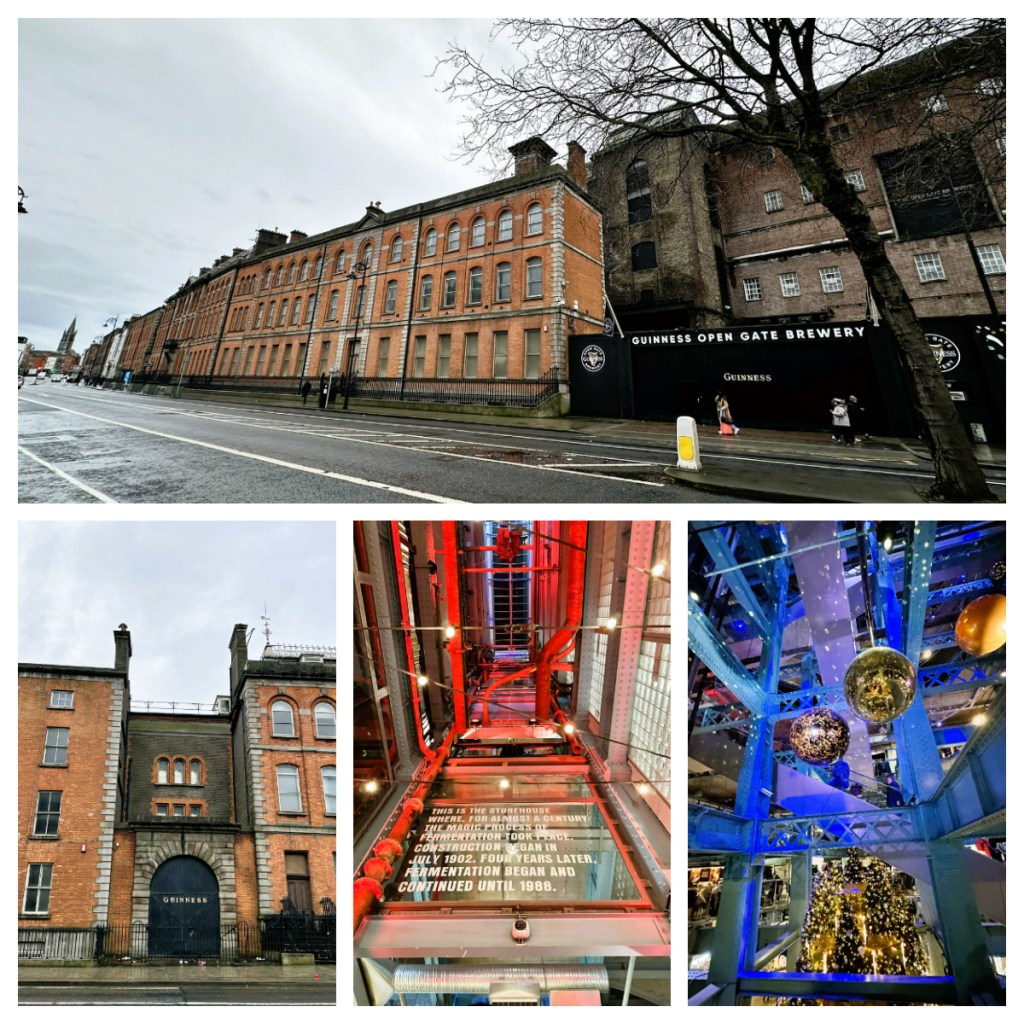
The Guiness store house is a huge imposing building taking up a whole block and let’s be honest, you must be living under a rock if you were not familiar with the iconic Irish beer which can be found all over the world.

Arthur Guinness started brewing on this site over 250 years and in 1759, he had the foresight to sign a 9,000 year lease on this St James’s Gate Brewery!  Now that shows true commitment to his product!  The Guinness family today continue not only the brewing legacy but also the philanthropic one, supporting and donating to various charities, historic building restorations and underprivileged communities and as well as maintaining a high level of employee welfare. 

As you worked your way up the levels (7 levels in total), you explored the history of Guinness and how they make it – from grain to glass.  To be honest, although it was interesting, there were a few too many people in some areas so I did not spend much time waiting around to read all the information panels and wasn’t that fussed with the place … until I reached the sterile “tasting room”.  It was completely white and sterile and when the room was full, they closed the door!  It had areas where you could enjoy the aromas of different parts of the beer and were each given a shot of Guiness.  I now actually started to feel like I was in the beer version of Willy Wonka’s chocolate factory – so many different floors and rooms!

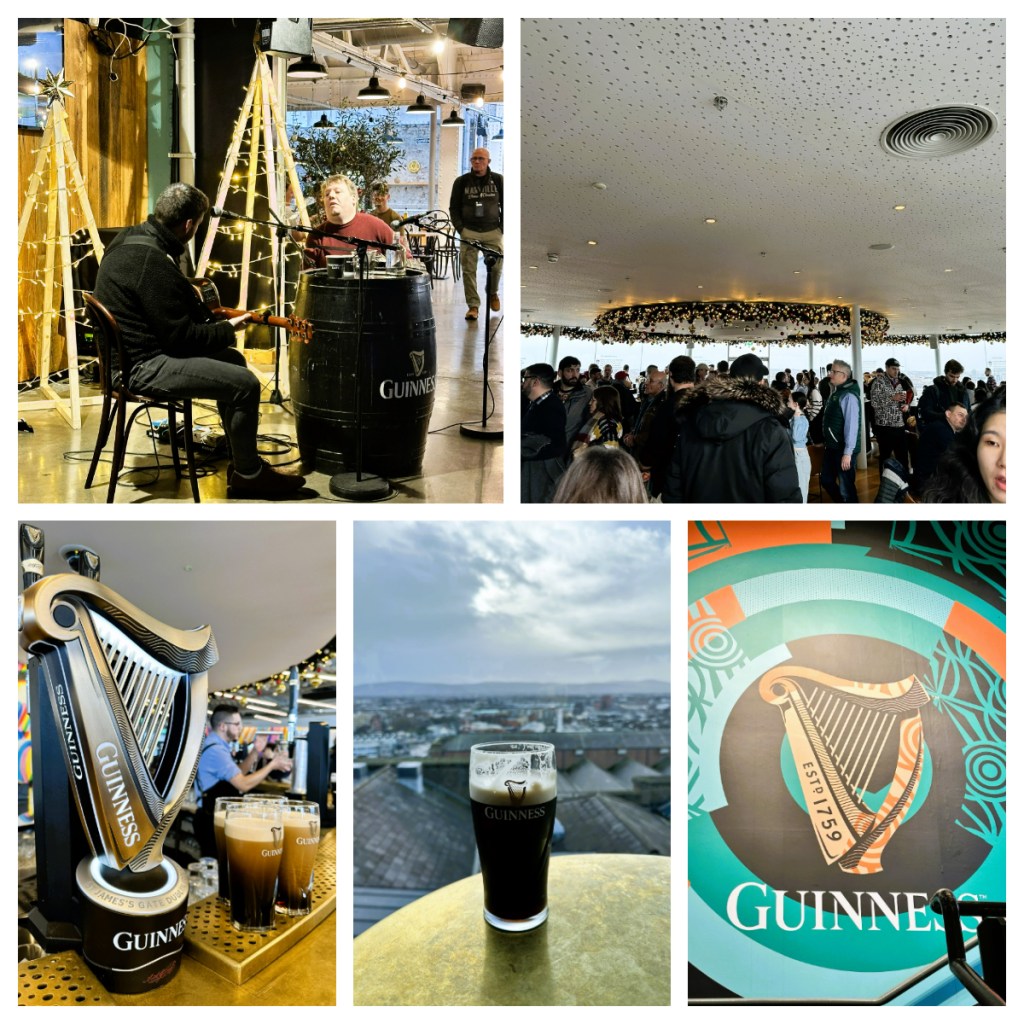
From here we moved I to the Velvet room (I think that was its name) for a brief talk about how to drink Guiness.  This room was filled with paintings of Guinness’s past and information about their contributions.  Instructions were given … “Pause and smell the aromas before taking a big slug lol.  Don’t sip just the creamy white head as that is for texture rather than taste”.  I must admit – I actually enjoyed it.  Perhaps I have always been drinking it wrong.

The final stop was for a free pint of Guinness (well, it is included in the entrance price) in the circular Gravity bar, one of Dublin’s most unique roof top bar, with a great view over the city. I was very lucky to get a seat after only a short time so could properly enjoy the view and my pint. 

I then headed down a couple of levels to one of the numerous restaurants for a Steak and Guinness pie (it had to be done) and to enjoy the magically Christmas decorations around the 7 story central core and the traditional music and dancing on show.  It was a perfect end to my visit. 

After an enjoyable couple of hours, I headed back out in to the cold for a 30 minute walk through a more gritty suburban part of the city.  (Turns out I could have walked through the lovely gardens of the museum of modern art, rather than the grungy back streets but thanks to google maps for keeping it real 🥴😂.)

My friends had told me that Kilmainham Gaol as a must see in Dublin and that bookings were hard to come by so I had scheduled a reminder to book as soon as they began available (a month before the visit date) to make sure I got a ticket. 

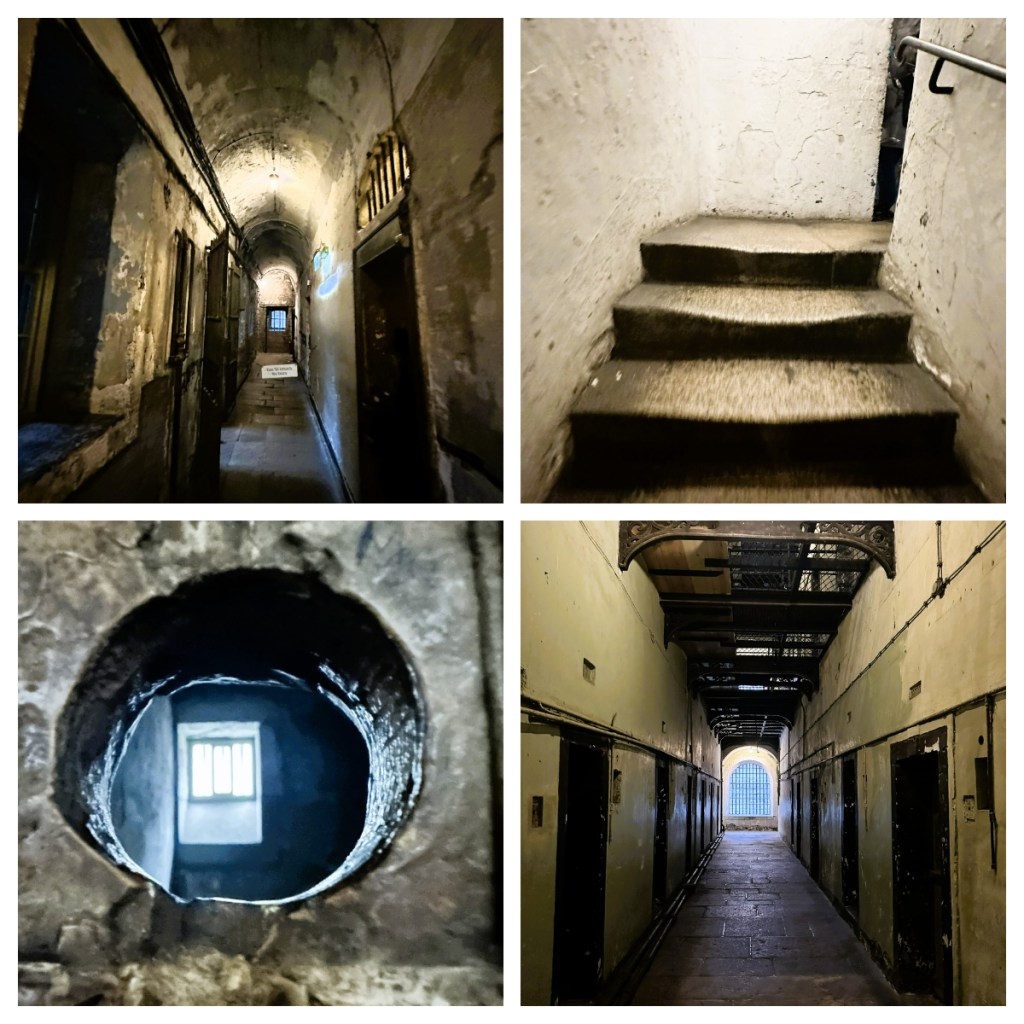
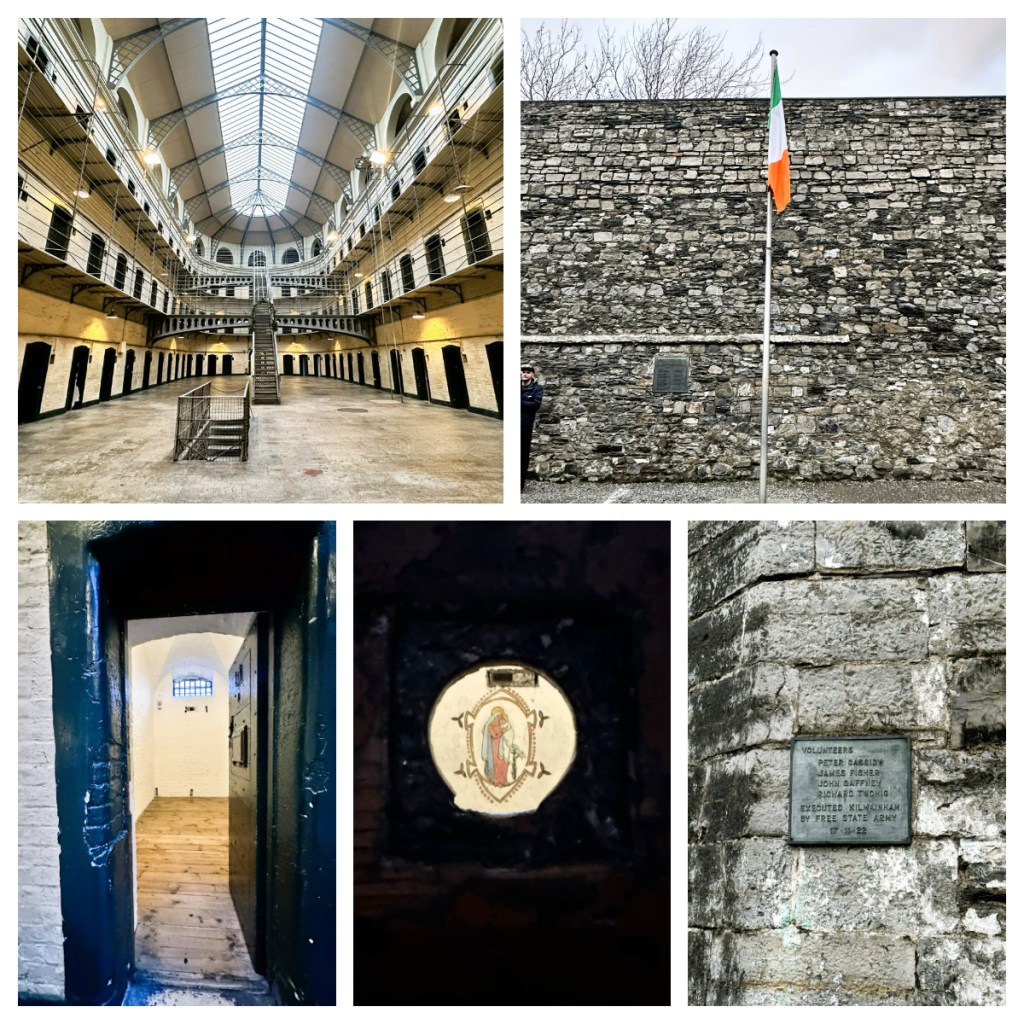
Since it was opened in 1796 as the Dublin County Gaol, until it was closed in 1924, thousands of men, women and children were held Kilmainham Gaol for offences that ranged from owing money or begging to political prisoners involved in the many Irish uprisings – from the 1798 rebellion, the 1916 Easter Rising, the Anglo-Irish war of 1919-1921 and the Irish Civil War in 1922/23. When the prison closed, the initial consensus was to tear it down as it held many bad memories, but in the 1960’s, a group of revolutionary veterans decided to preserve it as a national monument rather than tear it down so they can share the stories that are a huge part of Ireland’s history.

As if closing the loop, in 1966 the new museum was opened by the President of the day, Éamon de Valera. He had been one of the last prisoners released in 1924!

Our guide took us from the Court House, through what was a catholic chapel before we moved in to the earliest part of the prison – cells built for reform, based on the concept of “silence, supervision and separation” however the in the early days, the overcrowded prison did not allow for any reform or separation, with men, women and children all crammed in together in small cells with no heating (gas heating was not installed until 1890s. 

There was supposed to be 1 person per cell and in the  holding cells for those going to Australia, there could be up to 3 per cell … and their waiting time did not count as part of their sentence.  Some inmates were as young as 10 or 11.  In fact, the youngest prisoner was 3 year old Thomas Roberts who in 1856 he was imprisoned for begging. Sadly there is no record as to what happened to him when he left. During the famine there were up to 5 per cell as people were trying to get in to prison to get food! 

As we moved through the prison, from the oldest sections to newer areas, some of the cells showed the names of men and women who were help in them.  Many of the leaders of the unsuccessful rebellions against the British were held here – some were even executed on the grounds whilst others were released and went on to be part of future governments. Most of these leaders were not military men (and in some cases women), they were teachers, artists and poets.   

The most recent wing of the prison was much improved from those earlier areas.  Built in 1861 in the  panoctogan style, known as the all seeing eye – a guard can stand on the central platform and see everything.  It also considers that light is key for reformation and the glass room givens plenty of light. 

The tour ended in the execution yard, perhaps one of the most important sites in Irish history.  The site of a number of brutal executions, including public hangings.  The British started to lose support from many of the Irish citizens due these executions of politic prisoners and the treatment of the bodies after execution – in some instances they refused to give the bodies back to the families.  Who knows what they were hiding.  

It’s new life as a national monument also finds it popular as a location for movies, appearing in films such as the Italian Job, Michael Collins, In the name of the Father and even Paddington 2.

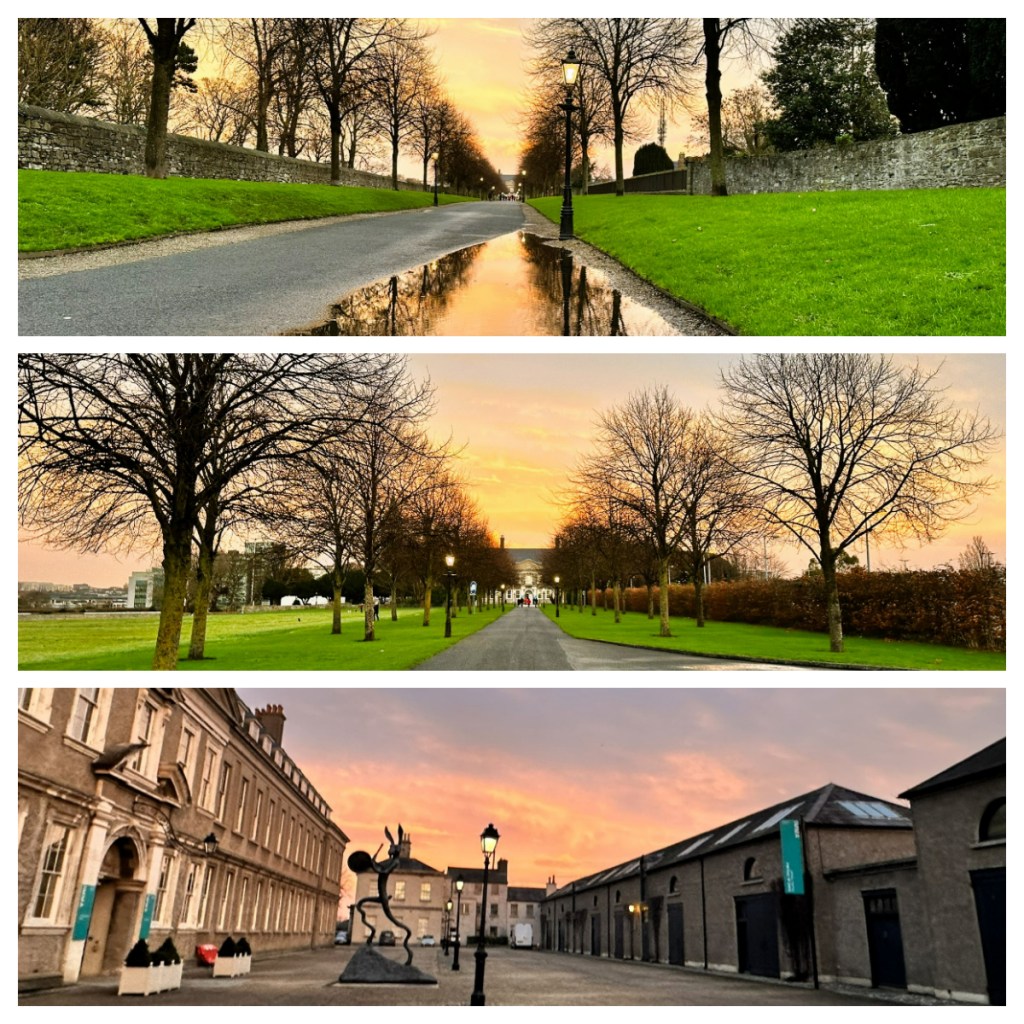
As I exited the prisoner I spotted the start of a beautiful sunset and I couldn’t resist taking a walk through the gardens of the museum of modern art before finding a bus back to my hostel, just in time to freshen up and change before fun night around Temple Bar with my friend Ania. 

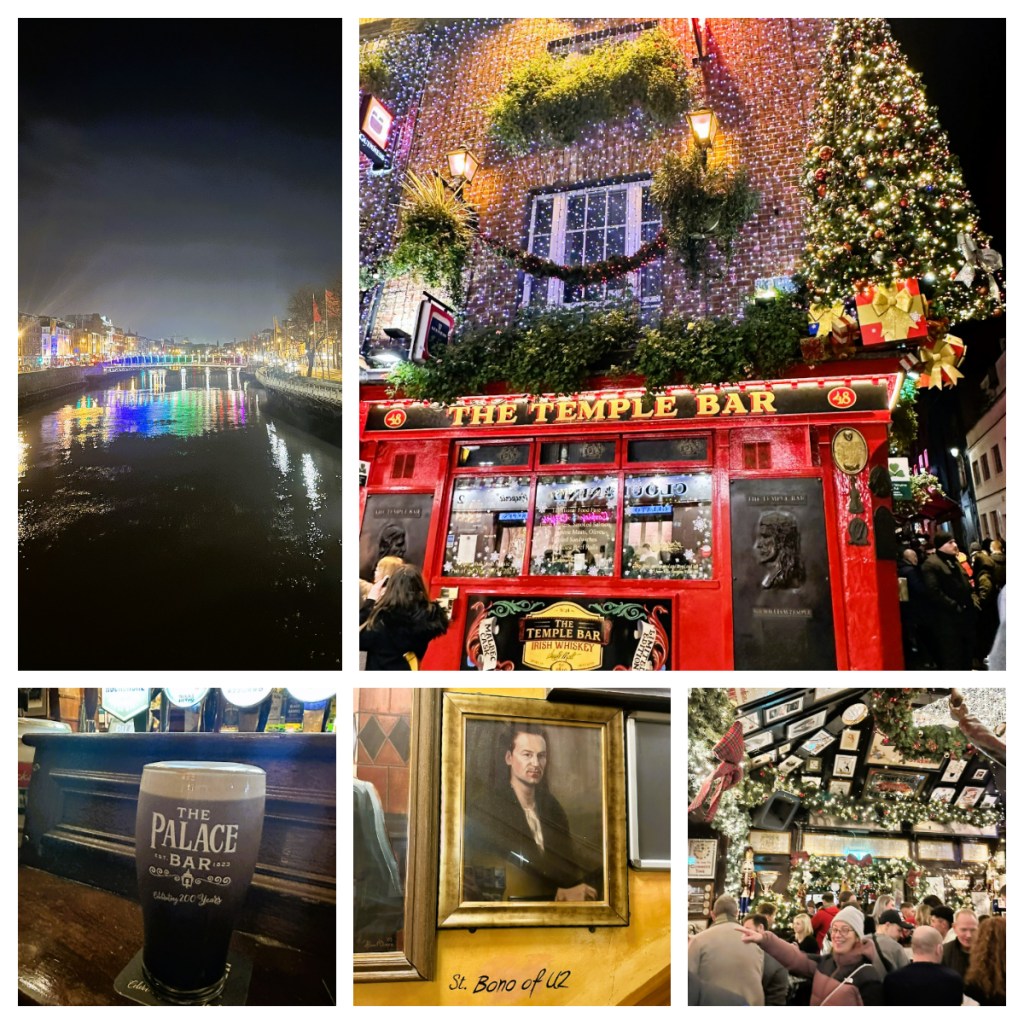
It was really busy and lots of tourists but fun never the less. I had been warned that the bars in Temple Bar are costly and they were not kidding!!  A pint of Heineken and a gin and tonic cost euro 26 – $45 – I am not sure where in NZ you would pay that much!  Let’s consider the budget well and truly blown 🥴  That said, it was a perfect day to finish off my time in Dublin.

Exploring Belfast

Northern Ireland, December 2023

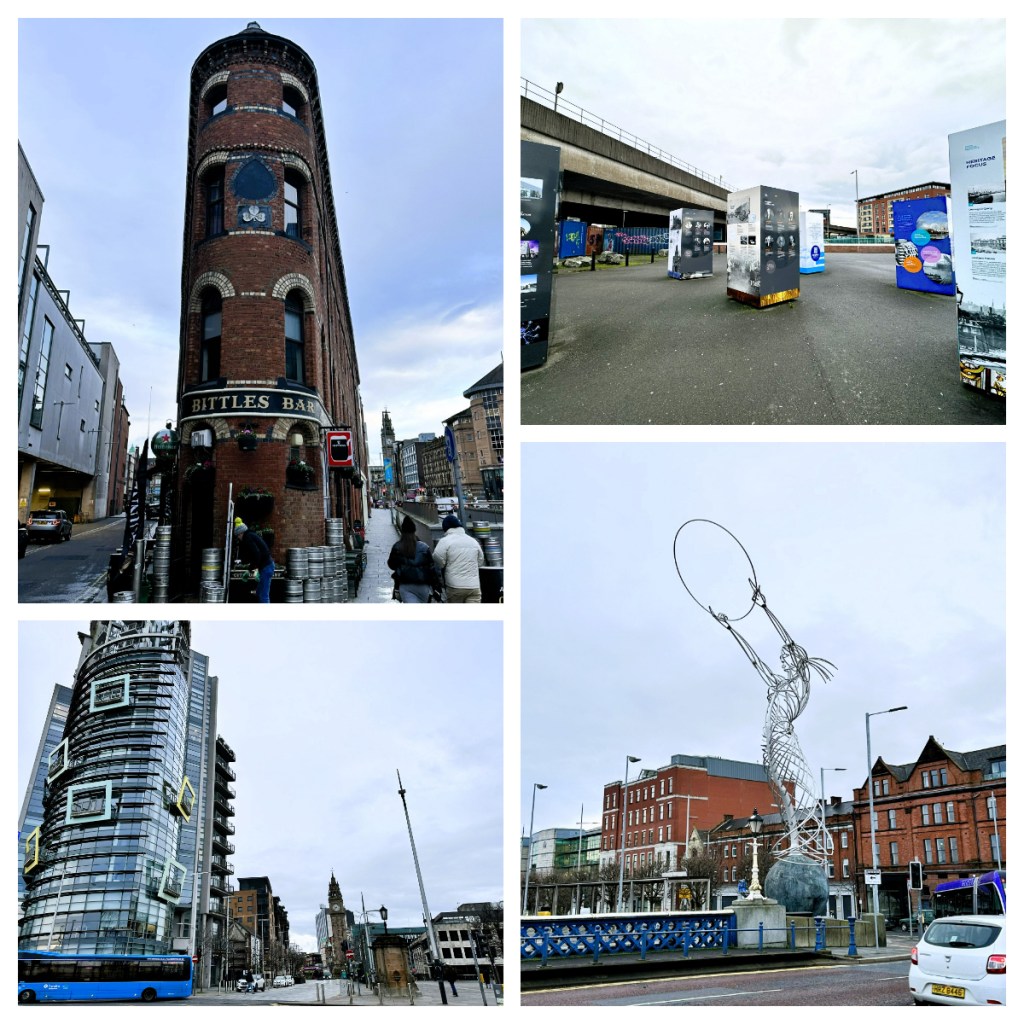
Awaking refreshed from a very comfortable night’s sleep and not a single regret about my room upgrade lol. I had two main things booked for the day – visit the Titanic Museum in the morning, and a Black Cab politic tour in the afternoon.  As I was now staying centrally, I took the opportunity to wander around first thing.  There is not much commentary to photos I took as I wandered, I just took photos of things I liked the look of and planned to find out more about the locations later!

I came across City Hall which was beautifully decorated for Christmas.  I wish I had explored a little more last night as I arrived just as they were in the process of dismantling the Christmas market in front of it (which had finished before Xmas) and taking down all the decorations.  So I got some lovely photos with lots of trucks in the pictures 🥴.

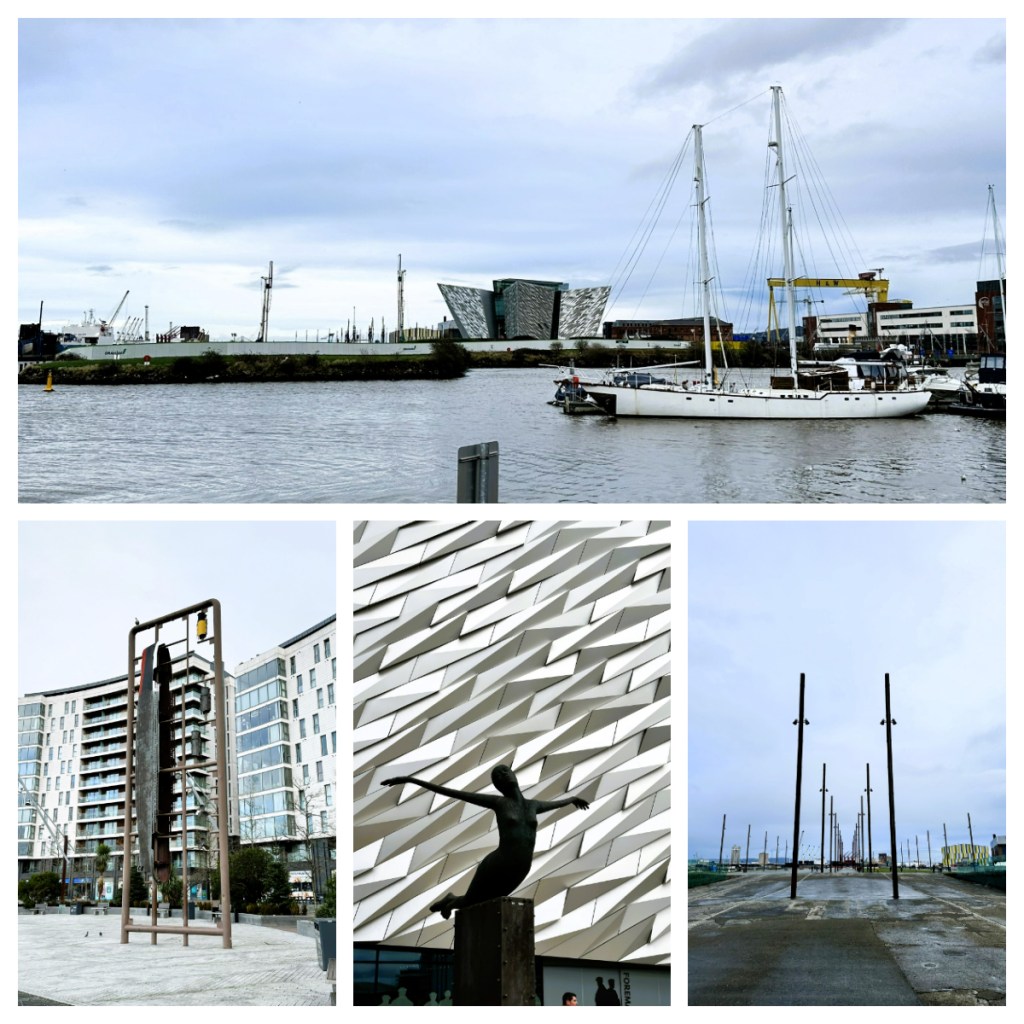
I paused for a hot chocolate at the large indoor Victoria Centre (a shopping centre) before continuing my wandering in the general direction of my first stop.  This took me across the river Lagan on to the Titanic Trail.  There were lots of very informative signs about historical Belfast and its ship building industry and I even spotted a couple of “city” seals in the river 😂. 

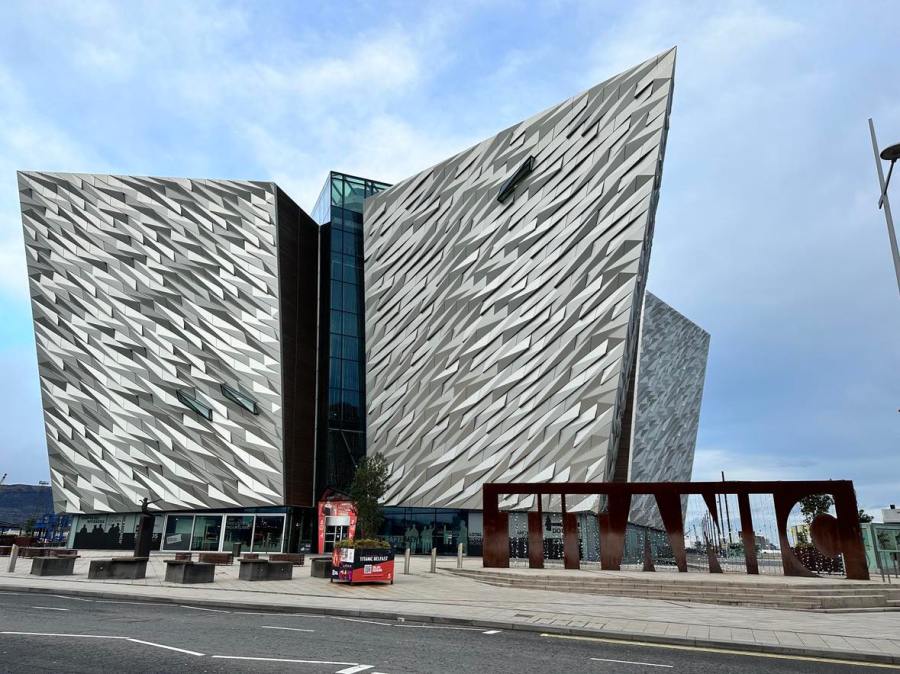
When I arrived at the museum there were a lot of people gathered outside.  Thinking it was not open yet, I took the opportunity to explore the outside area and the Olympic slipway where the Titanic was “born”.  In fact, it was actually security alert that had evacuated the building 🤦🏻‍♀️.  Thankfully I did not have to wait long before we were allowed in as it was bitterly cold. 

I had prebooked online which meant I could walk straight in and that I also got an audio guide.  Although it was not really necessary as there was plenty of good information around the museum, I enjoyed listening rather than having to try a read the sometimes crowded signs. 

The museum covered the history of the city including key trades such as linen, rope making, tobacco and ship building.  At one time, Belfast had the largest ship yard and glass blowing manufacturers in the world!

After going though the original gates from the Harland and Wolff shipyards we joined a short ride through a re-creation of the shipyards of the time to experience the heat and noise the workers had to endure.   Incredibly, the Titanic had more than 3 million rivets in it, most of which were put in by hand!

Now, I am pretty sure everyone knows the story of the Titanic. Launched in Belfast in 1912, it was the largest ship afloat at the time she was launched by the White Star Line.  Her inaugural journey was to take her from Southampton in England to New York with some of the wealthiest people of the time on board, as well as hundreds of European emigrants, travelling to build a new life in North America.

But, as we know, she never made it to her destination. On April 14th, she hit an iceberg mid Atlantic and sank in around 4 hours.  Touted as unsinkable, crew and guests were ill prepared for such a catastrophe and the ship only had life boats for about half the people on board! 

The audio guide took me through the exhibits, hearing emotional stories from survivors and displaying artifacts from the ship herself.  It seems that the disaster was the result of a domino effect:  weather, ice warnings, the lookout did not have  binoculars, the ship was going too fast for the conditions, flooding in low bulk heads, not enough lifeboats, no emergency drill … After the sinking of the Titanic, much was changed in maritime legal requirements, some of which remains in place.

The last part of the museum goes through all the modern day exploration of the wreck, with some incredible images of the wreck in recent years.  Even if you only have a short time in Belfast, I would highlighy recommend allowing a couple of hours to visit the Titanic Museum.

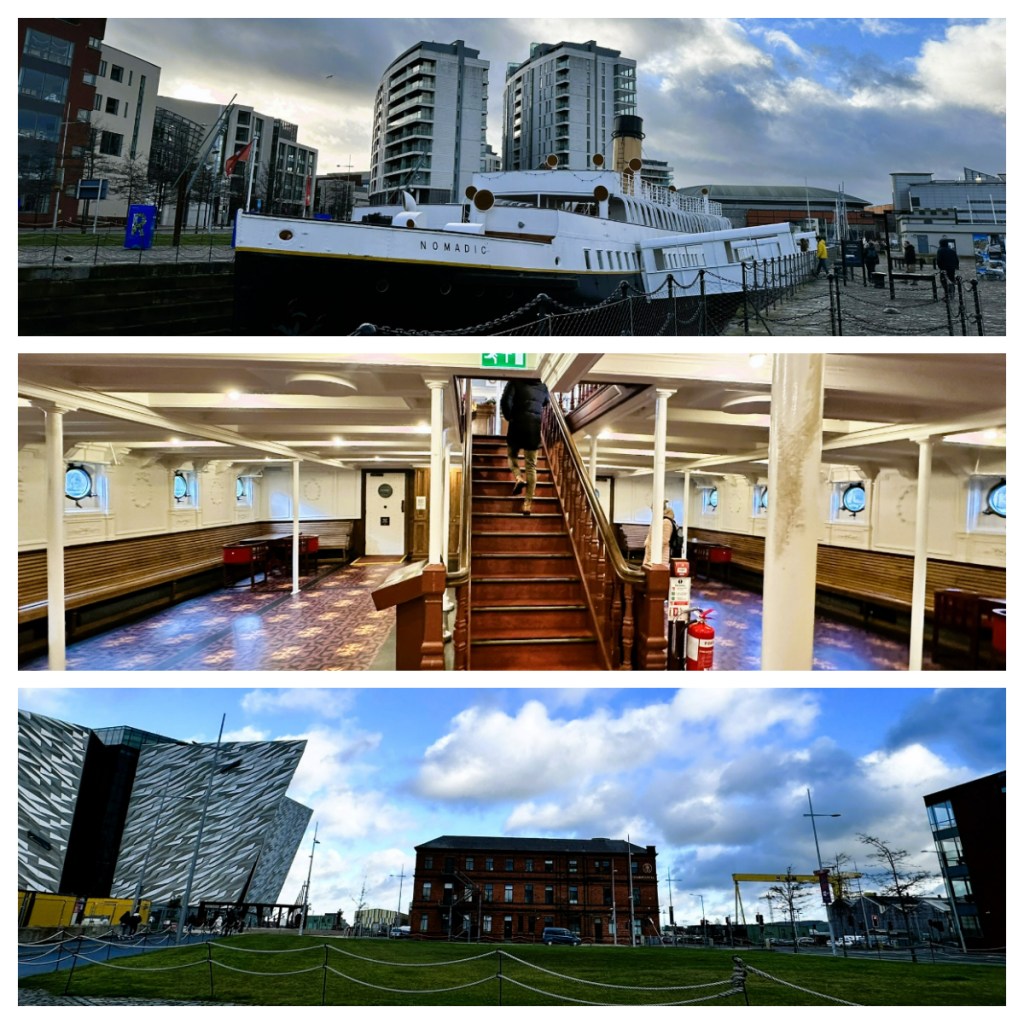
As part of the ticket for the Titanic Museum, you also can visit the SS Nomadic.  Launched the year before the Titanic in 1911, she was used as a tender, to transfer passengers and mail to and from the Titanic and her sister ship, the Olympic.  She is the only White Star Line ship left today and is moored in a dry dock just across from the museum. 

She is a beauty and if only the tender, I can only imagine how beautiful the Titanic herself was.

By the time I had finished in the museum the sun had come out, but it was still bitterly cold for the 30 minute walk back across the river to where I was staying and on the hunt for somewhere to have some lunch.  I had googled “where to eat in Belfast” and ended up at the Crown Liquor Saloon.  Described as a “gem of Victoriana”, the Crown Liquor Saloon was apparently one of the best gin palaces in the British Isles!  It dates back to 1826 and is apparently now owned by the National Trust who has ensured it has been sympathetically restored.

Unbeknown to me, I was only a couple of minutes walk from my hotel and in fact, I had passed it on my brief walk the evening before, but had rejected going inside as it looked dodgy 😂.  Now there is a prefect example for not judging a book by its cover!    Coincidentally,  my pick up for my afternoon tour was at the hotel I was now staying in.  Still definitely no regrets for moving accommodation (ask me again when I have to pay my credit card bill 🥴). 

My afternoon tour was one of the famous Black Cab political tours, another “must do” when in Belfast.  Not surprisingly, the tour is in a Black Cab and the driver, your guide, is a local who lived through “the Troubles” of the city. 

I will preface what I am about to right by saying that my guide, Billy, started off my telling me that he is Catholic, and therefore the stories he told me would be from his perspective, growing up during the worst of the city’s troubles.  It’s also important to note that the issues in Northern Ireland are incredibly complex and we real owned scratched the surface of the issues and my only regret was that I did not book a longer tour!!  That said, this is what I was told/learnt …

In 1921 the partition of Ireland lead to the creation of The Republic of Ireland and Northern Ireland.  Generally speaking the Protestants aligned themselves with Great Britain/UK, whilst the Catholics were staunchly Irish.  As Northern Ireland became part of the UK, the Irish population were discriminated against. Not being allowed to speak Irish, play Irish sport, practice their religion etc.  They could not have a proper education, nor were they allowed certain jobs.  1969 was not the beginning of the troubles in Northern Ireland (they date back to the partition), despite be earmarked as the start of the 30 year-long “Troubles”.

The Falls Road area of Belfast was (and I think still is) 100% catholic, though in the 60s/70s the city’s population was around 65% protestants who had all the positions of power.  It was here on Falls Road in August 1969, a Civil Rights march (in support of those in the Battle of Bogside in Derry) was attacked by Protestant loyalists, resulting in the death of 7 people (apparently the police fired bullets above the crowds, but in some cases they went in to buildings, killing innocent people inside). 100’s more were wounded many Catholic owned homes and businesses were destroyed. The police sided with the so called loyalists and failed to protect the Catholic people and areas.

The British Army were deployed to restore order and they ended up staying for 37 years (finally leaving in 2007, despite the official cease fire happening in 1994) and the riots led to the formation of the Provisional Irish Republican Army (the Irish led IRA), and the growth of loyalist paramilitaries e.g the Ulster Volunteer Force (UVF).  Accordingly to my according to Billy, there were 2-3 months in 1969 when it was not safe for Catholics to leave there homes and he missed a lot of school as a child in the early 70s as it was not safe to go.

Divis Tower is the only remaining building in what was a complex of 29 terraces and flats and it was used by the Police and British Army as a look out point and sniper nest. They took over the top few floors and left Catholic families living in the lower 17 floors to protect them.  However this also meant that they could only gain access by being dropped on the roof by helicopter.  Apparently they stayed there until 2005!

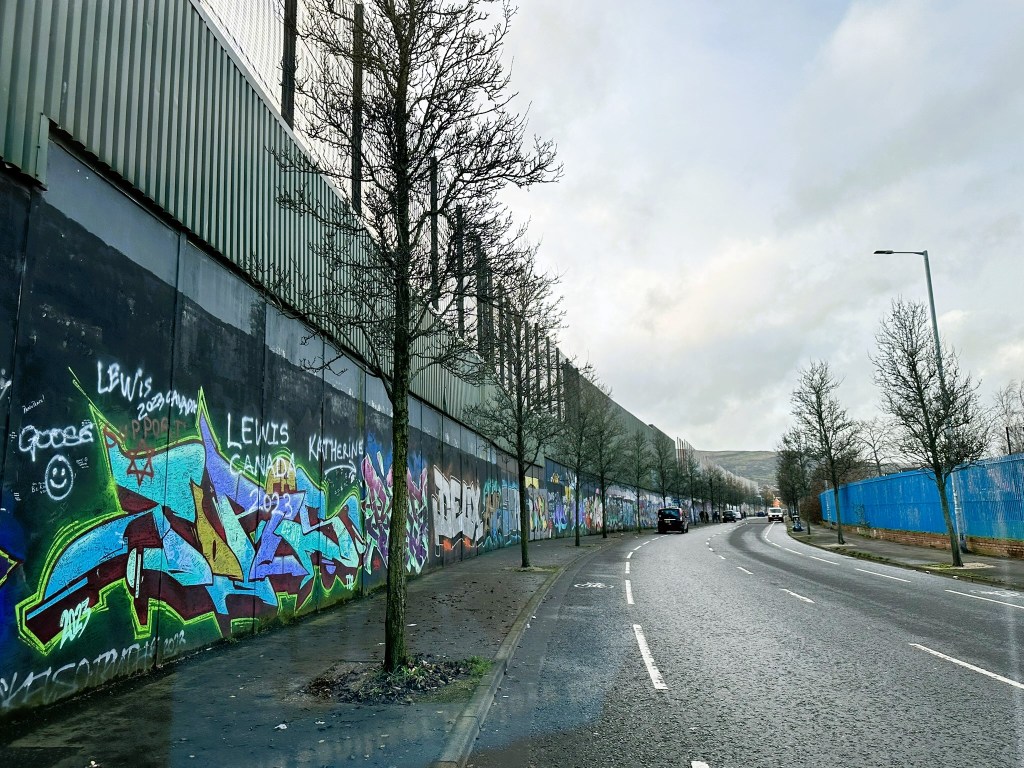
I must admit I was completely unaware that Belfast had walls, known as Peace Walls, separating parts of the city!!  The building of these started in 1969 to keep the two communities apart and today there are still around 30 walls left, around 13 miles of walls.  They were called Peace Walls as everyone understood that they were to keep the peace by minimising inter-community violence and therefore each side could feel safe in their homes.  Even today some of the gates in the walls are closed at night, others are just closed if there are increased tensions.

My guide was sure to point out that the walls have been built in Catholic gardens and very close to Catholic houses (in some cases as little as a metre from the house) – they were never built in protestant gardens!

These days, things are much calmer and are far less black and white (or Irish and British) as they once were. Even inter-community marriages are not uncommon today.  Despite this, although there have been discussions about taking the walls down, the majority of the communities still feel more comfortable keeping them in place and today they are covered in murals, old and new, some of which are now famous landmarks of the city.

We spent some time looking at the murals on both sides of the walls.  They ranged from more historical murals showing the victims of the 1981 hunger strikes to much modern murals showing support for the Palestine/Israel conflict – with the Catholics supporting Palestine (as they feel they are being persecuted in the same way that they were) and the Protestants supporting Israel.  On some of the more abstract murals, more like graffiti, visitors are encouraged to sign their names.

Today, in more peaceful times, the Sinn Fein politic party continues the fight in the Houses of Parliament on both sides of the border for a unified Ireland and in Belfast there are neutral zones where people are not allowed to fly flags of any kind or support any specific side or party.  That said, according to Billy, they are still at least two generations away from real peace, as those who lived through the Troubles still remind their children to “remember who you are, where you come from and what you have lost”.

I found this tour particularly interesting as I grew up only hearing the British side of the story, and living in London in the 1990’s, I experienced the fear of IRA bombs in the city (at least 3 went off in hearing distance).  I found it important to finally hear the other side of the story and be reminded that all stories have two sides.

During my wandering, I had discovered that my hotel was right next to the Grand Opera House and that there was a traditional UK Christmas pantomime on – I felt to round out my cultural experience for the day I should attend, and I managed to nab one of the last tickets. The Opera house is a beautiful example of Frank Matcham architecture opened in 1895 and today it was showing Snow White and the Seven Dwarfs and as with all pantos, although they may be touted for children there is plenty of double meanings for the adults 😉and it was great fun.

And to top it off, it turned out that I was sitting right by famous Northern Irish actress and singer Rachel Tucker – star of the West End.  All in all, a perfect way to finish up my few days in Northern Ireland.  

And to the North – Northern Ireland and the Causeway Cause

December 2023

4 days in and still waking at 4am 🤦🏻‍♀️but I won’t let that stop me, perhaps just slow me down a little lol.

Boxing Day, or St Stephens Day as they call it in Ireland, was a beautiful morning to be heading back to the airport to pick up my rental car and head north.  As always, I wanted to make sure I had plenty of time so went to get the 8.15 bus – which never came 🤦🏻‍♀️so it was a good job I was not in a hurry.  I did just have to stand on the side of the road in 4c for an extra 40 minutes waiting for the next one! 

Actually, its not entirely true that the bus did not turn up.  There was an AirCoach parked up near the bus stop but no driver – perhaps someone had a big night the night before! 

When the next bus came it said it was full – still no explanation as to what happened to the previous bus!  Thankfully I managed to get one of the last seats and finally made it to the airport.  But the fun was not yet over for the day.  I joined a long slow queue for my rental car pick up, to be told when I finally made the front of that queue that I needed to go somewhere else and to go wait outside for the shuttle bus 🤦🏻‍♀️!   And guess what – then join another queue!!!

Finally, I was in my car, and after a short amount of time getting use to it (remembering to change gears and to stop turning on the windscreen wipers instead of the indicators lol), I was glad to get out of the city, passing through some small towns and beautiful farmlands.  Sadly, no photos as I am now driving. 

I had not expected a border crossing when going from the Republic of Ireland to Northern Ireland, but I expected at least a sign!!  But there was literally nothing, just a sudden and subtle change in speed signs from kilometres per hour to miles per hour!   It was all rather odd, and it was clear that not everyone got the subtle change as they continued driving at 60kph and not 60mph – that is not such a subtle difference lol. 

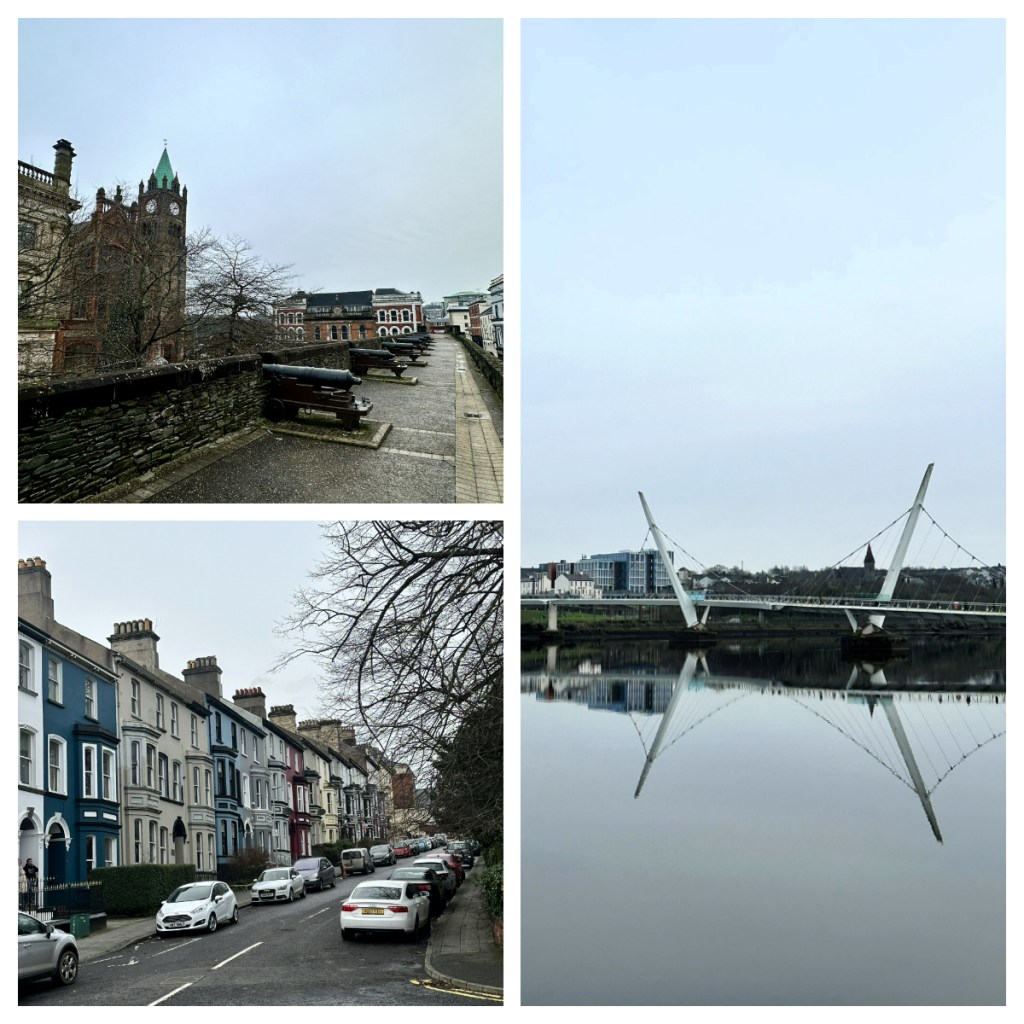
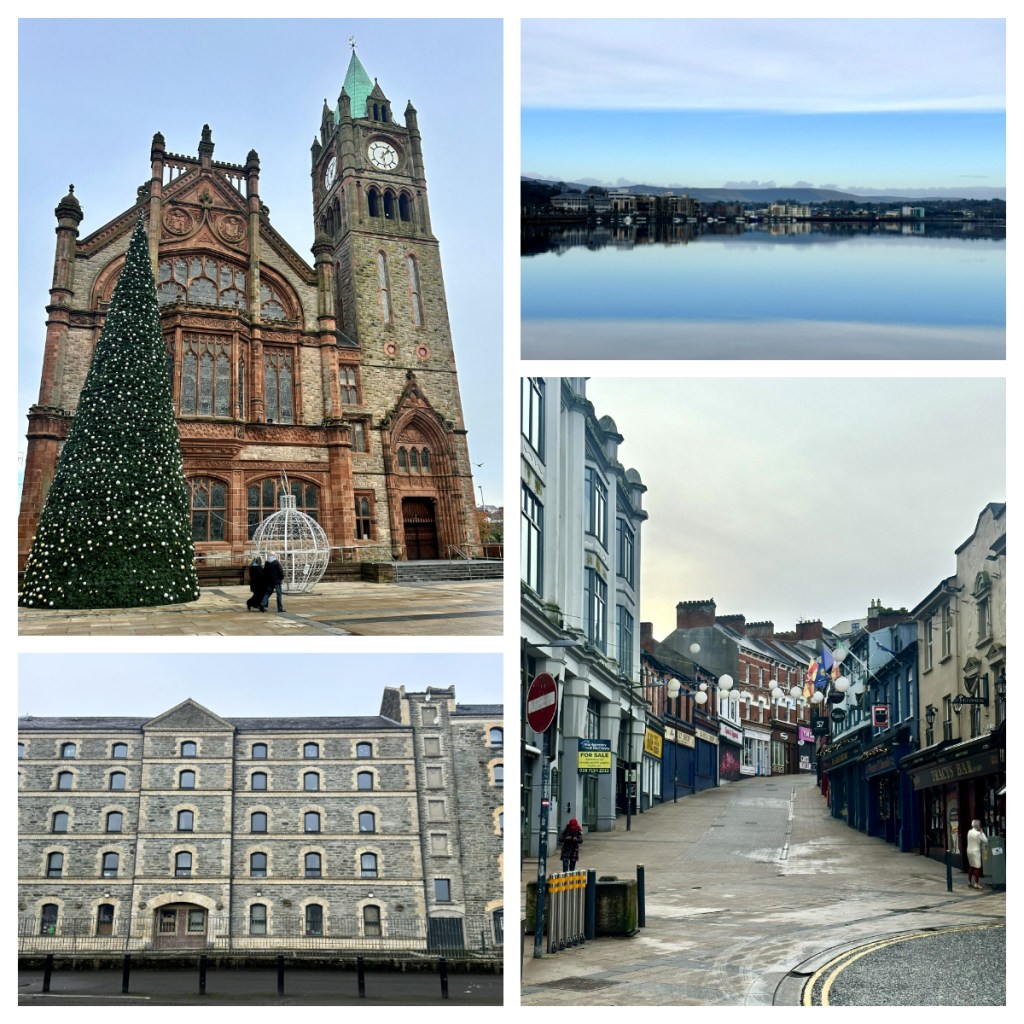
It was around 3.5 hours drive to my first stop of the day – Londonderry, or Derry as it seems is the preferred name.  It is the only remaining completely walled city in Ireland sitting on the banks of the river Foyle.  The walls were built in the early 1600’s as defenses and they were never breached!  Still today it provides a walkway around the entire inner city.

As with the rest of Northern Ireland, the history of Derry is complex and it is considered one of the oldest continuously inhabited places in Ireland, dating back thousands of years.  From the Tudor conquests in the early 1600’s to the Irish Rebellion later that century, the city became an important port for Irish emigrants leaving for the new world in the 18th and 19th centuries.

The Irish War of Independence between the Irish republican Army (IRA) and the British Forces ended with the partition of Northern Ireland in 1921, before and after which, sectarian violence raged.  I will go in to this a little more in when I write about my time in Belfast where I took one of the political tours to learn more about the partition and later the Troubles.   The result of the Partition of Ireland was that Derry suddenly became a border city.

The city and its port (one of the key reasons Britian wanted to maintain it during the partition) played an important role for the Allied navies as a base and jumping off point for shipping convoys between Europe and North America. 

Now that is probably enough of a history – or perhaps too much?  Unfortunately, given it was a holiday, I could not get a walking tour, so I had downloaded an online one.  It was ok but an in person one would have been better.

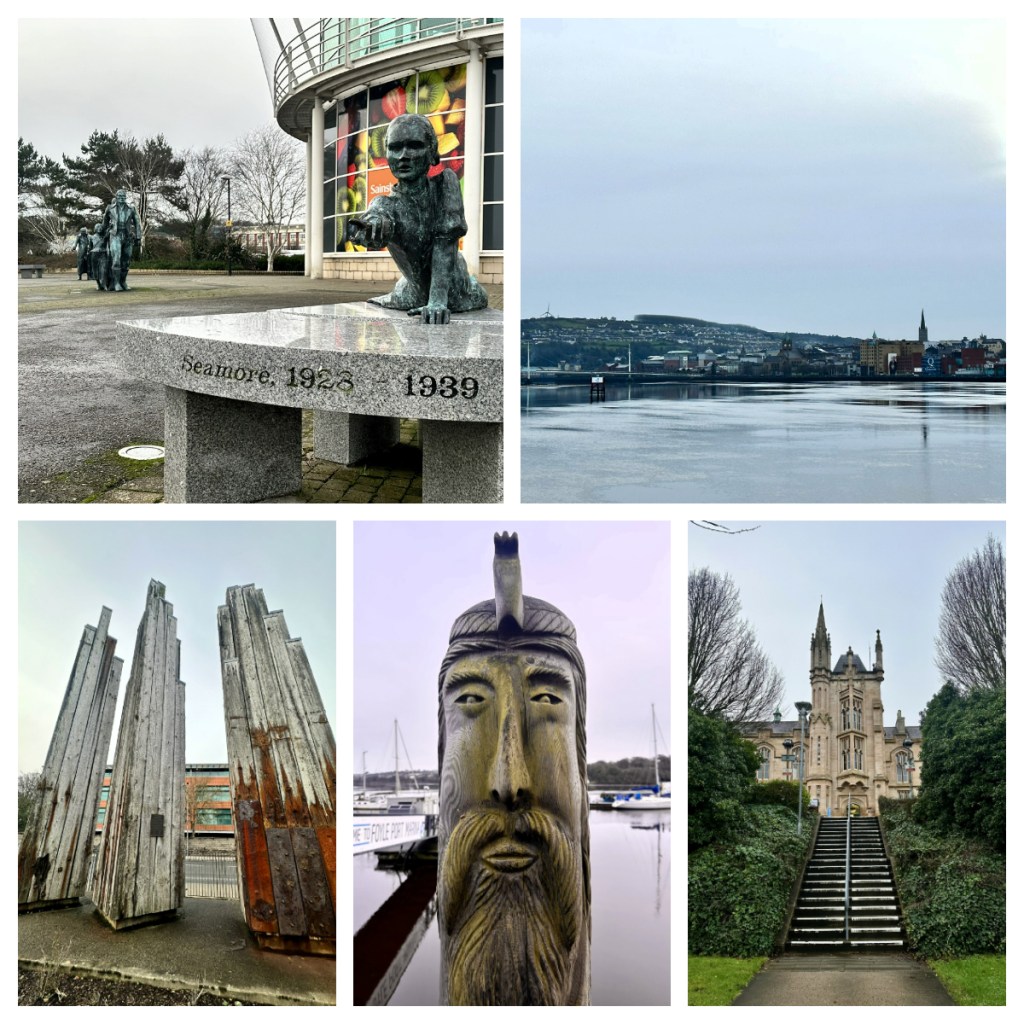
The walk took me passed the Guildhall and along the river Foyle, passed the Peace Bridge which opened in 2011.  The guide talked about the importance of textile industry and shipping to the city (see the brief history above) with stops along the way to see monuments to the shipping industry, Manannan Mac Lyr, the Great Northern Sea God in Celtic mythology and those who left from here in search of a better life. 

I continued up the hill, passed the some of the buildings of Ulster University and back down to the city walls and back to my car.  As I drove out of the city, I passed the famous “Free Derry corner” in the Bogside neighbourhood.   Between 1969 and 1972, this was a self-declared autonomous nationalist area (which they barricaded off from the security forces) and was the site of the Battle of Bogside in 1969.  It was also the site of the 1972 riot when 14 unarmed civilians were killed by British paratroopers – the event known as Bloody Sunday. 

By this time, it was almost 3pm and the darkness comes early here, particularly on these overcast days, so I hurried as quickly as the narrow country roads would allow to my next stop – the Dark Hedges.  Described as an avenue of beech trees, it was made famous when it appeared in Game of Thrones.  Firstly, I will say, it looks nothing like the images I had seen online, and I did hear some comments on the radio that they think it will disappear within the next 15 years if nothing is done to preserve it!  Not sure I would have said it was worth the detour, but my FOMO (fear of missing out) would have got the best of me if I had not gone and seen it for myself lol. 

It was really getting dark now as my final 30 minutes driving for the day took me along more narrow country lanes with no streetlights, definitely not my favourite driving conditions but I guess I had to be grateful that it wasn’t raining! 

After a long, cold day (I don’t think it has got above 5 degrees all day) I had hoped to get something warm to eat in the local pub in the village of Articlave where I was staying. Unfortunately, even though they were open, they were not serving food so I headed straight to my AirBnB and enjoyed a bougee cold dinner of mozzarella and prosciutto which I had bought in Dublin.  It was a comfortable house and nice room, and I had a great night’s sleep.

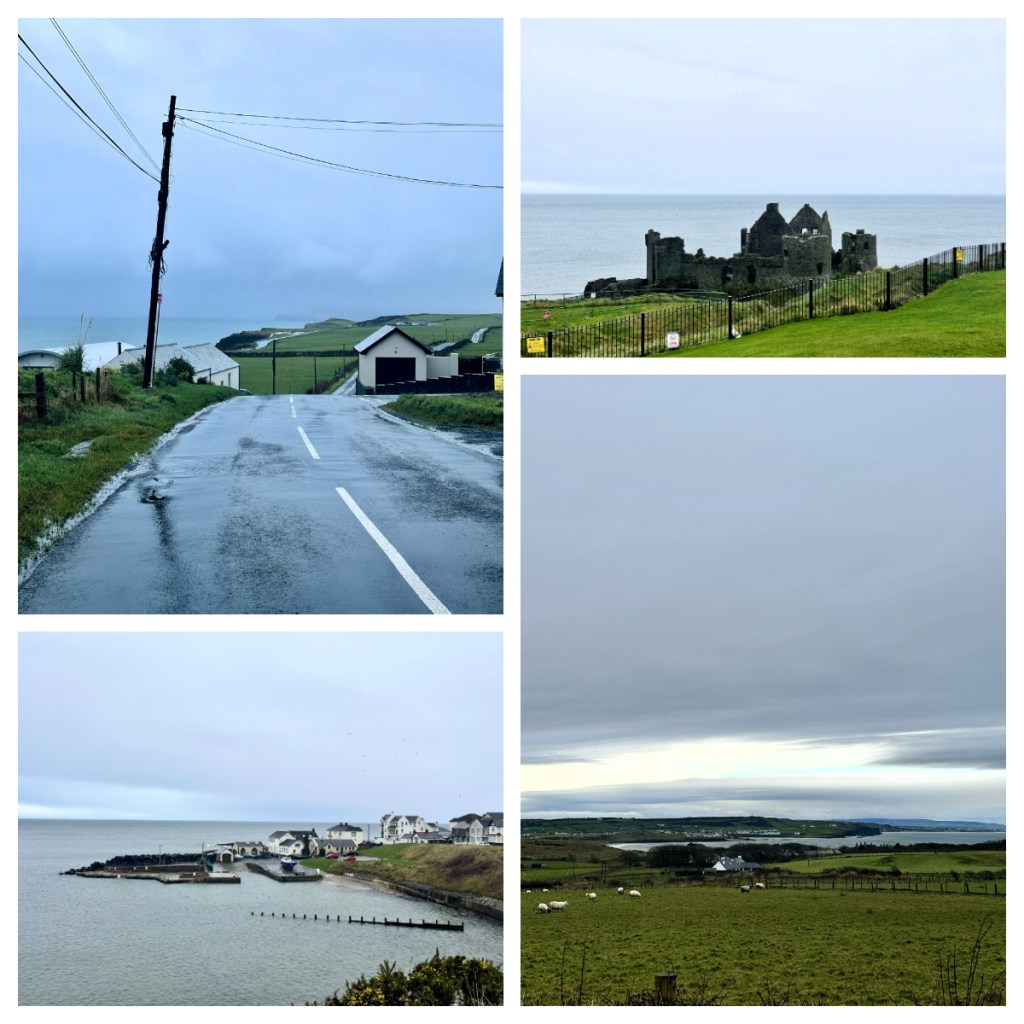
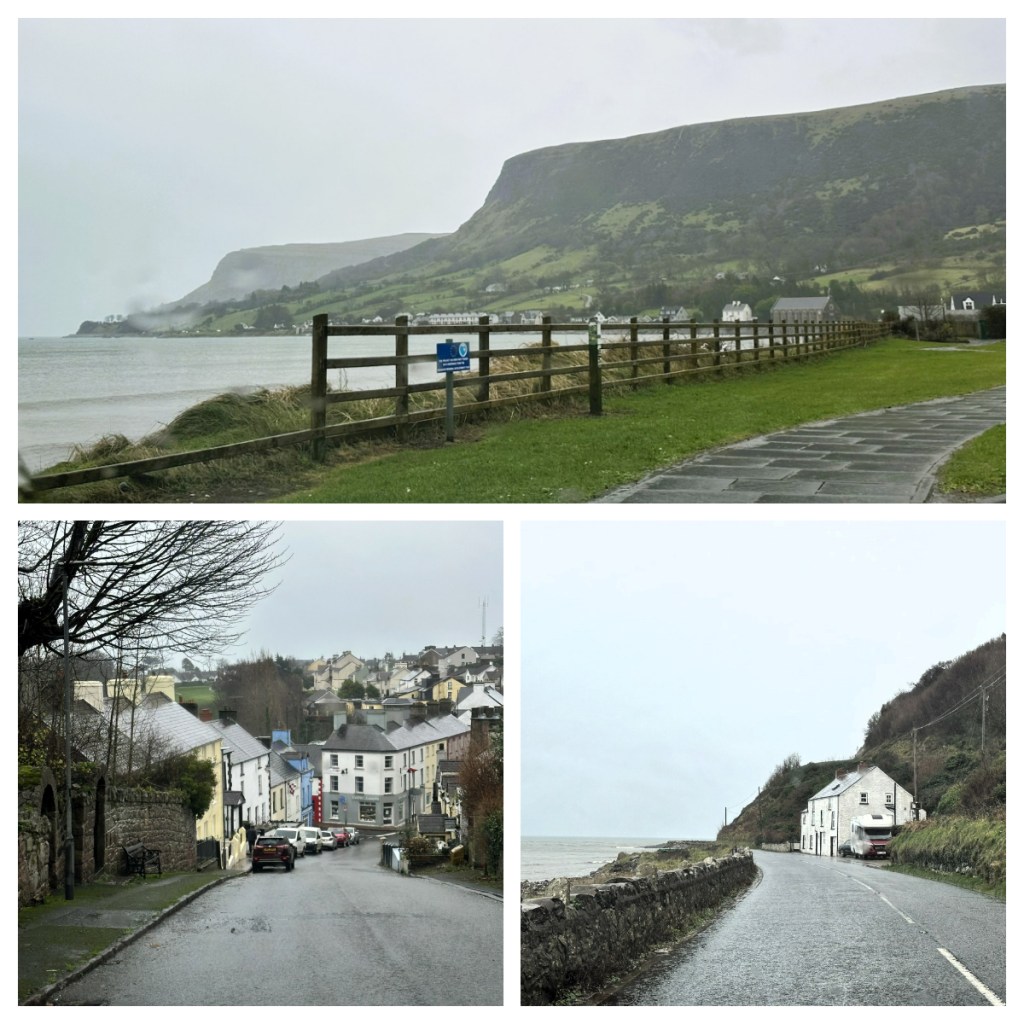
Over night it had rained and rained (I believe from Storm Gerrit who was ravaging the UK) and after fighting the household cats for my breakfast, I was back on the road, splashing through surface flooding to drive the Causeway Coastal Route – the coastal road between Derry and Belfast.

My first stop was at Dunluce Castle, a 16th/17th century castle built on the site of a 13th century fort.  The castle has had a colourful passed, being the home of Scottish chieftains and Irish ‘royalty’ and has been subject to a number of sieges, Sadly, it was left to ruin in the late 1600s when the Earl of Antrim moved on.  Unfortunately, the castle was closed so I could not explore, but you could still get a view of it from the car park.  

From here I took a quick detour through the cute seaside town of Portballintrae, before reaching one of the main sites for the day, the Giants Causeway, a UNESCO World Heritage site (Natural Landscape) which came to fame as its portrayal in Game of Thrones (I have never watched the show but wonder if I should give the number of filming sites I have been to!)

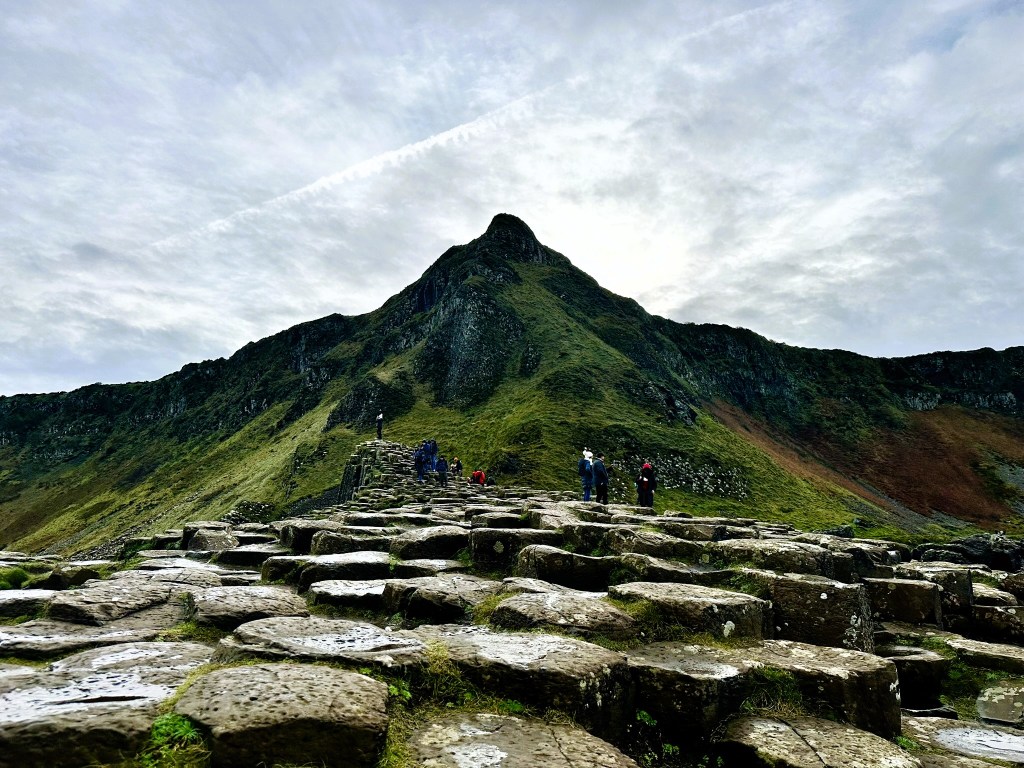
The guided tour that is part of your entrance fee starts in the information centre, and from here we walked down the road toward the causeway as our guide regaled us with information about the geology and the myth of the area. 

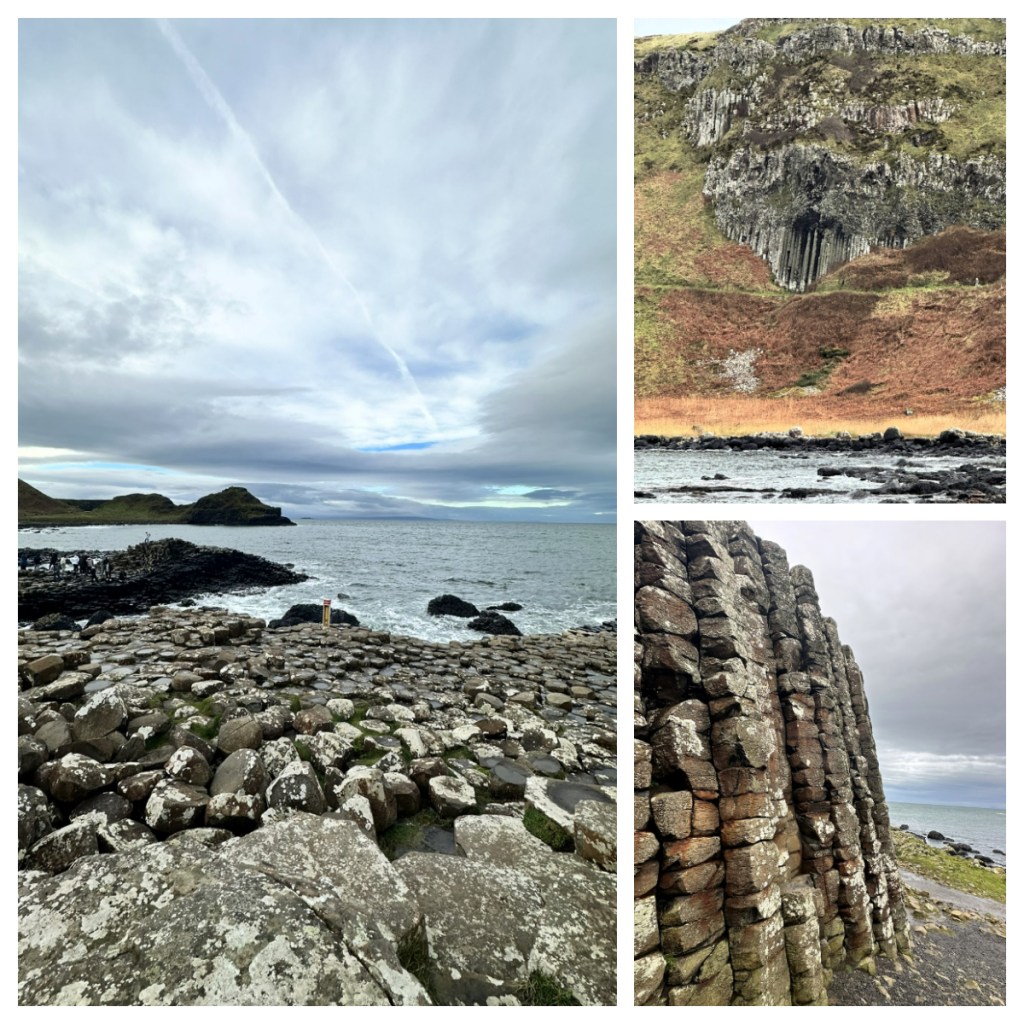
Geologically speaking, the 40,000 black basalt columns, are thought to be around 60 million years old, and the result of tectonic plate movements and successive lava flows.  There use to be over 60,000 columns but they were quarried in the early days and can be seen in buildings around the area, such as Dunluce Castle.  The site was declared a UNESCO World Heritage Site in 1986 (the only one in Northern Ireland) and it is one of Northern Ireland’s most popular tourist sites.  Thankfully be the off season it was not too busy (they sometimes get 7,000 people visit in a day). 

Now, there is the geological stories of Giant’s Causeway, there is also the legend of the infamous Finn MacCool.  The Irish take their mythology very seriously and much of it dates back to pre-Christian Ireland one of these is the mythical giant Finn. 

When Finn’s beloved Ireland was threatened by the Scottish giant Benandonner, he tore up the Antrim landscape and threw its pieces into the sea, resulting in a pathway across for Scotland.  When, Finn recognised just how strong Benandonner was, he made a hasty retreat back to Ireland where he disguised himself as a baby.  When Benandonner arrived at Finn’s house, he saw the huge baby and was terrified to think how big Finn must be if this was his baby – it was now his turn to flee, destroying as much of the Giant’s Causeway as he could on his way back to Scotland.   And of course, that is how it got its name.

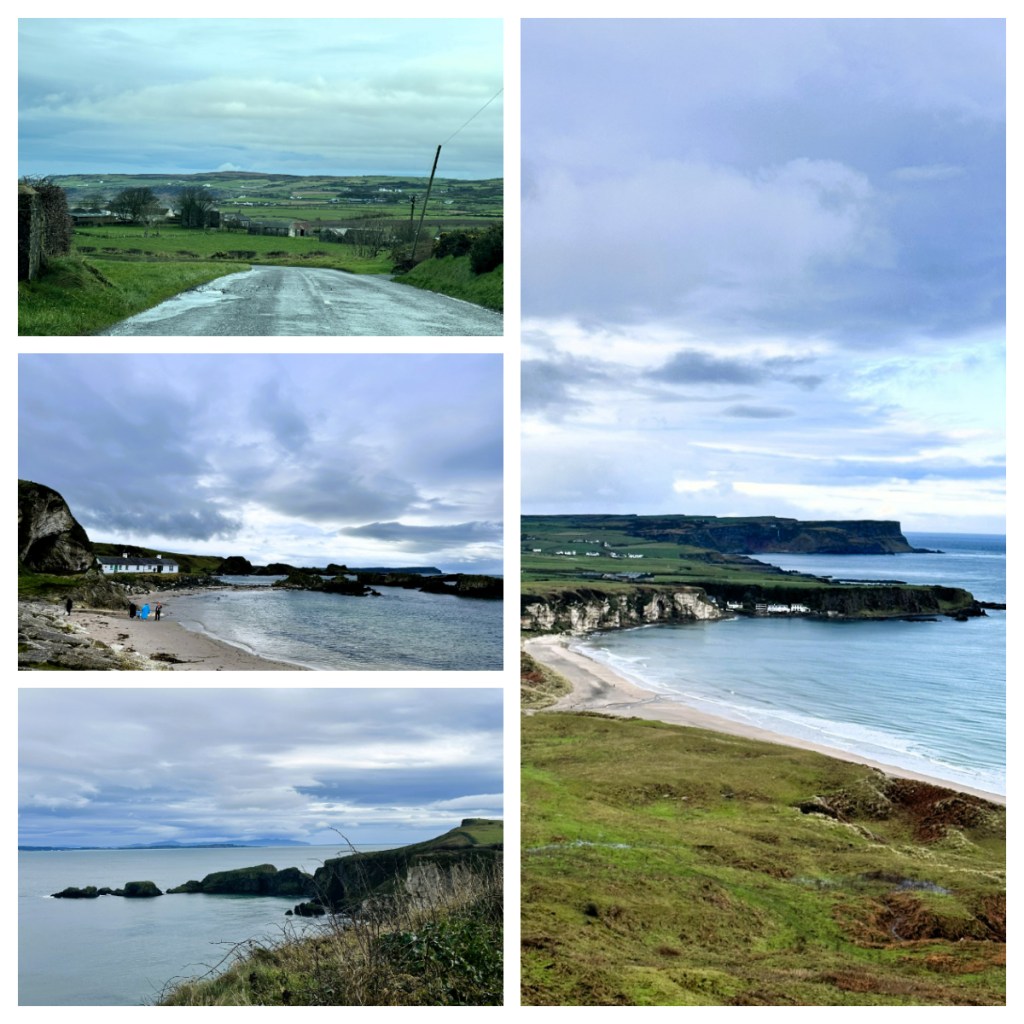
From the Giant’s Causeway, I continued along the coast, taking a another short detour in to the picturesque town of Ballintoy Harbour, apparently another Game of Thrones filming location and stopping along the way at viewpoints (the beauty of doing this independently rather than with one of the many tours is that I can stop wherever I want!) until I reached the next stop on the route – Carrick-a-Rede.

Carrick-a-Rede is a rope bridge that links the mainland to the tiny island of Carrickarede.   The rope bridge was first built in 1755 by Salmon fishermen who used the island as a base for the Salmon fishing season.  Of course, the build has been rebuilt many times over the years and today the 2008 built bridge, meets today’s health and safety requirements.   Sadly, due to the decline of the local salmon population (due mainly due to pollution and overfishing), 2002 saw the end of the salmon fishing industry in the area.

It was around a kilometre walk from the car park to the rope bridge, which is only around 20m long, but sits around 30ms above the exposed coastline.  As it was the low season, it was fairly quiet, and I can only image how long you might have to wait to cross in the summer.   As it was, it still took some time to get across, waiting for the group in front of me to take their photos/videos and then for the assistant to help someone across who had frozen just a few steps out on the bridge! 🥴

After the torrential rain of the night before, it had turned in to a beautiful day for my drive – a moody sky but no rain when I was doing my outdoor activities.  I was very fortunate!

I took another detour down a very narrow windy road to follow a sign to Kinbane Castle.  Built in 1547, what was a two story castle has been left for ruins after numerous sieges by the English and the raging weather.  When I reached the car park and saw the steep narrow pathway down the side of the cliff to the castle – I decided to enjoy the stunning view from the top 🥴🥴.

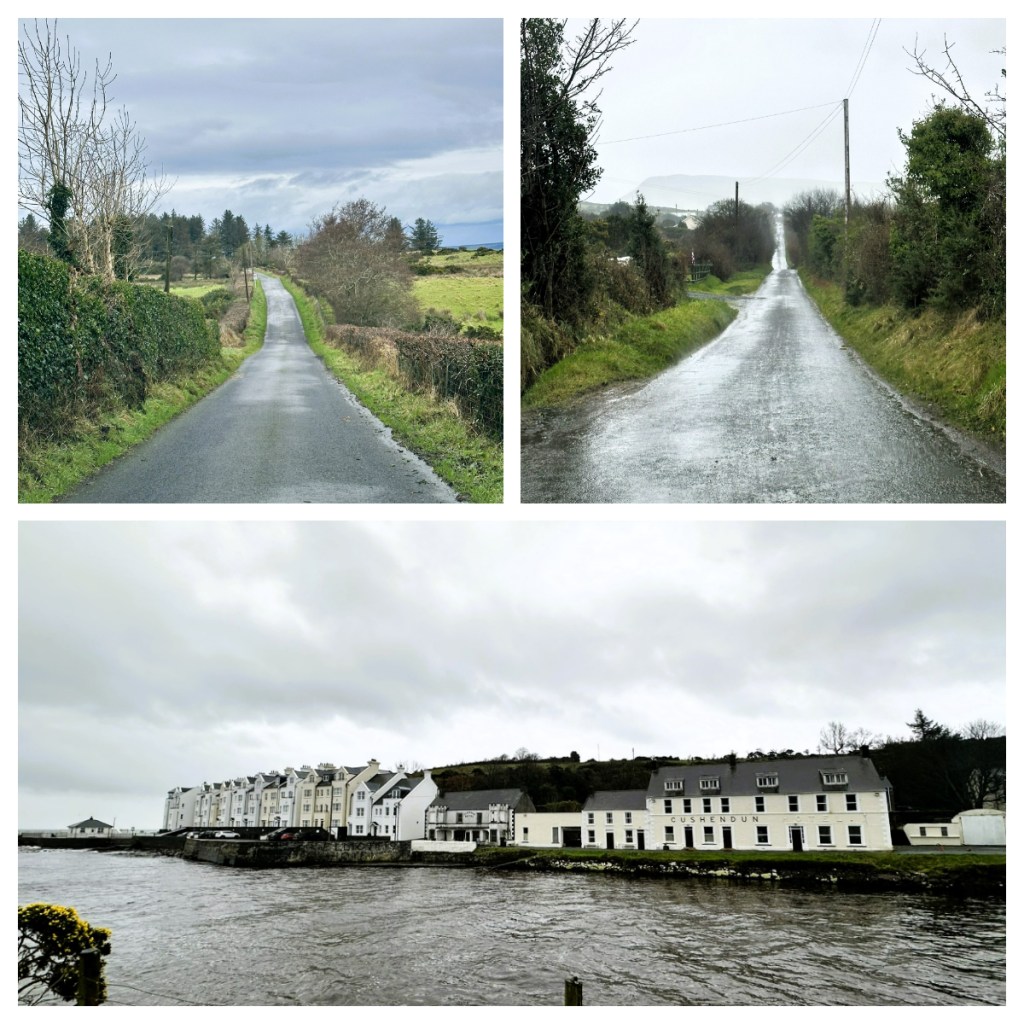
I had hoped to have a break at a café in the small town of Cushenden but unfortunately, as with many things, it was closed so after a quick photo stop, I continued.  The weather had started to deteriorate by this point, and I continued to question some life choices as some of the roads google maps took me on where barely roads in my opinion 🥴.  The dodgy road took me back to the coast and it continued right along the sea front.  The narrow road was covered in debris from the storm overnight and still had some surface flooding.  In fact, my final planned stop was literally washed out as the road was shut and the detour was another 20 minutes, so I decided to call it a day and head for the Belfast (still on some dodgy roads until I finally hit the motorway with some relief). 

After a long but successful day, I made my way to the Airbnb I had booked in Belfast.  Unfortunately, I was not keen on the area or the set up so I decided to book myself a hotel … the cost was worth a comfortable couple of nights, so I treated myself.  I was exhausted after another beautiful, busy day so was happy to be having somewhere comfortable to rest and relax to recharge.

An Irish Christmas

December 2023

It’s been a number of years since I have been away for Xmas – obviously it is summer in New Zealand which means longer holidays are possible with all the public holidays, so this year I thought I would take advantage of that and head north, way north … in hind sight, probably not the best idea going from summer to winter and travelling at the busiest time of the year … but, someone’s got to do it!

I caught Singapore Airlines straight out of Christchurch, no one in line at check in, no one in line for customs, no one in line for immigration – and that is why I would always try and travel to/from Christchurch if I can.  It is 10 hours to Singapore, then a 3 hour layover, followed by the long 14-15 hour leg from Singapore to London. I managed to get some sleep but of course never enough, or at the right time of the ‘day’. 

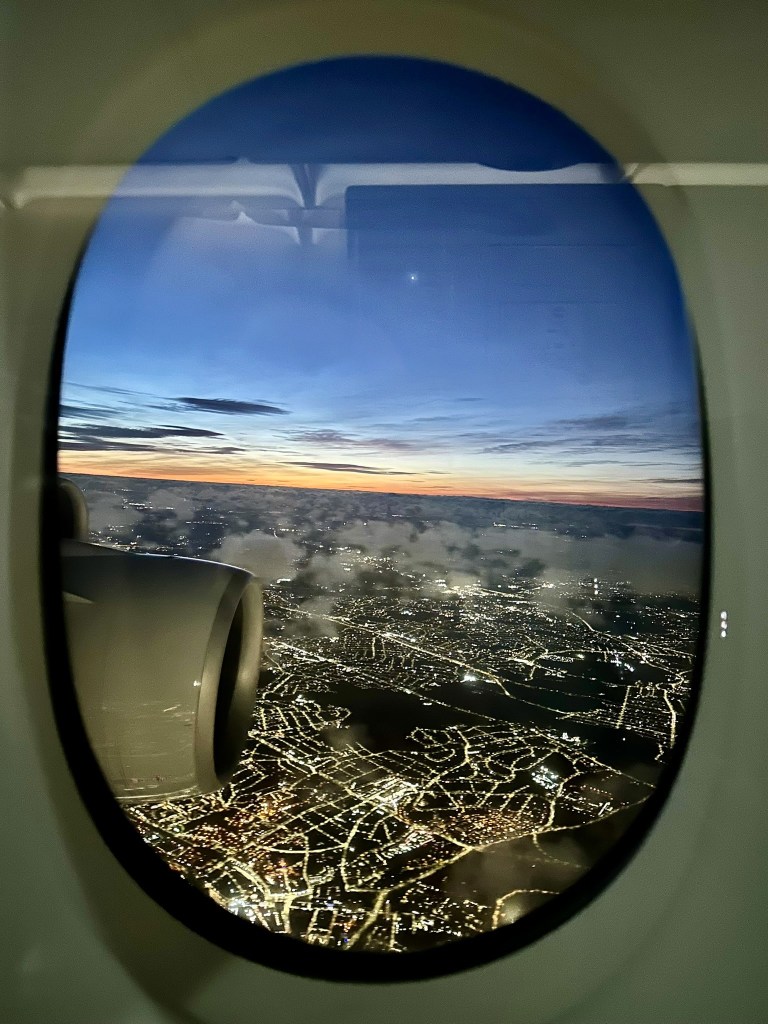
I had less than an hour to get to my gate for my final flight of the day in Heathrow, but with a delay of over an hour, I ended up having much longer.  I filled the extra time eating – probably 3 breakfasts in all, enjoying my favourite UK foods as I spotted them – including a Pret a Manger Christmas sandwich and being reminded that flat whites (coffee) in England do not equal flat whites in NZ!!  Almost 1 hour 20 late my final flight took off, a 1 hour hop to Dublin, the capital of the Republic of Ireland. 

We had a fairly long walk from the plane to immigration and baggage claim but that meant my bag was already out – all so quick and efficient.  I headed straight out the doors into some fresh air (finally) and then on to the Aircoach to the city centre.   Unfortunately, my hostel room was not ready, so I dropped my bag and headed out. Now the struggle really started – to stay away!

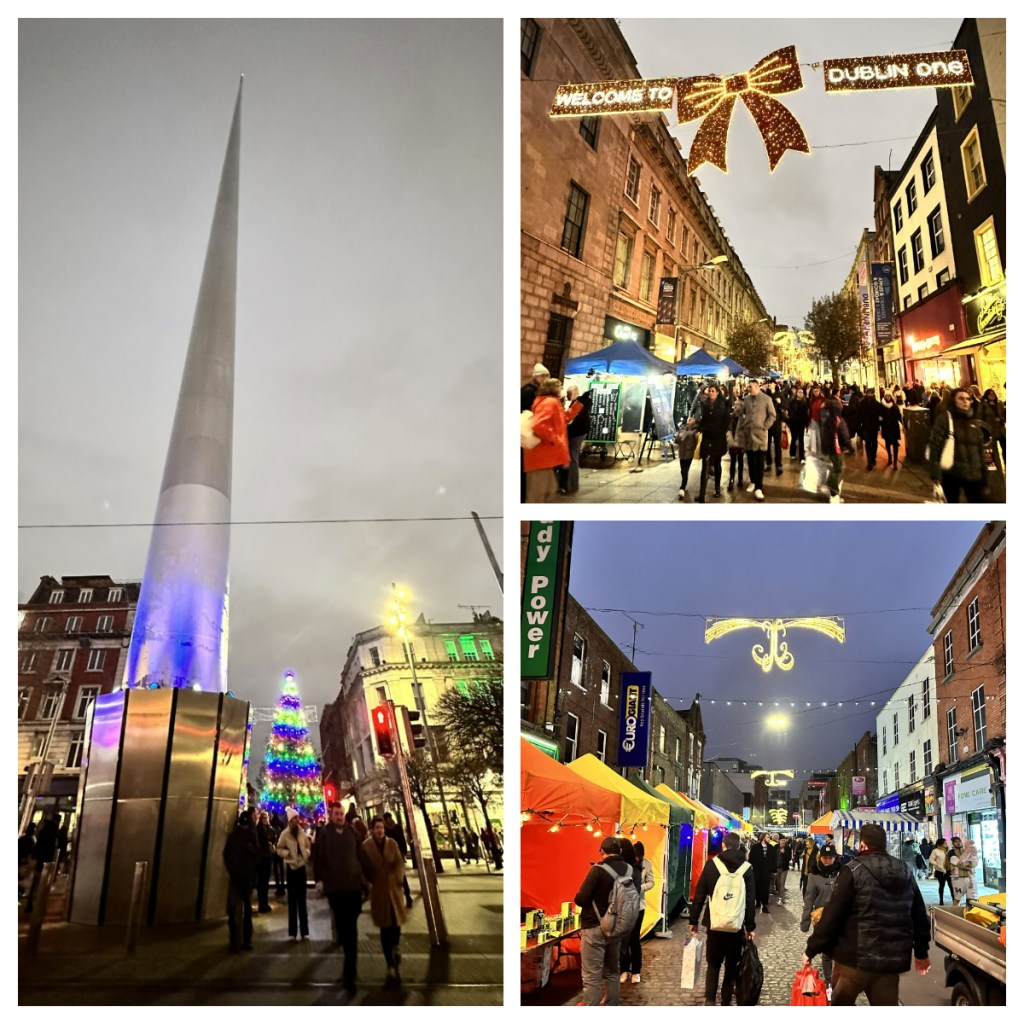
I wandered the streets, stopping to enjoy some of the many buskers along the famous Grafton Street,  including one I had often seen videos of on social media – I didn’t even know she was from Dublin so it was a nice surprise to see her live.  (Her name is Allie Sherlock and she has over 2.3M followers on Instagram along – check her our.)

I stopped in pub for some food and there was a musician playing, he started playing Fairytale of New York by the Pogues.  It was probably very corny and touristy but to me, it could not have been more perfect.   

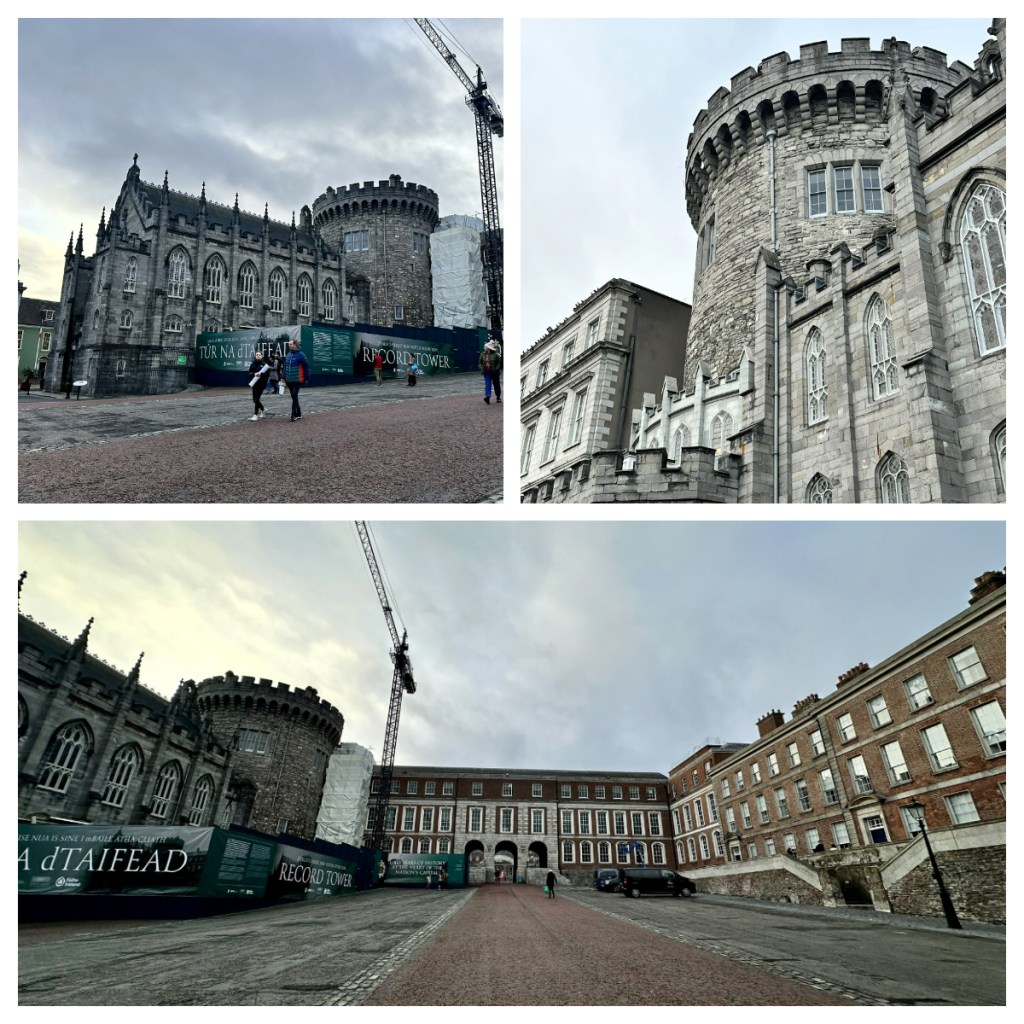
With still more time to kill, I joined a walking tour.  If things had gone to plan, I would have done a tour at 11am and be napping by 2pm, but the flight delay meant that was not possible so here I was 🥴.  The first stop of the tour was Dublin Castle where the guide, Kieran, gave us brief rundown of Irish history 101.  I should probably mention that he started off by telling us the Irish saying “you should never let the truth get in the way of a good story” – so some of what he told us may not be based on fact lol!

First stop Dublin castle where we learnt about the “arrival of strangers” as the arrival of the Vikings were known.  Historically, the Vikings were marauders, coming in to pillage Irish settlements and then leave, until around 800AD when a group of Vikings created the earliest and longest lasting Viking kingdom in Ireland.  They named it Dyflin, which then became Dubh Linn, the Irish for Black pool, a black water pond, part of the River Poodle, near their camp. 

Dublin Castle itself, was initial built on the same area as the Viking settlement in 1171 just after the Anglo Norman invasion began 800 years of English occupation, with the castle being the seat of English power.

In its life, the castle has been a military fortress, a prison, a treasury and law courts.  Following Ireland’s independence in 1922 Dublin Castle handed over to the new Irish government and it continues to be a key government complex.   Most of the original castle was destroyed in a fire in the 1600’s and has been rebuilt steady over the centuries. 

Kieran told us an interesting story about the theft of the Irish Crown Jewels that had been kept in safe, in a strong room.  They were discovered missing in July 1907.  They had just vanished without a trace.  Despite an extensive investigation, including the use of physics and Arthur Conan Doyle (because he had written the Sherlock Holmes stories), and a hefty reward being offered, to this day they have not been found.  Another fun fact, Bram Stoker (of Dracula fame) used to work in the castle when it was part of the Treasury. 

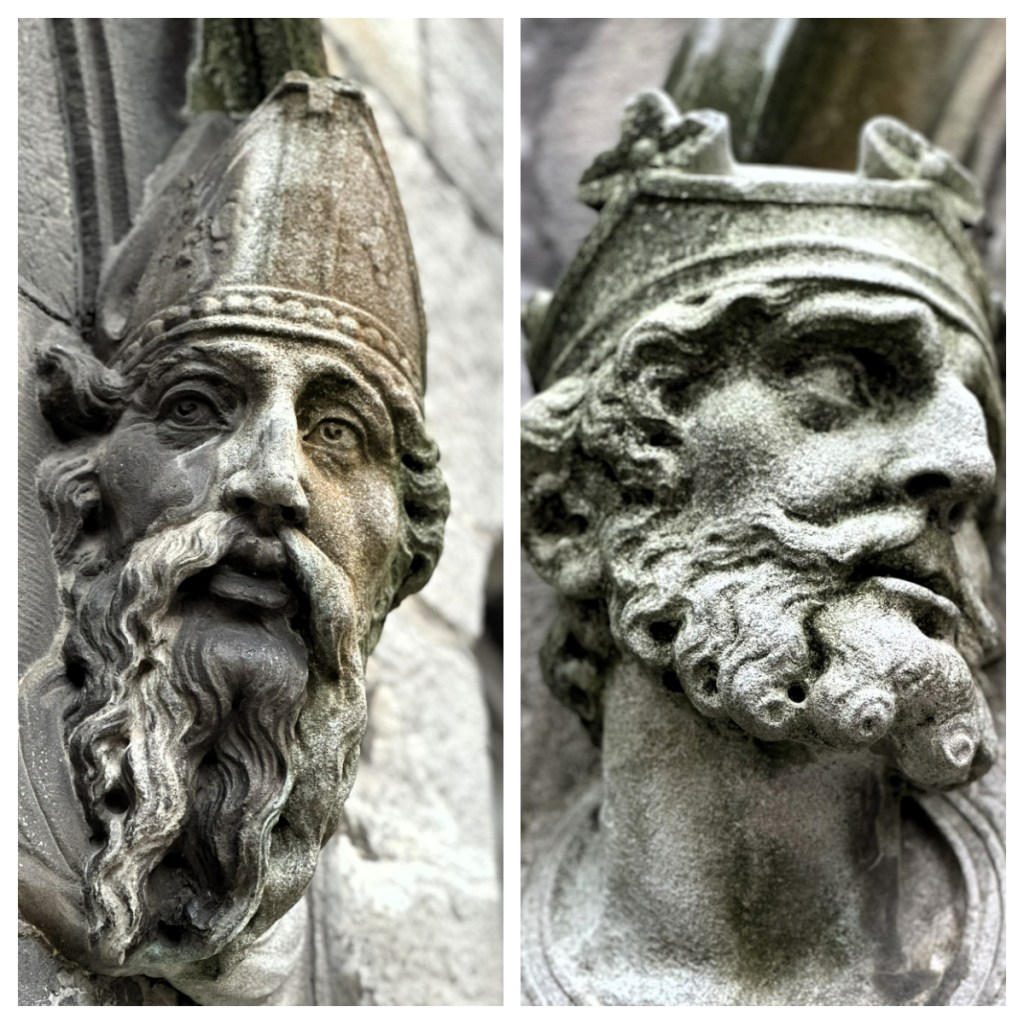
Speaking of fun facts, did you know St Patrick was not Irish???  He was actually Welsh! He was kidnapped by Irish pirates as a teenager and spent 6 years in Ireland as a slave.  He returned home for some time where he found God,  before returning to Ireland as a missionary to convert the then Irish pagans to Christianity.  To top it all off, Americans invented St Patrick’s day and it was first celebrated in the USA in 1932, before spreading back across the ocean to Ireland. 

We talked about the Gaelic language.  Ireland became official a bilingual country in 1922.  Prior to this, the ruling English had done a pretty good job of eradicating the language.  At one time it was illegal to speak it, resulting in a lot of local Gaelic speakers ending up in jail with no idea why (as every time they asked what was going on, they broke the law by speaking Gaelic).  Today about 40% of the population speak with competency, and it is mandatory for government workers including the Garda (Police). 

We passed the beautiful Christ Church, one of three cathedrals in Dublin.  This protestant cathedral was initial build in 1028, but most of what we see today is from 1875.  One of it’s biggest claims to fame is that Handel’s Messiah was premiered here in 1742.  After the concert they were cleaning the pipe organ and found the dead bodies of a cat and a rat – the original Tom and Jerry of Dublin.   Apparently, their bodies are preserved and on display inside the church, along with the heard of Laurence O’Toole, the patron saint of Dublin, who died in 1180.

We strolled through Temple Bar, enjoying the Christmas lights before crossing over to the banks of the River Liffey, the river that runs through the city.  There are a number of pedestrian and road bridges across the river.  The most famous foot bridge is the Liffey Bridge, better known as Ha’penny Bridge due to the toll that used to be paid.  It was actually built by the same company that built the Titanic and it almost collapses a couple of times, before they replaced the wooden planks. 

The tour ended at O’Connell Bridge, this time a road bridge and the only bridge in road that is as wide as it is long.   I was grateful that it was also right near my accommodation so I could finally check in to my room around 5.30.  My room was ok, a 4 bed female dorm, with a little ensuite bathroom which had what must be the smallest shower room I have ever seen 🥴.

One thing that will take a day or two to get used too is how early it gets dark- when it got dark I was thinking it must be really late, but it was not even 5pm!!  Great for enjoying the Xmas lights though.

Not surprisingly, I was up at 4am – jet lag and time zone differences suck!  I managed to sleep a little longer before I headed out just before 8am, and again it was still surprisingly dark.  I headed to a nearby supermarket to  stock up on food for the next couple of days when most things will be closed and I will be on the road.

Shopping done, I was out for another walk before meeting my friend Suzanne for a lovely afternoon catching up.  Enjoying good food and drinks in local pubs – some very old and one that had the smell of mulled wine filling the air.

We then went and joined the crowds at the “The Busk”.   Organised by Irish singer and actor Glen Hansard, the Busk is a Christmas Eve traditional and is a fundraiser for a homeless charity.  In previous years, the likes of Bono (from U2) have turned up, but this year, my bladder got the better of me before too long, so we escaped the crowds and headed to another pub for a last one for the road. There was a lovely atmosphere around the city and in the pubs and in each one we got chatting some of the other punters but I couldn’t believe how early everything closed.  By 7.30 the pubs were closing, I couldn’t even get a hot chocolate on my way back to my hostel as all the cafes were already closed.

Christmas Day dawned and everything was quiet in Dublin except for Church bells ring out around across the city.  Suzanne came and picked me up and we did a little tour through some of the beautiful seaside suburbs of Monkstown, Dun Laogjaire, Sandy Cove and Dalky.  We managed to find a park amongst the crowds at Sandy Cove – a famous spot for a Christmas Day swim.    There was so many people enjoying a dip in sea – not me though, I don’t swim in the sea in New Zealand so I definitely not going to do it in Ireland lol. 

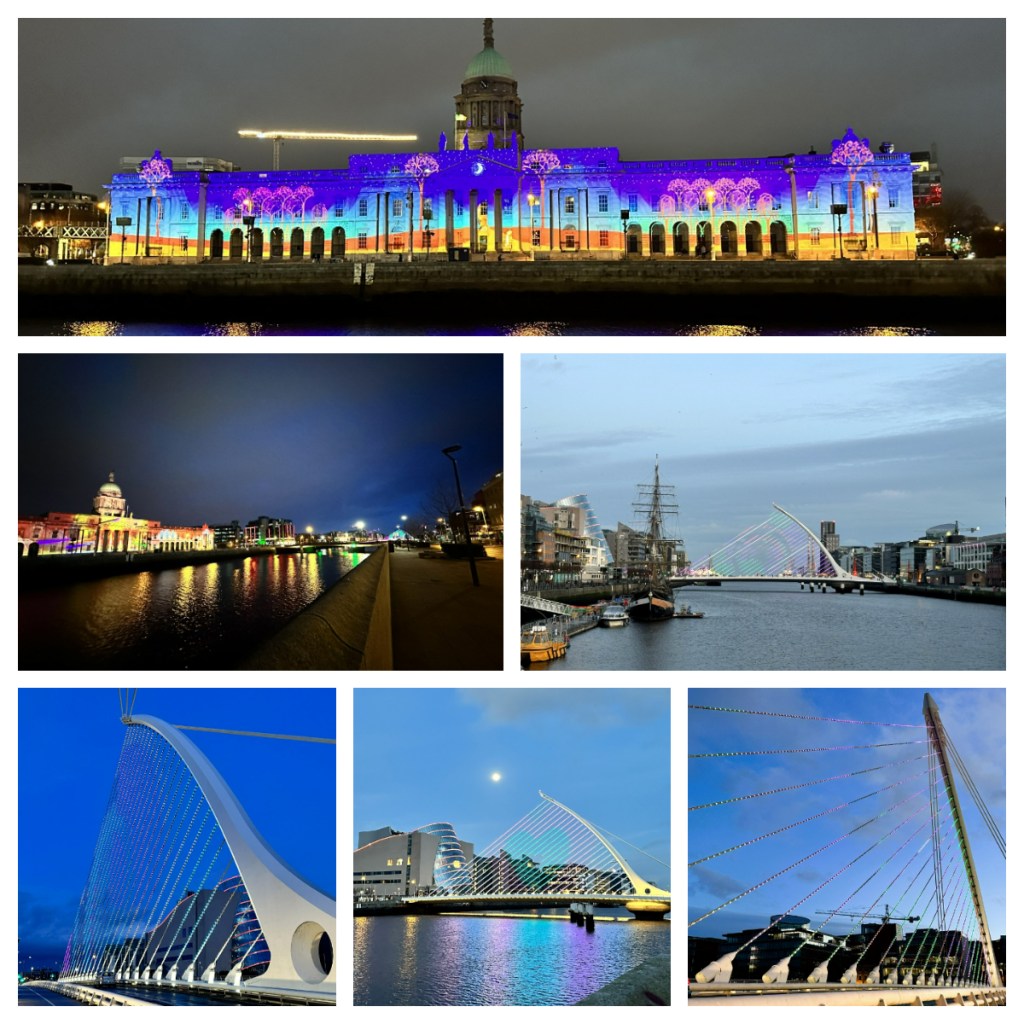
After a wonderful full Irish breakfast (ok, it was lunch time) and mimosas at Suzanne’s, I needed another walk lol.  This time I walked down along the river to enjoy the Christmas lights projected on to the Custom House and those on Samuel Beckett Bridge.  It was a great way to end my first few days in Dublin.