
Boston, USA
December 2025
As with most trips from New Zealand, it was a long travel day to get to the east coast of the USA. First a flight from Christchurch to Auckland, then Auckland to San Francisco, and finally San Francisco to Boston. You know it is a bumpy flight when the crew were told to sit down 4 times! Despite the turbulence, the flights were not too bad.
Upon my arrival into San Fran, I decided to try out the Mobile Passport Control (MPC) app, which is supposed to speed up your entry into the US by uploading your details in advance. The queue was definitely much shorter than the main one, but it did not move for some time as the so called ’dedicated’ gates were taking people from other queues – I can see how it could be quicker but not sure if it was on this day or not.
Either way it took just under an hour to get through all the formalities and into the departure area where my next flight went from and my search for coffee began. I only drink flat whites at home and many of the places that sold coffee only had filter coffee or something made by a machine (not a barrister) so I joined the long queue for the one that had barristers. My first observation being that their small is the size of our large – welcome to America lol. (It was not a good coffee but I drank it anyway as I was operating on very little sleep!)

I was glad to have a window seat on my last flight (and a spare middle seat) and there were great views of the city as we took off into the blue skies. The flight from the west coast to the east coast took about 5.5 hours, going from day to night, and blue skies and sun to freezing rain.
It was another bumpy flight and the captain came on multiple times to say that we were ‘completely safe’ 🥴 and I was surprised that on a flight of this length they did not provide a meal (unless you paid for it!) so I filled up on small bags of pretzels!
Upon arrival in Boston my bag did not appear on the carousel – but my airtag told me it was near me. Turns out it had come on an earlier flight and was left in a corner of the Luggage Hall. I could have saved myself 30 minutes if they had mentioned this! It had of course been a very long day (27 hours since I had left home) and I could not face public transport in the dark (and the sleet) to I opted for an uber. $NZ50 for a 6km journey seemed excessive but it was a stark introduction to prices in the US!
I had my own room in a hostel here in Boston. The room was basic but functional, quite industrial and concrete floors! Freezing cold to step on straight out of bed so ended up putting a towel on the floor to step on 🥴. Despite that, I had a great sleep and woke to a beautiful, but bitterly cold morning. I was keen to get out and explore and the hostel location was just a few minutes’ walk from Boston Common so I across the park to the Beacon Hill area – known for it’s narrow streets, brick footpaths, “federal” style houses and some of Boston’s most photographed streets.
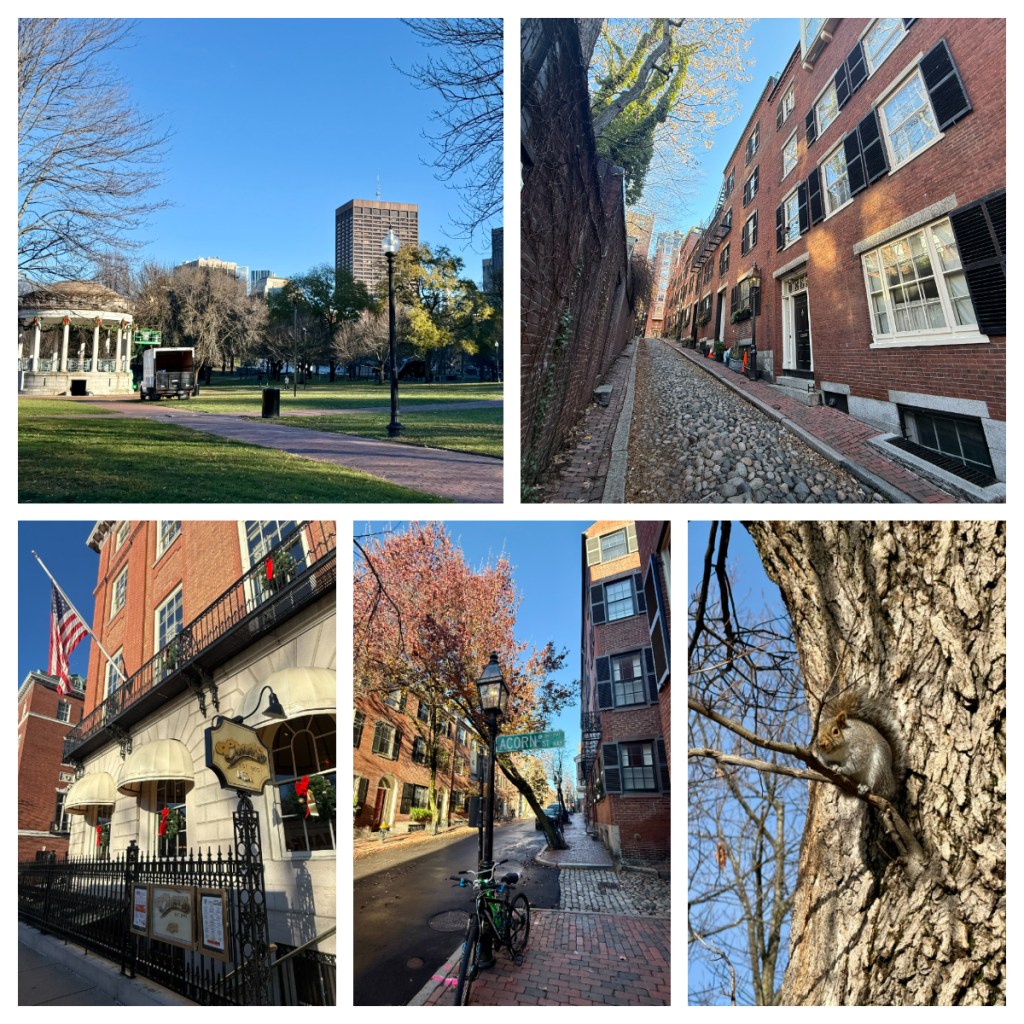
Christmas decorations along the streets and in the doorways and windows of houses were beautiful, although some not changed out Halloween stuff yet. I also passed by the “Cheers’ bar (you would need to be of a certain age to know what I mean by that (lol)) and started on my journey through American Christmas drinks – starting strong with an Eggnog Latte. It was sweet and a little odd (being unfamiliar with eggnog) but it grew on me🤣.
Back into Boston Common, I had the excitement of seeing my first squirrel, busily getting ready for their winter hibernation. I know they are really just rats with fluffy tails but they are kind of cute!
This morning I had booked to do a Freedom Trail walking tour – accordingly to every website I had looked at, this is a ‘must do’ when in the city. We only had a small group of 6 in total which was much better than some of the large groups we saw on the trial. Of course, you could do the walk on your own, following the red brick trial through the city, but we know how much I love a good history walk lol.
Boston played a crucial role in the American Revolution with the initial battles taking place in and around the city. I was a little embarassed to admit that most of the information I know about the American Revolution comes from the TV show Outlander and the musical Hamilton so it was time I got some real information! The Freedom Trail is around 4km long and takes you past 16 locations played a part in the history of the country, particularly around the fight for independence from the British.
We started in Boston Common, the first public park in the USA, and learnt about the earliest European settlers and their interactions with the local Massachuset tribe who were already living in the area. We also learnt about the changing landscape as the area used to have 3 small hills which were flatten and the dirt used to reclaim vast areas of land (the area called Back Bay was once the bay).
At the start of the revolution, in 1770, Boston had a population of only 15,000 people and at that time the Common was exactly that. A place to graze cattle, a place for public debate and protest (normally by the Sons of Liberty) and subsequently a camp for the incoming British soldiers as tensions built.
(There was so much information, I will try and keep this to the main points … and even then, this is likely to be a long blog so settle in lol.)
Victims of the Boston Massacre (who are also considered the first victims of the Revolution) are also memorialised here – more about this a little later.
One of our first stop was the Granary Buring Ground, where a number of Boston’s revolutionary heroes are buried:
John Hancock (1737 – 1793) – one of the richest men in the city (having made money from shipping) and a signatory of the Declaration of Independence. He actually found more ‘fame’ after the revolution.


Paul Revere (1735 – 1818) – of the Midnight Rise poem fame. He was a silver smith, cooper engraver, dentist and father of 16! He had to work a lot of jobs to feed all those children.
Robert Treat Payne (1731 – 1814) – a prominent lawyer and another ‘Founding Father
Samuel Adams (1722 – 1803) – one of the most outspoken of the Son’s of Liberty. Prior to his death he destroyed all his papers, noting that he had been committing treason for many years, so there is little known about his personal history. His second cousin, John Adams was another Founding Father and went on to be the second president of the United States.
Our guide noted that a lot of the early headstones would have been wood, or there would have been no marker at all, so many are more recent. He also told us to look out for some of the interesting death imagery on some of the stones – lots of Grim Reapers and skull and cross bones pictured 🤣 .
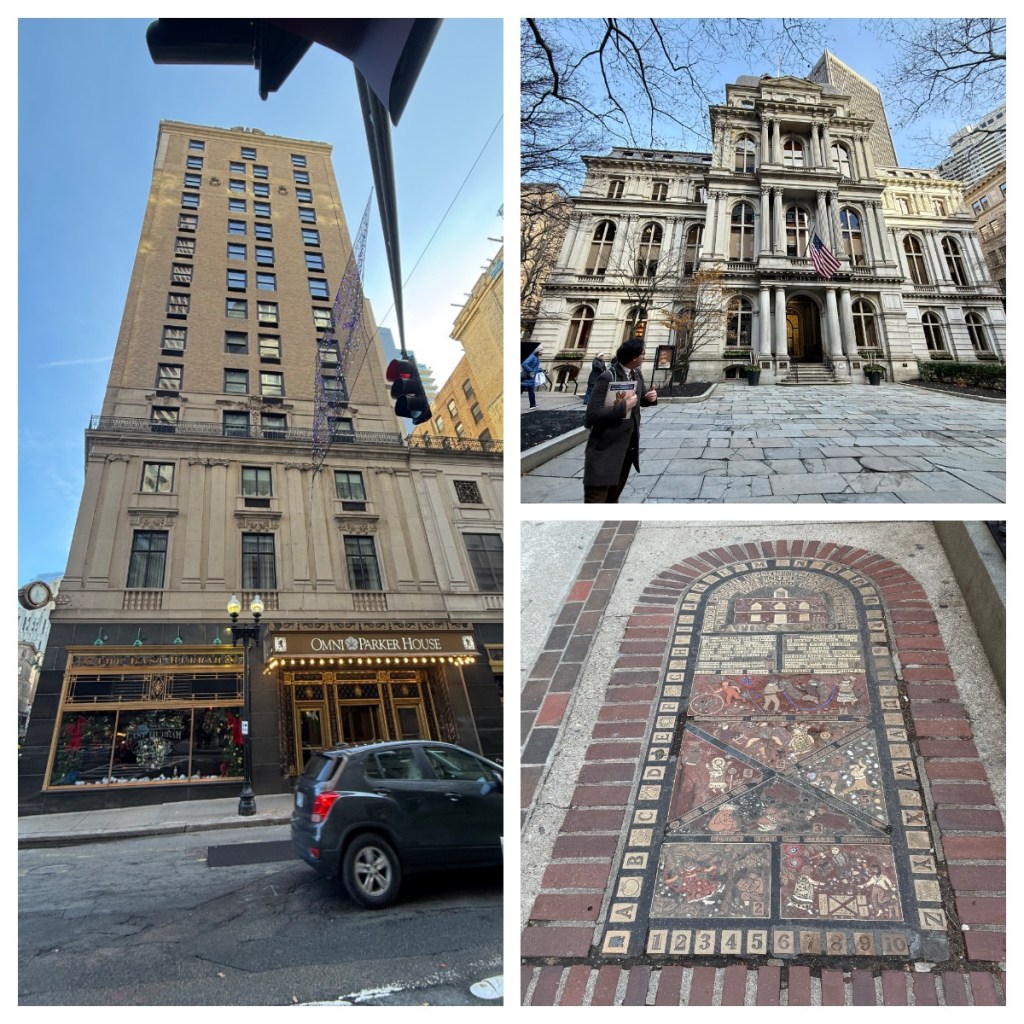
We passed the Parker House, a historic hotel, founded in 1855. Martin Luther King used to work here, JFK proposed and had his Batchelor party there, and they invented the Boston Cream Pie. Technically a cake, it is sponge cake, sandwiched with vanilla custard and drizzled with Chocolate icing. I made a note to go back later for this!
We stopped by the Old City Hall (now a Steak House) which is on the same grounds that once housed the old Latin School where all the Boston Founding Fathers went to school.
In the late 1750s, England were trying to recoup money to pay off their huge debt (a result of the 7 year war with France) and started to impose ridiculous taxes on the American colonies – violating their rights as English people and leading to the phrase “Taxation without representation is tyranny”
It started with a Sugar Act (1764) , taxing sugar and molasses, this was then repealed but soon replaced with the Stamp Act (1765) , taxing paper products! At this point the Governors house is destroyed in protest, resulting in that act being repealed, but then replaced with the Townsend Act (1967), taxing fancy goods, glass, paint (basically anything used in houses).
More protesting leads to 2,200 British soldiers being sent to the city to cut back on protests and smuggling (the city only has a population of 15,000). This lays the groundwork for the Boston Massacre that started outside (now the middle of a busy intersection) the Old State House on March 5th, 1770.
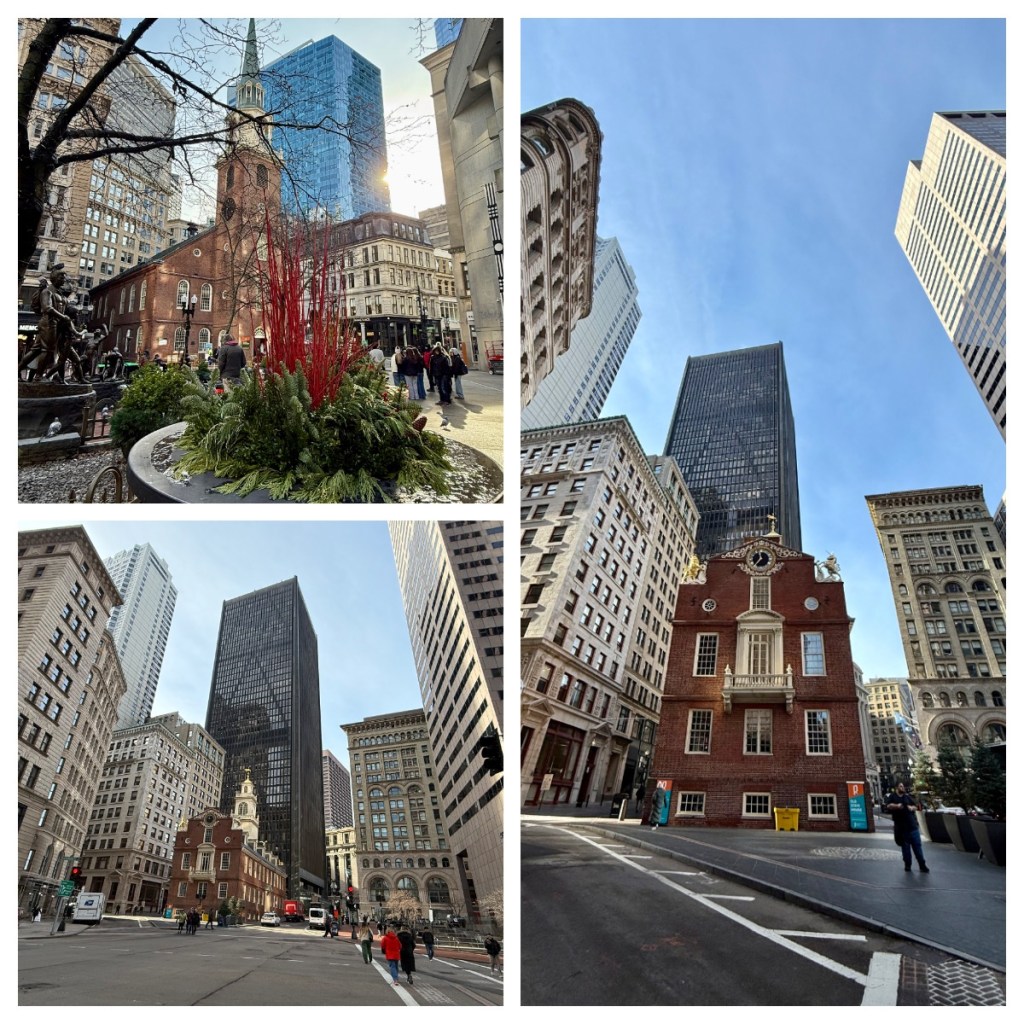
A group of young boys were throwing ice and snow and yelling such insults at him as “you are no gentlemen”! This escalates with the arrival of another solider who hits one of the boys, bring other people out of shops and taverns to see what is going on. Tensions are high and a rumour spread that there is a fire. Church bells start ringing to get people to bring water (as is the norm with fires). Of course there is no fire and everyone is ready for a fight.
No one really knows what happened next – from snowballs and insults from children, to bullets and death. John Adams (future president of the independent USA) acted as lawyer for the soldiers who are found guilty of manslaughter and are branded on the hand with the letter M.
After this the British troops are removed form the city and the Townsend Act is repealed. Tensions die down until …jump forward to 1773 and the Tea Act was put in place.
We continued walking, seeing the Old South Meeting House, once the largest meeting house in Boston, and the starting point for the infamous Boston Tea Party. On December 16th, 1773, 4000 people from around the region, gathered here to protest the latest attempt by the British to tax the colonies.
The Tea Act gave ships carrying tea just 20 days to off load their cargo (money did not exchange hands until the crates hit land). They also granted a monopoly to the British East India company, meaning they could only with them, undermining local merchants and distributors and ultimately replacing them with crown appointed distributors.
The Son’s of Liberty rallied and stopped the ships being offloaded and disguised as Mohawk Indians, they boarded three ships and threw their cargo of tea into the harbour. 342 chests of tea was destroyed, valued at around $US1.5M in todays money.
5 months later, when the news got back to England, they enacted the Intolerable Acts in 1774, which included shutting down the port of Boston and 4,000 soldiers were deployed to the city. This resulted in the Sons of Liberty leaving the city for Lexington and start their stock piling of guns and ammunition for the inevitable revolution.
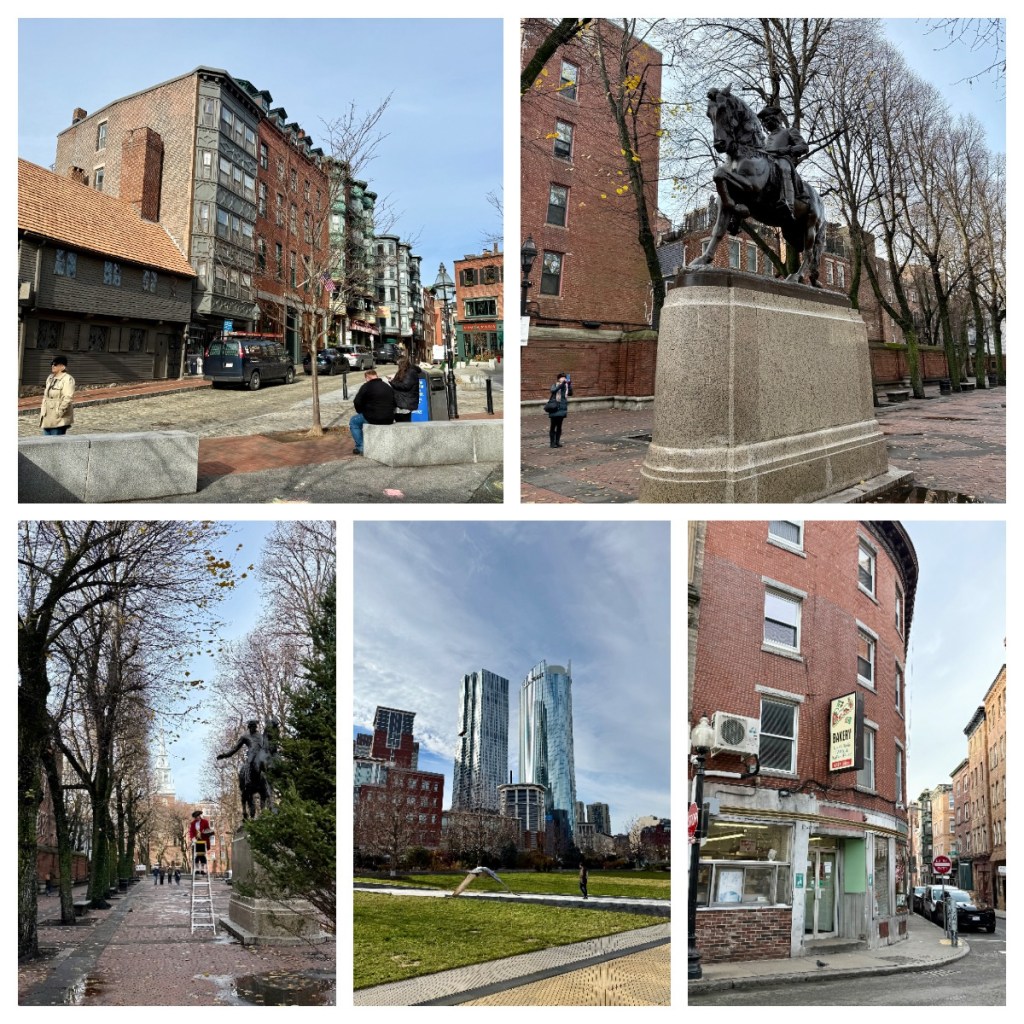
The Freedom Trial then took us across to the “North End” of the city, through some of the greenways that were created when they put a lot of the highways underground. Starting in the 1980’s the so-called Big Dig disrupted traffic in the city for 30 years! I can only image the disruption but I am sure it makes a huge difference to the city today.
This part of the city is the oldest residential area, some of which was settled in the 1630’s. There are lots of old buildings, lining cobble stone streets and is well known for its Italian population, leading to lots of great Italian restaurants and bakeries.
One of the last remaining wooden houses in the area is that of Paul Revere (who we met in the cemetery earlier in our walk) which was built in about 1680 and housed Revere and his family from 1770 to 1800. Today it has been fully restored and is a museum. The area is also home to an imposing Paul Revere statue, riding his steed in his infamous “midnight ride’.
The reality of the ‘midnight ride’ is not the same as the famous poem. There were a number of riders, including Mr Revere, who rode from Boston to Lexington to let the Son’s of Liberty know the British soldiers were coming. He was joined by Dr Joseph Warren and Dr Samuel Prescott amongst others and they travelled by horse and boat to ensure at least one of the messengers got through. Dr Prescott made it to Concord where the stockpile was.
Because of the early warning, 75 rebel were there to meet 700 soldiers and the soldiers fall back. On their way back to Boston they get shot at all the way.
The Freedom trail ended up on the shore, looking out towards Bunker Hill, the site of a great battle where the rebels were attacked by waves and waves of soldiers. They were finally defeated by the 3rd wave and although the British won a victory here, they lost so many soldiers in the process. As a result of the battle, nearby Charlestown caught fire and burnt to the ground. Abigial Adams, wife of John Adam’s wrote in a letter “the decisive day has com e on which the fate of American depends”.
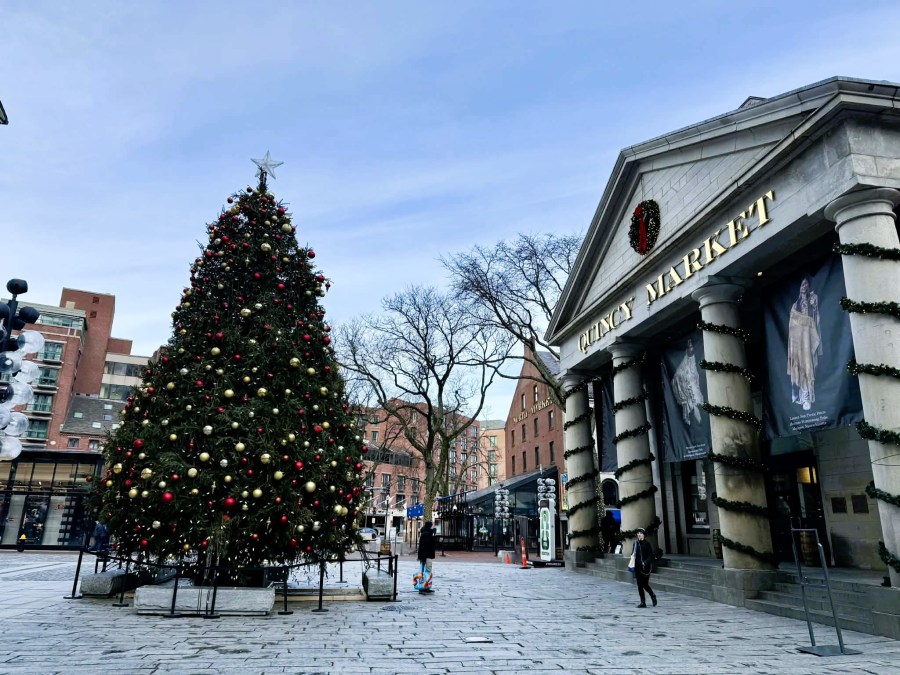
I walked back to historic Quincy market, a purpose built market, built in 1826. There were lots of food options, lots of lobster & chowder which the city is famous for, and the continued to walk along harbour walk along water front. It was all pretty quiet but I am sure it is a different place in the summer.


On my way back to my hostel, I did not forget to stop by the Parker House to get one of the Boston Cream Pies. It lookedbeautiful and given it cost me $US12.95 for a small one, I hoped that it was made of gold lol. I justified that it was one of those ‘when in Boston’ kind of things.
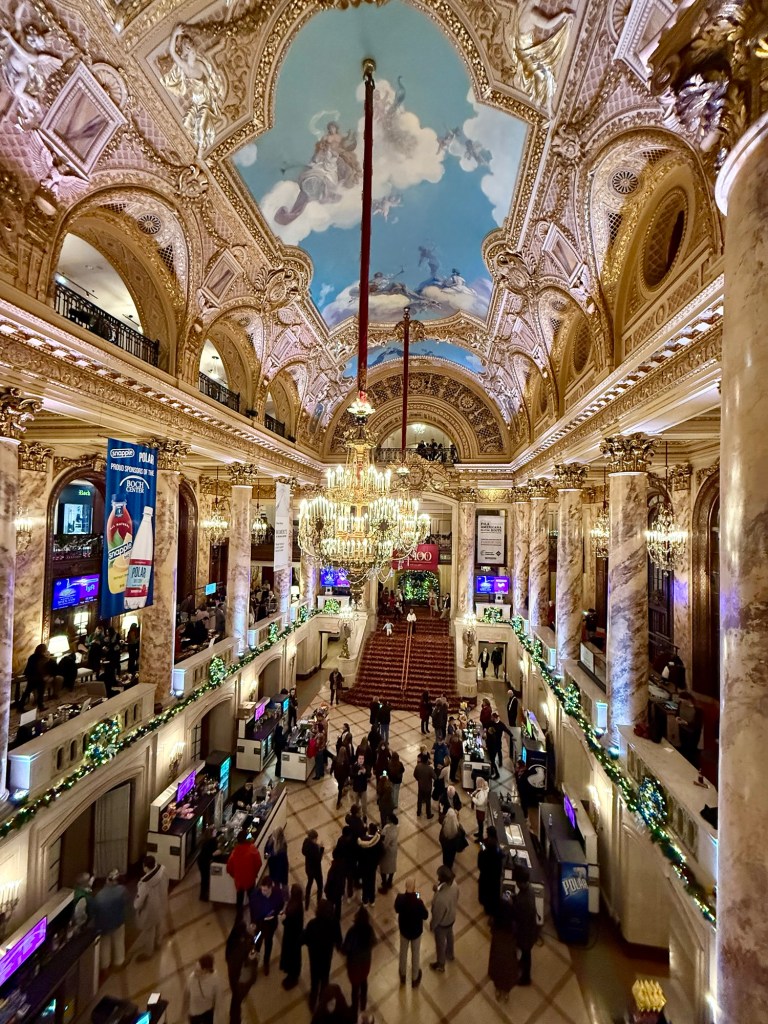
I rounded up the day going to a Cirque de Soliel Christmas show in the beautiful Wang Theatre (I was staying just around the corner from the theatre area) “Twas the night before”. The first of many shows and a great way to start my festive trip.
For my second (and final) day in Boston I adventured on the “T”, the Boston metro system and went out to explore the outlet shops of Assembly Row. It’s great that these days, many cities public transport can be paid for just by tapping your bank card. No need to buy a ticket. It makes taking the transport so much easier.
I had expected a mall but it was just a little suburb that was like a ghost town at this time of the day. Thankfully I had not expected it to be cheap despite being the outlet stores, with sales! There are however different shops and different options than at home so I did get a few things.
I headed back to city and had some lunch in a British pub (why I don’t know?) but I did get a Samuel Adams beer as I believe that sis another ‘must do’ in Boston.

I enjoy just wandering around the streets as it is a great way to stumble across things – this time I found myself in the main shopping area (which had odd Christmas ‘statues’) and on to the Copley Place mall, full of high end shops. Today’s novelty hot drink was a Gingerbread Dirty Chai – it was ok but not as good as the Eggnog Latte.
It had been a cold day and it was only to get colder as I headed out to see the Christmas tree lighting in Boston Common – a 2 hour concert and then the tree lighting . It started at -3 and snowing and ended feeling like -15! How festive 🤣❄️
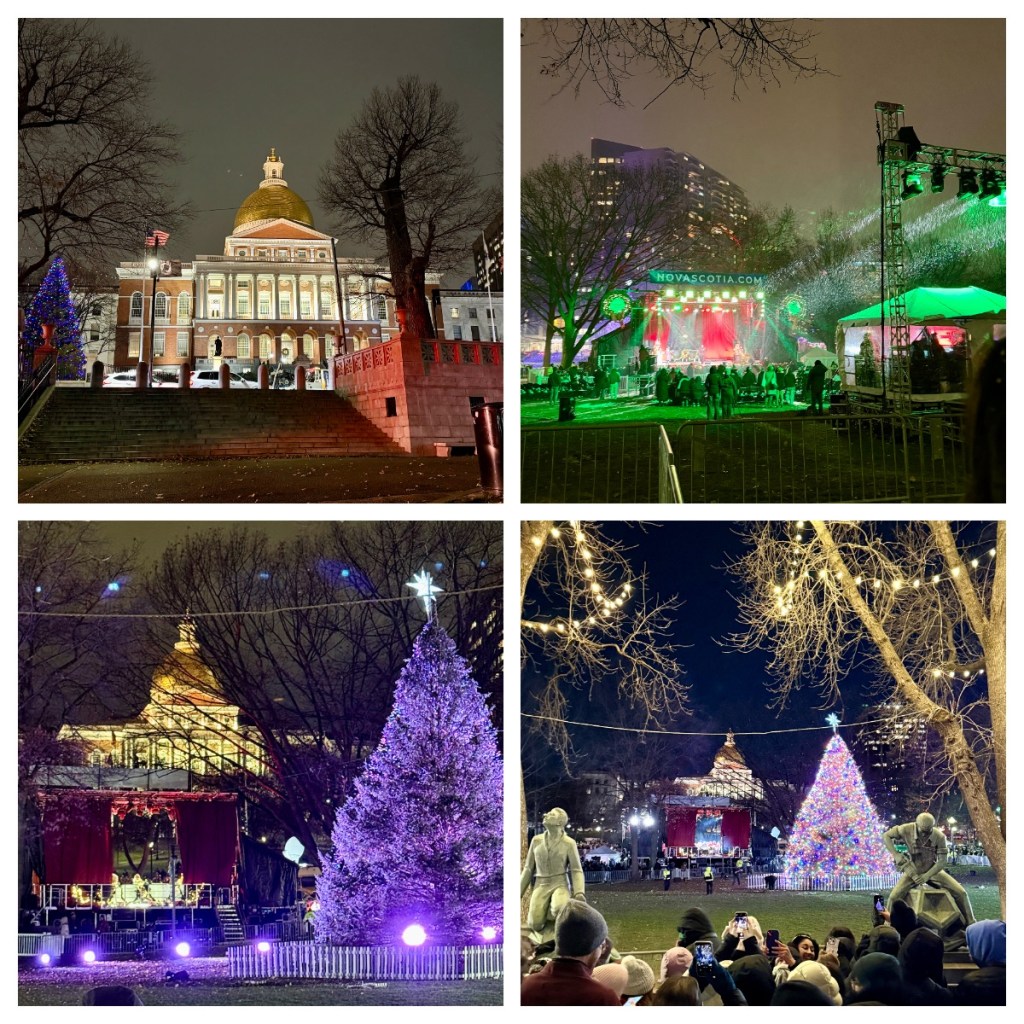
It was televised live starred the Pointer Sisters and in typical American style the concert had to stop for adverts! Despite this, and the cold, it was worth the wait to see the tree light up and the accompanying fireworks. I was happy to sample a hot apple cider (typically non-alcoholic here) on my way back to my warm bed.
Boston was a blast but time to move on.









 Cockneykiwi takes flight