The Wild West (& West End)

Galway, Ireland & London, England

Dec 2023/January 2024

After a full Irish breakfast (pretty similar to a full English breakfast but perhaps with Irish Soda bread) I met up with my friend Suzanne to drive from Dublin in the east to Galway in the west – a nice 3 hour drive through the countryside.

Galway grew up around a fortification built in 1124, today, despite being the 4th largest city in the Republic of Ireland, Galway only has a population of around 86,000. It is a very popular tourist destination due to its strong artistic and musical traditions, its lively atmosphere, great food and nearby dramatic landscapes.   

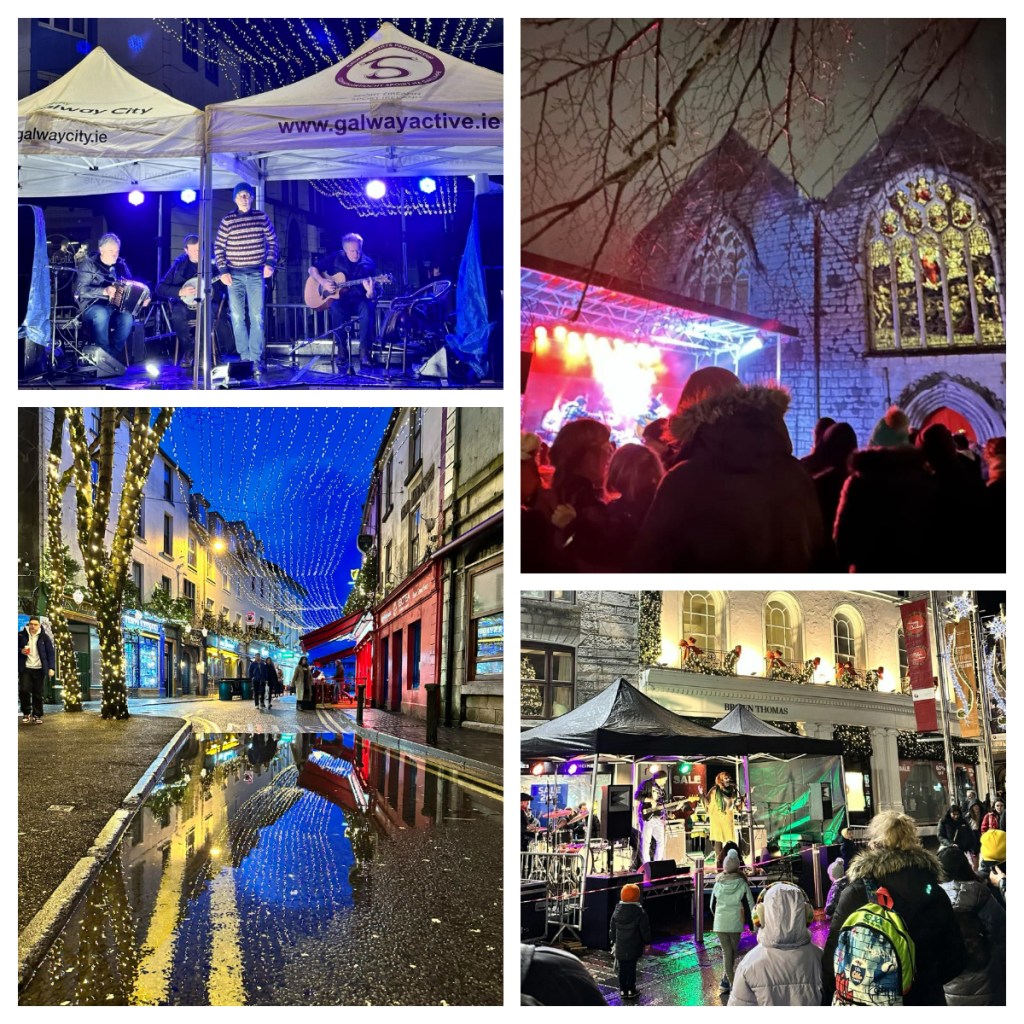
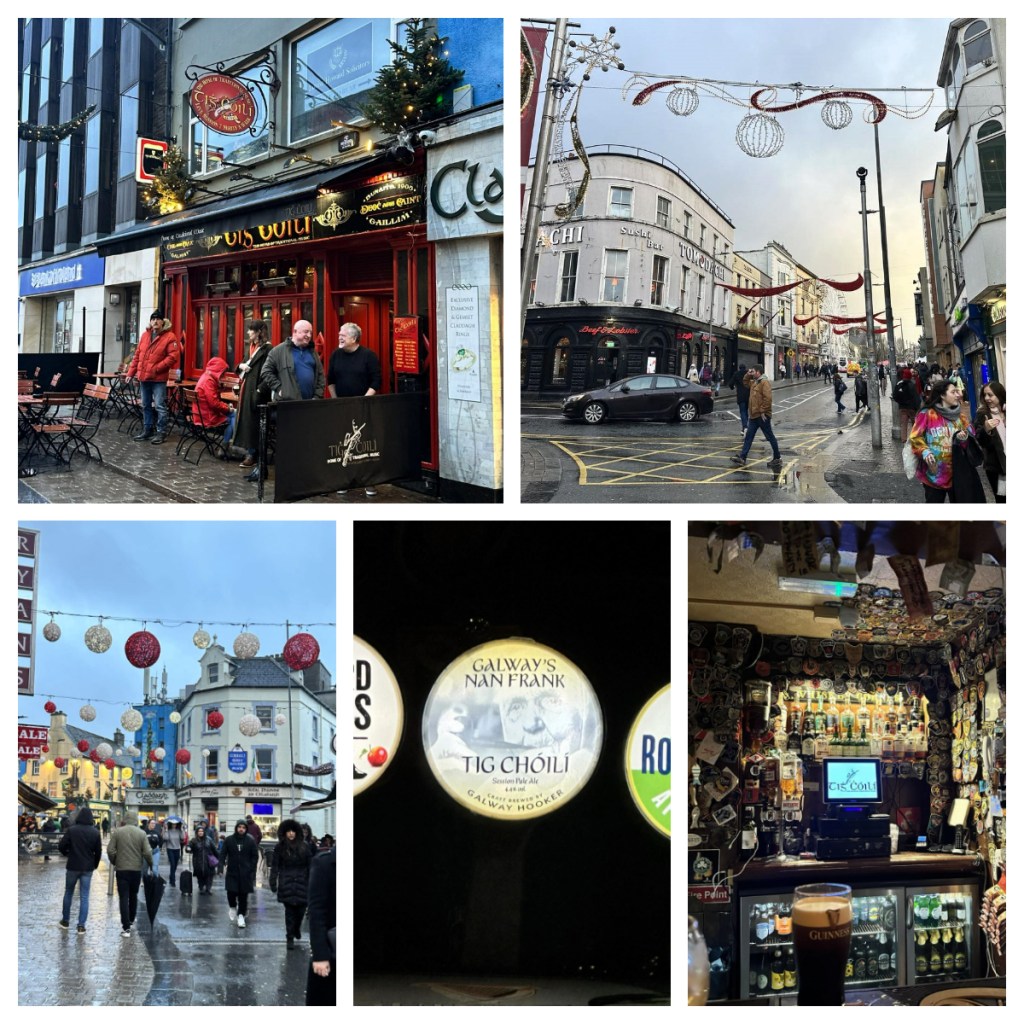
By the time we had arrived it was already midafternoon, so after checking to our hotel we headed out for something to eat.  There was a small Christmas fair in the central square and lots of beautiful Christmas lights around small old town and the light rain was not going to put us off exploring – in fact it was a great excuse to check out Tig Choili.  Touted as the home of traditional music it did not disappoint as they had a live trad music session going on as we arrived.  The small bar was packed with people and atmosphere.
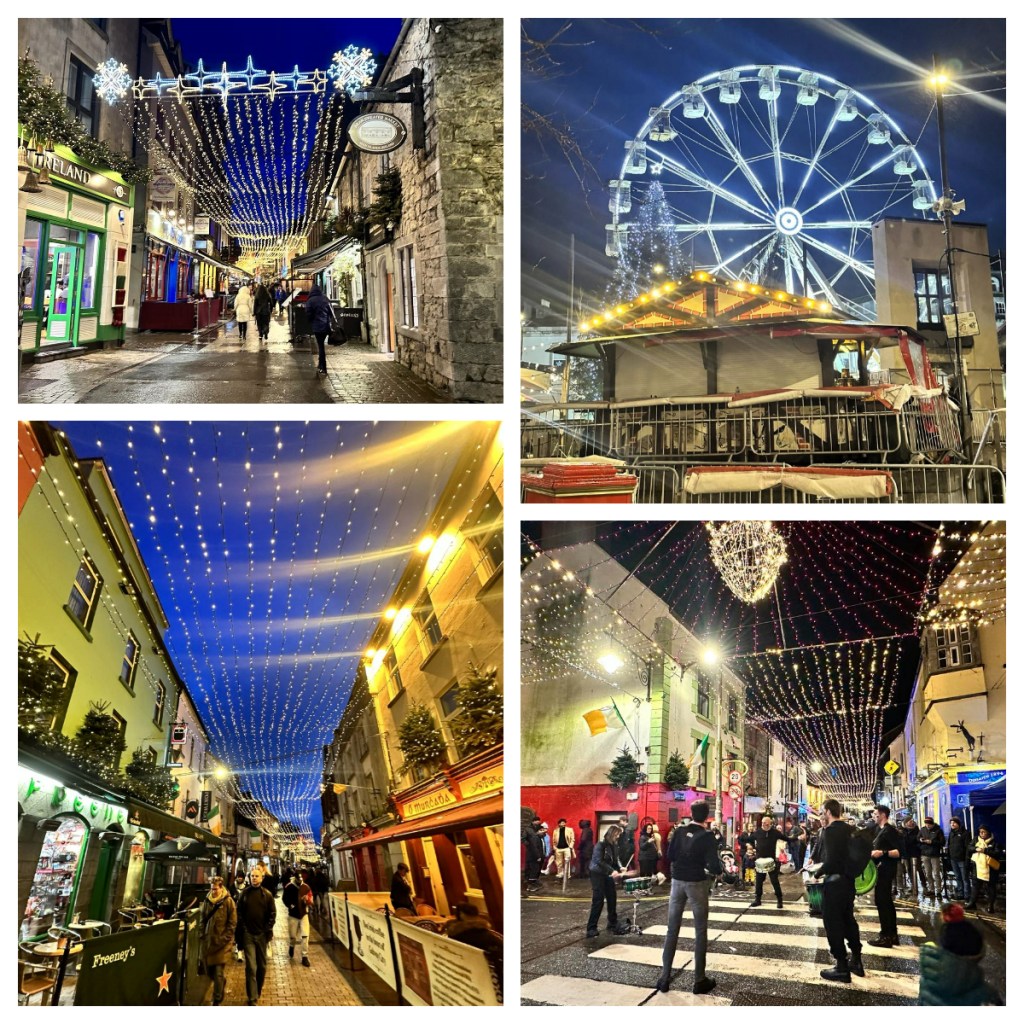
As it started to get dark, the lights came on and the puddles were filled with reflections (we all know I love a good reflection) and, as it was New Years Eve (did I mention it was New Years Eve?)  there was a programme of buskers set up around the old town.  We spent time wandering around the different stages enjoying the music – ranging from drumming, soul to trad.  (If you are on Instagram, check out the reel I did about the evening).  It was a great event.
We headed back to the hotel to get changed and before going back out to Monroes, a popular live music venue who were hosting Kíla, a popular Irish folk music group.  We had planned to stay here till midnight, but a friend of Suzanne’s who lived on the nearby Aran Islands was in town as asked us to join him at a small French restaurant across the road.  We did and it was fabulous – they were obviously hosting a 1920’s themed New Years eve dinner and we sat on the side, enjoying champagne and singing around the piano.  It was a great way to top of the evening and ring in the new year.

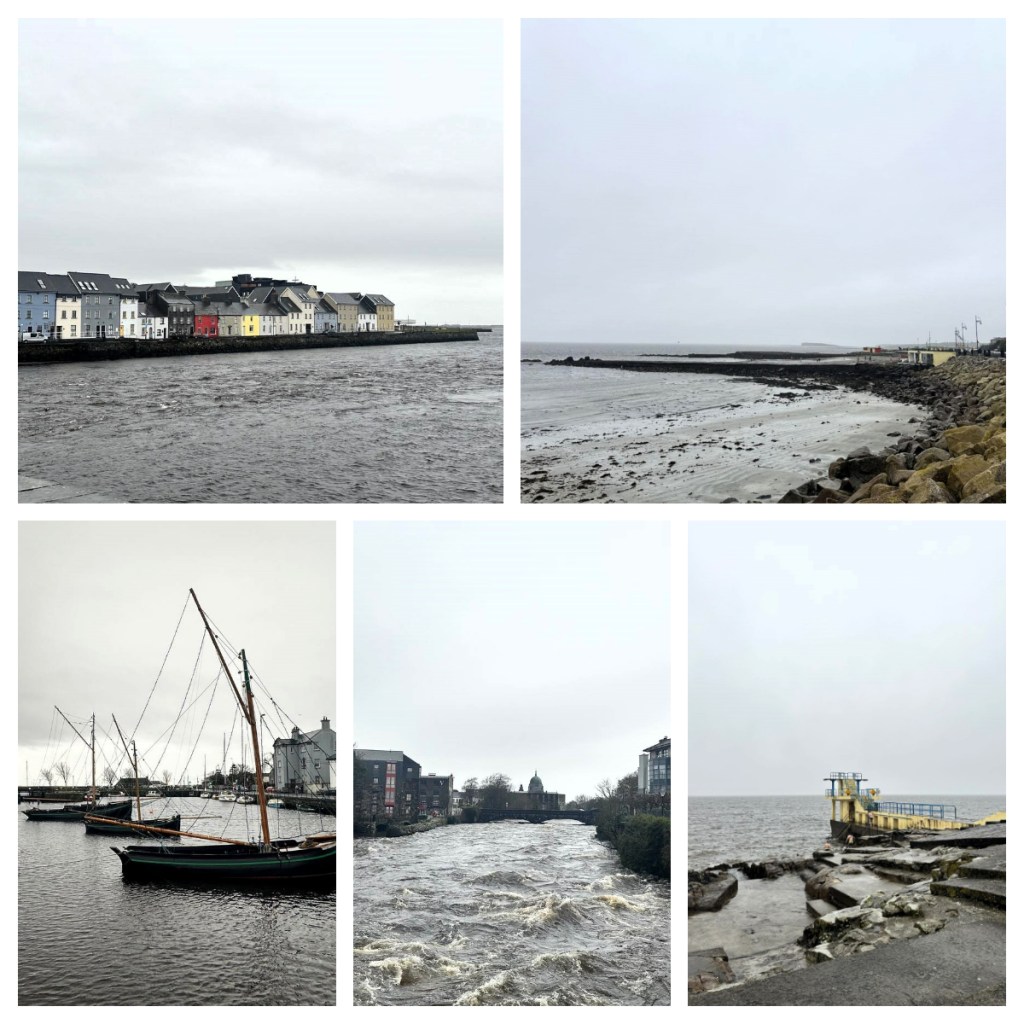
The hotel breakfast the next morning included another full Irish (it would be rude not to) before we decided to walk the 3km out to the Salthill Promenade.  Unfortunately, the rain really got us this time, setting in about 10 minutes into our walk … but we preserved and fully made it out to meet up with some other friends of Suzanne’s who were out here for a traditional New Years Day swim!! Ah, these Irish are a funny lot lol. 
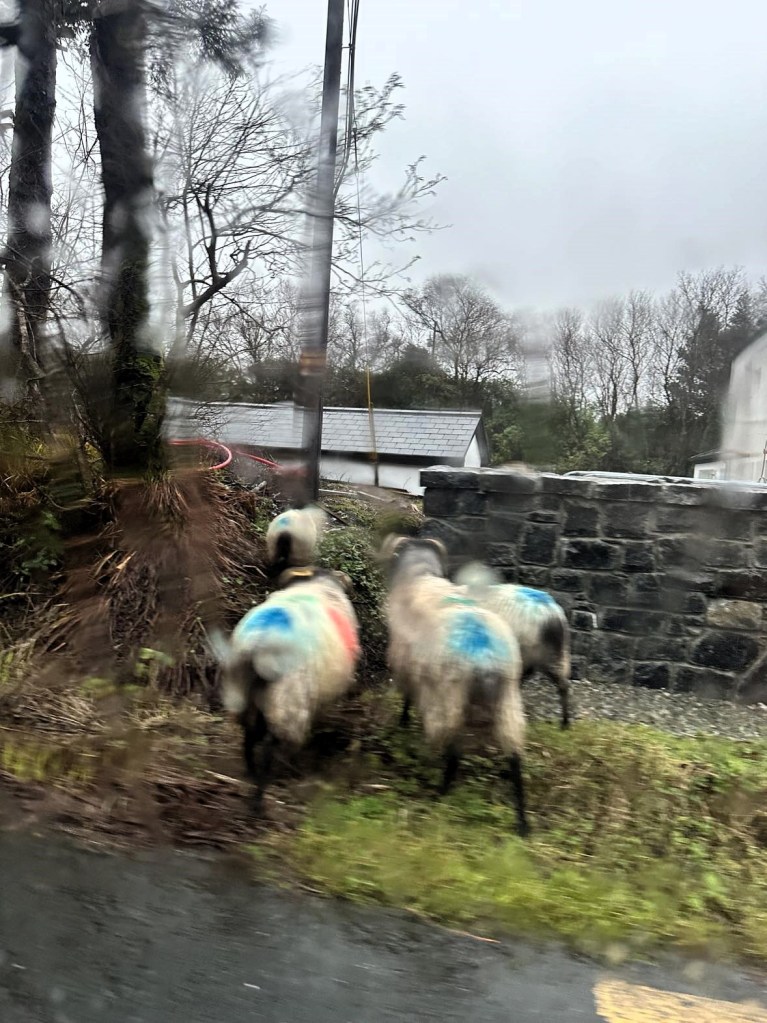
After a chat over coffee, it was time to hit the road again, this time to Clifden, the so-called capital of County Connemara.  The morning rain continued as we drove the 1 hour 20 minute drive through some surface flooding and sheep on the road – made me feel right at home lol. 

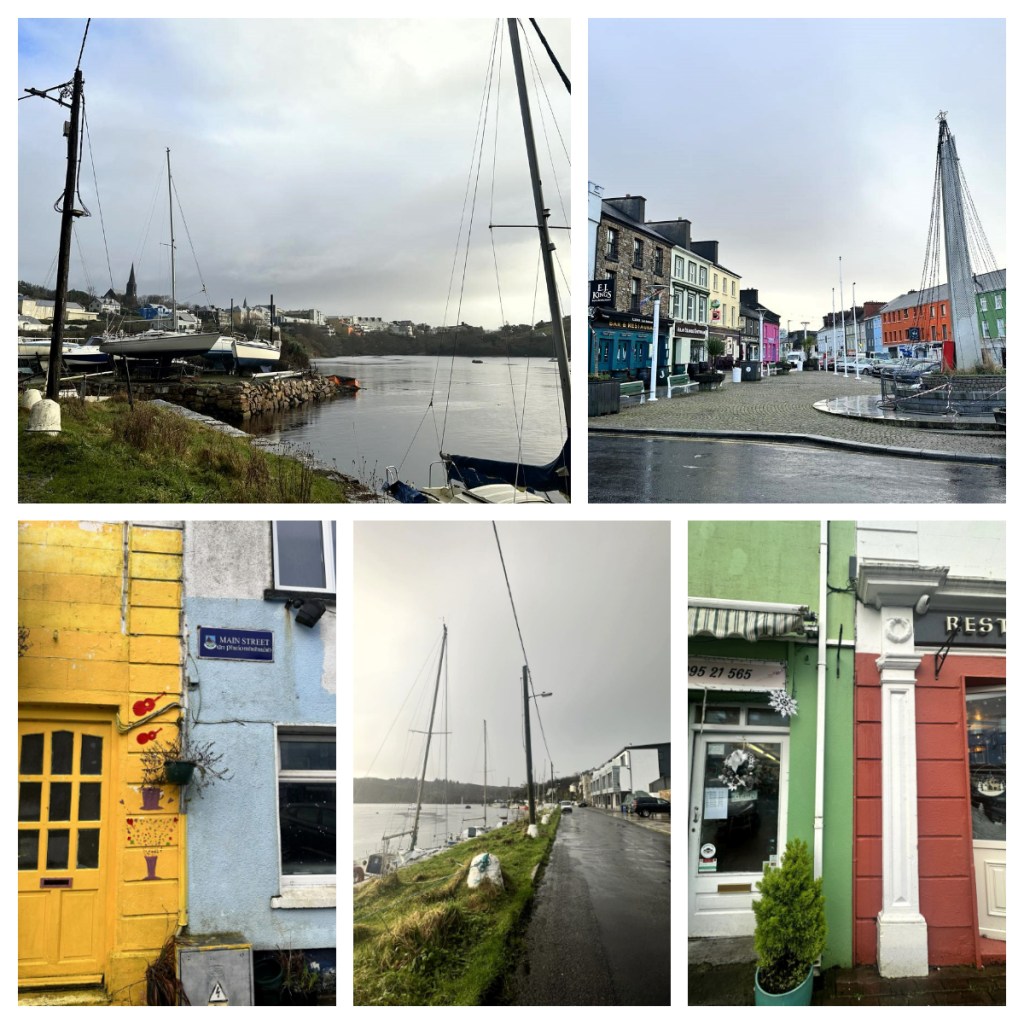
Despite its size (population around 2,500) it is the economic capital of the area and is the base for some of the best sites around this part of the west coast.  After a lovely dinner and a couple of drinks, we settled for an early night.

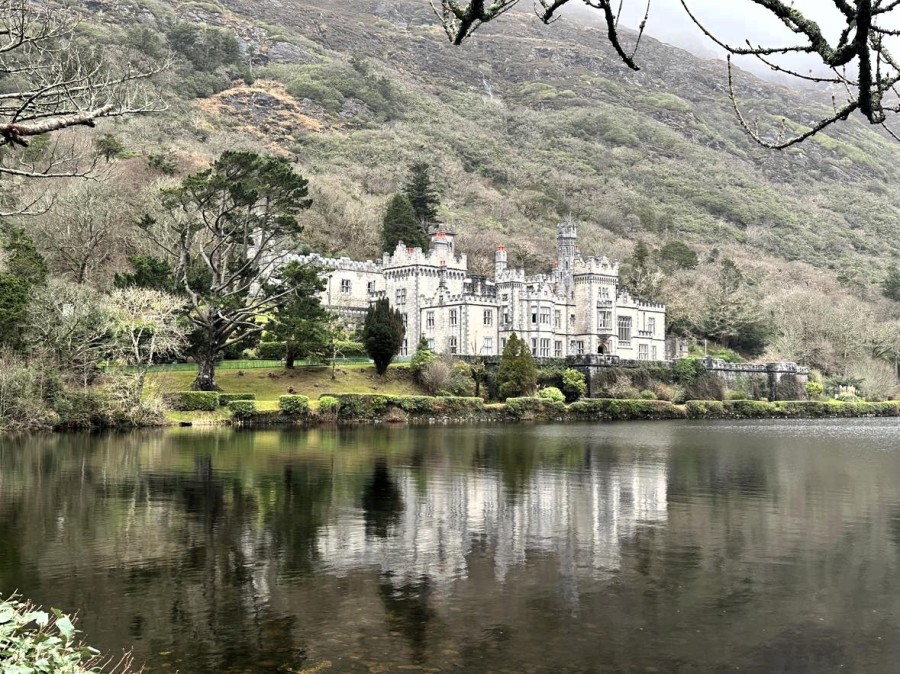
January 2nd, we set out to explore the area.  It was still overcast with a little rain, but we were not going to let us stop us.  First stop was the beautiful Kylemore Castle.  We were lucky enough to have a break in the weather and managed to get a moody version of that icon reflection view but decided to start in the Victorian walled garden as we were unsure how long the weather would hold! 

But first some history … Mitchell Henry, a wealthy doctor from London, built Kylemore Castle in 1868 for his wife Margaret after they feel in love with the area on their honeymoon in the 1840s.  The castle took 100 men 4 years to build and had 33 bedrooms, 4 bathrooms (which is a crazy ratio in today’s world), 4 sitting rooms, a ball room and of course rooms for all the servants.

When his beloved Margaret died in 1874 (of a fever she contracted in Egypt), Mitchell spent less and less time at Kylemore.  He did however build a Gothic chapel and mausoleum which holds the bodies of Margaret and Mitchell.

In 1903 the estate was sold to the Duke and Duchess of Manchester who lived there for a few years before having to sell it to repay gambling debts!! 

In 1920 the site was purchased by Irish Benedictine nuns after they had to flee their original location of Ypres in Belgium because of the war.  They ran a farm on the site and opened a school in 1923 which attracted the children of nobility from around the world as boarders (including an Indian princess and even Madonna tried to get her daughter in) and local girls as day students (for whom it is free).  Sadly, the school was forced to close in 2010 due to lack of students. 
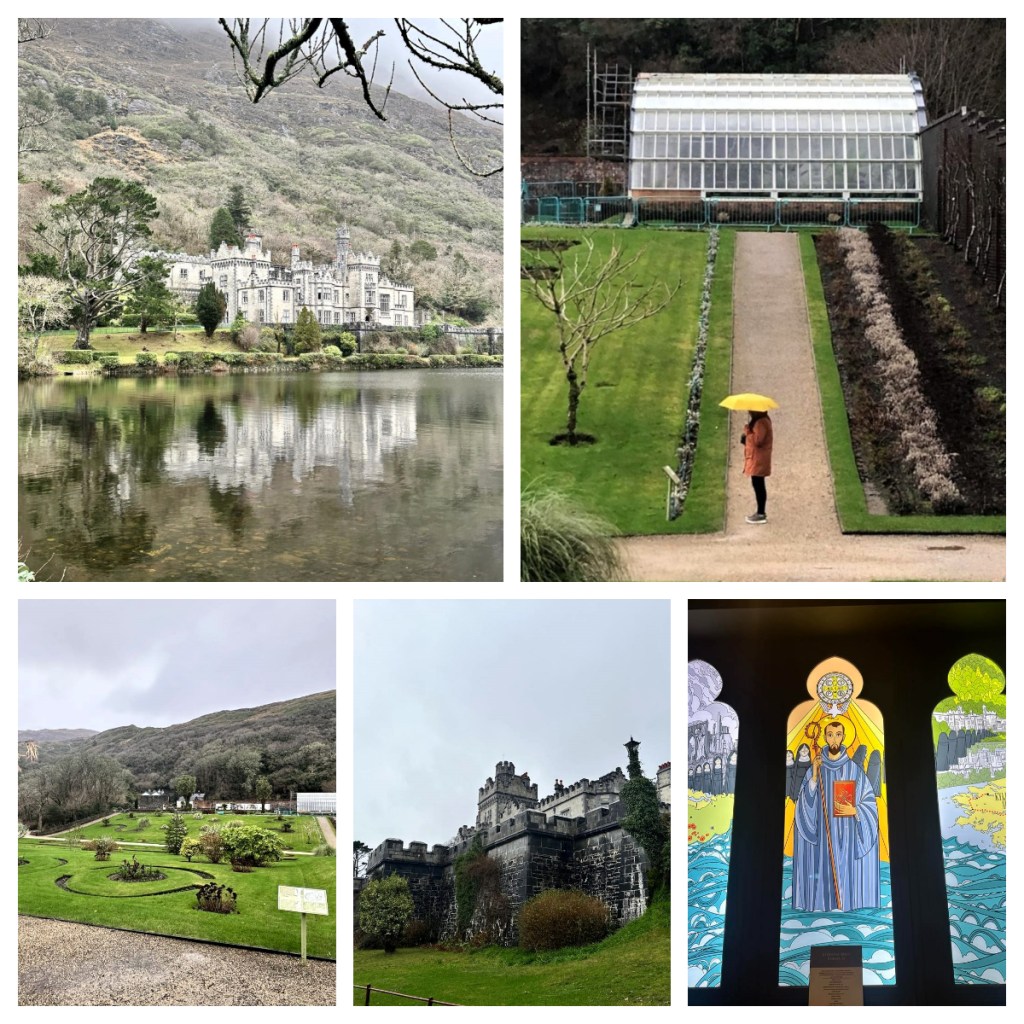
Back to our visit … we caught the shuttle bus the short distance to the gardens and enjoyed a strolled around it, learning abouts its history from its informative panels.  The 6 acre garden was created along with the castle in the late 1800s.  In its heyday, it had 21 glasshouses and 40 gardeners!! 

After many years of neglect, the nuns brought the gardens back to life and feed the nuns and the students from the school from the produce grown here, but it was not until 1995 when a group of historical restoration consultants, garden archaeologists and architects were brought together to bring the gardens back to their former glory.

After a short walk around the gardens, we caught the shuttle bus back to the reception area and took a short walk to the castle to join a history tour.  Our guide was so enthusiastic about the castle and it’s story, and it was fascinating learning more about the castle in a more personal way. 

We learnt about the fantasy fairytale exterior design and all the modern trappings it was built with inside including electric lights, gas heating and indoor plumbing.  In fact, it was one of the first private homes to have self-sufficient electricity from an onsite hydroelectric turbine.

Kylemore was great, but we had more to see before it got dark, so we moved on for a brief lunch stop in Letterfrack, a village founded by the Quakers in the mid-19th century, before continuing down narrow country lanes, through beautiful moody landscapes to Claddaghduff, the ‘jumping’ off point to reach the tidal island of Omey Island.  The island is said to have been one of the last lingering strongholds for pagans, before the monastery, Feichin’s Church was built in the 7th century. Subsequently it has supported some successful farms over the years.  Currently, the population is listed as 5!

At low tide, you can walk across the sand to the island, and in fact you can even drive!  Despite being there at low tide, there was still a few fairly wet spots and although my shoes were waterproof, I didn’t want them covered in saltwater so decided to wander around the foreshore while Suzanne went over to the island to explore.   My choice did not disappoint as I enjoyed just strolling around the beautiful wild beach and was awarded by a stunning rainbow. 🌈

Back in Clifden, now the New Year rush is over, many of the bars, restaurants and even hotels were closing up until February or March.  Thankfully we had one more night to have a couple of drinks in a couple of the local pubs, ending up in the bar by the hotel where there was live music and then to the hotel lobby where there was a piano player – actually the same guy who was playing the piano in the bar we ended up in on New Year’s Eve – small world lol.
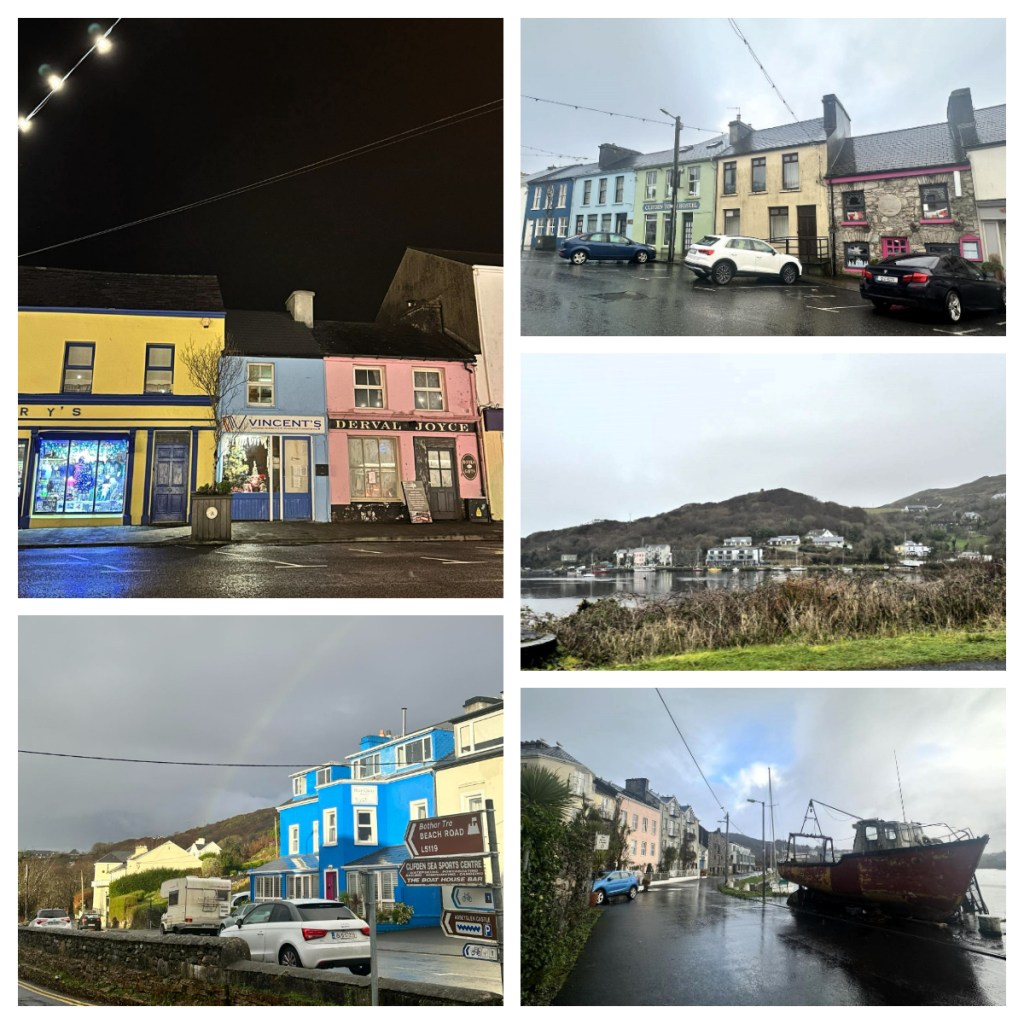
On our final morning away, Suzanne was not feeling well, so I got up and despite the rain, I headed out for a morning walk through the town and down to the waterfront.  Clifden is not a big town, but it was nice to stretch the legs before we headed back to Dublin, via a quick stop at Ireland’s oldest pub – Sean’s Bar in Athlone.  Established in 900AD!  I admit I do love the Irish pub atmosphere – dark, cosy, warm fire – nothing like it in the winter.

As well as Suzanne starting not to feel well, Ania, who I was supposed to stay with back in Dublin, tested positive for covid (Covid – disrupting plans since 2020)!  Despite feeling sick, Suzanne kindly offered a bed in her place for the night and it definitely an early night all around! 

Next morning I headed just around the corner to the airport bus stop.  It only ran from this area every 2 hours, so I went super early.  It was a lovely morning for my last trip through the city and I was lucky enough to get an earlier flight to London for my last couple of nights.

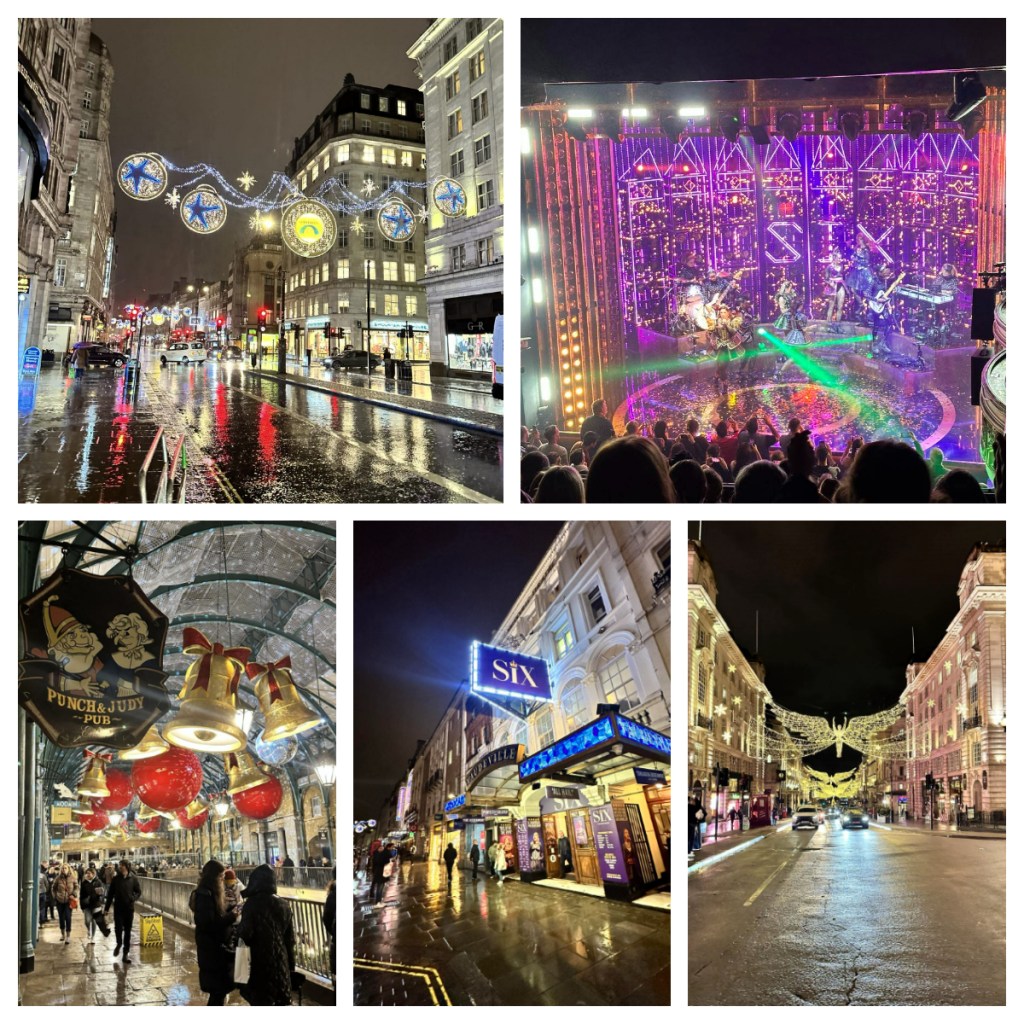
I caught the tube into the city to my hotel in Piccadilly – it was called a cocoon room, and it was true to its name in size, but it was clean, comfortable and in a great location, so I was happy.  By this point I felt like I was fighting to keep those Irish germs at bay and as the day went on, it became clear I was losing the battle.  After a quick nap I managed to head out in the torrential rain to see the Christmas lights, enjoy a bite at Pizza Express (an old favourite) and see Six – The Musical.   The musical was great fun and despite not feeling the best, the evening reminded me just how much I love London. 

The next morning, I managed to make it out for a walk around some of the central tourist attractions – around Trafalgar Square and down Pall Mall, just in time to catch the procession for the changing of the guard.  It was incredible to see how many people come to watch the regular event.  Just a great bit of English pomp and ceremony. 

In the afternoon I made my way out to the west of the city to visit an old friend and it was wonderful to catch up her, but I did have to have an early night and sadly felt even worse the next morning.  All final day activities were cancelled due to this unwanted Irish souvenir, and I had to book a day room in hotel at airport were I basically slept all day, until it was time to head to the airport for my flights home.

Despite the Irish germs, it was a great trip exploring new places and catching up with friends.

Back to the Republic

Ireland

December 2023

After another great night’s sleep, I left Belfast and drove south, back across the invisible border to the Republic of Ireland – there was not sign indicating the border on this road either!

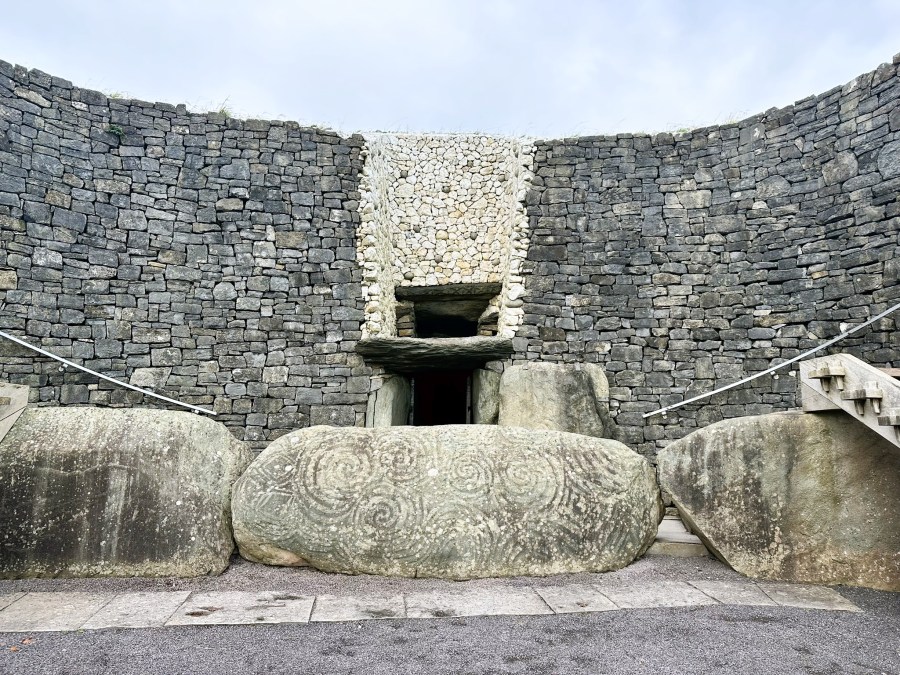
My destination the Boyne Valley in County Meath and the World Heritage Site of Brú na Bóinne.  Until I started researching for this trip, I was completely unaware of the Neolithic history of Ireland and that there are various stone age sites that you can visit – Newgrange being touted as “the jewel in the crown of Ireland’s Ancient East”.  Created around 5,200 years ago (3,200BC), it is older than Stonehenge, the Egyptian Pyramids at Giza and even the ancient city of Petra in Jordan!!  This blows my mind!

To visit Newgrange, the most well know of the passage tombs in the complex, you must start at the Brú na Bóinne Visitor Centre.  It was a cold day and the visitor’s centre was fairly quiet but given the staffing levels I assume they have much busier days/moments – there were 3 people within about 10 metres of each other, first to check my booking, the second to give me my ticket, and a third to check the ticket I was just given (in front of them) 🤔😂.  I have not seen such a great job creation scheme since the small shops in Japan!

Your visit to the site includes a bus from the visitor’s centre to the site itself and as you enter you are allocated to a specific bus time.  I had around 30 minutes to explore the really interesting exhibits and information.  Apparently, the Boyne area has many Neolithic sites which date back to the “new stone age” era when humans started farming and living in settled groups.  For them, Brú na Bóinne was a sacred place.

From the visitors centre, it was around a 5 minute walk across the River Boyne to the bus stop where I joined a group of people on the bus to the site itself.  A short ride down narrow country lanes and we got our first glimpse of the passage tomb of Newgrange. 

It is understood that passage tombs were used to contain the remains of the dead and it is likely that they were actually built over the bodies, rather than the bodies placed in afterwards.  However, Newgrange is considered to be more than just a passage tomb and is considered more likely an Ancient Temple with astrological, spiritual and ceremonial importance. In fact, this site has amazing examples of megalithic art on a scale not found anywhere else in the world!

We had time to wander around the mound, around 85m in diameter and 13m high (covering a total of around 1 acre) before meeting the guide for our time inside the tomb.  Unfortunately you could not take photos inside the tomb, which is a shame as the engineering that went in to the building of the tomb was amazing, as were the unique artworks. 

One of the most special things about the site, is that on the winter solstice, the passage and burial chamber are lit with the sun as it rises.  As we stood in the passage, which these days is lit with electrical lights, the guide turned off the lights and recreated the moment of the sun rising on the winter solstice.  As with other ancient wonders like the pryamids of Giza and those in the South American Mayan world, the astronomical knowledge of the architects, engineers and astronomers who built them is incredible.

It was a really interesting visit and the countryside was beautiful despite the freezing weather, I was just grateful it wasn’t raining.

From Brú na Bóinne it was only a short drive (down more narrow country lanes) to Slane where I was to spend the night.  I was a little early to check in to my accommodation so headed first to the Hill of Slane. 

Legend has it, in 433, St Patrick lit a fire on the hill, in defiance of the law of pagan High King Laoire, who forbade the lighting of any fire before his fire, on the nearby Hill Of Tara, was lit on the spring equinox. Despite being angry, the King was impressed by St Patrick’s devotion, he allowed him to continue his missionary work which brought Christianity to Ireland (basically putting the putting King out of a job)!

The hill is only 158m high and from the carpark it was just a short walk to the top which today houses the ruins of a Franciscan Monastery dating back to 1512 as well as those of a college built to house four priests.   From the ruins, there were also beautiful views out over the countryside.

From the hill I headed back in to the small village of Slane (population around 1,500) for lunch at the Village Inn and a quick visit to the nearby 18th century castle.  It was unfortunately closed so could only admire it from the outside, but I did pop in to it’s neighbouring whiskey distillery to do a little souvenir shopping before I made my way to my AirBnB. 

I had thought about heading to the pub later for some dinner but it was so cold and the Airbnb was so cozy I just stayed in!

When I headed out at 8am the next morning it was dark and raining but I had to set off to the airport to drop off my rental car.  I had been fortunate so far in avoiding the worst of the rain but not so this morning. 

From the airport I took the bus back to city and headed back to the same hostel I had been in before Christmas.  The hostel was ok and conveniently located and I had decided it was easier to go with the familiar rather than have to find my way to another place.  This time I had splashed out and booked myself a single, private room and luckily enough it was ready for me to check in to early.  Please note – a private room in a hostel = a room about the size of a shoe box but at least it was clean and I had my own bathroom.

With no time to rest, I dropped my bags and headed straight out. First to see the Jameson distillery.  Not being a whiskey drinker myself, I didn’t go in, but wanted to see it and make a few small purchases for gifts .. and it was kind of on my way … to the Guinness storehouse. I am also not a big Guinness drinker but I like it more than whiskey so thought I should visit!

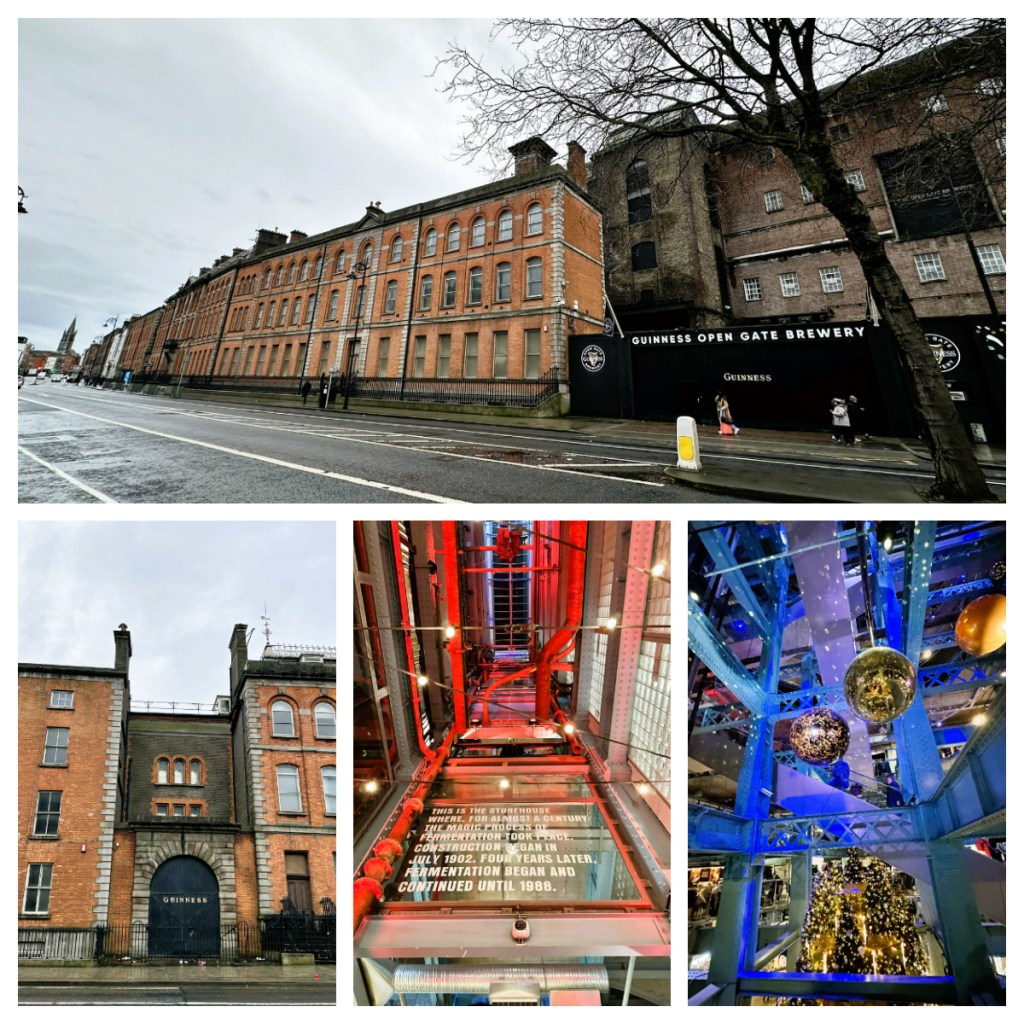
The Guiness store house is a huge imposing building taking up a whole block and let’s be honest, you must be living under a rock if you were not familiar with the iconic Irish beer which can be found all over the world.

Arthur Guinness started brewing on this site over 250 years and in 1759, he had the foresight to sign a 9,000 year lease on this St James’s Gate Brewery!  Now that shows true commitment to his product!  The Guinness family today continue not only the brewing legacy but also the philanthropic one, supporting and donating to various charities, historic building restorations and underprivileged communities and as well as maintaining a high level of employee welfare. 

As you worked your way up the levels (7 levels in total), you explored the history of Guinness and how they make it – from grain to glass.  To be honest, although it was interesting, there were a few too many people in some areas so I did not spend much time waiting around to read all the information panels and wasn’t that fussed with the place … until I reached the sterile “tasting room”.  It was completely white and sterile and when the room was full, they closed the door!  It had areas where you could enjoy the aromas of different parts of the beer and were each given a shot of Guiness.  I now actually started to feel like I was in the beer version of Willy Wonka’s chocolate factory – so many different floors and rooms!

From here we moved I to the Velvet room (I think that was its name) for a brief talk about how to drink Guiness.  This room was filled with paintings of Guinness’s past and information about their contributions.  Instructions were given … “Pause and smell the aromas before taking a big slug lol.  Don’t sip just the creamy white head as that is for texture rather than taste”.  I must admit – I actually enjoyed it.  Perhaps I have always been drinking it wrong.

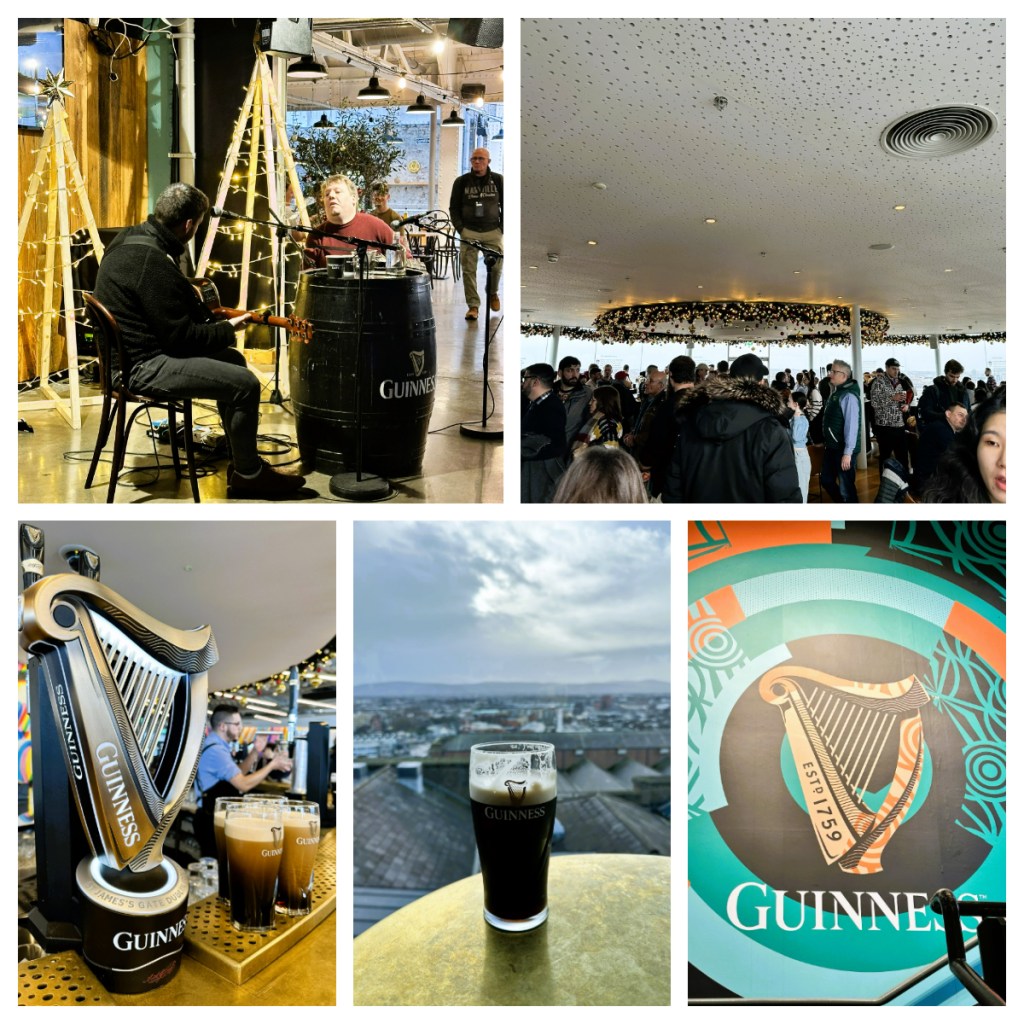
The final stop was for a free pint of Guinness (well, it is included in the entrance price) in the circular Gravity bar, one of Dublin’s most unique roof top bar, with a great view over the city. I was very lucky to get a seat after only a short time so could properly enjoy the view and my pint. 

I then headed down a couple of levels to one of the numerous restaurants for a Steak and Guinness pie (it had to be done) and to enjoy the magically Christmas decorations around the 7 story central core and the traditional music and dancing on show.  It was a perfect end to my visit. 

After an enjoyable couple of hours, I headed back out in to the cold for a 30 minute walk through a more gritty suburban part of the city.  (Turns out I could have walked through the lovely gardens of the museum of modern art, rather than the grungy back streets but thanks to google maps for keeping it real 🥴😂.)

My friends had told me that Kilmainham Gaol as a must see in Dublin and that bookings were hard to come by so I had scheduled a reminder to book as soon as they began available (a month before the visit date) to make sure I got a ticket. 

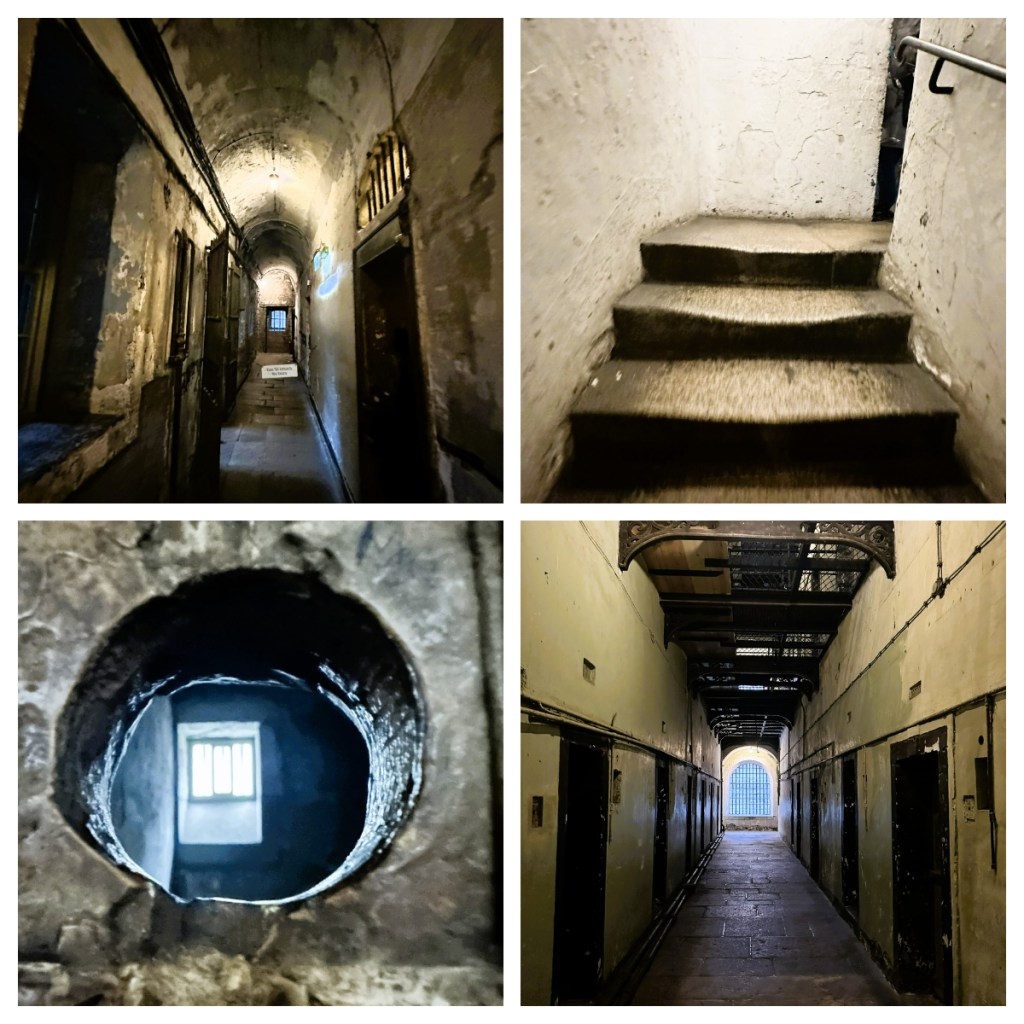
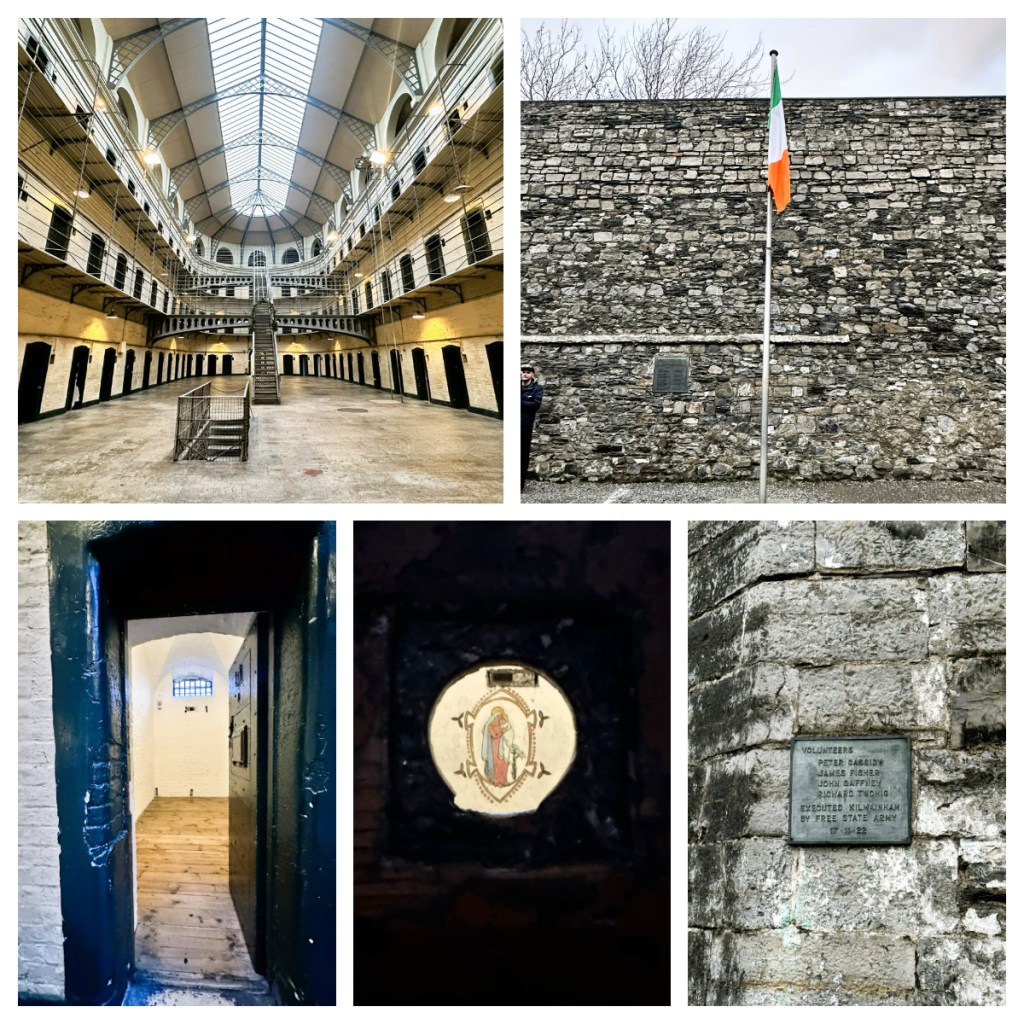
Since it was opened in 1796 as the Dublin County Gaol, until it was closed in 1924, thousands of men, women and children were held Kilmainham Gaol for offences that ranged from owing money or begging to political prisoners involved in the many Irish uprisings – from the 1798 rebellion, the 1916 Easter Rising, the Anglo-Irish war of 1919-1921 and the Irish Civil War in 1922/23. When the prison closed, the initial consensus was to tear it down as it held many bad memories, but in the 1960’s, a group of revolutionary veterans decided to preserve it as a national monument rather than tear it down so they can share the stories that are a huge part of Ireland’s history.

As if closing the loop, in 1966 the new museum was opened by the President of the day, Éamon de Valera. He had been one of the last prisoners released in 1924!

Our guide took us from the Court House, through what was a catholic chapel before we moved in to the earliest part of the prison – cells built for reform, based on the concept of “silence, supervision and separation” however the in the early days, the overcrowded prison did not allow for any reform or separation, with men, women and children all crammed in together in small cells with no heating (gas heating was not installed until 1890s. 

There was supposed to be 1 person per cell and in the  holding cells for those going to Australia, there could be up to 3 per cell … and their waiting time did not count as part of their sentence.  Some inmates were as young as 10 or 11.  In fact, the youngest prisoner was 3 year old Thomas Roberts who in 1856 he was imprisoned for begging. Sadly there is no record as to what happened to him when he left. During the famine there were up to 5 per cell as people were trying to get in to prison to get food! 

As we moved through the prison, from the oldest sections to newer areas, some of the cells showed the names of men and women who were help in them.  Many of the leaders of the unsuccessful rebellions against the British were held here – some were even executed on the grounds whilst others were released and went on to be part of future governments. Most of these leaders were not military men (and in some cases women), they were teachers, artists and poets.   

The most recent wing of the prison was much improved from those earlier areas.  Built in 1861 in the  panoctogan style, known as the all seeing eye – a guard can stand on the central platform and see everything.  It also considers that light is key for reformation and the glass room givens plenty of light. 

The tour ended in the execution yard, perhaps one of the most important sites in Irish history.  The site of a number of brutal executions, including public hangings.  The British started to lose support from many of the Irish citizens due these executions of politic prisoners and the treatment of the bodies after execution – in some instances they refused to give the bodies back to the families.  Who knows what they were hiding.  

It’s new life as a national monument also finds it popular as a location for movies, appearing in films such as the Italian Job, Michael Collins, In the name of the Father and even Paddington 2.

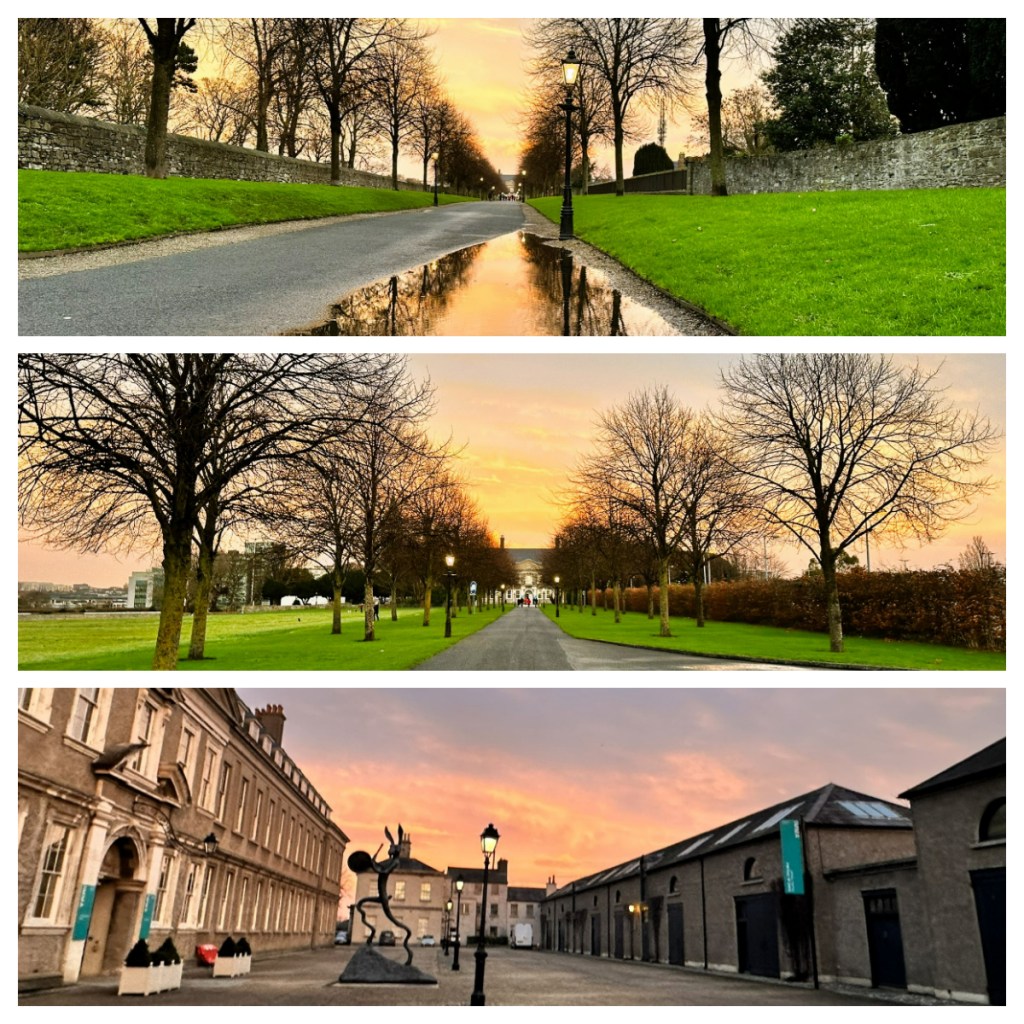
As I exited the prisoner I spotted the start of a beautiful sunset and I couldn’t resist taking a walk through the gardens of the museum of modern art before finding a bus back to my hostel, just in time to freshen up and change before fun night around Temple Bar with my friend Ania. 

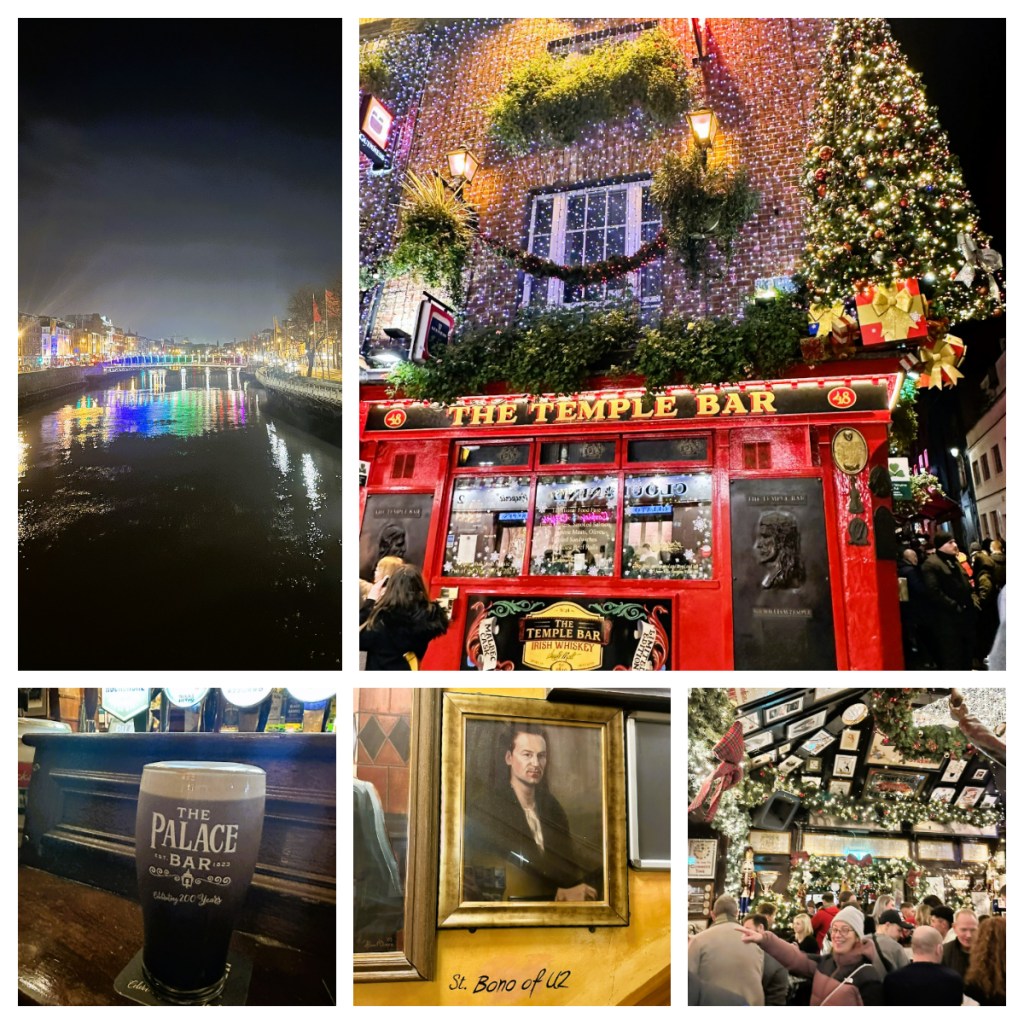
It was really busy and lots of tourists but fun never the less. I had been warned that the bars in Temple Bar are costly and they were not kidding!!  A pint of Heineken and a gin and tonic cost euro 26 – $45 – I am not sure where in NZ you would pay that much!  Let’s consider the budget well and truly blown 🥴  That said, it was a perfect day to finish off my time in Dublin.

An Irish Christmas

December 2023

It’s been a number of years since I have been away for Xmas – obviously it is summer in New Zealand which means longer holidays are possible with all the public holidays, so this year I thought I would take advantage of that and head north, way north … in hind sight, probably not the best idea going from summer to winter and travelling at the busiest time of the year … but, someone’s got to do it!

I caught Singapore Airlines straight out of Christchurch, no one in line at check in, no one in line for customs, no one in line for immigration – and that is why I would always try and travel to/from Christchurch if I can.  It is 10 hours to Singapore, then a 3 hour layover, followed by the long 14-15 hour leg from Singapore to London. I managed to get some sleep but of course never enough, or at the right time of the ‘day’. 

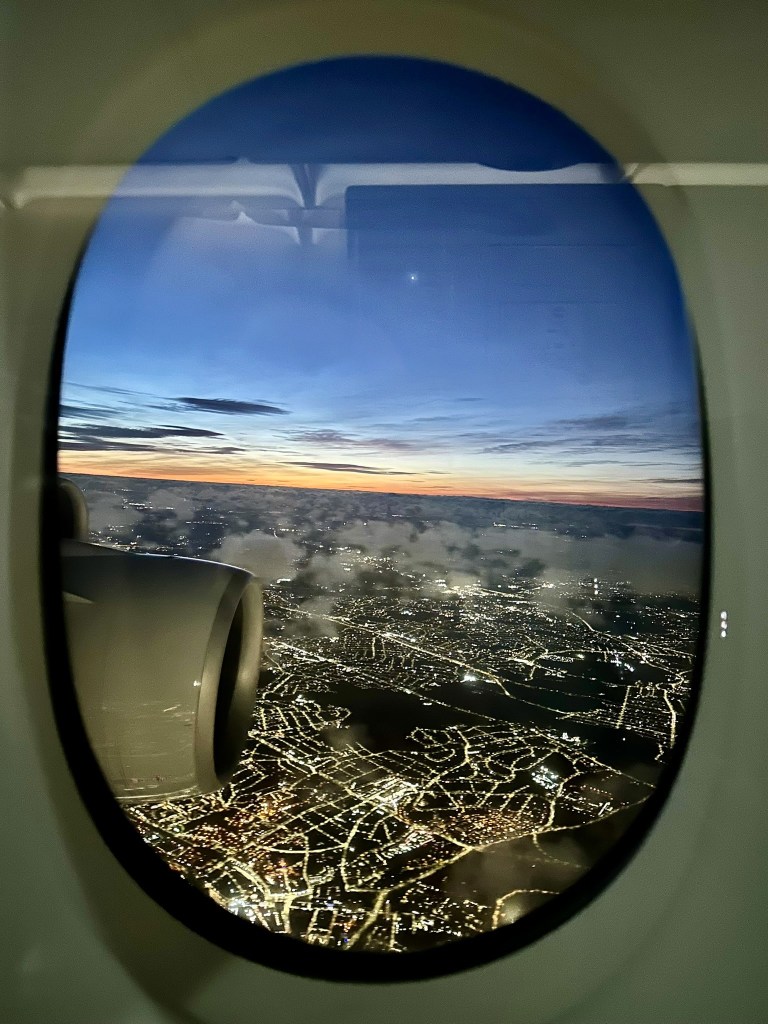
I had less than an hour to get to my gate for my final flight of the day in Heathrow, but with a delay of over an hour, I ended up having much longer.  I filled the extra time eating – probably 3 breakfasts in all, enjoying my favourite UK foods as I spotted them – including a Pret a Manger Christmas sandwich and being reminded that flat whites (coffee) in England do not equal flat whites in NZ!!  Almost 1 hour 20 late my final flight took off, a 1 hour hop to Dublin, the capital of the Republic of Ireland. 

We had a fairly long walk from the plane to immigration and baggage claim but that meant my bag was already out – all so quick and efficient.  I headed straight out the doors into some fresh air (finally) and then on to the Aircoach to the city centre.   Unfortunately, my hostel room was not ready, so I dropped my bag and headed out. Now the struggle really started – to stay away!

I wandered the streets, stopping to enjoy some of the many buskers along the famous Grafton Street,  including one I had often seen videos of on social media – I didn’t even know she was from Dublin so it was a nice surprise to see her live.  (Her name is Allie Sherlock and she has over 2.3M followers on Instagram along – check her our.)

I stopped in pub for some food and there was a musician playing, he started playing Fairytale of New York by the Pogues.  It was probably very corny and touristy but to me, it could not have been more perfect.   

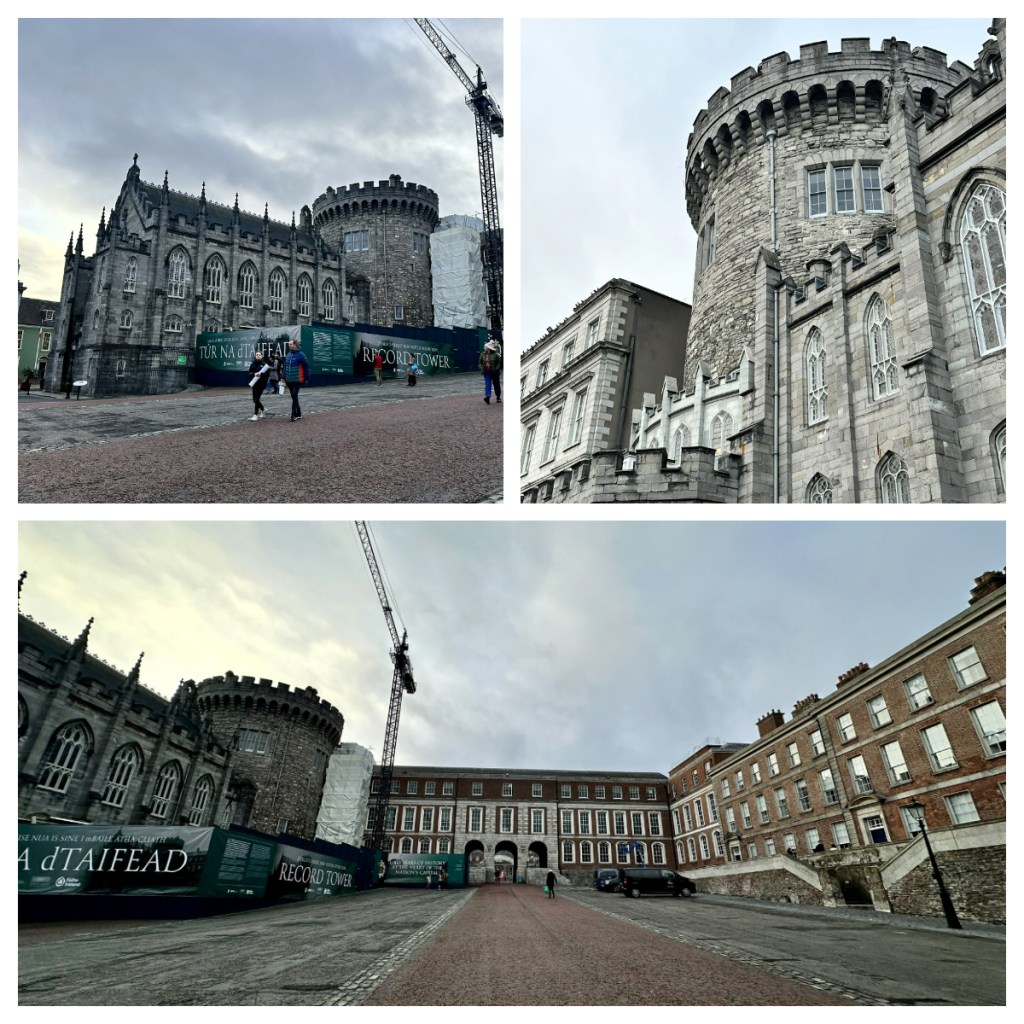
With still more time to kill, I joined a walking tour.  If things had gone to plan, I would have done a tour at 11am and be napping by 2pm, but the flight delay meant that was not possible so here I was 🥴.  The first stop of the tour was Dublin Castle where the guide, Kieran, gave us brief rundown of Irish history 101.  I should probably mention that he started off by telling us the Irish saying “you should never let the truth get in the way of a good story” – so some of what he told us may not be based on fact lol!

First stop Dublin castle where we learnt about the “arrival of strangers” as the arrival of the Vikings were known.  Historically, the Vikings were marauders, coming in to pillage Irish settlements and then leave, until around 800AD when a group of Vikings created the earliest and longest lasting Viking kingdom in Ireland.  They named it Dyflin, which then became Dubh Linn, the Irish for Black pool, a black water pond, part of the River Poodle, near their camp. 

Dublin Castle itself, was initial built on the same area as the Viking settlement in 1171 just after the Anglo Norman invasion began 800 years of English occupation, with the castle being the seat of English power.

In its life, the castle has been a military fortress, a prison, a treasury and law courts.  Following Ireland’s independence in 1922 Dublin Castle handed over to the new Irish government and it continues to be a key government complex.   Most of the original castle was destroyed in a fire in the 1600’s and has been rebuilt steady over the centuries. 

Kieran told us an interesting story about the theft of the Irish Crown Jewels that had been kept in safe, in a strong room.  They were discovered missing in July 1907.  They had just vanished without a trace.  Despite an extensive investigation, including the use of physics and Arthur Conan Doyle (because he had written the Sherlock Holmes stories), and a hefty reward being offered, to this day they have not been found.  Another fun fact, Bram Stoker (of Dracula fame) used to work in the castle when it was part of the Treasury. 

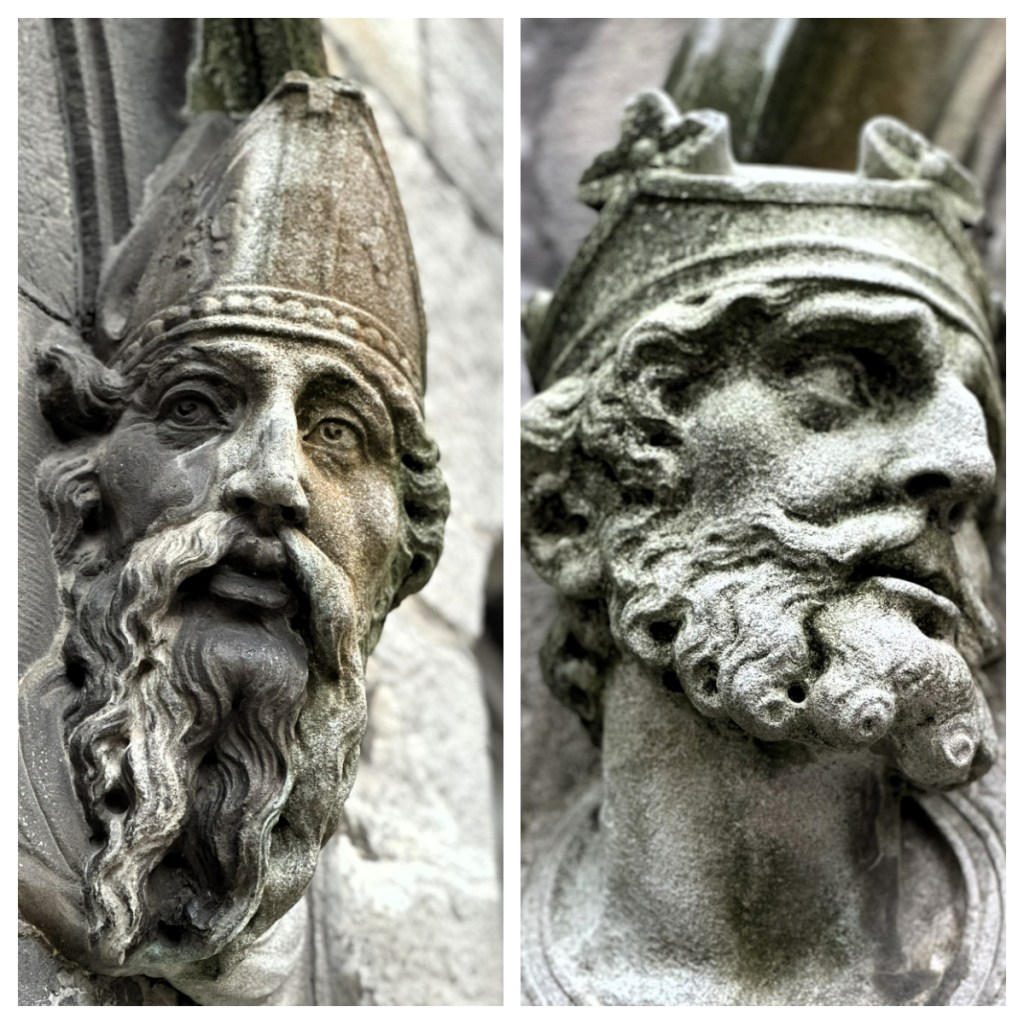
Speaking of fun facts, did you know St Patrick was not Irish???  He was actually Welsh! He was kidnapped by Irish pirates as a teenager and spent 6 years in Ireland as a slave.  He returned home for some time where he found God,  before returning to Ireland as a missionary to convert the then Irish pagans to Christianity.  To top it all off, Americans invented St Patrick’s day and it was first celebrated in the USA in 1932, before spreading back across the ocean to Ireland. 

We talked about the Gaelic language.  Ireland became official a bilingual country in 1922.  Prior to this, the ruling English had done a pretty good job of eradicating the language.  At one time it was illegal to speak it, resulting in a lot of local Gaelic speakers ending up in jail with no idea why (as every time they asked what was going on, they broke the law by speaking Gaelic).  Today about 40% of the population speak with competency, and it is mandatory for government workers including the Garda (Police). 

We passed the beautiful Christ Church, one of three cathedrals in Dublin.  This protestant cathedral was initial build in 1028, but most of what we see today is from 1875.  One of it’s biggest claims to fame is that Handel’s Messiah was premiered here in 1742.  After the concert they were cleaning the pipe organ and found the dead bodies of a cat and a rat – the original Tom and Jerry of Dublin.   Apparently, their bodies are preserved and on display inside the church, along with the heard of Laurence O’Toole, the patron saint of Dublin, who died in 1180.

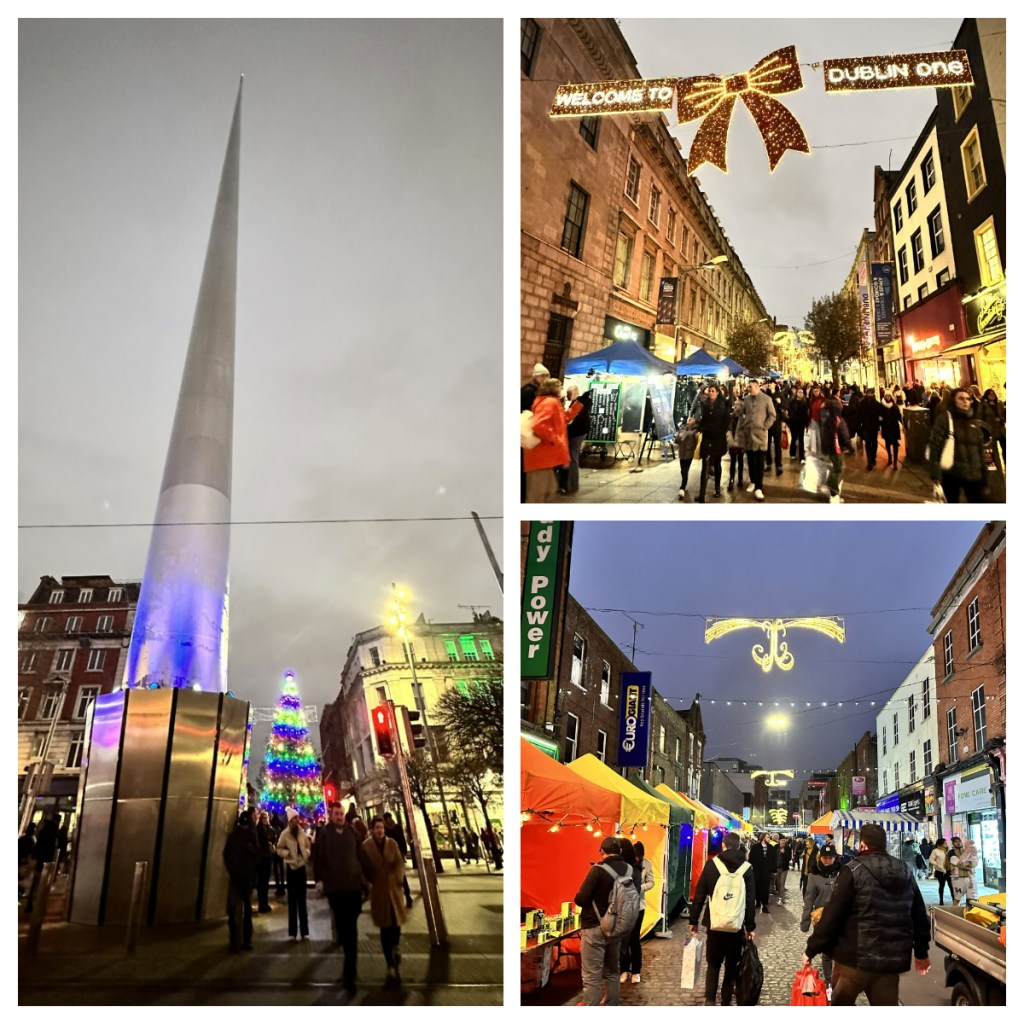
We strolled through Temple Bar, enjoying the Christmas lights before crossing over to the banks of the River Liffey, the river that runs through the city.  There are a number of pedestrian and road bridges across the river.  The most famous foot bridge is the Liffey Bridge, better known as Ha’penny Bridge due to the toll that used to be paid.  It was actually built by the same company that built the Titanic and it almost collapses a couple of times, before they replaced the wooden planks. 

The tour ended at O’Connell Bridge, this time a road bridge and the only bridge in road that is as wide as it is long.   I was grateful that it was also right near my accommodation so I could finally check in to my room around 5.30.  My room was ok, a 4 bed female dorm, with a little ensuite bathroom which had what must be the smallest shower room I have ever seen 🥴.

One thing that will take a day or two to get used too is how early it gets dark- when it got dark I was thinking it must be really late, but it was not even 5pm!!  Great for enjoying the Xmas lights though.

Not surprisingly, I was up at 4am – jet lag and time zone differences suck!  I managed to sleep a little longer before I headed out just before 8am, and again it was still surprisingly dark.  I headed to a nearby supermarket to  stock up on food for the next couple of days when most things will be closed and I will be on the road.

Shopping done, I was out for another walk before meeting my friend Suzanne for a lovely afternoon catching up.  Enjoying good food and drinks in local pubs – some very old and one that had the smell of mulled wine filling the air.

We then went and joined the crowds at the “The Busk”.   Organised by Irish singer and actor Glen Hansard, the Busk is a Christmas Eve traditional and is a fundraiser for a homeless charity.  In previous years, the likes of Bono (from U2) have turned up, but this year, my bladder got the better of me before too long, so we escaped the crowds and headed to another pub for a last one for the road. There was a lovely atmosphere around the city and in the pubs and in each one we got chatting some of the other punters but I couldn’t believe how early everything closed.  By 7.30 the pubs were closing, I couldn’t even get a hot chocolate on my way back to my hostel as all the cafes were already closed.

Christmas Day dawned and everything was quiet in Dublin except for Church bells ring out around across the city.  Suzanne came and picked me up and we did a little tour through some of the beautiful seaside suburbs of Monkstown, Dun Laogjaire, Sandy Cove and Dalky.  We managed to find a park amongst the crowds at Sandy Cove – a famous spot for a Christmas Day swim.    There was so many people enjoying a dip in sea – not me though, I don’t swim in the sea in New Zealand so I definitely not going to do it in Ireland lol. 

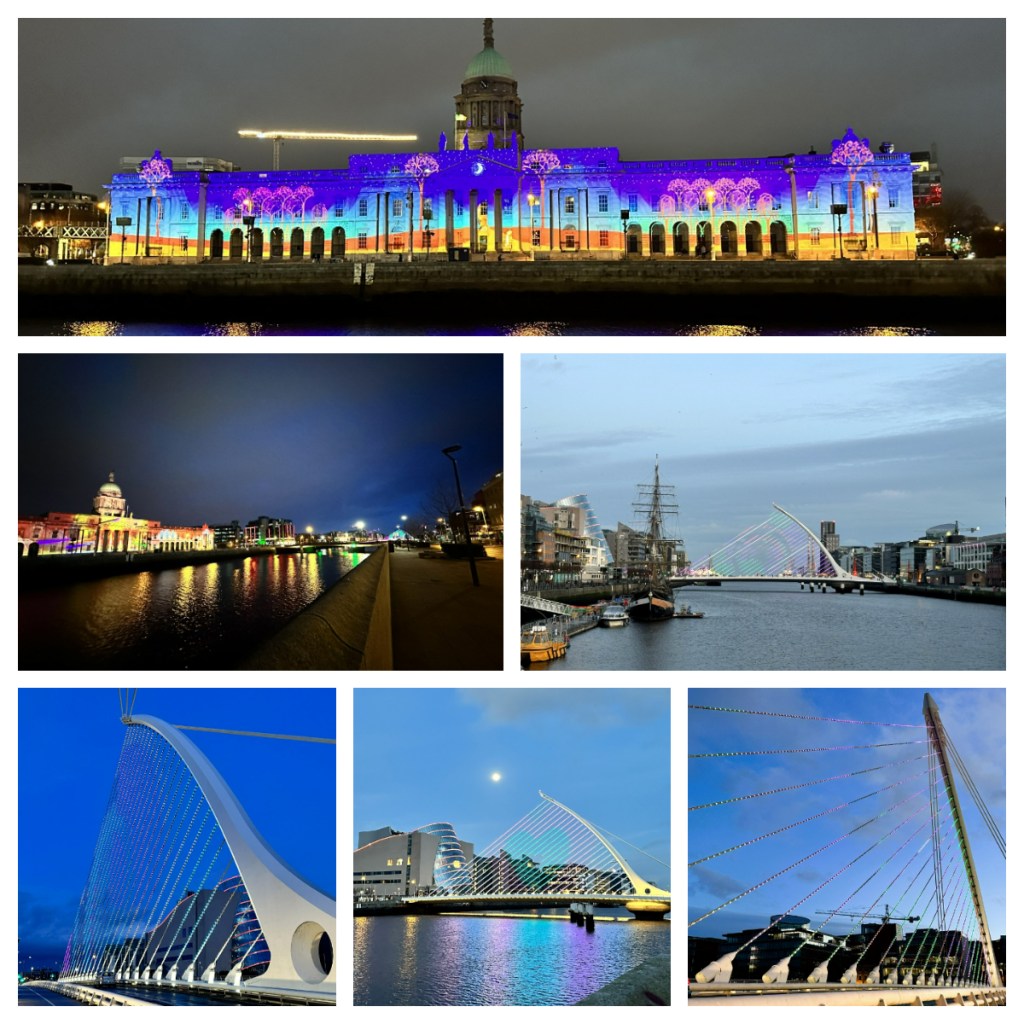
After a wonderful full Irish breakfast (ok, it was lunch time) and mimosas at Suzanne’s, I needed another walk lol.  This time I walked down along the river to enjoy the Christmas lights projected on to the Custom House and those on Samuel Beckett Bridge.  It was a great way to end my first few days in Dublin.