Goodbye Azerbaijan, hello Georgia

Azerbaijan & Georgia

April 2025

I was woken early by the Muslim call to prayer and to a misty morning. As I had now discovered the importance of the buildings just across the road from the hotel, I headed out for a quick walk and in search of coffee.

There are two caravanserais on the main road in old Sheki, the upper and the lower which both date back to the 18th-19th centuries.  They were built as fortified structures with just one gate, so they can be protected more easily. 

The Upper one is a tourist site, of course it was closed at 7.30am but I did manage to sneak in a small door (inset in to the big door) to have a quick look at the first courtyard.  As in time gone by, there are a lot of shops along the the outside and we had walked along them the night before.  Today they are mostly souvenirs and also some Halva shops, making a traditional local Halva (a sweet made from sesame paste and honey).
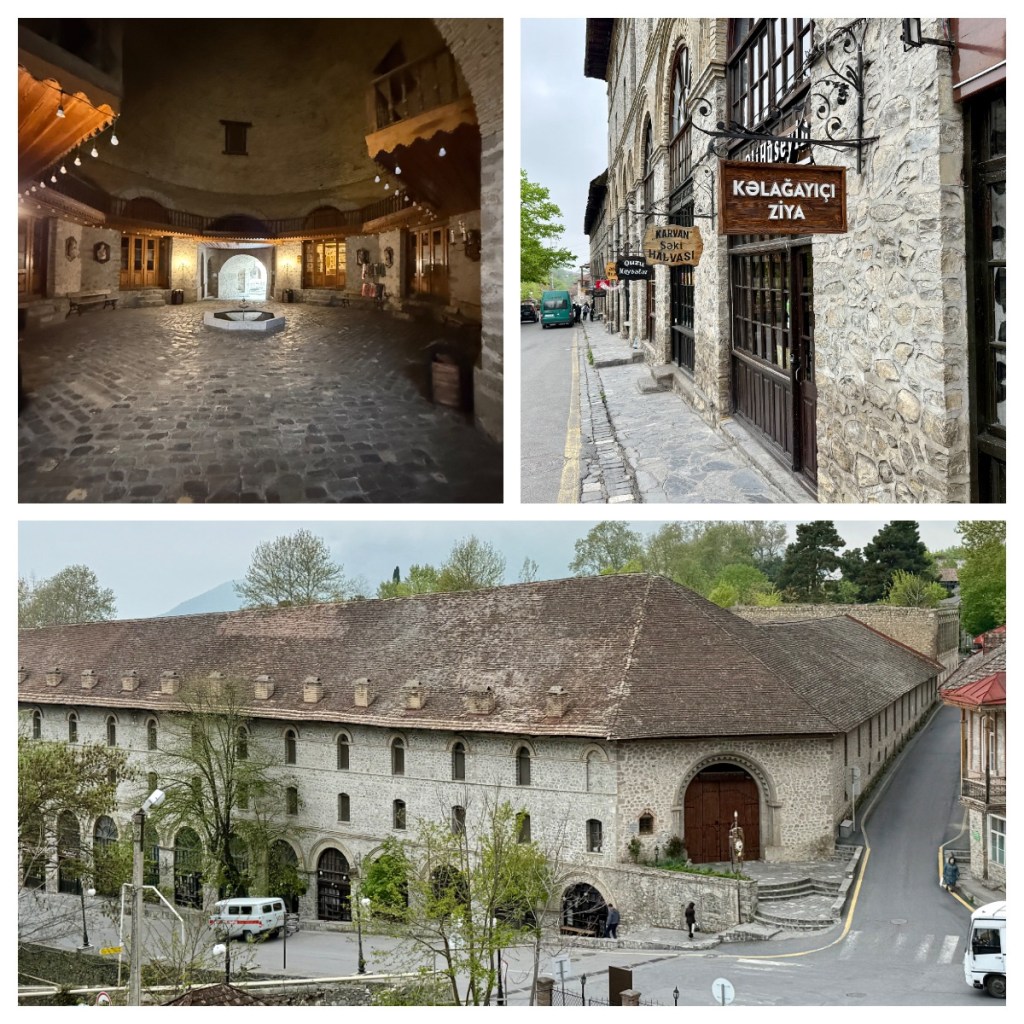
 

The Lower caravanserai is a hotel today, but more importantly for me (that sounds like a terrible thing to say 🤓), there was a lovely coffee shop just across the road … and it was open!  I enjoyed a coffee and watched the local Ladas go by – they definitely rule supreme in this part of the country and I love it.

As we headed towards the border, we passed yet another Albania church on a hill side – I should note that the Albanian churches I see on this trip are not related to the Albania of today, but of the ancient Caucasus Albania which sat in the south eastern part of the Greater Caucasus mountains (most of which sits in modern day Azerbaijan.  The mountain landscapes were filled with wild braided rivers, shepherds grazing their sheep and as we neared the border, trucks, lots of trucks.

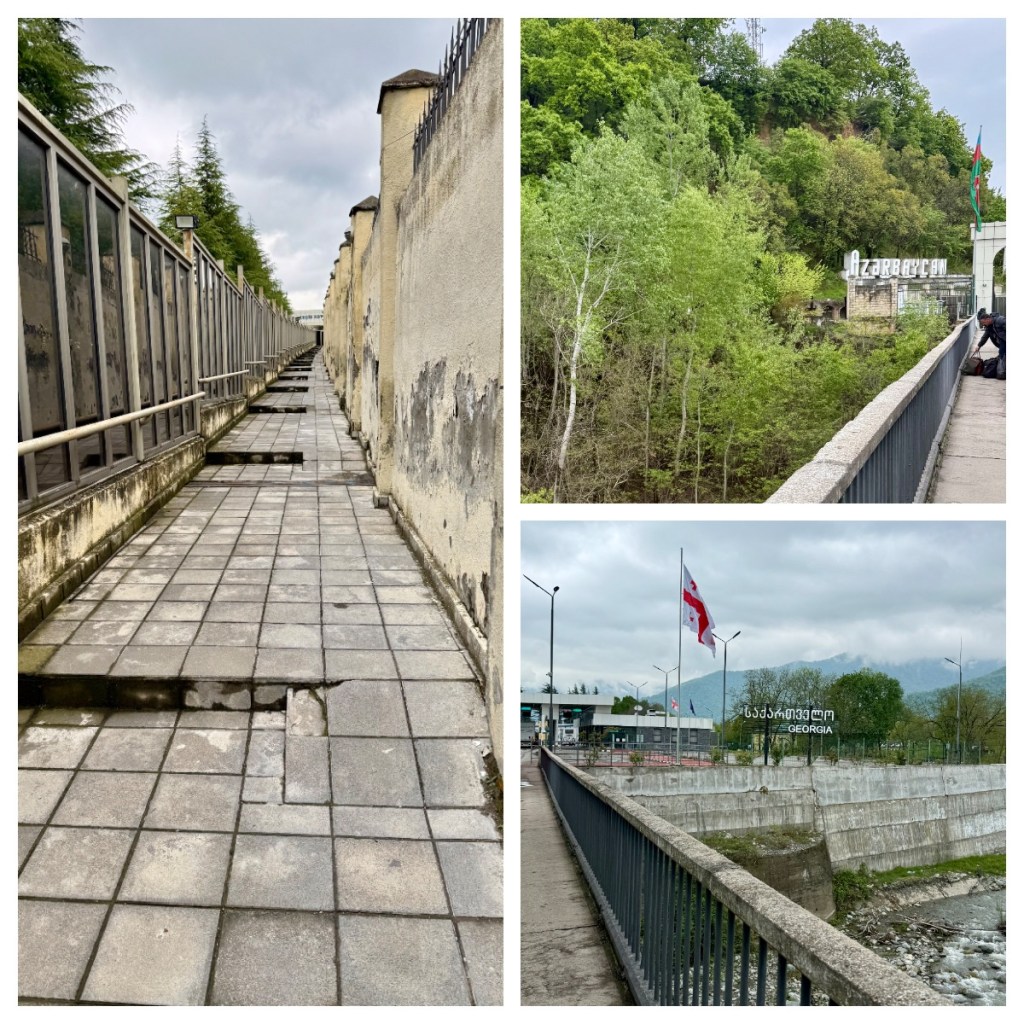
We said our goodbyes to Rugiya (our Azerbaijani guide) and our driver and walked to the border crossing.  It took around 45 minutes to depart Azerbaijan (only because we got caught behind a tour bus) and then walked the short distance across no mans land and into Georgia.  The Immigration guy was so excited to see a New Zealand passport – his exact comment was “I did not expect this today” lol.


We found our Georgian guide, Tazo and hit the road on the next leg of our Caucasus’s tour. Let’s be clear, we are talking about Georgia the country, and NOT the state in American as many first assume!

The currency here is the Georgian Lari (GEL), NZ$1 = GEL1.6.

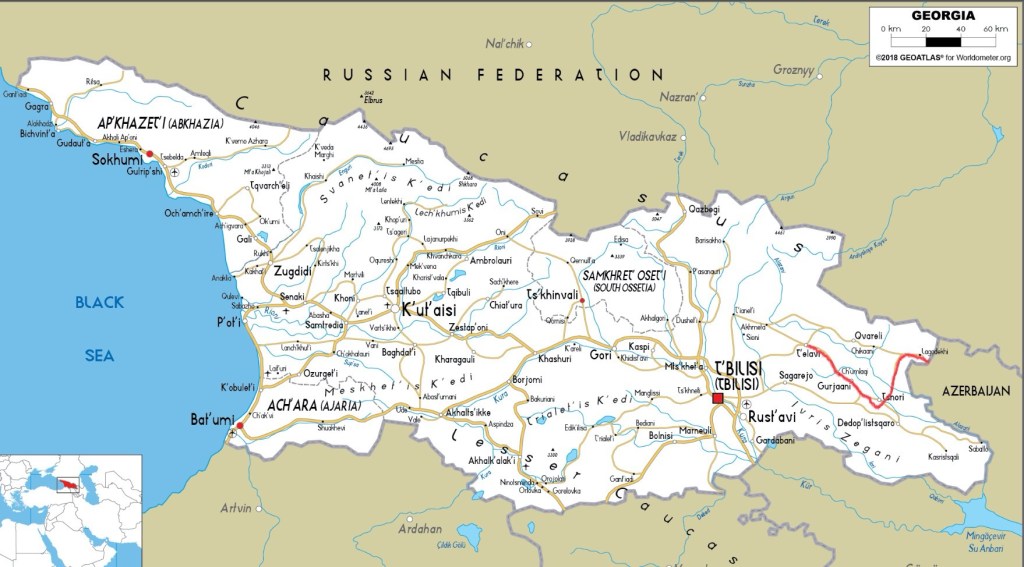
First, I little context. Georgia spans Eastern Europe and West Asia, bordering Russian, Turkey, Armenia and Azerbaijan.  It is a small country (only 69,000 km2 – compared to New Zealand’s 263,000 km2) with a population of around 3.7 million, 2 million of which live in the capital, Tbilisi.
As with most countries in this region, its history is complex and somewhat turbulent and even today, the geopolitics of the region continues to cause issues.  After adopting Christianity in the 4th centre, the Kingdom of Georgia remained strong until the 15th century when they succeeded to the Mongols, the Ottoman empire and Persia, before becoming part of the Russian Empire in 1801. 

After the fall of the Russian Empire, they had a couple of years as an independent republic before, once again, being invaded by the Red Army and becoming part of the USSR until 1991.  It was not until 2003 that they gained political stability and aligning themselves with the EU.   I will touch further on parts of this as we travel around and learn more.

The weather was less than ideal, but it was better than the forecast for the following day, so Tazo recommended that we visit the hilltop town of Sighnaghi today rather than tomorrow. A small town in the Kakheti region, Sighnaghi was built in the 18th century as a fortress but today it is referred to as Georgia’s “City of Love” (though I am not sure I know why)!

We drove up into the cloud to the town and we did have to imagine the charm of the town, and of course the view – which apparently is beautiful and our imagination continued as we wandered down through the cobble stone streets to our lunch stop.    

In just a few short hours, we were already impressed with Tazo and he ordered a great array of delicious Georgian food for our first meal.  It seems that walnuts, cheese and bread play an important part of Georgian meals and this meal incorporated all of the above – eggplant stuffed with walnut paste, khachapuri (a few different varieties but the basic one is bread with cheese), tomato salad, BBQ pork and Khinkali (broth and meat filled dumplings). 

All were delicious and I washed it down with my first glass of Georgian wine.   (I will warn you now, food photography is not my thing – most of time we would be half way through eating before we remembered to take the photos 😂.)

In just a few short hours we had already learnt some important information about Georgia and her people:

  • Georgian’s like food with flavour, and “food without salt is not food” lol.
  • Georgia is the home of wine making (more about that another day) and it is important for Georgian people.  Without wine, nothing happens and almost everyone makes their own.
  • Georgia’s main exports are copper and other minerals/ore.
  • The Georgian alphabet is unique and in fact, there are 3 versions of it.  One is widely used, the other two are predominately for religious texts and inscriptions. 
  • I was the first Kiwi guest that Tazo had had

The cloud lifted briefly to allow a quick and hazy view of the valley below, with the green pastures and fish farms (which seem a little random to me in the middle of fields lol).  Apparently there are also lots of minerals in the soil here which are great for grapes. 

While Tazo ran back up the hill to get the car, we took a short walk along part of the 4 km defensive wall to a watch tower flying a very tatty Georgian flag in one of the 28 watch towers along its length.  Again, we had to use our imagination on the view!


I have to admit, I was in a bit of a food coma on the next part of the drive but we had lots of good chat with Tazo on the journey to Telavi, the main administrative centre of the Kakheti region and our stop for the night. 

Dinner was not required but we bit have a snack and some homemade Green wine (they use the grape skins during fermentation) to finish of the day. 

But, before I finish this blog, I thought I would touch on the country’s name of Georgia and the infamous St George.  Georgians actually call the country Sakartvelo, and although it is not entirely clear where the English name of Georgia came from, there are a number of theories mostly based around St George.

St George, an early Christian martyr, was born in Cappadocia in the second half of the 3rd century. He is the patron saint of the country (and many others), a large number of churches in the country are built in his name, George (or Giorgi) is one of the most common male names and the country’s flag features his red cross on a white background!  What more do you need to convince you of is importance to the country and its people and perhaps the English name.

When he started fighting dragons, and became the patron saint of England is another story entirely lol.
 

North west to Sheki

Azerbaijan

April 2025

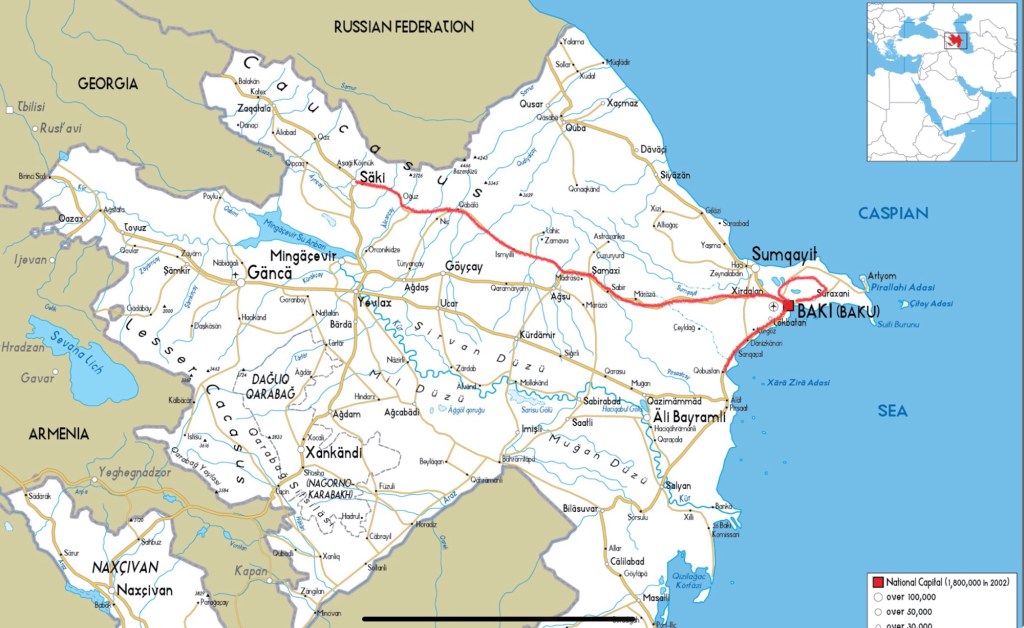
It certainly seems that things do not start early in this part of the world, so I always have time to do a little writing in the morning.  This morning’s pick up was 9.30am and this morning we left with our bags as we were leaving Baku behind and heading west.

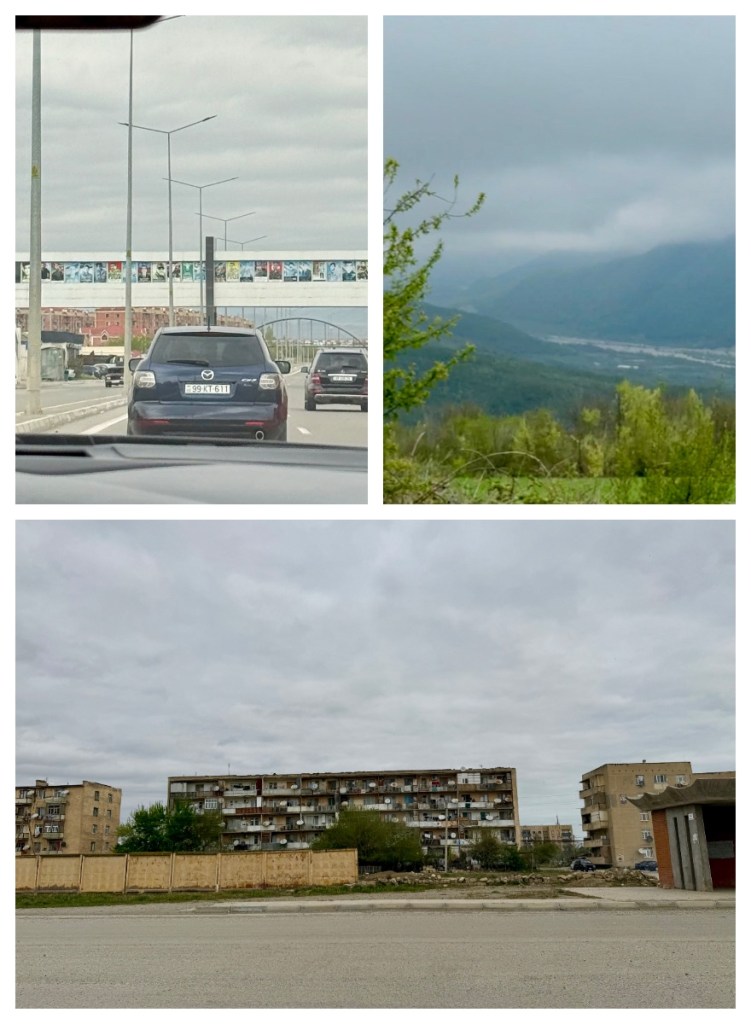
Not sure if I have previously mentioned some of Azerbaijan’s more recent history.  The country gained independence from the Russian Empire in 1918, but it was short lived as the Red Army invaded in 1920 declaring Azerbaijan as part of the USSR.  The country finally regained independence again in 1991 (after the collapse of the USSR in 1989) and the first president of independent Azerbaijan was Heydar Aliyev.  As we headed out of the city, we not only passed many more photos of fallen soliders, we also saw many large billboards of Heydar Aliyev.

Ilham Aliyev, Heydar’s son, took power in 2003 and has been President ever since. In this time he has increased the president term from 5 to 7 years, and removed the limit of times he can be reelected. So far, he has been President for 22 years and his wife is actually vice-president! Take from that what you will.

We did not see much in Baku that was a reminder of the Soviet times, but did see some old tower blocks as we drove out of the city.  Not only did the architecture change, but so did the landscape, and the further we got away from the coast, towards the Caucasus mountains, the more green the landscape became.

The long drive today gave me time to make some more observations about driving here.  Smoking and using phones whilst driving seem to be a national pastime – thankfully our driver did not smoke in the car but close enough to make it smell pretty bad.  Driving inside one lane and the use of seat belts appear optional (I think I have mentioned the lane driving part before!). The driver would put on his belt when passing police stations then take it off again.

The roads were actually way better than expected, except for a section were we travelled on a new road which was not finished yet.  Apparently, the new route cut over an hour off the trip and for some reason meant the driver had to go even faster.  In this case we were actually told this. At some points I had to close my eyes with some of the manoeuvres that the driver was doing.   I was thankful to arrive at our destination in one piece!

We were driving on the North West route, and the further we got out of the city the higher we climbed and the greener everything became.  Another observation was that the further we drove, the number of high end cars dwindled, and the number of Soviet era Ladas increased – (I love those things 😂).

We had a toilet stop at a roadside supermarket.  The supermarket was lovely, full of fresh produce, bu the toilet was smelly and squat so we did not bother with those!  Instead I decided to sample one of the popular Tarragon Lemonade drinks which seem to be very popular.  It tasted a little more like aniseed to me but it was ok, I definitely prefer the pear version.

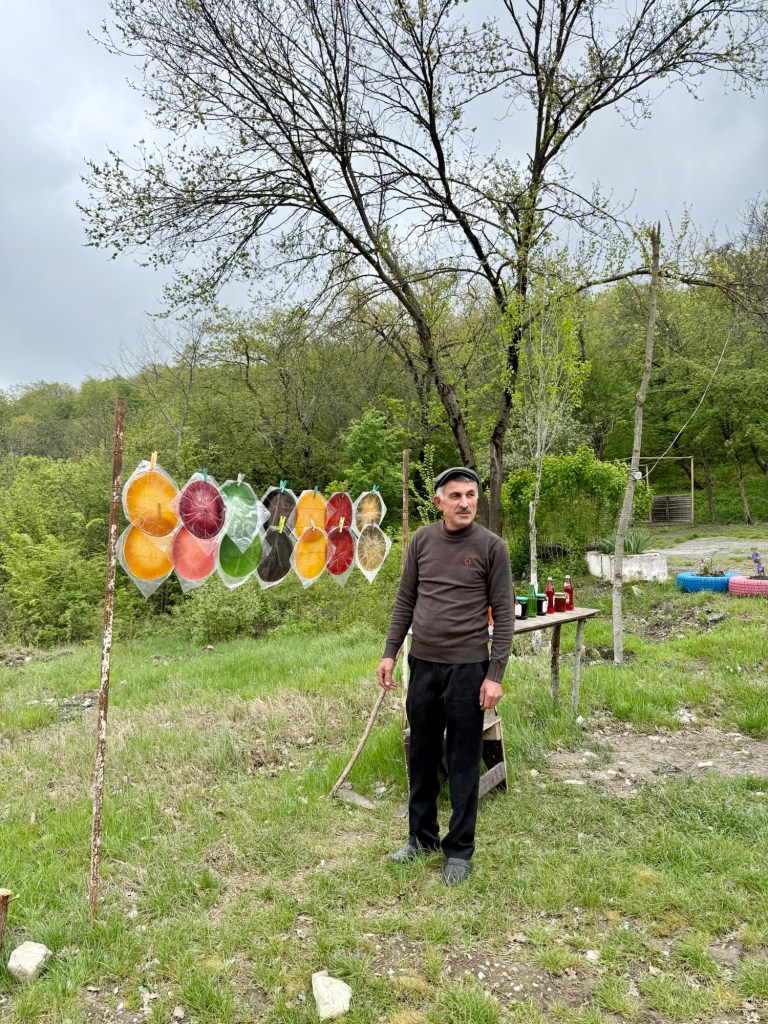
We started passing people selling fruit and vegetables on the roadside out of the back of their Ladas.  I wish I could have taken photos but at the speed we were going there was not much chance.  We did manage to stop at one to purchase a dried fruit thing, so at least there is one photo!  There were lots of Strawberries on offer, which looked lovely (from a distance) but apparently grown in greenhouses.

There are often times on my travel where landscapes are so like New Zealand, I could be at home and this was one of them.  The rolling green hills were so familiar and at one point we were stuck behind a truck full of sheep, making me feel right at home. The small quiet towns and cows grazing on the roadsides was like a different country to Baku.

We stopped for lunch at Nohur Lake, a beautiful lake surrounded by forest in the Greater Caucasus mountains.  I was surprised to learn, it is actually a manmade lake, to supply water to the local area, and is now a popular place for locals to visit.  It was a beautiful location, but not suprisingly, the restaurant on the lake was very expensive. I picked the cheapest thing on the menu, a chicken kebab for AZN16, every else was over 40!  I would rarely pay that for a causal lunch at home!

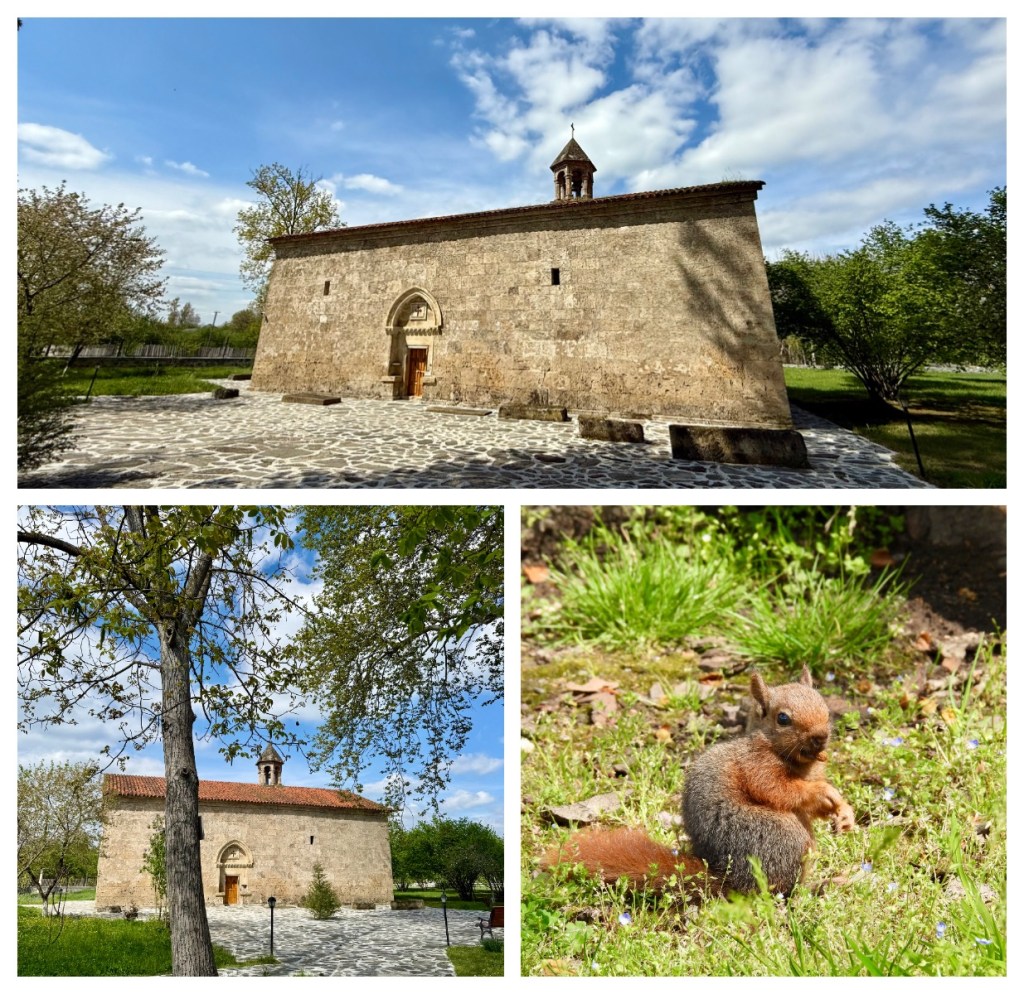
We stopped in the small town of Nij to visit Jotaari Church.  Initially an Armenian church, built in the 1820’s, it is now used by the Albanian-Udi population.  The Udi people were the native people of the Caucasus area and converted to Christianity in the 4th century.  There are only 10,000 Udi people today and around 4,000 live in this small village and still speak their own language.  Their Orthodox Christian church is open to the public, but as with many churches, no photos are allowed inside. 

In the church grounds there are a number of large Hazelnut trees, Hazelnuts being one of the main crops for the area.  We had a cute little wildlife encounter with a cute little squirrel foraging around under the trees which was an opportunity to bring out the camera – these days most of my photos are taken on my phone.

Now in the countryside, Ladas are definitely more prevelant and are often loaded down with stuff – sometimes it appears to be everything except the kitchen sink or perhaps including it!  Actually horse power also seems to work fine in this part of the country with people riding horses down the road, along with horses pulling carts. 

We had passed many police checks but were not stopped until we were just entering Sheki, our destination for the day.  Not really sure what they were checking but it seems very common. 

Sheki (also known as Shaki or Şeki) sits in the shadow of the snow capped Caucasus mountains, in the north west of Azerbaijan, was once a stop on the Silk Road, connecting east and west. 

Our first stop was the small nearby village of Kish and the Church of Saint Elishe, what was a Georgian Orthodox Church dating back to the 12th century. It subsequently became a Caucasus Albanian church.  The Sheki region was once one of the biggest Caucasian Albanian states in the region. 

To get to the church, we abandoned our car and jumped into a bright blue Lada driven by a lovely lady.  We zipped up the narrow cobbled streets with Azerbaijani music pumping – I loved it!  When we got to the top she kindly offered us samples of her homemade pomegranate wine and cognac from her shop before we went in to visit the church.  It was a beautiful spot and very peaceful.

Back down in Sheki old town, we visited the Khan’s Palace.  After it’s Caucasus Albanian era, the town became the capital for the powerful Sheki Khanate.

The palace was built at the end of the 18th century by master craftsmen (many from Iran) and there are intricate designs and details both inside and out.  Unfortunately, we could not take photos inside so you will have to believe me when I tell you of the wonders of the detail inside.  (I should note we were constantly watched by guards to ensure we did not take photos 😄.)

Each of the rooms are beautifully painted with murals including pomegrantes (the tree of life), Iris’s (apparently bacteria can’t survive in a room if it has Iris’s in it, or silk for that matter, one of the reasons they often had silk wall hangings).  Images of battles filled the throne room along with images that indicated the kind king that he was e.g. dragons breathing flowers rather than fire and goats playing with wolves.


One of the key features of the palace are some of the best examples of ‘shebeke’, the Azerbaijani stained-glass windows that are made without the use of glue or nails.  It was initially made with very fine glass imported from Venice, but today the glass is more than 3mm thick. They use small pieces of glass which slot into the wooden frames and some of the panes contain 1,800 pieces of wood and glass and weigh up to 40 kg.

After our palace visit, we went to the Shebeke workshop to see the master at work. He insisted we tried to put one together and then I felt obiliged to buy the one I made 😝 .  No, of course I was not obliged, I wanted it, I just wish I could have afforded a bigger one as they really are so beautiful and such an incredible skill. 

Also on the palace grounds is the Russian Orthodox Nukha Three Saints Church.  Today it seems to be more of a backdrop for dress up photos!


Back in town and we were dropped off at our hotel – the adeptly named Sheki Palace.  The photo does not do justice to the enormous room we had here.  We were on the top floor, which seemed a little attic like.  The windows were tiny but what a lovely view across the old town. 

 Sheki was an important stop on the Silk Road and the most obvious reminder of this is the two great caravanserais that dominate this part of the city.  Unfortunately, when dropping us off, Rugiya neglected to tell us the importance of these buildings so when we were wandering around the souvenir shops that occupy the bottom part of the Upper Caravanserai, we had no idea of the importance of the building itself!  And by the time we did realise, it was too late to go inside. I get very lazy when I have a guide and don’t really do much of my own research on places – lesson learnt!

Upon questioning, the driver did recommend a small local restaurant near our hotel, where we finally got to try the local Qutab, a stuffed flatbread. More commonly served for breakfast or as a snack, we tried all three types for dinner – meat, cheese and herbs, along with some dolma and compote (water with fruit) and it was all very tasty and a fitting way to end our last night in Azerbaijan.