
Georgia, April 2025

We woke to a cold and rainy day but, at one point, the rain cleared a little and I could see out to the beautiful snow-capped mountains in the distance and I was definitely excited for the next few days. Bur our first full day in Georgia was to be spent exploring in and around Telavi and avoiding the rain where possible.
I will warn you, today was a crash course in a small part of Georgia’s long history … and now I am sharing that with you so enjoy if you like that kind of thing 👍🏻or just look at the pictures and move on lol.
We started the day at the Telavi History Museum, a complex the includes the only preserved royal palace in Georgia, a church and a bath house, along with a museum and art gallery. The museum had a great collection of historical artefacts and information about the history of ceramics, architecture, coins, clothing and the importance of grapes and wine. It was interesting to see how the country has incorporated parts of its history, including Mongol, Russian and European, into its culture.


We then moved on to the art collection, a private collection of Ketevan Iashvili, a female cosmetologist born in the area in 1883. She had an interest in fine art and collected it throughout her life (sometimes she was apparently given art in lieu of payment for her services by wealthy customers). In the 1970’s she donated her collection to the museum and some of it can be seen here today.
We then had to brave the weather and head outside to visit one of the most important parts of the museum complex, the Palace of King Erekle II (also known as King Heraclius II or the Little Kakhetian). The much-loved King Erekle ruled Kakheti from 1744 to 1762, before uniting the regions of Kakheti and Kartli (upon the death of his father who was King of Kartli) and ruling both until his death in 1798. He is considered one of the most important and powerful Georgian kings, modernising the Government, economy and military, but unfortunately, he was also part of the reason for its downfall.
He was known as a great diplomat, and in an attempt to keep his kingdom safe, he made a pact with Russia for protection, unfortunately it was not enough to save it from a Persian invasion in 1785.
Construction on the palace started under King Archil II in the 17th century and what we see today was completed under King Erekle II, who turned a more simple palace (where he was born in 1720 and died, in the same room, in 1798) into a fortress with the construction of the 5m high walls.
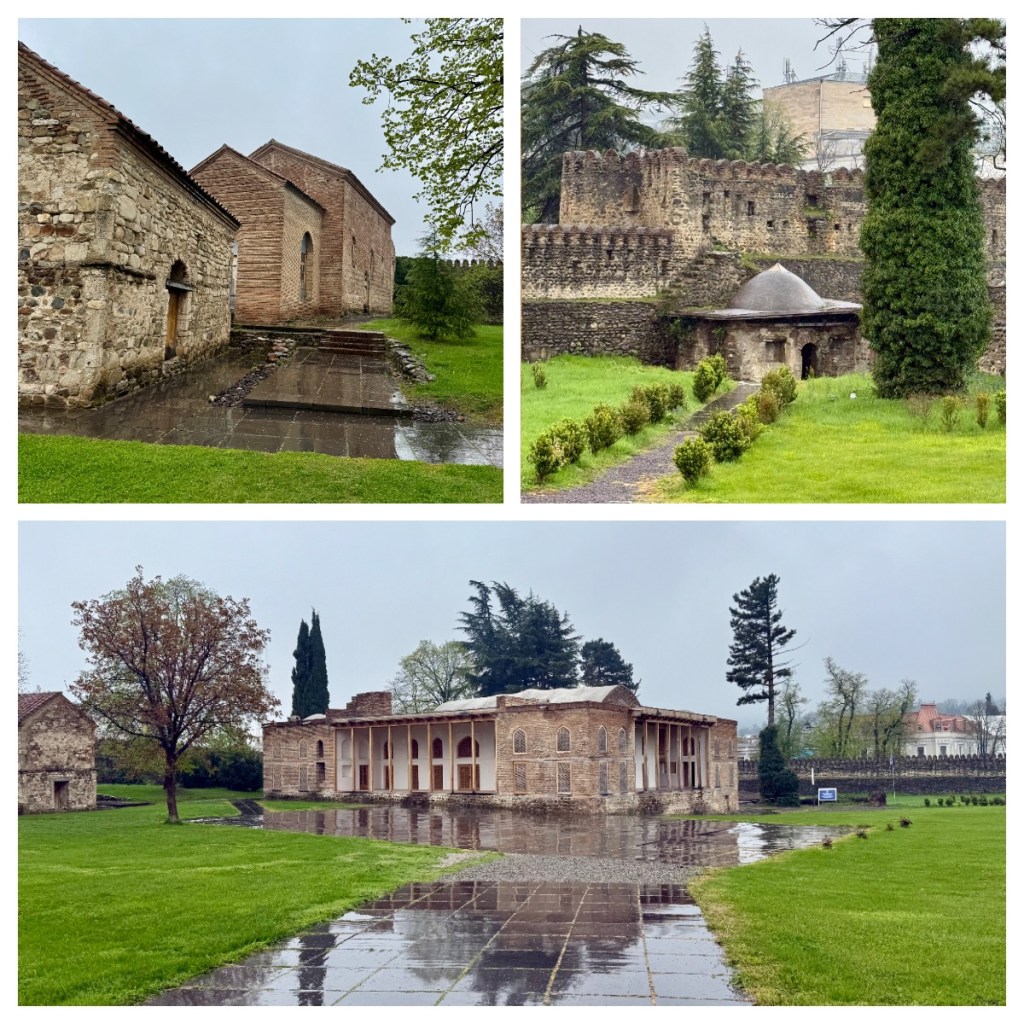

We had a local guide through the museum and the Palace and it was interesting to learn some more of the interesting facts about King Erekle and his palace. I have summarised what was a lot of information as best I can below:
- The palace is a shadow of its former glory. It used to be beautifully adorned with colourful walls and mosaic floors in a Persian style, all of which were destroyed by the Russians (Empire rather than USSR). Unfortunately there are no images and very little written about how it looked so it cannot be restored. The Russians also used the great Audience Hall as horses stables as a further sign of disrespect.
- King Erekle is considered the People’s King and form all accounts, he was liked by his people. He led from the front, literally, being 15 when he fought his first battle, and 75 when he fought his last.
- A 17 year old Erekle was taken to Persia for 2 years. He was a good diplomat and when he returned, ruling Persia allowed him to be King without giving up Christianity. I should note that this part of Georgia was under Persian rule longer than the rest of the country, but they always remained Christian at heart.
- Erekle was already King of Kakheti when his father, who was King of Kartli (the region where Tbilisi is) died, leaving Erkele to unite the two eastern Georgian kingdoms into a single state under his power.
- After initially using the death of his Persian ally, Nader Shah, to his advantage by declaring independence, King Erekle then signed a protection agreement in 1783 with Russia (chosen because they were Christian). Unfortunately, they did nothing to help when Persia did invade and in fact Russian troops went as far as to evacuate the area leading to a full invasion in 1795. He went to his death in 1798 hoping that Russia would come to the rescue so Georgia could continue its existence, but unfortunately, just 3 years later, it was consumed into the Russian Empire.
- King Erekle had 3 wives (not at the same time) and a total of 28 children, most who died young or at birth. His last wife was a strong, intelligent woman whom he married when she was just 12 and she bore him 23 of his 28 children. In the later years of his life, she had significant influence over his political decisions. She was not in favour of the agreement with Russia and was deported to St Petersburg in 1803 where she lived until her death.
In summary, he seems like he was a decent bloke, tried to do his best for his country and his people but was screwed over by his supposed mate! In fact his dress sense denoted his diplomacy and he was often depicted wearing a Persian style hat, a European style cape and a blue sash to represent Russian.
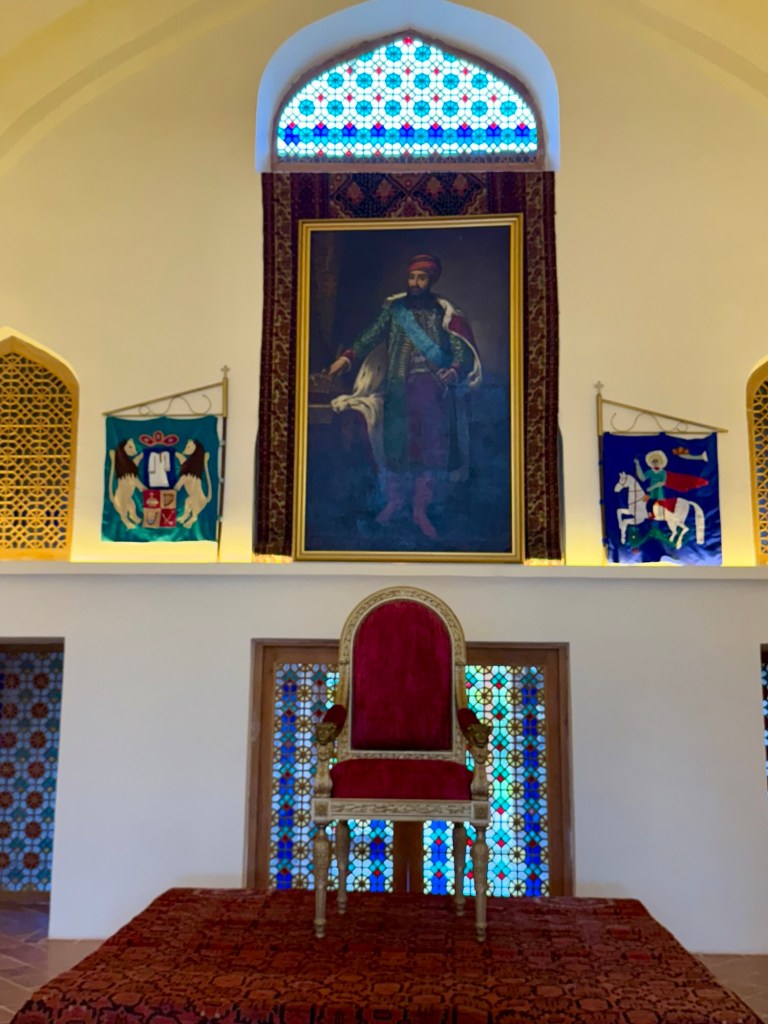
We did not explore much more because of the rain but could see the King’s personal Persian style bath house in the distance and churches in the grounds. One of the two churches actually dates back to the 9-10th centuries. Much older than the palace itself.

We took a quick detour to see the impressive 900 year old Plane Tree that is all that remains of the forest that used to cover the area. It is 46m tall and 12m in diameter and today, its health is closely monitored to ensure its ongoing survival. It is apparently considered a symbol of Georgia’s strength and resilience and it might also be able to make dreams come true lol.
We headed slightly out of the city to our next stop at the Aleksandre Chavchavadze House Museum in Tsinandali. Not surprisingly it was the home of Prince Aleksandre Chavchavadze. Born in 1786 (to a noble father who was at one time ambassador to our friend King Erekle) he was Georgian poet, public benefactor and once colonel of the Russian Army and is considered the ‘father of Georgian romanticism”. He inherited the house from his father and turned it into the cultural and intellectual centre of the country.
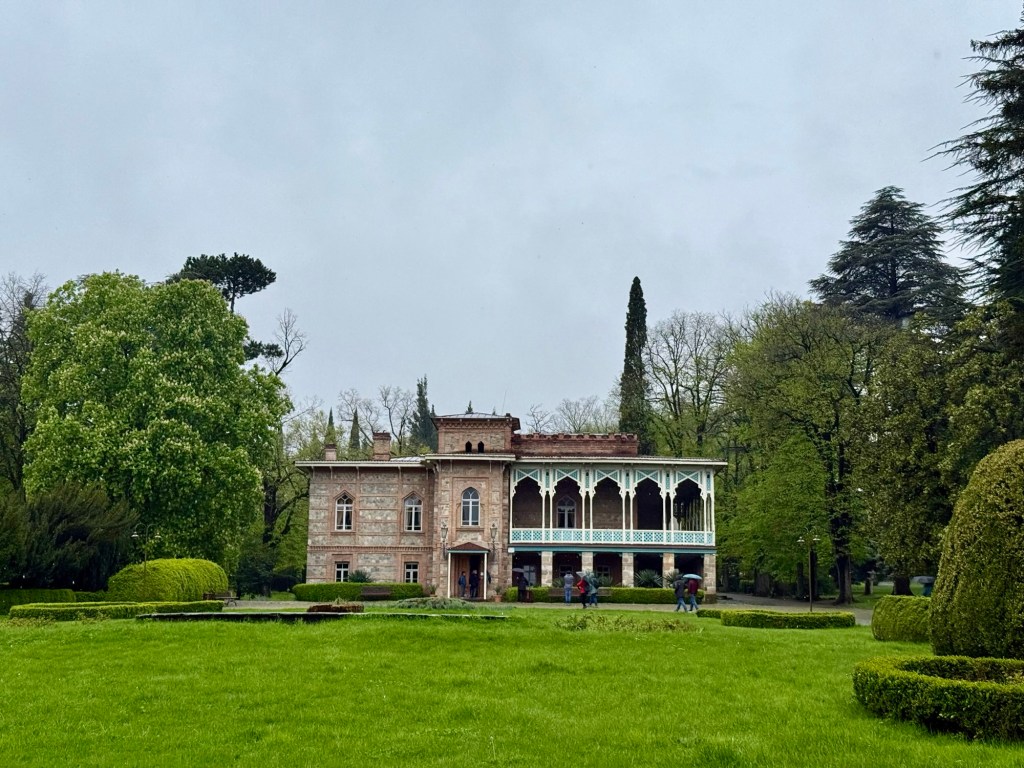
We had to wait for a tour in English so we braved the rain to run to the large building behind the house, which today is a Radisson hotel and the home of the estate’s wine collection and museum. Another of Chavchavadze’s claims to fame is that he was the first to bottle Georgian wine in a European style.
We were taken through a locked door and down some stairs into the estate’s vast historic wine cellar where more than 16,000 bottles of his personal collection are stored. We learnt about the 8,000 years of Georgian wine making history and saw some of the early artefacts they had collected, including pressing equipment and fragments of clay pots (used in the Georgian style of wine making) dating back to the 6th millennium BC!


There are detailed written records for the wine, and the earliest bottle of Aleksandre’s wine is from the 1841 vintage. Unfortunately, the early wine is no longer drinkable. (I wonder who dared to open a bottle to try it to come to that conclusion?)
Back in the house with our English speaking guide, we were taken around the rooms (no photos allowed inside) and given commentary about the family and the historical pieces on display. Not all the pieces belonged directly to the family but all were beautiful luxury items from collected from all over Europe and Russia. It included the oldest grand piano in Georgia and carpets from Azerbaijan.
As the story goes, in July 1854, the troops of a Chechnyan Muslim leader attacked the estate (avenging the family’s support for Russia), pillaging the house and kidnapping his relatives (including his son’s wife, her sister and their children). It was not until March 1855, after complex negotiations, they were returned in exchange for a ransom and an exchange of other prisoners.
Disillusioned with Russia’s control over Georgia, he ended up joining the failed Georgian rebellion against Russia in 1832 which resulted in him burning much of his poetry written between 1820 and 1832 in fears that it would be used against him, but he was still exiled, before returning to the Russian army at the request of the Tsar.
Following his death in 1846 (officially an accident, unofficially by the hands of Russian assassins) and that of his son David, the ransom loan had still not been repaid and the estate was given to the Russian Imperial family as a summer house. Summer seemed very far away on our visit as I am not sure the rain let up for a minute!
Finally the moment we had been waiting for was upon us – wine tasting. For this we travelled the short distance to the Kvareli Wine Cave which apparently have the largest storage of Georgian wine, which is stored in more than 7kms of tunnels. The tunnels were originally built in the 1950’s by the USSR army, allegedly as a missile base or a bomb shelter, before being converted into a wine cellar. Apparently at the time they were also building bomb shelters in Tbilisi, saying they were building a metro system!
After a traditional welcome song, we joined our wine guide to learn more about Georgian wine and the winery. In 1995 they started cultivating grapes and building wine making facilities and the existing tunnels made a perfect storage facilities – maintaining a standard 12-14C and 70% humidity.
This winery has a lot of award-winning wines (apparently over 200 gold medal winners) and have vineyards around the country, as they only use their own grapes to allow them to control the quality.
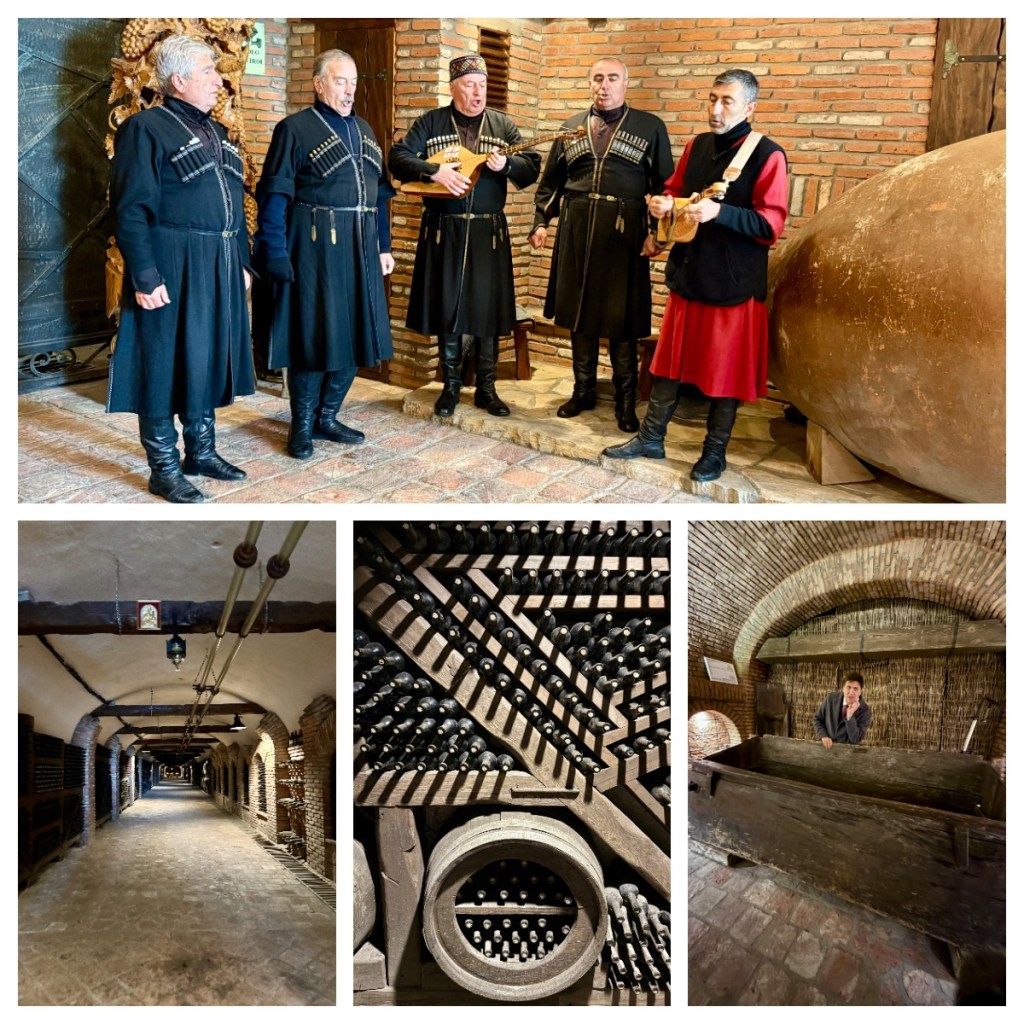

We learnt about the Georgian wine making process which mainly varies from the European style in that it is fermented in large clay pots, known as a Qvevri, Kvevri or Ch’uri. The pots are a special shape to allow for circulation and they push the skins and twigs to the bottom daily. When the bubbles stop, they seal the pot and then it sits for the required length of time. When ready, they traditionally use a scoop (made from a dry pumpkin skin) for the first sip, which is drunk from a clay bowl (it needs to be drunk in full and not sipped)!
We sampled a number of different wines and decided that we liked the semi-sweet ones, and I am a little embarrassed to say I preferred the European styles over the Georgian styles.
Back on the road, we had more great car chats with Tazo covering a multitude of topics – this is exactly what we wanted in a guide!

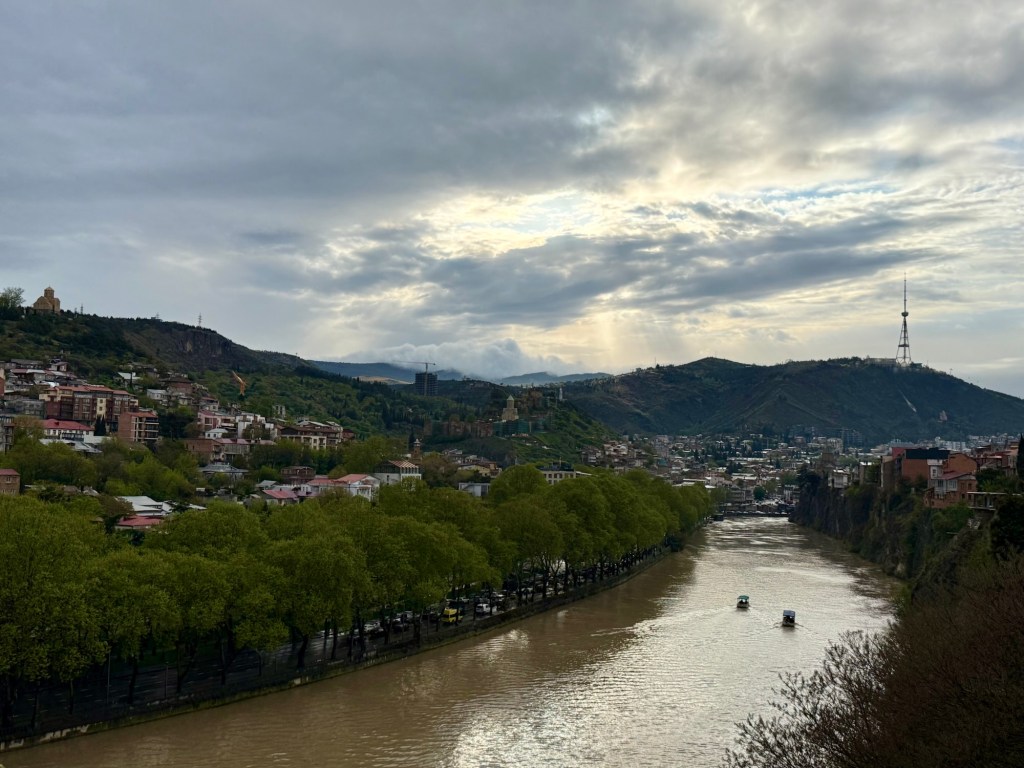
A quick stop at a random road side restaurant for a late lunch of a tasty Georgian beef soup and more Khinkali (I think most meals with include these lol) before arriving in to the Georgian capital of Tbilisi. By the time we got to our hotel, the rain had eased a little and I even saw the sun for a moment so popped out to get my first glimpse of this beautiful city (we will have more time to explore in on another day).
 Cockneykiwi takes flight