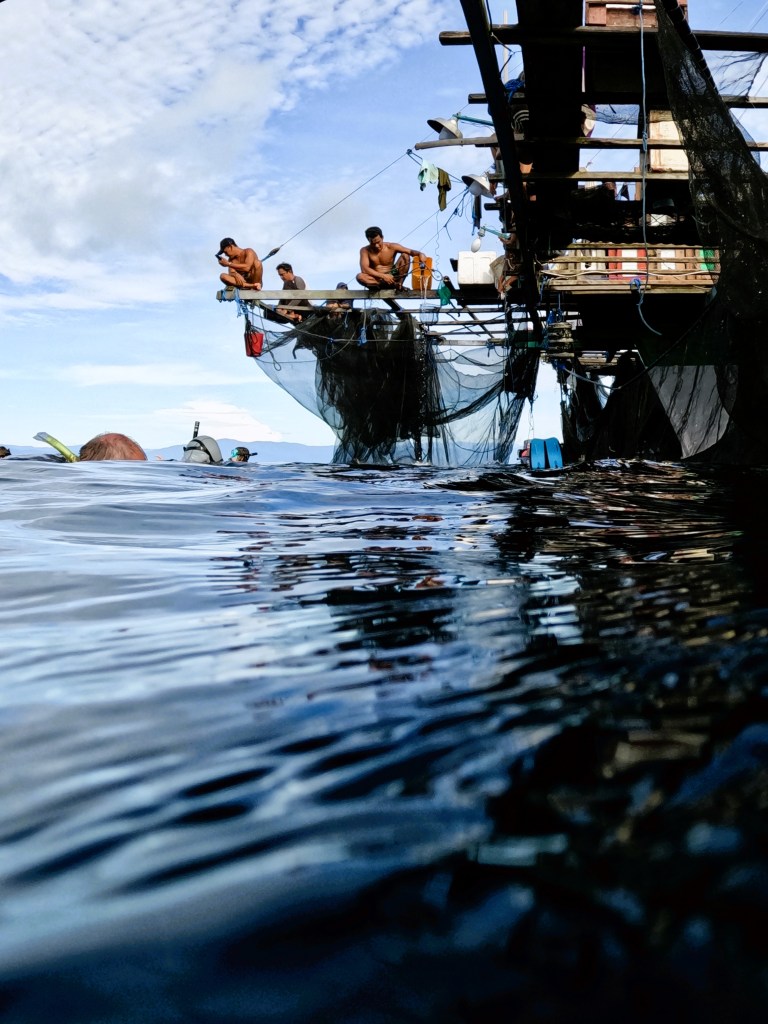
The Golden Marsh of Japan

Kanazawa, Japan

April 2023
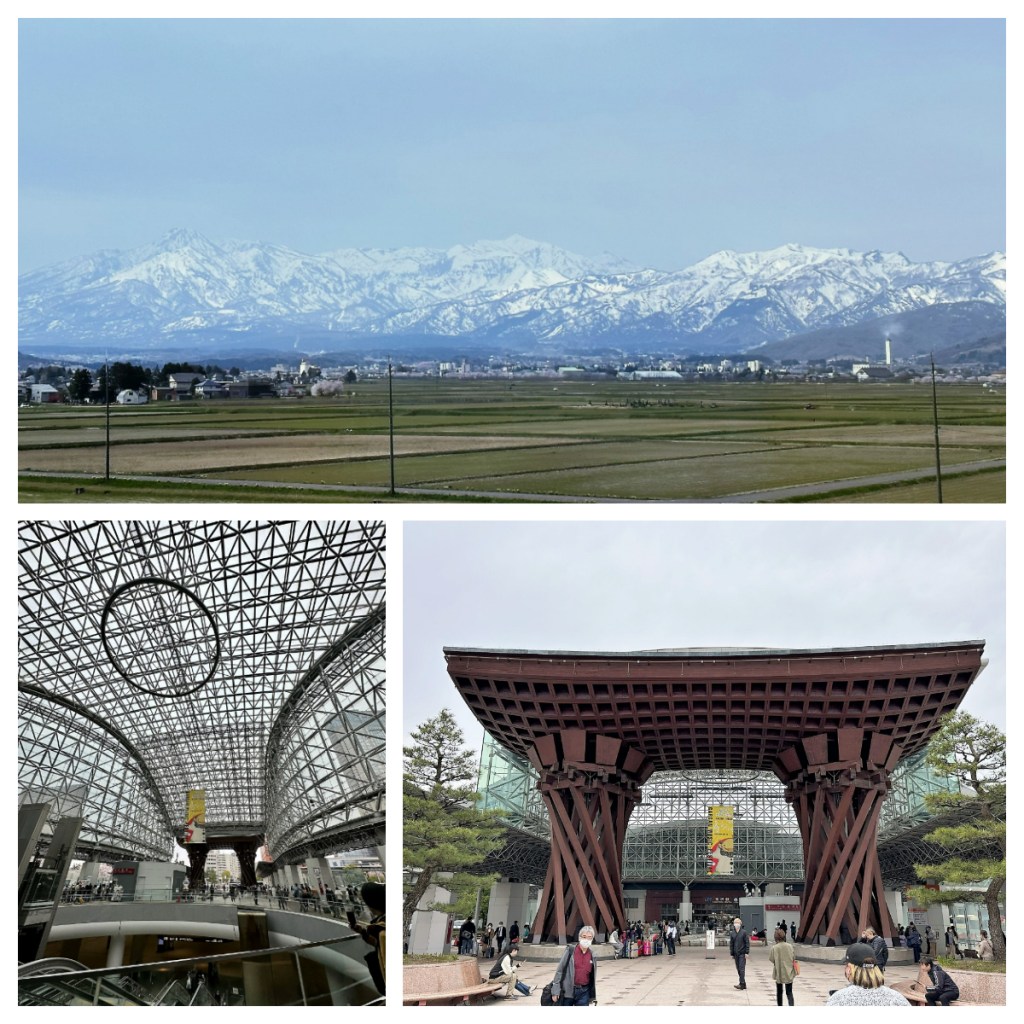
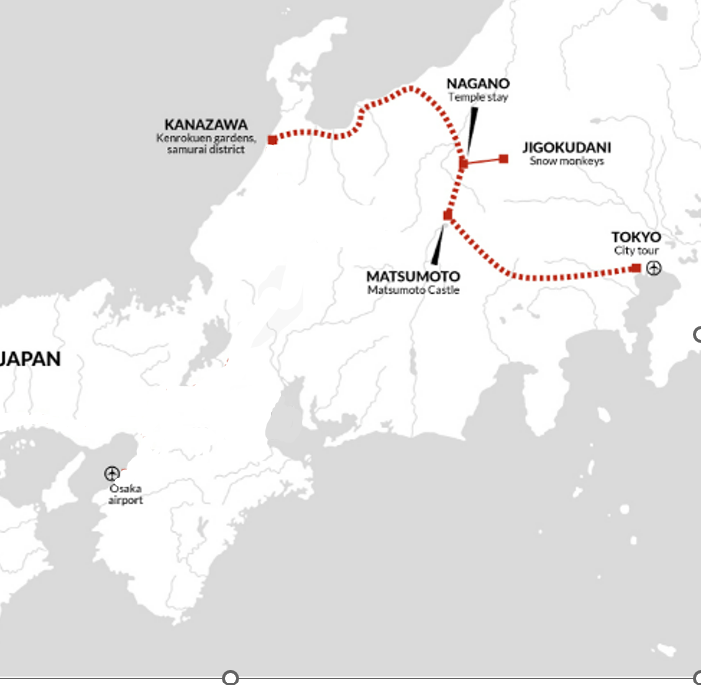
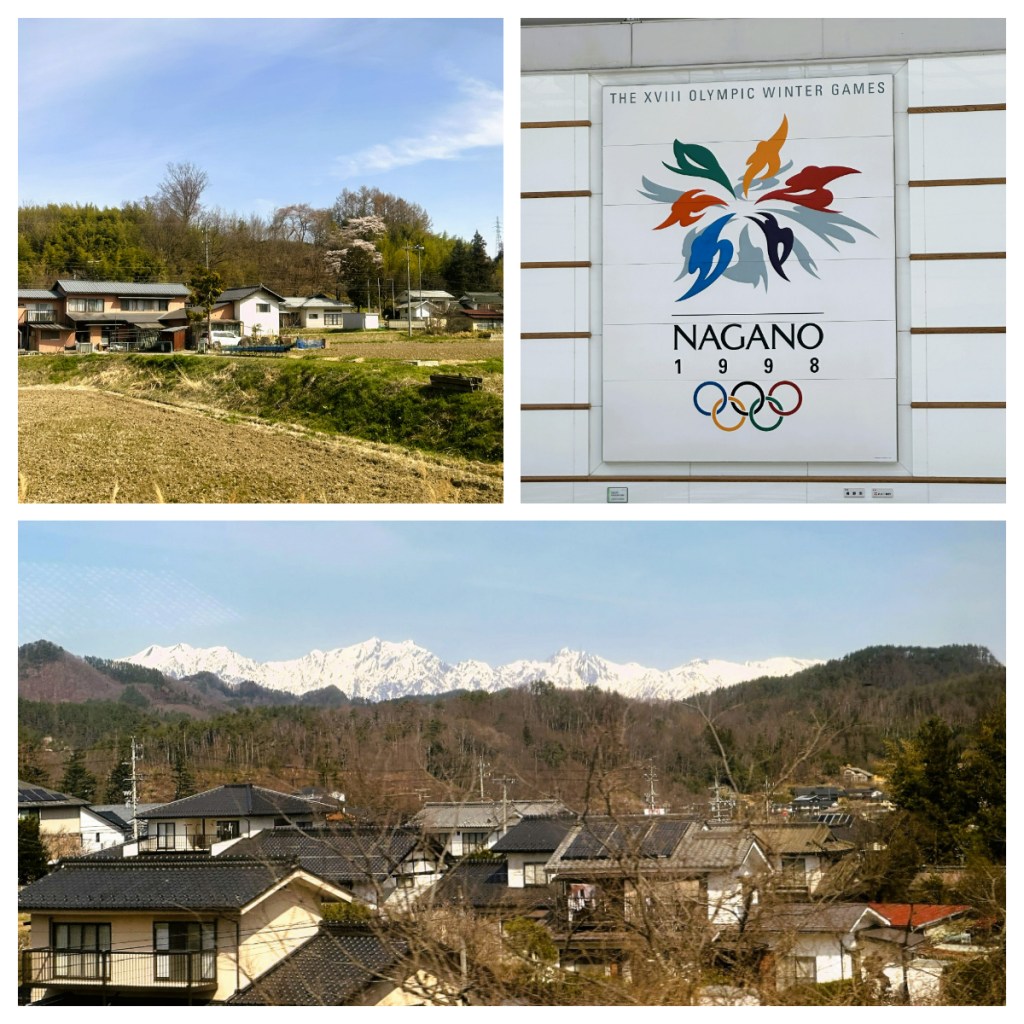
We took a public bus to the train station, to catch the train 1.5 hours to Kanazawa (public transport here is so efficient and easy), the capital of the Ishikawa Prefecture. The train took us through the beautiful Japanese Alps, passed rural towns filled with cherry blossom, overlooked by towering snow-capped mountains.

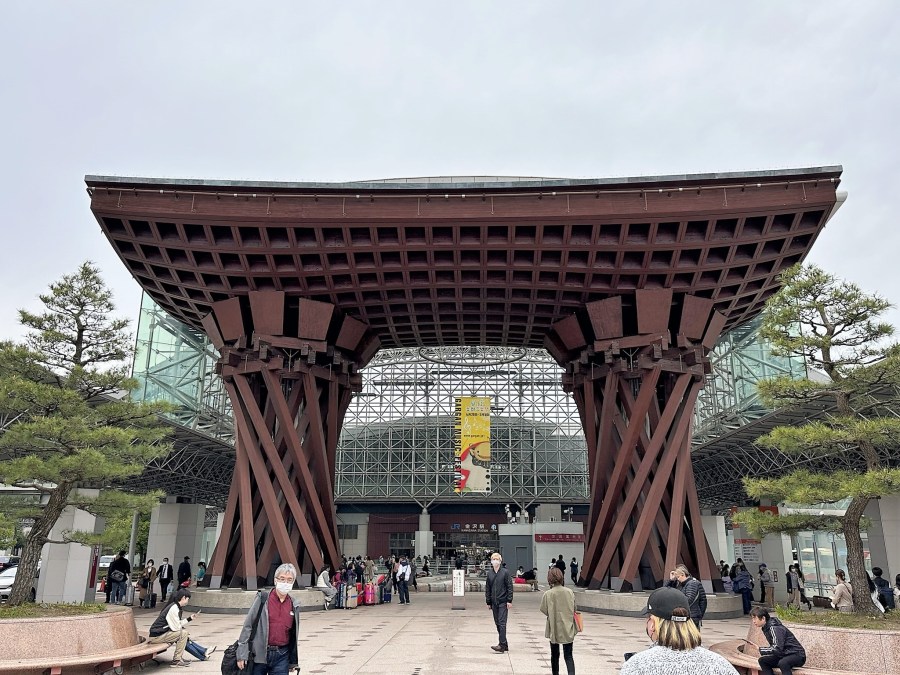
Kanazawa is a UNESCO City of Crafts and Folk Art and upon arrival I was wowed by the incredible architecture of the train station which is an interesting combination of both modern and traditional Japanese design.  It has a massive wooden traditional torii gate combined with a beautiful glass dome.  A very impressive welcome to the city.

Our hotel was just a few minutes’ walk from the station and as it was too early to check in, we dropped our overnight bags (it was here we were to be reunited with the rest of our luggage) and went out for some exploration. 

Our first stop was to be lunch and for once, the guide’s recommendation for lunch was not a convenience store, but … Gusto, a Cat Robot restaurant.  We all jumped at the opportunity.   It was just like a diner with lots of food choices (both Japanese and western), bottomless soft drinks AND, most importantly, a Cat Robot as a waiter!!   The food was not bad, and the service was fun – I for one definitely enjoyed the experience. 

From here we boarded a local bus and headed to the loop bus to Nagamachi, the Samurai district where middle to high-ranking samurai used to live with their families.  The city was once the economic and administrative centre of the Kaga Domain, making it one of the largest castle towns in feudal Japan.  The area is pretty well preserved as the city avoided the WWII bombing that other Japanese cities endured, and today you can walk down the narrow cobbled streets, surrounded by restored houses, waterways (useful to fight fires) and original earthen walls.

One of the houses is open to the public , the Nomura Samurai House, the home of 11generations of a high-ranking samurai family who served the ruling Maeda family from as early as 1583, right through to the end of the Edo period in the middle of the 19th century.  The appearance of the house has been well preserved including the beautiful rooms and the gardens which includes a 400 year old myrtle tree.

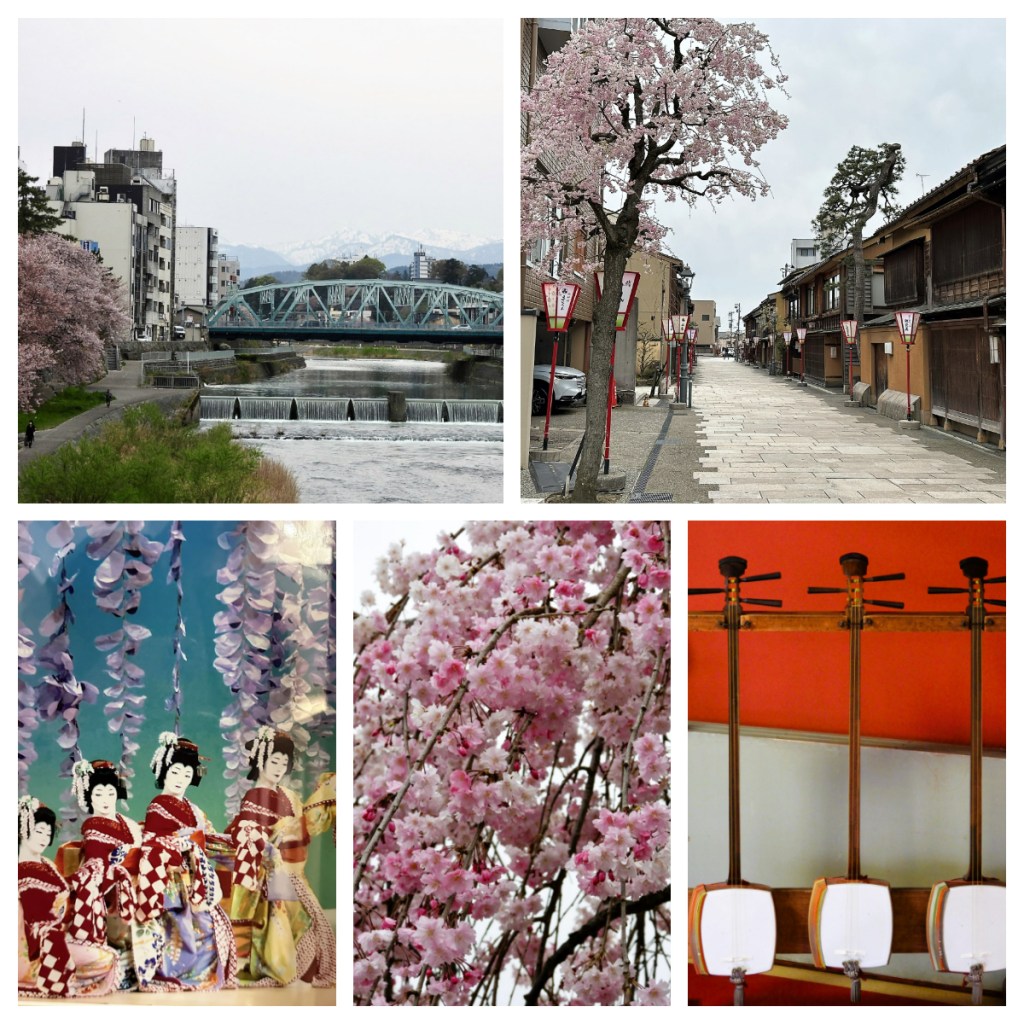
It was then a 15 minute walk across the Sai River (still lined with abundant cherry blossom and views back towards the mountains) to the Nishi Chaya district – one of the geisha districts of the city, where we visited the Kanazawa Nishi Chaya Shiryokan Museum.  The museum is in one of the Chaya houses, a traditional place of entertainment and it was interesting to learn a little more about the elusive geisha culture.  (Apparently, watching the Netflix show “The Makanai: Cooking for the Maiko House” gives a good insight in to the culture and traditional of the Geisha and it was next on my train viewing list, once I finished the Age of Samurai.)

By now we could check in to our rooms, and thankfully today was one of those rare days when I had time for a short rest before heading out to dinner at a nearby restaurant.  The food was not amazing as the set menu was mostly fish and nothing special in the way of vegetables or other food to try but I made the most of it by trying the local drinks (as it was all you can drink for 2 hours !) Sake, plum wine and local beer.  All of which aided a decent night’s sleep.

I was up before 6am to do something very important on day 7 – laundry. The hotel had machines that took 2 hours so trying to find the right time where I had the time and there were free machines was a challenge – for me early morning was that time.

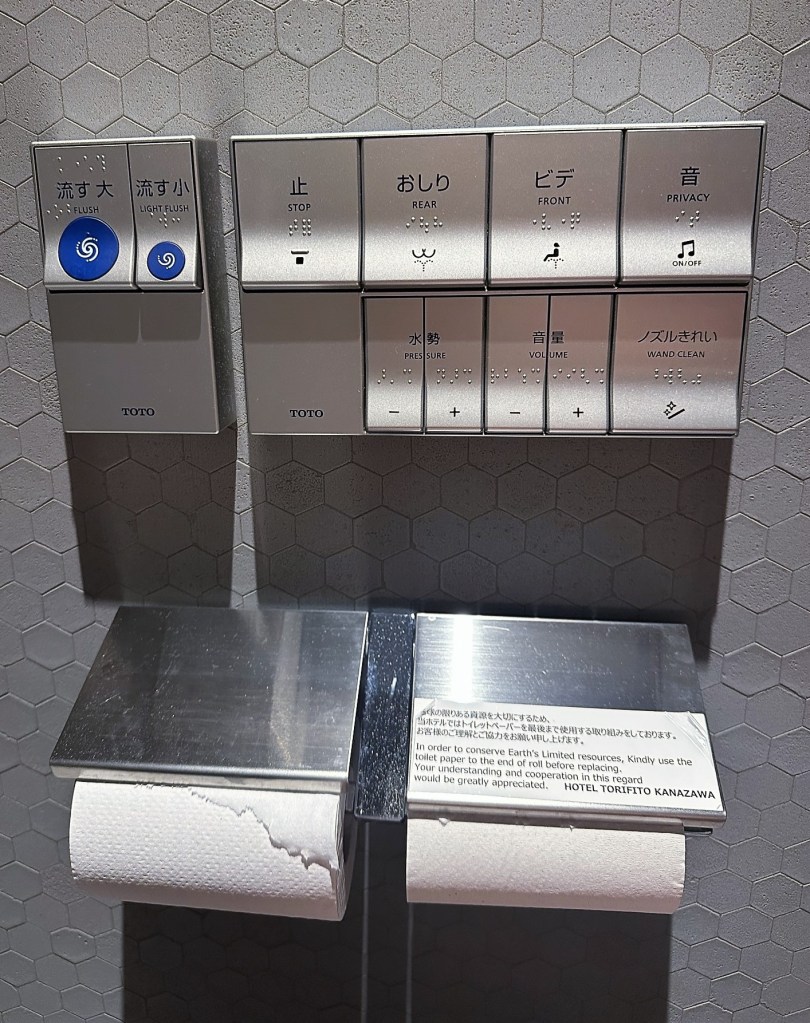
Let’s pause for a minute while I do my washing to talk about the wonders that are Japanese toilets! 7 days in and they are always clean, always have a heated seats and various washing functions – some even have privacy sounds (played whilst doing your business) and our Kanazawa hotel one even has its own hand basin that runs water when flushing!  Despite the brilliance of the toilets, public toilets rarely seem to have anything to dry your hands with🤔, no towels (paper or otherwise) or hand driers – I wonder why??
Washing and toilet musing done, it was time to enjoy what was (and would continue to be) the best hotel breakfast of the trip.  I started with chicken cutlet with Kanazawa curry (yum) and then sweet potato and coconut milk sweet soup with Warabi Mochi, a chewy, jelly like cube made from Warabi starch (a type of fern) rather than rice starch (yum yum).

With a full belly I was ready to start another day of exploration.  There was no need for the Loop bus pass that our guide had recommended, as we discovered that most places on our list for the day were within 10-20 minutes’ walk from each other so off we went on foot towards the first stop of the day at the Omicho Market, the largest market in the city since the Edo period! 
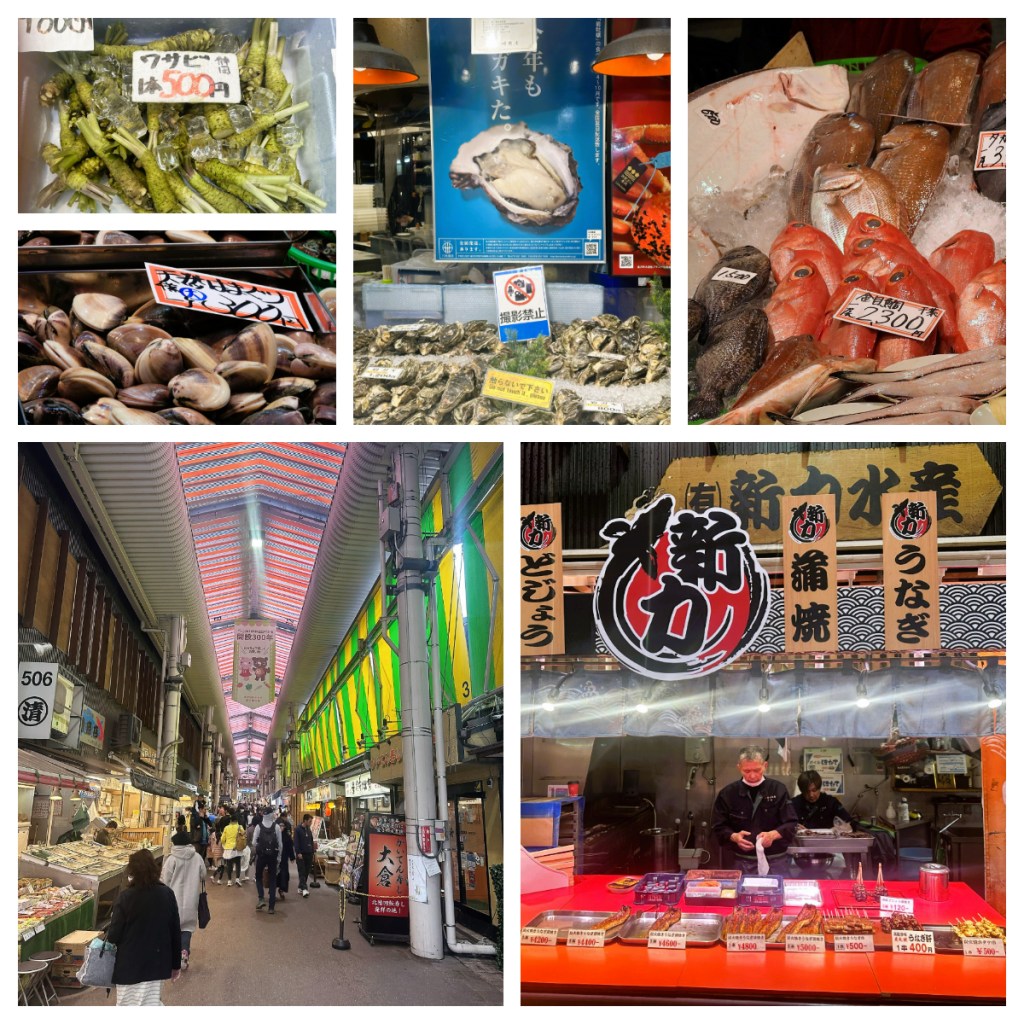
The over 200 shops in the covered network of ‘streets’ mainly sell fresh fish and produce but you can also find a whole range of other random items such as flowers, clothes, household items …  if I was a fan of seafood (which I am not), this would be a great place to enjoy the freshly prepared delights including oysters, eel and horny turban snails!

From the market it was just a short 10 minute walk to the Kanazawa Castle Park.  Not surprisingly on the grounds of the Kanazawa Castle.   Kanazawa, grew around the castle, which was the seat of the powerful Maeda Clan, lords of Kaga, once the second most powerful clan in Japan (this is sounding more like Game of Thrones by the day!).

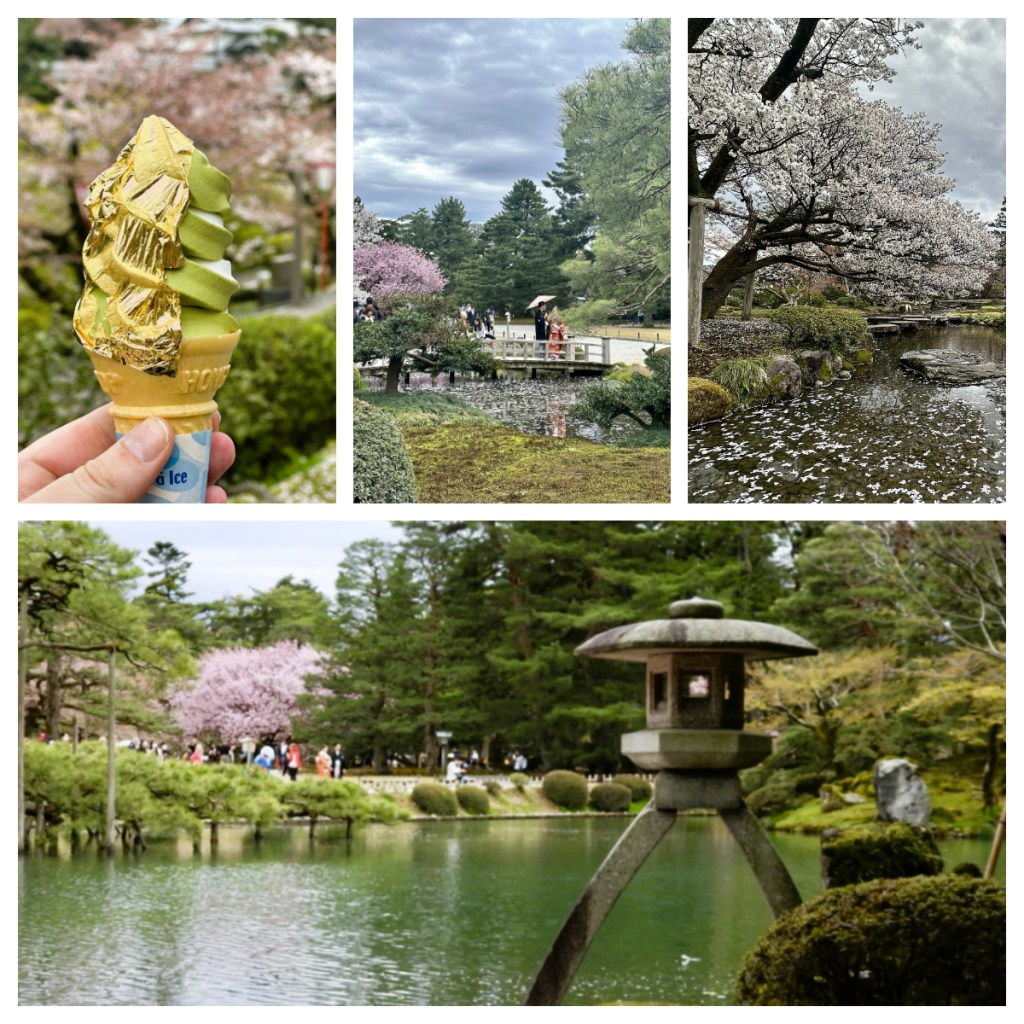
Much of the castle has been rebuilt numerous times, the last time after a fire in 1881.  We had decided not to go into the castle, but enjoy the beautiful park with its cherry blossom as we walked through and the Ishikawa-mon Gate (dating back to 1788) and into what used to be the castle’s outer gardens.  Today, Kenrokuen, which literally means “Garden of the six sublimities”,  is considered one of Japan’s most beautiful landscape gardens.

The “six sublimities” relates to a Chinese landscape theory of the six essential attributes required to make a perfect garden.   Spaciousness, seclusion, artificiality, antiquity, abundant water and broad views.  Having spent some time walking around the beautiful gardens, I can agree, that it definitely meets those criteria. 
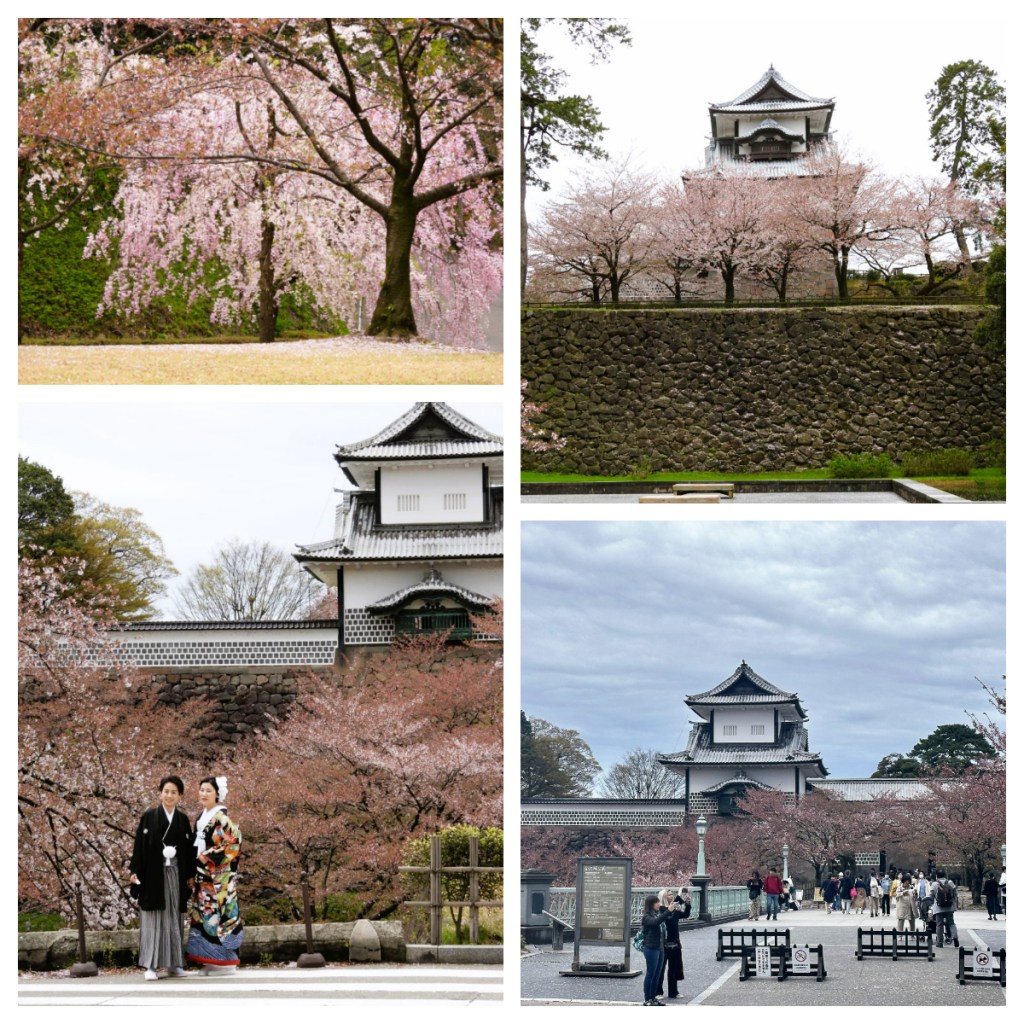
There was a small area of shops near the entrance to the park where I decided it was time to try a local delicacy – a soft serve matcha ice cream, covered in gold leaf!  Now, the matcha ice cream is probably a Japanese wide phenomenon, but the gold leaf is unique to Kanazawa.  Kanazawa actual means ‘gold marsh’, and the city is Japan’s ‘Gold Leaf capital’, producing 98-99% of the nation’s gold leaf.  Hence the use of it wherever they can lol.  I can’t say it tasted of anything, but it certainly looked pretty lol.

Upon entering the gardens, we paid ¥500 (around NZ$6) for a combined ticket that gave us entrance to the park as well as to one of the nearby museums.  (We learnt afterwards that if you entered via a different gate there was no charge!)  The gardens were beautiful, some trees still in full blossom, others already ‘snowing’ petals.  Lots of people dressed up in their traditional outfits having photos taken (here it mostly looked like local people but that is an assumption).
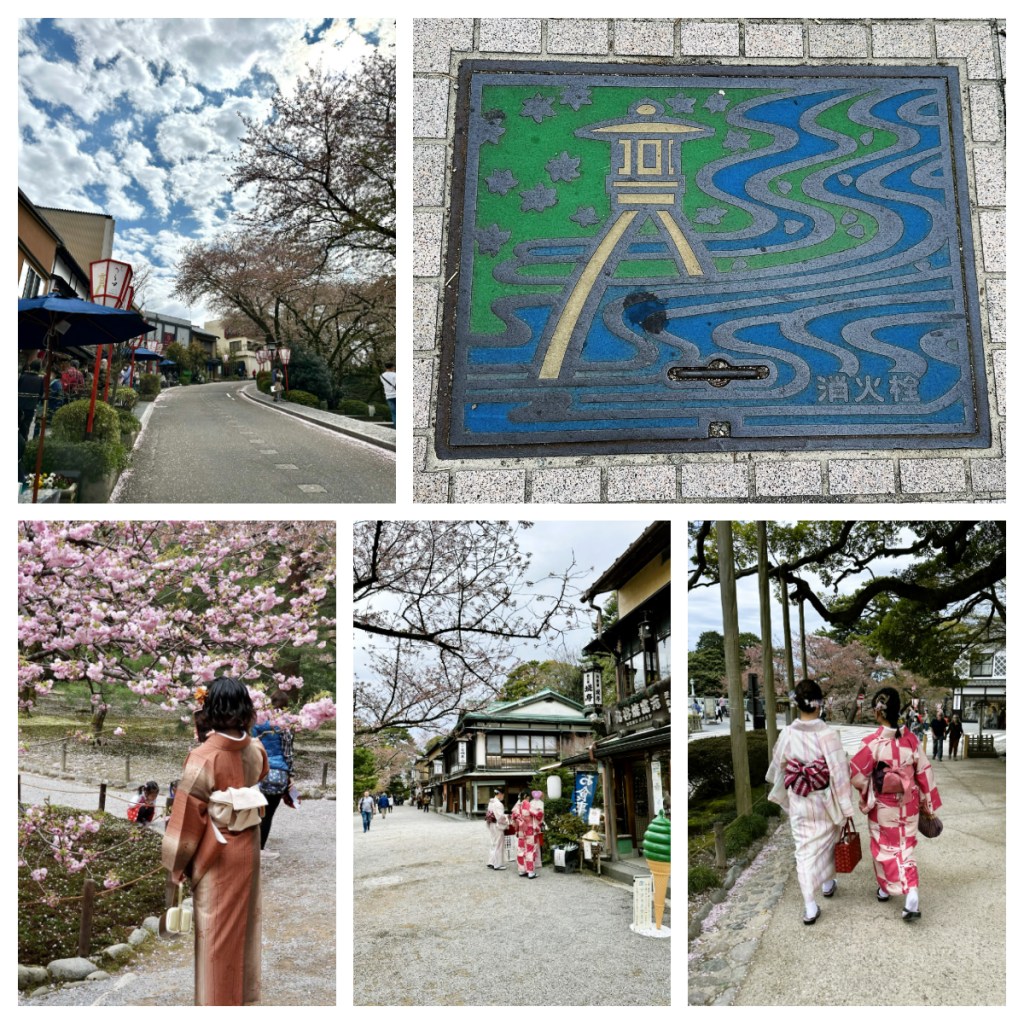
One of the key attractions in the gardens is the iconic, two legged Kotojitoro Lantern (most stone lanterns have only one leg).  It is a symbol of the gardens as well as the city (even appearing on its manhole covers) and I expected it to be huge (well, it appeared huge in all the photos I had seen of it)!  So we walked around the gardens, looking for the famous “thing” – turns out we had already passed it and taken photos of it without even realising it was the “thing” lol.  I had expected it to be 10 metres tall when in fact it was only 2 (and part of that is submerged in the lake).

Given that Kanazawa is the city of Crafts & Folk Art, we thought it only right to visit the small Museum for Traditional Arts and Crafts, just on the edge of the gardens. The museum houses beautiful examples of local handcrafts include gold leaf (of course) and dyed silk.

We exited the gardens and walked down a beautiful street where the cherry blossom was snowing and blowing around in the breeze and head towards one of the other geisha areas of the city – the Higashi Chaya District.  This is the largest of the preserved Geisha districts in the city and apparently Geisha culture still flourishes here. 

To have a “tourist” Geisha experience, it is necessary to book months in advance, so we just enjoyed a Tea House experience in one of the preserved Chayas.  With a menu only in Japanese our choices were a bit hit and miss but I managed to get a coffee and a pretty, if not particularly tasty traditional confectionary.

After another huge walking day, I was ready to head back to the hotel so left the others back at the market to enjoy a seafood dinner and made my way back home. 

(After thought – another great quirk about Japan is their adherence to rules.  They will stand at a crossing waiting for the ‘green man’ even if there is no traffic in sight!  I made the mistake a couple of times of just crossing and got some odd looks from other pedestrians who were waiting patiently lol)
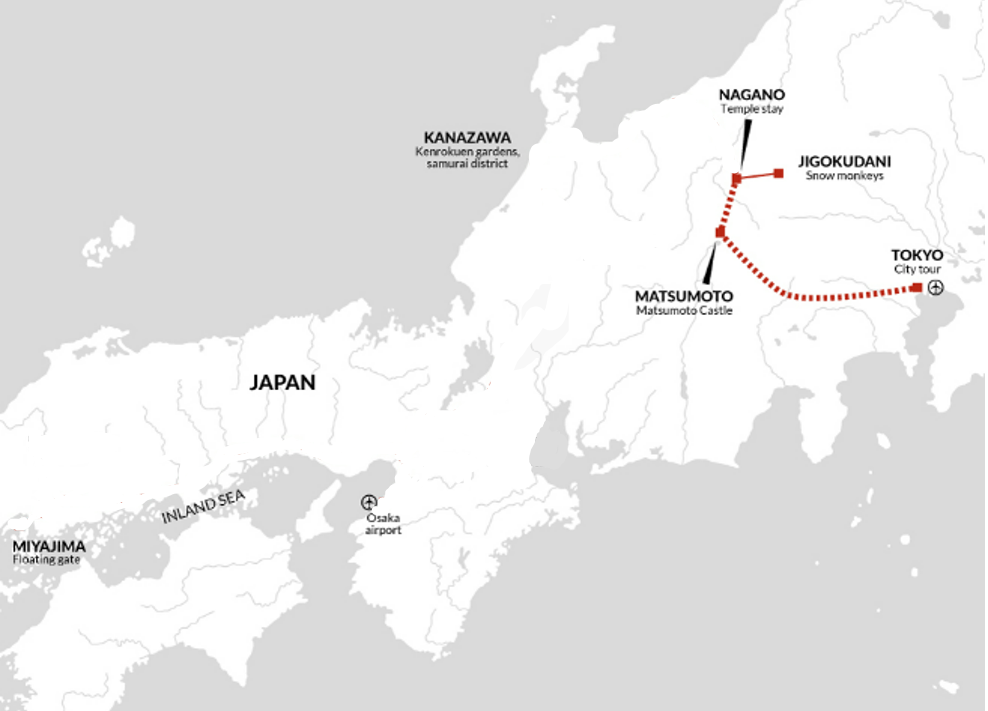
“Snow” Monkeys & Temples

Nagano

April 2023

Today was a day I have been waiting for my whole life (well most of it anyway) and in fact, it was the reason I chose the tour I am on as it visited this area. It started with a 50 minute train journey which took us through more picturesque rural villages with snowed capped mountains behind them to Nagano, the capital and largest city of Nagano prefecture.  The area, also known as the “roof of Japan” was the home of the 1998 Winter Olympics and they are still very proud of this.

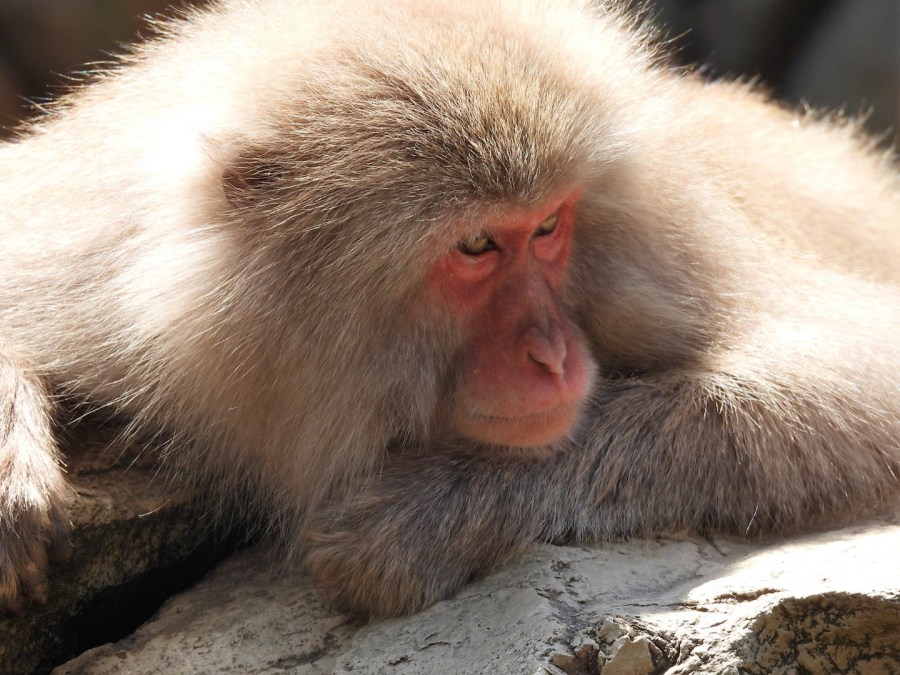
From the station we jumped on a minibus for a one hour drive in to Jigokundai Monkey Park where the famous Snow Monkeys of Japan live.  As early as 1964 the wild Japanese Macaques were observed soaking in the natural hot springs and the park was established where visitors could see the monkeys without cages or fences.  They feed the monkeys daily to keep them in the area and to stop them pillaging neighbouring farms, a habit that was getting them killed. 

After a beautiful 1.6 km walk through the quiet forest and along the Yokoyu River into the geothermic area of “Hells Valley” (the meaning of Jigokundai) we arrived at the man made onsen (or hot pool) where the monkeys like to hang out.  There was a troop of around 20 or 30 monkeys hanging around and even though it was not particularly cold, a few of them jumped in for a soak. 

Most kept their heads above the water, whilst one was keen to swim around underwater, apparently looking for some kind of water weed that it was eating.  As well as the water dwellers, there were babies playing all around the place and others just chilling out in the sun and grooming each other, all of them completely ignoring us and the handful of other visitors. 

I was prepared to be disappointed by the park as I was so excited about seeing the monkeys, but thankfully I wasn’t.  Of course, it would be more picturesque if there was snow around and perhaps, I will just have to come back again in the winter. 

Having spent maximum time watching the monkeys, I was one of the last back down to the cafe area for lunch (and to purchase the local Kit Kat specialty – apple, as the area is known for growing some of the best apples in the country) before jumping back in the bus for the return trip to Nagano (passed lots of apple trees) and to our temple accommodation for the night. 

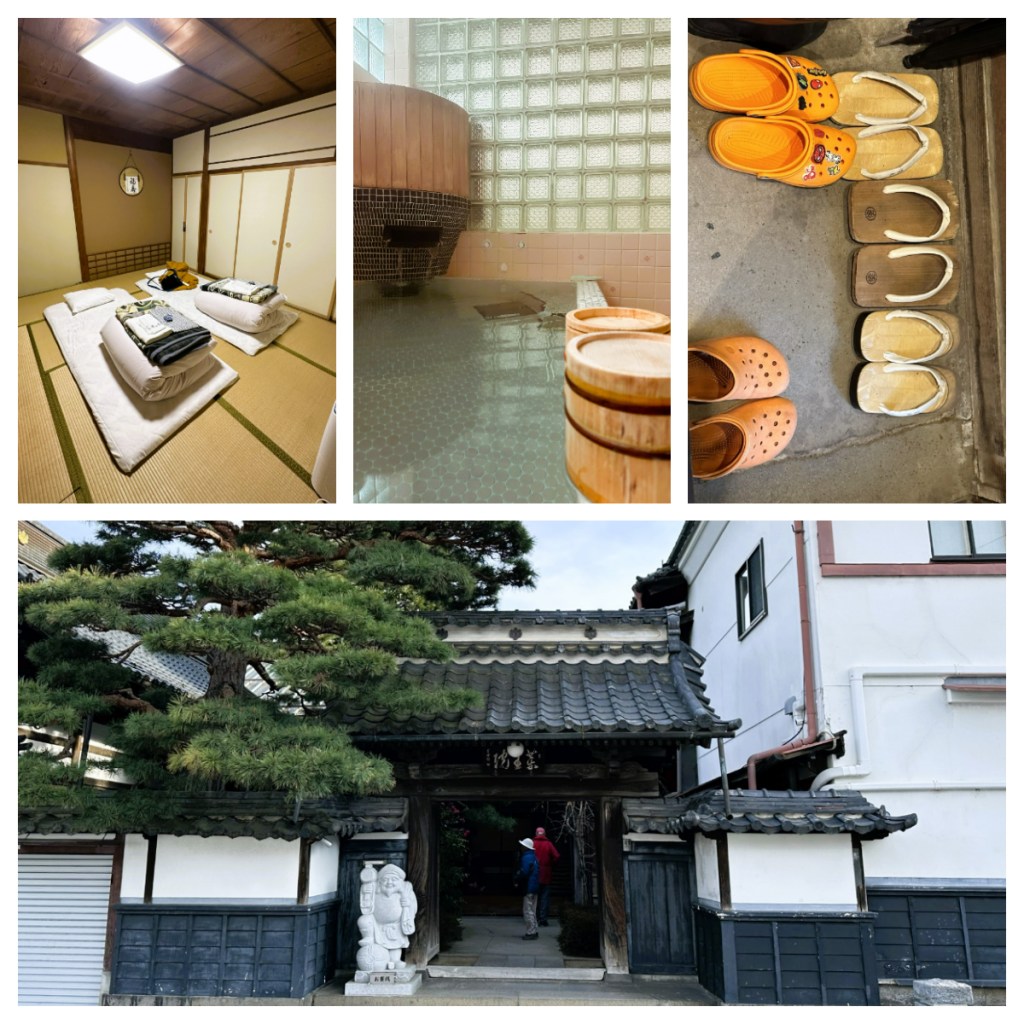
The temple inns, or Shukubo as they are known, were created to accommodate pilgrims travelling to the nearby temples for blessings and we were to follow in their footsteps.   The Inn was beautiful, with tatami mats on the floors (hence no shoes inside as these woven grass/rush mats are very delicate and very expensive) and sliding doors.  The rooms were basic, right down to the bed, which they called a futon, but clearly the west has adapted that word to include an actual bed base, whilst in Japan it is literally a thin mattress on the floor.   That said, I had expected it to be way more basic than it was.

As is normal in accommodation like this, the Inn had a small Sento (an indoor, non-natural version of an Onsen), a traditional hot tub, that is very popular in Japan. They are generally communal (sexes separated) and in almost every Sento, you must be naked to jump in for a soak!  As typical Westerners, we were not that keen on the idea of naked communal bathing so we worked out a schedule so we could all enjoy the experience. 

I was first up and was careful to read the instructions.  First undress in the small changing room and leave your clothes there. Then move into the hot tub area (which is already hot and steamy) and wash thoroughly using the soap and shower head provided in the corner of the room – it is important to ensure you have washed off all the soap!  Then submerge yourself in the hot tub.  We were all allocated 30 minutes but only lasted around 15 minutes in the water as it was very hot but it was still a nice experience.

Perhaps it is worth noting, that most public Onsens or Sento’s do not allow tattoos, due to there presumed links with the Japanese gangs.  Given that you have to be naked, you may need to cover any tattoos with plasters or tape.  If you look around, there are some that cater more for tourists and allow tattoos.

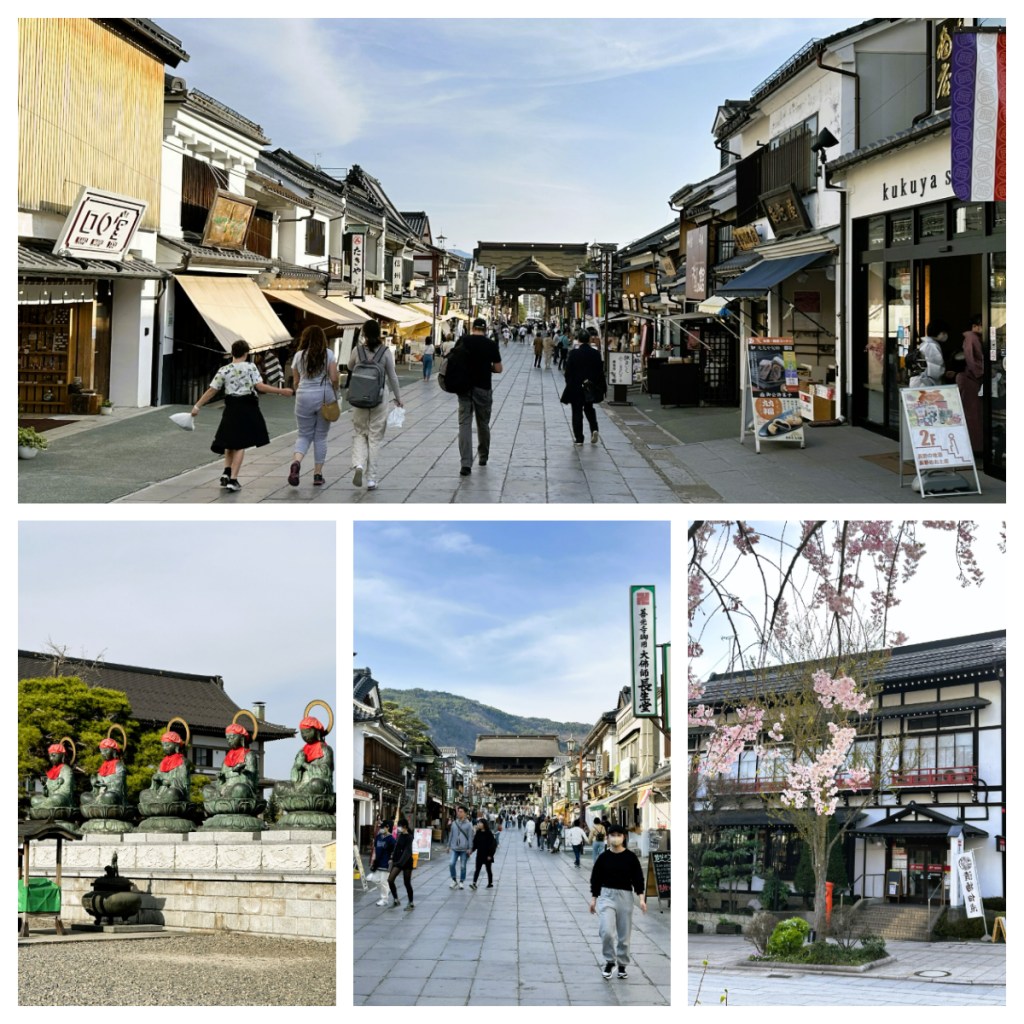
Out of the hot tub and dressed, I joined some friends for a walk around the town where we came across the beautiful Zenkoji Temple (where we would visit the next morning), and a beautiful 400m pedestrianised temple approach, lined with shops and small restaurants.  By this time it was already 5pm and many of the shops were closing up, but thankfully there were a few food places that stayed open till 6pm so dinner was to be early.

We started with delicious grilled Oyaki, a Nagano prefecture specialty, of a buckwheat dumpling stuffed with something (I had one pork and one mushroom).  Further down the road we purchased a Mahoraoba-no Tsuki, a famous (?) confectionary of the Shinshu Zenkoji temple.  The English translation is “Beautiful Moon of Fertile Land” with a whole chestnut in the middle of chestnut paste and dough.  This was not my favourite so I had to follow it up with a beautiful ice cream with apple and an apple and custard pie for later lol

A particular observation on some of the shops here, in particular the Chestnut sweet shop – there were 3 ladies working in the shop and they passed the 1 item from one of them to another in a basket, each seeming to have their own little job to do to wrap it beautifully before it went back down the line to me at which point I place my money in another basket which is then passed between them.  This was not the first time we have seen this kind of thing, but this case was extreme, I have no idea how they make any money. 

With a full belly and the shops now closed, we soaked up the early evening atmosphere along the now quiet street, admiring the small temples, cherry blossom, small dressed up dogs going for their evening stroll and the muscular, fierce looking guardian statues alongside the large Niomon or Guardian Gate and of course the local take on manhole covers.   

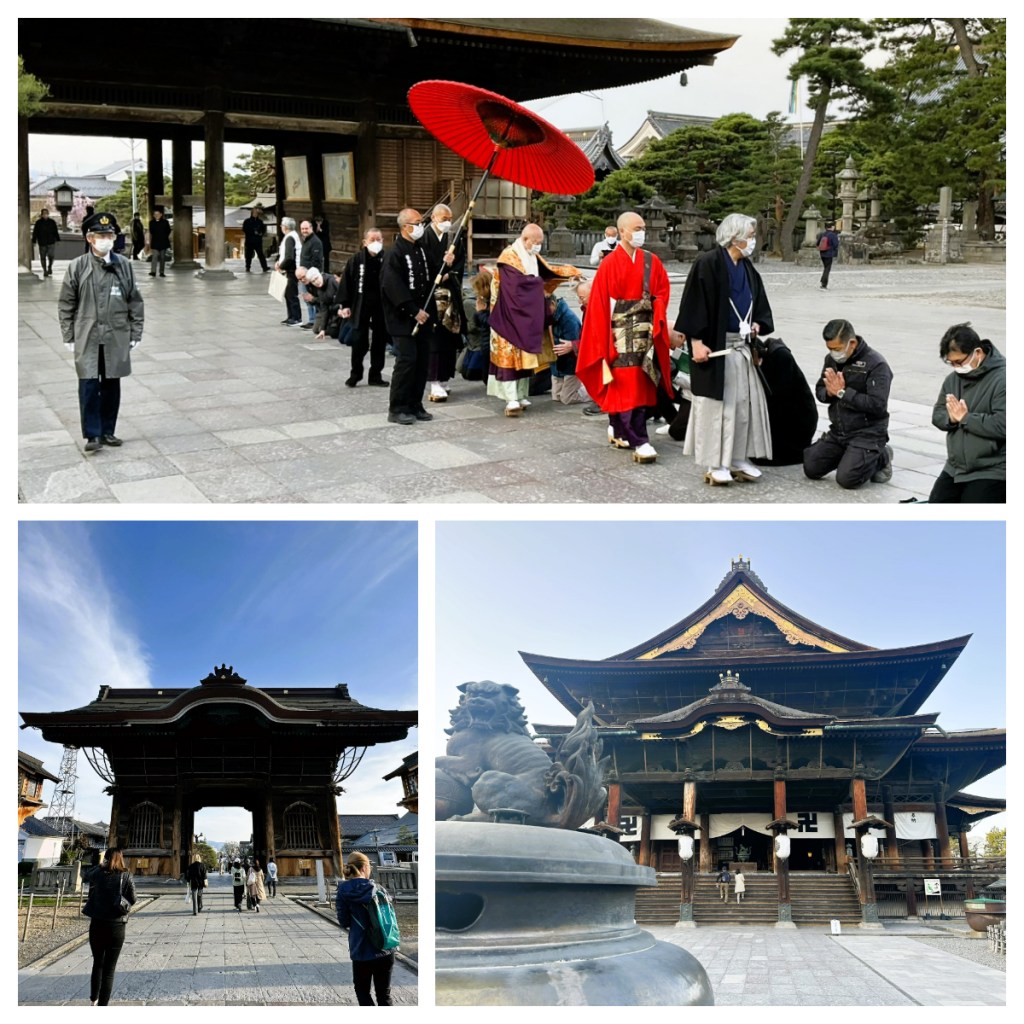
I decided to have an early night (although not a particularly good night of sleep) as we had an early start in the morning as we set off to the nearby Zenkoji Temple at 5.50am.   Finally, we had a couple of local guides, and if we listened carefully to their very accented English, we got lots of interesting information about this important temple complex.  Zenkoji temple was established in the 7th century, Zenkoji and is one of the most important temples in Japan and Nagano, the city that formed around it. 

The reason for getting up so early was to be blessed by the priest as part of the temples O-asaji or morning service. So, after a short walk around, we passed the many Buddha statues up through the Sanmon gate (built in 1750) and into the main temple forecourt where we joined others (mostly locals it appeared) on our knees as we waited for the procession.  As the priest passed by on his way to the ceremony he blessed us – basically by tapping us on the head with his rosary.

Once blessed, we followed the procession into the main hall (which was most recently rebuilt in 1707) for the O-asaji itself, which happens every morning around sunrise and is open to people of all faiths.    Inside there were no photos allowed, so you will just have to trust me when I say that it was beautiful. 

The ceremony began to the beating of drums and the chanting of sutras by the gathered monks. We spent about 20 minutes watching the ceremony, at which point our guides took us to the inner chamber and down into an underground chamber in search of the “key to paradise”.  The chamber is pitch black and you need to feel your way around the corridor but putting your right hand on the wall, until you find the “key”.  Doing so provides you with additional blessings so it was truly a blessed morning.

The temple complex is actually a non-sect temple, which means it is not affiliated to any specific Buddhist sect – it is believed this is because it was built before the individual sects formed. Therefore, it is popular amongst people of all religious backgrounds as a place to come and pray.

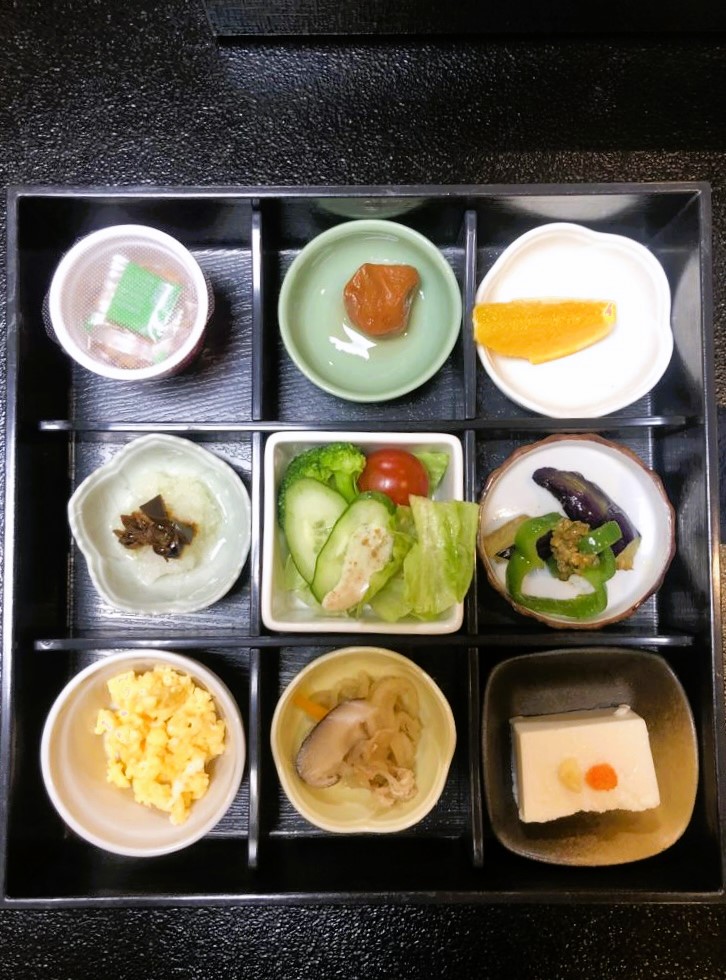
We spent some time walking through the vast complex which was so peaceful at this time of day but it was time for us to head back to our Inn for a traditional (and beautiful) monks’ breakfast consisting of lots of different things including miso, rice, salad, tofu, sour plum, fermented soya beans … most of which was pretty nice.  It was then time to make our way back to the train station and on to our next destination.

Cherry blossom & castle

Matsumoto

April 2023

This morning I woke early again (but at least it was 5am and not 2am 🥴).  It didn’t help that my roommate decided to turn on a light and read in the middle of the night, my sleep so far has not been great!!  I wanted to go up to the roof terrace for sunrise but for some random reason it is closed till 6.30am.  Now of course I could have run down to see it at the temple but that would have involved getting dressed which I was not quite ready to do 😂

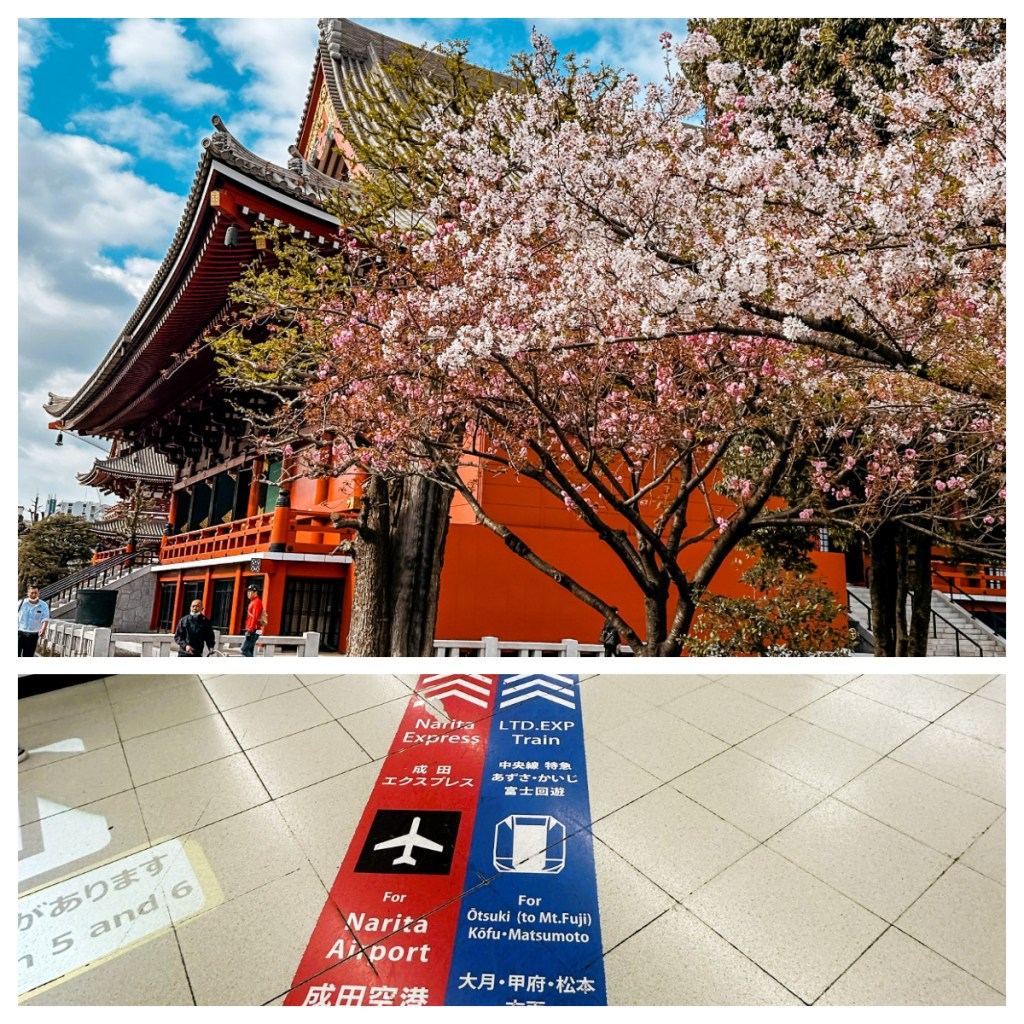
By 8am we were out the door of the hotel and on the walk passed the local temple (for the last time) to Asakusa station to catch the subway and then a train before boarding our Japan Rail train to Matsumoto – easy to find with the markings on the floor!  For many Japan Rail trains, you need to reserve a seat in advance, so we soon settled into our seats and I set up to do some Japanese research … by watching the “Age of Samurai” on Netflix.👍🏻 (FYI it was actually really interesting and gave me some good background to things we were to see in the coming days.)

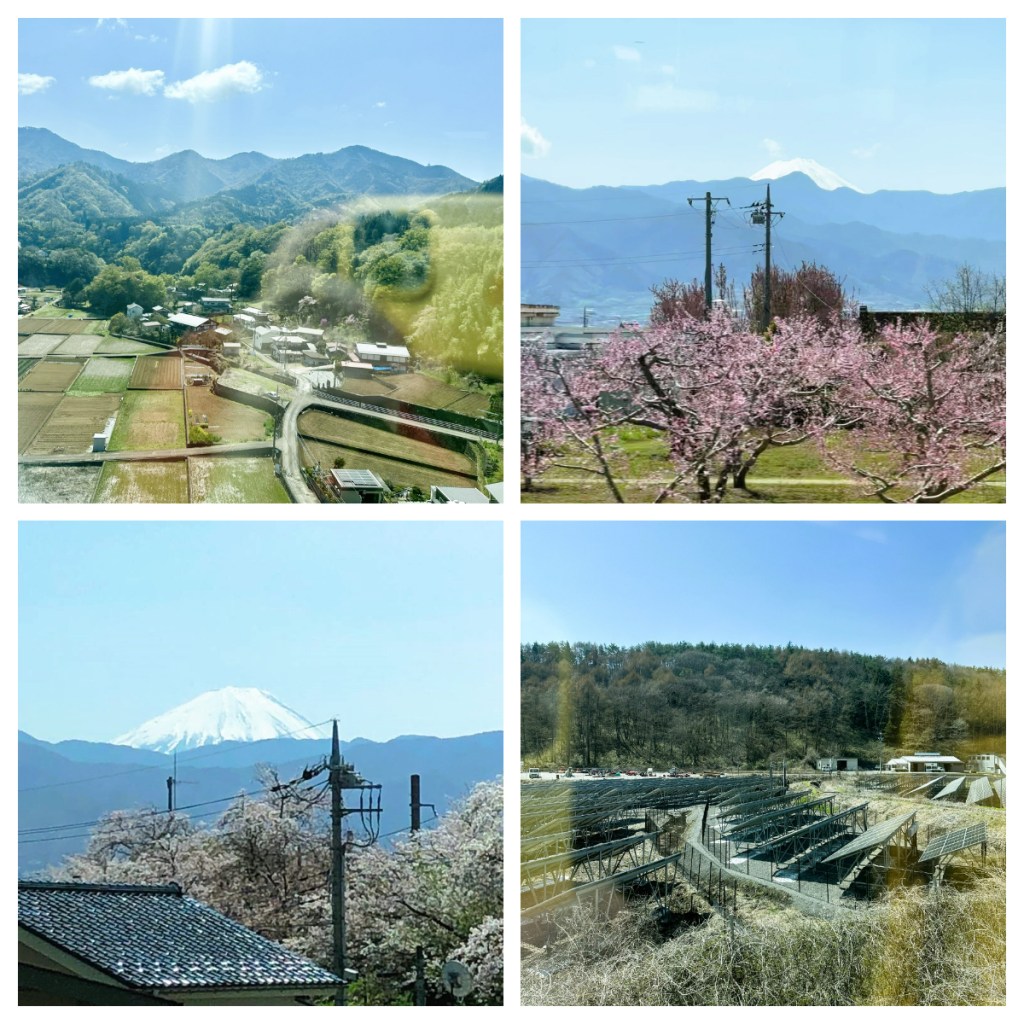
As the train travelled out of central Tokyo we travelled though small suburban areas, then small farming areas, passed tree covered hills and snowcapped mountains in the distance.    We managed to catch a glimpse of Fuji, popping up from behind the other mountains 🎉so happy to see it.  (Luckily, I did not make the effort to go out of town yesterday to see it as it had been covered in cloud 🥴).   The little rural towns were lovely with cherry blossom everywhere and oddly there were no farm animals to be seen.  There were however fields of solar panels lol.

It took just over 3 hours to reach our destination for the day, the small city of Matsumoto and from the train station it was a short walk to our hotel.  I was suitably impressed when I went to use the toilet in the hotel lobby and the toilet lid opened automatically – toilets here really are next level!  

To be honest, Tokyo overwhelmed me, and I was glad to be somewhere smaller (Matsumoto has a population of around 240,000 compared to Tokyo’s almost 14,000,000).  That said, writing this after the trip, I would have liked to have had a couple of days back in Tokyo at the end of the trip when I was more comfortable and confident with Japan and all its quirks.

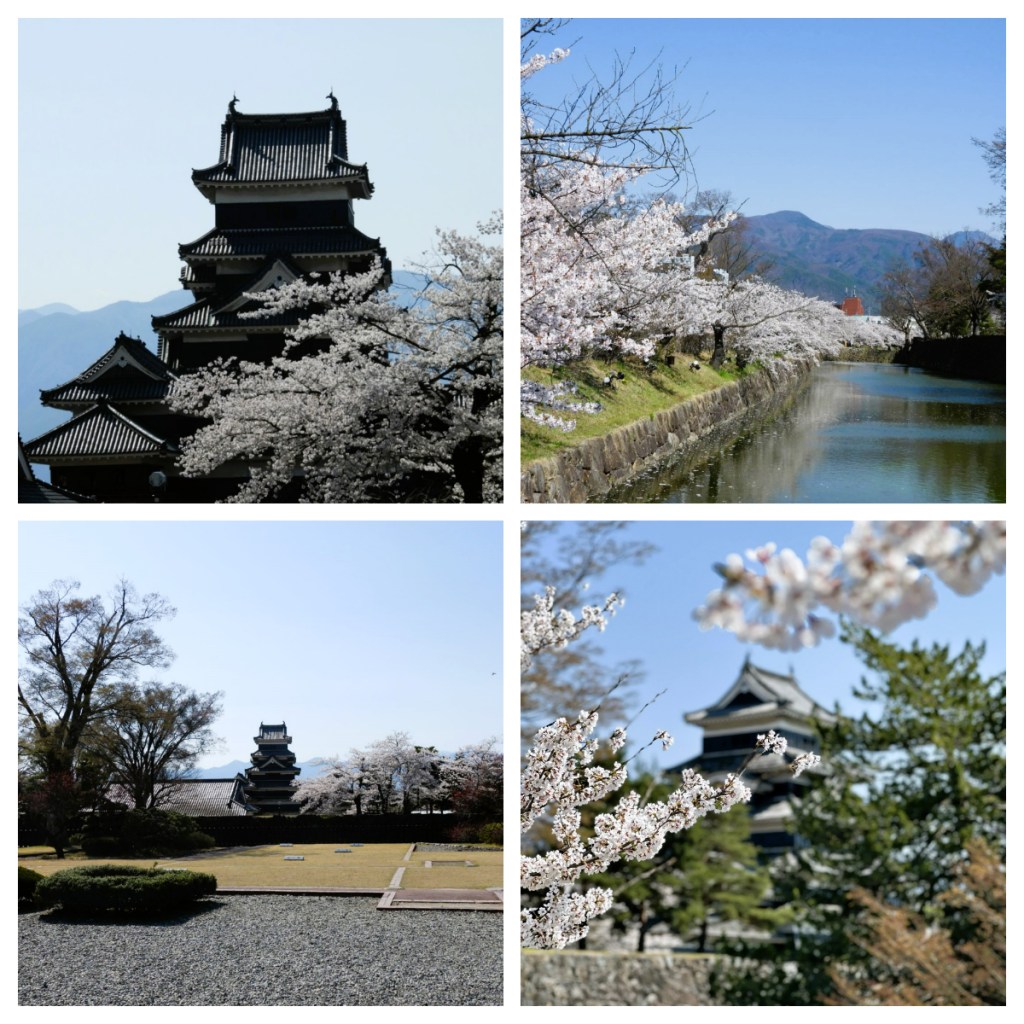
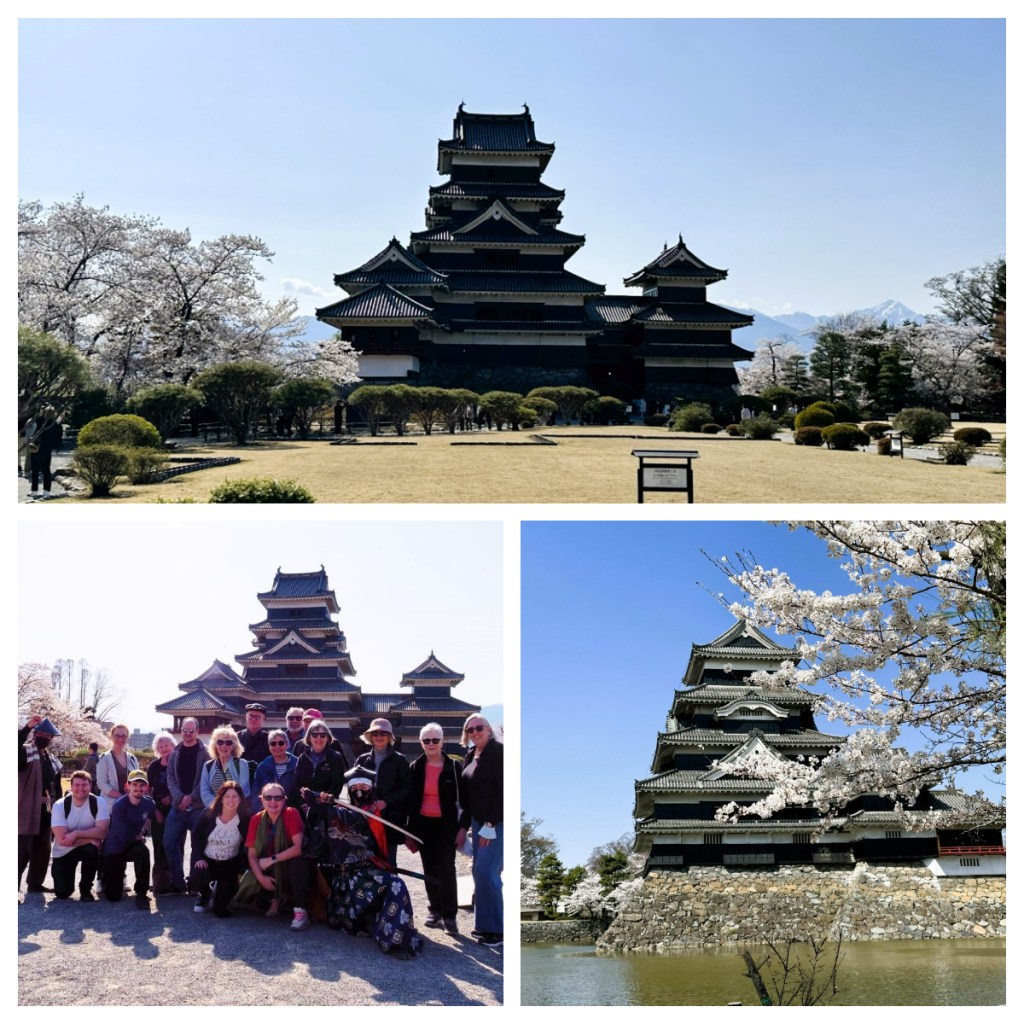
Matsumoto is famous for its iconic castle – Matsumoto Castle or “Crow Castle” because of its black colour.  It is one of five castles in Japan designed as “National Treasures” and is the oldest original castles left in the country (most temples and castles that we see are reconstructions).

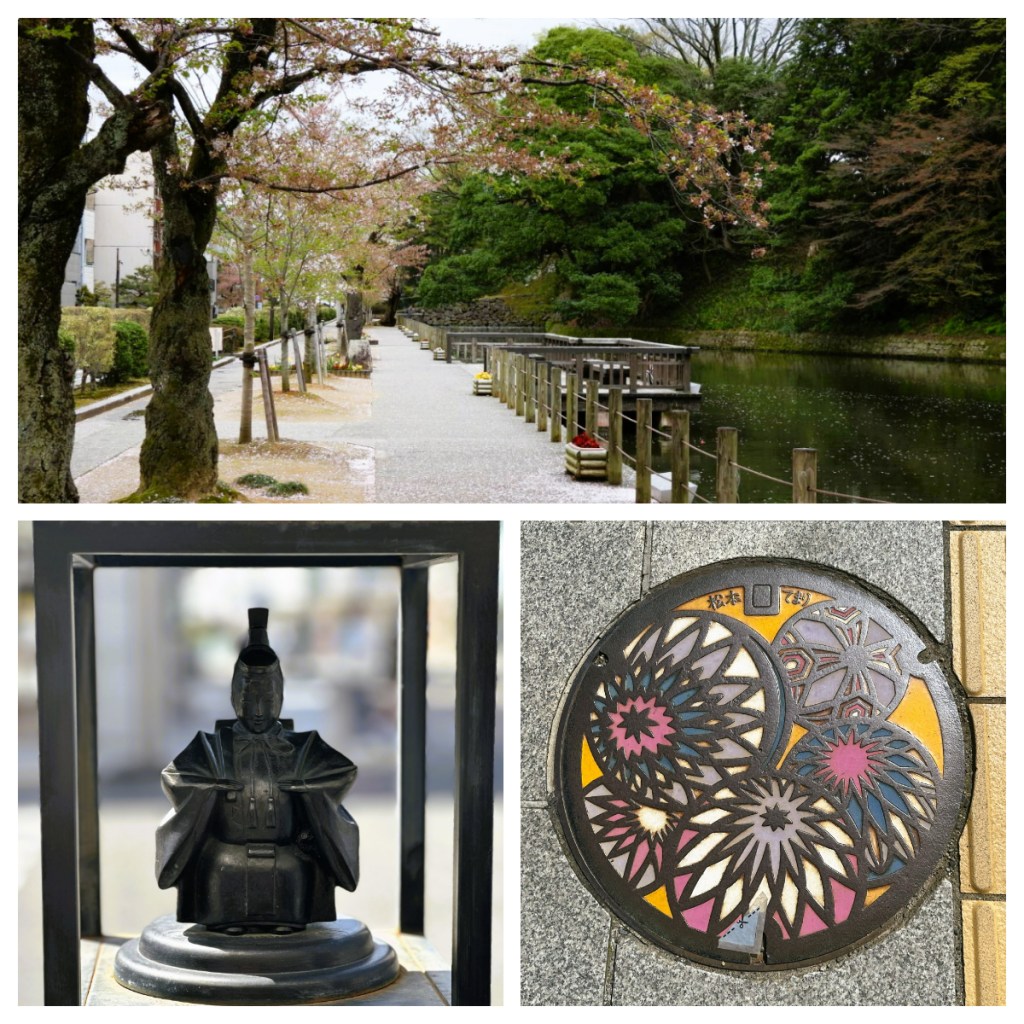
The walk to the castle took us through part of the very walkable city, past a couple of sites I planned to head back to, and I enjoyed noting the nice little local touches such as the Samurai lamps on the street and the beautiful manhole covers with local handicrafts on them.  (Manhole covers became a bit of a theme of the trip with each city/region having their own local design.  I will need to make a collage to show them all!)

When we arrived in the castle grounds, Rinrin (our guide) gave us some time to have lunch – as she directed us to the nearest convenience store!  I decided not to waste so much time eating and set off to walk around the outside of castle.   The gardens were beautiful and filled with cherry blossom, in fact some of the blossom here has not even peaked yet!  With the blossom and the snow capped mountains in the distance and the fact that there was nowhere near as many people as in Tokyo, I loved it.

Along the outer castle moat, the cherry blossom was particularly pretty, with the castle turret in the background.   In fact, the castle complex use to be vast, but in 1872, the Meiji government ordered the destruction of all feudal fortifications!  Most of the castle structures were destroyed but thankfully the locals rallied together to save the castle.  Today the foundations of these other buildings in the complex are only visible by them being marked out on the grounds around the castle.   

Having completed my walk around the entire complex, I meet up with the others as they finished their lunch.  I still had time to have something to eat before joining everyone to go across the moat and inside the castle walls to have the obligatory group photo with ‘fake’ samurai and ninja before entering the castle itself.  (I should note you can enjoy the castle garden.) for free and only have to pay to go into the castle itself)

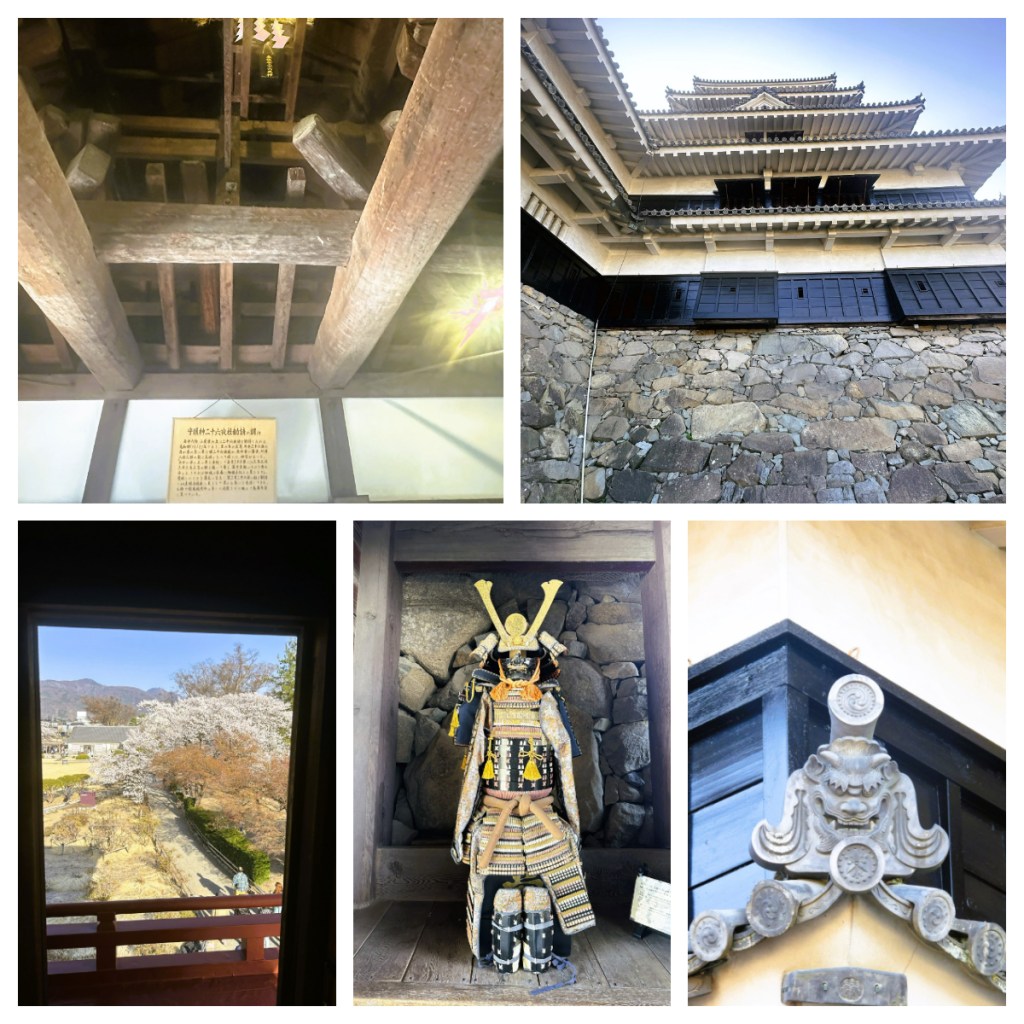
The beautiful five storey medieval castle was built in the late 16th century when one of the main ‘characters’ from my Netflix series, Oda Nobunaga ruled the area.  Although from the outside, the castle looks like it is five stories, on the inside it is actually six stories with a hidden or secret floor inside. Apparently, it’s black colour represents loyalty to Toyotomi Hideyoshi, another samurai who stared in the Age of Samurai (that programme really was great research lol) and who is credited with unifying Japan.
Whilst we waited to go inside the castle (sometimes the queues can be hours long, for us it was only 15-20 minutes), we were warned that inside there were “steps as tall as a small child” – it was true.  😂.  We walked through the one way system, up through the 5 (or is it 6) levels, each with small exhibits of items found on or near the castle grounds such as early guns and other weapons, armour and coins.  Always looking through the small windows used for soldiers to aim their arquebus guns or bow/arrows out of, or larger ones for throwing rocks out of.  

As I touched some of the old worn timber beams, I could not help but think of the samurai who touched the same beams before me.  Being immersed in history like this makes it so real, and I love it!

From the beautiful castle we split up and I walked with my crew to Nawate Dori, often known as Kaeru Machi or “Frog Street’ as it is dedicated to all things frog!  Apparently, this is because there used to be a lot of frogs along the banks of the Metoba River that runs alongside the street. They left for higher ground after a flood in 1959 and have never returned so have been replaced with stone frogs including the three very large stone frogs are positioned at the main entrance to the narrow brick street which has been a shopping hub since the 1500s. 

Frog Street is lined with small food and gift shops, many of which are frog themed.  Unfortunately, by the time we got there, many of the shops were starting to close (we are soon to learn that shops and even restaurants do not stay open late in Japan) but I did get a chance to buy a small frog trinket (which would be the start of another odd collection of quirky Japanese things) from a lovely old man who was keen to share the history of the street with me.

From Nawate Dori we crossed the river and walked a little down Nakamachi Dori.  Another narrow street lined with preserved buildings, this time white warehouse type buildings which once housed many of the city’s merchants.  We clearly missed the hype as most of the shops were closed and most of the restaurants were not yet open! 

Back on the main street, we decided, for the sake of research to visit what appeared to be a British pub (the “Old Rock”) advising beer from the local Matsumoto Brewery.  The local brew was pretty good, and we asked a local guy sitting on his own, to join us.  Tomo, a doctor from Tokyo did not seem to mind that his quiet dinner for one, turned in to a loud drink for 5 lol.  One of the things I love about travel – a Pol, an Irish, an American and a Kiwi sitting in a random bar with a Japanese guy … 

Whilst enjoying our drink, time got away from us, and we had to rush back to the hotel to check in and meet the group for dinner – which ended up being cancelled as the place the guide was going to take us was closed!  To be honest this was fine with me as I wanted to prioritise exploring over eating, as we were visiting on the last night of the 10 day long Corridor of Light. So we headed back to the castle to see the lights around the cherry blossom.  There were actually more people than there had been during the day, but it was beautiful and worth the second visit. Reflections are something I love and these were perfect.

But, by this time it was 8.40pm and almost everywhere we are trying for dinner was closing at 9pm and would not serve us!  I decided to give up head back to the hotel whilst the others continued to keep trying.  All in all, it was a lovely day.

Day 4 started off well.  I managed to sleep until 6am and then had an amazing breakfast spread, offering English and Japanese options. I had the weird combination of pineapple, French toast, dumplings, soba noodles, which apparently this place is famous for, fried chicken.   All very random, but all very nice.

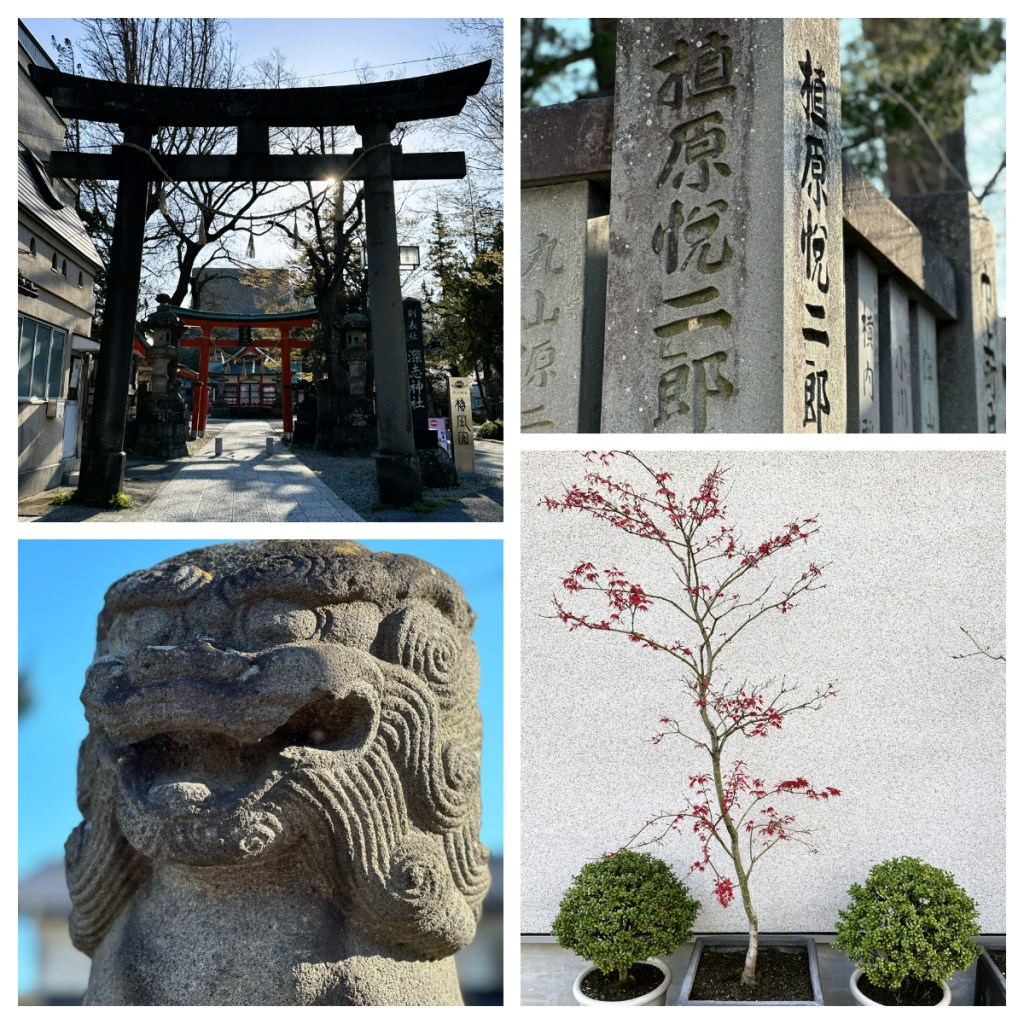
Awake, packed and breakfasted more than one hour before we left, I decided to go out for exploration.  I found another shrine on the map and headed to it – Fukashi- jinja Shrine.  It was a beautiful more, cold at around 4C but the there was blue sky, and it was sunny, and the shrine was so peaceful, and I was ready for the day ahead. 

Titanic Tokyo

April 2023

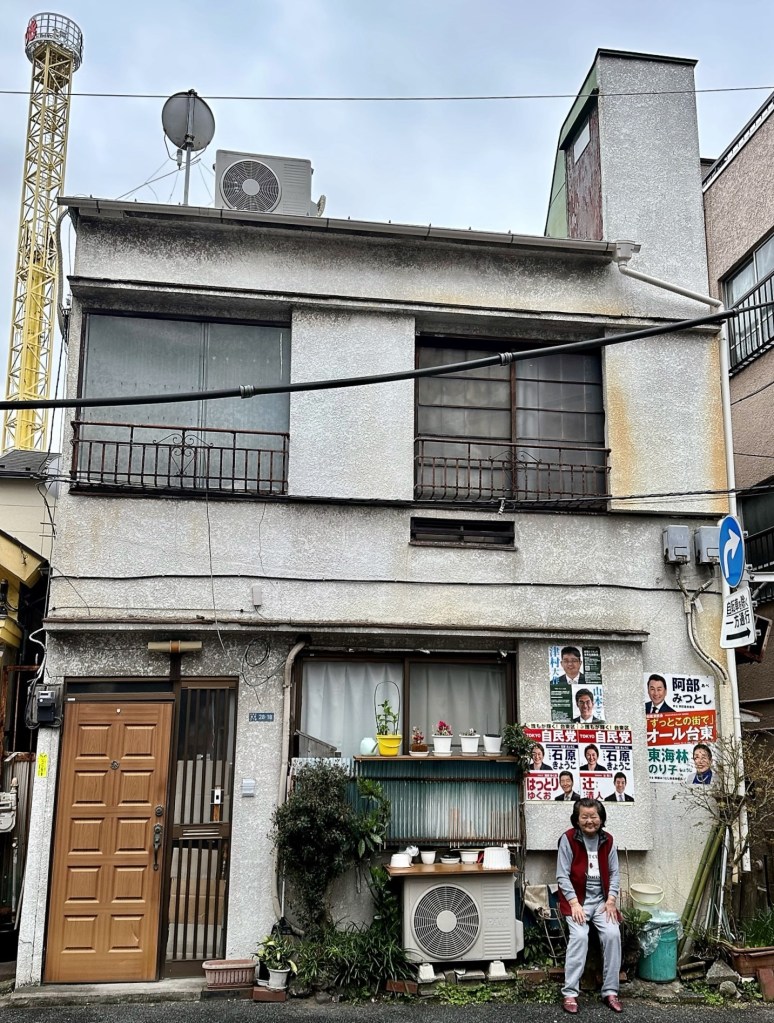
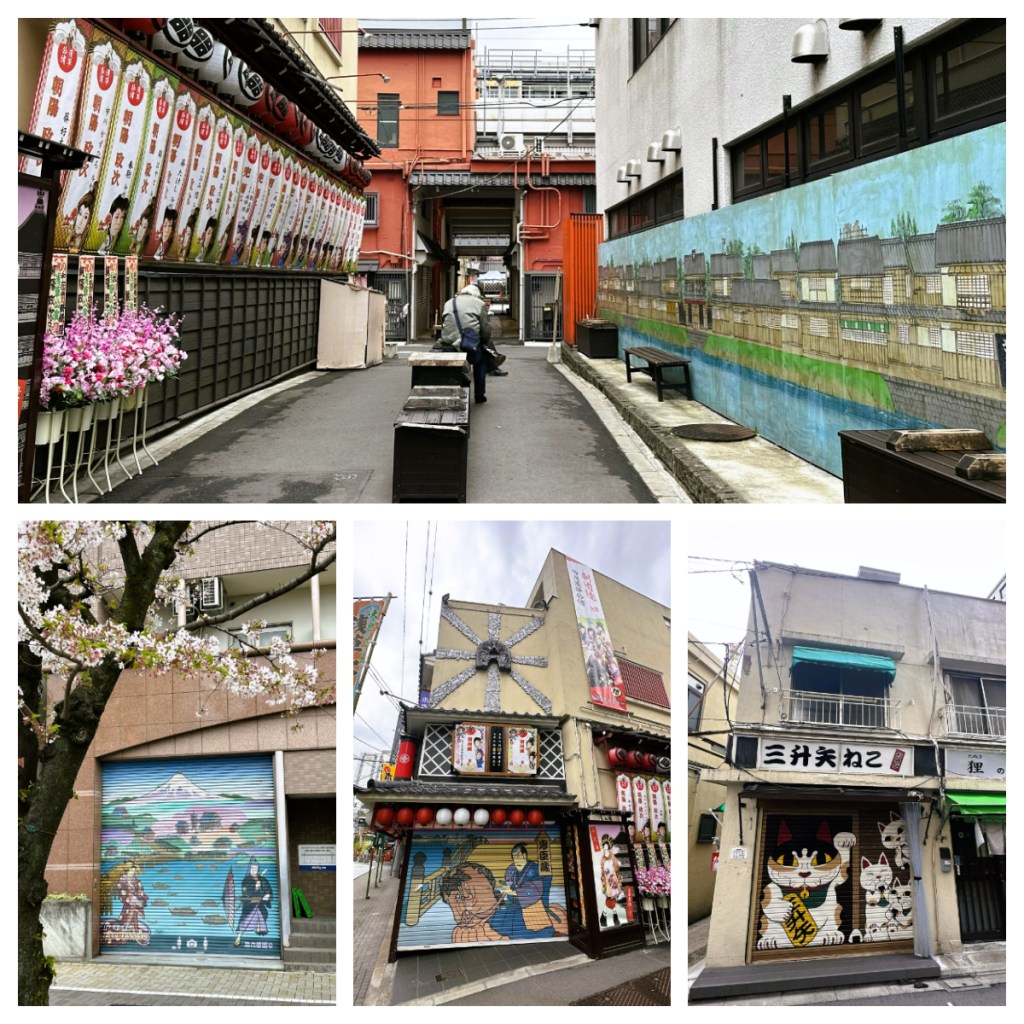
Thankfully I had no headache for day 2’s early rise, so took the opportunity to go for a walk whilst it was quiet. Even after one day I was definitely feeling more confident, so took the little back alleys around the local area.  I have said it before and I will say it again, I love exploring in the early morning when the local people are going about their morning business.  All those I passed were very friendly, despite the language barrier (including this lovely lady who was happy to pose for a photo).

I started back at the local temple (for the third time lol) and although it was nice to be able to take some photos without crowds of people, I was surprised by just how many people there were around at 6.30am! From the temple I found the lovely little Sumida Park along the river.  Locals taking their dogs for a walk, old people doing their morning Taichi under the cherry blossom and of course social media influencers having their photos taken lol.  Sadly, the sky was not blue but it was beautiful and peaceful amidst the Tokyo chaos.

From the peace of the park, I stumbled across a big super store called Don Quijote.   Apparently, it’s well known for selling pretty much everything, including lots of flavours of Kit Kats.  Now I will admit I went down a bit of a Kit Kat buying rabbit hole! 

Now I do like a Kit Kat, the regular one, as well as the couple of different flavours that we have in New Zealand, but Japan takes Kit Kats to a whole other level.    Apparently there have been over 300 seasonal and regional flavours of Kit Kats in Japan.  The reason for it’s success is its like to the Japanese phrase “Kitto Katus” which means “you will surely win” so they are often given as symbols of good luck.  I was not entirely sure why I was buying them on day 2 of the trip as I would have to carry them for almost two weeks, but I was unsure if/when I would see the same flavours again  – so I snapped up a box of Sake and the seasonal Sakura (cherry blossom) flavour of Strawberry cheesecake. 

One of my favourite things about this early morning walk was the paintings on the shop shutters.  Many were painted with Japanese designs and it was something you would not see later in the day when the shops were open.

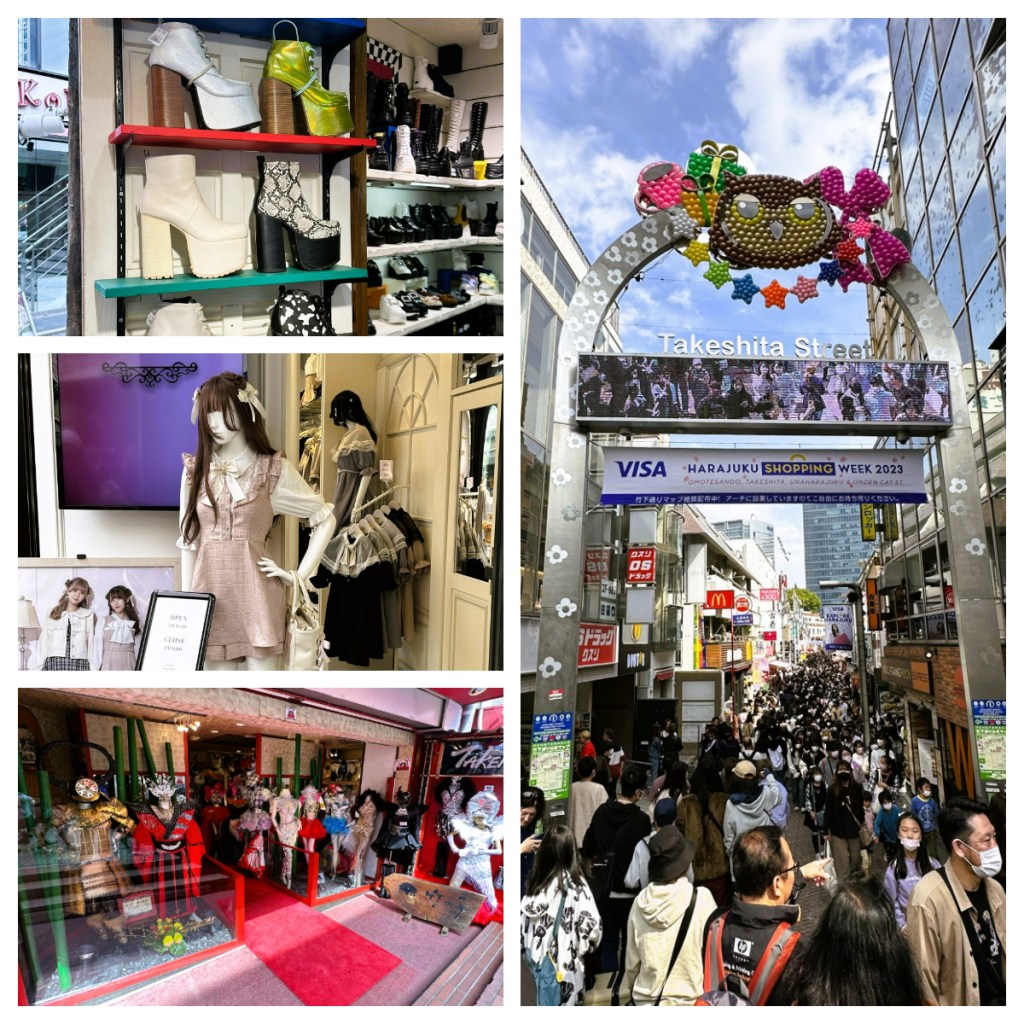
After breakfast I met up with Suzanne and Ania (let’s just call them “the Irish” even though that is not entirely true) and we set out for a day of independent exploration in Tokyo.  Our first stop being the Harajuku area which is known for its narrow shopping streets and Japanese “Harajuku” fashion.

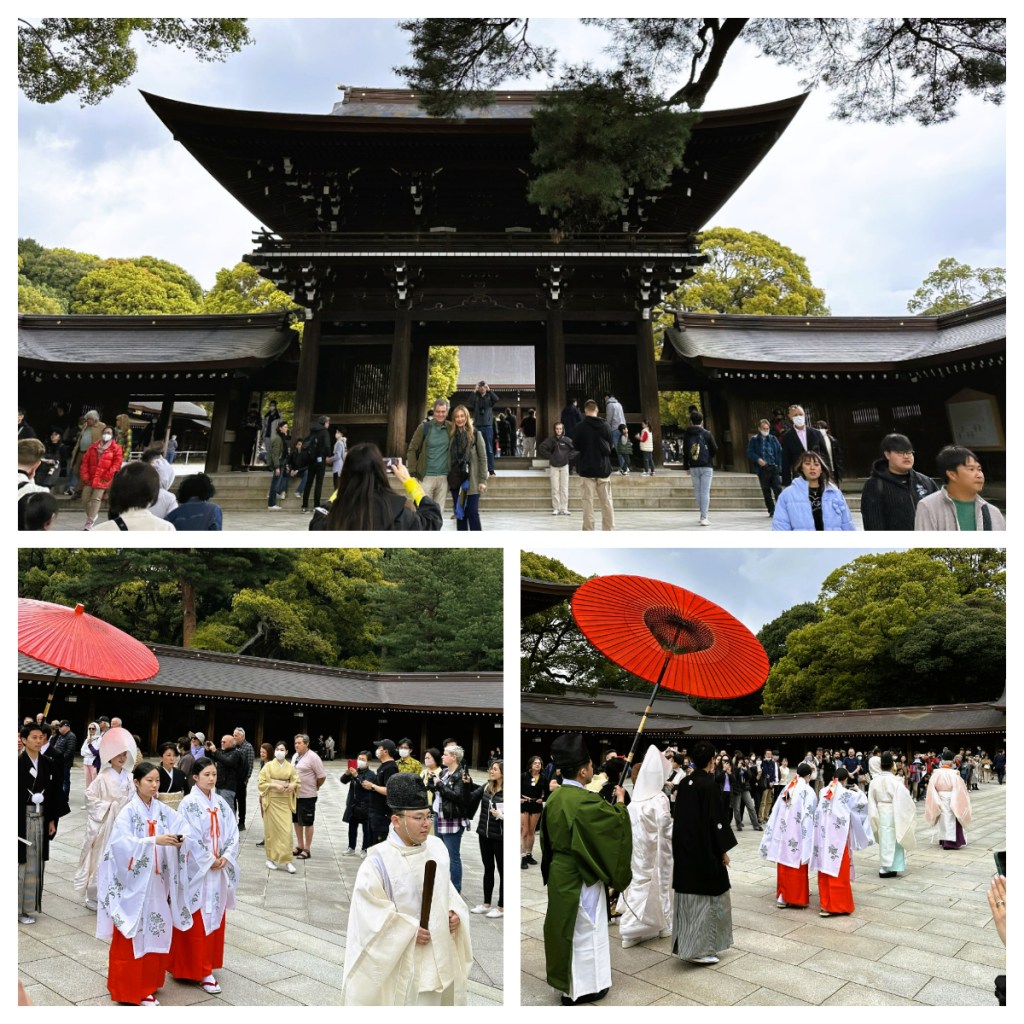
Before braving Takeshita Street (the main shopping street) we headed to the beautiful Yoyogi Park to visit the Meiji Jungu, a Shinto shrine.  Established in 1920, the shrine honours the Emperor Meiji and Empress Shoken who are recognised for leading Japan through a rapid period of modernisation in the 19th century.  After they passed away (in 1912 and 1914 respectively), the Japanese people wished to commemorate their “virtues”.  With donations of trees from all over Japan, and hours of voluntary work, the manmade forest was created and the original shrine as built.  As is already becoming a common story, the original building was destroyed in WWII bombing raids and was rebuilt in 1958.  Thankfully the forest survives and is still thriving.

We took a beautiful walk through the forest, passed towering arches or Torii gates (in fact the biggest wooden Torii gate of its kind) and passed their stock of sacred sake (offered every year by Sake brewers to the enshrined deities) and into the Shrine itself. We were lucky enough to time our visit with a beautiful wedding ceremony in all their traditional finery through the grounds.

From the peace and quiet of the forest, we dove headfirst in to crowds of the shopping street, stopping briefly for a coffee and yummy Sakura themed cake (Japan does cakes well!) before making our way to the infamous Takeshita Street. It seemed everyone and their dog were also walking down this narrow 400 metre long street (including the Kardashian’s from reality TV fam), lined with cutesy clothes and shoe shops and cult food shops.  There were long queues for things like Crepes and “Strawberry Fetish” (think “toffee strawberry” rather than “toffee apple”).   The street was packed, but apparently it was not so bad!  Sometimes, there are so many people it can come to a complete standstill!

As we walked further down the main road, the crowds and quirky shops turned into design stores and fancy buildings.  We were looking for what was supposed to be a lovely garden and it was either closed or we completely missed it (or possibly both).  Of course by now we were ready for a rest and some food and of course we could not find anywhere.  And so we kept on walking and ended up back at Shibuya Crossing (where I had visited the afternoon before).  It was here we finally ended up in what looked like a noddle restaurant, but it was actually a pasta place – I had lost the will to live at this point so was grateful for anything.

It seems that most restaurants/bars are not at street level, they are either down a narrow flight of stairs (as this restaurant was) or upstairs on various levels.  It is hard to judge from the narrow street level door and signage if it is a “suitable” place so it is a bit of a gamble!  Thankfully the Japanese Pasta place was great. 

Energised from food I headed out solo to go to the KitKat shop (yes, I was on a mission to find more KitKats).  Unfortunately turns out it was not a shop but a small stall in a department store that had lots of other sweet shops in it, but I got what I wanted which was another random selection of individual flavours such as Passionfruit, Ruby, white chocolate, Cassis etc.

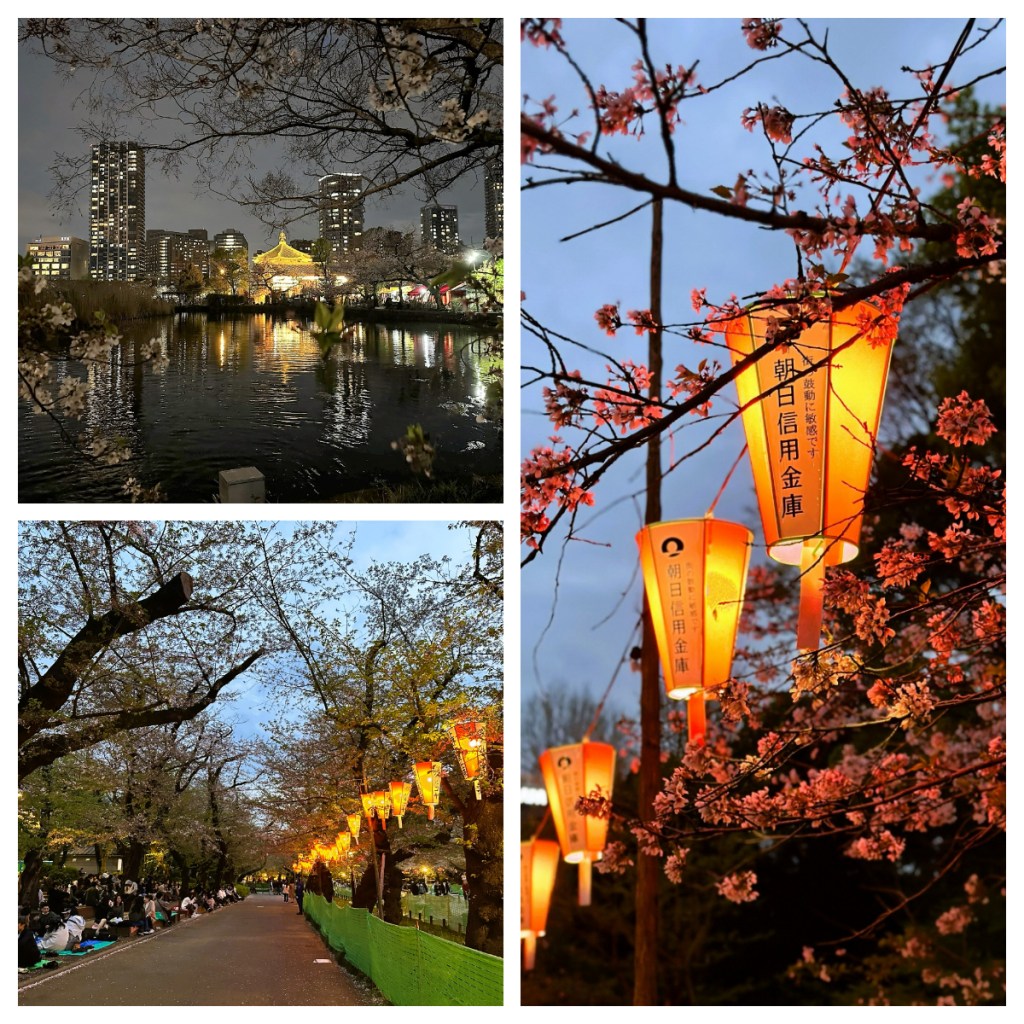
Having made that detour, I had to change trains at Ueno Park station on the way back to Asakusa – and decided that it was worth a visit. The large park was once part of the Keneiji Temple, but after the temple was destroyed during the Boshin Civil War in 1868, the temple grounds were converted into a western style park.  Today the park houses many museums, a zoo and is a famous spot in the city for cherry blossoms with more than 1000 trees lining the main pathway.  Despite being past their prime, the trees were still lovely, particularly as it got dark and they were lit by lanterns hanging amongst the trees.  The park was busy with tourists and locals alike, picnicing under the trees and eating food from the near by stalls and I was glad to have made the stop.

I could not resist another walk around my neighbour temple to get some more beautiful nighttime photos and by the time I made it back to the hotel, I had walked over 18km and my feet felt it!   But before I could go to bed, I had to rearrange my bags and pack for 2 days in my day bag.   As efficient as the train service is, there are two reasons why you don’t want to travel with large bags if you can avoid it. 

Firstly, the trains often only stop for a short amount of time and transfers between trains can involve a fair amount of walking and stairs so it can be difficult if you, and others around are trying to manhandle large cases on and off the train (believe me, I saw people trying to do it and was grateful not to be one of them). Secondly, if you can manhandle your bag on to the train, there is very little storage for large bags.  If it does not fit in the overhead rack, you may end up having to share your leg room with your bag! 

Because of this, many hotels offer a luggage forwarding service that means to leave your bag, and it is delivered to you in a day or two, at you next main destination.  For us, this meant that when we left Tokyo the next morning, we would not see out main luggage until we arrived in Kanazawa, in 3 days time.  As long as you can plan in advance like we did, it definitely made our Japan Rail experience more enjoyable.

There was really so much more to see in Tokyo and 2 days is nowhere near enough, but, it was time to explore other parts of the country.

Welcome to Japan

Tokyo, April 2023

Japan has been high on my bucketlist for a long time now, and this trip started as all good trips do – with an early start.  In this case with a 3.45am wake up call. It could have been an hour later, but my cautious side likes to ensure I have plenty of time for my transfer in Auckland.  It’s lucky I did, as the airline lounge in Auckland was incredibly busy and I had to wait 30 minutes for a coffee (first world problems I know, but problems nevertheless lol).

I had little sleep on the 11 hour flight from Auckland to Tokyo. Being a day flight, that was not too much of an issue as I wanted to be able to sleep not too long after I arrived in Tokyo, despite the 4 hour time difference.  We flew over New Caledonia, which looked beautiful from above and then over the Solomon Islands, the deep blue ocean and skies spotted with clouds were beautiful. I had a laugh to myself when lunch was served.  Not even halfway through the flight and the meal was served only with chopsticks 🥴 it’s going to be a fun couple of weeks!

Finally, as we neared Japan, I got my first view of the iconic Mt Fuji.  It was glowing in the hazy, orange sky as the sun had started to set in the west as was a long river winding across the land.  It was beautiful and any photos I got do not do it justice. At the same time, my excitement turned to nerves – did I have all the right paperwork? would I find my pickup? … I seem to get more nervous about these things the more I travel … or perhaps the older I get 🤔!

The arrival process was rather long winded but thankful my research into the constantly changing entry requirements ensured it all went smoothly.  First the quarantine check, I had already provided all info online so showed that page and was waved straight through.  Probably worth noting here that it was also helpful to have a mobile data connection – this was my first time using an e-sim (via Airalo) and this was the first of many times I would be grateful for it!

Next was the long queue for immigration, but again I had filled everything online and had QR code for it so when I finally made it to the front of the line 45 minutes later, the entry process went smoothly.  All that took so long, the bags were already off the belt waiting to be collected and finally, having done the customs check online, that process went quickly.  Note to anyone travelling to Japan, use the Visit Japan website and be sure to fill it in in advance to save time and hassle (until they change the rules again of course lol).

With the entry process completed, I found my pickup and we headed down into the train station to catch the Keisei skyline train.  My first Japanese train experience took me from Narita Airport into Tokyo city, and it was so clean (they sanitise and clean it after every journey to and from the airport) and efficient.  The train takes around 40 minutes for around ¥ 2570 (or NZ$32) compared to the drive which would take around 1.5 hours and cost well over NZ$100!  From the station in the city, we then took a short 10 minute taxi to the hotel.

I had a nice chat with the based Italian guide who met me as we travelled into the city.  She was not my tour guide, but she gave me some tips for places to go and explained that companies like Explore! (who I would be travelling with) struggle to hire local guides to do trips like this as the Japanese guides prefer to stay in one city rather than move around constantly.  This is a shame as although international guides can be well informed on the trip logistics and history of the country, you don’t get the same personal insights that you would from a truly local guide. Time will tell if this is true.

After a quick convenience store dinner (this will become a bit of a theme as they are most definitely convenient and well stocked) of some random (but delicious) creamy sponge cake and an unknown drink white coloured Fanta – going by the picture strawberry and custard 🤔, I checked out the lovely view from the hotel roof top before settling in for the night – after an almost 20 hour day 😴.  In reality I could not quite go to sleep as my roommate for the trip was yet to arrive – apparently her flight only landed 20 minutes after mine so not sure where she was 🤔 (It apparently took her more than 2 hours to get through immigration, so I was very lucky!)

My favourite things in Japan are already the clean, efficient transport system and the toilets!!!  Heated toilet seats for the win👍🏻.

My first full day in Japan started with waking up at 2am, 4am (you get the idea) and with a hammering headache! After a couple of rounds of tablets, I felt a little better and managed to make it down to breakfast.  It was an odd selection of options – beef curry, blue cheese salad, eggs benedict with spam or French toast!  I got the French toast – it was ok but definitely nothing to write home about (and yet, here I am writing about it lol). 

I meet my guide (Rinrin from Singapore) and the rest of my group at our welcome meeting on the rooftop.  There are 16 in the group.  More than half from the UK, a two from Australia, two from Ireland and a lady from Canada. It’s always interesting at this time, sizing everyone up, thinking who you will align with the most.  (Turns out it was the Irish – Suzanne and Ania (who is actually Polish) and Carla from Canada.)

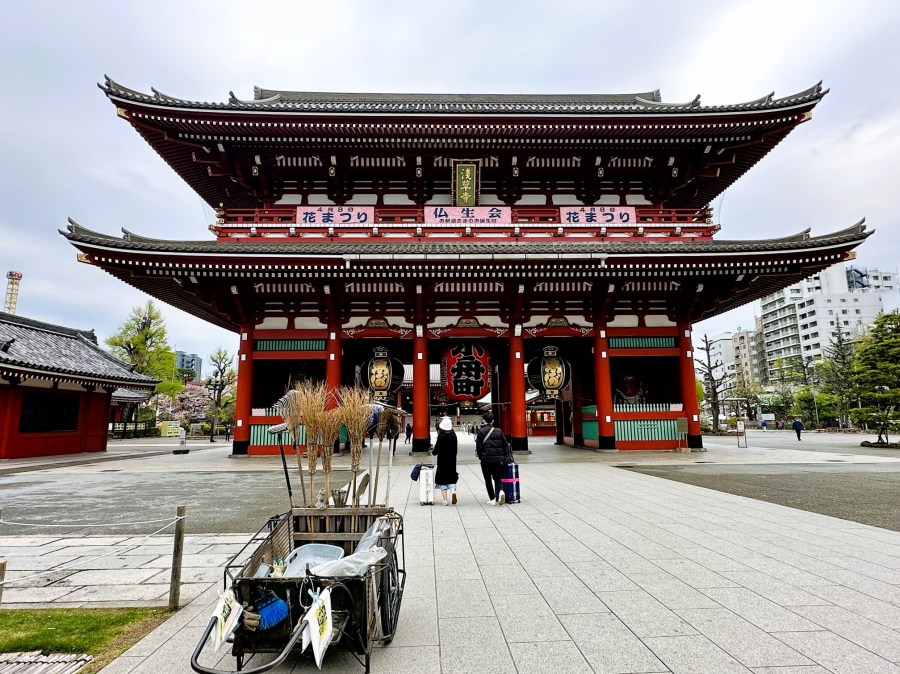
It was a beautiful day as we headed out on foot just around the corner from the hotel (in the Asakusa area) to the oldest and most important Buddhist temple in Tokyo – Senso-ji Temple.  As legend has it, in 628, two brothers fished a statue out of the Sumida river – it was a statue of the goddess of mercy – Kannon.  They put the statue back, but it always returned to them, so they build the temple, which was completed in 645, nearby for the goddess.  The temple was hit by a bomb and destroyed in WWII and was subsequently rebuilt and is now a symbol of rebirth and peace.

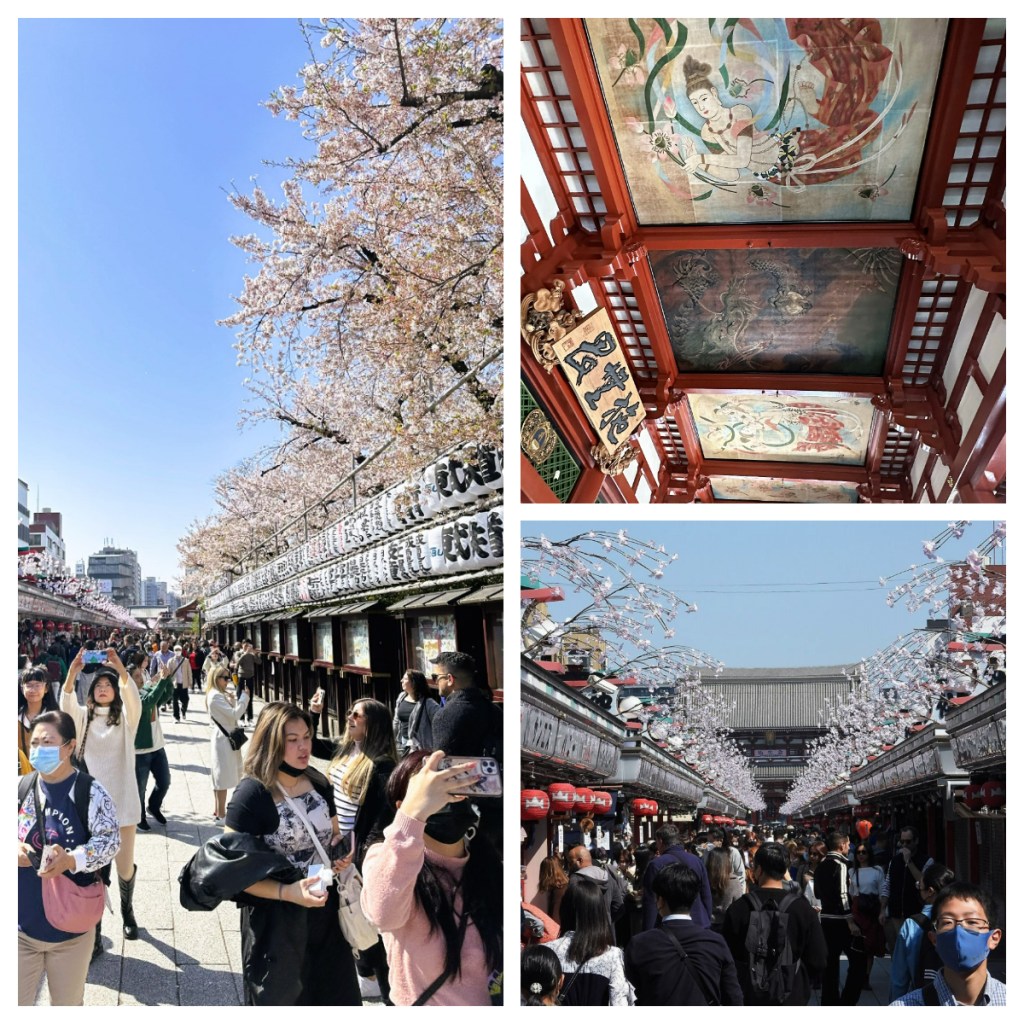
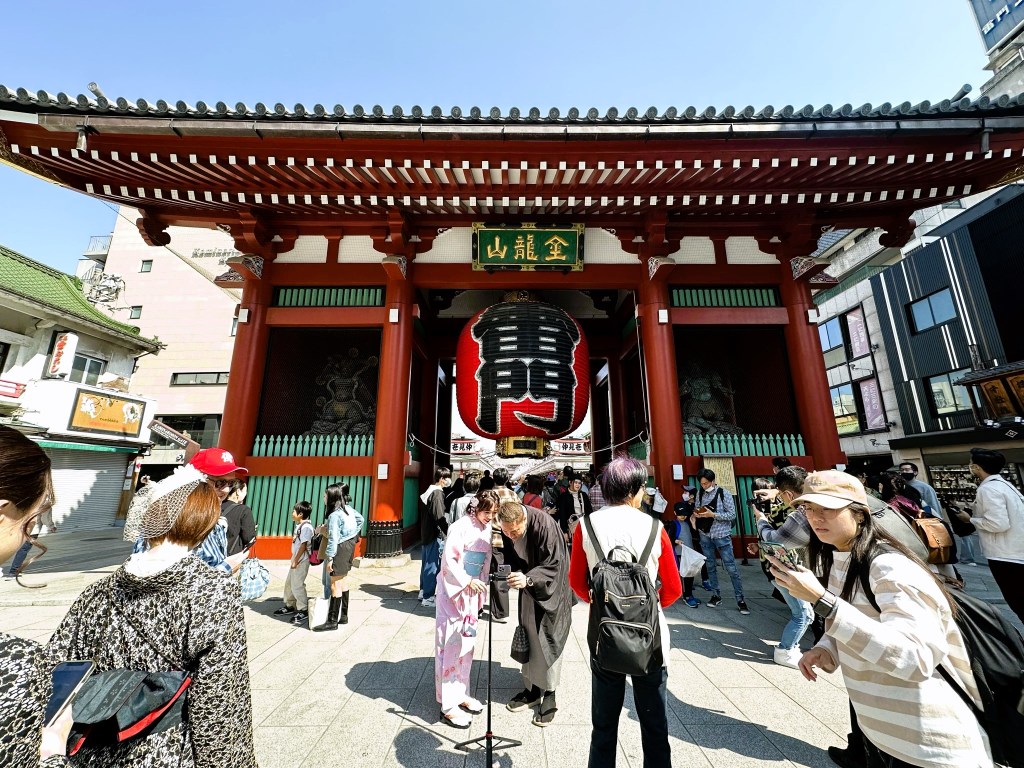
Rinrin mentioned that the temple was not as crowded as she expected it to be, but it was still very crowded for me 🥴 but I guess that is what you get when you visit Japan during Cherry Blossom season.  It doesn’t help that it is also holiday season here so there are also lots of local tourists too, some oddly taking their dogs for a walk in prams!  I definitely won’t be getting many of my perfect people free photos here lol.

From the temple, we walked down the narrow, 250m long shopping street called Nakamise-dori which dates back to the 18th century (although in its current form from post WWII).  There were amazing smells of all the sweet street food being cooked – but one of Japan’s many quirks is that eating on this street is prohibited (and it is frowned upon in general everywhere).  So you either eat gathered around the shop or take your purchases home.  This is reinforced by the lack of rubbish bins which results in carrying rubbish around all day!   

At the top of Nakamise, we came to the famous Kaminarimon, or Thunder Gate, the outer gate of the Sensoji Temple and a symbol of Tokyo.  Humorously, this famous historic site is now ‘sponsored’ by Panasonic 🤦🏻‍♀️

From the thunder gate we crossed the Sumida River, admiring our first view of a small part of the Tokyo skyline, including the Asahi company headquarters, with a very odd interpretation of a golden beer spout before boarding a local bus to next temple – Fukugawa Fododo Temple, just in time to watch their Goma fire ceremony.

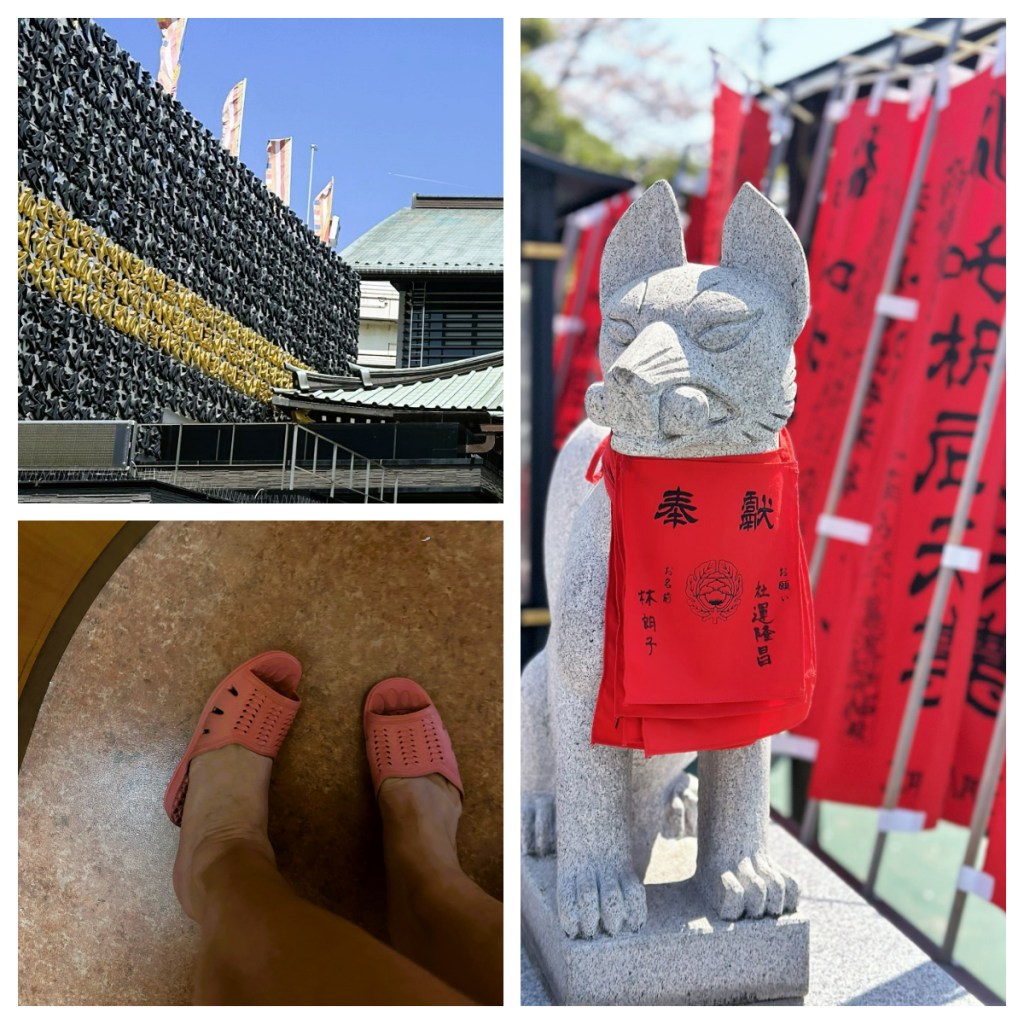
With our shoes off (a common occurrence in Japan) and masks on (not mandatory but many people still wear them, and some private places/temples ask for it), we entered the temple for the ceremony.  It was carried out by a number of monks. The head monk lit a fire with cedar to perform the purification and blessings, whilst the others took turns at blowing conch shells, beatingin trance inducing drums and chanting.  As well providing purification and blessings, the fire is meant to fend off evil spirits.   For a wooden temple, with a history of burning down, there was clearly no smoke detectors inside! (Sadly no photos allowed of the ceremony.)

After the ceremony we had time to work around the temple complex, starting with the toilets (oddly you will find much talk about toilets on a trip to Japan as the toilets are amazing) – as you can’t wear your shoes inside the temple, they provide “toilet” shoes – sadly not in my size 😂

Within the complex there was also a large wooden Fudomyo-o statue.  It is a Buddha guardian who represents the rath of Buddha, and also a small dark room with glow-in the dark imagines and pray wheels.  Outside, in contrast to the old wooden temple, the modern main hall next to it, is covered in gold and black Sanskrit which shows part of the Buddhist sutra.

From the temple we took a local subway train to the next stop where we walked through a really nice suburban area of Shiba, passed families picnicking in parks and kids playing baseball, to a smallish (size is very relative here) local station to get our JR (Japan Rail) pass for the rest of the trip.  Apparently if you go into the main station this can take 3-4 hours and our guide thought it would be much quicker to go to a small local station. 

A JR pass is like gold – it is only available to tourists and saves a significant about of money on Japan Rail travel.   But there is no way to replace it if you lose it and paying for the trips individually will costs thousands of dollars.  Oddly, purchasing a ticket for one of the most efficient train services in the world, is one of the least efficient processes – often involving pencil and paper rather than computer!!! (Worth noting it needs to be purchased online before you arrive and then picked up once you get to Japan.)

Thankfully we were ‘released’ to find some lunch while the guide waited for our tickets.  I joined a group who headed into a small mall near the station where we spent 30 minutes waiting for a table for some lunch.  Using google translate to translate the menu, I decided to try the ‘drinkable’ wagyu burger (I think it was actually “melt in the mouth” 😂) – it was great!  This place also has the most amazing wearable napkins – I never saw them again but they should be everywhere!

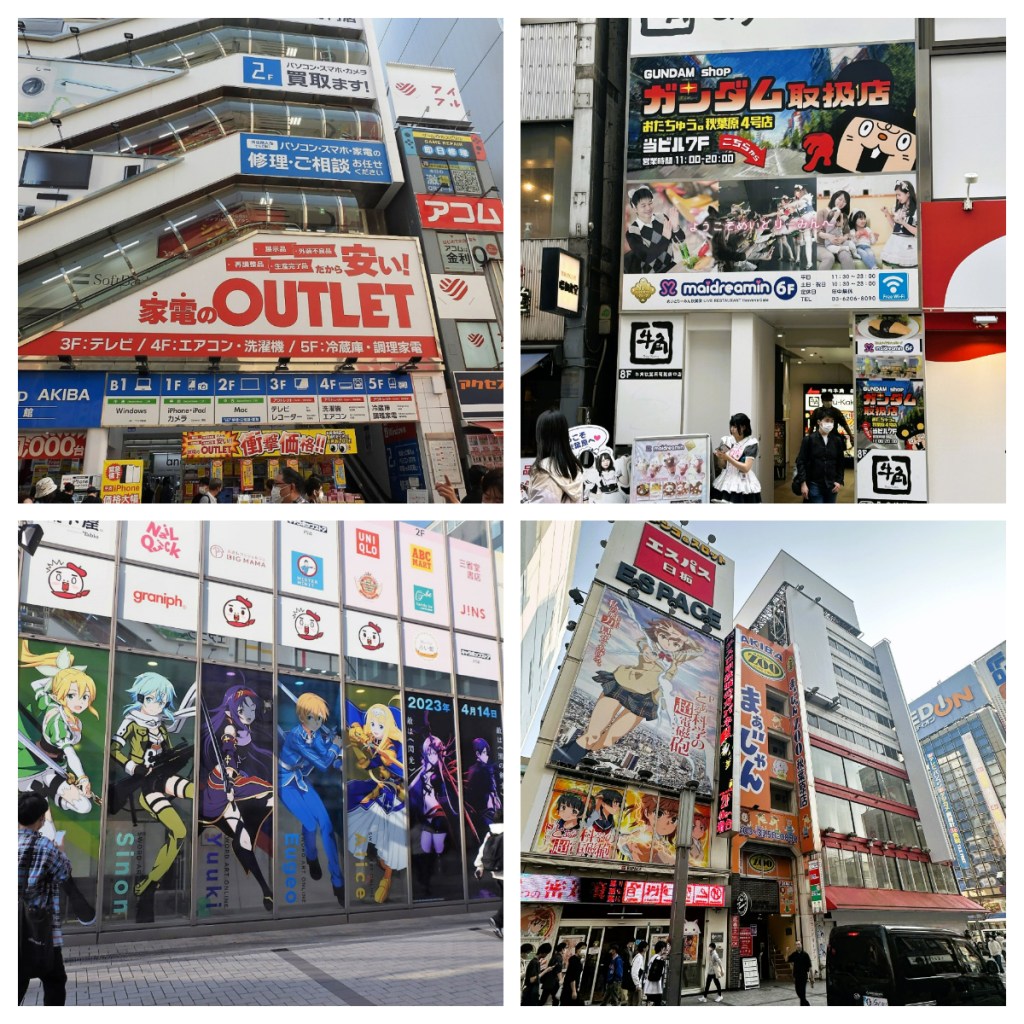
Lunch eaten and the precious JR pass in hand, we caught a train to Akihbara.  It started as the home to black market sellers of electronics after WWII but today it has become a hub for legitimate electronics shops and a mecca for the Japanese subcultures/fans of Japanese graphic cartoon tv/movies (anime) and graphic novels (manga).  With all the tall buildings, lights, music and crowds – this was more like the Tokyo I expected. 

I left the group here for my first solo expedition on the Tokyo transport system and I must admitted it started with some trepidation, even more so because my phone, which I was relying on for directions (I was so very grateful for google maps that provides a full breakdown on the journey including walking and public transport) was at 25%!   Thankfully, the train system is similar to London, though on a much larger scale once you find the right entrance, platform, train, direction and then fight to get a seat, it’s not too bad.

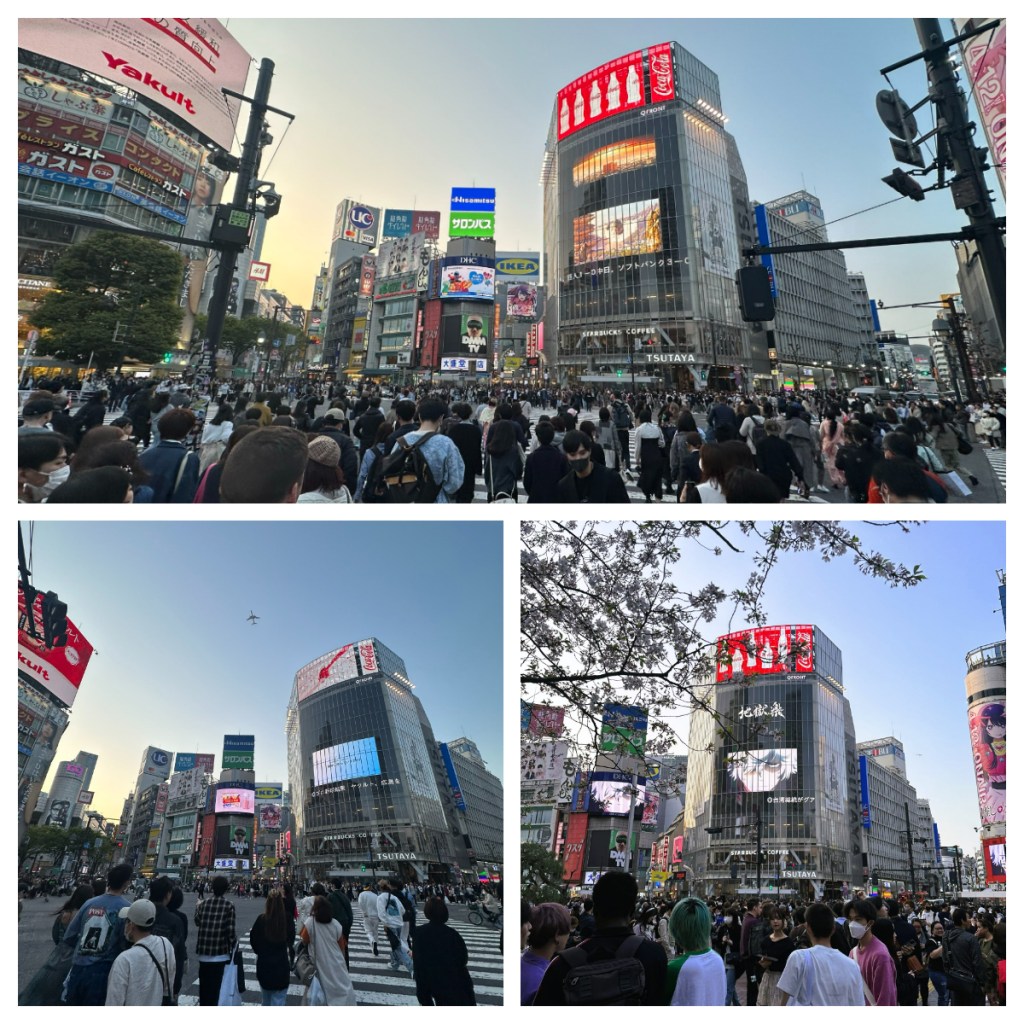
My destination was Shibuya, one of the largest shopping areas but probably more well known for its pedestrian crossing, known as the Shubuya Scramble.  The train station at Shibuya was crazy, almost is busy is the crossing itself!

Once I had fought my way out of the station, the looming tall buildings covered in neon advertising reminded me of Times Square in New York or Piccadilly Circus in London. It is definitely a “must see” in Tokyo, but I’m sure nowadays it is busy because of all the tourists that go there!

From here it was a 45 ninute journey back to Asakusa, and I found my way back to the Temple near my hotel where we had visited in the morning. It looked amazing at night and I took the opportunity to have street food for dinner from one of the small stalls near the temple – some sort of sweet waffle stuffed with cheese that I had seen on the Internet. It was pretty good and a great end to a long day.    

It was liberating having the opportunity to spend some time on my own working things out.  That’s always part of the fun.

Antics in Akaroa

Dec 2022/Jan 2023

 After a half day turnaround at home to drop off my side kick and repack with clean clothes, I was back on the road again – this time just over the hill to Akaroa – around a 1.5 hr drive. 

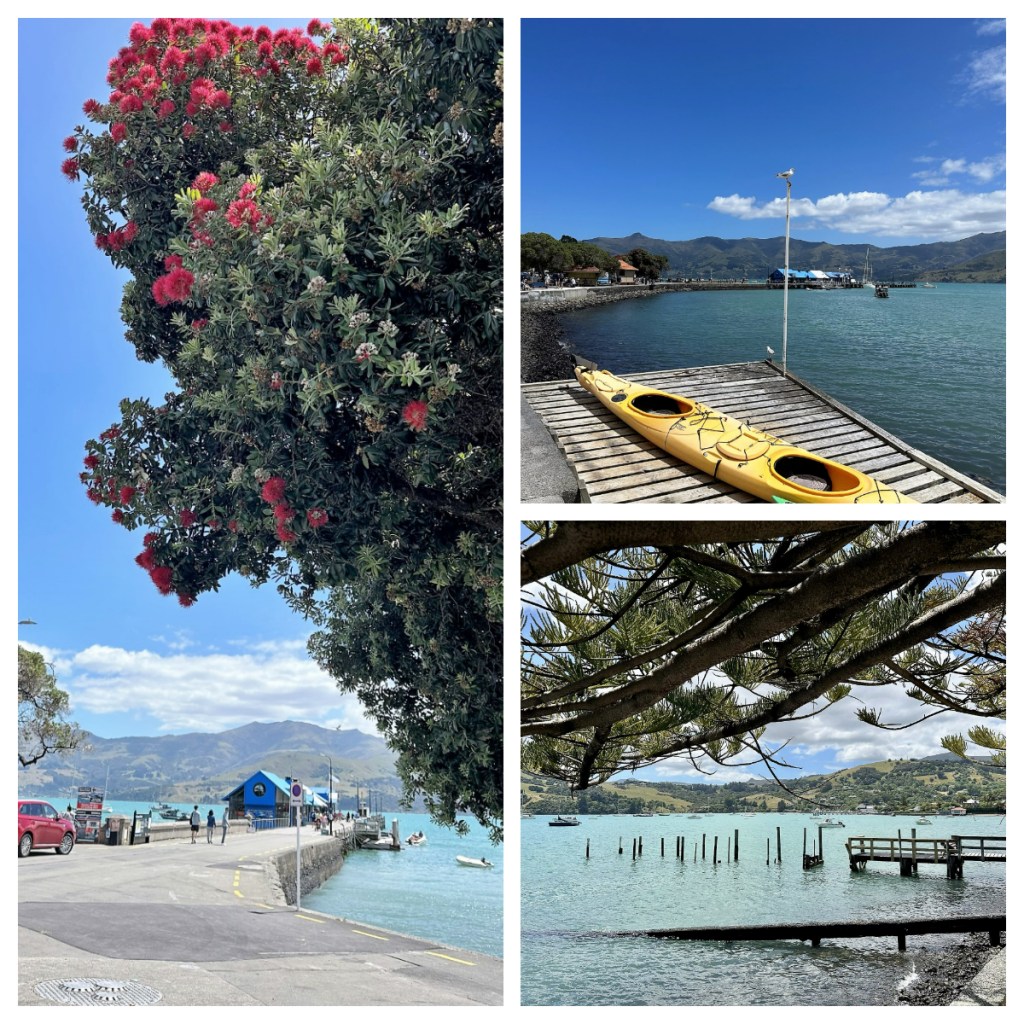
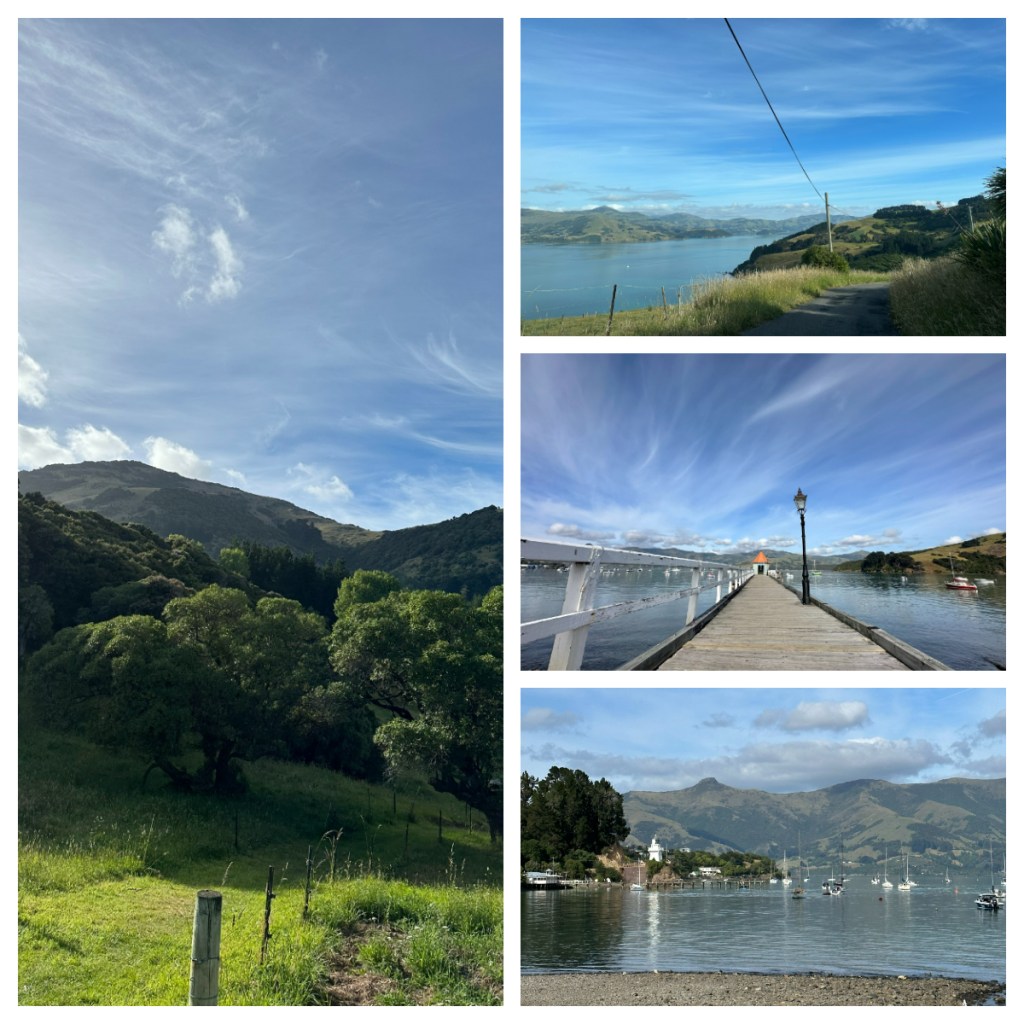
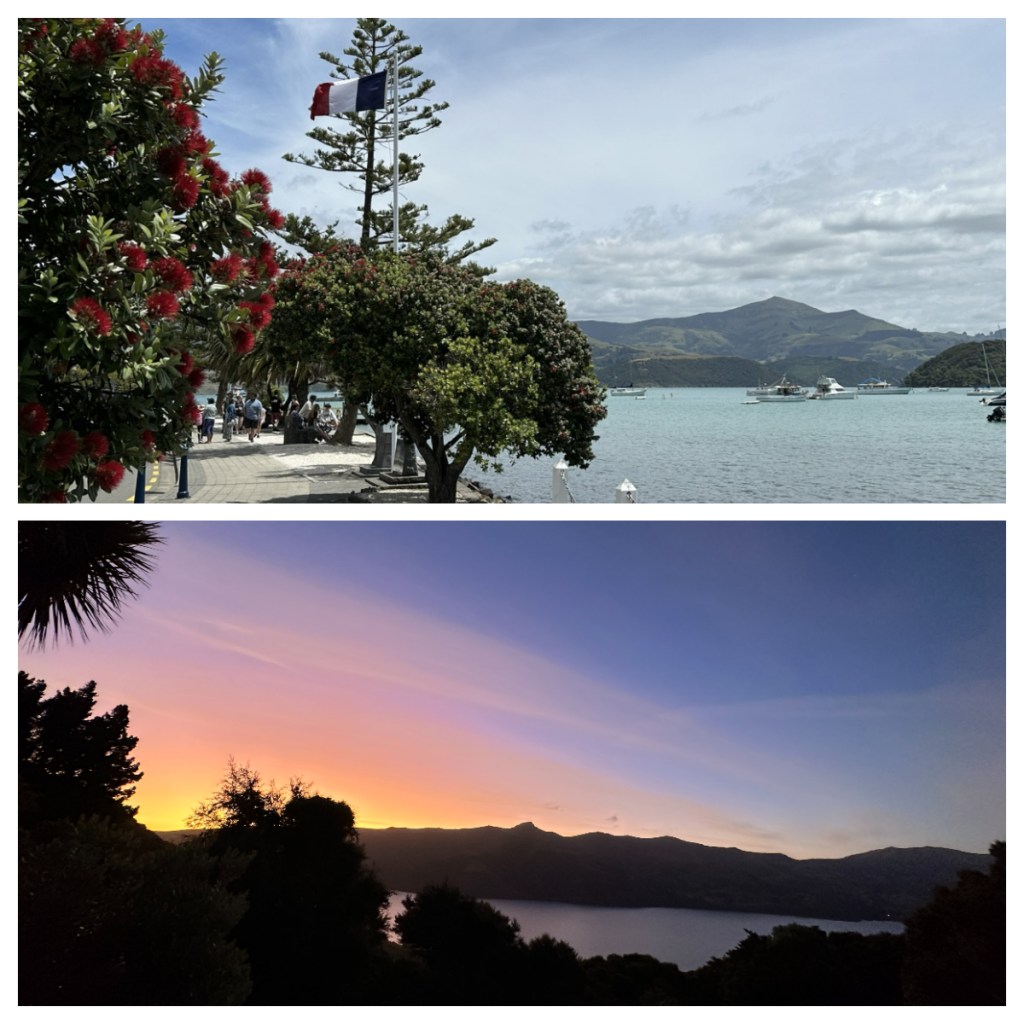
It was a lovely day and it was not surprising that the small town was bustling.  Akaroa only has a permanent population of just under 1,000 but that probably triples over the holiday season.  After a quick stop in town for lunch and a short stroll, I quickly left the ‘madness’ of town behind and headed out on a narrow winding road (I sense a theme here – at least it was sealed) to my accommodation.

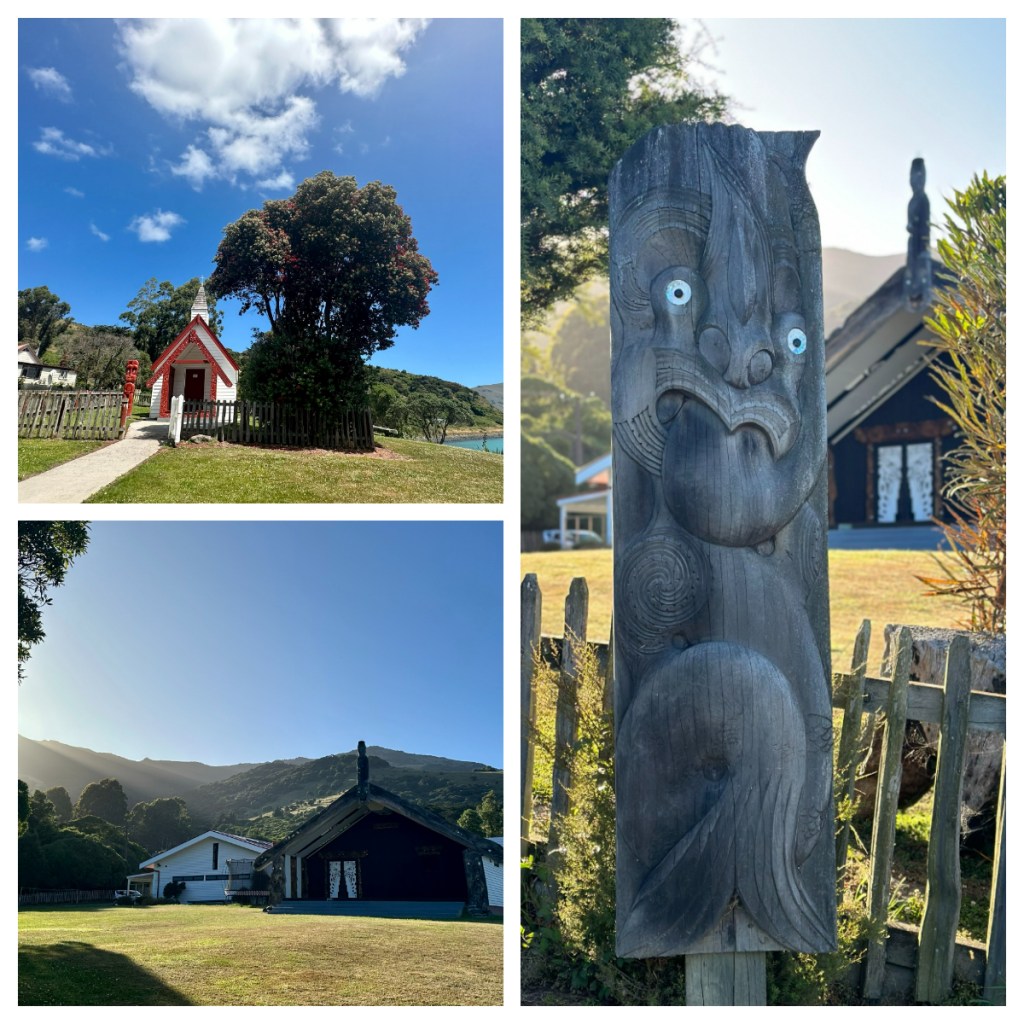
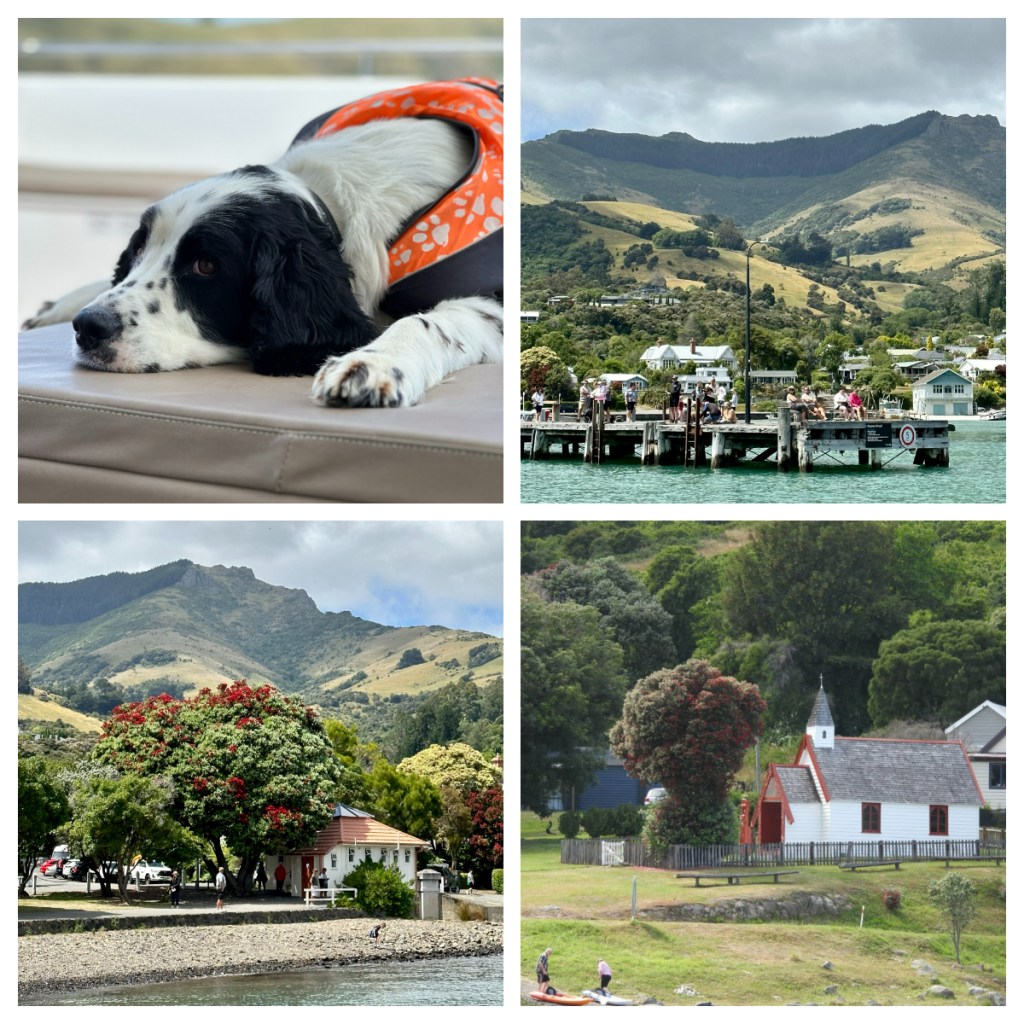
On the way, I stopped to admire a small Māori settlement of Ōnuku, consisting of a few houses, a beautiful small church and beautifully carved Whare Tīpuna (ancestral house).   These are reminders of what was once a thriving Māori community.  The church was built in 1878 and was a plain timber building and one of the first non-denominational church in the country.  It was refurbished and extended with the traditional carved porch in the 1940s as part of the Akaroa centenary and as a memorial to the early Māori of the area.  This was also one of the sites of the signing of the Treaty of Waitangi.

There was no sign for my Air BnB accommodation, but it was the right number so I headed down the track and found somewhere to park, before wandering along a narrow path until I finally found a sign that said “cabins”.  My host appeared and showed me to my room.  It was all very rustic with a kitchen and bathroom shared with another cabin, but it was peaceful, surrounded by bird song and it had lovely view from my balcony – it was perfect for me.

I spent the rest of the day reading and relaxing.  There was a beautiful sunset and amazing night sky to admire – annoyingly I had left my tripod in my other bag so no good night photos despite the beautiful clear night but I did my best!  (Did I mention that this was New Years Eve – I didn’t even make it to midnight lol.)

I had a great night’s sleep before taking the 10 minute drive down to town around 8.30am – it was so quiet and calm.  It’s lovely to be here before all the day-trippers turn up.  I took advantage of the peace and enjoyed a walk around the waterfront and joined a long line for coffee 🥴

My original nature cruise booking was cancelled at 9.15pm the night before as they did not have enough people booked on it, but thankfully I could book on another one – this time with Akaroa Dolphins.  They are a small family-owned business who donate part of their profits to conservation and research efforts in the area, in particular for the Hector’s dolphins.

Not only that, they have the cutest “dolphin spotting” dog – Albie.  Don’t ask me how he is supposed to ‘spot’ or ‘sense’ dolphins, and to be fair he spent most of the trip asleep on someone’s lap – but he was very cute ❤️😂.

As we left the town, we were given some really interesting history of the area – geological and human.  I won’t bore you with it (for a change lol) but I highly recommend the trip if you are interested.
Out of the shelter of the bay it was much cooler and definitely rougher than I thought it would be – thankful I was prepared for both, with my puffer jacket and pre-consumed seasickness tablets lol.   I was grateful for both as people started throwing up.  (I should note they did have warm jackets on board for people if they had not brought their own, sadly they only had sickbags for the seasickness and no miracle cure.

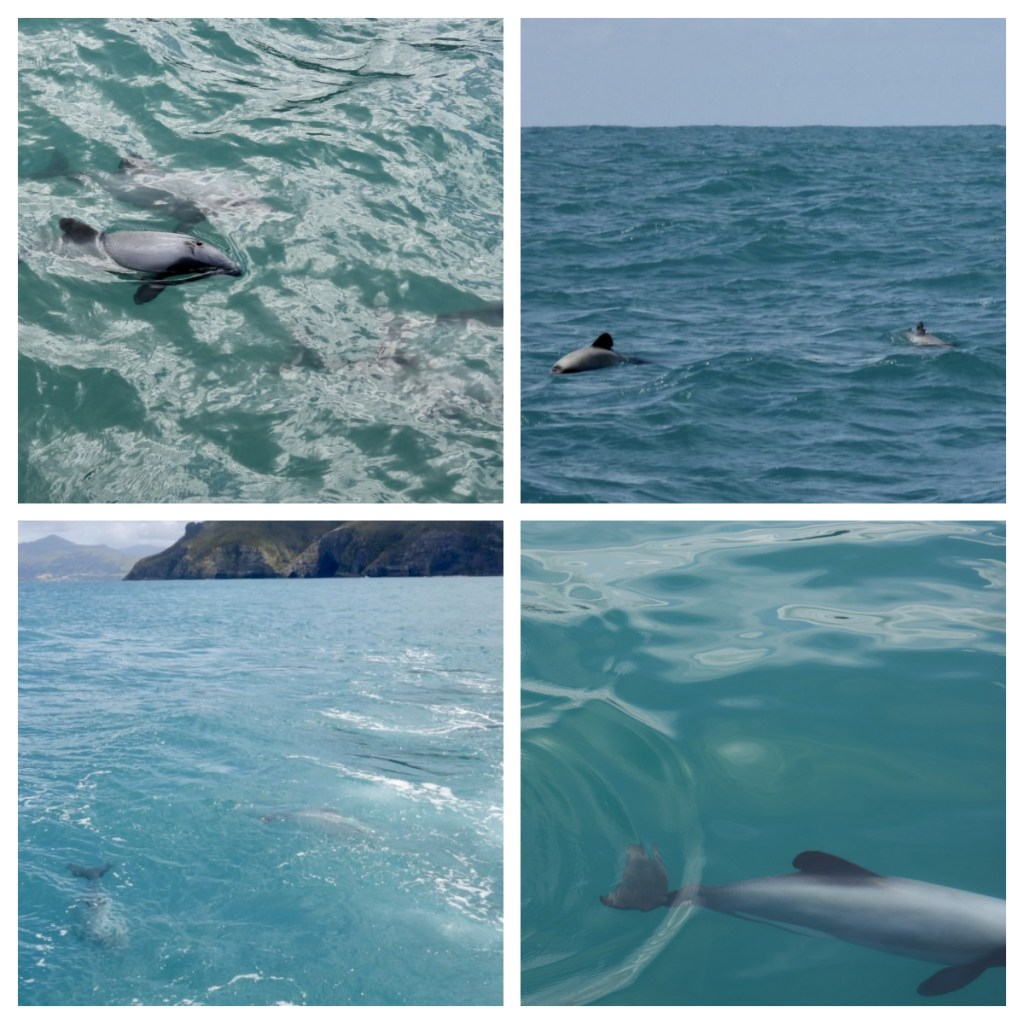
The star of the show is of course the Hector dolphins and we were fortunate to see a number of small groups (or maybe it was the same small group moving around the bay … who knows).

Hector dolphins are the smallest dolphin in the world and the population of approximately 15,000 are only found around the coast of New Zealand’s South Island (though a few do sometimes make their way north for short periods of time).  Not to be confused with their lookalike North Island cousins the Māui dolphin of which there are only around 50!

The dolphin ‘cousins’ are unique in the dolphin world with their distinct black facial markings, stocky bodies and mickey mouse ear shaped dorsal fin. Unlike other dolphins, they also only tend to be in small social groups rather than large pods, and we were so lucky to see so many but it was so hard to take photos with us moving, them moving and the swell🥴lol

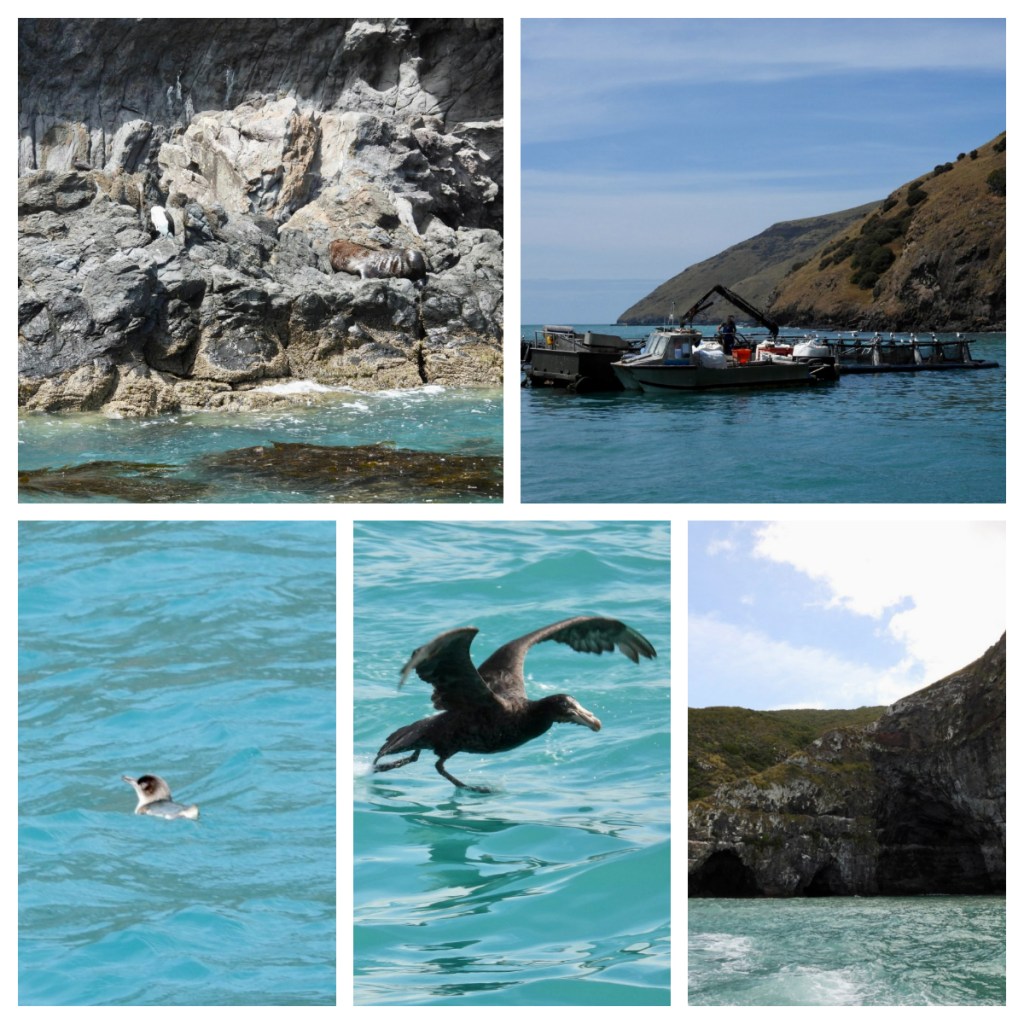
In between running around the boat spotting dolphins we saw cormorants (or shags as we call them here in New Zealand), white flippered penguins (which I visited in October 2020), giant petrels feeding on a dead seal (🥲) and seals hanging out on the rocks around the peninsula.
We passed a couple of “farms”, one for the award winning Akaroa Salmon – a family run business one of the pioneers of commercial salmon farming in New Zealand.  The second was a Paua (Abalone to others in the world) pearl farm – the source of New Zealand’s famous blue “pearls” (though colour can vary as much as the shell of the paua vary).  If you are keen to know more, they have their gallery on the wharf where the boats moor.
We were lucky enough to have 7 or 8 sightings of dolphins and as we sailed back towards the wharf the seas thankfully got calmer and we spotted yet another mother and calf – one final opportunity to get another crap photo 😂 Next time I think I will focus on taking videos as at least that way I can take decent screen shots from it.

It was a great morning and I would highly recommend a harbour tour with Akaroa Dolphins.

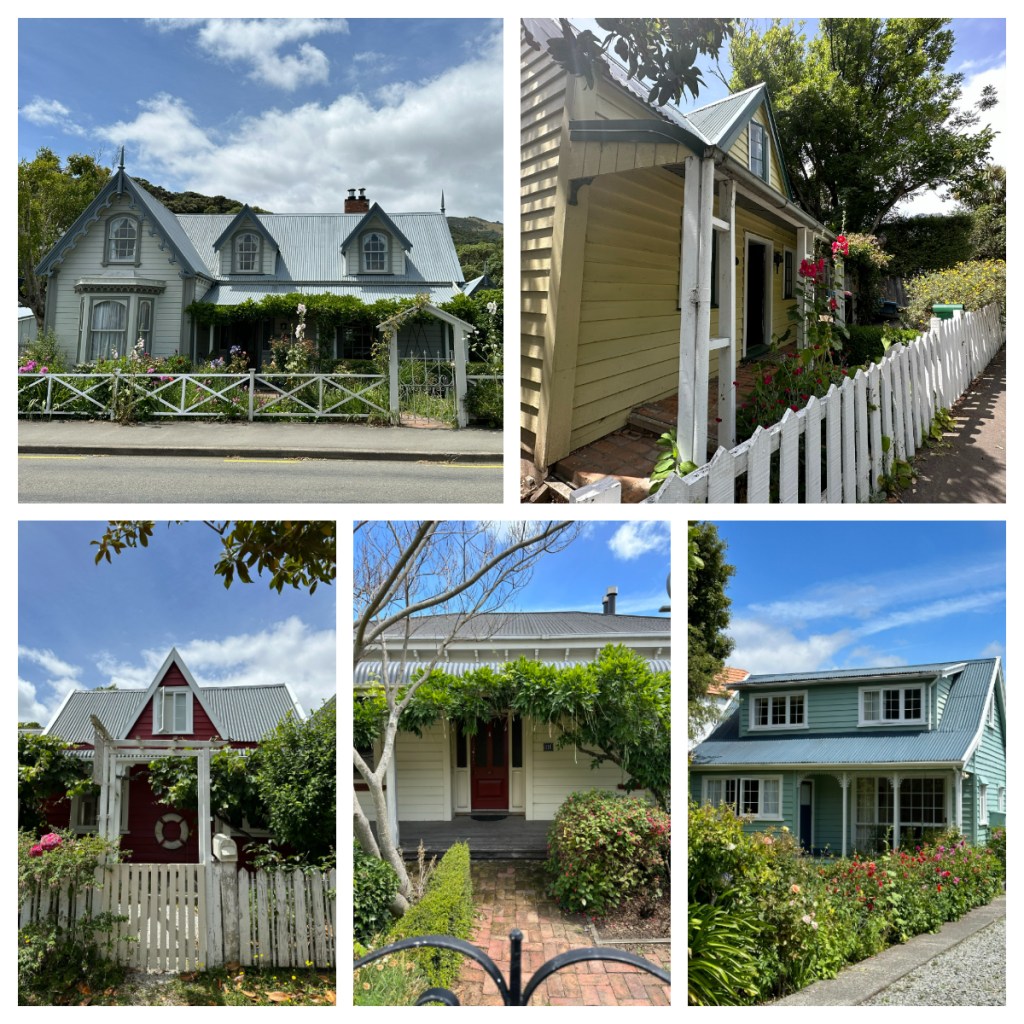
Back on land, I strolled around the town a little more – I love the old heritage cottages and gardens, many of which dating back to the mid-late 1800’s and many of which have been lovingly cared for.   (If you recall, Akaroa is Canterbury’s oldest European town, founded in 1840 by French settlers.)

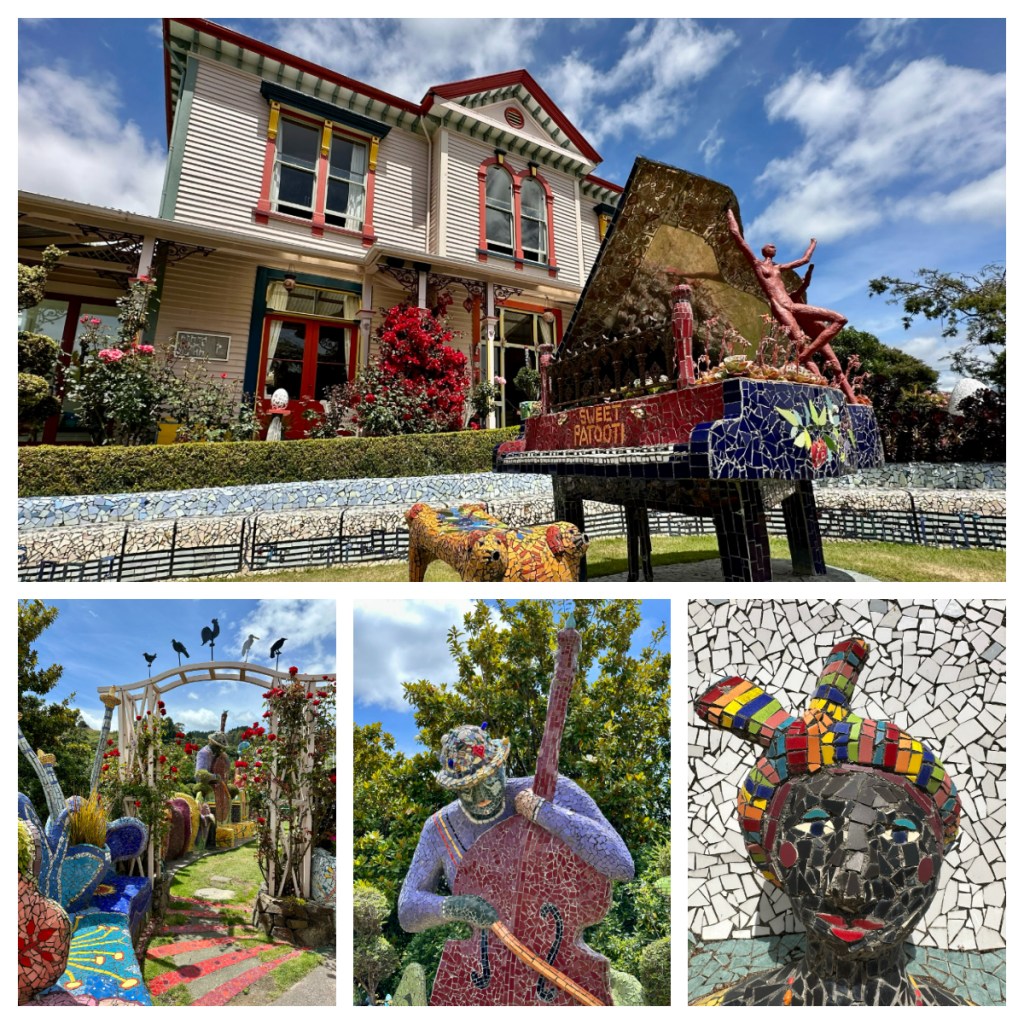
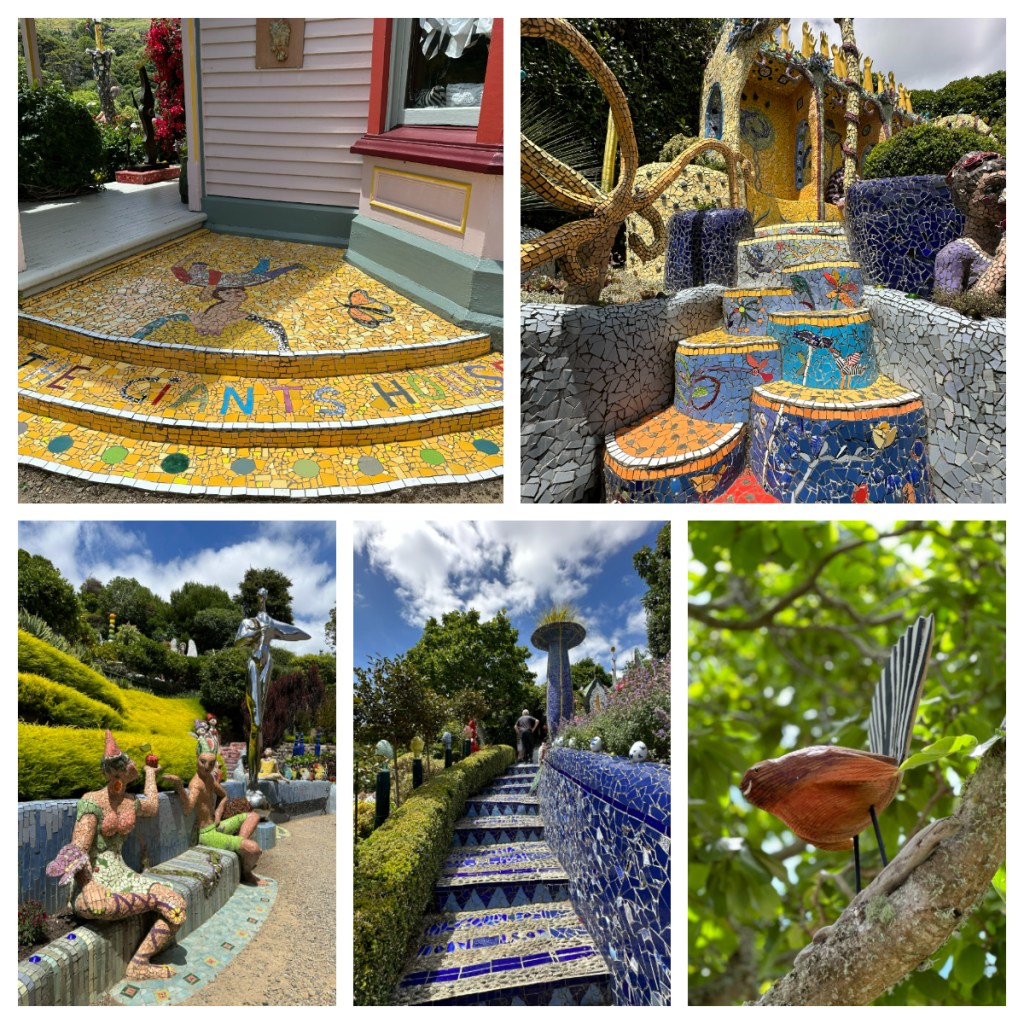
I have been to Akaroa many times, but I had never visited one of the “must dos” – The Giant’s House.  It was a bit of a walk up the hill, in what was now a hot day, to this very unique attraction.  The Giant’s House itself was built around 1880, but the main attraction is the garden, apparently a “garden of international significance” and its original sculptures and mosaics that fill the garden and its multitude of terraces.  Often described as a wonderland, it is the colourful and quirky creation of local artist Josie Martin. 

It reminded me of the Gaudi designed Park Güell in Barcelona and it was a lovely place to explore and enjoy afternoon tea from the café.  That said, the entry was a bit steep (and so was the driveway to get there 😂) at $25 per person, and it was not until you got to the top of the steep driveway that it showed what the price was.

Back down in town, I had lunch with some friends who were also in town for a couple of nights, and a spot of shopping before heading back out to my quiet oasis for a quiet afternoon and to enjoy the beautiful sunset.

I love the idea of sleeping in when I am on holiday, but I never can.  I wake early and always feel like I should be doing something so on my last morning was up and out by 7.30!  Of course, this gives me plenty of time to stop and see sights on my drive.  First up was the new Takapūneke Reserve.  After many years of advocacy, the area has only recently been named a protected reserve due to its culturally and historical significance for the local Ngai Tahu Māori and the history of New Zealand.

In 1830, the bay was the site of numerous horrific battles.  Te Rauparaha, a chief from Ngai Toa had revenge in mind when he convinced a British captain to take him and his warriors to the bay, concealed below deck.  The local chief was welcomed onboard and taken prisoner by Te Rauparaha, whilst is warriors attacked the village, destroying it and killing many of its inhabitants.

The British captain escaped being brought to justice for his part in the attack, but the battle was the catalyst for the appointment of a British Resident in New Zealand and the signing of the Treaty of Waitangi 10 years later.

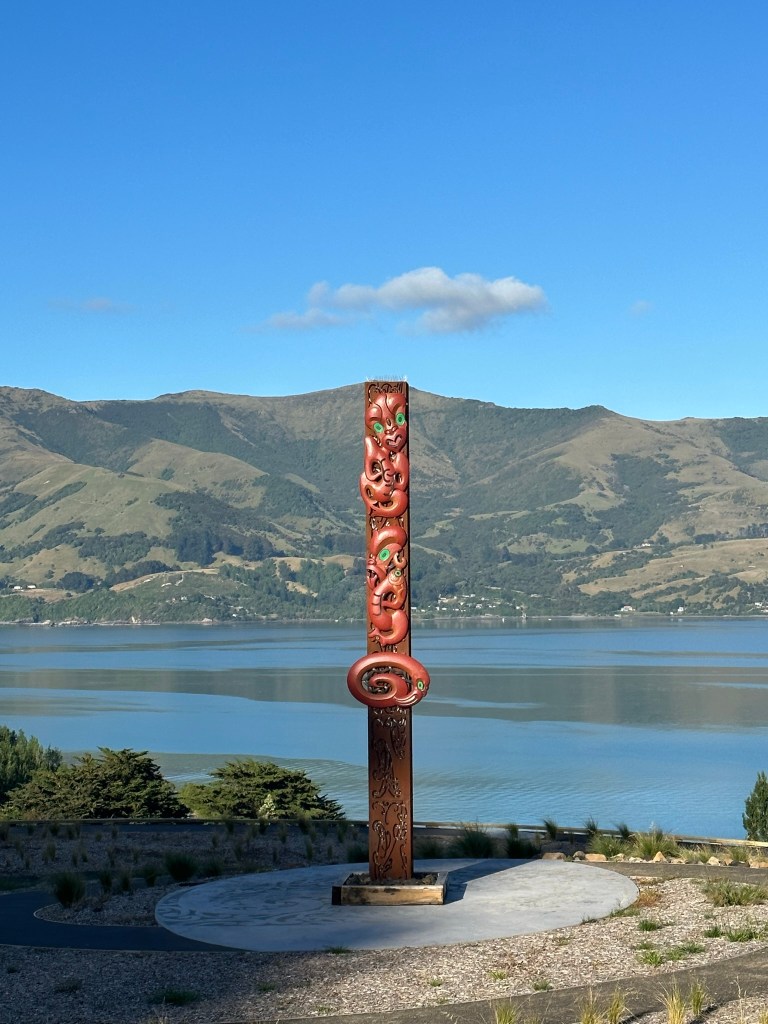
The first stage of the reserve is just a small area with the first of four beautifully carved Pou (carved wooden post) which will tell the story of the 200 year history.  This was only unveiled in June 2022.

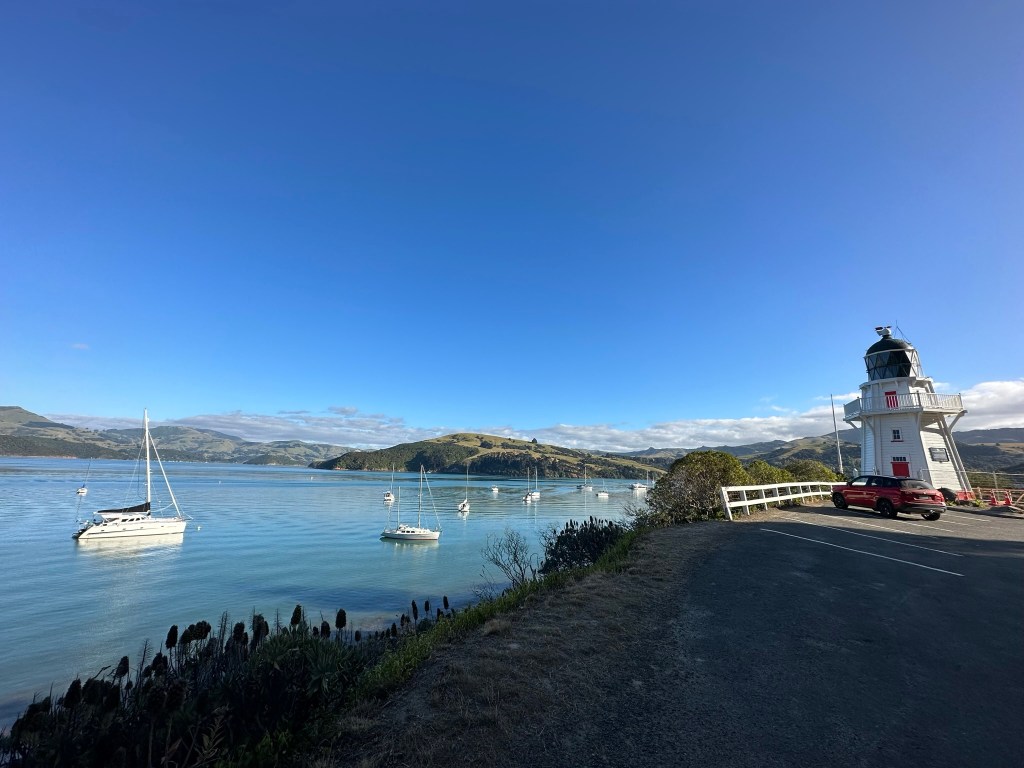
Further down the road from the sacred reserve, and I came across the old Akaroa lighthouse.  In 1880, the lighthouse sat out on the Akaroa Heads and it was moved to its current location in the town after being decommissioned in 1980 by the Akaroa Lighthouse Preservation Society.

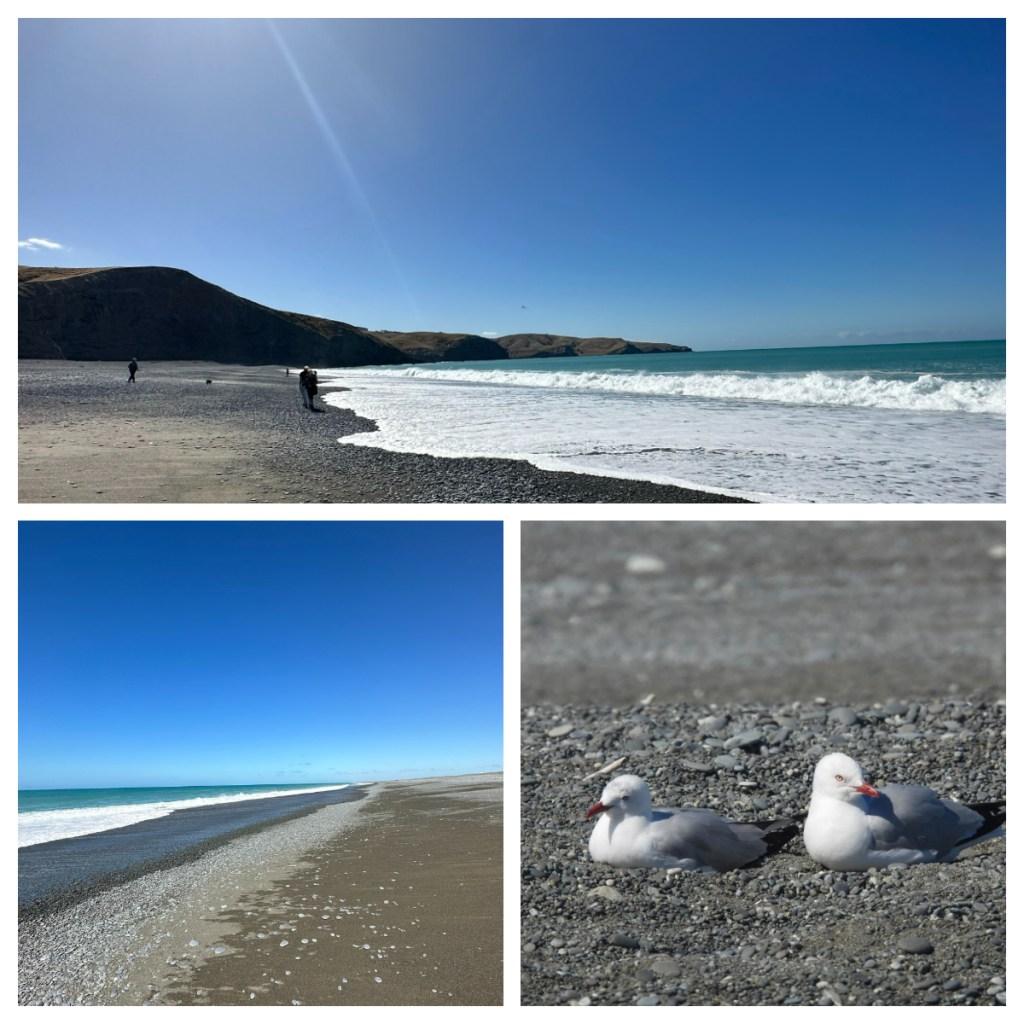
Back over the hills towards Christchurch I took a detour to the small settlement of Birdlings Flats, on the Kaitorete Spit.  Another important site for the local Ngāi Tahu for food gathering. The spit itself was created around 6,000 years ago by gravel being brought down by the Rakaia River and then swept north by ocean currents before being deposited on the spit.  It is very stony and pretty wild.  Apparently, it is possible to find gems on the beach but I was not so lucky this time.  Instead I just slogged through the stones, passed fisherman and small flocks of red bills gulls and terns hanging out together.

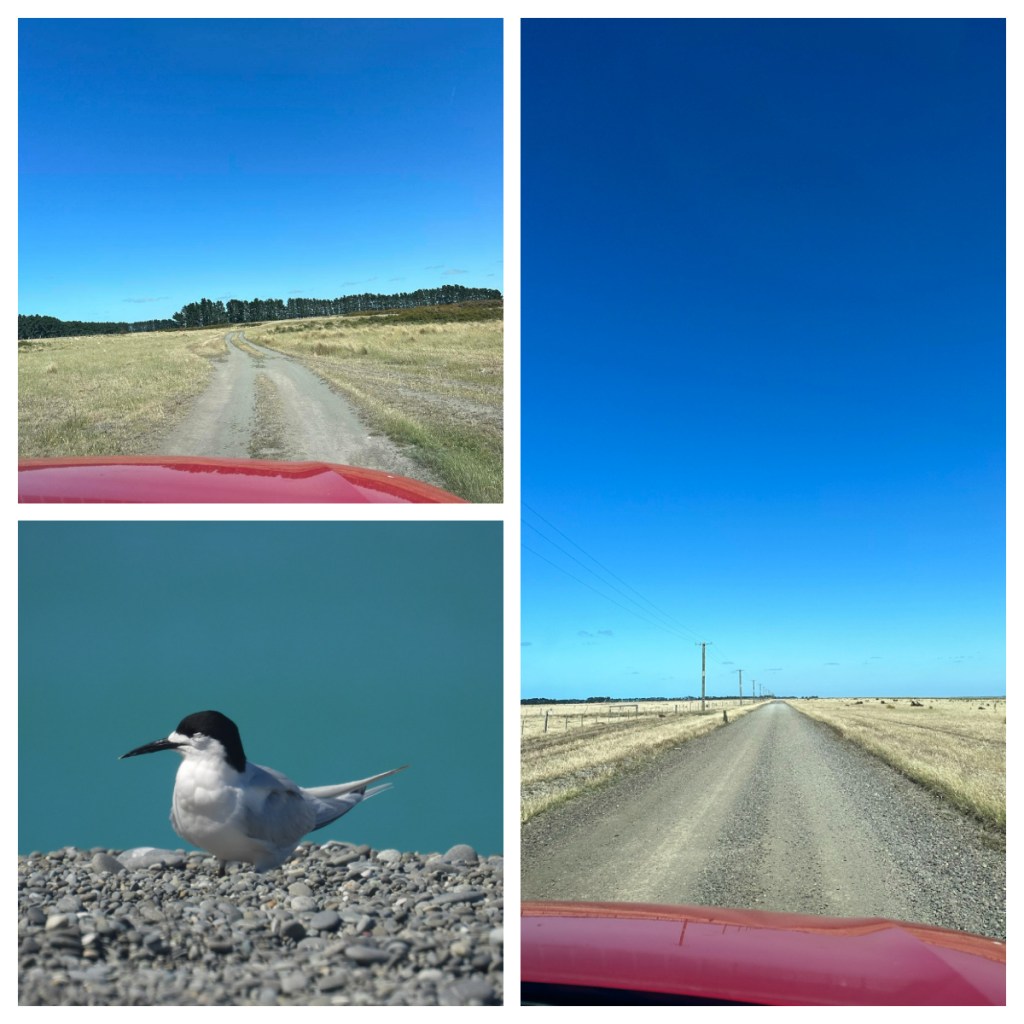
I decided I would try and drive down to the far end of the spit, where it tapers to 100m wide (from over 3km wide at it’s eastern end).  After 20 odd kilometres, the sealed road turned to gravel and then dirt.  I considered turning around a number of times as it appeared to be a gravel road to nowhere but I kept thinking I have gone too far to give up!

Finally, not far from the end (I think), I admitted defeat as the road became sand and it was hard going.  There was also no cell reception so if I got stuck I could not call anyone for help to get out!  It did give me an opportunity to use my All Wheel drive for the first time was kind of exciting and of course it is all in a day of adventuring …

Kaikoura cruising

December 2022

This year’s Aunty/Nephew Christmas trip turned in to the inaugural Aunty/Niece trip, as Isabel, my 12 year old niece stepped in to replace my nephew who is clearly now too cool for these kind of things lol. 

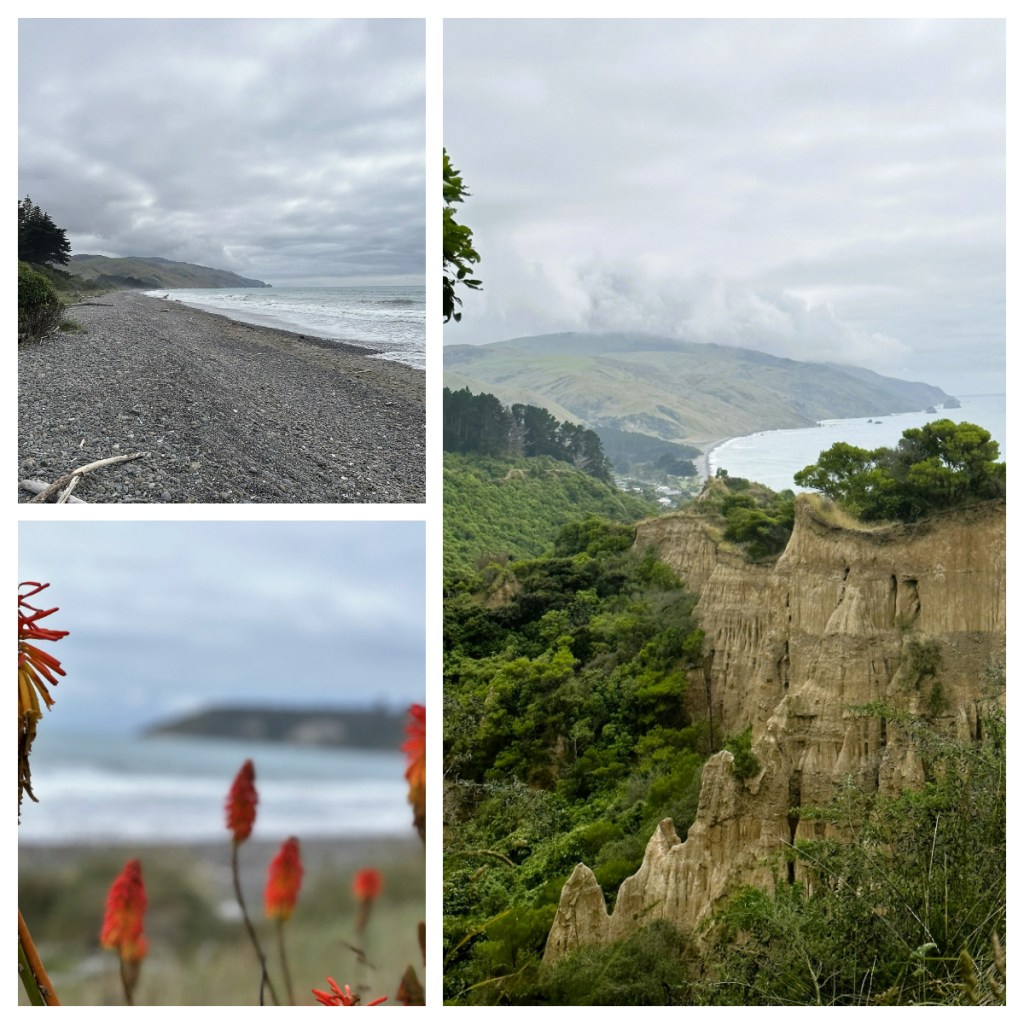
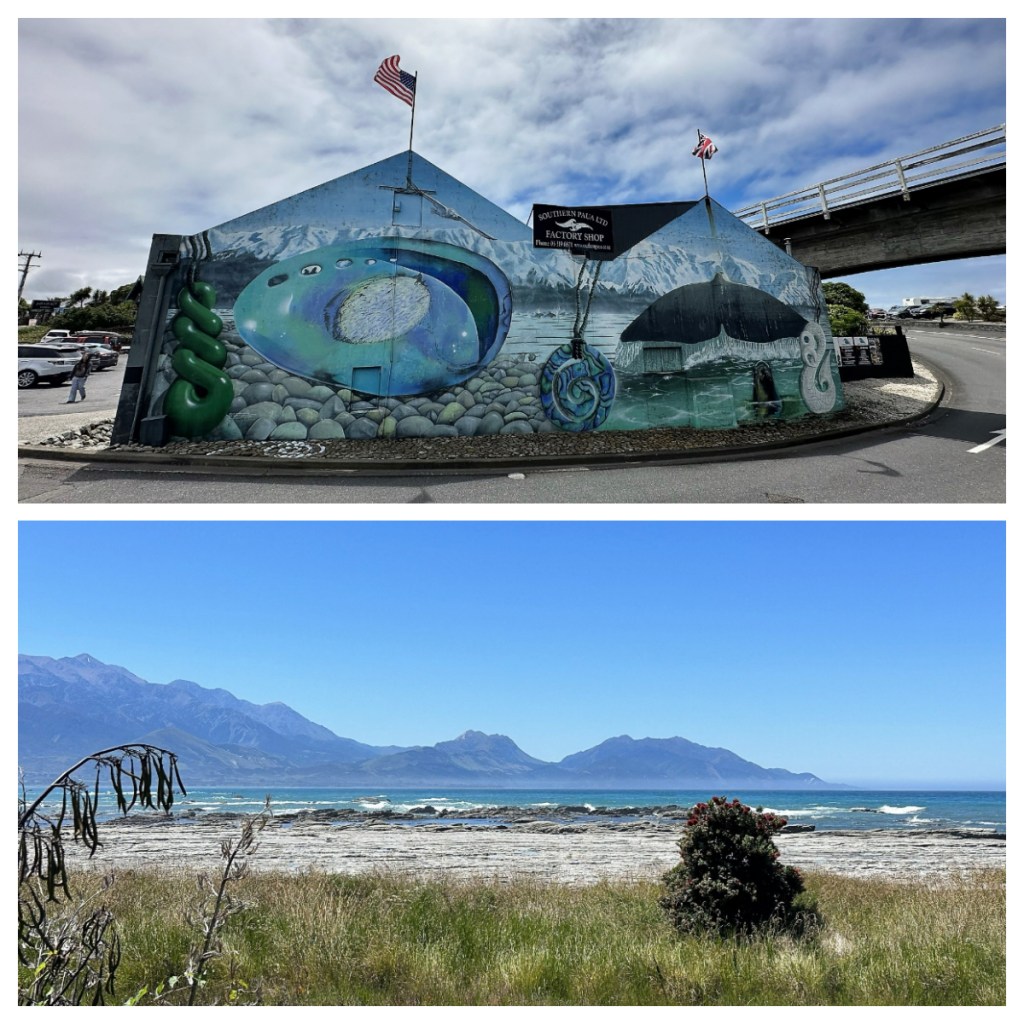
We decided to spend a few days in Kaikōura, a small coastal town around 2.30 hours north of Christchurch and well known for its water activities and wildlife encounters and of course all good road trip start with a detour – today, this was to visit the aptly named Cathedral Gully and the perfectly formed Gore Bay.

Once off the main highway, on to the Gore Bay Tourist Drive, a narrow windy country road until we came upon the view point for the gully.  It is just on the side of the road so no excuse not to stop and admire the “Badlands” topography.  Some of the rocks that we see here are about 2 million years old!!!  That blows my mine!!

After a quick stop in Gore Bay to see the beach, we were back on the road for the final scenic stretch to Kaikōura. 

Kaikōura has a permanent population of just over 2,000 but not surprisingly this number swells in the summer months as people flock there to enjoy the incredibly rich water and wildlife.  Famous not only for it’s whale and dolphin encounters but also for its abundance of seafood, in particular crayfish.  Kaikōura actually translates to ‘kai’ = food and ‘kōura’ = crayfish.

There is evidence of Māori occupation in the area back to the 1600s and the early European settlers arrived in the mid 1800’s to set up whaling stations.  As you can see, whales have been bringing people to the area for over 150 years.

As you may recall, in November 2016, Kaikōura was heavily damaged in a 7.8 magnitude earthquake.  The town was completely cut off as both road and rail links were badly damaged.  The bay and surrounding areas were lifted up by as much as 2 metres!!  It took almost a month to repair the road into the town, but today you would barely know it had happened.

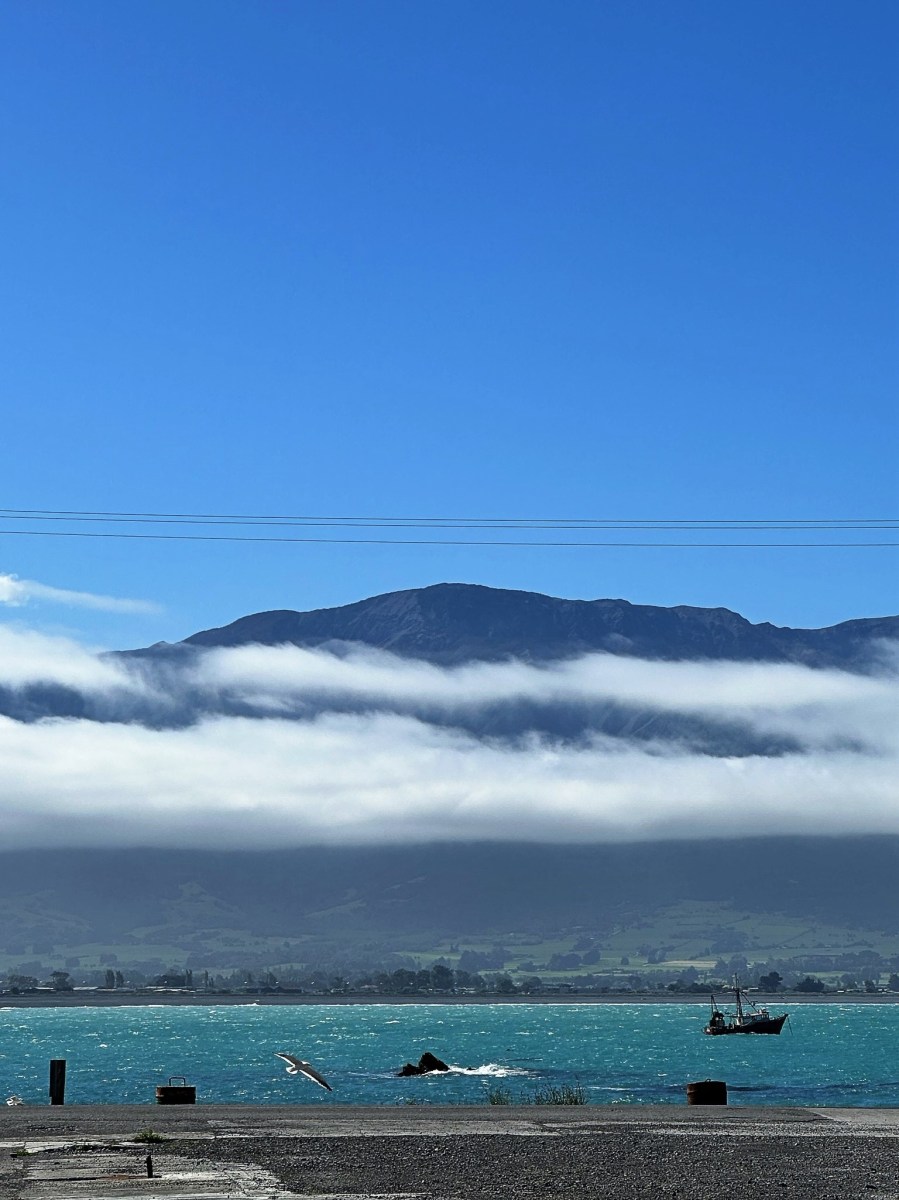
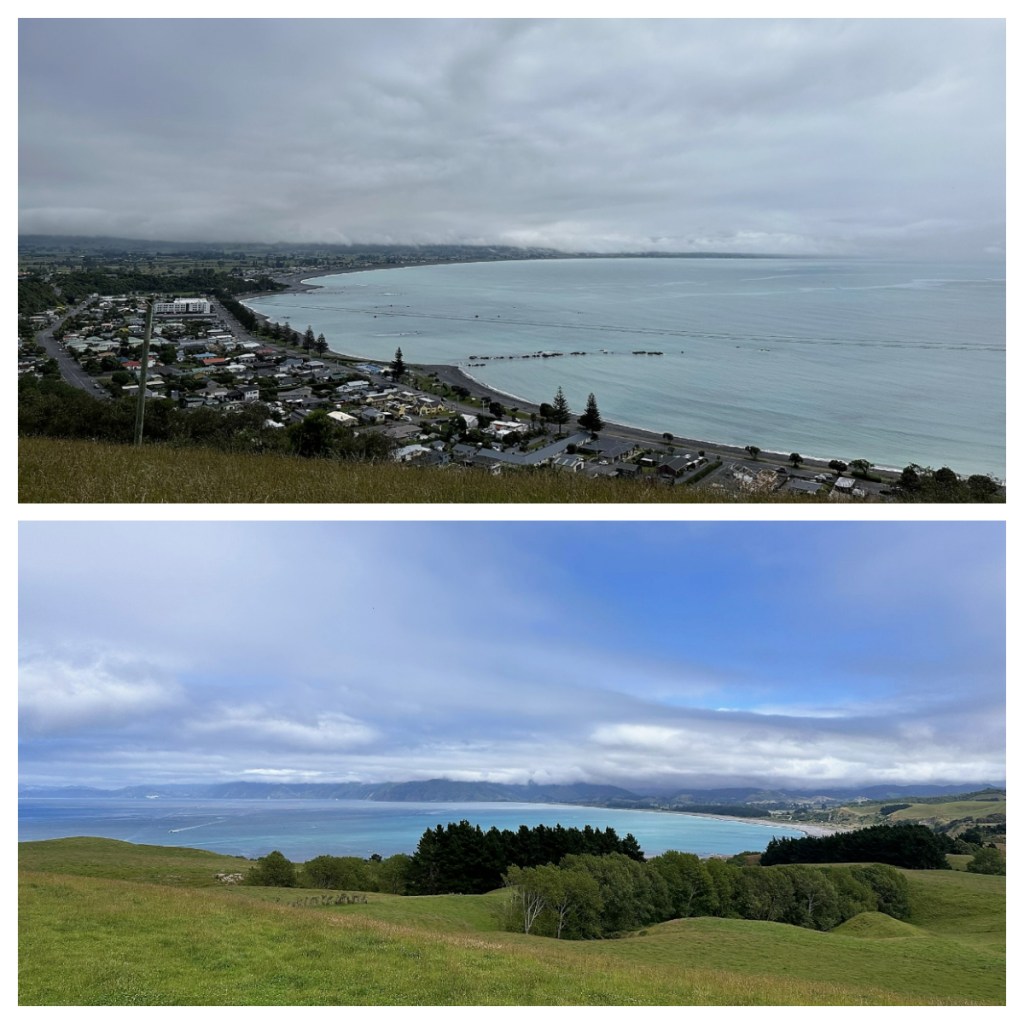
We may a quick stop at a view point over the town and peninsula, before checking in to our small cabin in the Top 10 campground and walking the short distance to town to wait for a pickup for our unique afternoon activity with Kaikoura Llama trekking.

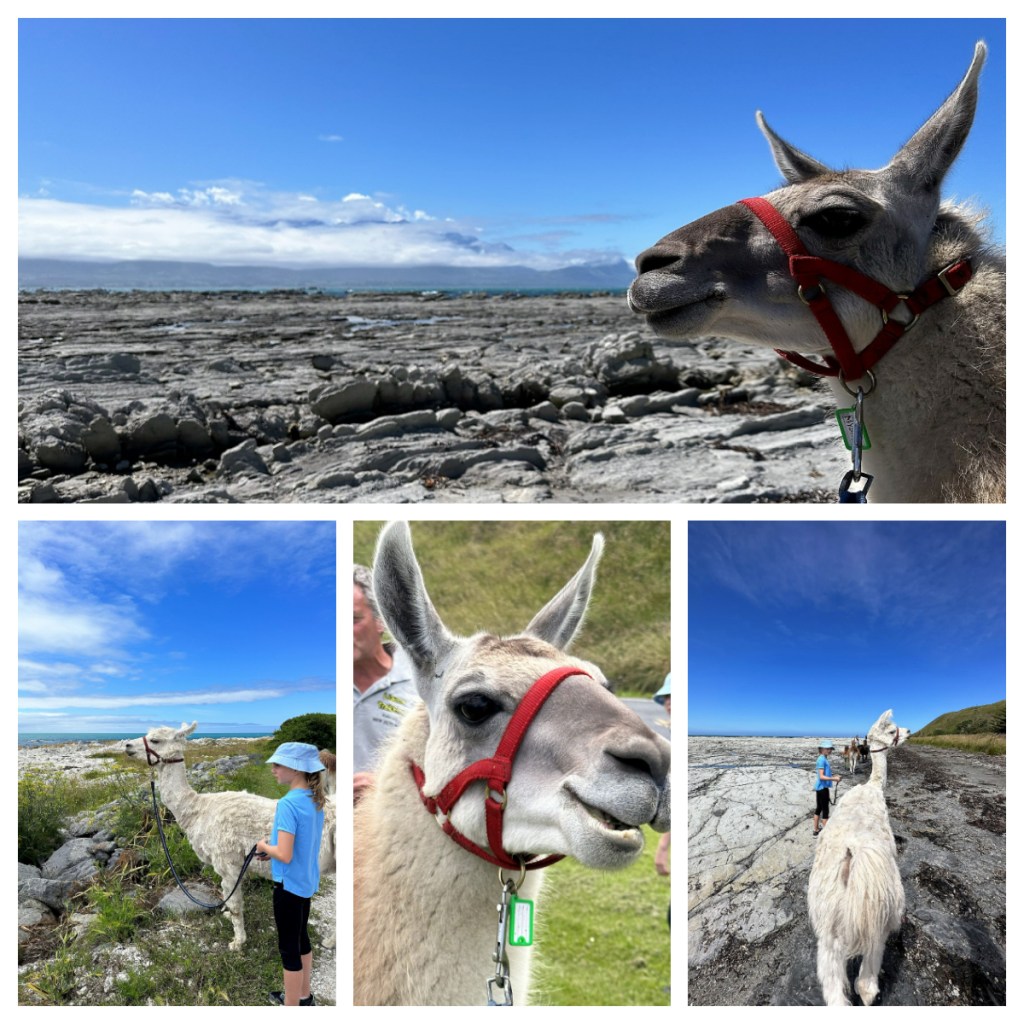
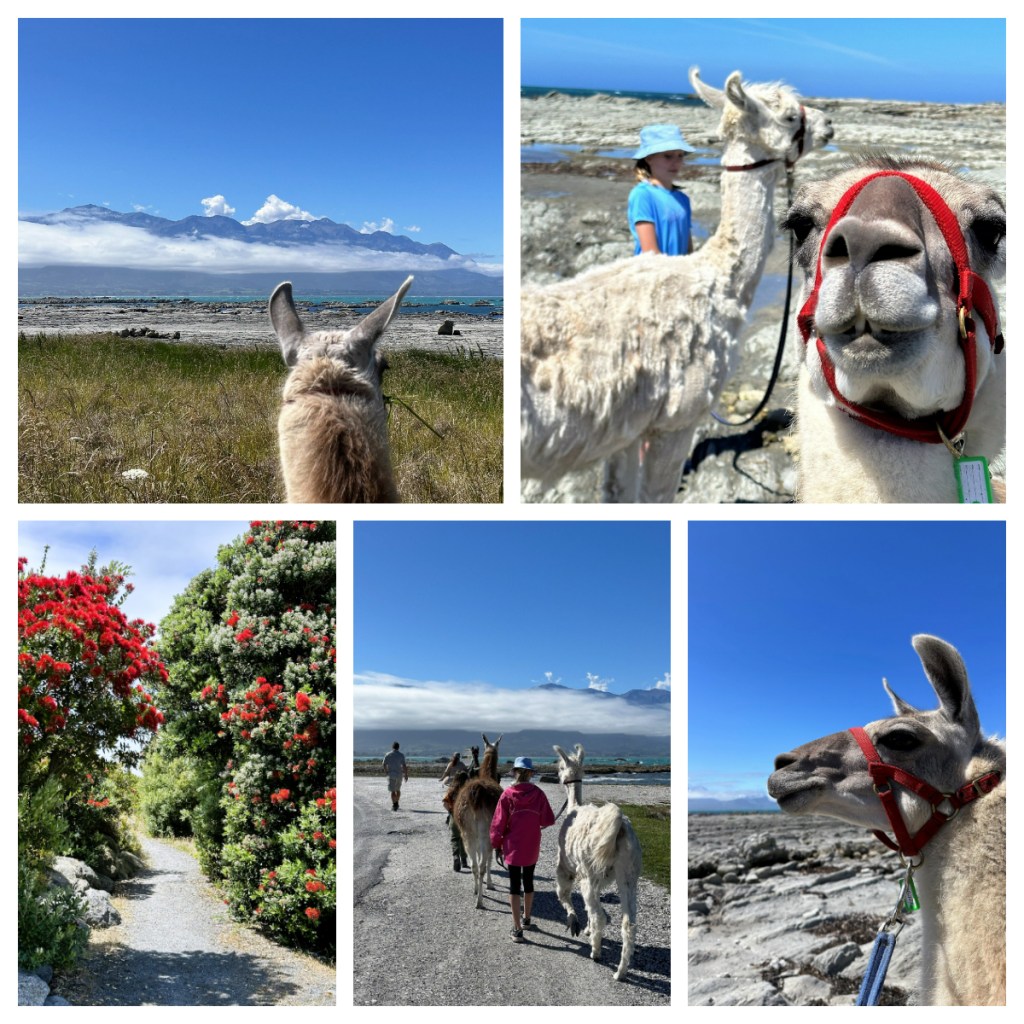
We were picked up by our Llama guide and his llamas and drove down to the end of the town where we disembarked the van and met our llamas for the walk.   The experience started with the ‘funny 15 mintues’.  This is the time where the llamas get used to area and suss out any possible dangers (including us) and where we get used to our llamas and their personalities.  They were very skittish about everything near by – people walking, cars, wind … on one hand it is not surprising, but on the other hand, they do this frequently so I did think they would be more accustomed to the route.

Once we were both settled in, we could all begin to enjoy the experience.  We were somewhat of celebrities (or should I say the llamas were lol).  Everyone we passed were surprised to see them and were keen to stop and take photos of us with our llamas.  In fact, we were walking with an actual ‘celebrity’ – the other people with us were a mother and her 8 year old daughter who had just flown in from America for a holiday.  Turns out, the girl was an actor, who had been in a very popular US programme – I am not sure anyone recognised her though (I certainly didn’t).

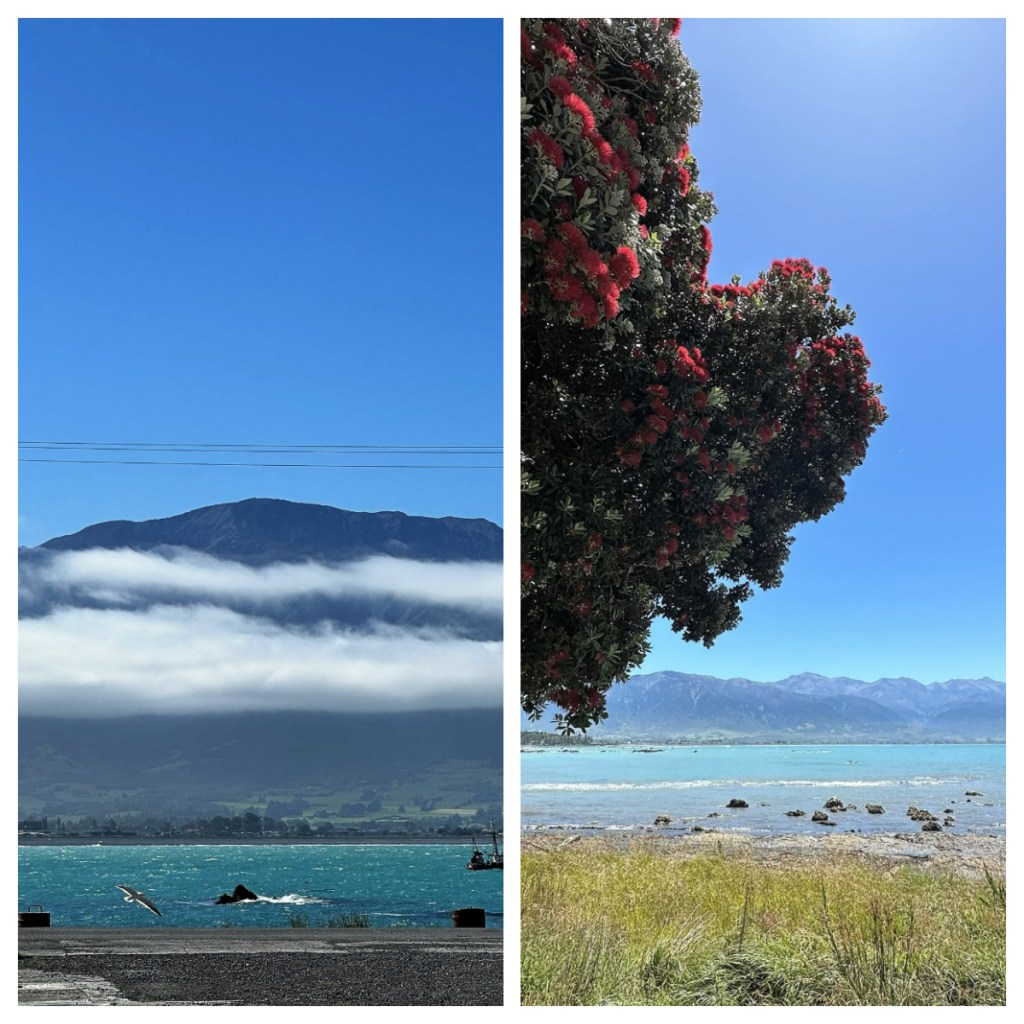
While walking, the cloud cleared from the mountains and it was stunning – a perfect Kaikoura afternoon, followed by a chilled evening at the campground.  (Top 10 campgrounds in New Zealand are great – always great facilities and awesome playgrounds.  I grew up having camping holidays and have very fond memories of the freedom of running around, making new friends. Isabel seemed to enjoy that as well.)

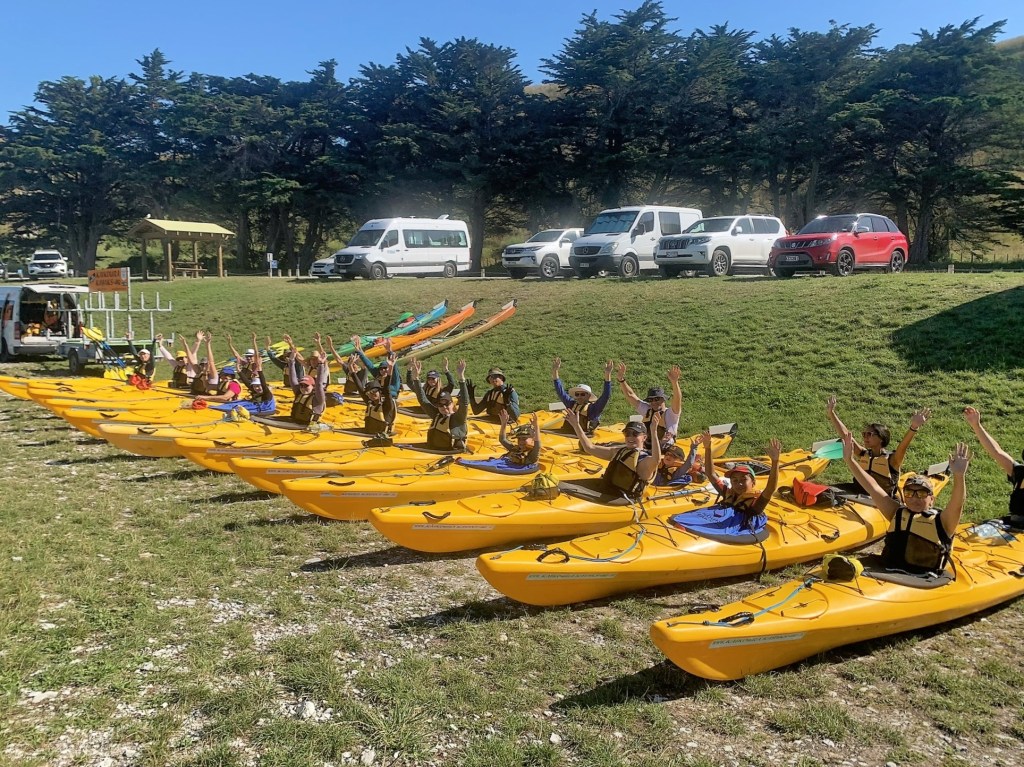
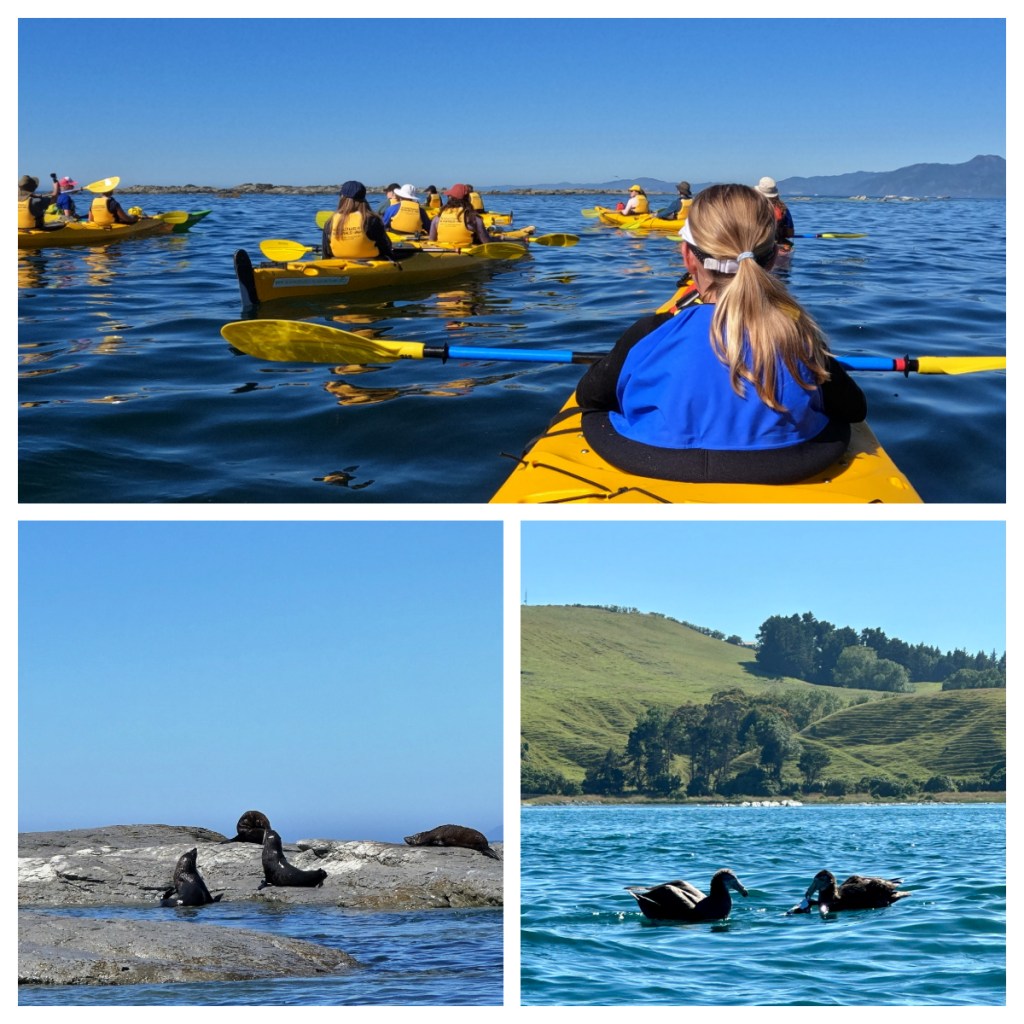
The following morning was beautiful and still – perfect of our morning adventure – kayaking with Kaikoura Kayaks.   It seemed like a popular activity and there was a large group of people checking in and getting set up in the office in town but it was all very efficient and we were soon on our way around to South Bay where we were kitted up and given a briefing about the kayaks and how to use them.

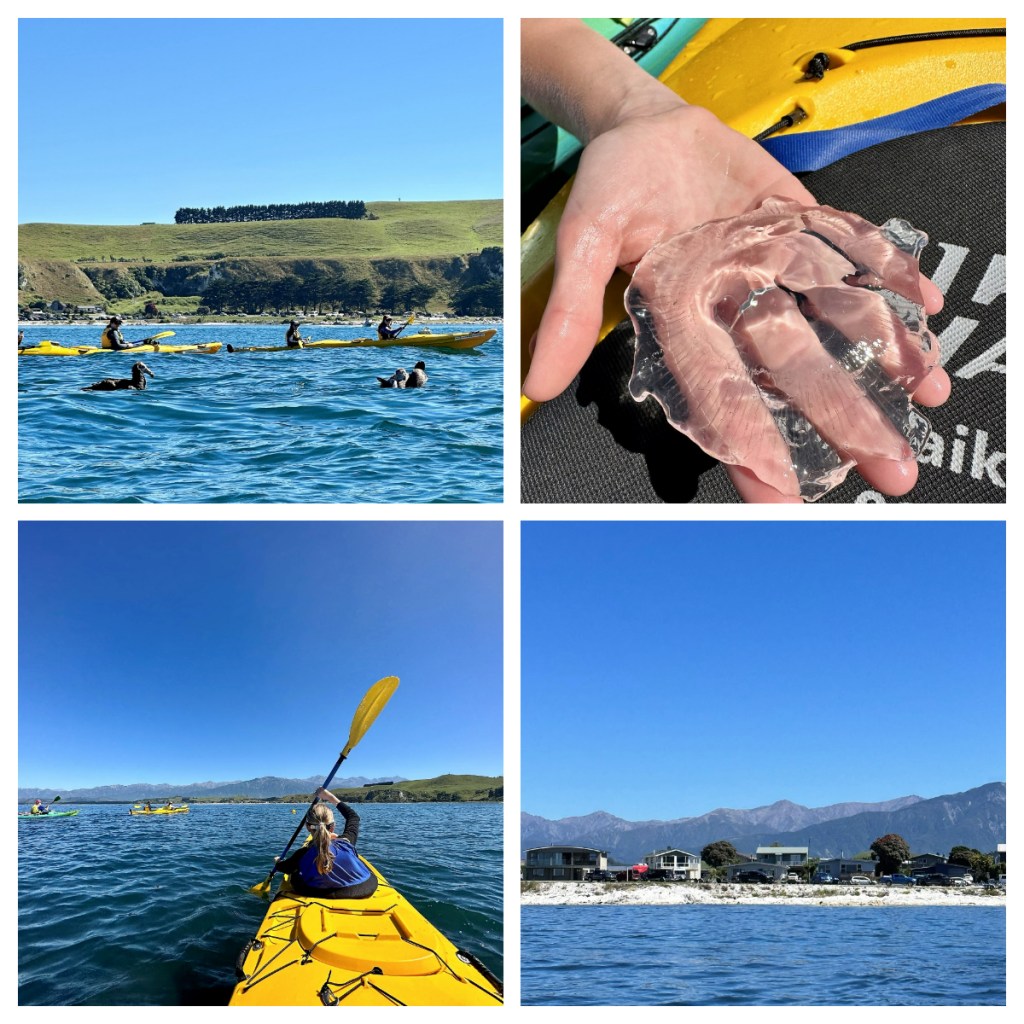
Once divided in to smaller groups, it didn’t actually seem like there were a lot of people and we set off out of the sheltered bay and out in to the great Pacific ocean.  We saw NZ fur seals on land and playing in the sea, giant petrels feeding, terns diving, the cutest baby black backed gull and some very cool jelly fish.  All in all it was a great morning paddle.

After lunch back at the campground we headed back out for what turned out to be a very long walk!!  We took a similar route to our llama walk the day before and not surprisingly, bumped into the llamas out for another walk – we were sure they remembered us 😂

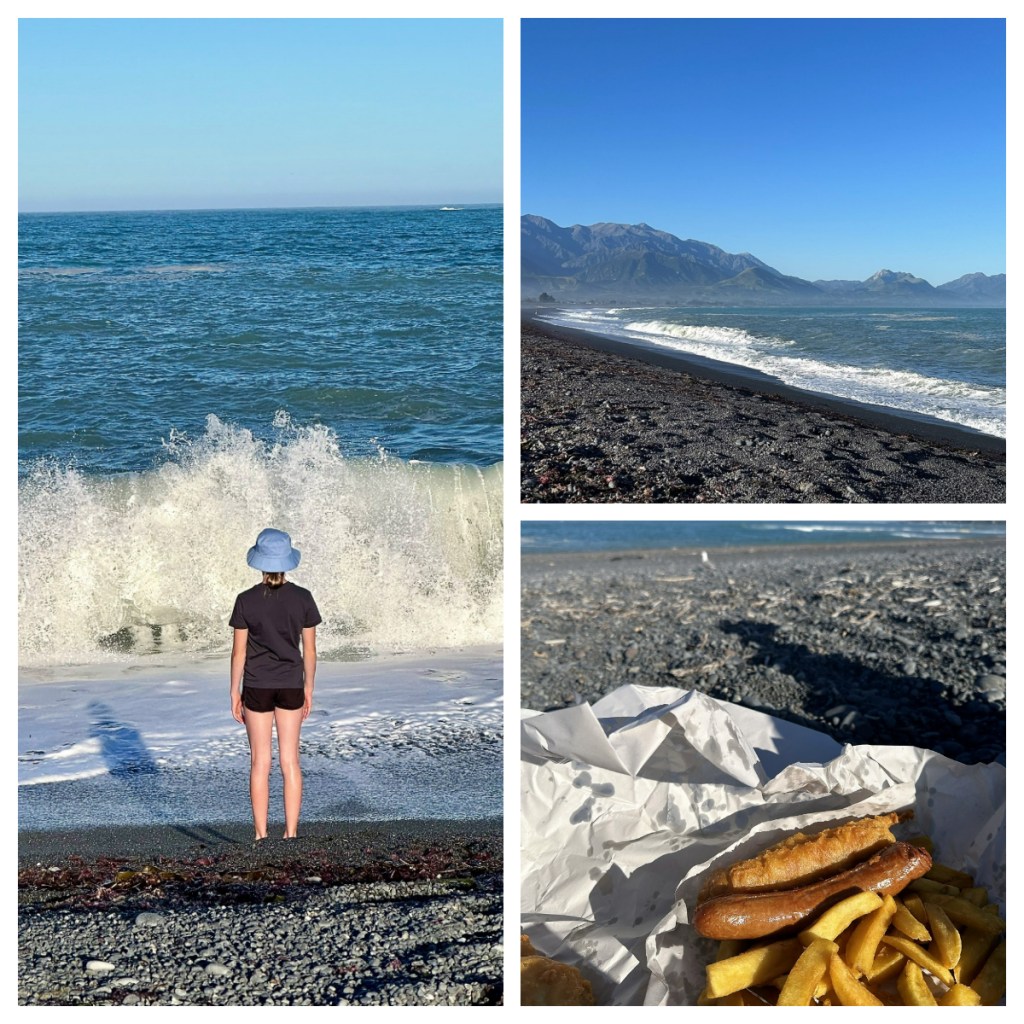
Dinner this evening was a Kaikoura classic – fish and chips on the beach.  The beach in Kaikoura is a stony but beautiful, with wild big waves crashing on it.  With the sun setting behind the mountains that flow down into the ocean it was the perfect ending to a great day.

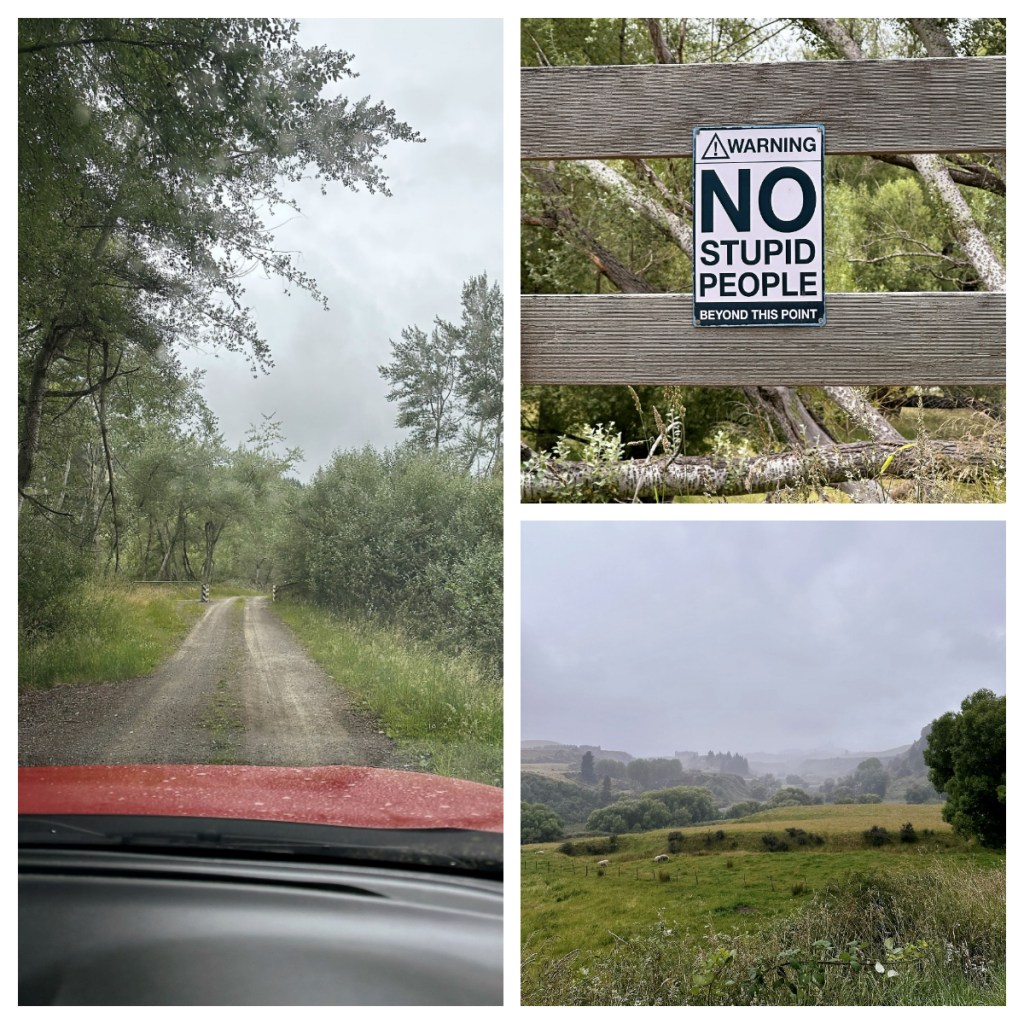
Our last morning was windy and overcast and we were even more grateful for the perfect kayaking day the day before. But not to miss an opportunity for adventure, we took a detour on the way home to explore.  A friend of Isabel’s had told her about a walk that took you through a stream in an area called “Stag and Spey”.  She did not know a lot of detail and I could hardly find anything about it online but we decided to go for it anyway, starting with a 20-30km drive along a gravel road, aptly called Stag and Spey Road.

It was drizzling slightly when we reached the end of the road and there was no signs (well, none that helped) and no obvious track.  Thankfully, I had found some vague instructions in a random post that said ‘walk in the river downstream” and then “go left at the fork”!

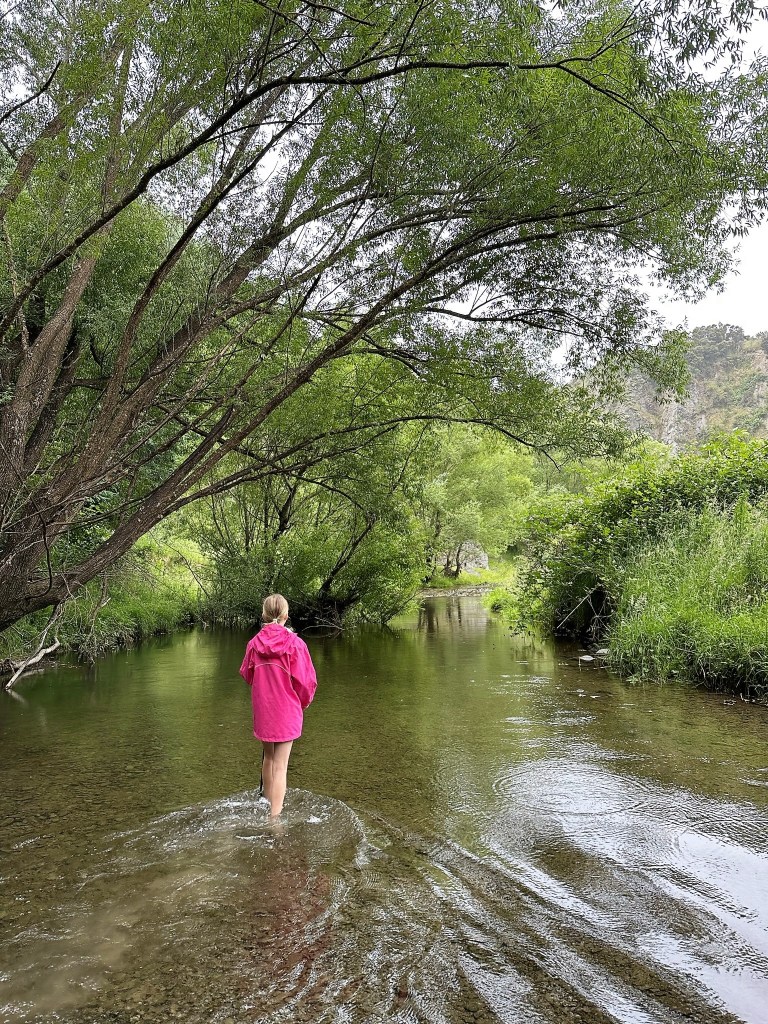
It was around 10 minutes downstream – mostly in the river and following a few footprints we could see on the narrow bank area.  We turned left at the fork and continued to walk upstream for a further 15 minutes.  There was supposed to be a waterfall somewhere but as we had no idea where it was, we decided to turn around at this point.  It would be a great place to go on a hot day as we passed lots of great swimming holes. 

We stopped in silence a couple of times and just listened to the sounds of nature around us – the slow running river, bird song, and light rain.  It was a great adventure and we both loved it. Back at the car we enjoyed some left over sausages and discussed the dirty state of my car!  I told her how I loved having a dirty car, as it made me feel like I live an exciting, adventurous life – Isabel replied ‘but you do’. I love that ❤️ 

All good things come to an end

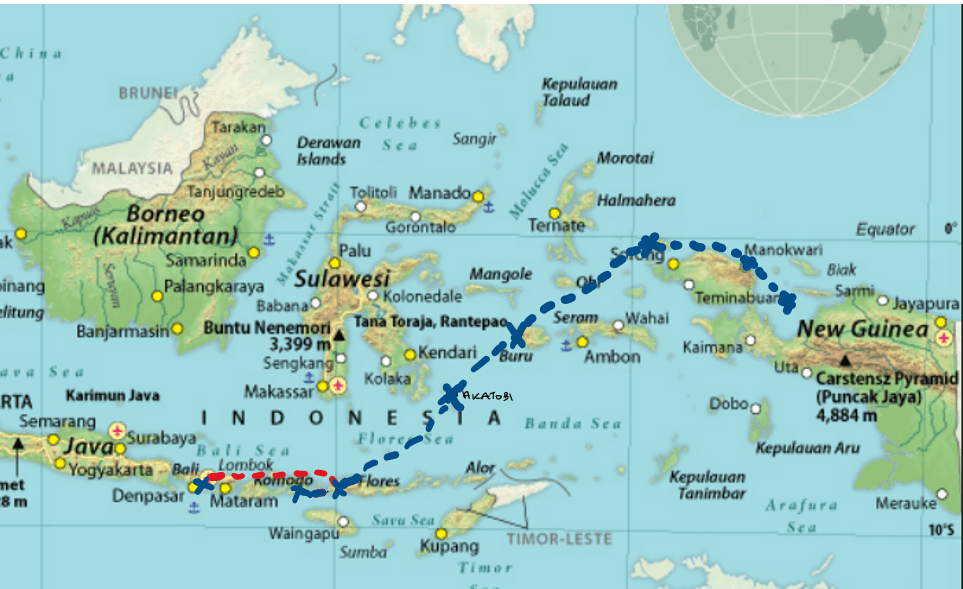
Western Papua, Indonesia/Papua New Guinea

October 2022

The distances we travel on this trip are immense, far more than what they look on the map (no kidding right), and to get to our next destination we sailed all afternoon, all night and well into the morning the following day.

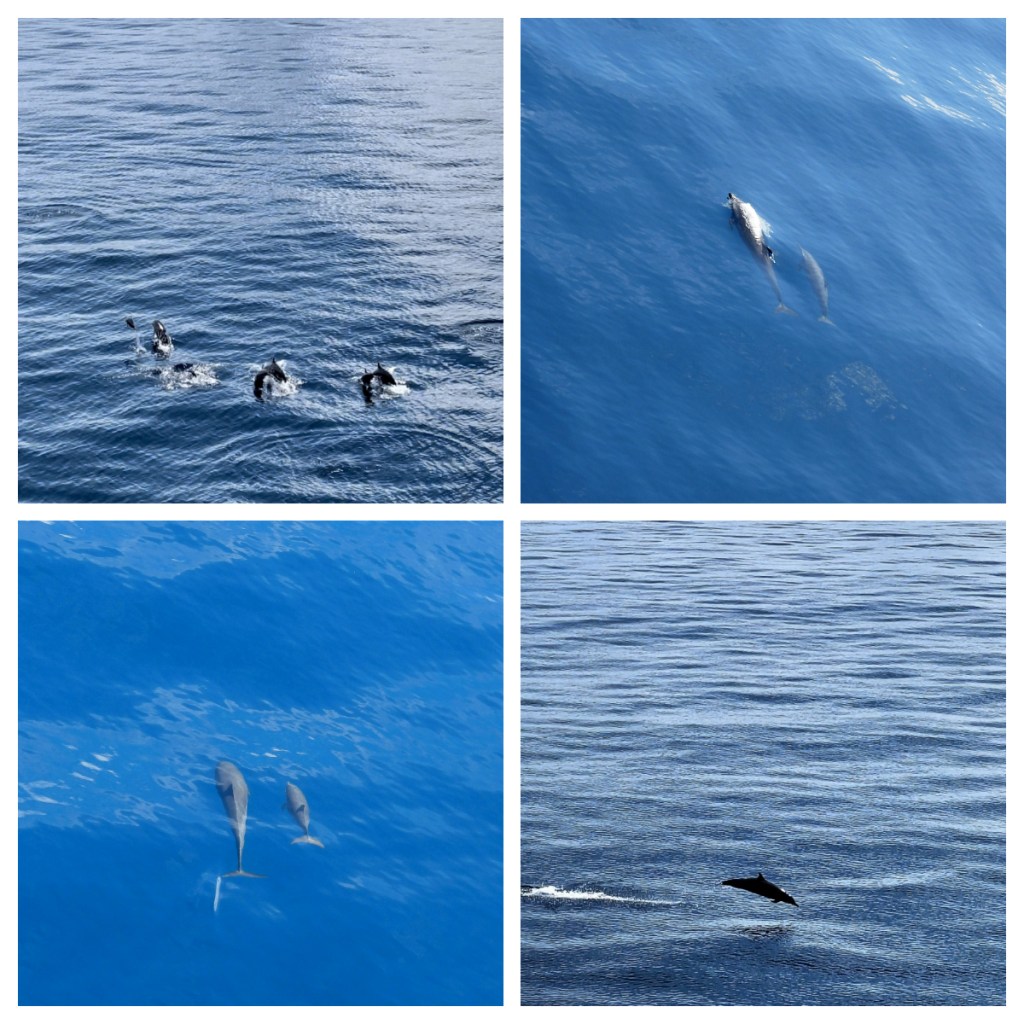
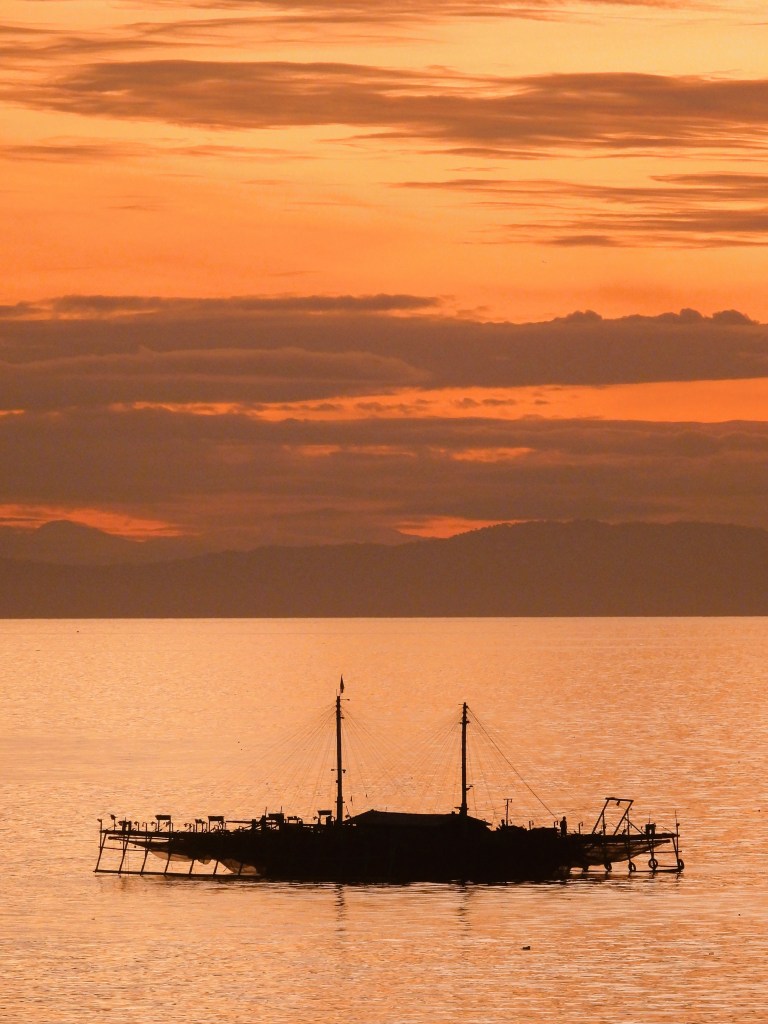
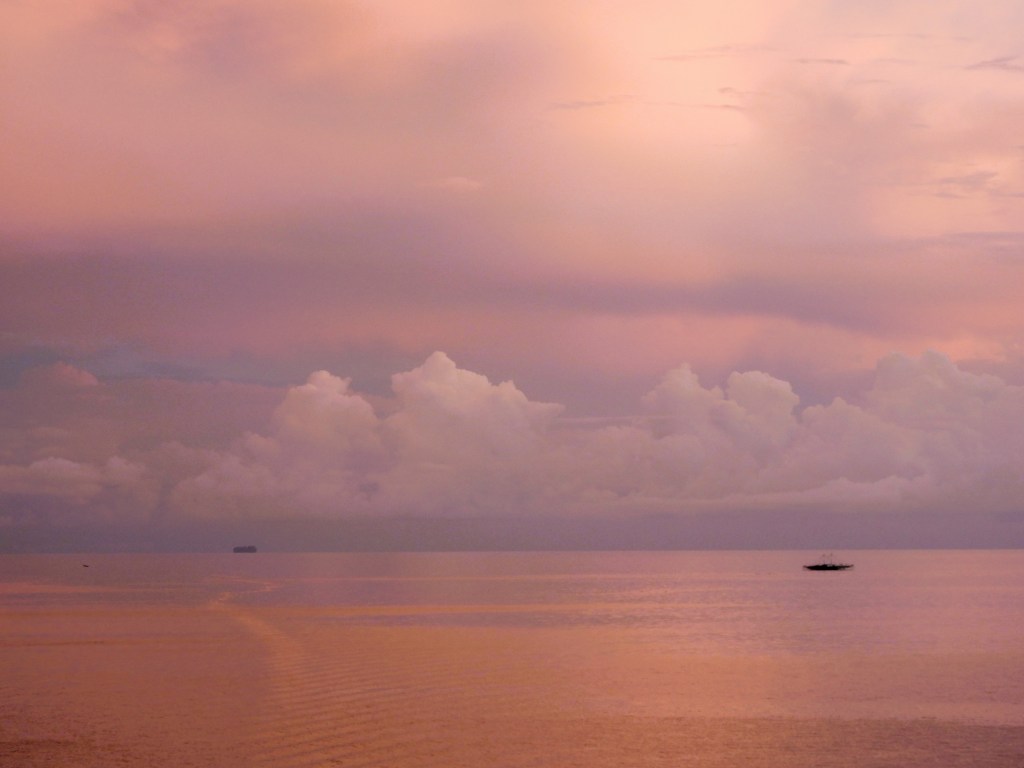
Despite having a leisurely morning, I was up early and in time to see not only beautiful rainbow, but another pod of dolphins (again no photos of the dolphins but I did get a half decent one of the rainbow).  I must admit I am so glad I get up early as this time of day is always so calm, and more often than not, stunning. 

It also means I get to join “breakfast with Rod the naturalist” and this morning we got double Rod, as straight after our morning chat, Rod gave us another lecture on Island Diversity which was really interesting until it came to an abrupt stop when the call for dolphins went out.  This time it was not just a handful of spinner dolphins that were too fast, but hundreds of them that spent ages jumping around the boat – lots of babies and mothers riding the surge of the bow.  This time I did have my camera, but, in typical fashion, the battery died!  I got a few videos but sadly no great photos.   Not for the first time on this trip, I must remind myself to enjoy the moment and not fixate on getting the perfect photos.

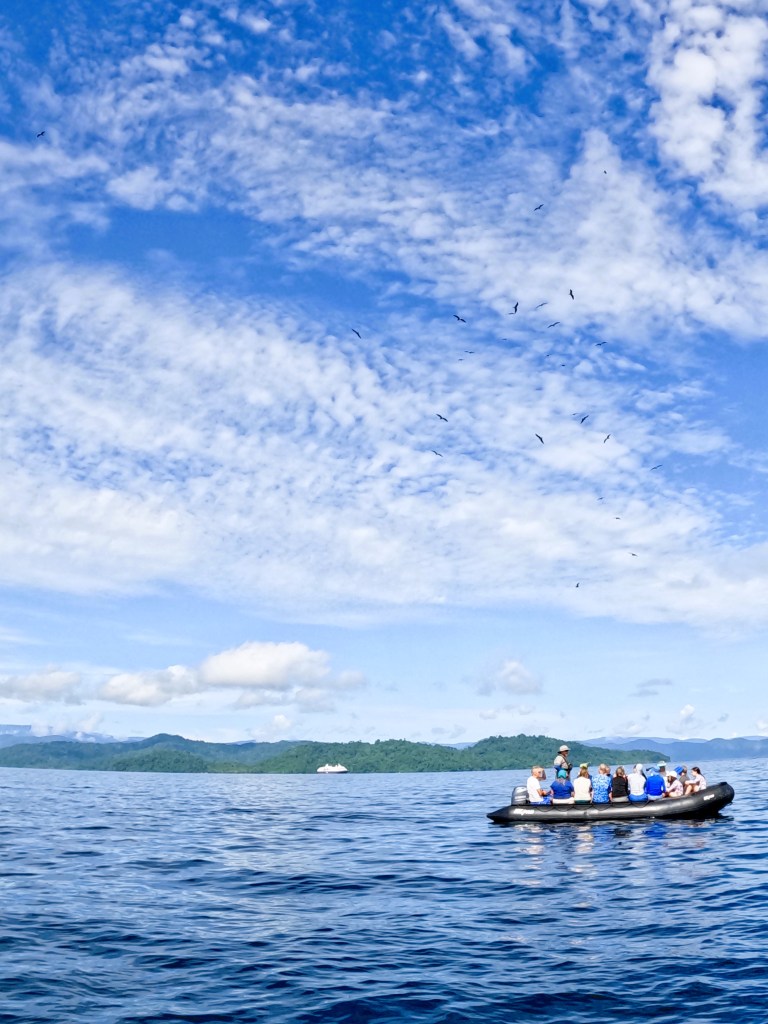
It was a lovely morning “steaming” down the coast of Papua, watching the wildlife, passing the rugged coastline as the waves crashed against the cliffs.  As we had a later start today, we also had a wonderful brunch, rather than breakfast.  One thing I can definitely not complain about is the food.  It has been plentiful, varied and delicious!

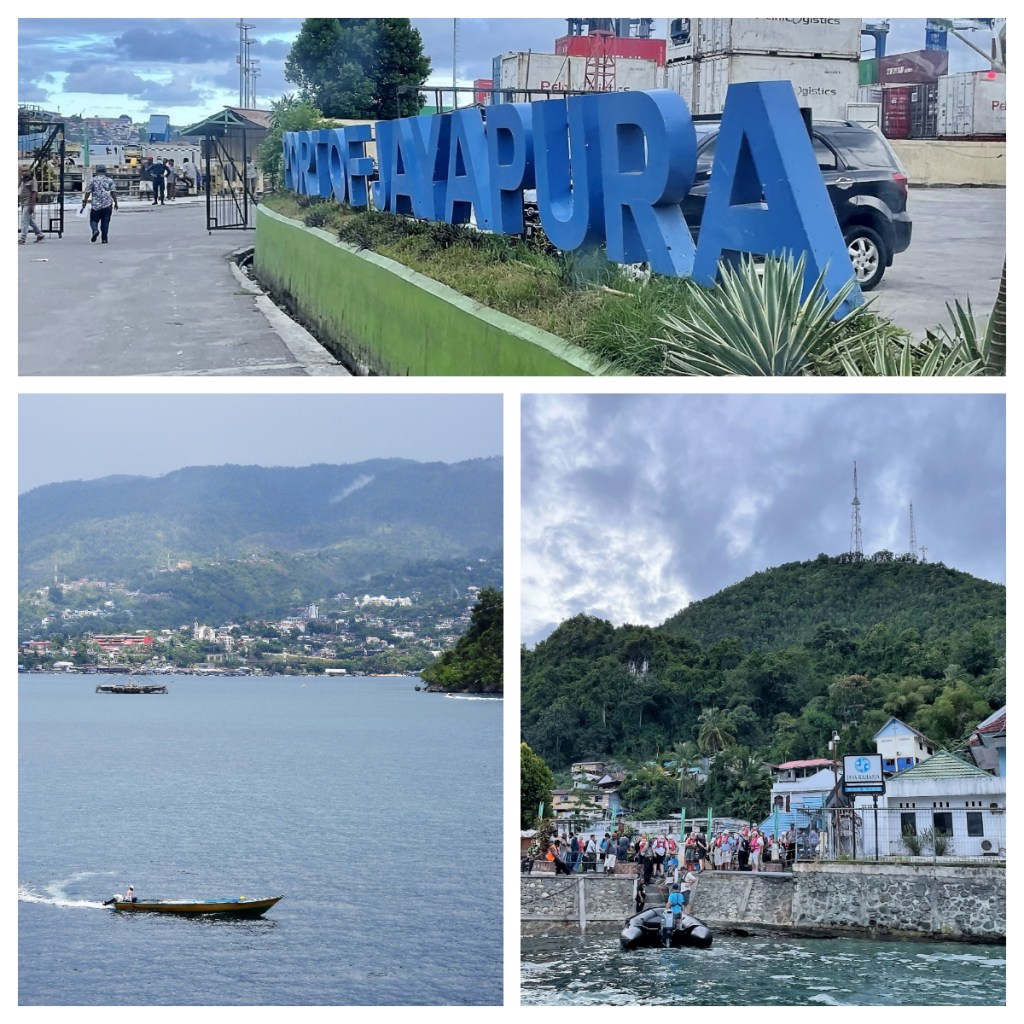
Our destination for the morning was Jayapura, the capital and largest city of the Indonesia province of Papua.  In fact, it is actually the largest city on the entire island of Papua, even bigger than Port Moresby (the capital of neighbouring Papua New Guinea that shares the island).  Once known as Hollandia, it is also the fastest growing city in Indonesia and in the 2020 census it was reported to have a population of our 400,000.

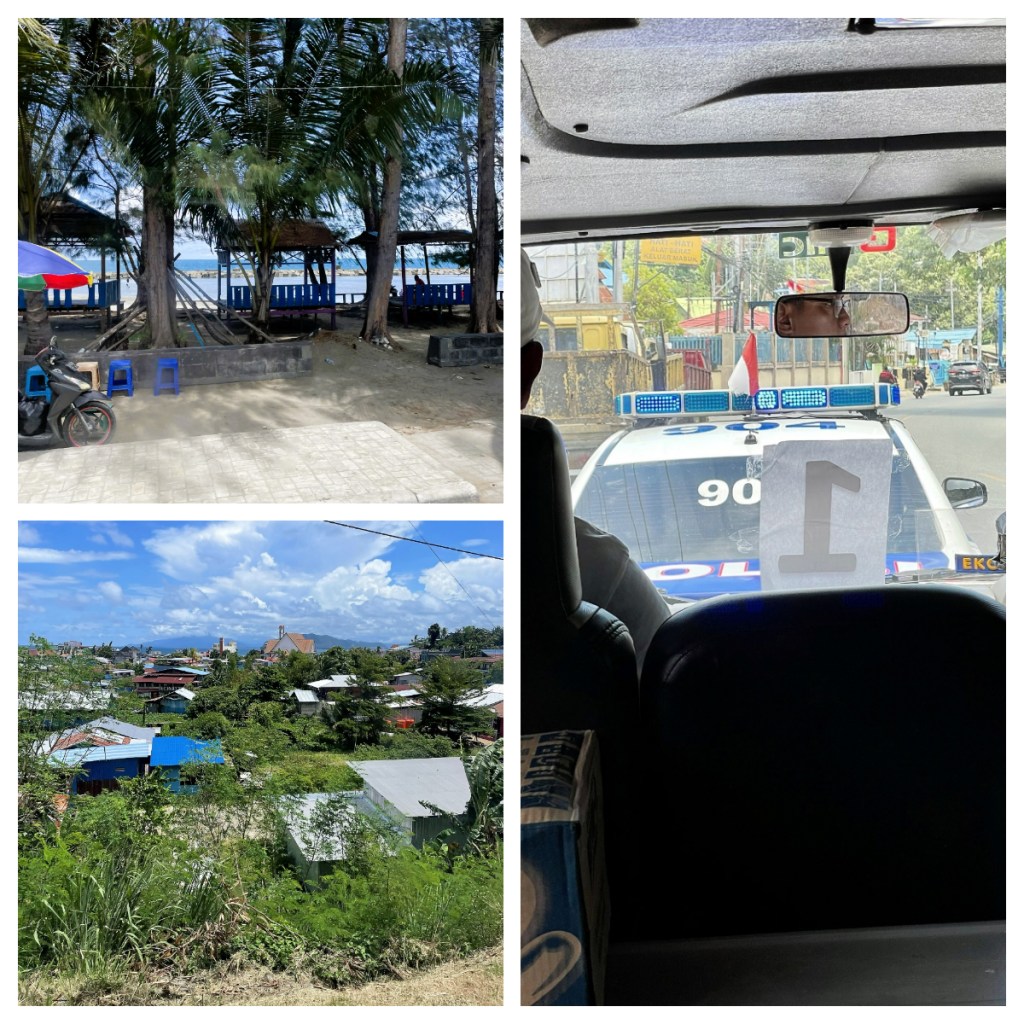
Compared to the islands and towns we have visited in the last couple of days, Jayapura appeared huge!  So big and busy in fact, once we travelled by zodiac to the huge port and boarded the buses that waited for us, we headed through town with … wait for it …a police escort!!  Cleary the standard hazard lights and horn honking is not sufficient here – so official lights and sirens it is as we drove through the town completely ignoring traffic lights and give ways. 

We passed through the bustling town and out through a small beach area, past families enjoy the beach front park and then out passed the new bridge that heads over to the land border between Indonesia and Papua New Guinea (which apparently has only recently reopened after the pandemic).

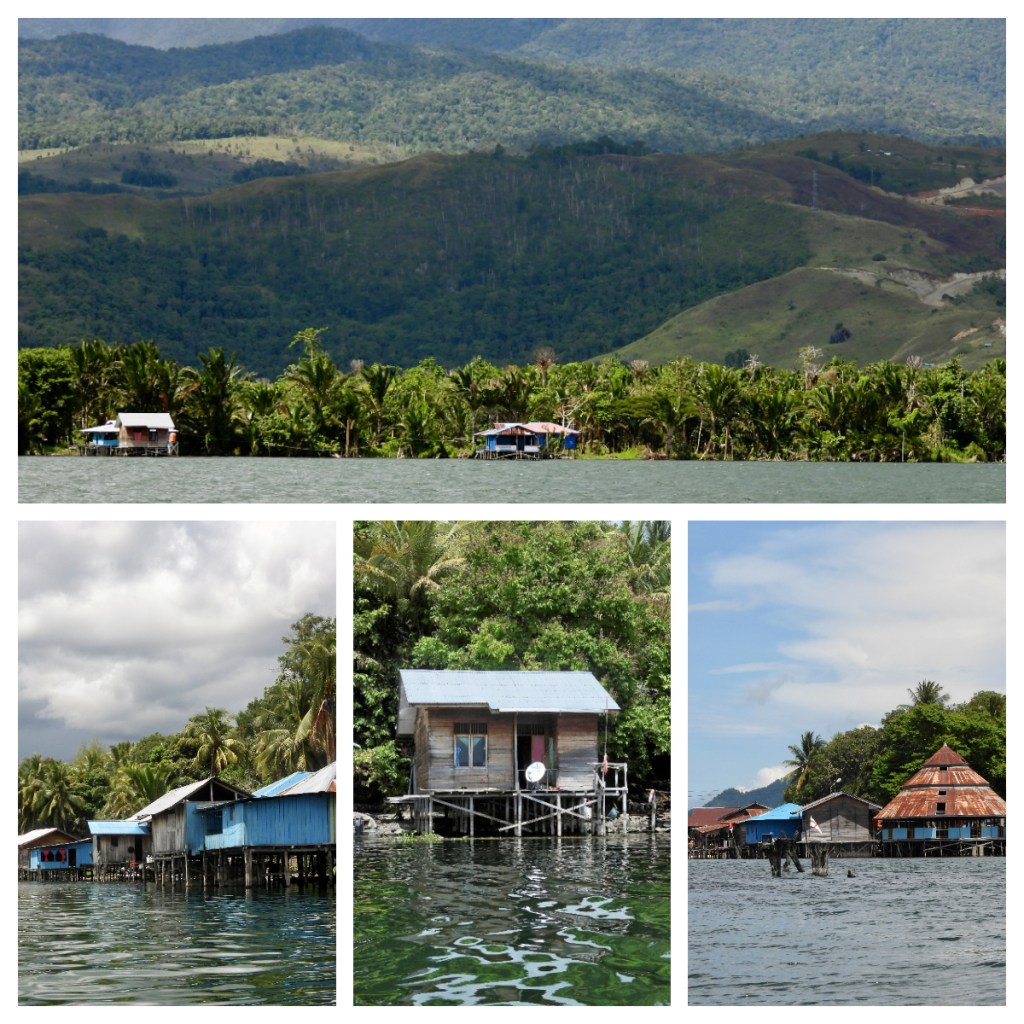
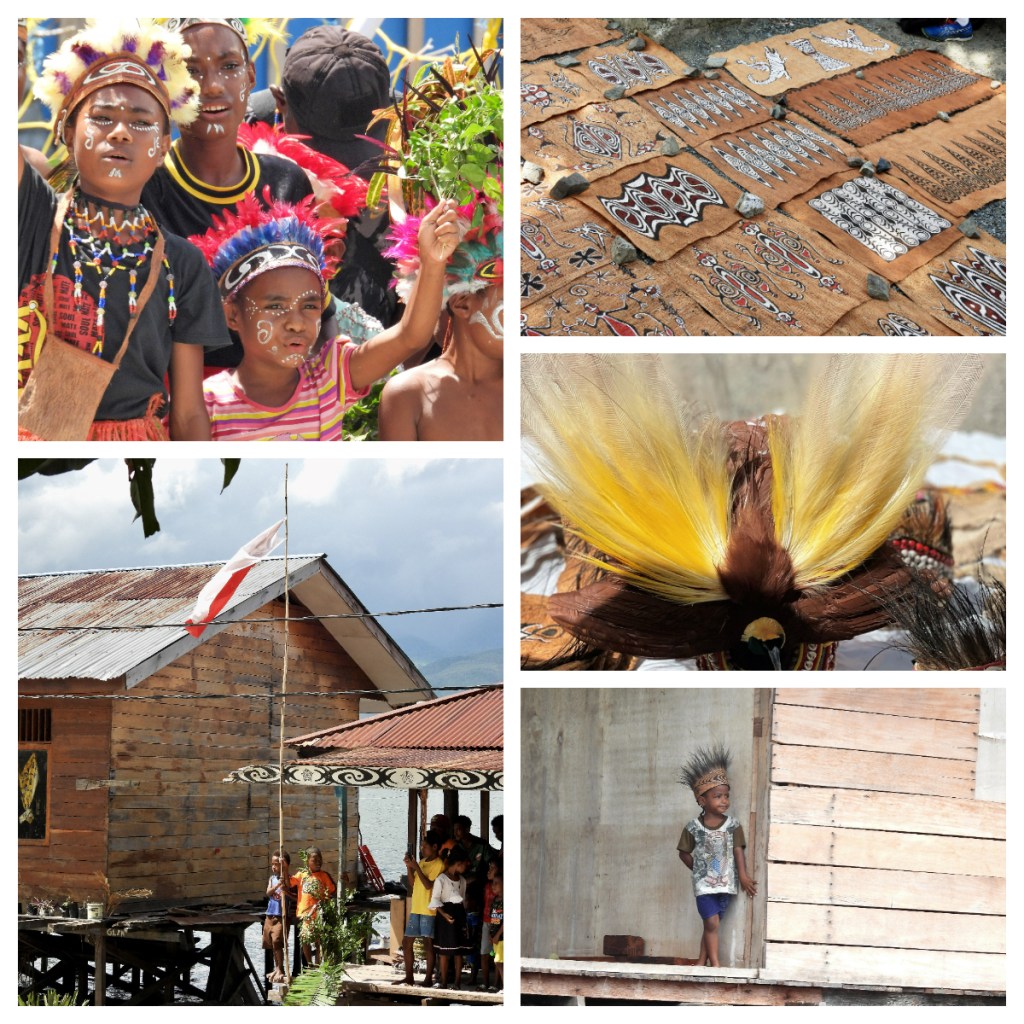
Our destination for today was Lake Sentani, in the Cyclops Mountains Nature Reserve.  The lake is a tropical, shallow lake with a surface area of just over 100 k2, and is home to 22 islands.  On board our small local boats we zipped around the lake and around the small islands looking at the wooden stilt houses of the island inhabitants.

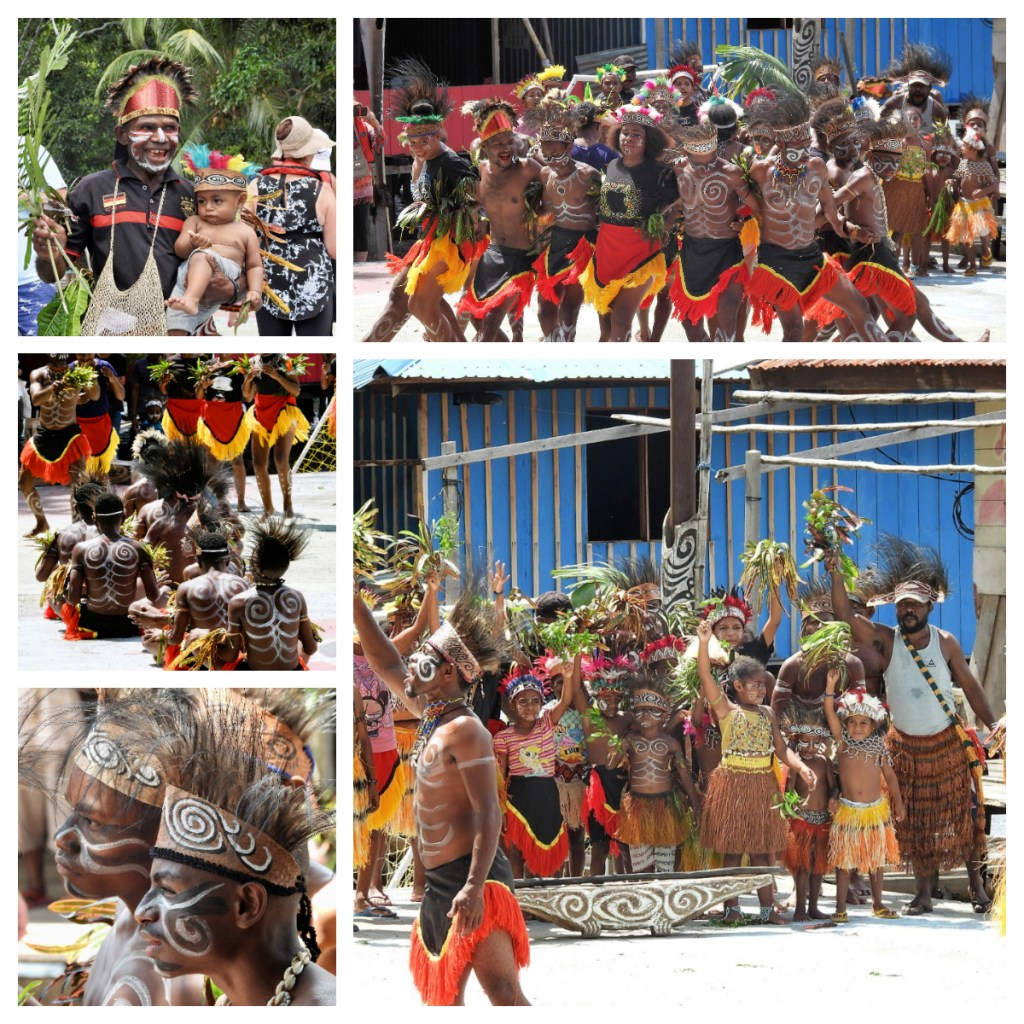
We arrived at Assey Village (population 500 (give or take)) on one of the islands to the sound of the Kundu drum and the singing from our welcoming party of elaborately dressed villagers.  Once we were all ashore, they put on a spectacular performance of a traditional dance about their ancestral snake who brought them to live on the lake.

It was amazing to see villagers of all ages partaking in the performances, but what struck me as odd was that as we watched the dances, we were seated in the village cemetery at the edge of the main square.  On top of that, the cemetery was scattered with WWII relics – including an old machine gun which is being used to display handcrafts for sale!

Speaking of handcrafts for sale, there were lots (as in most of our stops), beautiful bark paintings featuring traditional designs, weaved bags, polished stones axes (used locally as for bride prices) and local headdresses – including one with a Bird of Paradise!  Yes, a real, whole Bird of Paradise – sadly still being killed for such ceremonial pieces.

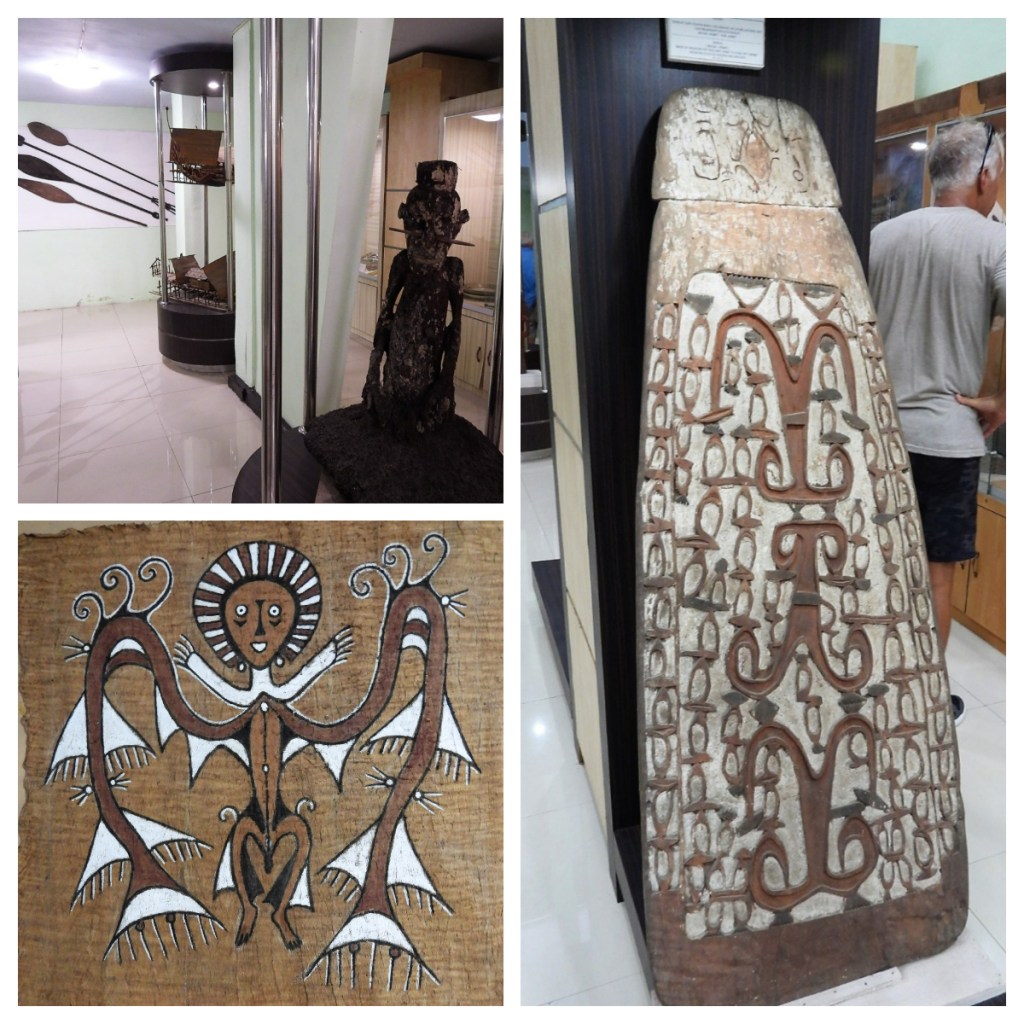
After saying our goodbyes, we travelled back across the lake to pick up buses and police escort again and on our way back into town had a quick stop at the Loka Budaya Museum.  We had about 20 minutes to have a quick look around the fascinating collection of local artefacts from the region.

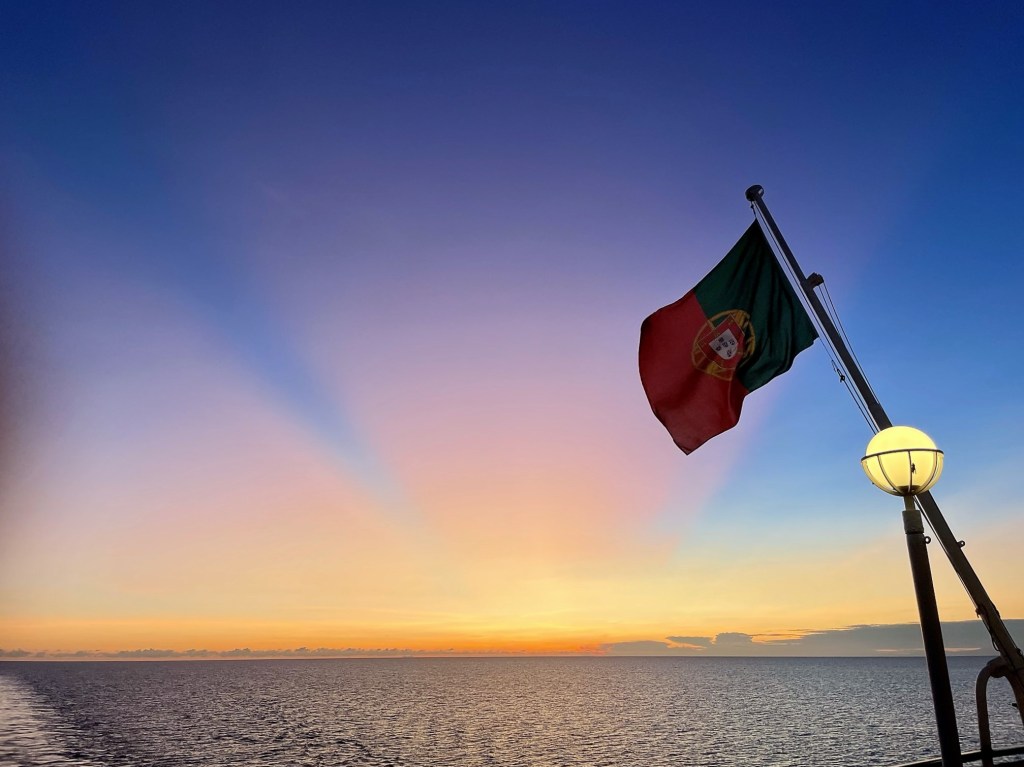
Back at the wharf we say goodbye to our police escort and goodbye to Indonesia.  Whilst we were ashore, all our exit immigration stuff was done and as soon as we were back on board we started travelling south towards Vanimo, 36 nautical miles to the south and the first port in Papua New Guinea (country number 100 for me – finally!)

New country, new time zone and 6pm became 7pm as the PNG immigration came on board to do all the customs and immigration formalities with the crew as we had dinner before we continued steaming down the jungle clad coastline – this time of Papua New Guinea.

And so, we went I to our final full day on board. After another beautiful early morning (each one different, each one beautiful), the morning continued with packing and a lecture on one of the traditions of the Sepik River area – “Making men into crocodiles”.   A scarification initiation where young men’s skin is made to look like that of the revered crocodile. Apparently, there is a resurgence of young men wanting to go through this lengthy and painful process (similar to the resurgence of other Pasifika young people getting their traditional tattoos) and only initiated men can take leadership roles within the villages.

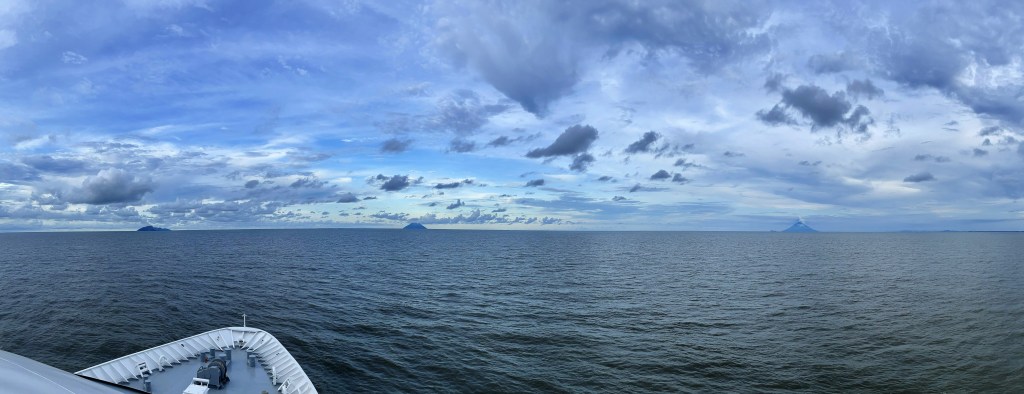
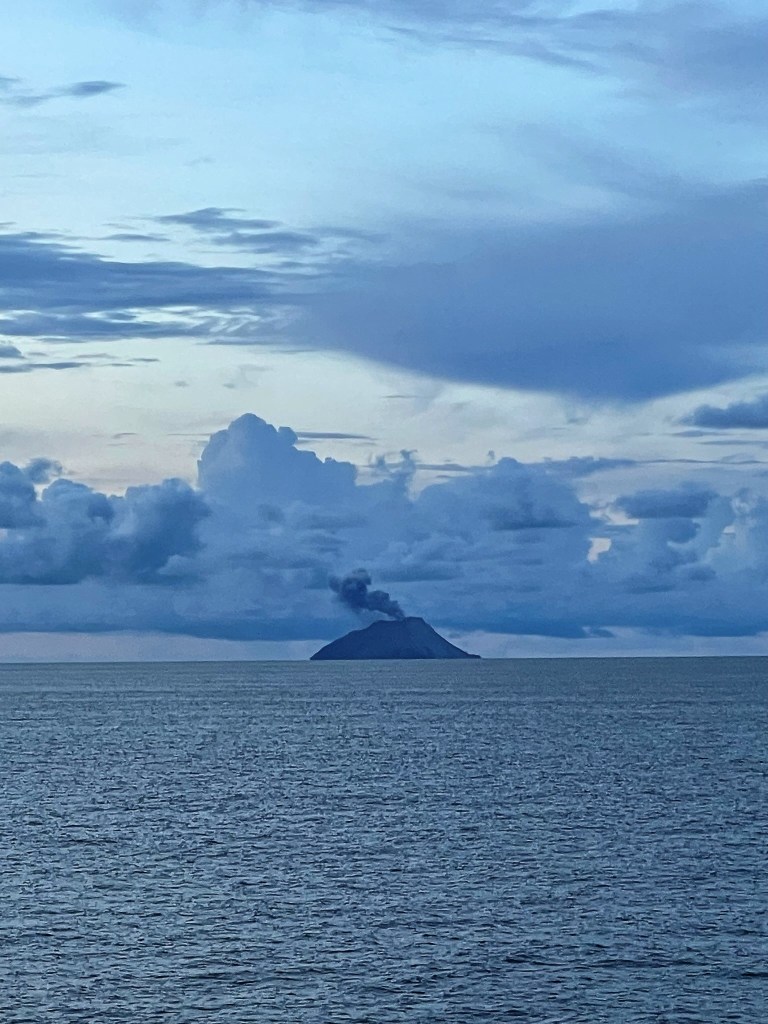
Back on deck after the lecture, there was a moody sky and the sea was changing from blue to muddy brown as we neared the mouth of the Sepik river.  On the horizon we could see a couple of active volcanic islands.  Using maps.me I could see that the islands were called Kadovar and Bam (I am sure they are hoping it does not go ‘bam’ lol).   I should also note that there appears to be island volcano further out in the Bismarck Sea called Blup Blup 😂.  Now that is one I want to see! 

Now, back to the mighty Sepik river  – the Amazon of the region and one of the world’s great river systems.  It is 1,146 kms long and up 1.6 kilometres wide and acts like a highway for the villages along the river and its smaller tributaries.

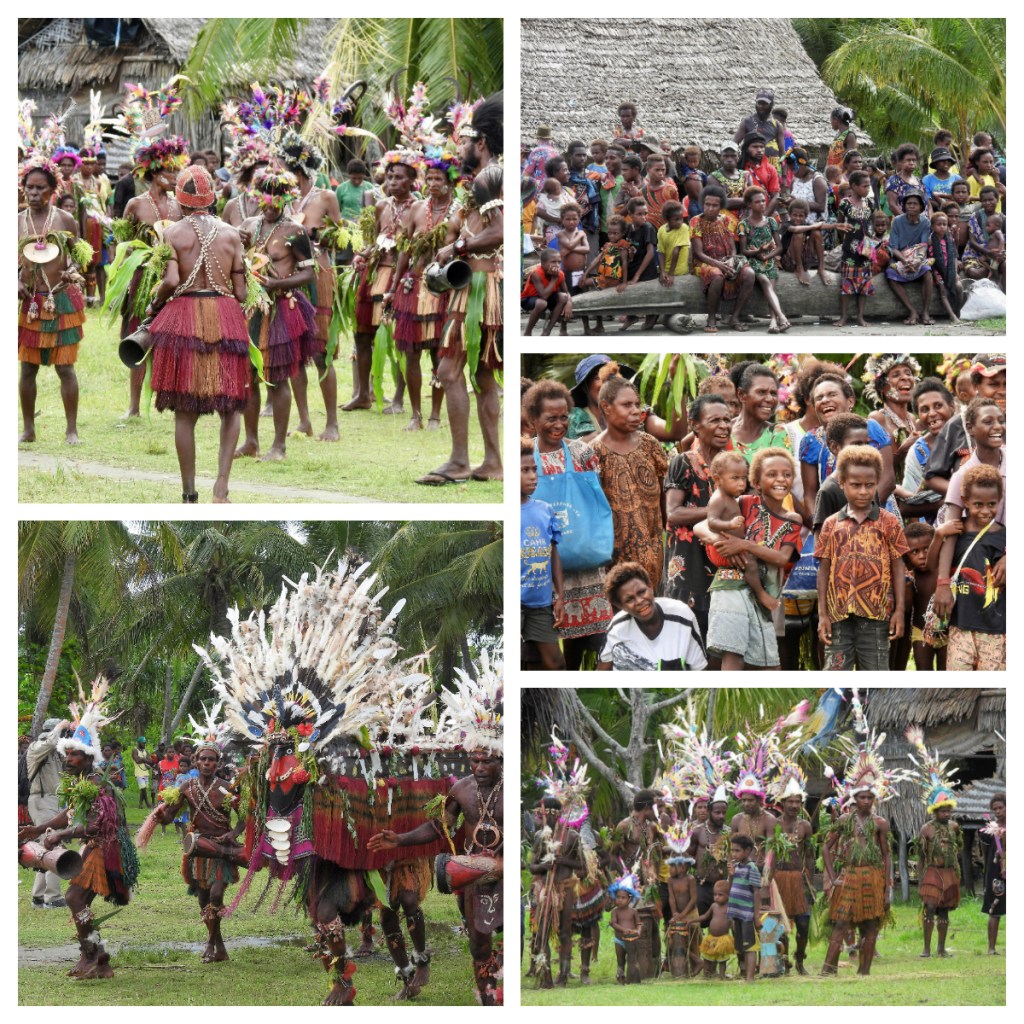
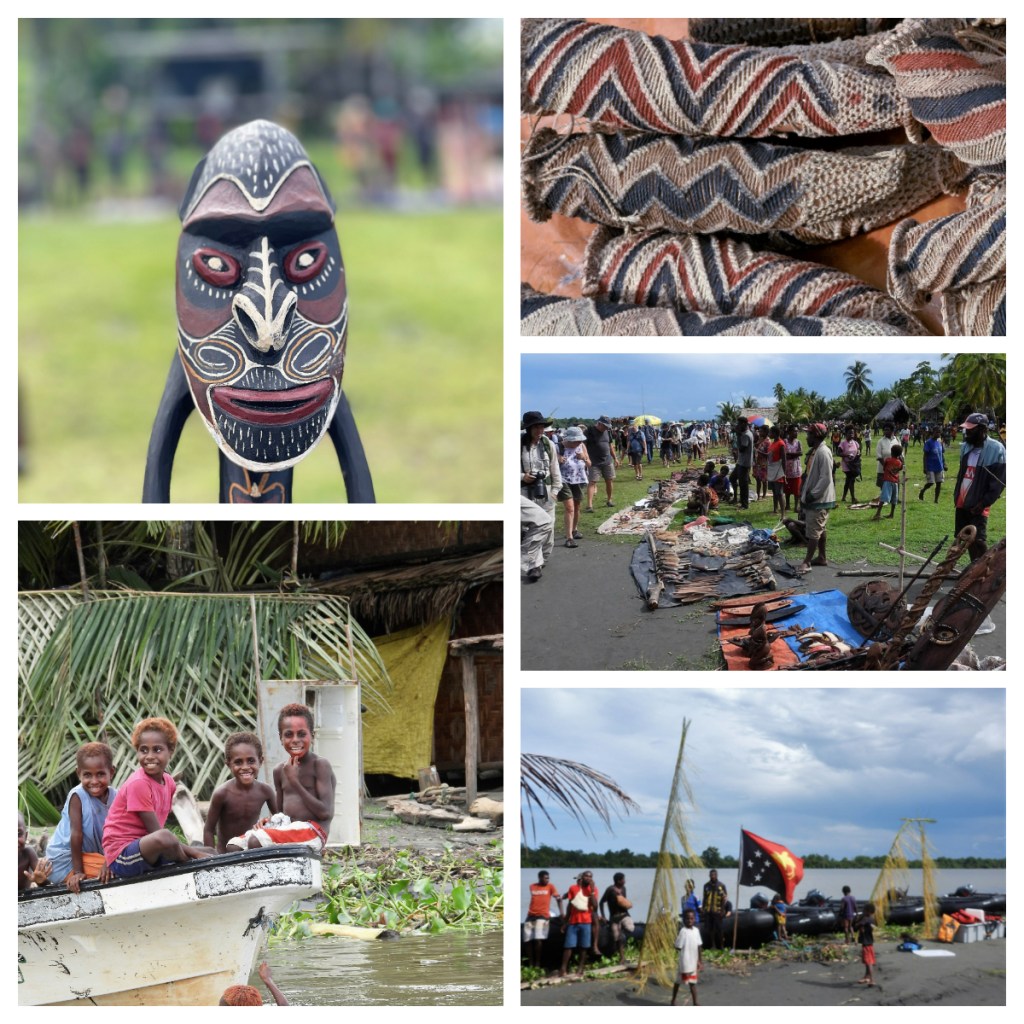
Our main destination for the day was Kopar Village, one of the villages near the mouth of the river.  We were told that many performers and artists/crafts people had travelled for days to be part of our visit and of course for our final stop we were greeted by singing and drumming before being treated to a performance of the national anthem and raising of the flag and then they busted out the village’s traditional Dragon Dance amongst other colourful rhythmic dances including a fair amount of twerking which everyone gathered, locals and visitors alike, loved lol.

They also performed a small skit and although we didn’t really know what was going on, the large gathering of locals (who outnumbered us greatly) found it hysterically funny and I loved that they were enjoying the performances as much as we were.

Following the performances, the ‘shopping mall’ was open.  So many handicrafts, brought to the village to sell from all over the region.  The area is renowned for its beautiful handicrafts, including totems, masks, bilum bags etc.  There was definitely some pressure to purchase, not from the local sales people, but just from knowing that they have just had two 2+ years of no tourism and therefore no sales, and that they had travelled so far to be here for us.  I bought a small wooden sculpture to join my global collection and thankfully everyone really had their shopping head on!

As we were not in PNG for long, and had had no opportunity to change money, the ship had organised for a couple of the expedition crew to act as a bank.  If we found something we wanted and agreed a price, we would then go and get the money from one of the ‘bankers’ and the cost would be added to our cabin bill in US$.  It was a really convenient way to do it and, between everyone we broke the bank lol, spending all the Kina (the local currency) that they had.

Once I had finished shopping, it was nice just to wander around the village, watching the children play – some with balloons some of the ship’s guests had brought with them, others just entertaining themselves, splashing around at the water’s edge.

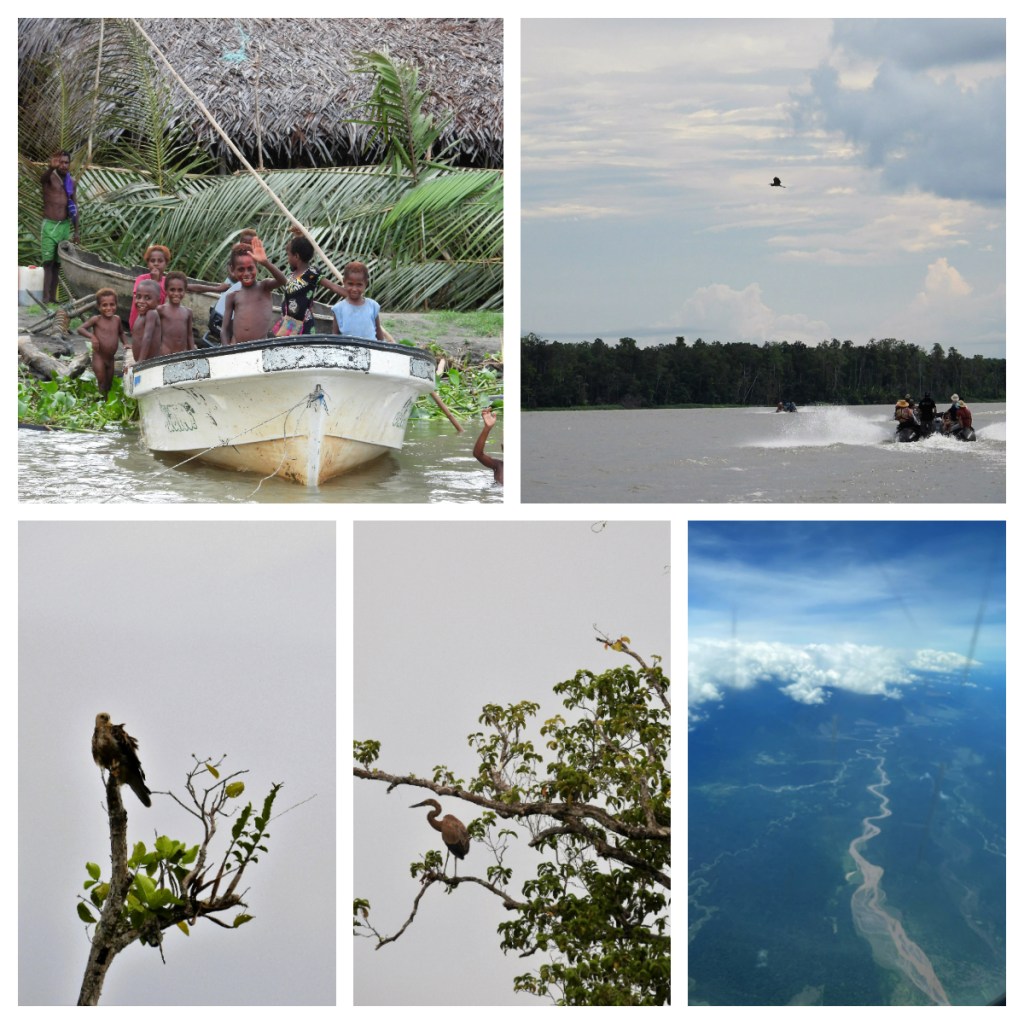
Sadly, it was time to say goodbye to Kopar village and we boarded our zodiacs and headed further down the river to explore a little.  Unfortunately, our zodiac driver decided that we could not fit down the narrow tributaries, but it was great fun speeding along and spotting birds along the shoreline.  A few of those identified were sea eagles, whistling kite and a great billed heron amongst many others. 

Back on board, my quiz team reunited to enjoy the wine that we won.  Sitting on the back deck we could enjoy the small eruptions of the Manam volcano as we sailed passed before heading down for our farewell dinner.  A perfect end to a perfect day.  I must admit, this final day was my favourite – the kind of action packed days I expected to have most days.  It’s a shame it took to the last day for it to all come together.

And so the final morning rolled around and it was a beautiful morning as we pulled into Madang Harbour.  Some people were staying on board to continue on for another couple of weeks through PNG, Solomon Islands and Vanuatu and although I would have liked to be continuing, for the first time I was also glad to be disembarking due to all the issues!  That said, it was definitely sad to say goodbye to my new friends.

Once our goodbyes were said to those staying on board, we were transferred to the small airport where we were to catch our charter flight to Port Moresby.  I guess it was really no surprise that the small airport was pretty disorganised.  No one really knew what we should do or where we should go (I had to laugh as it was really just on par with some of the other excursions on the trip lol).  Finally, we were directed to a large hangar where everyone’s bags were inspected before being tagged for the flight.  And then we waited. 

On the short transfer through town, it was clear that there was far more poverty on this side of the border.  The infrastructure was much more limited, there were lots of men just hanging around on street corners, shutters and barb wire on shops and buildings and the roads were terrible.  Such a contrast to the thriving city of Jayapura just over the border.

The waiting in the airport hangar continued and for a small airport it seemed relatively busy.  Finally, our plane arrived (with the new passengers joining the ship for the next 2 weeks) and we were on our way to Port Moresby to make our connections home.

How do I summarise this trip?  Firstly, this part of the world is AMAZING!  I saw some incredible places and wildlife and met some lovely people.  Unfortunately, this trip was just not active enough for me and there was too much time spent travelling and not enough time spent doing!  I guess that is always going to be an issue when trying to travel such long distances.  And of course, we had the ship issues causing a 5-day delay in boarding and missing full days of activities which really put a dampener on things. 

Ultimately, I have to say the beauty of the natural world has to win over.

Battles and Beaches

Biak Island & Rusbasbedas Island, Indonesia

October 2022

Our last few days in Indonesia where to be more about the culture – albeit of Western Papua (which is distinctly different to what most visitors to Indonesia see in Bali).  So, on a moody morning and now apparently being covid free (🥴🤔). We headed out with the group at 6.30am to visit Biak.  

We were welcomed to the island of Biak in the manner to which we have become accustomed, with a colourful dance as we landed.  This time, the local Yospan dance, from a group that had been practicing for 3 days and they put on a performance for every zodiac arrival!   This dance is a traditional dance from this northern coastal region of Papua which they performance for welcomes and cultural events.  I have read that overtime; the dance has been developed with variations in movement and customs whilst still maintaining its authenticity.   The group even waited around and gave another performance as we departed.  

Biak City is the main town on the island of Biak off the coast of Papua.  As of the 2020 census, the island itself had a population of around 122,000 people, most of whom live in Biak City. The people of this area are mostly native Papuan (Melanesians) or a mix of Chinese/Papuan (locally called Cina-Biak) and although Indonesian is the official language, many speak the local language of Biak – and, like most of the other islands we have visited, the use of English is pretty limited.   

One thing we noticed here again (after seeing it in Manokwari for the first time), was the massive queues at petrol stations.  It seems to be a problem unique to this part of the country and we were determined to find out what the issue was and why it was unique to Papua.  We did ask a few people and many were of the view that fuel rationing was a way the government were keeping them under control!!  I also tried googling the issue but only found a few fleeting references to ‘false news’ and no issues with fuel supplies so not sure we will ever know the truth.  

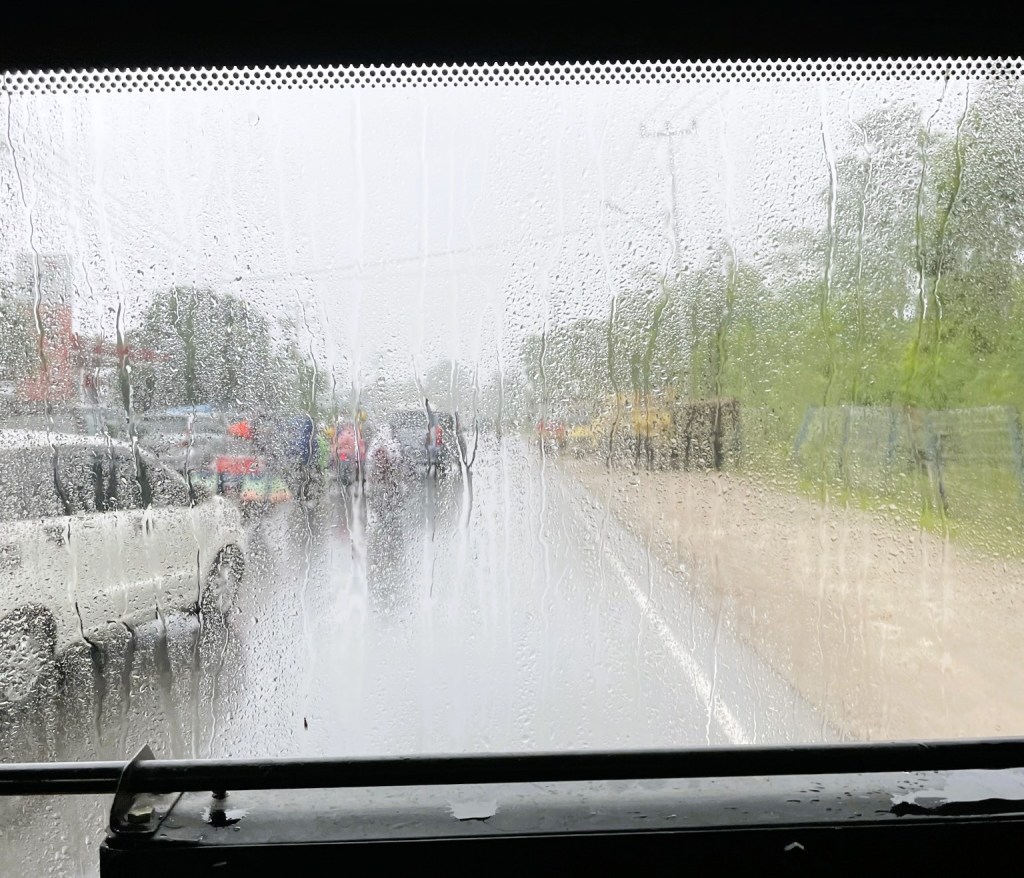
It started raining just as we bordered our buses, but it was not enough to stop our exploration.    Sitting on the edge of Cenderawaish Bay, the area of Biak Island is known not only for its nature beauty and marine life, but also for the tragedy that affected thousands during the Battle of Biak and the role that it played in the War in the Pacific, particularly between May and August 1944.    This area of the Pacific, islands that are now form part of Indonesia, Papua New Guinea, Solomon Islands and Vanuatu saw many brutal battles as the War in the Pacific raged. 

Considered part of the New Guinea campaign (Western Papua did not become part of Indonesia until 1969) the Battle of Biak was fought between the USA and Japanese armies in an attempt for the Americans to clear the area for a drive to liberate the Philippines and remove the Japanese army from the area.   The island was held by up to 11,000 Japanese and it was one of the first battles where they employed the tactic of allowing the enemy troops to land unchallenged, only to create an inland kill zone that they were not prepared for.  The Japanese utilised the honeycomb of caves as ambush points to attack the advancing US troops.  

After months of heavy battle on land (with the Americans landed 12,000 troops and 500 vehicles on the island), control of Biak almost became a critical battle in the war and on June 22 the Americans finally broke through Japanese defenses leaving around 3-4,000 Japan soldiers to make a final stand.

We were here to visit the Binsari Caves (also known as Japanese Cave).  For the local Biak people, the caves are a place to get in touch with their ancestors, but during the Battle of Biak it became a battleground and was used as a hideout, by the Japanese army, housing up to 5,000 soldiers at one time. On June 7, 1944 the Allied Forces dropped bombs and fuel drums on the caves, killing at least 3,000 Japanese soldiers who had taken refuge in the caves rather than surrender.  Those who were not killed outright were buried alive.

Today, the site is a monument to WWII, attracting tourists from around the world, including many from Japan who come to pray for relatives who died on the island.  It covers a large area including a collection of old mortars, bullets and weapons and you can walk down in to the remaining open areas of the caves.  Today it is hard to imagine the horror that happened here as we walked through the caves, along the boardwalks looking up at the tangled tree roots that reach down from the surface.

Back on the surface we visited the small museum which houses further weapons, clothing and other bits and pieces recovered from the caves including a collection of bones and skulls from some of the victims.  It was a sobering moment reflecting on the human tragedy of war.

Back in the ‘city’ we stopped at a local market – it was clean and tidy and all the products (mainly fruit, vegetables and fresh fish) were beautifully arranged in geometrical patterns.  Surprisingly, even the fish part of the market did not smell bad – I guess the fish were just that fresh.  It was nothing like the market we visited back on Flores which was completely chaotic!  We had time to wander around the stalls and chat to a few of the vendors who were all happy to entertain our photo requests. 

I noticed here, that so many products come in little sachets, similar to what I have seen in places like Ghana – soap powders, shampoo, coffee, drink powder and here, also milkshake mix powder in some interesting flavours, including Choco Cheese, Cream Cheese and durian.

Back on the waterfront, waiting for our zodiac pick up, our welcome dancers continued to entertain us and our naturalist friend Rod explored the small park area to see what bugs he could find (which turned out to be an Janovpholus wevill bug).  With him around, waiting time can always be occupied.

Back on the ship we sailed a short distance to our next destination, Rusbasbedas Island (I actually can’t even find it on a map) being joined by a small pod of dolphins as we travelled (they were far too quick for photos on this occasion).  The seldom visited Rusbasbedas Island was spectacular – a small island with pristine soft, white sand beaches and a shear drop off, just offshore which means the ship can get very close to the island. Yet another perfect paradise island with warm waters perfect for snorkeling in the turquoise shallows and out over the edge of the drop off to explore the reef edge and its inhabitants.

After an action-packed morning, we were back on the ship for lunch and another afternoon at sea – there were a couple of lectures, but I decided just to chill, read and watch the world go by. It was disappointing to hear (via rumours amongst the passengers rather than being told by the expedition crew) that we were going to miss another whole day of the itinerary as we were still playing catch up for our delayed start.    I am definitely seeing some amazing places and meeting some lovely people but the lack of information and missing big chunks of the trip is very disappointing. 

I sat at the back of the of ship watching another beautiful sunset before heading inside for the briefing, dinner and quiz night.  We had a great team with people from German, Russia, Australia and New Zealand (so the teams name was GRANZ) and we came 3rd which was pretty good.  We won 2 bottles of red wine which we planned to enjoy tomorrow night.

A whale of a sharky time

Cenderawasih Bay, Indonesia

October 2022

Today I woke thinking “today is going to be a good day”.  There was a beautiful sunrise, and it was the first day we actually had a number of different activities planned which meant more than just 2-3 hours off the ship! 

Our first outing was to be the most exciting, swimming with Whale Sharks in Cenderawasih Bay.  Whale Sharks are slow moving filter feeds and are the largest fish species, growing up to 18m in length!  They are incredibly mobile and can be found throughout the world in warm tropical waters. 

Cenderawasih Bay is in north-eastern Indonesia and around half of the bay is in the Cenderawasih Bay National Marine Park.  Locals in the area have reported seeing Whale Sharks in the area since the 1940s and today they are attracted by the Bagan’s, or local lift-net fishing platforms which have been used since the early 2000s.  Fisherman use the platforms to cast their nets and, in the area where we were visiting, they were in water around 60-70m deep, but they can be in water 1000’s of metres deep – apparently still tethered to the ocean floor.  The fisherman have a love/hate relationship with the whale sharks as they do sometimes make holes in the fishing nets and suck all the fish out! 

The fact that whale sharks often hang around the bagans, has meant that this area has become popular with tourists as you have a near-certain chance of encountering whale sharks (mostly juvenile males) and having a lengthy encounter with them.  They are also here all year round which is unique to this area as in most other places popular for whale shark encounters e.g. Ningaloo in Western Australia) they are highly seasonal.

Sometimes they do get caught in the net and they are normally released without harm, but this has presented opportunities for the sharks to be tagged with fin-mounted tags so their journeys can be tracked.  Some of these have long life batteries which should last up to two years, transmitting data around every 3-4 days (when they sharks are on the surface). The sharks from this area tend to not travel far (hence why there are always whale sharks to see in the area), but some have been tracked travelling down the coast of Western Papua and into Papua New Guinean waters near the Sepik River (exactly the same route we are travelling).  The tracker also tracked horizontal movements which has shown some of the sharks diving to a depth of more than 1000m!!  It is thought this behaviour is food related and the hunt for deeper plankton.

In his talk on a previous day, our local guide Abraham, had talked to us about some of these conservation efforts he was involved in with the Whale Sharks in Indonesia and it was great to hear his first hand experiences.

The day really started off well as for the first day ever, they had enough zodiacs in the water so everyone could be out on the water at once.   On a negative note, it meant everyone was out at once lol – the fisherman on the bagan were basically feeding the whale (by dropping fish into the water) and around 20-25 people were in the water at one time crowding around it as it hung, vertically in the water feeding.  It was all a bit too much of a circus show for me. 

Thankfully, on our second turn in the water the shark was moving around a bit so I managed to get so better views of it’s natural behaviour … and then a second one turned up, smaller than the first but it was amazing to see. They are truly such beautiful animals, who appeared to be unbothered by our presence in the water with them, either hanging out eating the fish been dropped in the water, or swimming around under our feet. By the time of our last swim, the water was pretty murky with all the fish bits that had been dropped in (now that sounds gross! lol).

Abraham used photos taken to check the whale shark database and identify the individual sharks we were swimming with. 

All in all, we had 3 turns in the water with the sharks, in between which we sat on the zodiacs watching dozens of Greater and Lesser Frigatebirds fly around us, diving in to catch the fish missed by the whale sharks.  It was a wonderful morning.

Back on the ship and it all turned to custard. I had had a little bit of a cough overnight and as I had rigorously told someone off the day before that they were being responsible by having Covid symptoms and not getting tested … you know where this is going … I decided to take a test just so I could say I had … and guess what, it was positive 🤦🏻‍♀️🤦🏻‍♀️ 

Firstly, I was really annoyed as I clearly got it on the ship, and it is so irresponsible of them not to tell people it is on the ship!!! I probably caught it from the irresponsible person I had berated the day before lol!!  Secondly, what the f*** do I do now🤔🤔

After no interest from the expedition crew, my roommate finally tracked down the ship’s doctor who came and took another test – oddly, but thankfully, this was negative (though it was the least invasive test I have had) and I decided to relax for the day and avoid people before resuming activities the following day.  I was also grateful that my roommate had had covid just a few weeks before we came away, so she was negative all along thank goodness.

And so, instead of all the activities, the rest of the day was spent on the deck reading while everyone else was off the ship and in the room when people were back!!  Oh what fun lol!